
Geopolitics

Geopolitics

Global Geopolitical Overview: Strategic Realignment, Maritime Escalation, and Economic Fragmentation (14–21 July 2026)

The global geopolitical landscape over the past week has been defined by the rapid breakdown of fragile regional ceasefires, an aggressive re-architecting of international trade policy, and an accelerating consolidation of middle-power security coalitions. The formal collapse of the short-lived United States-Iran memorandum of understanding has triggered an unprecedented escalation in maritime hostilities across the Strait of Hormuz, throwing global energy markets into renewed volatility and forcing a systemic reallocation of international capital. Concurrently, the proliferation of unilateral trade duties by the United States—leveraging legacy statutory provisions following judicial constraints on executive tariff powers—has strained relationships with key allies, most notably Canada and Latin American trade partners.
Global Geopolitical Overview: Strategic Realignment, Maritime Escalation, and Economic Fragmentation (14–21 July 2026) Read More »

Geopolitics

The Recalibration of Indo-Pacific Geopolitics: An Analytical Assessment of India’s Diplomatic Tour of Indonesia, Australia, and New Zealand

The geopolitical architecture of the Indo-Pacific underwent a significant recalibration from July 6 to 11, 2026, during the official state visits of Indian Prime Minister Narendra Modi to Indonesia, Australia, and New Zealand. Spanning the Eastern Indian Ocean, Oceania, and the Southern Pacific, this three-nation tour served as a comprehensive operationalisation of India’s foreign policy frameworks, specifically the Act East Policy and the Mutual and Holistic Advancement for Security Across the Regions (MAHASAGAR) vision.

The Recalibration of Indo-Pacific Geopolitics: An Analytical Assessment of India’s Diplomatic Tour of Indonesia, Australia, and New Zealand Read More »

Geopolitics

The Hydro-Strategic Pivot: India’s Sovereignty and National Security in the Indus Basin

The partition of British India in August 1947 was executed along demographic and political lines rather than geographical or hydrological boundaries. This historical rupture instantly split a highly integrated, cohesive network of irrigation canals in the Indus River Basin, transforming shared water resources into a source of acute transboundary friction. As the upper riparian state, India possessed physical control over the headworks and upstream channels, while Pakistan, as the lower riparian state, was structurally dependent on these very waters for approximately eighty percent of its irrigated agriculture.

The Hydro-Strategic Pivot: India’s Sovereignty and National Security in the Indus Basin Read More »

Geopolitics

The Geopolitical Anatomy of a Negotiated Stalemate: Iran, Israel, the United States, and the Fragile Regional Ceasefire of 2026

Historical Genesis: From the Twelve-Day War to the Outbreak of the 2026 Conflict

The contemporary security architecture of West Asia is defined by a highly unstable, multi-layered conflict system that escalated rapidly from a series of localised confrontations into a full-scale regional war. To understand the fragility of the current ceasefire, the geopolitical trajectory must be traced back to the collapse of the June 2025 Twelve-Day War ceasefire. Brokered under the joint mediation of the United States and Qatar, the 2025 truce went into effect on June 24, following a highly structured 24-hour wind-down sequence. Under those terms, Iran initiated a complete cessation of hostilities, followed twelve hours later by Israel, in a sequenced mechanism designed to bring an official end to the twelve days of intense kinetic exchanges.

The Geopolitical Anatomy of a Negotiated Stalemate: Iran, Israel, the United States, and the Fragile Regional Ceasefire of 2026 Read More »

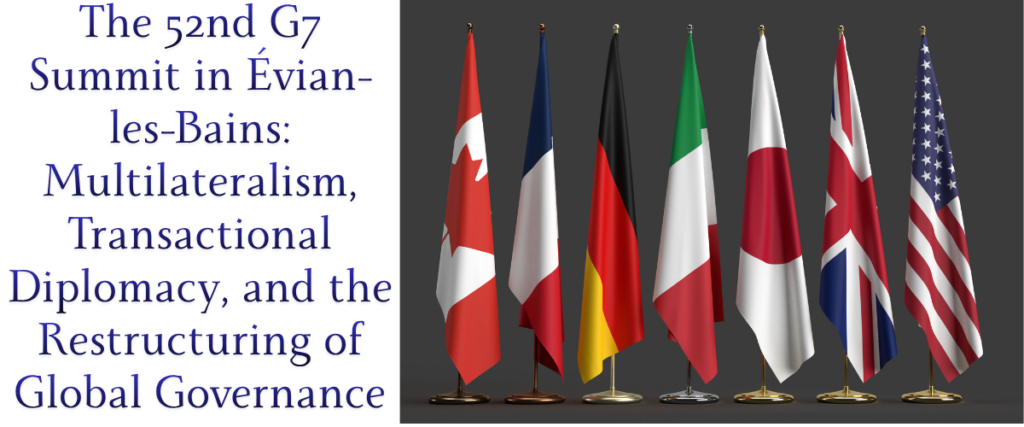
The 52nd G7 Summit in Évian-les-Bains: Multilateralism, Transactional Diplomacy, and the Restructuring of Global Governance

The 52nd G7 Summit in Évian-les-Bains: Multilateralism, Transactional Diplomacy, and the Restructuring of Global Governance

The 52nd G7 Summit, hosted by France in the alpine resort town of Évian-les-Bains from June 15 to 17, 2026, convened at a critical juncture marked by severe geopolitical volatility, trade frictions, and systemic challenges to global governance. The summit’s proceedings and side negotiations exposed a complex interplay between formal, institutionalised multilateralism and a rising tide of bilateral transactional diplomacy. While the formal agenda prioritised the reduction of global economic imbalances, critical mineral security, and pioneering regulations on artificial intelligence (AI), the event was heavily overshadowed by dramatic diplomatic breakthroughs and unilateral actions. Chief among these was the signing of a peace memorandum of understanding (MoU) between the United States and Iran at the Palace of Versailles, bringing a precarious end to three months of intense military hostilities. Simultaneously, European leaders successfully navigated diplomatic rifts to secure unified commitments on Ukraine, while guest nations from the Global South leveraged their invitations to advance national security and commercial objectives. This report provides an exhaustive analysis of the participant dynamics, major policy outcomes, tech-sovereignty disputes, and humanitarian initiatives that defined the 2026 summit.

The 52nd G7 Summit in Évian-les-Bains: Multilateralism, Transactional Diplomacy, and the Restructuring of Global Governance Read More »

Geopolitics

The U.S.-China Tech Truce Fallacy: Why High-Level Summits Fail to Resolve Structural Friction Over Advanced Semiconductors and Taiwan

The high-profile diplomatic engagements between U.S. President Donald Trump and Chinese President Xi Jinping are frequently heralded as crucial turning points capable of stabilising the world’s most critical bilateral relationship. The bilateral summits—such as the trade truce negotiated in Busan, South Korea, in October 2025, and the subsequent state visit to Beijing on May 14–15, 2026 —have been framed by official readouts as historic steps toward building “a constructive relationship of strategic stability”. These meetings, heavily promoted in Chinese media as a “historic reset”, have sought to project an image of mutual understanding, complete with public commitments on agricultural purchases and aviation deals.

The U.S.-China Tech Truce Fallacy: Why High-Level Summits Fail to Resolve Structural Friction Over Advanced Semiconductors and Taiwan Read More »

Scroll to Top