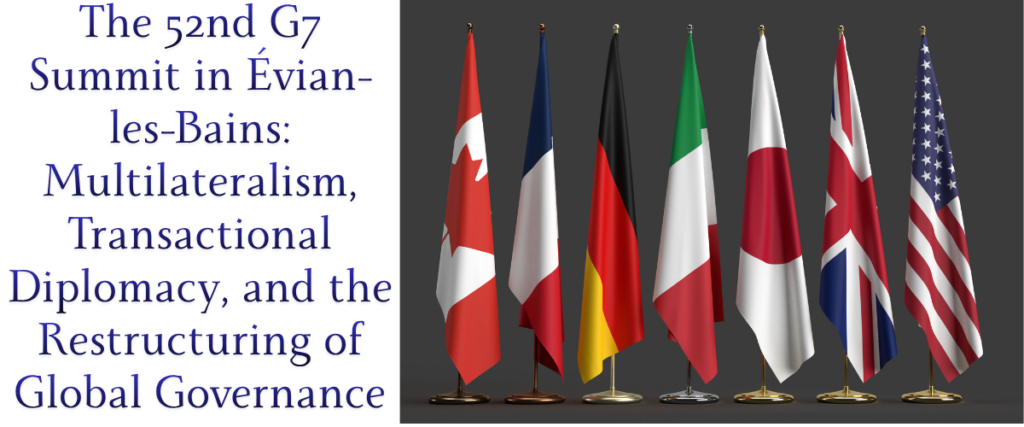
The 52nd G7 Summit, hosted by France in the alpine resort town of Évian-les-Bains from June 15 to 17, 2026, convened at a critical juncture marked by severe geopolitical volatility, trade frictions, and systemic challenges to global governance1. The summit’s proceedings and side negotiations exposed a complex interplay between formal, institutionalised multilateralism and a rising tide of bilateral transactional diplomacy2. While the formal agenda prioritised the reduction of global economic imbalances, critical mineral security, and pioneering regulations on artificial intelligence (AI), the event was heavily overshadowed by dramatic diplomatic breakthroughs and unilateral actions2. Chief among these was the signing of a peace memorandum of understanding (MoU) between the United States and Iran at the Palace of Versailles, bringing a precarious end to three months of intense military hostilities6. Simultaneously, European leaders successfully navigated diplomatic rifts to secure unified commitments on Ukraine, while guest nations from the Global South leveraged their invitations to advance national security and commercial objectives9. This report provides an exhaustive analysis of the participant dynamics, major policy outcomes, tech-sovereignty disputes, and humanitarian initiatives that defined the 2026 summit.
Security Logistics and the Presidential Postponement
The logistics of the 52nd G7 Summit reflected the unusual domestic and cultural pressures bearing down on modern international diplomacy. Originally scheduled to take place from June 14 to 16, 2026, the summit was postponed by one day to avoid a scheduling conflict with the “UFC Freedom 250” mixed martial arts event2. This professional sporting event, held on the South Lawn of the White House to mark both Flag Day and U.S. President Donald Trump’s 80th birthday, drew record-breaking viewership and required the physical presence of the U.S. executive, necessitating a shift in the global diplomatic calendar to ensure full American participation in France2. The UFC event featured a lightweight championship unification match between Ilia Topuria and Justin Gaethje and an interim heavyweight title fight between Alex Pereira and Ciryl Gane, attracting over 17 million viewers across the Americas13.
Évian-les-Bains, situated on the French shore of Lake Geneva, became the first French town to host a G7 or G8 summit twice, having previously hosted the 29th G8 summit in 20032. Because the town’s geography requires most foreign delegations to arrive via Geneva Airport in neighbouring Switzerland, the summit mandated unprecedented cross-border security and tactical coordination2. The Swiss Confederation, represented by President Guy Parmelin, managed reception logistics and coordinated with French authorities and the Swiss cantons of Geneva, Vaud, and Valais to secure the airspace and transport corridors leading to the primary summit venue, the Hôtel Royal2. On June 13, 2026, a French gendarme lost his life, and two others were seriously injured in a road accident while securing the G7 routes in Haute-Savoie, underscoring the severe operational and security stakes of the event2.
| Country / Institution | Representative | Official Title | Status |
| France | Emmanuel Macron | President (Host) | Core Member2 |
| Canada | Mark Carney | Prime Minister | Core Member2 |
| Germany | Friedrich Merz | Chancellor | Core Member2 |
| Italy | Giorgia Meloni | Prime Minister | Core Member2 |
| Japan | Sanae Takaichi | Prime Minister | Core Member2 |
| United Kingdom | Keir Starmer | Prime Minister | Core Member2 |
| United States | Donald Trump | President | Core Member2 |
| European Council | António Costa | President | Core Member2 |
| European Commission | Ursula von der Leyen | President | Core Member2 |
| Brazil | Luiz Inácio Lula da Silva | President | Invited Guest2 |
| Egypt | Abdel Fattah el-Sisi | President | Invited Guest2 |
| India | Narendra Modi | Prime Minister | Invited Guest2 |
| Kenya | William Ruto | President | Invited Guest2 |
| Qatar | Tamim bin Hamad Al Thani | Emir | Invited Guest2 |
| South Korea | Lee Jae Myung | President | Invited Guest2 |
| Ukraine | Volodymyr Zelenskyy | President | Invited Guest2 |
| UAE | Mohamed bin Zayed Al Nahyan | President | Invited Guest2 |
The Evolving Participant Matrix and Exclusions
The core G7 composition featured several leadership changes2. The summit served as a debut platform for Japanese Prime Minister Sanae Takaichi, the first female prime minister of Japan, who was attending her first G7 leaders’ summit2. Canada was represented by its newly elected Prime Minister, Mark Carney, while Friedrich Merz led the German delegation as its new Chancellor2. To project a more inclusive and globally representative forum, French President Emmanuel Macron expanded the traditional core gathering to include prominent leaders from the Global South and the Middle East, specifically targeting states playing pivotal roles in regional security, supply chain resilience, and economic mediation4.
Among the invited guests, Indian Prime Minister Narendra Modi and Brazilian President Luiz Inácio Lula da Silva participated actively, having been personally invited by Macron during the AI Impact Summit in New Delhi in February 20262. Modi’s arrival was preceded by a bilateral meeting with Macron at Villa Kerylos in Nice on June 14, 2026, where the two leaders took a widely publicised selfie and inaugurated an Innovation Conference4. Modi utilised the G7 platform to propose a global Skilled Mobility Partnership and an Economic Corridor for the Global South, positioning India as a primary advocate for developing nations4.
While invitations were extended to Saudi Arabian Crown Prince Mohammed bin Salman and Syrian President Ahmed al-Sharaa, neither attended the summit2. The invitation to Syria was historically significant, representing the first time Damascus had been invited to a G7 forum since the summit’s founding in 197518. This invitation, hand-delivered to Syrian Finance Minister Yisr Barnieh during financial talks in Paris, was intended to explore Syria’s role as a strategic overland supply chain corridor amidst the maritime blockade of the Strait of Hormuz2. Ultimately, ongoing domestic economic instability and logistical constraints prevented al-Sharaa’s attendance18. Conversely, South Africa was excluded from the guest list, prompting South African officials to allege that their exclusion was the result of U.S. diplomatic pressure, a claim the French government publicly denied2.
Bilateral Transactionalism and the Versailles Peace Accord
The defining event of the summit occurred on the night of Wednesday, June 17, 2026, when President Trump signed a comprehensive peace memorandum of understanding (MoU) with Iran at the Palace of Versailles2. Hosted by President Macron to mark the 250th anniversary of the United States’ independence, the dinner at the historic French palace was designed as a diplomatic gesture to ensure that the U.S. delegation remained for the entirety of the summit, rather than departing early as had occurred in previous years6. The signing itself unfolded in a highly unconventional, impromptu manner20. Upon arriving at Versailles, President Trump was notified by his aides that the final text of the peace agreement with Iranian President Masoud Pezeshkian had been resolved20. Trump decided to sign the document immediately20. Because the agreement had not yet been physically prepared, U.S. Secretary of State Marco Rubio requested that French Foreign Minister Jean-Noël Barrot secure a high-speed printer after 11:00 PM20. The documents, printed in English and Persian, were placed directly onto the dining table in the palace after the dishes were cleared20. Trump signed the A4 sheets of paper in front of approximately thirty onlookers, including a smiling President Macron and several surprised French ministers, while President Pezeshkian signed the reciprocal “Islamabad Memorandum of Understanding” in Tehran8.
| Country | Strategic Commitment under the 14-Point MoU | Implementation Timeline |
| United States | Termination of unilateral primary/secondary sanctions and UN/IAEA restrictions7. | To be finalised within 60 days of the final agreement7. |
| United States | Full release and availability of frozen or restricted Iranian state financial assets7. | Immediately upon implementation of the MoU7. |
| United States | Mobilisation of a minimum of $300 billion with regional partners for Iran’s reconstruction7. | Investment mechanism to be finalised within 60 days7. |
| United States | Complete removal of the naval blockade and proximity forces7. | Removal begins immediately; fully completed within 30 days7. |
| Iran | Complete reopening of the Strait of Hormuz to restore pre-war commercial shipping traffic7. | Immediately upon signing of the MoU7. |
The agreement was widely welcomed by G7 leaders in their final declarations2. Despite initial European anger over Trump’s unilateral execution of the military campaign against Iran, the joint communiqué specifically praised the “strong leadership” of the U.S. president in securing the ceasefire9. However, European leaders remained highly cautious, prompting German Chancellor Friedrich Merz, French President Emmanuel Macron, British Prime Minister Keir Starmer, and Italian Prime Minister Giorgia Meloni to issue a joint statement declaring their readiness to deploy a military operation to secure merchant shipping and clear mines in the Strait of Hormuz23. The French aircraft carrier Charles de Gaulle and allied warships were placed on active standby to enter the operational area within two to three days23. Underpinning this security stance, the European Commission implemented parallel measures to bolster its defence industrial base24. The Commission amended its European Innovation Council (EIC) Work Programme 2026 to incorporate the Defence Mini-Omnibus, offering dual-use startups up to €2.5 million in grants and €30 million in equity investments alongside a new €100 million STEP Defence Scale Up call24.
While the Middle East dominated the headlines, European leaders successfully maintained a unified front concerning the war in Ukraine5. Before the summit, there was significant anxiety that President Trump would pressure Ukrainian President Volodymyr Zelenskyy to accept immediate, unconditional territorial concessions9. However, intense lobbying by European counterparts, combined with a brutal Russian missile and drone attack on major Ukrainian cities just hours before the summit commenced, galvanised G7 unity9. The G7 leaders’ statement on Ukraine contained robust language, offering “unwavering support” and commending Kyiv’s resilience2. The G7 committed to accelerating the delivery of advanced air defence batteries, interceptor missiles, and long-range weapons systems, and pledged to coordinate stronger sanctions against Russian oil and gas exports2.
In East Asian diplomacy, South Korean President Lee Jae Myung utilised the outreach sessions to engage in a series of bilateral discussions, most notably with President Trump11. Seated adjacent to each other during the official state dinner, Lee and Trump held an in-depth, two-hour conversation11. Lee congratulated Trump on the Iran ceasefire and sought to translate this diplomatic momentum to the Korean Peninsula26. Lee requested that the United States play an active, constructive role as a peacemaker with North Korea, emphasising diplomacy over force—a posture that Trump reportedly endorsed, describing Lee as a “strong leader”10. Additionally, Lee engaged with Canadian Prime Minister Mark Carney to pitch South Korea’s advanced defence manufacturing sector for Canadian procurement projects and discussed critical mineral stockpiling agreements26.
Macroeconomic Imbalances and the Critical Minerals Alliance
Addressing global macroeconomic imbalances was designated by the French presidency as a primary structural objective1. Under the guidance of the French Ministry of Economy and Finance, the G7 focused on the threats posed by industrial overcapacity, systemic underinvestment, and predatory trade practices1. In the final declarations, the G7 called for enhanced surveillance by the IMF and the OECD to monitor how domestic fiscal policies in major economies contribute to global imbalances, a measure that received formal backing from guest nations Egypt, Kenya, and South Korea2. The discussion on economic security was heavily centred on China’s trade practices2. Leaders discussed how Beijing’s heavily subsidised industrial sectors were flooding export markets, leading to job losses in Western economies9. The final communiqué warned that G7 nations “seek to deter and stand ready to take actions, where necessary, in a coordinated manner, against economic coercion”2. However, this message of economic deterrence was somewhat undermined by President Trump’s closing remarks, in which he publicly thanked Chinese President Xi Jinping and Russian President Putin for remaining neutral during the U.S.-Iran conflict9.
To build tangible economic resilience independent of China, the G7 formally established the non-binding Critical Minerals Resilience and Production Alliance2. Originally launched during Canada’s 2025 G7 Presidency, the Alliance serves as a “trusted buyers’ club” designed to diversify supply chains, eliminate market concentration, and channel private investment into strategic mining and processing projects across allied nations30.
| Alliance Partners | Participating Nations | Strategic Project Focus |
| RCT Solutions & Sio Silica | Germany, Canada | Extraction of 99.9%+ pure silica sand to construct an integrated solar manufacturing hub in Manitoba30. |
| Hanwa Co. Ltd. & KAP Minerals | Japan, Canada | Joint development and extraction of rare earths and phosphate reserves in Ontario30. |
| Eni & Nouveau Monde Graphite | Italy, Canada | Direct equity investment in the Matawinie Mine in Québec to scale up commercial graphite production30. |
| First Phosphate, SACE, CDP, SIMEST, MAIRE, Denmark’s Export Credit Agency | Canada, Italy, Denmark | Financing and engineering support for a new phosphate mine and phosphoric acid processing facility in Québec30. |
| Liminal By WMC & Regeneration Enterprises Inc. | Netherlands, United States, Canada | Critical minerals recovery and environmental restoration projects across New Brunswick, British Columbia, and the Yukon30. |
| Schneider Electric & Torngat Metals | France, Canada | Advanced rare earths mining, refining, and processing operations in Québec30. |
| Sumitomo Corporation & Ucore Rare Metals Inc. | Japan, Canada | Strategic supply agreement for rare earth elements to feed magnet manufacturing facilities in Japan and North America30. |
AI Sovereignty and Digital Protectionism
On the final day of the summit, the digital economy and frontier technologies took centre stage during a high-profile working lunch titled “Ensuring the safe, rapid and effective deployment of artificial intelligence”31. The session brought together G7 leaders, partner nations, and prominent executives from the world’s leading AI laboratories, including Sam Altman (CEO of OpenAI), Demis Hassabis (CEO of Google DeepMind), Dario Amodei (CEO of Anthropic), Arthur Mensch (CEO of Mistral AI), and Aidan Gomez (CEO of Cohere)31. The discussion was severely strained by recent unilateral regulatory interventions by the United States31. Just prior to the summit, the U.S. administration issued a national security directive preventing foreign nationals from utilising Anthropic’s newest and most advanced frontier models, “Fable 5” and “Mythos 5”31. This directive forced Anthropic to pull its flagship models offline globally, drawing sharp criticism from international partners31.
| Participating AI Enterprise | Executive Representative | Corporate Headquarters |
| OpenAI | Sam Altman (CEO) | United States31 |
| Google DeepMind | Demis Hassabis (CEO) | United Kingdom / United States31 |
| Anthropic | Dario Amodei (CEO) | United States31 |
| Mistral AI | Arthur Mensch (CEO) | France31 |
| Cohere AI | Aidan Gomez (CEO) | Canada31 |
| Meta | Alexandr Wang (Chief AI Officer) | United States31 |
President Macron publicly criticised the U.S. directive, labelling it a “strictly nationalist” reaction31. Macron delivered a forceful plea directly to President Trump, warning that withholding cutting-edge AI technologies from democratic allies would diminish the global value of American tech firms and fracture the unified democratic response to authoritarian regimes31. Backing his rhetoric with domestic policy, Macron announced that France would significantly increase state funding for its domestic AI industry as a hedge against potential future blockades by the United States31. In response to these tensions, OpenAI’s Sam Altman delivered a speech advocating for the creation of an “international forum” to establish globally accepted standards for model testing, safety guardrails, and impartial risk analysis, arguing that AI safety should not be left solely to private entities31. Aidan Gomez of Cohere AI added that democratic nations must focus on ensuring that they produce not only the most capable AI systems but also the “second most capable” to maintain systemic resilience against non-market competitors31.
Beyond AI, broader digital regulations highlighted growing divergences between the U.S. and European approaches34. British Prime Minister Keir Starmer utilised the forum to detail the United Kingdom’s legislative plans to ban children under the age of 16 from utilising social media platforms, a policy that France announced it was also actively considering34. The G7 subsequently adopted the “Leaders’ Call on a Safer Digital Space for Minors,” focusing on modifying chatbot behaviours and language protocols when interacting with children2.
Global Health Security and Humanitarian Initiatives
In addition to high-level geopolitical and economic negotiations, the G7 leaders addressed critical threats to human security, formalising coordinated responses to an escalating health epidemic and launching a global scientific campaign29.
The Bundibugyo Ebola Response
The G7 issued an urgent, coordinated call to action to address the re-emerging outbreak of the rare “Bundibugyo” strain of Ebolavirus in the Democratic Republic of the Congo (DRC) and Uganda29. Centred in isolated, conflict-affected areas of eastern DRC, the outbreak presented severe containment and logistical challenges, made worse by the fact that existing standard vaccines and therapeutics are not fully effective against this specific filovirus strain35. Supported by outreach partners Egypt, India, Kenya, and South Korea, the G7 committed over $1 billion in immediate funding to support the containment efforts, aligned with the United Nations Office for the Coordination of Humanitarian Affairs (OCHA)35.
| Funding Contributor | Allocated Financial Support | Targeted Intervention Scope |
| United States | $370 million (immediate); up to $500 million (Ebola-specific); $650 million (humanitarian) | Rapid deployment of health resources, disease surveillance, and Great Lakes regional humanitarian aid29. |
| European Union | €493 million (including €84 million in immediate emergency/research aid) | Clinical vaccine development, frontline medical support, and long-term health system preparedness24. |
| African Union / Africa CDC | $518 million (mobilised through regional partners) | Implementation of the Continental Preparedness and Response Plan, contact tracing, and border surveillance35. |
| UN OCHA | Humanitarian Reset Funding targets | Lifesaving humanitarian aid intended to reach 87 million people in the region35. |
The Global Cancer Initiative
The 2026 summit marked the first time the G7 elevated cancer research and prevention to a core, top-tier priority2. Recognising that cancer causes approximately 10 million deaths annually and that global cases are projected to rise 80% by 2050, the G7 committed to a highly coordinated, data-driven scientific campaign29.
The initiative is structured around three primary pillars:
- Pediatric and Young Adult Cancers: Establishing international data interoperability protocols to facilitate the secure sharing of clinical, genomic, and imaging data across borders, creating larger cohorts for rare pediatric cancers2.
- Cancers with Poor Prognosis: Channelling joint public-private research funding into oncology targets with low survival rates, promoting rapid clinical trial designs29.
- Universal Access and Early Detection: Standardising screening protocols and accelerating the clinical translation of advanced diagnostics to ensure equitable access to oncology care in developing nations29.
Preparatory Ministerial Tracks and Structural Foundations
The comprehensive outcomes achieved at the Évian Summit were built upon months of intense preparatory negotiations across seven distinct ministerial tracks, which translated broad diplomatic goals into actionable commitments39.
In April 2026, the Environment Ministers met in Paris to establish the “Nature & People Finance Alliance” and the “Real Estate Resilience for Prosperity Partnership,” designed to make infrastructure more resilient to climate-induced disasters39. These discussions also focused on combating illegal, unreported, and unregulated (IUU) fishing, expanding marine protected areas, and addressing global water pollution through the G7 Water Coalition39. On June 8, 2026, the G7 Agriculture Ministers held an extraordinary meeting to address critical bottlenecks in the global fertiliser trade caused by the maritime blockades in the Middle East, seeking to insulate vulnerable agricultural markets from severe food security shocks39.
The social dimension of the G7’s agenda was formalised during the G7 Labour and Employment Ministers’ meeting held at the International Labour Organisation (ILO) headquarters in Geneva in June 20262. The resulting “Social G7 Communiqué” emphasised the integration of labour standards within critical mineral supply chains, the establishment of career training frameworks for AI deployment, and the promotion of labour mobility2. To solidify these commitments, the ministers announced a major G7 conference on labour mobility and career progression to be held in Paris in December 20262. Additionally, the G7 Foreign and Home Affairs tracks finalised joint declarations on securing international seaports to combat drug trafficking and strengthening border surveillance cooperation to tackle migrant smuggling networks29.
Conclusion
The 52nd G7 Summit in Évian-les-Bains exposed a profound structural paradox within contemporary international relations2. On one hand, the summit demonstrated that the G7 remains a highly capable vehicle for coordinating complex, technical policies among advanced democratic economies2. The formalisation of the Critical Minerals Resilience and Production Alliance and the massive mobilisation of over $1 billion for the Ebola outbreak illustrate the group’s capacity to deploy capital and structure supply chains to counter systemic vulnerabilities30.
On the other hand, the summit revealed that high-level, decisive geopolitical breakthroughs are increasingly occurring outside the formal structures of multilateral consensus2. The signature achievement of the week—the US-Iran Peace MoU—was not the result of G7 deliberation, but rather a swift, transactional bilateral negotiation executed on a standard sheet of paper in the corridors of Versailles20. Furthermore, the public disputes over AI technology blockades and the unilateral introduction of export controls by the United States indicate that economic nationalism continues to challenge the principles of shared growth and democratic technology alignment31. While host nation France successfully projected an image of “convergence and real action,” the underlying reality of the 2026 summit is one of a highly fragmented global order, where formal summits serve as elaborate, scenic backdrops for a pragmatic, transactional style of global statecraft1.
Disclaimer
The information and analyses presented in this article are intended solely for educational, research, and general informational purposes. This document does not constitute legal, financial, investment, or official policy advice, and the views expressed herein do not represent the formal positions of any participating governments or international organisations.
References
- G7: Priorities for the Évian Summit, https://us.diplomatie.gouv.fr/en/g7-priorities-evian-summit
- 52nd G7 summit – Wikipedia, https://en.wikipedia.org/wiki/52nd_G7_summit
- Emmanuel Macron and Donald Trump test their bruised bromance at G7 summit, https://www.ft.com/content/cd9e31af-9521-4a77-8d89-882bb1e4a23e?syn-25a6b1a6=1
- G7 Summit 2026 begins in Évian: Key leaders, dates, and venue details – The Hindu, https://www.thehindu.com/news/international/g7-summit-2026-begins-in-evian-key-leaders-countries-dates-and-venue-details/article71104781.ece
- G7 meeting in France: What’s on agenda, who is attending?, https://www.aljazeera.com/news/2026/6/15/g7-meeting-in-france-whats-on-agenda-who-is-attending
- Dinner with Donald Trump, President of the United States of America, at the Palace of Versailles. – Élysée, https://www.elysee.fr/en/emmanuel-macron/2026/06/17/dinner-with-donald-trump-president-of-the-united-states-of-america-at-the-palace-of-versailles
- $300 billion, sanctions relief, Hormuz reopening: What Tehran gets, what Washington gains from peace deal MoU, https://timesofindia.indiatimes.com/world/us/frozen-assets-300-billion-hormuz-nuclear-programme-more-what-us-iran-gain-from-peace-deal/articleshow/131815523.cms
- The Moment Iran’s President Signs Peace Deal with the US – YouTube, https://www.youtube.com/watch?v=E0IaR33Sv5s
- Takeaways from the G7: Trump’s new attitude toward allies buoyed by their praise for Iran deal – Newsday, https://www.newsday.com/news/nation/g7-summit-trump-macron-takeaways-versailles-p20405
- Will Lee Jae Myung’s G7 gamble preserve future diplomacy with North Korea?, https://www.scmp.com/week-asia/politics/article/3357580/can-lee-jae-myungs-g7-balancing-act-bridge-north-korea-divide
- President Lee Jae-myung Strengthens Korea’s Global Leadership at the G7 Summit, https://www.twk.co.kr/news/articleView.html?idxno=2195
- UFC Freedom 250 – Wikipedia, https://en.wikipedia.org/wiki/UFC_Freedom_250
- UFC Freedom 250 viewership released: How it compares to major sports events, https://www.newsweek.com/ufc-freedom-250-viewership-numbers-break-record-paramount-says-12093788
- What time is the UFC fight on the White House lawn? UFC Freedom 250 schedule and how to watch live, https://www.hindustantimes.com/sports/us-sports/what-time-is-the-ufc-fight-on-the-white-house-lawn-ufc-freedom-250-schedule-and-how-to-watch-live-stream-101781388772092.html
- UFC Freedom 250 – AMC Theatres, https://www.amctheatres.com/movies/ufc-freedom-250-83219
- G7 summit in Évian, https://www.eda.admin.ch/en/g7-summit-in-evian
- G7 Summit: Who are the world leaders gathered in France?, https://www.livemint.com/news/world/g7-summit-who-are-the-world-leaders-gathered-in-france-11781673318373.html
- As Syria’s Sharaa heads to G7, economic pain deepens at home – The New Arab, https://www.newarab.com/news/syrias-sharaa-heads-g7-economic-pain-deepens-home
- Syria’s Sharaa visit to White House will not happen this weekend, official says, https://www.aa.com.tr/en/world/syria-s-sharaa-visit-to-white-house-will-not-happen-this-weekend-official-says/3964434
- Trump Signs Iran Peace MOU on A4 Paper at Versailles, https://www.chosun.com/english/world-en/2026/06/19/FLNVQ32OX5EQ5H2FWVHCHJWQNE/
- ‘Very naive’: French left up in arms as Macron hosts Trump at Versailles, https://www.theguardian.com/world/2026/jun/17/french-reaction-macron-host-trump-versailles
- Iran Signs Peace Agreement with US – YouTube, https://www.youtube.com/shorts/LCbCKXC9zAw
- G7 powers make new war plans at Évian summit, https://www.wsws.org/en/articles/2026/06/17/gfrz-j17.html
- Daily News 17 / 06 / 2026 – European Commission, https://ec.europa.eu/commission/presscorner/detail/en/mex_26_1379
- G7 leaders open summit talks in France on Ukraine and the Middle East, https://www.wlrn.org/npr-breaking-news/2026-06-16/g7-leaders-open-summit-talks-in-france-on-ukraine-and-the-middle-east
- Trump tells Lee he’ll help advance peace on Korean Peninsula, https://www.hani.co.kr/arti/english_edition/e_international/1264211.html
- President Trump pledges peace-building role for Korean Peninsula, https://www.korea.net/NewsFocus/policies/view?articleId=294288
- Prime Minister Carney meets with President of the Republic of Korea Lee Jae Myung, https://www.pm.gc.ca/en/news/readouts/2026/06/16/prime-minister-carney-meets-president-republic-korea-lee-jae-myung
- G7 France 2026 : focus on development matters, key challenges, debates and emerging priorities, https://focus2030.org/en/g7-france-2026-focus-on-development-issues-understanding-the-challenges-keeping-up-with-the-latest-news/
- Prime Minister Carney secures new partnerships in defence and critical minerals at the 2026 G7 Leaders’ Summit, https://www.pm.gc.ca/en/news/news-releases/2026/06/17/prime-minister-carney-secures-new-partnerships-defence-and-critical
- French president urges US to share cutting-edge AI and democracies to cooperate on regulation, https://apnews.com/article/g7-france-ai-sovereignty-7d783c6de4356962e338b8b8563d48ea
- G7 Summit in Evian: Day Three | France in the U.S., https://us.diplomatie.gouv.fr/en/g7-summit-evian-day-three
- G7 Summit in Evian : Day Three., https://www.elysee.fr/en/emmanuel-macron/2026/06/17/g7-summit-in-evian-day-three
- French President Macron to wind up G-7 summit with focus on AI, Trump dinner, https://www.straitstimes.com/world/europe/french-president-macron-to-wind-up-g-7-summit-with-focus-on-ai-trump-dinner
- G7 Leaders’ call for a coordinated response to the Bundibugyo ebola outrbreak: 16 June 2026, https://www.gov.uk/government/news/g7-leaders-call-for-a-coordinated-response-to-the-bundibugyo-ebola-outrbreak-16-june-2026
- leaders’ call for a coordinated response to the bundibugyo ebola outbreak – Bundesregierung, https://www.bundesregierung.de/resource/blob/975228/2441598/7569fc1c7de494910a26163ec98a998f/2026-06-17-leaders-call-for-a-coordinated-response-to-the-bundibugyo-ebola-outbreak-data.pdf?download=1
- The outcomes of the G7 Summit in Évian | France in the U.S., https://us.diplomatie.gouv.fr/en/outcomes-evian-g7-summit
- G7 Summit of Evian: Testing Unity, Credibility of World’s Major Economic Powers., https://qna.org.qa/en/News-Area/Special-News/2026-6/14/g7-summit-of-evian-testing-unity-credibility-of-worlds-major-economic-powers-report
- The Road to France’s 2026 G7 Evian Summit, https://g7.utoronto.ca/summit/2026evian/road.html
- France’s action in the G7 | France Diplomatie, https://www.diplomatie.gouv.fr/en/the-ministry-in-action/contributing-to-sustainable-balanced-globalization/summits-and-global-issues/france-s-action-in-the-g7
- The G7’s Overriding Goal: Getting Through | Chicago Council on Global Affairs, https://globalaffairs.org/commentary/analysis/g7s-overriding-goal-getting-through
- G7 Summit in Évian: Day Two, https://us.diplomatie.gouv.fr/en/sommet-du-g7-devian-deuxieme-jour