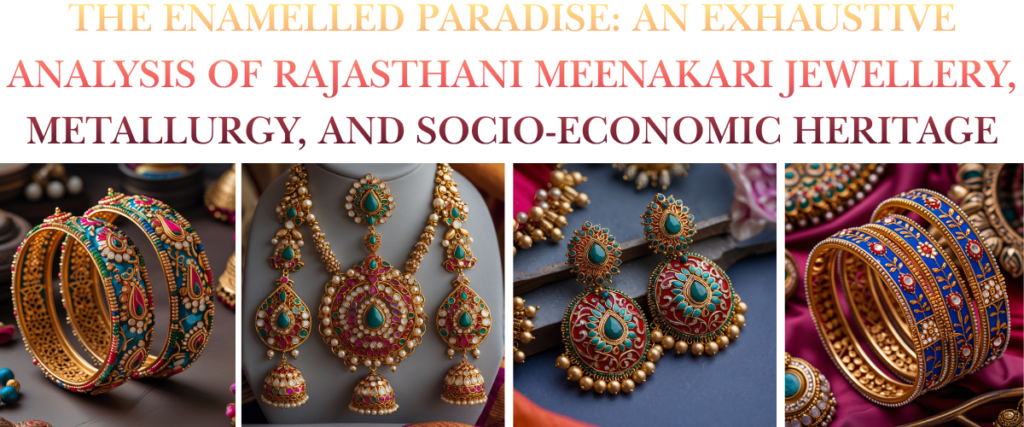
The jewellery-making heritage of the Indian subcontinent is an ancient narrative of cultural synthesis, technological mastery, and royal luxury.1 Among its most celebrated manifestations is Meenakari, a highly sophisticated vitreous enamelling technique that marries metallurgy, chemistry, and miniature painting.2 Originating as a decorative medium for royal palaces, Meenakari evolved under the patronage of the Mughal and Rajput courts to become the definitive ornamentation of the Indian elite.1 This report examines the historical trajectory, technical processes, chemical foundations, regional variations, and contemporary socioeconomic landscapes of Meenakari jewellery, particularly within its spiritual and geographic home of Rajasthan, India.5
Historical Genesis and Cultural Migration
The historical trajectory of Meenakari in India is a compelling study of cultural migration, geopolitical integration, and artistic assimilation. To fully understand its development, one must examine the geopolitical forces that facilitated its journey from the palaces of Safavid Persia to the royal courts of Rajasthan.1
Persian Origins and Mughal Adoption
The etymology of Meenakari traces back to the Persian words mina or minoo, translating to “heaven” or “paradise,” referencing the azure colour of the sky.2 Alternatively, the term aligns with the Sanskrit mina, denoting “colored glass” or “heavenly”.10 The art of decorating metal surfaces with fused colored enamels was originally developed in Safavid Persia, where artisans in the Sassanid era utilised it to ornament the architecture of mosques, palaces, ceilings, and royal thrones.1
The craft migrated to the Indian subcontinent in the sixteenth century during the Mughal Empire, where it found an ardent patron in Emperor Akbar.1 Mughal rulers utilised the technique to elevate the grandeur of their courts, applying brilliant enamels to royal utensils, weapons, and architectural details.1 According to historical lore, the begums (royal women) of the Mughal court became so captivated by the vibrant, gem-like quality of the enamels that they insisted the technique be adapted for personal ornamentation.2 This demand initiated a shift, transforming Meenakari from an architectural embellishment into a highly prestigious jewellery form.1
Another pivotal historical figure in this migration was an aristocrat named Raja Ram, who in the sixteenth century introduced Lahore’s master enamellers to the court of Mughal Emperor Shah Jahan.2 Deeply charmed by the intricate patterns, Shah Jahan patronised the establishment of dedicated enamelling workshops in Mewar, Rajasthan, making the state an early regional centre for the art form.2
The Rajasthani Settlement: Raja Man Singh I and the Lahore Legacy
While the Mughals introduced the art to India, it was the Rajput rulers of Rajasthan who secured its legacy and catalysed its evolution.2 At the turn of the sixteenth century (circa 1589–1614), Raja Man Singh I of Amber (Amer), a trusted general in the court of Emperor Akbar, encountered the craft in Lahore.7 Recognising its artistic and economic potential, Raja Man Singh I invited five highly skilled Sikh master enamellers from Lahore to settle in his capital at Amer.3
These artisans belonged to the Mair Rajput caste of professional goldsmiths (Swarnkar or Sunar).13 They established workshops (karkhanas) under direct royal patronage, passing their highly guarded skills down through generations under the traditional Guru-Shishya Parampara (teacher-disciple lineage).12 When the capital shifted to the newly planned city of Jaipur in 1727 under Sawai Jai Singh II, the Meenakari guilds relocated, cementing Jaipur as the global epicentre of gold enamel craftsmanship.12 This lineage remains unbroken, as evidenced by master craftsmen such as the late Padma Shri Kudrat Singh (1924–2002) and his son Inder Singh Kudrat, whose ancestors were among the original Lahore artisans invited by the Kachwaha kings.12
| Historical Era / Ruler | Approximate Period | Key Contribution to Meenakari Development |
| Safavid Persia (Sassanid Roots) | Pre-16th Century | Invention and architectural application of vitreous enamelling on walls, domes, and thrones.1 |
| Mughal Emperor Akbar | 16th Century | First major imperial patron; integrated Persian enamellers into Indian royal courts.1 |
| Raja Man Singh I of Amer | 1589–1614 (Late 16th Century) | Imported five Sikh Mair Rajput master enamellers from Lahore, establishing the Rajasthani school of gold enamelling.11 |
| Raja Ram / Shah Jahan | 17th Century | Introduction of Lahore artisans to Mewar, extending the geographic footprint of Meenakari across Rajasthan.2 |
| Sawai Jai Singh II | 1727 (Early 18th Century) | Founded Jaipur; relocated the royal guilds (karkhanas), establishing Jaipur as a permanent global hub.12 |
| Sardar Kudrat Singh Meenakar | 1924–2002 (Modern Era) | Celebrated master craftsman; awarded the National Award (1965) and Padma Shri (1988) for preserving traditional techniques.12 |
Other prominent rulers of Jaipur influenced different arts; for example, Maharaja Ram Singh II (1835–1880) modernised Jaipur and introduced Blue Pottery, while Ishwari Singh constructed the landmark Isar Lat tower.12 However, the core patronage of gold Meenakari remained a continuous legacy of the Kachwaha dynasty, which preserved the craft’s position as a prestigious royal art form.12
The Karkhana Division of Labour: Step-by-Step Craftsmanship
The creation of a single piece of authentic Meenakari jewellery is a highly decentralised and collaborative endeavour.2 It cannot be completed by a single individual; instead, it relies on a specialised guild of craftsmen, each performing a precise role in a structured sequence.2
The Guild of Specialised Artisans
The traditional Meenakari workshop operates via a sophisticated division of labour, utilising the specific expertise of seven distinct classes of artisans:
- The Sonar (Goldsmith): Fabricates the primary structural framework (ghat) of the jewellery piece from pure gold or silver.2
- The Nacquash (Designer / Chitteria): Traces the intricate artistic patterns onto the metallic surface using a fine-tipped brush.2
- The Kalamkar (Engraver / Ghaaria / Chilai Artist): Uses specialised chisels and engraving needles (takala) to carve deep recesses and grooves into the metal base, creating raised walls that will serve as the boundaries for the enamel.2
- The Meenakar (Enamellist): Prepares the mineral oxides, crushes the silicate glass, meticulously applies the paste into the engraved grooves, and executes the high-temperature firing.2
- The Ghotnawala (Polisher): Uses agate stones, charcoal, and specialised polishing media to burnish and smooth the fired enamel surface, revealing its latent brilliance.1
- The Kundansaaz (Stone Setter / Jadiya): Embeds precious gemstones (rubies, emeralds, diamonds) into the front of the jewellery piece using refined gold foil (kundan).2
- The Patua (Stringer): Weaves the final structural threads, pearls, or decorative beads, transforming the metalwork into a wearable accessory.2
| Artisan Title | Alternative Regional Name | Primary Material Handled | Technical Function |
| Sonar | Swarnkar / Sunar | Pure Gold ( ) / Fine Silver 2 ) / Fine Silver 2 | Structural fabrication and alloy forging.2 |
| Nacquash | Chitteria | Paper, Ink, Fine Brushes 2 | Pattern designing and tracing.2 |
| Kalamkar | Ghaaria / Chilai Artist | Steel Chisels, Takala Needles 2 | Deep metal engraving and groove excavation.2 |
| Meenakar | Enamellist | Glass Frits, Metallic Oxides 2 | Paint application, chemical mixing, and kiln firing.2 |
| Ghotnawala | Polisher | Agate, Charcoal, Lime, Tamarind 1 | Surface burnishing and lustre development.1 |
| Kundansaaz | Jadiya | Gemstones, Pure Gold Foil (Kundan) 2 | Gemstone setting and front-side ornamentation.2 |
| Patua | Stringer | Silk Thread, Pearls, Beads 2 | Final assembly, stringing, and wearability.2 |
The Chronological Execution of Vitreous Enamelling
The physical fabrication of Meenakari jewellery is a demanding process that requires great patience and technical skill.2 It is executed through a sequence of steps designed to ensure a permanent chemical bond between the metal and the glass enamel 2:
- Preparation and Engraving: Once the Sonar prepares the metal sheet, it is secured onto a hard bed of purified lac (chapadi).2 This stabilises the metal, allowing the Kalamkar to engrave delicate designs of flora, fauna, or mythological motifs without bending the framework.7
- Enamel Paste Preparation: Highly purified silicate glass frits are thoroughly ground in a mortar and pestle with water and binding agents (such as pomegranate seeds).3 This glass powder is mixed with specific metal oxides that dictate the final colour of the enamel.2
- Sequential Application and Firing: The enamel paste is applied to the engraved recesses using fine steel needles or spokes.3 The piece is placed on an iron mesh and introduced into a kiln heated to temperatures between
 and .7 The heat melts the glass powder, causing it to flow evenly within the engraved grooves and fuse chemically with the underlying metal.2
 - Finishing and Lustre Retrieval: After cooling, the surface appears dull and uneven. The Ghotnawala polishes the piece with a mixture of charcoal, oil, and agate.1 Finally, the jewellery is washed in a mild acidic solution of lime and tamarind, which gently dissolves surface impurities and enhances the brilliant, glassy lustre of the fused enamel.2
The Thermodynamic Chemistry of Vitreous Enamels
True Meenakari is not a form of painting, but rather a complex metallurgical and chemical process. The permanence and intense colouration of the enamel are governed by the high-temperature fusion of transition metal oxides within a silicate glass matrix.2
The Sequence of Thermal Fusion
A critical chemical constraint in Meenakari is the varying thermal resistance (melting points) of different colored glass frits.2 Enamels that require the highest temperatures to melt must be applied and fired first, while those that melt at lower temperatures are applied in subsequent stages.2
If this sequence is violated, subsequent firings would re-melt the previously applied colours, causing them to bleed, decompose, or run off the metal.7 Consequently, opaque white is traditionally fired first, as its composition requires the highest thermal energy to flux.7 Red, which relies on volatile, heat-sensitive compounds, is fired last at a lower temperature threshold.7
Chemistry of Colouration in Meenakari
The vibrant colours of Meenakari are achieved by doping the base silicate glass with specific metal oxides.2 Under the intense heat of the kiln, these metal ions dissolve into the glassy network, acting as light-absorbing centres that produce deep, three-dimensional colours.21
| Color | Chemical Compound / Oxide | Chemical Formula | Firing Conditions | Visual Character & Lustre |
| Blue / Blue-Violet | Cobalt Oxide 3 | 24 | Highly stable in both oxidation and reduction 22 | Intense, deep cobalt blue; highly reflective.23 |
| Green / Turquoise | Copper Oxide / Chrome Oxide 22 | 22 | Oxidation (oxygen-rich atmosphere) 22 | Clear, bright grass green or rich turquoise blue.23 |
| Yellow | Potassium Chromate / Iron Oxide 9 | 23 | Mild oxidation 23 | Soft golden-straw yellow to bright, translucent amber.22 |
| Ruby Red | Gold Chloride / Purple of Cassius 7 |  | Highly controlled reduction; often requires a gold base 7 | The most prized and difficult colour: brilliant, transparent royal crimson.7 |
| Violet / Purple | Manganese Carbonate 9 | 24 | Oxidation at lower concentrations ( ) 23 ) 23 | Eggplant purple to light, delicate lavender.22 |
| Black | Cobalt, Iron, & Manganese oxide blend 9 |  | Neutral kiln atmosphere | Opaque, dense jet black; used for high-contrast outlines.23 |
| White | Tin Oxide / Antimony Oxide 21 |  | High temperature 24 | Highly opaque, reflective canvas white forms the base for painting.2 |
Pure gold ( ) is the preferred base metal for Meenakari.2 Gold’s high melting point (
 ) ensures it remains structurally stable during repeated firings, while its chemical inertness prevents metal-enamel reactions that can discolour the pigments.12 Furthermore, gold acts as a perfect specular reflector, bouncing light back through translucent enamels to create a brilliant, self-illuminating effect.2
While silver and copper are also used, they have distinct chemical limitations: only a narrow range of colours (primarily blues, greens, and yellows) will adhere to silver without turning grey or peeling due to thermal expansion mismatches.7
Regional Typologies and Artistic Dialects of Rajasthan
Over centuries of practice, the geographical clusters of Rajasthan have developed distinct stylistic signatures, separating their work from other Indian centres.5
Jaipur: The Epitome of Panchrangi and Ruby Red
Jaipur remains the undisputed capital of gold Meenakari.6 The signature style of Jaipur is Panchrangi Meena, which utilises a palette of five traditional colours: opaque white (safed), opaque light blue (fakhtai), transparent dark blue (khula nila), transparent green (khula sabz), and the prized ruby red (laal).2
Jaipur’s work is traditionally executed on the reverse side of Kundan-Jadau jewellery.7 This practice, dating back over two hundred years, forms a vital component of the Solah Shringar (the sixteen traditional adornments of royal women).8 The front of the ornament displays a lavish array of raw, uncut gemstones set in pure gold, while the reverse features a hidden universe of highly detailed Meenakari.8 This duality ensures that even the side resting against the skin is an exquisite work of art, preventing raw metal from tarnishing or causing skin irritation.8
Jaipur is also characterised by two major application styles:
- Ek Rang Khula: This style utilises a single solid colour of translucent enamel across the engraved surface, allowing the gold base’s natural lustre to shine through.2 It is highly sought after by modern brides who wish to coordinate their jewellery with their wedding attire.7
- Band Meena: Also known as closed meena, this style involves the application of thick, opaque layers of enamel, creating solid, vibrant blocks of turquoise, parrot green, and pink outlined by delicate gold borders.2
The Silver Clusters: Nathdwara, Bikaner, and Udaipur
While Jaipur monopolises high-value gold Meenakari, other cities in Rajasthan have carved out niches in silver enamelling.7
- Nathdwara: Located near Udaipur, Nathdwara is famous for its silver Meenakari, which is deeply tied to the worship of Lord Krishna in his Shrinathji form.7 The enamelling here is characterised by religious iconography, devotional motifs, and Pichwai-inspired themes.7
- Bikaner and Udaipur: These clusters specialise in mirror-like silver enamelling, creating larger decorative items like boxes, bowls, thrones, and low stools (chowki) alongside personal jewellery.7
For comparison, Banaras (Varanasi) in Uttar Pradesh practised Gulabi Meenakari, which stands in contrast to the opaque styles of Rajasthan.2 Banaras craftsmen apply transparent pink enamel in delicate brushstrokes over a white base to create a three-dimensional, rose-tinted effect inspired by the local chaiti rose.16
Comparative Matrix: Meenakari versus Thewa Art
There is a frequent conflation in luxury markets between Meenakari and Thewa art, another celebrated heritage craft of Rajasthan originating in Pratapgarh.2 Despite sharing a geographical origin and a royal history, their physical composition and technical execution are fundamentally different.18
| Feature | Rajasthani Meenakari | Pratapgarh Thewa Art |
| Core Definition | The fusion of powdered glass and metal oxides onto engraved metallic bases.2 | The fusion of ultra-thin, hand-carved gold sheet onto colored molten glass.18 |
| Primary Base Material | Gold (), Silver, Copper, or Brass.7 | Multicoloured Belgian glass sheet (chapadi lac base for carving).18 |
| Metal Content | Thicker gold framework engraved to receive liquid glass.2 | Micrometre-thin  gold sheet carved into a delicate jaali (filigree).18 gold sheet carved into a delicate jaali (filigree).18 |
| Firing Temperature | .20 | (Glass prep at ).28 |
| Visual Appearance | Solid, opaque, or translucent glassy colours bounded by raised metal walls.2 | A glittering sheet of colored glass overlaid with a continuous, flat gold illustration.25 |
| Historical Origin | Jaipur/Amer, Raja Man Singh I (16th century).11 | Pratapgarh, Nathu Lal Sonewal (1707).25 |
| Typical Motifs | Peacocks, floral trellises, deities, and geometric abstractions.1 | Hunting scenes (shikargah), royal weddings, and mythological epics.18 |
Technical and Economic Realities: Hot Enamel versus Cold Enamel
In the modern jewellery market, the term “enamel” has been diluted by the introduction of synthetic polymers.29 Collectors and retailers must distinguish between traditional vitreous (hot) enamel and modern epoxy (cold) enamel to preserve the value of heritage art.29
Traditional Meenakari relies entirely on vitreous enamel (Pakka Meena), a true glass-on-metal fusion.20 The raw material is inorganic silica powder.21 Because of its high firing temperatures, it chemically bonds with the metal substrate, creating a surface that is exceptionally hard, scratch-resistant, chemically inert, and UV-stable.20
Vitreous enamel is characterised by an optical depth and brilliance that cannot fade over centuries, making it an ideal family heirloom.4 However, it is highly temperamental; slight temperature fluctuations in the kiln can crack the glass or alter the colour, making each piece unique.29
In contrast, epoxy enamel (cold enamel, lacquer, or resin) is a modern organic polymer mixed with chemical pigments.29 It requires no kiln firing, drying to a hard finish at room temperature or under low UV light.29 While it offers uniform colour and is inexpensive to produce, cold enamel lacks the longevity and optical brilliance of glass.29 Over time, epoxy enamel is prone to scratching, yellowing, peeling, and chemical degradation when exposed to household perfumes, oils, or sunlight.29
Traditional vitreous enamel pieces command a substantial price premium, reflecting both the high precious metal content and the specialised, labour-intensive skills required for their creation.6
Modern Market Dynamics, Preservation, and Future Outlook
The twenty-first century has brought both global opportunities and severe existential threats to the traditional Meenakari artisans of Rajasthan.4
The Contemporary Dematerialisation Threat and Artisanal Crossroads
The democratisation of luxury has created a mass market for fashion jewellery, leading to the widespread use of cheap imitation products like screen-printed metals and cold epoxy enamels.4 This has put immense economic pressure on traditional Meenakars.30
The decentralised nature of the craft means that family workshops often operate with low margins, leaving artisans vulnerable to exploitation by retail middlemen.30 Consequently, younger generations within traditional jeweller families are facing a critical crossroads.30
Faced with the long, unpaid apprentice periods of the Guru-Shishya tradition and the physical toll of working over hot kilns, many are abandoning the family craft.13 Instead, they are turning to standardised career paths in Jaipur’s booming IT and service sectors, raising the risk of losing centuries of specialised oral knowledge.30
Safeguarding Authenticity: Geographical Indications and Policy Intervention
To combat these threats, a concerted preservation effort has emerged involving government agencies, non-governmental organisations, and financial institutions.10
- Geographical Indication (GI) Status: Jaipur Meenakari has been granted a Geographical Indication (GI) tag under the Government of India.10 This legal designation ensures that only registered, authorised artisans practising within the designated geographic region of Jaipur can market their products under this name, protecting the craft from cheap industrial imitations.31
- NABARD and the Rajasthan Handicraft Policy (2022): The National Bank for Agriculture and Rural Development (NABARD) actively funds and registers traditional artisans, offering them direct access to national and international trade platforms.31 Concurrently, the state’s Rajasthan Handicraft Policy, launched in September 2022, offers financial incentives, skill development programs, and marketing support to help revitalise disappearing craft forms.30
- A Shift to Daily and Contemporary Wear: Modern designers are successfully rewriting the narrative of Meenakari.4 Historically restricted to heavy, uncut diamond bridal sets, contemporary ateliers are adapting the craft for modern daily wear.4 By using minimalist geometric patterns, abstract forms, and pastel colours (such as mint greens, soft pinks, and lavenders), designers are attracting younger, global consumers.4 Meenakari is now being integrated into delicate monogram pendants, stackable rings, watch faces, and even luxury home accessories, breathing new life into this ancient craft.1
Conservation Protocols for the Discerning Collector
Authentic vitreous Meenakari is highly durable, but its glass-on-metal composition requires specific care to maintain its brilliance for generations:
- Chemical Avoidance: The jewellery must never be exposed to harsh household chemicals, abrasive cleaners, or chlorine, which can dull the glassy surface or corrode the gold joints.5 Cosmetics, hairsprays, and perfumes should always be applied before putting on Meenakari pieces.35
- Physical Protection: Because vitreous enamel is essentially a thin layer of glass fused to metal, severe drops or hard impacts can chip or crack the design.35 The jewellery should be wrapped in a soft microfiber cloth and stored in individual compartments within an airtight box to prevent scratching from harder gemstones.5
- Cleaning: The surface should be cleaned gently using a dry, soft cotton cloth.5 If needed, a mild wash with a diluted mixture of lime and warm water, followed by immediate drying with a lint-free cloth, can restore its original lustre.2
Conclusion
Meenakari jewellery remains one of the finest examples of the artistic and technical achievements of Indian craftsmanship.5 For over four centuries, the master craftsmen of Rajasthan have preserved a delicate balance between metallurgical science and miniature painting, transforming raw metal and mineral oxides into a physical representation of paradise.2
While the modern market introduces challenges through synthetic imitations and economic pressures, the craft is proving resilient.4 Through legal protections like the GI tag, proactive state policies, and innovative designs by contemporary artists, Meenakari is successfully transitioning from the exclusive courts of the Mughal emperors into the global arena of modern luxury.4 It stands not merely as an ornament, but as a living bridge between historic royal patronage and contemporary artistic expression.5
Disclaimer
This report is compiled for informational and educational purposes based on historical records, craft documentation, and material science studies available at the time of publication.31 The chemical analyses, historical dates, and technical details cited represent traditional workshop practices and scholarly consensus; actual artisanal techniques may vary slightly between family lineages and individual workshops. Mention of specific brands, artisans, or organisations does not imply endorsement, but serves to illustrate documented market and cultural trends within the craft ecosystem.
References
- Rajasthan’s Radiant Legacy: Exploring Exquisite Meenakari Jewellery Designs – Oak Lores, accessed on June 2, 2026, https://oaklores.com/2025/05/20/rajasthans-radiant-legacy-exploring-exquisite-meenakari-jewellery-designs/
- Meenakari: A Regal Emblem | Handcrafted Jewellery Excellence, accessed on June 2, 2026, https://www.mohinijewels.com/meenakari-a-regal-emblem/
- Meenakari Jaipur – Stunning Artwork & Unique Crafts | Swadesh Online, accessed on June 2, 2026, https://www.swadeshonline.com/sections/meenakari-jaipur
- Enamoured By Enamel? – Solitaire magazine is a International …, accessed on June 2, 2026, https://gjepc.org/solitaire/enamoured-by-enamel/
- The Charm of Meenakari Indian Jewelry: A Kaleidoscope of Colors – Mirana Jewels, accessed on June 2, 2026, https://miranajewels.com/blogs/blog/the-charm-of-meenakari-indian-jewelry-a-kaleidoscope-of-colors
- Meenakari Jewellery: History, Designs & Buying Guide – Johori, accessed on June 2, 2026, https://johori.com/blogs/news/meenakari-jewellery-history-designs-and-buying-guide
- Meenakari Jewellery Of Rajasthan – AuthIndia – India’s Largest Art Community, accessed on June 2, 2026, https://www.authindia.com/meenakari-jewellery-of-rajasthan
- Meenakari Craft Varanasi – Research & Archive Indian Handicrafts – Gaatha.org, accessed on June 2, 2026, https://gaatha.org/Craft-of-India/meenakari-craft-varansai/
- Meenakari – A Rajasthani Craft of Poetry On Metal – iTokri, accessed on June 2, 2026, https://itokri.com/blogs/craft-masala-by-itokri/meenakari-a-craft-with-poetry-on-metal
- What is Meenakari? – HummingCrafts, accessed on June 2, 2026, https://hummingcrafts.com/what-is-meenakari/
- Meenakari – Handmade in Rajasthan – rajasthan Gov, accessed on June 2, 2026, https://handmadeinrajasthan.rajasthan.gov.in/content/industries/handmadeinrajasthandepartment/artandcraft/jewellery0/meenakari.html
- [Solved] ‘Meenakari’ art was brought to Jaipur from Lahore by – Testbook, accessed on June 2, 2026, https://testbook.com/question-answer/meenakari-art-was-brought-to-jaipur-from–69dc925c1ab4962188e344f3
- Inder Singh Kudrat – Wikipedia, accessed on June 2, 2026, https://en.wikipedia.org/wiki/Inder_Singh_Kudrat
- Kudrat Singh – Wikipedia, accessed on June 2, 2026, https://en.wikipedia.org/wiki/Kudrat_Singh
- SHILPGURU, NATIONAL AWARDEE IN FINE ART OF DESI MEENAKARI/ ENAMEL KUNDAN JEWELLERY – SAKOYA, accessed on June 2, 2026, https://www.sakoyafoundation.com/SHILPGURU,%20NATIONAL%20AWARDEE%20IN%20FINE%20ART.html
- Gulabi Meenakari: The Soulful Pink of Banaras, accessed on June 2, 2026, https://punarnawa.com/blogs/our-journal/gulabi-meenakari-the-soulful-pink-of-banaras-9
- FeelOri Glossary of Indian Fashion & Heritage Jewellery, accessed on June 2, 2026, https://feelori.com/pages/jewelry-glossary
- Thewa~Mandsaur – Craft Archive | Research on Indian Handicrafts & Handloom, accessed on June 2, 2026, https://gaatha.org/Craft-of-India/craft-research-thewa-jewelry-craft/
- Traditional Vs Modern ‘Meenakari Jewellery’: Pointers for the Discerning, Precautions for the Novice – A Review – Neuroquantology, accessed on June 2, 2026, https://www.neuroquantology.com/open-access/Traditional+Vs+Modern+%25E2%2580%2598Meenakari+Jewellery%25E2%2580%2599%253A++Pointers+for+the+Discerning%252C+Precautions+for++the+Novice+%25E2%2580%2593+A+Review_9505/?download=true
- Enamel Jewelry in Mumbai, इनेमल ज्वेलरी, मुंबई, Maharashtra, accessed on June 2, 2026, https://dir.indiamart.com/mumbai/enamel-jewelry.html
- Metal Oxides – Digitalfire.com, accessed on June 2, 2026, https://digitalfire.com/glossary/metal+oxides
- GLAZE COLOR – Glendale Community College, accessed on June 2, 2026, https://www.glendale.edu/academics/academic-divisions/visual-performing-arts-division/ceramics/study-guides/glaze-color
- How Metal Oxides Color Ceramic Glazes – Allan Chemical Corporation | allanchem.com, accessed on June 2, 2026, https://allanchem.com/metal-oxides-color-ceramic-glazes/
- Major Oxides in Glazes – Glazy Help, accessed on June 2, 2026, https://help.glazy.org/concepts/oxides
- Quick Guide to Famous Indian Jewellery Styles | Indianbijou, accessed on June 2, 2026, https://indianbijou.wordpress.com/2015/01/17/famous-indian-jewellery-styles/
- When History Meets Elegance THEWA ART JEWELLERY – Passion Vista Magazine, accessed on June 2, 2026, https://www.passionvista.com/when-history-meets-elegance-thewa-art-jewellery/
- Thewa – Wikipedia, accessed on June 2, 2026, https://en.wikipedia.org/wiki/Thewa
- Thewa Jewellery – Ancient Indian Art from Pratapgarh – Manek Ratna, accessed on June 2, 2026, https://manekratna.com/blog/thewa-jewellery/
- Enamel in jewellery making: an in-depth look at an ancient art form, accessed on June 2, 2026, https://www.thejewelleryeditor.com/jewellery/know-how/enamel-jewelry-making-indepth-look-ancient-art-form-trending-2022/
- The Vital Role of Art in Jaipur’s Economic Landscape – MeMeraki, accessed on June 2, 2026, https://www.memeraki.com/blogs/posts/the-vital-role-of-art-in-jaipurs-economic-landscape
- GI Tagged Crafts of India: Protecting Our Cultural Treasures | Bharti Sanskriti, accessed on June 2, 2026, https://bhartisanskriti.com/art-craft/gi-tagged-crafts-of-india-protecting-our-cultural-treasures/
- accessed on June 2, 2026, https://hummingcrafts.com/what-is-meenakari/#:~:text=Geographical%20Indication%20(GI)%3A%20Jaipur,identity%20and%20promoting%20fair%20trade.&text=NGOs%20and%20Design%20Schools%3A%20Organizations,markets%20through%20e%2Dcommerce%20platforms.
- Geographical indications in India – Wikipedia, accessed on June 2, 2026, https://en.wikipedia.org/wiki/Geographical_indications_in_India
- NABARD support gets GI certification for 5 traditional products in Rajasthan – PIB, accessed on June 2, 2026, https://www.pib.gov.in/PressReleasePage.aspx?PRID=1947186
- Jaipur Meenakari 22 Karat Gold Pendant & Chain – Swadesh Online, accessed on June 2, 2026, https://www.swadeshonline.com/product/jaipur-meenakari-pendant-chain-7514531
- Brass & Bliss Collection Ruby Red Meenakari Short Necklace Set – Khallaq, accessed on June 2, 2026, https://khallaq.in/product/brass-bliss-collection-ruby-red-meenakari-short-necklace-set/
- Akulya Jewels Ruby Red and White Kundan and Minakari Long Necklace (Se, accessed on June 2, 2026, https://intl.nykaafashion.com/products/akulya-jewels-ruby-red-and-white-kundan-and-minakari-long-necklace-set-of-2-095