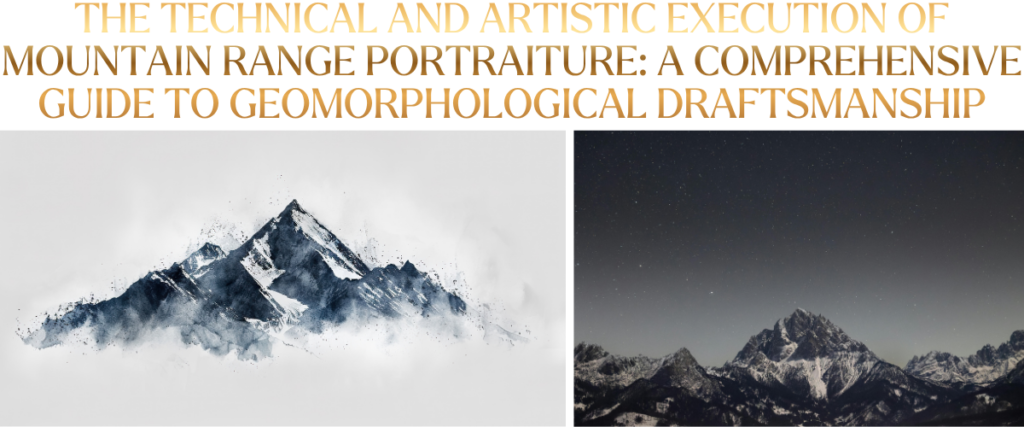
The drawing of mountain ranges represents one of the most compelling challenges in landscape draftsmanship. A successful mountain portrait does not merely replicate a jagged outline; it captures the structural anatomy of the earth, the physical impact of geological erosion, and the optical phenomena dictated by the atmosphere. To render these immense structures with authenticity, an artist must synthesise a firm understanding of three-dimensional geometry, structural geology, and the physics of light. By treating mountains as complex, multi-planed solids rather than flat, triangular silhouettes, the artist can transition from simplistic representation to mature, high-fidelity draftsmanship.
Material Science and Medium Selection
The selection of drawing media directly dictates the range of tonal values, the precision of textures, and the overall longevity of the artwork. A professional landscape portrait requires a carefully calibrated set of tools to execute both the delicate, atmospheric distances and the sharp, tactile details of the foreground.
Graphite and Charcoal Classifications
Graphite pencils are manufactured by blending varying proportions of clay and graphite.1 Harder pencils, designated with the letter “H,” contain more clay and produce light, precise lines, whereas softer pencils, designated with “B,” contain more graphite and produce dark, expressive marks.1 For mountain drawing, a wide range of grades is essential to master the play of light and deep shadow.2 Alternately, charcoal pencils provide an exceptionally versatile and forgiving medium, particularly for field sketching on hikes where lightweight gear is required.3 Charcoal allows for dramatic contrast, rapid value application, and a highly expressive rendering of rocky surfaces.3
| Medium Type | Core Grade/Type | Lead Characteristics | Primary Landscape Application |
| Hard Graphite | 9H to 2H 2 | Hard, pale core; resists smudging and produces fine, precise lines 1 | Mapping layout lines, sketching horizons, and detailing distant ridges 3 |
| Medium Graphite | HB to F 1 | Medium hardness; versatile and easily erased 2 | Underdrawing, intermediate structural contours, and light mid-ground shading 2 |
| Soft Graphite | B to 9B 2 | Soft, dark core; lays down broad, rich strokes and dense blacks 1 | Deep crevice rendering, rocky textures, and heavy foreground shadows 2 |
| Charcoal Pencil | Light, Medium, Dark 3 | Highly friable; easily smudged, layered, and manipulated 3 | High-contrast tonal drawings, atmospheric rendering, and rapid field studies 3 |
| White Charcoal | White chalk/pigment 3 | High opacity; highlights dark or toned papers 3 | Sunlit peaks, reflective snowcaps, and localised glints on rock faces 3 |
Paper Selection and Surface Tooth
The paper’s “tooth”—the microscopic texture of its surface—determines how easily graphite or charcoal is sheared from the drawing tool and held within the fibres.10 Smooth papers, such as hot-pressed watercolour sheets or Bristol board, are exceptional for fine, photorealistic detail and intricate lines.10 However, because they lack physical ridges and valleys, achieving even, dark, and highly layered shading on smooth paper requires specialised blending techniques, such as the stump method.1
Conversely, medium and textured papers, including vellum, cold-pressed watercolour sheets (such as Fabriano rough paper), and specialised sanded papers (such as UART or Clairefontaine Pastelmat), provide an ideal surface for mountain draftsmanship.10 Sanded paper is available in various grits; for instance, a coarse 240-grit paper offers a highly toothy texture that easily grabs soft leads and charcoal, which is exceptionally suited for capturing the rugged grain of mountain rock.14
Textured papers allow for more even, luminescent shading and a greater range of tone because the graphite settles naturally into the paper’s physical pockets.1 For finished, professional works, utilising archival, acid-free, 100% cotton paper is critical to prevent yellowing and degradation over time.10
Erasures and Blending Instruments
The tools used to manipulate and remove graphite are as critical to the rendering process as the pencils themselves.
- Kneaded Erasers: These pliable, putty-like tools do not leave messy residue or damage the paper’s surface.9 An artist can sculpt a kneaded eraser into a sharp pencil point to lift pinpoint highlights, flatten it into a narrow edge to clean up a sharp ridge line, or roll it gently across a shaded area to create soft, graduated tones.8 The eraser is cleaned simply by stretching and folding it, which distributes the lifted graphite particles evenly throughout the putty.8
- Tortillons and Blending Stumps: Although often confused, these tools possess distinct structural differences.4 A tortillon is constructed from a rolled sheet of paper, features a single pointed end, and is hollow inside.4 A blending stump is a solid, tightly wound paper tool with two pointed ends.4 Both are used to smudge, blend, and soften hard pencil strokes, allowing the artist to ease transitions between harsh shadow planes and soft atmospheric regions.4
Geological Foundations and Structural Layout
A convincing mountain drawing requires a firm understanding of structural geology. On a macro scale, mountains are primarily the result of tectonic plates clashing and folding the Earth’s crust, which creates continuous, interconnected mountain crests and ridges.18 Isolated, single peaks are generally characteristic of volcanic activity rather than standard mountain ranges.18 Consequently, mountains should always be drawn as grouped, overlapping, and interconnected structures.5
The Core Baseline and Horizon Line
The drawing begins with the establishment of a light horizon line, which provides spatial orientation.5 Over this, the artist maps a wavy, irregular zig-zag baseline that defines the layout of the range.5
An important geomorphological detail involves the proximity of the mountains to the viewer. Foreground mountains and hills, which are closer, often exhibit rounder, softer contours because soil, weathering, and dense vegetation have smoothed their outlines over time.6 In contrast, background mountains situated far away reveal sharper, more jagged points because their rocky, alpine skeletons are visible above the tree line and are less obscured by immediate local vegetation.19
The Block Construction Method
To translate these complex geological forms into manageable shapes, the artist can utilise the block construction technique.20 This method treats the mountain faces as a series of overlapping blocks.20
The artist always draws the block in the absolute front first.20 The top outline of the block behind it is then initiated directly from the edge of the front block.20 By closing the top line of the rear block, a “closed block” is formed, indicating a distinct, vertical change in depth.20
Alternatively, by leaving the top of the rear block open, a “slant” can be established, which seamlessly merges the block into the surrounding terrain.20 Applying these principles to a general mountain contour allows the artist to build up complex layers of rock that look physically anchored to one another.20
Ridge Development and the Lightning Bolt Technique
The primary ridge line defines the core boundary where different faces of the mountain meet.6
- Primary Ridges: Starting from the apex of each peak, the artist draws a jagged, irregular line down the centre of the mountain face.5 This ridge should slope downward on each side of the peak, defining two major planes: one facing the light source and one facing away.21
- The “Lightning Bolt” Pattern: Using the vertices—the corners and bending points—of the primary centre line, the artist branches out secondary jagged lines.5 These lines should become finer as they move outward or disappear behind other lines.5 The resulting network resembles a lightning bolt, which divides the massive, flat face of the mountain into a detailed system of minor rock formations, ledges, and foothills.5 Small breaks are introduced into these lines to suggest structural shelves and vertical drops.5
Advanced Geomorphological Rendering Techniques
With the structural framework in place, rendering the surface quality of the rock requires a disciplined approach to shading, line quality, and texture.7
Planar Shading and Line Quality
A mountain’s surface is comprised of numerous angled surfaces called planes.7 The boundary between light and shadow falls precisely along the edges where these planes meet.7
To reinforce these planes, the artist must vary the stroke weight—a concept known as line quality.24 Outlines on the side of the mountain receiving direct light should be broken, thin, or entirely omitted.6 Conversely, outlines on the shadowed side must be thick, dark, and bold.24
Furthermore, the shading lines must follow the actual contours of the mountain.6 If the mountain face dips or curves, the shading strokes must dip or curve in the exact same direction.6
Shading Orientation and the Raindrop Trajectory
The orientation of the shading lines across a plane communicates its slope and direction to the viewer.7
- The Raindrop Trajectory: Shading lines should be oriented to show the path a single raindrop would take as it flows across the rock face.7 For vertical cliffs, the shading lines must run straight down.7 For horizontal ledges, paths, or flat plains, the lines must run horizontally.7 For angled, oblique surfaces, the lines must run at a corresponding angle.7
- Background Tones for Weight: To eliminate the distracting, stark white of the paper on shadowed faces, the artist can apply parallel lines horizontally or diagonally to create a uniform background tone.20 This background tone takes away the glare of the paper and immediately gives the mountain a sense of physical heaviness and solid mass.20
Fractures, Wedges, and “Snodgrassing”
Cracks and veins are highly effective at defining rock planes because they are physically forced to bend as they travel across different angled surfaces.7
- Planar Shifting: Every time a crack crosses from one plane to another, the artist must sharply change its angle.7
- “Snodgrassing” (Dark Divots): At the narrow intersections where multiple cracks meet, the rock is highly vulnerable to erosion and often breaks away, leaving deep, dark recessions.7 Illustrators refer to the technique of filling these convergent tips with dense, dark graphite as “snodgrassing”.7 This small detail creates a powerful three-dimensional illusion, making the cracks appear deep and weathered.7
- Light and Shadow Wedges: Along the main ridge where light meets shadow (the terminator zone), the transition should not be a sterile, straight line.7 The artist should draw jagged wedges of shadow that intrude into the highlighted side, and wedges of light that creep into the dark side.7 This interlocking pattern replicates a natural, fractured alpine ridge.7
Texturing Methodologies
To represent the tactile, coarse surface of different rock types, the artist can employ several advanced texturing techniques:
- Frottage: This technique involves placing the drawing paper over a rough, textured surface (such as stone or tree bark) and rubbing a dry medium over it.25 The pencil captures the underlying lumps and bumps, providing an organic, highly realistic base texture for rocky surfaces.25
- Stippling: By applying a series of small dots, the artist can build up highly controlled gradients of value.1 When the dots are placed close together, they create deep shadows; when spaced farther apart, they suggest a lighter, coarse stone texture.2
- Broken Cross-Hatching: Unlike traditional cross-hatching, where lines intersect and overlap to blend tones, broken cross-hatching uses small, non-overlapping sets of parallel lines.25 The artist draws one set of parallel lines, and then places a neighbouring set at a perpendicular angle without letting the lines touch.25 This produces an unpolished, highly fractured texture that is ideal for representing rough, weathered stone.25
Atmospheric Perspective and Tonal Gradation
Atmospheric perspective is the optical phenomenon caused by light scattering as it travels through dust, water vapour, and air molecules.26 This scattering has a profound, predictable effect on how a mountain range appears as it recedes into the distance.26
The Physics of Atmospheric Depth
As mountains move further away from the viewer:
- Value and Contrast Compression: The contrast between the light and shadow sides of the mountain decreases.26 Shadows become lighter, while highlights become darker, with both eventually converging to match the value of the sky at the horizon.26
- Edge Softening: Sharp, jagged edges seen in the foreground become increasingly soft, hazy, and blurred as they recede.27
- Texture Loss: High-frequency details—such as individual cracks, rocks, and trees—completely disappear, leaving behind flat, simplified shapes.27
- Colour Temperature and Hue Shifts: In colored landscapes, shorter wavelengths of light (blue and violet) scatter more than longer wavelengths (red and yellow), causing distant mountains to take on a distinct blue or purple cast.26 This effect is amplified in heavily forested, low-pollution areas, where trees emit volatile organic compounds (VOCs) that create a dense, blue-scattering vapour.29
Environmental Exceptions to Tonal Rules
While the general rule dictates that distant objects become cooler and lighter, specific environmental conditions can alter or completely reverse these transitions 30:
- Sunset and Sunrise: During golden hours, fog, vapour, and clouds reflect the intense, warm light of the sky.19 Consequently, distant mountains will take on the dominant, warm sky colour—such as vibrant oranges, pinks, and purples—rather than standard cool blues.19
- Winter Scenes: In snow-covered landscapes under direct sunlight, the traditional value transition can reverse.30 The snow-covered background mountains near the horizon can appear highly illuminated, warm, and bright as they catch the sun, while the immediate foreground snow and ice in shadow can appear cooler and darker.30
Contextualising Scale with Secondary Elements
A mountain range can appear abstract and lose its sense of grand scale if it is not properly contextualised within the landscape.21 To ground the scene and define the physical proportions of the peaks, the artist must introduce secondary elements such as trees, forests, people, or rustic shacks.6
- Foreground Integration: In the immediate foreground, these elements must be drawn with high detail, rich contrast, and sharp outlines to anchor the viewer’s attention.6
- Background Integration: As these elements recede into the distance, they must be drawn progressively smaller, with a light, sketchy, and simplified quality.6 A tiny, loosely sketched pine tree or cabin positioned at the base of a middle-ground mountain immediately communicates the immense, towering height of the neighbouring peak.6
| Spatial Zone | Contrast Level | Edge Quality | Texture & Detail Level | Scale Elements |
| Foreground | High, deep, rich blacks and crisp whites 6 | Razor-sharp, highly defined outlines 29 | Highly visible cracks, individual stones, and rough bark 6 | Large, highly detailed trees, cabins, and physical figures 6 |
| Middle Ground | Moderate; compressed range of mid-tone greys 20 | Semi-soft; clear structure but no harsh outlines 27 | Moderate; simplified rock planes and major crevices 2 | Small, simplified clusters of trees and basic architectural outlines 6 |
| Background | Extremely Low; light, flat tones merging with the sky 26 | Very soft, hazy, and partially dissolved 27 | Minimal to none; flat, atmospheric shapes 27 | Tiny, sketchy textures representing entire forests or fields 6 |
Practical Step-by-Step Execution Workflow
This structured, six-stage workflow guides the artist through the systematic creation of a multi-layered mountain landscape, ensuring both structural integrity and atmospheric depth.
Step 1: Layout and Horizon Establishment
Using a hard, light pencil (such as a 2H or 4H), the artist lightly sketches a straight horizon line across the paper to serve as a spatial reference.2 Directly over this, the artist maps out a wavy, irregular zig-zag baseline to establish the layout of the entire range.5 Care is taken to vary the height, width, and spacing of the peaks to ensure a natural, organic composition.6
Step 2: Overlapping and Block Construction
Working from the foreground to the background, the artist outlines the individual mountain peaks.2 The closest peaks are drawn with rounder, softer contours to suggest immediate vegetation and weathering.6 The background peaks are drawn with sharp, jagged edges.19 By extending the baselines of the front mountains across the shapes behind them, the artist utilises overlapping to establish clear spatial depth.5
Step 3: Developing Ridges and Planes
From the peak of each mountain, the artist draws a jagged, irregular centre ridge line down the face of the form using an HB pencil.5 Using the “lightning bolt” technique, secondary structural lines are branched off the main ridges.5 This step defines the core geometric planes of the entire range, establishing which side of each mountain faces the sun and which side rests in shadow.5
Step 4: Applying Atmospheric Value Shading
A consistent light source is chosen (for example, the upper right of the composition).5 Using the atmospheric value scale, the artist begins shading the shadow side of each mountain 21:
- The background mountains are shaded with a hard 2H pencil using extremely light pressure to lay down a flat, uniform, pale grey value.2
- The middle ground is shaded with an HB or B pencil to create medium grey values, keeping the shadow transitions soft.2
- The foreground is shaded with a soft 2B or 4B pencil to build rich, dark shadow values, creating strong contrast with the bright, highlighted rock faces.2
Step 5: Rendering Geomorphological Details and Textures
Detailing is applied selectively to reinforce the illusion of depth.27
- In the foreground, the artist uses a sharp HB or B pencil to draw jagged cracks that change angles as they traverse different planes.2 Deep accents of “snodgrassing” are applied to the intersections of these cracks using a soft 4B or 6B pencil.2 Fine scratches and stippled dots are rendered along the terminator zone to represent the rough, tactile surface of the stone.7
- In the middle ground, textures are heavily simplified; only the largest rock fractures are drawn, with softer, less defined strokes.6
- In the background, all textures are omitted to allow the shapes to recede atmospherically.27
Step 6: Highlight Refinement, Blending, and Grounding
The artist evaluates the drawing as a whole.6 A blending stump or tortillon is used to soften harsh transitions in the background and middle ground, reinforcing the atmospheric haze.4 A kneaded eraser, moulded into a fine point, is used to dab and lift clean highlights along the primary ridge lines and sun-exposed peaks of the foreground and middle ground, mimicking reflecting snow or glinting rock faces.6 Finally, deep, rich grounding shadows are applied at the very base of the foreground rocks to anchor them firmly to the earth, giving the entire mountain landscape a sense of immense scale, weight, and stability.7
Conclusion
The successful portraiture of a mountain range demands a balanced integration of structural geometry, geological accuracy, and atmospheric physics. By replacing simplistic triangular silhouettes with multi-planed geometric forms, the artist establishes believable three-dimensional volume. Further, by rendering rock details—such as angled cracks, snodgrassed fractures, and terminator-zone textures—alongside a disciplined application of atmospheric perspective, the artist successfully translates the colossal scale of nature onto a flat sheet of paper. Ultimately, masterly mountain drawing is not about recording every stone, but rather about selectively organising light, shadow, and edge to evoke the majestic spirit of the alpine landscape.
Disclaimer
This article is intended solely for educational and instructional purposes. The artistic techniques, material recommendations, and step-by-step procedures described herein represent traditional methods of draftsmanship and may vary based on individual artistic styles, paper types, and pencil brands. Environmental conditions, natural variations in geology, and unique lighting scenarios may produce visual phenomena that differ from the generalised rules of atmospheric perspective and geomorphological shading outlined in this text. The author and publisher assume no liability for any artistic dissatisfaction or damage to personal drawing materials resulting from the application of these techniques.
References
- How do I choose the right paper for graphite pencils? – Strathmore Artist Papers, accessed on June 9, 2026, https://www.strathmoreartist.com/faq-full/graphite-shading-techniques-and-how-to-select-paper-for-graphite
- Unveiling the Secrets: Discover the Joy of Pencil Drawing Mountains – Full Bloom Club, accessed on June 9, 2026, https://fullbloomclub.net/pencil-drawing-of-mountains/
- Newbie Question re: Graphite Pencils and drawing landscapes while hiking – Reddit, accessed on June 9, 2026, https://www.reddit.com/r/drawing/comments/ziceae/newbie_question_re_graphite_pencils_and_drawing/
- How to use a tortillon in drawing – Quora, accessed on June 9, 2026, https://www.quora.com/How-do-you-use-a-tortillon-in-drawing
- How to draw mountains (easy step by step tutorial) ⛰️ – Dreieck.com, accessed on June 9, 2026, https://dreieck.com/en/drawing/mountains/
- How to Draw a Mountain Landscape Easy – artlooklearn.com – Art Lessons, accessed on June 9, 2026, https://artlooklearn.com/draw-a-mountain-scene/
- How to Draw Rocks • John Muir Laws, accessed on June 9, 2026, https://johnmuirlaws.com/how-to-draw-rocks/
- Kneaded Eraser Techniques: Master Highlights and Blending – Art Noise, accessed on June 9, 2026, https://shop.artnoise.ca/blogs/art-supplies-guides-and-studio-tips/kneaded-eraser-techniques-highlights-blending
- 3 Kneaded Eraser Techniques for Realistic Drawing (Video!), accessed on June 9, 2026, https://www.thedrawingsource.com/kneaded-eraser.html
- The Best Paper for Pencil Art – PaperPapers Blog, accessed on June 9, 2026, https://www.paperpapers.com/news/the-best-paper-for-pencil-art/
- The Best Paper Types for Various Drawing Techniques – Doodlers Anonymous, accessed on June 9, 2026, https://www.doodlersanonymous.com/the-best-paper-types-for-various-drawing-techniques/
- The Best Drawing Paper For Graphite Pencil – Carol’s Drawing Blog – Toad Hollow Studio, accessed on June 9, 2026, https://www.toadhollowstudio.com/wp_blog/best-drawing-paper-for-graphite/
- MOUNTAIN LANDSCAPE Original Graphite Pencil Drawing 9.5″ x 13″ | eBay, accessed on June 9, 2026, https://www.ebay.com/itm/225494508002
- Textured Drawing Papers for Colored Pencils – Carrie L. Lewis, Artist, accessed on June 9, 2026, https://www.carrie-lewis.com/textured-drawing-papers-for-colored-pencils/
- How to use a kneaded eraser – The Weekend Beckons, accessed on June 9, 2026, https://theweekendbeckons.com/how-to-use-a-kneaded-eraser/
- Simple Ways to Use a Kneaded Eraser: 12 Steps (with Pictures) – wikiHow, accessed on June 9, 2026, https://www.wikihow.com/Use-a-Kneaded-Eraser
- How to Draw Mountains with Pencil | Easy Step-by-Step Landscape Tutorial – YouTube, accessed on June 9, 2026, https://www.youtube.com/watch?v=kkHij9wOe5g
- Learn to Draw Mountains and Mountain Landscapes – Art-Class.net, accessed on June 9, 2026, https://www.art-class.net/06-tutorials/landscapes/mountains-rocks.php
- How To Draw A Mountain Landscape – Easy Mountain Range Drawing Tutorial, accessed on June 9, 2026, https://luukminkman.com/en/blog/how-to-draw-a-mountain-landscape/
- How to Draw Mountain – Pen and Ink Drawings by Rahul Jain, accessed on June 9, 2026, https://pendrawings.me/how-to-draw-mountains/
- How to Draw Mountains – A Realistic Mountain Drawing Tutorial, accessed on June 9, 2026, https://artincontext.org/how-to-draw-mountains/
- How to Draw Mountains: Easy Step by Step Tutorial – Shihori Obata, accessed on June 9, 2026, https://www.shihoriobata.com/blog/how-to-draw-mountains/
- How to Draw Rocks and Mountains in a quick Landscape Sketch – Crave Painting, accessed on June 9, 2026, https://cravepainting.com/blog/how-to-draw-rocks-and-mountains
- How to Render Rocks and Stones | Longstride Illustration, accessed on June 9, 2026, https://longstrideillustration.com/how-to-render-rocks-and-stones/
- Techniques for creating drawing texture – Mont Marte, accessed on June 9, 2026, https://www.montmarte.com/blogs/tips-techniques/techniques-for-creating-drawing-texture
- 3 Key Tips for Mastering Atmospheric Perspective – Virtual Art Academy, accessed on June 9, 2026, https://www.virtualartacademy.com/atmospheric-perspective/
- Creating Atmospheric Perspective in Landscape Painting – Irish Artmart, accessed on June 9, 2026, https://irishartmart.ie/creating-atmospheric-perspective-in-landscape-painting/
- How to Paint Atmospheric Perspective – Draw Paint Academy, accessed on June 9, 2026, https://drawpaintacademy.com/atmospheric-perspective/
- The Visual Tools You Need to Create Atmospheric Perspective …, accessed on June 9, 2026, https://www.outdoorpainter.com/visual-tools-need-create-atmospheric-perspective/
- Mastering Aerial Perspective for Believable Landscape Paintings – Lori McNee, accessed on June 9, 2026, https://lorimcnee.com/mastering-aerial-perspective-for-believable-landscape-paintings/