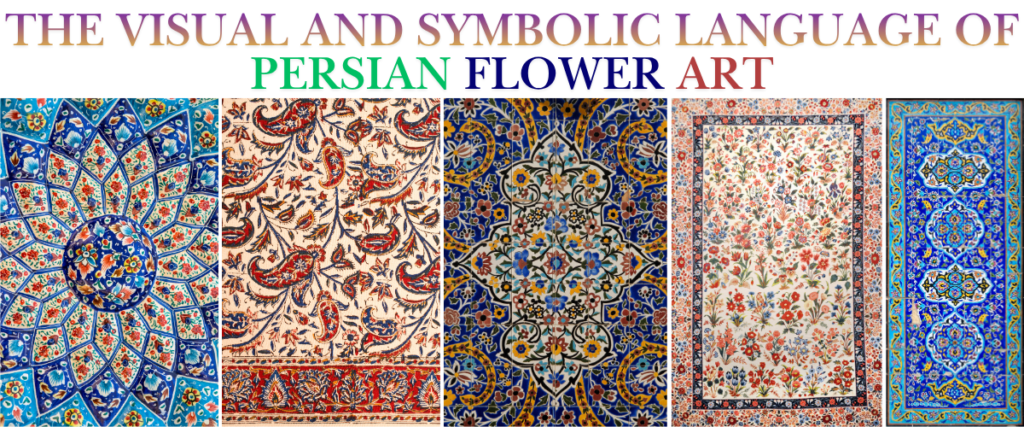
The floral traditions of Persian visual culture represent one of the most sophisticated integrations of aesthetics, philosophy, and botanical symbolism in world art history1. Across millennia, the depiction of flowers in Persia has transcended simple ornamentation, operating as a multi-layered visual language that conveys cosmological order, mystical devotion, political prestige, and poetic metaphor1. From the monumental stone reliefs of the Achaemenid and Sasanian empires to the illuminated manuscripts of the Timurid era, the silk weaving of Safavid looms, and the vibrant tilework of the Qajar period, Persian flower art reflects a continuous dialogue between humanity, nature, and the divine4.
Philosophical and Cosmological Foundations of Persian Floral Aesthetics
To comprehend the evolution of Persian flower art, one must examine the philosophical concept of the garden as an earthly manifestation of paradise3. The English word “paradise” originates directly from the Old Persian term pairi-daeza, which denoted a walled enclosure or protected sanctuary3. In the arid, sun-scorched topography of the Iranian plateau, the creation of an irrigated, enclosed garden (bāgh) was simultaneously a technological achievement and a spiritual act3. The classical Persian garden design, known as the chahār bāgh (fourfold garden), organises spatial geometry through intersecting water channels that divide the landscape into four distinct quadrants4. This spatial structure originally mirrored pre-Islamic Zoroastrian cosmology, which divided the universe into four primary elements: earth, water, wind, and fire8. Following the Islamic conquest of Persia, this layout integrated seamlessly with Qur’anic descriptions of paradise, which depict celestial realms nourished by four flowing rivers of water, milk, wine, and honey4.
Within this conceptual environment, flowers were viewed not as accidental decorative elements, but as physical manifestations of divine order and cosmic grace2. Classical Islamic philosophy in Persia developed the concept of zinat (adornment or beauty), which asserted that visual beauty serves an elevated function: elevating human consciousness and revealing divine attributes through material forms4. Consequently, artistic representations of floral life developed along an intentional axis between naturalistic observation and geometric abstraction1. Artisans sought to portray the inner spiritual reality (bātin) of the botanical subject rather than merely reproducing its temporary external form (zāhir)4.
This intellectual framework permitted floral motifs to move fluidly across varied artistic media4. The same stylised blossoms and scrolling vines carved into Sasanian stucco walls were systematically reinterpreted centuries later within the gilding of sacred manuscripts, the knotting of imperial carpets, and the glazing of architectural monuments4.
The Mystical Symbiosis of Gol-o-Morgh: The Rose and the Nightingale
Among the most celebrated themes in Persian decorative arts is Gol-o-Morgh (flower and bird painting), particularly its central subtheme, Gol-o-Bolbol (the rose and the nightingale)1. While depictions of birds and vegetation existed in pre-Islamic Persian art, the specific genre of Gol-o-Morgh coalesced during the Ilkhanid (1256–1353) and Timurid (1370–1507) periods1. This development occurred through the creative synthesis of imported Chinese huaniao (bird-and-flower) pictorial conventions with native Persian poetic and mystical allegories1.
In classical Persian literature and visual arts, the rose (gol) and the nightingale (bolbol) form an indivisible allegorical pair1. The rose represents the ultimate beloved, possessing flawless beauty and remote perfection while protected by sharp thorns1. The nightingale embodies the passionate lover, the poet, or the yearning human soul (rūh), singing ceaseless songs of devotion, longing, and spiritual intoxication1. Quantitative textual analyses of classical Persian poetry reveal that over sixty percent of lyrical and mystical verses utilise imagery of the rose and nightingale, illustrating its central status in the regional cultural consciousness14.
| Historical Era | Primary Mediums | Stylistic Characteristics | Symbolic Emphasis |
| Ilkhanid & Timurid (14th–15th c.) | Manuscript margins, detached silk scrolls | Chinese-influenced, delicate brushwork, asymmetric compositions | Integration of literary metaphors into text illustrations1 |
| Safavid Dynasty (1501–1722) | Single-sheet miniatures, textiles, mural paintings | Dynamic fluid movement, vibrant polychrome palettes, naturalistic details | Earthly elegance, courtly luxury, and mystical longing1 |
| Zand Dynasty (1750–1794) | Oil paintings, tilework, mirror cases | Balanced compositions, prevalence of the hundred-petaled rose (gol-e sadbarg) | Serenity, tranquillity, and refined decorative harmony5 |
| Qajar Dynasty (1785–1925) | Lacquer pen boxes (qalamdan), vanity boxes, architectural tiles | High density of detail, European shading techniques, rich warm hues | Symbol of national identity, intense romantic devotion, multi-layered mysticism1 |
In Sufi philosophical literature, the Gol-o-Bolbol theme functions as an extended theological metaphor1. Sufi scholars such as Ruzbihan Baqli (1128–1209) interpreted the vibrant red rose as the direct earthly manifestation of Divine Majesty (Jalāl) and Beauty (Jamāl)13. When the nightingale becomes intoxicated by the presence of the rose, its song represents the human soul responding to the primordial divine call13. Visual depictions of the nightingale’s physical posture carry specific spiritual meanings5. A bird painted with open eyes signifies a seeker who remains fully conscious of both the physical universe and spiritual truths, whereas a bird shown with closed eyes indicates a mystic who has closed outward senses to perceive divine light through the inner eye of the mind5. Similarly, depictions of a bird hunting insects or butterflies represent the struggle between spiritual light and material darkness, wherein light consistently prevails5.
During the post-Safavid and Qajar eras, Gol-o-Morgh evolved from manuscript borders into an independent decorative genre1. Lacquerware objects—including pen cases (qalamdan), mirror covers, and reading stands—were decorated with hyper-detailed renderings of roses, irises, and nightingales5. Master artisans such as Luft’Ali Suratgar combined European techniques of volumetric shading with traditional spiritual iconography, establishing a highly refined style that defined nineteenth-century Persian decorative arts5.
Manuscript Illumination and Decorative Geometry: The Art of Tazhib
While Gol-o-Morgh leans toward lyrical narrative, Tazhib represents the geometric structuring of botanical form9. The term Tazhib derives from the Arabic root zahab, meaning gold, and refers specifically to the practice of illuminating manuscripts with gold leaf, mineral pigments, and elaborate floral framing9. Originating in pre-Islamic Sasanian wall plastering and metalwork known as Zarnegari, Tazhib matured within Islamic manuscript traditions as the primary method for embellishing copies of the Qur’an, epic poetry, and royal decrees6. The historical and artistic importance of this practice was globally acknowledged when UNESCO inscribed illumination arts onto the Representative List of the Intangible Cultural Heritage of Humanity16.
Tazhib relies on a systematic visual framework built around stylised botanical elements9. Master illuminators, historically designated as Mozheb, organise patterns into three core categories:
- Naghsh-e Eslami (Arabesque Motifs): Characterised by stylised, spiralling vine structures that split symmetrically into leaf forms and geometric scrolls9. Eslami designs represent the continuous flow of divine life force throughout creation, forming balanced geometric frameworks that enclose calligraphic blocks9.
- Naghsh-e Khatayi (Khatai Botanical Scrolls): Comprising interconnected floral forms, including stylised lotus blossoms, peonies, unopened buds (gonca), and multi-pointed leaves (panch) linked by thin, curving stems9. Khatayi motifs maintain symmetry along individual floral axes while weaving across page margins, symbolising natural movement and vitality9.
- Naghsh-e Tashir (Margin Abstractions): Consisting of expressive decorative brushwork applied to outer page margins, frequently rendered in gold paint9. Tashir integrates stylised flora with figures of real and mythical animals, such as gazelles, lions, and the legendary Simurgh bird, framing the text within an idealised wilderness9.
| Tazhib Component | Primary Visual Elements | Colour Palette & Pigment Sources | Functional Application |
| Gilding (Zarhalkori) | High-purity gold leaf, powdered gold paste | 24k Gold, Silver leaf, Electrum alloys | Highlight focal borders, medallions, and text dividers9 |
| Mineral Pigments | Stylised palmettes, fine outlines | Cinnabar (Shangarf – Red), Lapis Lazuli (Blue), Verdigris (Green) | Create vibrant colour fields within geometric frames9 |
| Plant-Based Dyes | Background washes, soft fills | Walnut husk extract, concentrated tea, saffron, gum Arabic binders | Stain parchment, tone paper, and bind metallic leaf9 |
| Metallic Oxides | Outlines, details, shadow work | Lead tetroxide (Orange), Copper oxide, Zinc white | Provide structural lines and detailed contrast9 |
Executing Tazhib demands extreme technical precision15. Papers were burnished with an agate stone and sized with egg white or starch to produce an imporous surface9. Illuminators then laid out complex geometric grids using dividers and horsehair brushes11. The production peak of Tazhib occurred during the Timurid Renaissance, notably at the court library of Sultan Baysonqor (1397–1433) in Herat, where scribes, painters, and binders produced manuscripts that set standards for the entire Islamic world6.
The Imperial Flora: Safavid Textiles and the Shah Abbasi Motif
During the Safavid Dynasty (1501–1722), Persian floral art expanded significantly in scale, driven by court patronage and international commerce1. Under Shah Abbas I (reigned 1588–1629), who transferred the imperial capital to Isfahan in 1598, state workshops (karkhanehs) were established to produce textiles, carpets, and ceramics for internal use and foreign export7. This period witnessed the development of the Shah Abbasi pattern, one of the most recognised floral motifs in textile history10.
The Shah Abbasi motif is a curvilinear floral palmette derived from stylised lotus and peony blossoms, presented either in profile or as a multi-petaled, radially symmetrical flower10. Unlike the angular motifs typical of nomadic tribal weaving, the Shah Abbasi pattern is entirely curvilinear: every petal, leaf, and stem bends smoothly, linked by scrolling arabesque vines (eslimi)10. In carpet compositions, this design frequently utilises the toranj-o-lachak layout, featuring a prominent central medallion (toranj) representing the divine sun surrounded by a dense field of floral scrollwork, anchored by quarter-medallions in the four corners (lachak)18.
| Motif Name | Primary Visual Form | Typical Layout | Distinctive Visual Identifiers | Key Weaving Centres |
| Shah Abbasi | Multi-petaled palmette blossom based on lotus/peony | Central medallion with corner extensions (toranj-o-lachak) or allover repeat | Curvilinear, symmetrical palmettes connected by thin scrolling vines (eslimi)10 | Isfahan, Kashan, Tabriz, Qum10 |
| Herati | Diamond layout containing a central rosette framed by four curved leaves | Dense, repeating allover field grid | “Fish-like” curved leaves (mahi) surrounding a central floral diamond | Ferahan, Sarouk, Hamadan10 |
| Boteh | Teardrop shape with a curved top point (origin of Paisley) | Repeating offset rows | Isolated, unlinked teardrops filled with internal floral details | Kerman, Yazd, Shiraz10 |
| Gol-e Sadbarg | Dense, hundred-petaled rose depicted in full bloom | Focal clusters, medallion accents | Voluminous, naturalistic rose blooms showing layered petal depth | Shiraz, Sanandaj, Qajar ateliers5 |
Under Safavid economic policy, silk production became a major export commodity managed directly by the crown7. European royal houses, Ottoman dignitaries, and Mughal courts actively imported Persian floral velvets and carpets7. Woven with metallic gold and silver wrapped threads alongside vibrant natural dyes—such as madder root for deep reds, indigo for blues, and pomegranate rinds for yellows—these textiles established a luxurious visual language that influenced global textile production for centuries7.
Architectural Bloom: Floral Tilework from Isfahan to Shiraz
The floral motifs refined in manuscript painting and carpet design were adapted to architectural surfaces through glazed tilework (Kāshi Kāri)7. Architectural tile decoration served both practical and expressive roles: protecting mudbrick structures from seasonal weathering while transforming solid walls into shimmering representations of paradise4.
The historical evolution of Persian floral tilework displays marked shifts in execution, colour, and composition:
- Safavid Mosaic Tilework (Kāshi-ye Mo’arraq): Dominant in the sixteenth and seventeenth centuries, this technique involved firing single-colour glazed tiles, cutting them into small floral and arabesque pieces, and assembling them like precise puzzles7. The Sheikh Lotfollah Mosque (built 1603–1619) in Isfahan exemplifies this method23. Its dome features beige and turquoise floral arabesques that scale down toward the centre, creating an optical illusion of celestial height23.
- Qajar Seven-Color Tiles (Kāshi-ye Haft Rang): Gaining prominence in the eighteenth and nineteenth centuries, this technique involved painting complex floral compositions directly onto square white tiles before firing22. This allowed for smooth colour transitions, complex painterly detail, and faster production22.
The pinnacle of Qajar floral tilework is found at the Nasir al-Mulk Mosque (the Pink Mosque) in Shiraz22. Designed by architects Mohammad Hasan-e-Memār and Mohammad Reza Kāshi-Sāz and completed in 1888, the mosque breaks from traditional blue palettes by utilising rose-pink (gol-e mohammadi), magenta, yellow, and iris-purple glazes22. The interior walls and stalactite vaults (muqarnas) are covered in depictions of blooming roses and nightingales22. When morning sunlight filters through the stained-glass windows (orosi) of the prayer hall, it casts colourful patterns across the tiled surfaces and carpets, creating an immersive play of light and floral form22.
Botanical Lexicon and Mythological Symbolism in Persian Culture
Beyond their collective role in garden compositions, individual flowers carry distinct symbolic associations in Persian literature, mythology, and visual arts2. Understanding this botanical lexicon allows for a deeper reading of Persian decorative programs3.
| Flower Name | Primary Symbolic Meaning | Cultural & Literary Context |
| Rose (Gol) | Perfection, divine beauty, impermanence, spiritual love | Associated with the Prophet’s night journey (Mi’raj) and Saadi’s Golestan[cite: 2, 25] |
| Tulip (Laleh) | Perfect love, martyrdom, sacrifice, divine presence | Originates in the legend of Farhad and Shirin; shares root letters with Allah[cite: 2, 25, 26] |
| Narcissus (Narges) | Beloved’s eyes, self-contemplation, spring renewal | Symbolises languid beauty and early spring awakening in classical poetry2 |
| Lotus (Niloofar) | Rebirth, purity, eternity, royal nobility | Appears in pre-Islamic Sasanian reliefs; served as the basis for the Shah Abbasi motif3 |
| Cypress (Sarv) | Uprightness, eternity, endurance, connection to heaven | Evergreen tree featured alongside floral borders in gardens and rugs3 |
The rose (gol) holds supreme status as the national floral emblem of historic Persia1. The Damask rose (Rosa damascena) in particular represents divine perfection, the beauty of the beloved, and the briefness of worldly existence1. In Sufi traditions, the rose’s fragrance is considered a spiritual blessing (baraka)2. Saadi’s literary work Golestan (The Rose Garden) uses the growth and decay of a rose garden to communicate moral and philosophical lessons2.
The tulip (laleh) holds a powerful position in Persian symbolism, second only to the rose2. Wild red tulips blooming across the plateau were traditionally said to spring from the blood of fallen heroes who sacrificed themselves for truth and love2. This connection made the tulip an emblem of ultimate devotion2. In Persian Sufism, the word laleh (لاله) holds deep mystical value: when written in Arabic script, it uses the exact same letters as Allah (الله), leading mystics to view the tulip as a direct reflection of divine presence2.
The narcissus (narges) is connected to the eyes of the beloved in classical poetry2. Its drooping stem suggests languid eyes focused inward in self-contemplation3. As an early spring bloom, it also signifies rebirth and the renewal of life3. The lotus (niloofar), an ancient symbol carved into the stone monuments of Persepolis, represents purity and rebirth because it emerges clean from muddy waters to open toward the sun3.
Contemporary Reinterpretations and Subversions of Floral Motifs
In modern and contemporary Iranian art, artists have re-examined classical floral motifs—especially Gol-o-Morgh—transforming decorative patterns into powerful tools for socio-political critique and cultural commentary28. Rather than treating historical themes purely as nostalgic craft, contemporary creators utilise floral forms to explore identity, historical trauma, and modern social realities28.
Contemporary artistic approaches recontextualise traditional motifs across several distinct themes:
- Formal Reinterpretation: Farshid Mesghali creates abstract sculptures and paintings that rework the fluid lines of Gol-o-Bolbol into modern geometric forms, while Ladan Broujerdi applies traditional illumination patterns to pop objects to highlight tensions between historical heritage and globalised consumer culture28.
- Ideological Critique: Rasool Soltani incorporates the Gol-o-Bolbol pattern into political commentary, placing traditional floral backdrops behind figures such as an Iranianized, bearded Superman or pairing them with public slogans to critique societal contradictions28.
- War and Memory: In Childhood of Jamshid, artist Sharafjahan embroider delicate Gol-o-Bolbol roses directly onto archival photographs of child soldiers from the Iran-Iraq War28. The juxtaposition of fragile floral beauty with military conflict highlights the impermanence of youth and the human cost of war28.
- Psychological Abstraction: Dariush Hosseini paints large abstract canvases where birds and flowers appear in states of structural decay28. His birds are rendered in dark, bat-like silhouettes, and his roses are uprooted, capturing feelings of vulnerability and environmental tension28.
Through these modern interventions, Persian flower art remains an active, evolving aesthetic system28. By adapting a decorative language originally developed for royal courts and illuminated manuscripts, contemporary artists continue to use floral motifs to comment on the complexities of modern society28.
Conclusion
Persian flower art represents a continuous visual tradition that seamlessly connects technical skill, natural observation, and spiritual philosophy1. Whether expressed through the geometric structure of manuscript illumination (Tazhib), the flowing silk weaves of Safavid carpets, the vibrant glazes of Qajar architectural tilework, or modern contemporary art, the depiction of flowers in Persia extends far beyond simple ornament5. Botanical forms have provided a persistent cultural language through which Persian artists have expressed divine order, celebrated earthly life, and reflected upon the human condition across centuries1.
Disclaimer
This article is presented strictly for educational, historical, and cultural research purposes. Analysis of historical art movements, architectural monuments, and cultural symbolism is derived from published art historical scholarship and classical literary sources.
References
- GOL O BOLBOL – Encyclopaedia Iranica, https://www.iranicaonline.org/articles/gol-o-bolbol/
- Flowers in Persian Mythology Throughout History – La Rose Florist, https://larose-florist.com/blog/2025/11/23/flowers-in-persian-mythology-throughout-history/
- Flowers in Ancient Persia: Culture, Cultivation, and Trade – Comma Blooms Florist, https://commablooms.com/blog/2025/12/05/flowers-in-ancient-persia-culture-cultivation-and-trade/
- A Guide to Flower Depiction in Persian Art: Gardens of Paradise and the Language of Beauty – Magenta Florist, https://magenta-florist.com/blog/2025/11/18/a-guide-to-flower-depiction-in-persian-art-gardens-of-paradise-and-the-language-of-beauty/
- Persian Rose-and-Nightingale Paintings – World History Encyclopedia, https://www.worldhistory.org/Persian_Rose-and-Nightingale_Paintings/
- Tazhib (Illuminated Manuscript) – Cultural Institute, https://en.irancultura.it/manuscript-illuminated-tazhib/
- Falcons and Flowers: Safavid Persian Textile Arts – UNL Digital Commons, https://digitalcommons.unl.edu/cgi/viewcontent.cgi?article=1045&context=textileresearch
- Beauty & Artistry in Iran | Persian Garden & Mosaic Tiles Odyssey Traveller, https://www.odysseytraveller.com/articles/persian-garden-and-persian-mosaic-tiles/
- Read All About Persian Illuminated Manuscript – Irandoostan, https://irandoostan.com/persian-illuminated-manuscript/
- Shah Abbasi Pattern History – RugIndustry, https://rugindustry.com/learn/history/shah-abbasi-pattern-history/
- TAZHIB (Gilding Or Illuminated Manuscript ) – Sermeh, https://sermeh.net/blog/tazhib-gilding/
- Meaning of the Nightingale (Bolbol) in Persian Culture – TŪTĒ Gifts, https://tutegifts.com/blogs/persian-gifts-inspirations/meaning-nightingale-bolbol-persian-culture
- BIRD SYMBOLISM IN PERSIAN MYSTICISM POETRY – ScholarHub UI, https://scholarhub.ui.ac.id/cgi/viewcontent.cgi?article=1227&context=irhs
- (PDF) The Rose and the Nightingale in Persian Art – Academia.edu, https://www.academia.edu/35622497/The_Rose_and_the_Nightingale_in_Persian_Art
- Islamic Manuscript Illumination | Deen Arts Foundation, https://deenartsfoundation.org/services/islamic-manuscript-illumination/
- Art of illumination: Təzhib/Tazhib/Zarhalkori/Tezhip/Naqqoshlik – UNESCO Intangible Cultural Heritage, https://ich.unesco.org/en/RL/art-of-illumination-tzhib-tazhib-zarhalkori-tezhip-naqqoshlik-01981
- Ottoman illumination – Wikipedia, https://en.wikipedia.org/wiki/Ottoman_illumination
- Shah Abbasi – Premium Persian Carpets, https://premiumpersian.co.za/shah-abbasi/
- Shah Abbasi Design – Persis Collection, https://www.persiscollection.com/shah-abbasi-design/
- Shah Abbas Rug Design And Great Persian Safavid Empire Ruler, https://nazmiyalantiquerugs.com/blog/shah-abbas-rug-design-and-great-persian-safavid-empire-ruler/
- Shah Abbasi Carpets | carpetworld, https://carpetworld.be/2025/04/26/shah-abbasi-carpets/
- Nasir al-Molk (Pink) Mosque, Shiraz | History & Architecture – NiluTours Iran Tour Operator, https://nilutours.com/blog/nasir-al-molk-mosque-shiraz/
- Shiraz Iran Tiles royalty-free images – Shutterstock, https://www.shutterstock.com/search/shiraz-iran-tiles
- Persian pattern hi-res stock photography and images – Alamy, https://www.alamy.com/stock-photo/persian-pattern.html?pseudoid=609E06B9-2B85-41D7-B623-FC750DBD812D
- A Guide to Flowers in Persian Culture – M Florist, https://mflorist.hk/floral-journal/a-guide-to-flowers-in-persian-culture
- Language of Flowers: Symbolism of Roses, Tulips & More | Pink Clover, https://pinkcloverflorist.com/blogs/flower-tips/the-language-of-flowers-symbolism-of-tulips-roses-and-more
- Flower and Plant Symbolism of Persian Rugs | Common Motifs, https://idinorientalrugs.com/symbolism-of-persian-rugs/
- The Rose and the Nightingale: A Persian Iconography – JAMM ART, https://jamm-art.com/media/36888/the-rose-and-the-nightingale-press-release.pdf