The Sovereignty of Stone: A Multi-Dimensional Analysis of Uluru-Kata Tjuta National Park

The Sovereignty of Stone: A Multi-Dimensional Analysis of Uluru-Kata Tjuta National Park

The Australian interior is defined by a landscape of profound antiquity, where the geological record and human cultural memory converge in a manner found in few other places on Earth. Uluru-Kata Tjuta National Park, a 1,326-square-kilometre sanctuary in the southwestern corner of the Northern Territory, serves as the primary custodian of this intersection. Recognised globally through its dual UNESCO World Heritage listing—achieved for natural values in 1987 and as a cultural landscape in 1994—the park represents more than a collection of iconic landforms; it is a living entity managed through a sophisticated partnership between the Anangu Traditional Owners and the Australian Government.

The Sovereignty of Stone: A Multi-Dimensional Analysis of Uluru-Kata Tjuta National Park Read More »

Comprehensive Botanical, Nutritional, and Therapeutic Analysis of Stone Fruits: A Review of the Drupe Classification

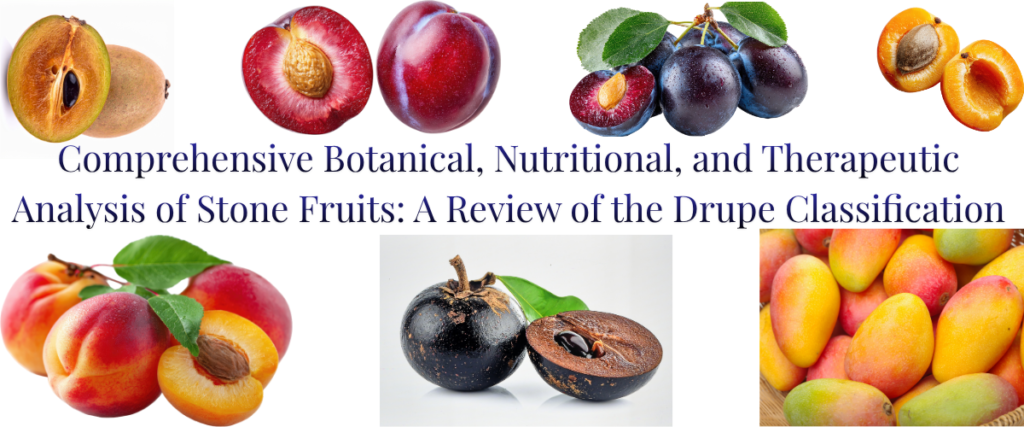
Comprehensive Botanical, Nutritional, and Therapeutic Analysis of Stone Fruits: A Review of the Drupe Classification

The classification of stone fruits, known in botanical discourse as drupes, represents a diverse group of angiosperms that play a fundamental role in human nutrition, agricultural economics, and therapeutic medicine. A drupe is defined as a simple fleshy fruit that typically contains a single seed, derived from a single ovary of an individual flower. The architectural hallmark of the drupe is its three-layered pericarp structure: the exocarp, which forms the outer skin or peel; the mesocarp, the thick and often succulent edible portion; and the endocarp, a lignified, stony interior that serves as a protective vessel for the reproductive kernel. This evolutionary strategy—the encapsulation of a vulnerable seed within a hardened shell, which is in turn surrounded by a nutrient-dense and attractive flesh—facilitates seed dissemination by animals while ensuring the seed survives the transit through digestive tracts.

Comprehensive Botanical, Nutritional, and Therapeutic Analysis of Stone Fruits: A Review of the Drupe Classification Read More »

Information-Technology-Industry

The Global Information Technology State of Play: Weekly Review Ending 1 May 2026

The global IT industry has entered an “Agentic Reality” driven by autonomous frontier models like GPT-5.5 and rapid military AI adoption. Concurrently, the semiconductor market faces intense “memflation” from explosive AI demand, as escalating insider cyber breaches expose critical security vulnerabilities within major Australian state government networks and commercial ecosystems.

The Global Information Technology State of Play: Weekly Review Ending 1 May 2026 Read More »

Weekly-Financial-Review-

Global Capital Markets and Geopolitical Fragility: An Analysis of the Week Ending 1 May 2026

In early May 2026, global financial markets exhibited a stark “K-shaped” divergence. United States equities achieved record highs, fueled by an AI capital expenditure boom and resilient corporate earnings. Conversely, energy-dependent European and Asian regions struggled with supply-driven inflation and the unresolved Strait of Hormuz blockade.

Global Capital Markets and Geopolitical Fragility: An Analysis of the Week Ending 1 May 2026 Read More »

The Alchemy of Imperfection: A Master-Level Treatise on Kintsugi Portraiture on Canvas

The Alchemy of Imperfection: A Master-Level Treatise on Kintsugi Portraiture on Canvas

The emergence of kintsugi as a prominent aesthetic in contemporary mixed-media portraiture represents a significant philosophical and technical departure from traditional Western notions of restoration. While the origins of the craft are found in the repair of 15th-century Japanese ceramics, its application to the two-dimensional canvas offers a profound metaphor for the human condition. Kintsugi, translated as “golden joinery,” is not merely a method of fixing what is broken but a disciplined practice of celebrating the history of an object—or in the case of portraiture, the history of a person—through the illumination of its fractures. This analysis explores the transition of kintsugi from a ceramic repair technique to a sophisticated medium for portraiture, detailing the materials, methodologies, and psychological implications of the golden seam.

The Alchemy of Imperfection: A Master-Level Treatise on Kintsugi Portraiture on Canvas Read More »

The Alchemy of Imperfection: A Comprehensive Analysis of Kintsugi Art, Philosophy, and Technical Methodology

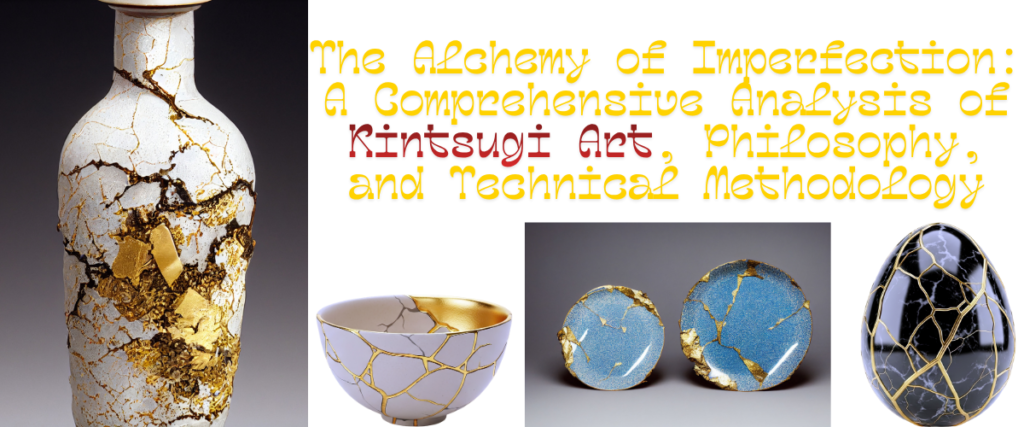
The Alchemy of Imperfection: A Comprehensive Analysis of Kintsugi Art, Philosophy, and Technical Methodology

The Japanese art of Kintsugi, often translated as “golden joinery,” represents a profound departure from conventional Western approaches to restoration and material conservation. While the prevailing ethos of many global restoration traditions seeks to erase the evidence of damage and return an object to a state of pristine, pre-fractured perfection, Kintsugi embraces the break as a pivotal moment in an object’s biography. By utilising urushi lacquer mixed with powdered precious metals—most commonly gold, but also silver or platinum—this technique illuminates the scars of existence, transforming a once-broken vessel into a unique masterpiece that possesses greater aesthetic and historical value than the original, undamaged piece. This meticulous practice, which treats breakage and repair as an essential part of an object’s history rather than something to be disguised, is deeply intertwined with the Japanese worldview, bridging the gap between functional craft and metaphysical contemplation.

The Alchemy of Imperfection: A Comprehensive Analysis of Kintsugi Art, Philosophy, and Technical Methodology Read More »

Scroll to Top