
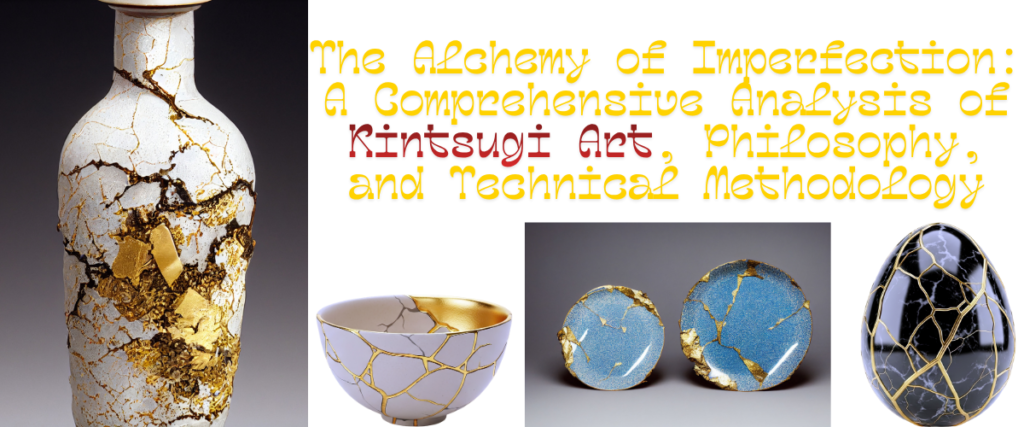
The Japanese art of Kintsugi, often translated as “golden joinery,” represents a profound departure from conventional Western approaches to restoration and material conservation.1 While the prevailing ethos of many global restoration traditions seeks to erase the evidence of damage and return an object to a state of pristine, pre-fractured perfection, Kintsugi embraces the break as a pivotal moment in an object’s biography.2 By utilising urushi lacquer mixed with powdered precious metals—most commonly gold, but also silver or platinum—this technique illuminates the scars of existence, transforming a once-broken vessel into a unique masterpiece that possesses greater aesthetic and historical value than the original, undamaged piece.1 This meticulous practice, which treats breakage and repair as an essential part of an object’s history rather than something to be disguised, is deeply intertwined with the Japanese worldview, bridging the gap between functional craft and metaphysical contemplation.2
The Historical Evolution of Golden Repair
The historical origins of Kintsugi are inextricably linked to the Muromachi period (1336–1573), a formative era in Japanese cultural history characterised by the flourishing of Zen Buddhism and the formalisation of the tea ceremony.1 While the use of urushi—the sap of the lacquer tree—for basic repairs can be traced back thousands of years to the Jomon period, the specific aesthetic elevation of these repairs into the “golden” form known today is rooted in the 15th-century court of Shogun Ashikaga Yoshimasa.7
The seminal legend of Kintsugi begins with Yoshimasa sending a cherished Chinese tea bowl back to its country of origin for repair after it was broken.4 In this period, the common method for ceramic repair in China and Europe involved the use of metal staples—small, bridge-like clamps drilled into the ceramic to hold shards together.1 When the bowl was returned to Yoshimasa, it was functional but aesthetically jarring, marred by bulky and unsightly metal staples that disrupted the delicate harmony of the vessel.1 Dismayed by this utilitarian solution, the Shogun commissioned Japanese craftsmen to develop a more elegant means of restoration.1
The craftsmen turned to the existing tradition of urushi lacquerware, a craft with over 9,000 years of history in Japan.9 By using lacquer as an adhesive and finishing the mend with powdered gold, they created a repair that echoed the spiritual and aesthetic values of the burgeoning Higashiyama culture.8 One of the most famous tea bowls from this era, known as “Bakohan” (meaning “locust clamp”) due to the appearance of its original Chinese staple repairs, served as a catalyst for this movement.8 Although the Bakohan itself was not initially repaired with gold, the quest for a superior alternative to its “ugly” staples led directly to the birth of modern Kintsugi.8 Today, the Bakohan bowl is housed in the Tokyo National Museum, designated as an important cultural object.8
During the subsequent Edo period (1603–1868), Kintsugi expanded beyond the elite circles of Shoguns and tea masters to samurai households, wealthy merchants, and common artisans.1 This expansion was driven by a growing desire to preserve valuable or sentimental objects amid a culture that increasingly valued resourcefulness and the “quiet elegance” shaped by time.1 The practice became so revered that historical accounts even suggest some collectors would intentionally break high-quality pottery just to have it repaired with gold, reflecting a paradoxical shift where destruction became a prerequisite for ultimate beauty.5
Philosophical Foundations: The Ethics of Wabi-Sabi, Mottainai, and Mushin
To understand Kintsugi as more than a technical repair method, one must examine the philosophical framework that informs its practice. It is the physical manifestation of several core Japanese concepts that celebrate transience, imperfection, and the ethical use of resources.2
Wabi-Sabi: The Appreciation of Impermanence
The primary aesthetic driver of Kintsugi is wabi-sabi, a worldview rooted in Zen Buddhism that finds beauty in the imperfect, the impermanent, and the incomplete.1 Wabi-sabi draws inspiration from the “Three Marks of Existence”—impermanence (mujo), suffering (ku), and non-self (ku).10 In the context of pottery, this means that a fracture is not a failure but a site of revelation.4 The gold seams do not hide the break; they illuminate it, honouring the object’s survival and its “individual” history.1
| Philosophical Concept | Definition in Kintsugi Context | Aesthetic Application |
| Wabi | Finding beauty in simplicity and asymmetry. | The unforced, natural path of a crack across a bowl.10 |
| Sabi | Appreciating the beauty of natural aging and wear. | The patina on the lacquer and the dulling of gold over time.1 |
| Mono no Aware | A compassionate sensitivity to the fleeting nature of things. | The emotional poignancy felt when viewing a shattered and restored object.2 |
Mottainai: The Spirit of Resourcefulness
The second pillar, mottainai, is a Japanese term expressing regret at waste.2 It reflects an ancient belief that every object has an essence or soul, and to discard it when it is still capable of being useful is a form of disrespect.5 Kintsugi transforms the relationship with breakage from one of loss into one of joy, promoting a “sustainable art” form that finds value in revitalising discarded items.5 This ethos has evolved into modern “Eco-Kintsugi,” where practitioners upcycle pottery damaged during production or natural disasters like earthquakes to create new heirlooms.5
Mushin: The State of Equanimity
Mushin, often translated as “no-mind,” refers to a state of mental flow and non-attachment amid changing conditions.2 In Kintsugi, this encompasses the acceptance of fate and change as inherent aspects of human life.6 When an object breaks, the owner practices mushin by accepting the new reality without angst, allowing the artisan to “reconnect” the fragments in a way that reflects this newfound equanimity.2
The Materiality of Urushi: The “Living Diva” of Lacquer
The technical success of traditional Kintsugi relies almost exclusively on urushi, a natural lacquer refined from the sap of the lacquer tree (Toxicodendron vernicifluum).8 Urushi is a unique biological substance; unlike Western paints that dry through the evaporation of solvents, urushi cures through a chemical process of polymerisation triggered by humidity and temperature.7
The Chemical and Biological Nature of Lacquer
Urushi is often referred to by artisans as a “living diva” because of its sensitivity to the environment and its volatile chemical makeup.15 The primary active component is urushiol, an oily compound that is also found in poison ivy and poison oak.16
| Material Property | Description and Impact on Craft |
| Hardeners | Cures only in high humidity (70-80%) and warmth (20-30°C).7 |
| Allergenic | Raw urushi causes a severe, itchy rash known as urushi dermatitis.17 |
| Durability | Once cured, it is resistant to heat, alcohol, acids, and water.9 |
| Food Safety | Fully polymerised urushi is non-toxic and traditionally used for tableware.3 |
Because of the risk of dermatitis, practitioners must wear protective rubber gloves and long sleeves.16 People with allergies to mangoes are particularly susceptible to urushi reactions, as the plants belong to the same botanical family.17 Despite these hazards, urushi has been favoured for centuries because it creates a bond that is both flexible and incredibly strong, allowing ceramics to withstand daily use.9
The Technical Execution: A Step-by-Step Methodology
The traditional Kintsugi process is a slow, multi-stage endeavour that can take months to complete, as each layer of lacquer must be allowed to cure properly before the next stage begins.7 The following methodology outlines the rigorous standards required for authentic restoration.
Preparation and Priming
The initial stage involves cleaning the shards to remove any residual oils or previous repair materials.19 For porous earthenware, the broken edges are often “sized” or sealed with a thin coat of raw urushi (ki-urushi) to prevent the adhesive from being absorbed too deeply into the clay body.15 Masking tape is frequently applied around the cracks to protect the original glaze from stray lacquer.23
Adhesion: The Role of Mugi-Urushi
To bond the shards, the artisan creates a mixture known as mugi-urushi.23 This is a “barley lacquer” made by combining wheat flour with water to create a sticky dough, which is then mixed with raw urushi in a 1:1 ratio.23 This mixture serves as a powerful natural glue. Once the pieces are joined and held in place with rubber bands or tape, they are placed in a muro—a humidified wooden cabinet—to cure for several days.23
Filling and Levelling: Sabi-Urushi and Kokuso
After the shards are securely bonded, any remaining gaps or missing pieces must be addressed. Small fissures are filled with sabi-urushi, a fine putty made of raw urushi and tonoko (powdered clay or stone).23 For larger chips or missing fragments, the artisan uses kokuso, a coarser putty made of lacquer mixed with rice flour, wood dust, and sometimes hemp fibres.11 These areas must also be cured in the muro and then sanded smooth using specialised materials like magnolia charcoal or waterproof sandpaper (600–1500 grit).15
Finishing and Decoration: The Maki-e Technique
The final aesthetic layer involves the application of nakanuri, or intermediate layers of refined lacquer.15 For a gold finish, a final thin layer of red bengara-urushi is painted onto the repair line.22 This red base provides a warm glow that enhances the appearance of the gold powder.23
When this layer reaches a specific level of tackiness, the artisan applies the metal powder.23 This is done using a mawata (silk cotton ball) or an ashirai kebo (a soft horsehair brush) to delicately dust the gold over the lacquer.24
| Metallic Finishing Options | Purity and Use Case |
| Pure Gold (23K–24K) | Highest value, food-safe, classic bright lustre.11 |
| Silver Powder | Used for gintsugi; offers a subtler, cooler elegance.1 |
| Platinum Powder | Extremely durable and high-value; modern luxury application.1 |
| Brass/Bronze Powder | Affordable; primarily used for practising or decorative items (not food-safe).9 |
Specialised Tooling in the Lacquer Tradition
The precision of Kintsugi is facilitated by a set of specialised tools, many of which are handcrafted from natural materials to interact harmoniously with the volatile urushi.27
- Hera (Spatulas): Traditionally made from Japanese cypress (hinoki) or bamboo, these spatulas are used for mixing lacquer and applying putty.27 Wood is preferred over plastic because it is more flexible and can be shaped by the artisan to fit specific repair geometries.27
- Fude (Brushes): Kintsugi utilises various round and flat brushes (hira fude).28 The finest detail brushes were historically made from cat or rabbit hair, although modern synthetics are now common in some regions.15
- Funzutsu (Sieve Tubes): Small bamboo tubes with a fine mesh on one end used to tap powdered gold evenly over the repair lines.28
- Muro/Furo (Curing Cabinet): Perhaps the most critical “tool,” this wooden box is used to control the humidity and temperature necessary for the chemical curing of the lacquer.19
- Polishing Stones and Charcoal: Specialised charcoals like sumi togi (magnolia charcoal) and whetstones of varying grits are used to achieve the perfectly flush, mirror-like finish of the repair.15
Comparative Analysis: Traditional vs. Modern Methodologies
The global popularity of Kintsugi has led to the proliferation of “modern” or “simplified” versions, which often rely on synthetic materials rather than traditional lacquer.7 This shift has created significant differences in the safety, durability, and cultural authenticity of the resulting pieces.7
| Feature | Traditional Urushi Kintsugi | Modern Epoxy Kintsugi |
| Binding Agent | Natural tree sap (Urushi) 9 | Synthetic Epoxy Resin 7 |
| Timeframe | 2 to 6 months 14 | 1 to 10 days 7 |
| Safety | Food-safe once fully cured 3 | Generally NOT food-safe 3 |
| Heat Resistance | Up to 95°C (Boiling) 3 | Poor; may soften or leach chemicals 9 |
| Curing Process | Polymerisation in high humidity 7 | Chemical reaction at room temperature 7 |
| Market Cost | High (Labour and material intensive) 7 | Low (Accessible DIY kits) 7 |
Modern kintsugi kits typically include epoxy mixed with gold-colored mica or brass powder.20 While these are excellent for beginners and decorative objects, they do not possess the “lineage” of traditional craft and are strictly prohibited for items that come into contact with the mouth.3
Kintsugi as a Psychological Paradigm for Resilience
In the 21st century, Kintsugi has transcended its origins as a ceramic repair technique to become a global emblem for emotional healing and trauma recovery.30 It offers a powerful framework for addressing mental health challenges by re-authoring the narrative of suffering.30
The Rejection of the “Humpty Dumpty Rule”
Conventional psychological paradigms often suggest that trauma causes “irreparable harm,” a concept referred to by some practitioners as the “Humpty Dumpty Rule,” where what is broken can never be put back together.34 Kintsugi provides a radical alternative by demonstrating that renewal is possible and that the repaired state can be stronger than the original.6 This is scientifically supported by the concept of Post-Traumatic Growth (PTG), where individuals report higher levels of life appreciation and personal strength following moderate levels of adversity.30
Therapeutic Applications
Mental health professionals increasingly use Kintsugi as a metaphor to reduce shame and increase self-compassion.30 The “golden seams” represent the wisdom, resilience, and support systems used to mend the fractured self.30
- Cracks as History: Challenges like depression or burnout are not signs of weakness but chapters in a larger story.30
- Integrating Damage: Healing is not about erasing the past but integrating it into a “more resilient whole”.30
- Accepting Imperfection: By embracing one’s “brokenness,” an individual can let go of unrealistic perfectionist expectations, which are known risk factors for anxiety.5
Preservation and Maintenance of Repaired Wares
Kintsugi-repaired vessels are delicate artworks that require specific care to maintain their structural integrity and the lustre of the precious metal finish.7
The 6 Golden Rules of Aftercare
- Aging Period: A newly repaired item should be allowed to age in an enclosed environment for at least one month before being used for food or tea, as the lacquer continues to harden over time.19
- No Microwave or Dishwasher: The presence of gold powder makes the items unsafe for microwaves.3 High heat and aggressive detergents in dishwashers will erode the lacquer and tarnish the gold.37
- Hand Washing Only: Use a soft sponge and warm, soapy water. Avoid abrasive metal sponges or vegetable-fibre brushes, which can scratch the finish.19
- Temperature Stability: Avoid thermal shock. Do not take an object directly from the refrigerator and fill it with boiling water, as sudden expansion can cause the mend to fail.19
- No Prolonged Soaking: Do not submerge Kintsugi pieces in water for extended periods. Moisture can eventually penetrate micro-fissures and weaken the bond.19
- Structural Handling: If a handle has been repaired, do not lift the vessel solely by the handle.19 The joint, while strong, may not restore the original structural resilience of the ceramic.7
Specialised Tool Maintenance for Artisans
For those practising the craft, tool care is equally vital. Urushi-coated spatulas and workbenches should be cleaned with ethanol (ideally 100% anhydrous).39 Brushes used for urushi must be washed with vegetable oil (like rapeseed oil) and then wiped clean with ethanol-soaked tissues to prevent the lacquer from hardening at the tip.19 Brushes used for gold powder (ashirai brushes) should never be oiled, as the residue will interfere with their ability to pick up fine metal particles.39
The Future of Kintsugi: Sustainability and Cultural Exchange
In the modern era, Kintsugi is experiencing a revival driven by the global move toward sustainability and ethical consumption.5 In 2020, initiatives like The Kintsugi Labo JAPAN were launched to combat the high rate of ceramic waste by reviving discarded vessels from kilns and wholesalers.8 This “Eco-Kintsugi” model aligns with contemporary environmental values while preserving traditional craftsmanship.5
Furthermore, Kintsugi is increasingly used as a symbol of international friendship and cultural diplomacy.8 Artistic collaborations and jewellery lines inspired by kintsugi philosophies—such as those by New York designer George Inaki Root—have introduced the aesthetic to the global fashion and design markets.2 As society moves away from “fast” consumption, the slow, meaningful rhythm of Kintsugi repair offers a compelling alternative that honours the objects we own and the lives we lead.
Conclusion
Kintsugi is far more than an ancient technique for mending broken pottery; it is a profound philosophical statement on the nature of value, resilience, and existence.2 By choosing to highlight fractures with gold rather than hiding them, this art form challenges the modern obsession with perfection and the disposable nature of our material world.5 It teaches that there is a quiet, luminous beauty in things that have been broken and survived—a beauty that is unattainable without the experience of damage.4 Whether applied to a 15th-century tea bowl or used as a framework for human emotional recovery, Kintsugi reminds us that our “cracks” and “scars” are not signs of failure, but rather the golden seams that hold our unique history together.1
Disclaimer
This article is intended for educational purposes. Traditional Kintsugi involves the use of raw urushi lacquer, which contains urushiol. Direct contact with wet urushi can cause severe allergic reactions (urushi dermatitis). Always use appropriate protective gear, such as rubber gloves and long-sleeved clothing, when handling lacquer. Modern Kintsugi methods using epoxy resins or synthetic glues are generally NOT food-safe and should not be used on items intended for consumption. If a skin reaction occurs, discontinue use and consult a physician immediately. The maintenance of Kintsugi-repaired items requires strictly following care instructions to ensure the stability of the bond and the safety of the user.
References
- Discover the Origin of Kintsugi – and Experience It Firsthand – In Kanazawa House, accessed on April 15, 2026, https://www.in-kanazawa.com/post/origin-of-kintsugi
- Kintsugi – Wikipedia, accessed on April 15, 2026, https://en.wikipedia.org/wiki/Kintsugi
- Is Kintsugi Repair Food Safe? — Precious Scars Studio, accessed on April 15, 2026, https://www.preciousscarsstudio.com/blog/is-kintsugi-repair-food-safe
- Kintsugi – the practice of golden joinery. – Ikigai Tribe, accessed on April 15, 2026, https://ikigaitribe.com/kintsugi/
- Kintsugi: A Japanese Philosophy for a Better World – The Kintsugi …, accessed on April 15, 2026, https://kintsugilabo.com/blogs/journal/philosophy
- Kintsugi – Spiritual Link – RSSB, accessed on April 15, 2026, https://rssb.org/2024-01-19.html
- Traditional Kintsugi or Modern Kintsugi: Which Repair Style Suits You – Tatsujin Style, accessed on April 15, 2026, https://tatsujin-style.com/blogs/journal/traditional-kintsugi-or-modern-kintsugi
- Origins – The Kintsugi Labo JAPAN, accessed on April 15, 2026, https://kintsugilabo.com/blogs/%E3%83%8B%E3%83%A5%E3%83%BC%E3%82%B9/origins
- Traditional Kintsugi vs Modern Kintsugi: what is the difference and …, accessed on April 15, 2026, https://www.goenne.com/post/traditional-kintsugi-vs-modern-kintsugi-what-is-the-difference
- Embracing Imperfection: Kintsugi Pottery – Ocha & Co., accessed on April 15, 2026, https://www.ochaandco.com/blogs/ocha-tea-blog/kintsugi
- Kintsugi Tools & Materials – In Kanazawa House, accessed on April 15, 2026, https://www.in-kanazawa.com/post/kintsugi-tools-materials
- Why Kintsugi – The Kintsugi Village, accessed on April 15, 2026, https://kintsugivillage.org/why-kintsugi/
- Different techniques of Kintsugi – Sansho, accessed on April 15, 2026, https://sansho.com/blogs/news/the-different-techniques-of-kintsugi
- Traditional Kintsugi vs Modern Kintsugi, accessed on April 15, 2026, https://kintsugi-kit.com/blogs/tsugu-tsugu-columns/traditional-kintsugi-vs-modern-kintsugi
- 5 Traditional Kintsugi Materials – The Salvage Company, accessed on April 15, 2026, https://www.salvagecompany.co.uk/the-repair-line/top-5-traditional-kintsugi-materials
- Raw urushi 5g for Kintsugi – Chimahaga, accessed on April 15, 2026, https://chimahaga.com/products/raw-urushi-5g
- Urushi Rash | What to Expect and How to Treat It – A Complete Guide for Kintsugi Lovers, accessed on April 15, 2026, https://kintsugi-kit.com/blogs/tsugu-tsugu-columns/urushi-rash
- Urushi Rash – Kintsugi Suomi – Kintsukuroi Finland, accessed on April 15, 2026, https://kintsugi.fi/en/additional-information-and-instructions/urushi-rash
- Kintsugi Beginner’s Guide, accessed on April 15, 2026, https://kintsugi-kit.com/pages/3-steps-to-start-kintsugi-at-home
- Can you eat out of a kintsugi bowl? What is food-safe kintsugi? A Guide to Safe Materials and Techniques in Traditional Kintsugi – Goenne, accessed on April 15, 2026, https://www.goenne.com/post/food-safe-kintsugi-is-your-kintsugi-repaired-tableware-safe-for-food-and-drinks
- How to Care for Kintsugi-repaired Wares – POJ Studio, accessed on April 15, 2026, https://pojstudio.com/blogs/kintsugi/how-to-care-for-kintsugi-repaired-wares
- Kintsugi: Japan’s Art of Broken Pottery, accessed on April 15, 2026, https://artfuljapan.com/post/kintsugi-japans-art-of-broken-pottery/
- Traditional Kintsugi | The Process, accessed on April 15, 2026, https://nmckintsugi.com/process/
- Kintsugi Tutorial – Chrissie Home and Design, accessed on April 15, 2026, https://chrissiehomeanddesign.com/blogs/news/kintsugi-tutorial
- Kintsugi 8 – How to make and use Sabi-urushi – Takamago, accessed on April 15, 2026, https://www.takamago.com/en/post/kintsugi-8-how-to-make-and-use-sabi-urushi
- Mugi-Urushi – megu.space, accessed on April 15, 2026, https://megu.space/mugi-urushi.html
- tools – UrushiLAB, accessed on April 15, 2026, https://www.urushilab.com/urushi/tools/
- Essential Kintsugi Tools – Traditional Japanese Craft, accessed on April 15, 2026, https://www.kintsugi.art/en/kintsugi-outils-indispensables
- Tools – kintsugi studio, accessed on April 15, 2026, https://www.kintsugistudio.com/tools.html
- Kintsugi and the Art of Emotional Healing: Embracing Cracks in Our Mental Health Journey, accessed on April 15, 2026, https://teladochealth.org.uk/blog/kintsugi-and-art-of-emotional-healing/
- accessed on April 15, 2026, https://artfuljapan.com/post/kintsugi-japans-art-of-broken-pottery/#:~:text=effect%20called%20yobitsugi.-,Modern%20Adaptations,irritation%20if%20not%20handled%20properly.
- The Kintsugi Bowl: A Powerful Symbol of Resilience, accessed on April 15, 2026, https://www.masteringresilience.com/blog/the-kintsugi-bowl
- A Streak of Gold: The Art of Kintsugi and Emotional and Traumatic Healing | Online Therapy in Colorado Springs, CO | David Johns, accessed on April 15, 2026, https://www.archwaycounseling.net/a-streak-of-gold-the-art-of-kintsugi-and-emotional-and-traumatic-healing
- Trauma and Kintsugi – Geral T. Blanchard | Author~Psychotherapist, accessed on April 15, 2026, https://www.geralblanchard.com/trauma-and-kintsugi
- How Kintsugi Can Be a Guide for Healing from Trauma, accessed on April 15, 2026, https://www.wyandotbhn.org/how-kintsugi-can-be-guide-healing-trauma/
- The Japanese art form of kintsugi: embracing the imperfections of life | Mayo Clinic Connect, accessed on April 15, 2026, https://connect.mayoclinic.org/blog/living-with-mild-cognitive-impairment-mci/newsfeed-post/the-japanese-art-form-of-kintsugi-embracing-the-imperfections-of-life/
- Caring for your kintsugi-repaired piece: an invaluable guide, accessed on April 15, 2026, https://kintsugi-shop.com/caring-for-your-kintsugi-repaired-piece-an-invaluable-guide/
- Caring for Your Treasures: A Guide to Preserving Fine Japanese & Chinese Ceramics, accessed on April 15, 2026, https://oriental-artisan.com/blogs/knowledge/caring-for-your-treasures-a-guide-to-preserving-fine-japanese-chinese-ceramics
- Cleaning and Storing Kintsugi Tools – Chimahaga, accessed on April 15, 2026, https://chimahaga.com/blogs/journal/cleaning-and-storing-kintsugi-tools