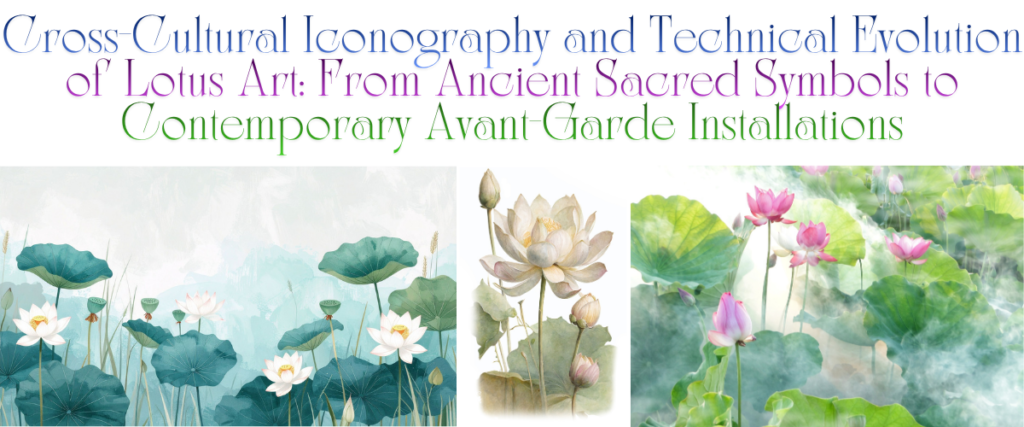
The botanical representation of the lotus has served as one of the most enduring, globally dispersed, and philosophically complex motifs in the history of art.1 Across thousands of years, artists, architects, and theologians have utilised the unique physiological habits of the genus Nelumbo (the sacred lotus) 1 and Nymphaea (the water lily, frequently conflated with the lotus in antiquity) 3 to convey profound metaphysical narratives. Emerging from anaerobic, murky mud and traversing turbid waters to bloom pristine and dry above the surface, the flower provides an intuitive physical blueprint for the journey of the human soul rising above material miredness toward spiritual awakening.1
The sacred lotus, Nelumbo nucifera, is native to tropical Asia, producing massive green leaves that span up to three feet across.1 Its diurnal blooming sequence is highly distinct, typically lasting three to four days; the blossom opens in the early morning and closes toward the late afternoon, closing notably earlier on its very first day of blooming.1 Because Nelumbo nucifera lacks blue cultivars, the vibrant blue flowers depicted in ancient Near Eastern and Mediterranean art belong to the genus Nymphaea, specifically the blue water lily, Nymphaea caerulea.3 This report traces the iconographic, architectural, and technical evolution of lotus art, demonstrating how ancient Near Eastern and Egyptian solar cosmologies laid the foundation for highly structured Asian devotional iconographies, and how these traditional paradigms have been subverted, abstracted, and reinvented by modern and contemporary avant-garde artists.
Ancient Near Eastern and Mediterranean Cosmologies: Solar Myths and Material Culture in the Nile Valley
In the ancient Near East and Mediterranean basins, the water lily emerged as a central motif linked to solar movement, agricultural fertility, and cosmic order.1 The specific physical properties of the blue water lily (Nymphaea caerulea) and the white water lily (Nymphaea lotus)—notably their diurnal cycle of opening at dawn to reveal a radiant yellow centre and closing or submerging at dusk—prompted ancient civilisations to align the plant with celestial mechanisms.3
For the ancient Egyptians, the water lily was an essential cosmological symbol of creation and daily rejuvenation.4 The plant was closely linked to the primeval waters of Nun, from which the world originated, and to the sun god Ra, who was believed to rise from a giant blossoming lotus at the dawn of creation.1 Similarly, the creation deity Atum was represented by the white water lily, symbolising the birth of light out of primordial darkness.1 In funerary art, the lotus served as a vehicle for resurrection; the deity Horus was depicted as being reborn daily from a blossoming lotus, while Osiris, the king of the gods and judge of the dead, wore a crown woven with lotus blossoms, and his queen, Isis, was represented by the budding flower.1 Beyond these religious texts, the practical and medicinal value of the plant was celebrated in Egyptian material culture, where the fragrant blue lotus was utilised for its narcotic, pain-relieving, and consciousness-altering properties to bridge the gap between physical reality and other spiritual realms.3
The lotus also functioned as a political emblem of state unity.4 In dynastic iconography, the lotus served as the specific symbol of Upper Egypt, and following the unification of the state under Pharaoh Menes, administrative and decorative art frequently featured the Sema-Tawy motif, which depicted the Upper Egyptian blue lotus intertwined with the Lower Egyptian papyrus plant to symbolise regional integration.2 This symbology permeated all strata of Egyptian material culture, as evidenced by archaeological recoveries of faience, wood, and steatite artifacts.
| Artifact & Classification | Historical Period & Origin | Material Medium | Symbolic and Decorative Function |
| Model Lotus Flower 8 | Middle Kingdom, Late Dynasty 11 (ca. 2051–1981 B.C.) | Painted and plastered wood | Excavated from the Temple of Mentuhotep II at Deir el-Bahri; designed as part of offerings carried by female bearers to represent eternal resurrection.8 |
| Scarab with Cruciform Lotus 9 | Middle Kingdom, Dynasty 13 (ca. 1770–1670 B.C.) | Bright blue glazed steatite | Manufactured in workshops near Lisht, it functions as a protective seal-amulet referencing life, renewal, and Upper Egyptian regional identity.9 |
| Lotus Flower Inlay 5 | New Kingdom, Amarna Period (ca. 1353–1336 B.C.) | Faience | It was utilised as a decorative architectural element in royal palaces to mirror the daily cycle of solar rebirth and physical rejuvenation.5 |
| Scarab with Lotus Decoration 7 | Early New Kingdom, Early Dynasty 18 (ca. 1550–1458 B.C.) | Green glazed steatite | Features two carefully incised lotus flowers merging at the stem, serving as an amuletic promise of continuous self-regeneration.7 |
| Lotiform Chalice 10 | Third Intermediate Period, Dynasty 22–25 (ca. 945–664 B.C.) | Faience | relief vessel decorated with scenes of the child of the sun god emerging from watery marshes; associated with Midsummer New Year celebrations and political renewal.10 |
Beyond Egypt, the open lotus was integrated into the artistic vocabularies of neighbouring civilisations. The ancient Persians viewed the fully opened lotus flower as an emblem of the sun and the giver of physical life.1 In Phoenician iconography, the flower was depicted as a winged celestial vehicle, borne to heaven surrounded by the moon and stars.1 In classical Greece, mythic traditions incorporated the flower’s solar associations, as seen in the legend of Hercules borrowing the golden, lotus-shaped cup of the sun to cross the ocean.1
The Global Expansion: From Christian Iconography to Islamic/Mughal Architecture
The symbolic vocabulary of the lotus eventually crossed major theological boundaries, moving from pagan solar myths into early Judeo-Christian and Islamic artistic traditions.2 During the fifth century, the lotus motif entered Christian art following the landmark Council of Ephesus in present-day Turkey.2 This council formally declared the Virgin Mary as Theotokos—the Mother of God, rather than merely the mother of Christ’s human form—which prompted Christian artists to adopt the pure, water-emergent lotus as a visual metaphor for her immaculate, unblemished nature and divine motherhood.2
This cross-cultural migration was further accelerated by geopolitical movements across Central and Western Asia.2 Following the thirteenth-century Mongol invasions, the lotus—which had long been a favourite aesthetic icon in China—was carried westward, appearing prominently in Persian Islamic manuscripts and textiles.2 By the sixteenth century, when a Persian-influenced dynasty established the Mughal Empire in India, the lotus became a critical tool for synthesising regional aesthetics.2 Mughal imperial art combined Indian, Chinese, and Persian representations of the flower, decorating palaces and monuments to project a unified cultural vision.2
This synthesis achieved monumental expression in the architecture of the Mughal capital at Fatehpur Sikri, where stone pillars are carved with prominent, highly stylised lotus motifs.2 Similarly, the white marble dome of the Taj Mahal, commissioned by Emperor Shah Jahan in 1632, is crowned with a massive, inverted lotus design that acts as a structural and spiritual finial, transforming the imperial mausoleum into a physical representation of celestial perfection.2 This architectural lineage continues into modern civic spaces, as demonstrated by the Lotus Temple in Delhi, completed in 1986.2 Constructed for the Bahá’í Faith, the temple’s modern, white marble petals mimic a massive opening lotus flower, utilising the ancient plant to project a message of interfaith unity and global peace.2
Dharmic Devotional Iconography: Hinduism, Buddhism, Jainism, and Sikhism
Within the indigenous religious traditions of India—Hinduism, Buddhism, Jainism, and Sikhism—the sacred lotus (Nelumbo nucifera) evolved from a generalised fertility symbol into a highly codified aesthetic and iconographic system.1 Across these faiths, the “Lotus Throne” (Padmasana) became the standard pedestal for divine figures.3 Depicting a deity or enlightened being seated in the crossed-leg lotus position atop an open blossom signifies their total transcendence over the murky waters of worldly suffering, desire, and material attachment.3
In Hindu philosophy, the lotus is regarded as the firstborn of creation and the primordial womb of the universe.3 This is expressed in the creation legend of Vishnu Padmanabha (Lotus-navel), which depicts the creator god Brahma emerging from a golden lotus that grows directly from Vishnu’s navel while he rests upon the cosmic ocean.1 The goddess Lakshmi, associated with wealth and fertility, is named Padma, representing the abundance that grows after the monsoon rains and blossoms in autumn during the rice harvest.1 Other deities are systematically aligned with the flower: Saraswati, the goddess of wisdom, is portrayed seated upon a pristine white lotus representing pure knowledge; Kubera, the god of wealth, sits upon a stylised lotus throne; and Vishnu is frequently described as the “Lotus-Eyed One” (Pundarikaksha).3 In yogic and Tantric traditions, the lotus serves as a map of human consciousness, where the internal energy centres (chakras) are visualised as wheel-like lotuses, culminating in the opening of the Sahasrara—the thousand-petaled lotus of enlightenment at the crown of the skull.3
Subtle Spine (Sushumna Nadi)
|
(Enlightenment – 1000-Petaled Lotus at the Skull Crown)
|
[ Ajna ] (Third Eye Lotus)
|
[ Vishuddha ] (Throat Lotus)
|
[ Anahata ] (Heart Lotus)
|
[ Manipura ] (Navel Lotus)
|
(Sacral Lotus)
|
[ Muladhara ] (Root Lotus – Grounded Potential)
Buddhism adopted these Indian iconographic systems, utilising the lotus to symbolise the absolute purity of body, speech, and mind rising above material attachment.3 According to traditional biographical literature, when Gautama Buddha was born, he immediately took seven steps, and lotus flowers bloomed in his footprints to prevent his sacred feet from touching the earth.3 This symbolism is central to the Saddharma-Pundarika (The Lotus Sutra), which represents the Buddha’s highest teachings and emphasises the Mahayana vow of planting roots deeply to save all living beings.1
In Himalayan and esoteric Buddhist art, the lotus is depicted in a variety of symbolic colours 3:
- The Pink Lotus: Regarded as the supreme, true lotus of the Buddha, representing his historical presence and spiritual authority.3
- The White Lotus: Symbolises the awakening of Bodhi, mental purity, and the total pacification of one’s ego.3
- The Blue Lotus: Represents the victory of the spirit over material intelligence, knowledge, and wisdom.3
- The Red Lotus: Associated with the Padma Buddha family of energy, representing both the positive quality of compassionate warmth and the negative, deluded side of passion and clinging.1
Himalayan material culture is highly rich in lotus representations, as preserved in major public collections and regional temple practices.2 Deities are routinely defined by their relationship to the flower; for instance, the bodhisattva of wisdom, Manjushri, is sometimes painted in a relaxed, contemplative pose atop the rippling water of a lotus pond, while Avalokiteshvara—worshipped in Nepal in 108 distinct forms—is depicted as Padmapani (“Lotus-in-Hand”) holding a delicate lotus stalk.6 Contemporary Nepalese and Tibetan artists, such as Buchung Nubgya, continue this heritage by painting complex thangkas of Avalokiteshvara using traditional pigments derived from beets and local fruits.6
In Tibet, Padmasambhava (Guru Rinpoche), who introduced Buddhism in 762 A.D., is depicted sitting on a magnificent lotus throne, holding a vajra and a skullcup, reflecting his birth from within a lotus flower.1 The Dalai Lama is formally referred to as the “Lord of the White Lotus” because the colour white contains all other colours, symbolising spiritual perfection.1
In esoteric ritual art, three-dimensional mechanical-hinged lotus mandalas are used to represent deity palaces.6 Crafted in bronze or brass, these sculptures feature central figures like Hevajra and Nairatmya standing inside a closed flower bud; during meditation, the mechanical hinges allow the petals to open, revealing the central deities and their surrounding retinue, serving as a physical metaphor for the unfolding of cosmic space and mental clarity.6
East Asian Brush Traditions: Technical Systems and Political Subversion
In China, the lotus was valued not only for its medicinal and culinary uses but as a central theme in literati poetry, philosophy, and classical brush painting (Guohua).1 The aesthetic approach to painting the lotus shifted from a purely decorative exercise to a highly disciplined, philosophical practice rooted in Taoist and Buddhist principles, requiring years of study to master rapid, instinctual strokes on Xuan paper.12
The technical execution of the lotus in Chinese brush painting relies on two distinct traditional techniques: Goule (outlining) and Mogu (boneless).13 To paint the petals using Goule, the artist dilutes black ink with water in an ink dish to create a light grey base, wets a large, hard-bristle brush, and dries the tip on a paper towel.13 Before starting each stroke, the tip is dipped into a slightly darker ink.13 The artist holds the brush vertically, close to the bristles, and starts each stroke with an upward reverse movement of about an eighth of an inch before sweeping downward from the petal’s tip toward the centre.13 To project vital energy (Qi) into the line, the artist moves the entire arm and body rather than just the wrist or fingers.13 Petals are executed in a strict, sequential order: the first petal is drawn with three distinct strokes, and the subsequent petals are painted with less brush pressure and drier ink to create the illusion of overlapping depth.15
To paint the expansive leaves using the Mogu technique, the artist applies wet, rich washes of grey and dark ink without preliminary outlines, establishing a sharp contrast between the flat top edge and the soft bottom edge of the leaf.13 While the base wash is still damp, the artist uses a small, hard brush with undiluted dark ink to draw the veins radiating outward from the centre, allowing the veins to fuse naturally with the leaf body without diffusing excessively.13 The stamen is added using dark, wet ink to create oval dots clustered in a half-circle around the central pod, and small “dew drops” are painted in the negative space around the stems to unify the composition and establish a sense of depth.13 To organise these elements, classical compositions often follow a rhythmic “S” curve derived from the Taoist Yin/Yang symbol, starting from the lower edge of the paper, flowing through the heavy “boneless” leaf, and culminating in the delicately outlined blossom at the top.13
Taoist “S” Composition Path:
<– Top Left
\
\ (S-Curve Flow)
\
<– Bottom Right
This technical mastery was frequently used by classical Chinese literati, such as Bada Shanren (Zhu Da), Shitao, Qi Baishi, and Zhang Daqian, to express personal integrity and resilience.11 Because the lotus remains pure despite growing in mud, it served as a popular metaphor for the upright scholar who refuses to be corrupted by a compromised political administration.1
This tradition of political subversion through botanical art continued into the modern era. On the eve of the Cultural Revolution, the modern master Pan Tianshou produced his monumental work Red Lotus (c. 1965).12 Employing a Song dynasty “one-corner composition” inherited from court painters like Liang Kai, Pan arranged angular, expressive black ink washes to form a spindly, precariously tilted lotus stem.12 While classical painting historically favoured light pink or white blossoms, Pan chose a vibrant red hue for the flower, matching the colour to the calligraphic inscription at the top of the canvas.12 This was a deliberate, double-coded artistic strategy:
- Conformity to Party Mandates: The bright red colour superficially aligned with the Chinese Communist Party’s rigid cultural dictate that all revolutionary art must be “red, bright, and shining” (hong, guang, liang).12
- Intellectual Dissent: In his poetic inscription, Pan subtly likened the red flower to Zhang Changzong (nicknamed Liulang), an infamous, decadent eighth-century court favourite of Empress Wu Zetian.12 Through this literary allusion, Pan used the guise of patriotic red art to critique political opportunism and corruption within the contemporary regime, demonstrating how classical literati painting techniques could be adapted to comment on the complexities of modern Chinese identity.12
Modern Indian Mythologies and Ecological Realism
In the mid-to-late twentieth century, Indian modernists began moving away from Western academic realism to reclaim indigenous imagery, using the lotus pond as a central subject for personal myth-making and ecological observation.16 A. Ramachandran (1935–2024), a graduate of Santiniketan who studied under Nandalal Bose, initially painted expressionist, politically charged canvases depicting urban suffering.18 However, by the 1980s, Ramachandran underwent a profound artistic transformation, returning to Indian classical aesthetics, Kerala temple murals, and Ajanta cave paintings.18
Central to this new direction was his discovery of the lotus ponds around Udaipur, Rajasthan—specifically the remote Shiva temple of Obeshwar and the village of Eklingji.17 Rather than treating the pond as a decorative landscape, Ramachandran approached it as a vibrant, self-contained ecosystem.17 He spent days in direct observation, sketching the shifting light, the massive leaves, the swaying stalks, and the hidden life beneath.17
This research resulted in monumental, highly saturated oil paintings and multi-panel serigraphs characterised by several distinct features:
- Oblique Aerial Perspectives: Influenced by Japanese folding screens and Indian miniature painting, Ramachandran flattened the receding space, bringing the dense foliage and flowers forward in rich, opaque renderings.19
- The Intertwining of Femininity and Nature: Lyrical, stylised female figures (modelled on the local nomadic Bhil women) move fluidly through the water and foliage.17 These figures are not passive subjects of a male gaze, but represent Shakti—the primal creative energy of nature.17
- The Autocaricature and Insect Life: In works such as Autobiography of an Insect in the Lotus Pond (2000), Ramachandran painted a dense thicket of lotus leaves populated by dragonflies, beetles, and butterflies.19 Crucially, the artist gave these insects his own bearded face, placing himself within the natural cycle of life, death, and decay as an equal, humble participant in the ecosystem.19
Similarly, contemporary artist Seema Kohli uses the lotus pond to explore metaphysical truths and the divine feminine.16 Kohli’s work is deeply influenced by the philosophy of the Hiranyagarbha (the Cosmic Egg) from the Yajur Veda.22 In her “Krishna Krishna Series Lotus Pond” and “Golden Womb” series, Kohli builds intricate, dreamlike canvases embellished with 24-carat gold and silver leaf.22 Beneath stylised golden suns or moons that watch over the scenes, waves of deep indigo and violet acrylic paint swirl into a dense canopy of pink blossoms and green leaves.24 Populated by winged women, celestial beings, and deer, Kohli’s paintings depict a world with no separation between time, space, and identity.22
This modern reclamation of the lotus is also visible in the work of contemporary painters like Swati Kale, whose 2024 oil painting Lilies of the Sun combines classical technique with meditative grace, and Sulakshana Dharmadhikari, whose lyrical watercolours are favoured for serene domestic spaces.16
Contemporary Avant-Garde: Minimalism, Ephemeral Substrates, and Spatial Installations
In twenty-first-century contemporary art, artists have moved beyond traditional painterly representation to engage with the physical structure of the lotus.25 They use its components in minimalist, site-responsive, and ephemeral installations to explore modern themes of displacement, diaspora, and bodily precarity.25
In his 2026 solo exhibition “The Quiet Sublime” at the Aurora Museum in Shanghai, Chinese artist Wang Yizhou presented a body of work that strips the lotus of its traditional decorative blossoms and leaves.25 In his painting Lotus (2017), Wang retains only the stem—rendering it as a single, vertical calligraphic element isolated at the centre of an empty composition.25 This minimalist line has its origins in the artist’s childhood habit of water calligraphy, tracing characters with water on dry stone slats where the marks quickly evaporated.25 In his mature oil paintings, this line is infused with the variable pressure and elasticity of traditional Chinese brushwork, keeping the composition suspended between abstract formalism and landscape.25 By choosing not to paint the flower itself, Wang commands the surrounding space entirely through the tension of the single, curving stem.25
In contrast to this graphic minimalism, Canadian-born artist Lotus L. Kang (b. 1985) creates site-responsive installations that explore impermanence, inheritance, and the leaky boundaries of identity.27 A key element of her practice is the “misuse” of photographic materials.26 In major museum presentations, including the 2024 Whitney Biennial and her solo exhibition I hear the hollow boom of time (2026, Frye Art Museum), Kang suspends massive, cascading sheets of unfixed, industrial photographic film throughout the galleries.26 Exposed to the ambient light of the exhibition spaces over time, these sensitive surfaces undergo a slow, continuous chemical transformation—a process the artist terms “tanning,” likening the film’s responsive surface to human skin.26
To ground these suspended photographic skins, Kang places tatami mats on the gallery floors, adorned with sand-cast aluminium and bronze sculptures of everyday domestic items: perilla leaves, cabbage, anchovies, and sliced lotus roots.26 The cast lotus root appears frequently across her installations, such as In Cascades (2023) and her kinetic sculpture Azaleas II (2025).26 For Kang, casting these foods in metal serves several artistic purposes.
Firstly, the lotus root is a common ingredient in East Asian cuisine, and in her installations, it evokes the physical, domestic labour of immigrant women and the sensory inheritances of the kitchen.30 Secondly, the sand-casting process captures the natural, porous, and rhizomatic structure of the root.31 Its hollow, circular voids mirror the industrial steel joists supporting her installations, suggesting that strength lies not in solid density, but in the capacity to hold open space.31 Finally, the irregular, mud-grown shape of the rhizome is deeply personal for Kang, who describes the form as being “embedded within my psyche, my body, my physicality”.31 By casting the organic root in cold aluminium, she freezes an ephemeral object of nourishment into a permanent metal relic, illustrating the tension between preservation and decay.30
This dialogue between organic transience and permanent art-making is also reflected in the pop-realist work of veteran American painter Alex Katz.32 In his 2025 exhibition “White Lotus” at GRAY Chicago, Katz presented monumental canvases featuring flat, cool, and highly simplified representations of figures on a beach in Maine, combining pop aesthetics with cinematic scale to transform ordinary human forms into monumental landscapes.32
Kang’s Installation Material Layout:
<– Suspended Aerial Layer
|
| (Interwoven space)
|
<– Grounded Floor Layer [29, 30]
While contemporary artists like Kang and Wang utilise industrial and synthetic mediums to represent the lotus, a parallel movement explores the physical plant itself as an artistic medium.25 Originating from the Himapan Gallery in Bangkok, Thailand, and brought to New York City by Tristan de Terves, the practice of Lotus Leaf Painting utilises real, dried lotus leaves as natural canvases, celebrating the natural imperfections and unique organic structures of the plant.33
| Process Phase | Technical Execution Method | Material Medium | Aesthetic and Structural Purpose |
| Canvas Preparation 33 | Broad, natural lotus leaves are harvested in Thailand, dried, and mounted onto square canvases.33 | Organic lotus leaves and 40 cm x 40 cm wood frames.33 | Establishes a completely unique, textured surface with natural veins, minor colour differences, and small holes.33 |
| Surface Prep 33 | Artists use tools to gently scrape away any excess natural glue from the mounted leaf surface.33 | Natural leaf surface and scraping tools.33 | Thins the top layer of the leaf fibre, preparing the organic surface to absorb pigment and unify the final texture.33 |
| Colour Selection 33 | Artists select quick-drying pigments to establish the thematic tone of the composition.33 | Quick-drying acrylic paints.33 | Options range from “Zen” white and natural green earth tones to warm reds, oranges, and deep mineral blues.33 |
| Pigment Application 33 | Paint is drizzled onto a paper dish, applied using sponges, and refined with thin detail brushes.33 | Sponges, thin brushes, and acrylic paints.33 | Thin, diluted paint layers keep the natural veins of the leaf translucent; thicker layers create dense, opaque colours.33 |
| Varnishing & Preservation 33 | Artists apply a protective seal immediately after painting, followed by a second coat twenty-four hours later.33 | Protective liquid varnish and soft brushes.33 | Seals the organic leaf tissue from humidity and air exposure, preserving the ephemeral artwork for up to ten years.33 |
Conclusion
The evolution of the lotus in art demonstrates how a single botanical motif can bridge cultural divides and adapt to shifting artistic movements.1 From its beginnings in ancient Egyptian tomb paintings and Hindu creation myths, the lotus served as a symbol of divine order and spiritual transcendence, representing the soul’s ability to rise above earthly suffering.3 In East Asian ink traditions, it became a vehicle for philosophical contemplation and subtle political commentary, requiring disciplined brushwork to capture its natural grace.12 In modern and contemporary art, the lotus has been Liability-adapted as both a complex ecological system and a minimalist conceptual form.17 Contemporary installations use its physical components—from dried leaves to cast-metal roots—to explore personal narratives of immigration, family heritage, and the passing of time.30 By moving from traditional representations of the sacred to modern reflections on human vulnerability, lotus art continues to find new ways to connect the natural world with our shared search for meaning.1
Disclaimer
This article is intended solely for educational, historical, and art-historical research purposes. The classifications, interpretations of religious iconography, and analyses of contemporary artworks contained herein reflect documented scholarly perspectives and do not represent personal theological endorsements or official institutional valuations. Mention of specific galleries, auction houses, artists, or exhibition schedules (including those scheduled for the current year, 2026) is strictly for academic context and does not constitute commercial promotion or investment advice regarding fine art acquisition. All technical details regarding organic mediums, such as lotus leaf painting, are provided as historical records of artistic practices and should not be used as professional instructions for material preservation.
References
- The Lotus – Tricycle: The Buddhist Review, accessed on May 23, 2026, https://tricycle.org/magazine/the-lotus/
- Following the Lotus Around the World – Storytrails, accessed on May 23, 2026, https://storytrails.in/religions/following-the-lotus-around-the-world/
- Sacred lotus in religious art – Wikipedia, accessed on May 23, 2026, https://en.wikipedia.org/wiki/Sacred_lotus_in_religious_art
- Ancient Egyptian Lotus: Symbolism and Types (Blue & White) – Egypt Fun Tours, accessed on May 23, 2026, https://egyptfuntours.com/blog/ancient-egyptian-lotus-flower/
- Lotus Flower Inlay – New Kingdom, Amarna Period – The Metropolitan Museum of Art, accessed on May 23, 2026, https://www.metmuseum.org/art/collection/search/548302
- Lotus Flower: Himalayan Art | Rubin Museum of Himalayan Art, accessed on May 23, 2026, https://rubinmuseum.org/the-lotus-flower-sacred-symbol-of-transcendence/
- Scarab with Lotus Decoration – Early New Kingdom – The Metropolitan Museum of Art, accessed on May 23, 2026, https://www.metmuseum.org/art/collection/search/557107
- Model Lotus Flower – Middle Kingdom – The Metropolitan Museum of Art, accessed on May 23, 2026, https://www.metmuseum.org/art/collection/search/545284
- Scarab with Crucifom Lotus Flower Decoration – Middle Kingdom – The Metropolitan Museum of Art, accessed on May 23, 2026, https://www.metmuseum.org/art/collection/search/545705
- Lotiform Chalice – Third Intermediate Period – The Metropolitan Museum of Art, accessed on May 23, 2026, https://www.metmuseum.org/art/collection/search/548339
- Lotus Painting | Chinese Art Gallery – China Online Museum, accessed on May 23, 2026, http://www.chinaonlinemuseum.com/painting-lotus.php
- Pan Tianshou, Red Lotus (article) | China – Khan Academy, accessed on May 23, 2026, https://www.khanacademy.org/humanities/art-asia/imperial-china/x97ec695a:people-s-republic-of-china-1949present/a/pan-tianshou-red-lotus
- How to Paint a Lotus – Education – Asian Art Museum, accessed on May 23, 2026, https://education.asianart.org/resources/how-to-paint-a-lotus/
- Chinese Brush Painting, accessed on May 23, 2026, https://losangeles.china-consulate.gov.cn/eng/hzjl/culture_1/acc/200404/t20040409_5421982.htm
- Learning the Art of Chinese Brushpainting: The Lotus Flower – Asian Art Museum, accessed on May 23, 2026, https://education.asianart.org/wp-content/uploads/sites/6/2019/09/Lesson-How-to-Paint-a-Lotus-AAM.pdf
- Buy Beautiful Lotus Flower Paintings Online For Your Space at Artflute, accessed on May 23, 2026, https://www.artflute.com/collections/lotus-paintings
- Nature & Femininity in A. Ramachandran’s Lotus Pond Paintings – AstaGuru, accessed on May 23, 2026, https://www.astaguru.com/blogs/nature–femininity-in-a-ramachandran%E2%80%99s-lotus-pond-paintings-818
- A. Ramachandran – Vadehra Art Gallery, accessed on May 23, 2026, https://www.vadehraart.com/artists/97-a.-ramachandran/
- Evening Sale: Modern Art -Sep-16, 2023 -Lot 31 -A Ramachandran – Saffronart.com, accessed on May 23, 2026, https://www.saffronart.com/auctions/postwork.aspx?l=43318
- Lines to Words – Art of Ramachandran, accessed on May 23, 2026, https://www.artoframachandran.com/lines-to-words.html
- A Ramachandran: ‘I am an artist who paints by the acre’ – Open Magazine, accessed on May 23, 2026, https://openthemagazine.com/art-culture/a-ramachandran-i-am-an-artist-who-paints-by-the-acre
- Seema Kohli’s Exhibition at Museum of Sacred Arts in Belgium – Laasya Art, accessed on May 23, 2026, https://laasyaart.com/indian-artist-seema-kohli-indian-art-paintings-exhibition-in-belgium/
- Seema Kohli – Buy Paintings and Artwork Online | Eikowa, accessed on May 23, 2026, https://www.eikowa.com/collections/seema-kohli
- “Krishna Series Lotus Pond”: Blue Violet Serigraphs Painting by Seema Kohli – ArtZolo.com, accessed on May 23, 2026, https://www.artzolo.com/products/krishna-series-lotus-pond-painting
- The Quiet Sublime by Wang Yizhou: A Line Without Borders, Drawn Across Mountains and Time | Larry’s List, accessed on May 23, 2026, https://www.larryslist.com/artmarket/features/the-quiet-sublime-by-wang-yizhou-a-line-without-borders-drawn-across-mountains-and-time/
- Lotus L. Kang: I hear the hollow boom of time | Frye Art Museum, accessed on May 23, 2026, https://fryemuseum.org/exhibitions/lotus-l-kang-i-hear-hollow-boom-time
- 212: What Is Parasite and What Is Kin? – MoMA, accessed on May 23, 2026, https://www.moma.org/calendar/galleries/5835
- Lotus L. Kang and Nour Mobarak in Conversation | Frye Art Museum, accessed on May 23, 2026, https://fryemuseum.org/calendar/event/lotus-l-kang-and-nour-mobarak-conversation
- Lotus L. Kang – Esther Schipper, accessed on May 23, 2026, https://www.estherschipper.com/artists/194-lotus-l.-kang/
- Lotus L. Kang Scaffold – KADIST, accessed on May 23, 2026, https://kadist.org/work/scaffold/
- Lotus L. Kang: At First Blush – Flash Art, accessed on May 23, 2026, https://flash—art.com/article/lotus-l-kang/
- Alex Katz – White Lotus – Exhibitions – Richard Gray Gallery, accessed on May 23, 2026, https://www.richardgraygallery.com/exhibitions/alex-katz11
- Have You Tried Lotus Leaf Painting? – YogaCity NYC, accessed on May 23, 2026, https://www.yogacitynyc.com/single-post/2016/10/10/Have-You-Tried-Lotus-Leaf-Painting