July 2026

Information-Technology-Industry

Global Information Technology Industry Weekly Report: Platform Proliferation, Sovereign Infrastructure Interventions, and Institutional Fractures

The week ending July 10, 2026, marked a structural transformation in the global information technology industry. OpenAI launched its agentic software system, sparking an enterprise price war with the newly launched Grok model. Simultaneously, legal conflicts erupted as Apple sued OpenAI for corporate trade secret theft regarding consumer hardware components.


Global Information Technology Industry Weekly Report: Platform Proliferation, Sovereign Infrastructure Interventions, and Institutional Fractures Read More »

Weekly-Financial-Review-

High-Tech Hegemony Versus Geopolitical Friction: Global Stock Market Report for the Week Ending 10 July 2026

The week ending 10 July 2026 highlighted a clash between structural technology investments and intense geopolitical headwinds. Military conflicts between Washington and Tehran spiked global energy prices. Simultaneously, South Korean chipmaker SK Hynix’s stellar Nasdaq debut powerfully reinforced the world’s durable artificial intelligence investment boom, effectively stabilising global equity markets.

High-Tech Hegemony Versus Geopolitical Friction: Global Stock Market Report for the Week Ending 10 July 2026 Read More »

The Architecture of Visual Repetition: A Comprehensive Analysis of Motif Art

The Architecture of Visual Repetition: A Comprehensive Analysis of Motif Art

In the study of art history, iconography, and decorative design, a motif is a foundational structural element that establishes composition, visual rhythm, and thematic depth. Derived from the French word for a dominant or driving idea, a motif is defined as a recurring visual fragment, shape, subject, or conceptual device that unifies a single artwork or connects a broader body of creative work. Rather than acting as mere surface embellishment, motifs are visual anchors. They bridge the gap between simple formal elements—such as line, shape, and colour—and the abstract thematic inquiries that define human expression.

An examination of motif art reveals its role in how artists across cultures and eras impose order on spatial environments, preserve sacred myths, and articulate complex psychological states.

The Architecture of Visual Repetition: A Comprehensive Analysis of Motif Art Read More »

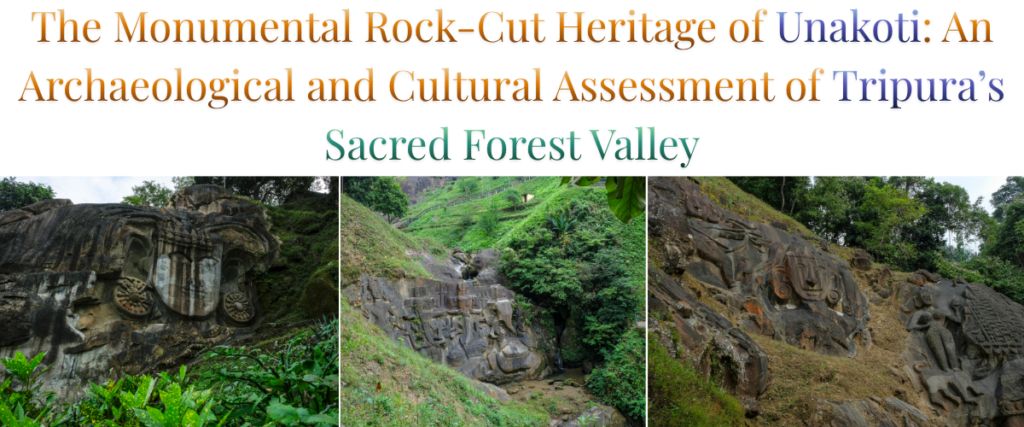
The Monumental Rock-Cut Heritage of Unakoti: An Archaeological and Cultural Assessment of Tripura’s Sacred Forest Valley

The Monumental Rock-Cut Heritage of Unakoti: An Archaeological and Cultural Assessment of Tripura’s Sacred Forest Valley

Located in the dense, subtropical forests of the Raghunandan Hills within the northern region of Tripura, India, the archaeological site of Unakoti stands as one of the most significant yet enigmatic open-air rock-cut galleries in India. Known natively in the local Kokborok language as Subrai Khung—a term intimately tied to the Tripuri name for Lord Shiva as the supreme creator of the universe—Unakoti features a vast assemblage of colossal bas-relief carvings and freestanding stone sculptures dating primarily from the seventh to the ninth centuries CE. The name “Unakoti” itself, translating to “one less than a crore” (or 9,999,999) in Bengali and Hindi, represents both a precise numerical concept in Hindu cosmology and a profound sculptural reality that defines this sacred forest valley.

The Monumental Rock-Cut Heritage of Unakoti: An Archaeological and Cultural Assessment of Tripura’s Sacred Forest Valley Read More »

Geopolitics

The Hydro-Strategic Pivot: India’s Sovereignty and National Security in the Indus Basin

The partition of British India in August 1947 was executed along demographic and political lines rather than geographical or hydrological boundaries. This historical rupture instantly split a highly integrated, cohesive network of irrigation canals in the Indus River Basin, transforming shared water resources into a source of acute transboundary friction. As the upper riparian state, India possessed physical control over the headworks and upstream channels, while Pakistan, as the lower riparian state, was structurally dependent on these very waters for approximately eighty percent of its irrigated agriculture.

The Hydro-Strategic Pivot: India’s Sovereignty and National Security in the Indus Basin Read More »

Information-Technology-Industry

Global IT Industry Review: Sovereign AI, Regulatory Milestones, and Emerging Cyber Threats (Week Ending 3 July 2026)

The global technology landscape is undergoing a structural realignment as artificial intelligence transitions from a standard commercial software sector into critical sovereign infrastructure1. This shift is characterised by unprecedented discussions regarding public and state-level ownership in frontier AI developers. During the week ending 3 July 2026, reports emerged that OpenAI had initiated conceptual talks with the United States administration to grant the US government a 5% equity stake in the company. Pioneered by OpenAI Chief Executive Sam Altman, the proposal aims to establish a framework under which leading domestic AI developers—including Anthropic, Google, and Meta Platforms—would allocate equivalent equity to a state-backed investment vehicle modelled on the Alaska Permanent Fund.

Global IT Industry Review: Sovereign AI, Regulatory Milestones, and Emerging Cyber Threats (Week Ending 3 July 2026) Read More »

Scroll to Top