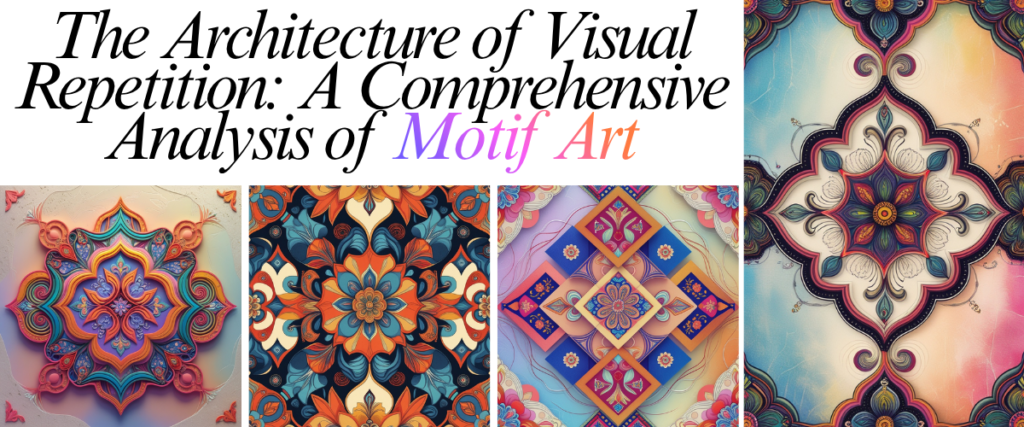
In the study of art history, iconography, and decorative design, a motif is a foundational structural element that establishes composition, visual rhythm, and thematic depth1. Derived from the French word for a dominant or driving idea, a motif is defined as a recurring visual fragment, shape, subject, or conceptual device that unifies a single artwork or connects a broader body of creative work1. Rather than acting as mere surface embellishment, motifs are visual anchors5. They bridge the gap between simple formal elements—such as line, shape, and colour—and the abstract thematic inquiries that define human expression5.
An examination of motif art reveals its role in how artists across cultures and eras impose order on spatial environments, preserve sacred myths, and articulate complex psychological states8.
Conceptual Distinctions in Art History and Narrative Theory
To understand motif art, it is necessary to separate the concept from closely related design terms that are often conflated in general usage, specifically symbols, patterns, and themes1. While these elements operate together in a visual composition, they perform distinct structural and communicative roles5.
A symbol is a singular visual entity that represents an idea, emotion, or abstract concept5. A symbol does not require repetition to convey its message; a single depiction of a heart, a skull, or a balance scale immediately communicates love, mortality, or justice6.
A motif, conversely, is defined by its recurrence1. When an artist repeats a symbol or image throughout a work, it transitions into a motif, accumulating psychological weight and drawing the viewer’s attention to a deeper narrative path5.
A pattern is a highly structured, rhythmic composition created through the systematic, mechanical repetition of one or more motifs12. While a motif maintains a distinct, recognisable identity that can stand alone, a pattern relies on duplicating that motif across an infinite plane, often causing the individual element to merge into a larger decorative surface12.
A theme is the ultimate abstract message, lesson, or philosophical lesson of an artwork5. Themes are rarely painted directly onto a canvas; instead, they are inferred by the viewer as they decode the recurring motifs and symbols arranged by the artist5.
Within narrative and literary theory, motifs perform a parallel function by utilising recurring objects, sensory descriptions, or plot devices to reinforce central themes5. For example, in literature, weather changes, repetitive walks, or mismatched marriages are used as motifs to reflect interior emotional states and social critiques5.
A long-standing debate exists within structuralist criticism regarding the exact relationship between symbols and motifs6. One school of thought argues that a motif is simply a symbol that happens to repeat6. An alternative perspective contends that symbols are merely the basic building blocks of motifs, which are larger, systemic systems6. Under this view, a singular icon like a raven does not become a motif merely through repetition6. Instead, the recurring bird is understood as part of a broader motif of thresholds and boundaries, which serves to develop abstract themes of psychological deterioration and mortality6.
Taxonomic Classifications of Motifs
Visual motifs are classified based on their formal properties, sources of inspiration, and levels of geometric abstraction8. Artists select these forms to evoke specific atmospheric effects, cultural contexts, or emotional responses8.
Geometric motifs are constructed from mathematically precise shapes, straight lines, and symmetrical curves, such as circles, triangles, squares, and spirals8. These forms are often inspired by natural structures, such as the spiral of a seashell, the branching of a tree, or the symmetry of mineral crystals15. When organised systematically, geometric motifs communicate order, modernity, and universal truth8.
In contrast, organic and botanical motifs draw directly from the fluid, asymmetrical, and curving lines of living plants, flowers, leaves, and vines7. These motifs, often termed biomorphic, celebrate natural growth and vitality, lending a soft, dynamic quality to decorative surfaces7.
Representational and figurative motifs depict recognisable real-world subjects, including human figures, animals, landscapes, and man-made objects8. These designs range from realistic copies of nature to highly stylised interpretations that reflect the imaginary ideas of the artist8.
Finally, mythological and sacred motifs carry deep spiritual or protective meanings within specific cultures, often depicting deities, protective symbols, and legendary narratives8. These designs connect everyday life with the spiritual world, serving as visual prayers or markers of status8.
| Motif Category | Primary Sources & Inspirations | Visual & Structural Characteristics | Historical & Cultural Examples |
| Geometric | Mathematics, nature’s structural logic, crystals, mineral formations11. | Rigid symmetry, precise angles, clean circles, repeating linear grids8. | Greek meander key, Roman egg-and-dart, Islamic arabesque, Moroccan tilework10. |
| Botanical & Organic | Florals, climbing vines, leaf structures, organic growth11. | Curving lines, asymmetrical forms, fluid biomorphic contours7. | Egyptian lotus, Greco-Roman acanthus leaf, Art Nouveau lilies and vines10. |
| Figurative & Animal | Human anatomy, beasts, birds, aquatic life, and daily objects8. | Highly stylised or realistic silhouettes, narrative pacing, anthropomorphic figures8. | Master of Animals, confronted lions, Celtic three hares, Byzantine silk peacocks10. |
| Sacred & Symbolic | Religious texts, cosmic mythologies, cultural folklore, protective rituals8. | Rich in metaphor, symmetric alignments, often simplified into distinct emblems8. | Buddhist Cintamani, Turkish elibelinde, Pennsylvania Dutch hex signs, Adinkra symbols9. |
Historical Evolution and Artistic Movements
The stylistic evolution of motif art spans from ancient architecture to the dynamic abstractions of the modern era, reflecting shifts in technology, philosophy, and cultural exchange8.
Antiquity and the Sacred Cosmos
In ancient civilisations, motifs were rarely used for simple decoration; instead, they were deeply tied to the sacred order of the universe8. Byzantine mosaics, such as those found in the Hagia Sophia, arranged millions of tiny stone and glass tesserae into geometric and floral motifs designed to represent divine harmony15.
In Islamic architecture, the prohibition of figurative representations led to the development of complex arabesques and geometric tessellations10. These infinitely repeating patterns were designed to guide the viewer into a meditative state, serving as a visual metaphor for the endless nature of the divine11.
The Arts and Crafts Movement and Art Nouveau
During the nineteenth century, the rise of industrial manufacturing prompted a romantic return to handcraftsmanship8. The Arts and Crafts Movement, championed by William Morris, reintroduced highly detailed motifs inspired by local fields, forests, and medieval folklore8. Morris designed wallpaper and textiles featuring stylised birds, thistles, and vines, establishing a new decorative standard that celebrated natural imperfections8.
This philosophy directly paved the way for Art Nouveau (circa 1890–1910), a movement that sought to unite the fine and applied arts17. Art Nouveau went beyond using nature as a simple surface print; it used organic growth as a structural guide17. Architects like Victor Horta and Antoni Gaudí designed structures where iron railings, door handles, and support columns curved like climbing vines, integrating ornament directly into architectural support17.
This visual style was shaped by Japonisme—the arrival of Japanese woodblock prints in Europe, which introduced flat colour planes, asymmetrical layouts, and flowing contour lines to Western artists17. Illustrators like Aubrey Beardsley adopted these lessons, using dramatic black-and-white contrasts and the signature “whiplash curve” to define the graphic identity of the era17.
At the same time, design theorists like Owen Jones published The Grammar of Ornament (1856), documenting historic decorative motifs from Islamic Spain to classical Europe, providing a cross-cultural design resource for generations to come10.
Impressionism and the Method of Plein Air
The definition of “motif” underwent a major conceptual shift with the rise of French Impressionism in the 1860s1. Rather than referring to a repeating decorative element, the term “motif” was used to describe the actual physical landscape or subject being painted1.
The phrase “to paint from the motif” (peindre sur le motif) became central to the movement, describing the practice of painting spontaneously outdoors (en plein air) directly in front of the subject1. Although pioneered earlier in Britain by John Constable between 1813 and 1817, this approach was embraced by Claude Monet, Camille Pissarro, and Berthe Morisot to capture the changing qualities of light and atmosphere1.
When Monet exhibited Impression, Sunrise at the first group exhibition in Paris in 1874, critics used the term “Impressionism” as an insult, mocking the loose brushwork used to capture the natural motif1.
Technical Execution in Textile and Surface Design
Translating a hand-drawn motif into a continuous pattern requires careful planning and mathematical precision12. Surface designers must consider how motifs interact with the material, the manufacturing process, and the human body12.
Directionality and Spacing
The layout of a textile is defined by its directional alignment12. One-way prints feature motifs oriented in a single direction, meaning they will look upside down if the fabric is rotated12. While visually striking, one-way layouts require careful cutting and assembly during garment construction12. Two-way prints feature motifs aligned along a central axis, making them appear identical from the top or bottom12. This format provides high fabric efficiency, as the material can be cut in either direction12. Non-directional, or tossed, prints scatter motifs randomly across the plane, creating a dynamic surface that remains visually balanced from any angle12.
Designers also control the visual weight of a pattern by adjusting the spacing between motifs12. Motifs can be tightly packed together in an “open-and-closed” format, or spaced widely to let the background colour show through12.
In specialised industrial applications, railroaded motifs are oriented horizontally across the fabric roll rather than vertically, allowing for seamless application across large surfaces like sofas or wide draperies.
Layout and Repeat Formats
To print a pattern continuously across yards of fabric, the design must be constructed as a repeating unit12. The arrangement of these units determines the rhythm, movement, and visual flow of the textile14.
- Block Layout: The motif is repeated in a straight grid, aligned both horizontally and vertically14. While simple to design, it can create noticeable horizontal bands that distract the eye.
- Half-Drop Layout: Each vertical column of motifs is shifted down by exactly half the height of the repeat unit12. This offset prevents the eye from seeing rigid horizontal lines, creating a more natural flow across the fabric14.
- Brick Layout: Mirroring the classic alignment of brick masonry, this layout shifts horizontal rows of motifs by half the width of the repeat unit12. This format is highly effective for rectangular or geometric motifs12.
- Tossed / Spot Layout: Motifs are scattered across the ground plane at varying distances and orientations, leaving negative space between them to create a sense of floating movement7.
| Repeat Configuration | Horizontal Alignment | Vertical Alignment | Visual Effects & Rhythms | Common Uses |
| Block / Side Layout | Perfectly aligned in straight rows14. | Perfectly aligned in straight columns14. | Rigid, formal, and highly structured; can produce distracting horizontal bands14. | Men’s shirting, formal upholstery, geometric wallpapers8. |
| Half-Drop Layout | Offsets vertically in adjacent columns12. | Staggered down by exactly half a repeat unit12. | Softens vertical lines; prevents tracking; creates an organic visual flow14. | Large floral prints, flowing dress fabrics, classical wallpapers8. |
| Brick Layout | Staggered horizontally by half a repeat unit12. | Aligned in straight vertical columns12. | Balanced yet dynamic; mimics structural masonry and stable architectural lines12. | Geometric textiles, kitchen backsplashes, exterior tilework12. |
| Tossed / Spot Layout | Scattered at irregular intervals14. | Rotated in multiple directions12. | Playful, informal, and energetic; floats on the background plane14. | Children’s apparel, casual summer wear, novelty prints14. |
Motifs in Interior Architecture, Styling, and Spatial Balance
In interior design and architecture, motifs are used to establish proportion, historical context, and visual harmony within three-dimensional spaces26. Integrating repeating shapes and textures across walls, furniture, and fittings brings order to an environment26.
Spatial Balance and Architectural Integration
Interior designers use positive and negative space to define functional zones and create visual pathways27. Positive space is occupied by objects like furniture and decor, while negative space refers to the open areas that allow the eye to rest27.
Achieving a balance between these spaces is key to creating a harmonious room27. Prominent design firms, such as Hecker Guthrie, achieve this balance by pairing rich, natural textures with minimalist layouts, keeping spaces functional and filled with light27.
Historically, architectural motifs have been carved into wood, stone, or plaster to add texture and shadow to walls20. Classic details like egg-and-dart mouldings are used on cornices and mantelpieces to provide an elegant repeating shadow line10.
In traditional Indian interiors, classical ceiling and wall paintings are paired with jaalis (carved lattice screens) to filter light and cast delicate geometric shadow patterns across the floor, balancing heavy stone frames with open, airy details26.
Positive Space (Furniture, relief carvings, wall motifs)
▲
│ (Creative tension and spatial flow)
▼
Negative Space (Open pathways, plain walls, uncluttered floors)
Modern Interior Styles and Motif Application
To keep a room from feeling cluttered, designers recommend using motifs selectively across different surfaces20. For instance, a repeating geometric shape might appear on a wallpapered accent wall, and then be quietly echoed in the metalwork of a chandelier, the silhouette of a chair, or the legs of a dining table26. This subtle repetition unifies the space without overwhelming the viewer26.
Different interior styles rely on specific motifs to cultivate their unique atmospheres28:
- Modern Coastal: This style uses a palette of soft blues, sandy neutrals, and crisp whites to create a calm, light-filled environment29. Coastal motifs like shells, coral, and woven fans are used sparingly to keep the space feeling sophisticated and clean29.
- Mid-Century Modern: Inspired by the design innovations of the mid-20th century, this aesthetic pairs sleek, functional wood furniture with bold, abstract geometric prints, organic curves, and lots of indoor greenery29.
- Wabi-Sabi: Rooted in Japanese philosophy, this approach values natural materials, simplicity, and the beauty of imperfection29. It avoids rigid repeating patterns in favour of rough wood, handmade ceramics, and weathered stone textures29.
Myth-Migration and Trans-Cultural Narrative Motifs
Motifs also travel across geographic boundaries and historical eras, shifting in meaning as they are adopted by different cultures9. This process, known as myth-migration, shows how shared human experiences are expressed through common symbols9.
Myth Transmission and the Hero Archetype
According to mythological research, sacred myths often transform into secular folk tales and historical legends as they travel31. During this transmission, the stories lose their specific geographic origins and become part of a shared global folklore31.
A prominent example is the hero archetype, which features a series of repeating narrative motifs: a noble origin, a threat of death in infancy, a miraculous rescue, youth spent in exile, and a return to defeat a primary enemy31. This narrative structure appears in the Roman myth of Romulus and Remus, who were placed in a basket on the Tiber River and rescued by a she-wolf, as well as the Greek legend of Hercules, who defeated deadly snakes placed in his cradle31.
Sacred Myth (Religious context / divine origins)
│
▼ (Migration and cultural transmission)
Secular Hero Legend (Romulus & Remus / Hercules)
│
▼ (Further distillation over centuries)
Universal Folk Tales (Cinderella / Narrative archetypes)
Secularisation and Fairy Tale Motifs
As these narratives migrated across Europe and Asia, specific motifs were adapted to fit local environments and cultural values9. The story of Cinderella, which exists in over three hundred variations worldwide, relies on a series of shared symbolic motifs31.
In the ancient Greek story of Psyche, the heroine is forced by an angry mother-in-law to sort seven species of seeds, accomplishing the task with the help of friendly ants31. In the later Central European versions of Cinderella, the evil stepmother replaces the mother-in-law, and helpful pigeons replace the ants31.
These stories also feature a recurring fascination with feet, such as step-sisters cutting their feet to fit a tiny slipper, or the Germanic goddess Skadi choosing her husband based solely on the appearance of his feet31.
Similarly, everyday objects carry deep symbolic meaning across different cultures31. In Hindu rituals, the oil lamp is a sacred motif where the oil represents devotion, the wick represents the earth, and the flame represents divine love31. This highlights how simple, physical objects are elevated into sacred symbols that connect daily life with spiritual practice8.
Contemporary Adaptations: From Social Spaces to Institutional Identities
In the 20th and 21st centuries, contemporary artists and designers have pushed the boundaries of motif art, using repetition to explore personal identity, social commentary, and cultural preservation21.
| Artist | Representative Medium | Core Motif Employed | Intellectual & Symbolic Focus |
| Yayoi Kusama | Immersive installations, sculpture33. | Polka dots, infinity nets, pumpkins21. | Self-obliteration, psychological obsession, cosmic infinity21. |
| Andy Warhol | Silkscreen printing, acrylic painting32. | Campbell’s soup cans, commercial logos32. | Mass consumerism, celebrity culture, industrial replication32. |
| Damien Hirst | Mixed media, butterfly wings21. | Symmetrical butterfly wings (Kaleidoscope)21. | Mortality, beauty, stained-glass spiritualism, collection21. |
| Anselm Kiefer | Mixed media, lead, straw, painting33. | Sculptured lead beds, barren landscapes33. | Collective historical trauma, German mythology, memory33. |
| Daniel Buren | Site-specific installations, fabric21. | Alternating vertical stripes ( width)21. width)21. | Deconstruction of architectural space, authorial refusal21. |
| Yoshitomo Nara | Painting, bronze sculpture, drawing33. | Stylised, large-eyed children and animals33. | Nostalgia, rebellion, innocence paired with aggression33. |
| Mel Bochner | Conceptual printmaking, painting32. | Repeated thesaurus words (“Blah Blah”)32. | Linguistic visual noise, irony, erosion of semantic meaning32. |
| Nan Goldin | Autochromatic snapshot photography33. | Candid, vulnerable portraits of queer life33. | Domestic dependency, intimacy, struggle, survival33. |
Bespoke Indigenous Design and Motif Artwork
In contemporary graphic and public design, the term motif artwork has taken on a specific meaning, particularly within Australian design collectives like Gilimbaa35. In this context, a motif artwork is defined as a standalone, intricate symbol created to convey a specific organisation’s story and its relationship with Indigenous history35.
Rather than serving as a simple logo, these designs use traditional visual storytelling methods to capture complex histories35. For example, the artwork Journey Lines of Connection, created by David Williams for LifeFlight Australia, combines modern aeromedical themes with Indigenous history36. The design was inspired by the early 20th-century drawings of Ngarrindjeri inventor David Unaipon, who envisioned helicopter-like flying machines based on the physics of the boomerang, creating a bridge between ancestral ingenuity and modern lifesaving technology36.
Geopolitical Resilience: The Motif Art Studio
Motif art also serves as a tool for community building and resilience in challenging geopolitical environments37. Founded in 2016 in the Samara refugee camp in southwest Algeria, the Motif Art Studio was built by Sahrawi artist Mohamed Sleiman Labat using materials discarded after devastating desert floods37. Labat constructed the studio from car parts, broken furniture, and damaged tent fabrics, turning waste into an artistic space37.
The architecture of the studio was inspired by the traditional Sahrawi tent, which features four doors facing different directions37. This design is highly practical in the desert: when sandstorms blow from one direction, the door facing the storm can be closed while the opposite door remains open to let in air and light37.
By hosting workshops, community discussions, and collaborative projects, the studio has shifted its focus toward the “living arts,” working with local families to develop home gardens and promote food sovereignty in the Hamada Desert37. Here, the physical motifs of nomadic architecture and desert survival are transformed into a living practice of cultural preservation and environmental action37.
Conclusion
From the calculated geometry of ancient temples to modern canvas repeats and site-specific installations, the motif remains a powerful visual tool for establishing order, rhythm, and meaning12. By repeating a single visual element, artists can guide the viewer’s eye, communicate cultural identity, and express complex psychological states5. Whether used in industrial textile production, interior design, or community activism, motif art demonstrates how simple repeating forms can connect daily life with shared human histories9.
Disclaimer
This research report is intended solely for educational, historical, and informational purposes. The analysis of artistic movements, textile repeat patterns, architectural histories, and cultural design philosophies is based on historical records and design theory. It does not constitute professional interior design, architectural engineering, legal counsel regarding cultural property, or commercial valuation advice.
References
- Motif – Tate, https://www.tate.org.uk/art/art-terms/m/motif
- What are Motifs in Art? | A guide to art terminology – Avant Arte, https://avantarte.com/glossary/motif
- Definition Motif Art Music Even Design Stock Illustration 2354905623 – Shutterstock, https://www.shutterstock.com/image-illustration/definition-motif-art-music-even-design-2354905623
- Motif | art – Britannica, https://www.britannica.com/art/motif
- Motif vs. Theme in Literature | Definition & Examples – Lesson – Study.com, https://study.com/academy/lesson/what-are-themes-and-motifs.html
- Motif – Definition and Examples – LitCharts, https://www.litcharts.com/literary-devices-and-terms/motif
- Understanding Formal Analysis – Getty Museum, https://www.getty.edu/education/teachers/building_lessons/formal_analysis.html
- A Deep Dive into Motif Design : History, Meaning, Types, Techniques, Examples, and Best Practices with 7 steps – designthinking blog, https://designthinkingblogs.livepositively.com/education-learning/a-deep-dive-into-motif-design-history-meaning-types-techniques-examples-and-best-practices-with-7-steps
- Historic Design Motifs, The History, Culture and Anthropology – Marasim, https://blog.marasim.co/historic-design-motifs-the-history-culture-and-anthropology-and-relevance-to-craft/
- Motif (visual arts) – Wikipedia, https://en.wikipedia.org/wiki/Motif_(visual_arts)
- Understanding Art Motifs and Their Types | PDF | Abstract Art | Heraldry – Scribd, https://www.scribd.com/document/854172245/Note-on-Motif
- Difference between Motif and Pattern – Textile Learner, https://textilelearner.net/study-of-motif-and-pattern-and-their-differences/
- What’s the difference between motif and pattern in art? – Quora, https://www.quora.com/Whats-the-difference-between-motif-and-pattern-in-art
- Understanding Indian Textile Motifs | PDF | Weaving | Loom – Scribd, https://www.scribd.com/document/374897169/StudyOfMotifs-pdf
- Geometric Art: A Journey through Precision, Philosophy, and Enduring Legacy – The Artling, https://theartling.com/en/artzine/geometric-art-a-journey-through-precision-philosophy-and-enduring-legacy/
- The Elements of Art: Shape | National Gallery of Art, https://www.nga.gov/educational-resources/elements-art/elements-art-shape
- Art Nouveau (1890–1910): Mucha, Klimt, Lalique — Origins & 14 Artists – Solis Prints, https://www.solisprints.co.uk/pages/movement-art-nouveau
- 13,100+ Motif Art Nouveau Stock Photos, Pictures & Royalty-Free Images – iStock, https://www.istockphoto.com/photos/motif-art-nouveau
- https://en.wikipedia.org/wiki/Motif_(visual_arts)#:~:text=6%20External%20links-,Some%20examples,Sheela%20na%20gig%2C%20puer%20mingens.
- The Most Popular Interior Design Motifs and their Symbolic Meaning – just decorate!, https://justdecorate.wordpress.com/2014/06/19/the-most-popular-interior-design-motifs-and-their-symbolic-meaning/
- Pattern Art: 10 Famous Artists You Must Know – Artsper Magazine, https://blog.artsper.com/en/a-closer-look/art-movements-en/famous-pattern-artists-names/
- Textile Pattern Repeat Techniques | PDF – Scribd, https://www.scribd.com/document/867279792/A-textile-designer-creates-patterns-keeping-in-mind-current-trends
- CHRONICLES AND FABLES: Poetic Narratives in Print Textile Pattern Design, https://www.researchgate.net/publication/309522852_CHRONICLES_AND_FABLES_Poetic_Narratives_in_Print_Textile_Pattern_Design
- Textile Design Course Certificate | Free & Fast Course – Elevify, https://www.elevify.com/en/courses/beauty-fashion-and-textiles/fashion/textile-design-course-0c417
- Micro Motifs royalty-free images – Shutterstock, https://www.shutterstock.com/search/micro-motifs
- Motifs: Magical Makeover for Your Home – Houzz, https://www.houzz.in/magazine/motifs-magical-makeover-for-your-home-stsetivw-vs~80250785
- Tips for Working with the Seven Elements of Design — IDI Australia, https://www.theinteriordesigninstitute.com/au/en/blog-tips-for-working-with-the-seven-elements-of-design
- 30 Iconic Interior Design Styles Everyone Talks About — Explained – Homes To Love, https://www.homestolove.com.au/decorating/interior-design-styles-20386/
- How to Decorate Your Home in 6 Different Interior Design Styles, https://www.abiinteriors.com.au/the-interior-edit/how-to-decorate-your-home-in-different-interior-design-styles/
- Understanding Interior Design Styles: A Comprehensive Guide for Interiors – Maison Flâneur, https://www.maisonflaneur.com/blogs/flaneur-magazine/understanding-interior-design-styles
- Seven Examples of Migrating Motifs and Symbols | by Slovenská národná galéria – Medium, https://medium.com/@sng.online/seven-examples-of-migrating-motifs-and-symbols-555c0753d436
- Pattern and Repetition in Art: 7 Repeat Pattern Artists Who Use Visual Rhythm to Shape Perception – Maddox Gallery, https://maddoxgallery.com/blogs/news/pattern-and-repetition-in-art
- Contemporary Artists You Need to Know | Sotheby’s Institute of Art, https://sothebysinstitute.com/articles/contemporary-artists-you-need-to-know/
- 25 Iconic Modern Art Paintings & Famous Contemporary Artworks – Artamine, https://www.artamine.com/blogs/artamine-editorials/25-iconic-modern-art-paintings-and-famous-contemporary-artworks
- COMMISSIONED ARTWORK PROPOSAL, https://www.nacc.gov.au/sites/default/files/documents/2024-12/FOI%2025-32%20document%20attachment.pdf
- LifeFlight Australia – Gilimbaa, https://www.gilimbaa.com.au/our-work/lifeflight-australia/
- Motif Art Studio | Who We Are, https://motifartstudio.com/