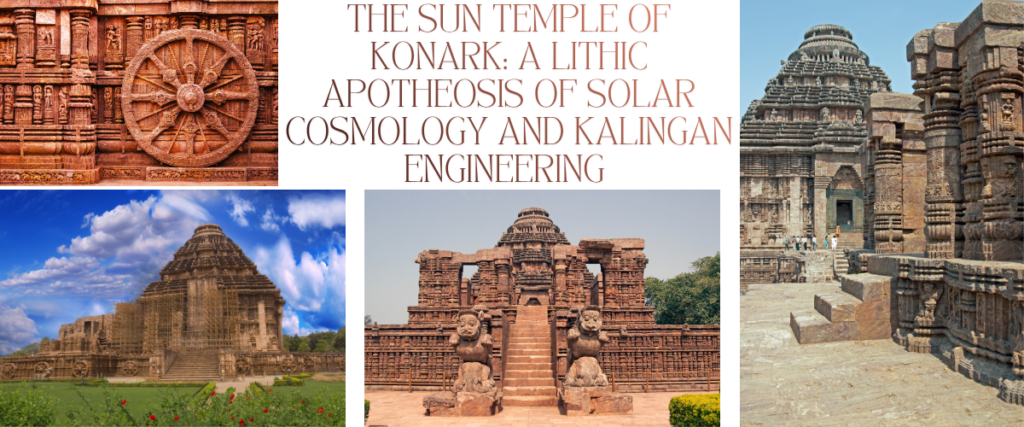
The Sun Temple of Konark: A Lithic Apotheosis of Solar Cosmology and Kalingan Engineering
The Sun Temple at Konark, situated on the eastern littoral of the Indian subcontinent in the state of Odisha, represents the definitive climax of the Kalinga school of architecture and stands as one of the most sublime monuments of medieval South Asian artistic achievement. Conceived in the 13th century as a monumental stone chariot for the Hindu solar deity, Surya, the temple is more than a mere site of worship; it is an intricate fusion of theological symbolism, sophisticated astronomical timekeeping, and royal political assertion. Its name, derived from the Sanskrit Kona (corner) and Arka (sun), denotes its location in the “Corner of the Sun,” a region historically revered as Ark Kshetra. Designated as a UNESCO World Heritage site in 1984, the temple complex, even in its partially ruined state, continues to captivate researchers and pilgrims alike through its grand scale, the precision of its solar alignments, and a sculptural program that encompasses the entirety of human and divine experience.