The 52nd G7 Summit in Évian-les-Bains: Multilateralism, Transactional Diplomacy, and the Restructuring of Global Governance

The 52nd G7 Summit in Évian-les-Bains: Multilateralism, Transactional Diplomacy, and the Restructuring of Global Governance

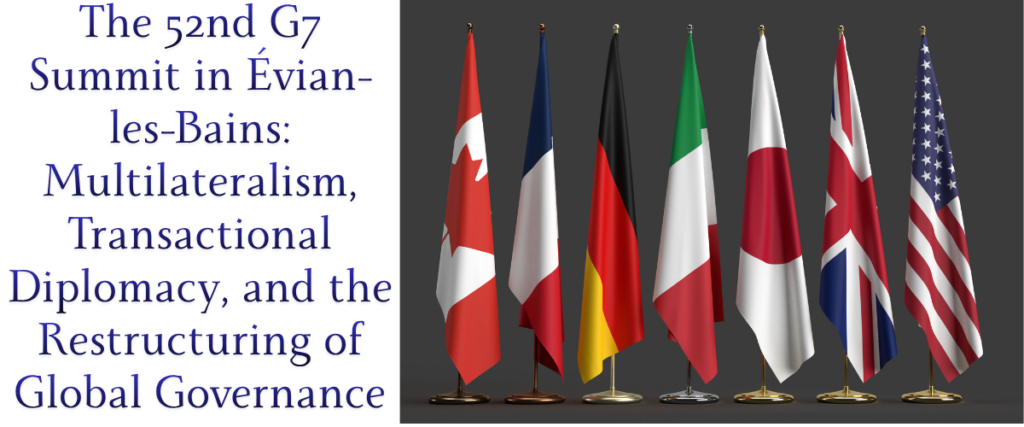
The 52nd G7 Summit, hosted by France in the alpine resort town of Évian-les-Bains from June 15 to 17, 2026, convened at a critical juncture marked by severe geopolitical volatility, trade frictions, and systemic challenges to global governance. The summit’s proceedings and side negotiations exposed a complex interplay between formal, institutionalised multilateralism and a rising tide of bilateral transactional diplomacy. While the formal agenda prioritised the reduction of global economic imbalances, critical mineral security, and pioneering regulations on artificial intelligence (AI), the event was heavily overshadowed by dramatic diplomatic breakthroughs and unilateral actions. Chief among these was the signing of a peace memorandum of understanding (MoU) between the United States and Iran at the Palace of Versailles, bringing a precarious end to three months of intense military hostilities. Simultaneously, European leaders successfully navigated diplomatic rifts to secure unified commitments on Ukraine, while guest nations from the Global South leveraged their invitations to advance national security and commercial objectives. This report provides an exhaustive analysis of the participant dynamics, major policy outcomes, tech-sovereignty disputes, and humanitarian initiatives that defined the 2026 summit.


The 52nd G7 Summit in Évian-les-Bains: Multilateralism, Transactional Diplomacy, and the Restructuring of Global Governance Read More »

Information-Technology-Industry

Geopolitical Consolidation, Architectural Re-engineering, and the Physical Limits of the AI Era: Global IT Industry Review for the Week Ending 19 June 2026

In June 2026, the AI industry experienced unprecedented regulatory disruption and market consolidation. The US government suspended Anthropic’s Claude Fable 5 over security concerns, exposing severe geopolitical vulnerabilities. Simultaneously, Salesforce’s purchase of Fin and SpaceX’s acquisition of Cursor highlight a rapid industry shift toward vertically integrated, autonomous AI agent workflows.

Geopolitical Consolidation, Architectural Re-engineering, and the Physical Limits of the AI Era: Global IT Industry Review for the Week Ending 19 June 2026 Read More »

The Typology and Technical Mechanics of Sketching Styles: Material Behaviours, Methodologies, and Professional Frameworks

The Typology and Technical Mechanics of Sketching Styles: Material Behaviours, Methodologies, and Professional Frameworks

Material Classification and Medium Dynamics

Sketching is fundamentally defined by the physical interaction between a drawing medium and the substrate surface. The physical properties of these materials dictate how marks are generated, controlled, and preserved, exerting a profound influence on the final artistic style. Drawing mediums are broadly categorised into five primary families based on their material mechanics: dry precision, dry expressive, liquid, grease-based, and experimental digital hybrids.

The Typology and Technical Mechanics of Sketching Styles: Material Behaviours, Methodologies, and Professional Frameworks Read More »

The Ecological and Anthropological Tapestry of Bhitarkanika National Park, Odisha, India: An Estuarine Conservation Analysis

The Ecological and Anthropological Tapestry of Bhitarkanika National Park, Odisha, India: An Estuarine Conservation Analysis

Geographical and Hydrological Architecture

Bhitarkanika National Park, nestled in the Kendrapara district of northeastern Odisha, represents one of the most complex estuarine wetland networks in the Indian subcontinent. Covering a core national park area of 145 square kilometres, the system is situated within the broader Bhitarkanika Wildlife Sanctuary, which extends over 672 square kilometres. This geographical configuration sits in the deltaic region formed by the confluence of major seasonal river systems, specifically the Brahmani, Baitarani, Dhamra, and Pathsala rivers, before they discharge into the Bay of Bengal.

The Ecological and Anthropological Tapestry of Bhitarkanika National Park, Odisha, India: An Estuarine Conservation Analysis Read More »

Geopolitics

The U.S.-China Tech Truce Fallacy: Why High-Level Summits Fail to Resolve Structural Friction Over Advanced Semiconductors and Taiwan

The high-profile diplomatic engagements between U.S. President Donald Trump and Chinese President Xi Jinping are frequently heralded as crucial turning points capable of stabilising the world’s most critical bilateral relationship. The bilateral summits—such as the trade truce negotiated in Busan, South Korea, in October 2025, and the subsequent state visit to Beijing on May 14–15, 2026 —have been framed by official readouts as historic steps toward building “a constructive relationship of strategic stability”. These meetings, heavily promoted in Chinese media as a “historic reset”, have sought to project an image of mutual understanding, complete with public commitments on agricultural purchases and aviation deals.

The U.S.-China Tech Truce Fallacy: Why High-Level Summits Fail to Resolve Structural Friction Over Advanced Semiconductors and Taiwan Read More »

Scroll to Top