Author name: Swapnil Bhatnagar

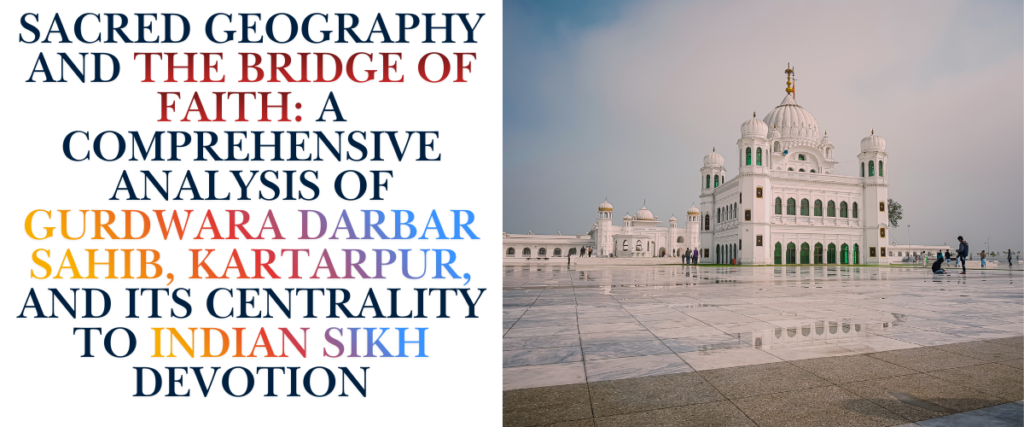
Sacred Geography and the Bridge of Faith: A Comprehensive Analysis of Gurdwara Darbar Sahib, Kartarpur, and its Centrality to Indian Sikh Devotion

Sacred Geography and the Bridge of Faith: A Comprehensive Analysis of Gurdwara Darbar Sahib, Kartarpur, and its Centrality to Indian Sikh Devotion

The spiritual landscape of the Sikh faith is defined by a unique relationship between geography, memory, and the divine. For the global Sikh community, and specifically for those residing in India, few sites hold as much transformative power as Gurdwara Darbar Sahib, Kartarpur. Located on the right bank of the Ravi River in Pakistan’s Narowal district, this sacred site represents the foundational cradle of Sikhism. It is not merely a destination for religious tourism but is widely regarded as the “City of the Creator,” the place where the abstract spiritual insights of Guru Nanak Dev Ji, the first Sikh Guru, were crystallised into a lived social reality. The significance of Kartarpur for Indian Sikhs is multifaceted, encompassing historical reverence, the trauma of the 1947 Partition, the ritual of long-distance devotion, and the complex geopolitical struggle for physical access that culminated in the opening—and subsequent challenges—of the Kartarpur Corridor.

Sacred Geography and the Bridge of Faith: A Comprehensive Analysis of Gurdwara Darbar Sahib, Kartarpur, and its Centrality to Indian Sikh Devotion Read More »

Regenerative Gardening: Moving Beyond "Organic" to Soil-Healing Systems

Regenerative Gardening: Moving Beyond “Organic” to Soil-Healing Systems

The evolution of sustainable horticulture has reached a critical juncture where the mitigation of environmental harm is no longer sufficient to address the compounding crises of soil degradation, biodiversity loss, and climate instability. While the “organic” movement provided a necessary departure from the heavy chemical reliance of the mid-twentieth century, it often remains a prescriptive system focused on the avoidance of prohibited substances rather than the active restoration of ecological functions. Regenerative gardening emerges as a proactive paradigm shift, moving beyond the “do no harm” philosophy of organic standards to embrace a holistic, outcomes-based approach that seeks to heal the land, sequester atmospheric carbon, and rebuild the complex biological networks that define healthy soil.

Regenerative Gardening: Moving Beyond “Organic” to Soil-Healing Systems Read More »

Information-Technology-Industry

The Global Information Technology Sector: Structural Pivots and Physical Fragility (Week Ending 13 March 2026)

The global information technology sector is rapidly pivoting toward the “industrialisation of artificial intelligence,” highlighted by massive $650 billion infrastructure investments from leading hyperscalers in 2026. However, this digital expansion faces physical vulnerabilities, notably a geopolitically driven helium shortage currently threatening the entire global semiconductor manufacturing supply chain.

The Global Information Technology Sector: Structural Pivots and Physical Fragility (Week Ending 13 March 2026) Read More »

Weekly-Financial-Review-

Global Equity Markets and Economic Synthesis: Weekly Review Ending 13 March 2026

The week ending 13 March 2026 brought **profound systemic stress** to global equity markets. An **escalating Middle East conflict** and the strategic blockade of the Strait of Hormuz triggered severe energy volatility. Consequently, intense “risk-off” sentiment and looming fears of stagflation firmly dominated global investor discourse across major trading floors.

Global Equity Markets and Economic Synthesis: Weekly Review Ending 13 March 2026 Read More »

The Persian Canvas: A Comprehensive Narrative of Artistic Evolution, Philosophy, and Technical Mastery

The Persian Canvas: A Comprehensive Narrative of Artistic Evolution, Philosophy, and Technical Mastery

The history of Persian painting is a multi-millennial odyssey that transcends mere aesthetics, serving as a profound mirror to the cultural resilience, spiritual yearning, and intellectual sophistication of the Iranian people. From the archaic sketches found in prehistoric caves to the luminous, gold-flecked manuscripts of the Timurid and Safavid courts, and finally to the vibrant experiments of modern practitioners, this artistic tradition has consistently sought to visualise the “imaginary screen” of the soul. In the Persian worldview, the act of painting is rarely about the mere imitation of nature; rather, it is an attempt to capture the essence of the “example universe”—a realm existing between the sensible and the reasonable where the divine light illuminates all forms.

The Persian Canvas: A Comprehensive Narrative of Artistic Evolution, Philosophy, and Technical Mastery Read More »

The Shadow of the Burnt Peak: A Comprehensive Research Report on the Legend and Legacy of Mount Tarawera

The Shadow of the Burnt Peak: A Comprehensive Research Report on the Legend and Legacy of Mount Tarawera

The volcanic history of New Zealand is written in layers of ash, scoria, and deeply held cultural narratives. Among the various peaks that define the Taupō Volcanic Zone, Mount Tarawera stands as a singular monument to the duality of natural beauty and catastrophic power. Known to the Māori as the “Burnt Peak” or “Burnt Spear,” Tarawera’s history is not merely a chronicle of geological events but a complex tapestry of spiritual warnings, ancestral guardianship, and the eventual destruction of one of the world’s greatest natural wonders. The eruption of June 10, 1886, remains the deadliest volcanic event in the post-European history of New Zealand, a disaster that was, according to local legend, heralded by an unmistakable spectral omen: the phantom canoe of Lake Tarawera.

The Shadow of the Burnt Peak: A Comprehensive Research Report on the Legend and Legacy of Mount Tarawera Read More »

Scroll to Top