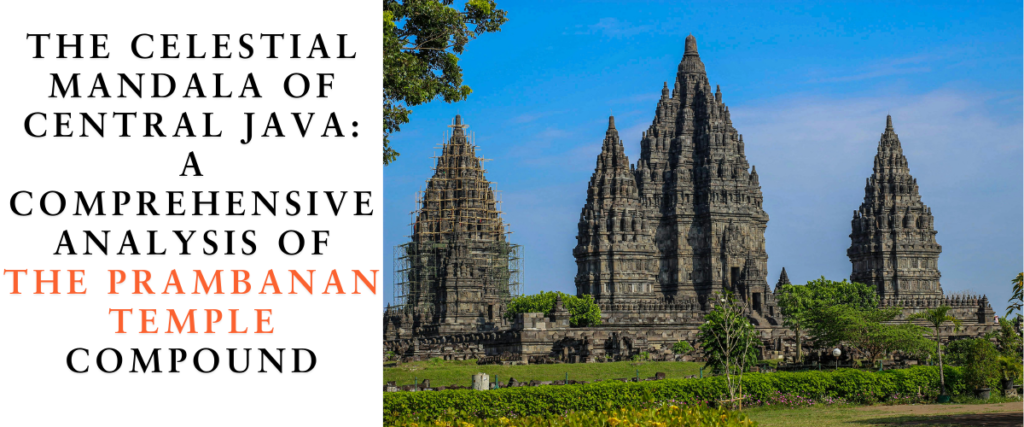
The Celestial Mandala of Central Java: A Comprehensive Analysis of the Prambanan Temple Compound
The central plains of Java, Indonesia, serve as a silent witness to one of the most sophisticated spiritual and architectural endeavours of the first millennium. Rising from the volcanic soil of the Prambanan Plain, the 9th-century Hindu temple compound of Prambanan, also known locally as Candi Prambanan or Loro Jonggrang, stands as a monumental testament to the Sanjaya dynasty’s religious devotion and political authority. Dedicated to the Trimurti—the expression of the divine as the Creator (Brahma), the Preserver (Vishnu), and the Destroyer (Shiva)—the complex is not merely a collection of stone structures but a physical manifestation of Hindu cosmology, designed to mirror the sacred Mount Meru, the abode of the gods. As the largest Hindu temple site in Indonesia and the second-largest in Southeast Asia after Angkor Wat, Prambanan represents a pinnacle of classical Javanese art and architecture, reflecting a period where spiritual philosophy and advanced engineering converged to create an enduring legacy of stone.