
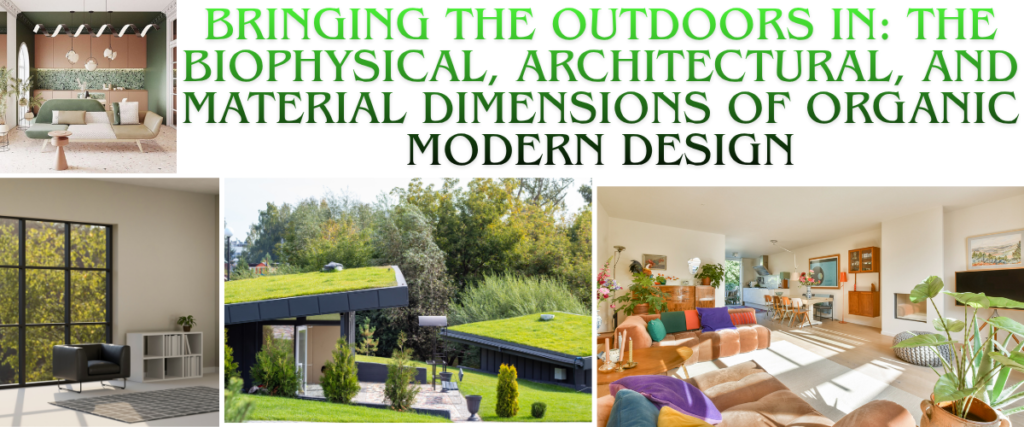
Foundations of Organic Modernism: History, Philosophy, and Evolution
The contemporary residential interior is undergoing a profound structural evolution. In an era dominated by relentless digital immersion, screen fatigue, and urban density, the domestic space is increasingly required to serve as a grounding psychological sanctuary.1 This socio-cultural pressure has driven the rise of “Organic Modern” interior design, an aesthetic that balances contemporary minimalism with the warmth, texture, and restorative properties of the natural world.2
The Transition from Cold Minimalism
During the 2010s, stark, clinical minimalism dominated high-end residential architecture.4 Defined by monochromatic colour schemes, high-gloss synthetic surfaces, and rigid geometries, this movement offered visual order but was often critiqued as cold, impersonal, and emotionally detached.4 Organic Modern design emerged as a direct response to this spatial sterility.4 It preserves the clean lines, uncluttered floor plans, and functional focus of modernism while softening the edges through raw, tactile natural materials.3 This evolution represents a shift toward “warm simplicity”—a design approach that seeks clarity without coldness and simplicity with a genuine sense of soul.3
Architectural Ancestry and Philosophical Roots
Rather than a passing digital trend, Organic Modernism represents the convergence of several major architectural and philosophical traditions.1 It draws directly from mid-century modernism, Japanese wabi-sabi philosophy, and the principles of organic architecture championed by twentieth-century pioneers such as Frank Lloyd Wright and Alvar Aalto.1 These architects advanced the belief that human dwellings should be designed in harmony with their surrounding landscapes, utilising local materials, celebrating natural imperfections, and fostering a seamless connection between the interior and exterior environments.4
This architectural foundation is enriched by the Japanese concept of wabi-sabi, which finds beauty in transience, simplicity, and imperfection.1 In practice, this means prioritising natural patinas, asymmetrical forms, and materials that weather gracefully over time over high-gloss, manufactured finishes.1
The style also aligns with “slow living,” a movement focused on reducing unnecessary decorative excess to foster psychological wellbeing, everyday comfort, and ecological responsibility.2 Consequently, Organic Modern interiors favor curated, meaningful collections over mass-produced furniture sets, encouraging a home that feels “collected rather than decorated”.1
The Science of Biophilic Design and Wellness
At the core of the Organic Modern movement is biophilic design—the practice of integrating natural features and processes into the built environment to support human health and cognitive performance.4
The Evolutionary Imperative of Biophilia
The term “biophilia,” first introduced by psychoanalyst Erich Fromm and later developed by biologist E.O. Wilson, describes an innate, genetically determined human need to connect with life and lifelike processes.6 Wilson argued that because humanity evolved in direct contact with natural environments, humans possess a biological affinity for the textures, lighting patterns, and geometries of nature.6 Modern urban life, which frequently separates people from these natural stimuli, can disrupt this biological connection, contributing to chronic stress, fatigue, and decreased cognitive function.1
To address this, biophilic design incorporates natural light, fresh air, moving water, and organic materials into residential layouts.2 This integration supports mental health, lowers physiological stress markers, and creates a restorative domestic environment.4
Direct and Indirect Multi-Sensory Pathways
Biophilic design pioneer Stephen Kellert established a framework dividing the integration of nature in the built environment into direct and indirect experiences.6 Organic Modernism utilises both pathways to create a rich, multi-sensory domestic landscape 6:
- Direct Environmental Experience: This pathway focuses on tangible contact with natural elements like light, air, and water.6 Large windows, skylights, and glazed internal doors maximise natural light, which helps regulate human circadian rhythms and track the passage of time.2 Natural ventilation, achieved through strategically positioned operable windows, introduces changes in temperature and air velocity that mimic the outdoors, preventing air stagnation.6 Integrating indoor water features, such as fountains or reflective pools, adds natural movement and soothing acoustic elements to the home.6
- Indirect Natural Experience: This pathway utilises natural geometries, materials that age over time, and representations of natural systems.6 Using wood and stone surfaces that show a natural patina or grain represents a key indirect experience, prompting a positive cognitive response to the passage of time in our surroundings.6
- Vegetative Vitality: Incorporating indoor plants goes beyond decoration; it serves as a direct biophilic link.2 Plants like aloe vera, snake plants, and spider plants improve indoor air quality by removing environmental toxins like benzene and formaldehyde.9 Rather than scattering small potted plants throughout a room—which can create visual clutter—designers favour large, sculptural flora, such as fiddle-leaf figs, Monstera deliciosa, or tall arrangements of wild-foraged branches in heavy stone vases.1
Spatial Engineering, Soft Geometry, and Architectural Flow
To keep an Organic Modern space from feeling too rustic or chaotic, design professionals use a disciplined spatial layout.2 This approach relies on soft geometries and open floor plans to maintain clean lines and an uncluttered feel.1
Soft Geometry and the Three-to-One Rule
While traditional modernism relies on sharp, hard-edged geometric grids, Organic Modernism introduces fluid, curvilinear shapes that mimic natural contours.1 To balance these elements, design practitioners often apply a geometric guidelines ratio: for every three linear, straight-edged pieces of furniture in a room, one prominent curved element should be introduced to break the visual grid.1
This rule creates a pleasing tension between the structured and the sculptural.1 Typical curvilinear additions include kidney-shaped sofas, rounded nesting coffee tables, arched entryways, and fluid pendant lights.1 These soft geometries are often paired with low-profile furniture, like low-slung lounge chairs and platform beds, keeping sightlines open and emphasising a sense of spaciousness.8
Flexible Zoning and Indoor-Outdoor Integration
The spatial layout of an Organic Modern home prioritises light, airy, and continuous floor plans.2 However, entirely open-plan layouts can sometimes lack acoustic privacy and clear functional definition.2 To resolve this, architects employ flexible zoning.2
Using internal glazed doors or double doors allows different zones to be closed off physically while preserving visual connection and light transmission.2 Sliding barn doors in textured wood or patinated metal offer a space-saving, rustic alternative that adds architectural detail to the home.2
Furthermore, the physical envelope of the home is designed to blur the line between indoor and outdoor spaces.7 Architects achieve this through large bifold patio doors, covered transition walkways, continuous flooring materials that extend from the living room to the patio, and outdoor living areas built directly into the home’s layout.2
Comparative Design Analysis
To understand the unique qualities of Organic Modernism, it is helpful to compare its core features with traditional minimalism and Scandinavian design.4
| Design Parameter | Traditional Minimalism | Scandinavian Design | Organic Modern | Source |
| Philosophical Focus | Extreme reduction; “less is more”; elimination of ornament.4 | Democratic design; functional simplicity; maximising natural light.4 | Warm simplicity; biophilic connection; balancing contemporary structure with natural elements.2 | 2 |
| Material Palette | Chrome, glass, polished concrete, high-gloss lacquered plastics.5 | Blond timbers (pine, birch), light wools, painted surfaces.4 | Raw, textured timbers (oak, walnut), honed stone, plaster, bouclé, linen, jute.1 | 1 |
| Color Strategy | High-contrast, monochromatic (pure white, cold grey, black).4 | Cool neutrals; pale blues; white bases with soft, light woods.4 | Warm neutrals, oatmeals, and putties accented by terracotta, sage, and soft charcoal.1 | 1 |
| Geometric Form | Rigid, linear grids; sharp, angular architectural lines.10 | Straightforward, clean-lined, functional geometry. | Curved, organic shapes are integrated via a structural three-to-one balancing ratio.1 | 1 |
| Sensory Atmosphere | Pure, structured, expansive; sometimes perceived as cold.4 | Bright, clean, cozy (hygge), highly functional. | Grounded, calming, multi-sensory, and focused on wellness.2 | 2 |
The Curated Material Palette: Textural Contrasts and Spatial Depth
In an interior defined by restraint and a muted colour palette, texture becomes a key tool for creating depth and visual interest.1 Designers replace high-contrast colours with tactile variety, combining smooth and rough, soft and hard, and matte and gloss finishes.4 This sensory contrast keeps the eye engaged and makes a space feel warm and lived-in.4
Unpolished Woods and Natural Stones
Wood is a foundational material in Organic Modern design, valued for its warmth, texture, and natural grain.2 The style avoids yellowed, high-gloss finishes in favour of matte, low-sheen woods like white oak, walnut, wenge, and sustainable bamboo.1 Reclaimed timber is highly prized for its unique character and environmental sustainability, and is often used for exposed ceiling beams, custom mantelpieces, or large statement furniture.5
These rich timbers are paired with natural, non-reflective stones.1 Rather than using high-gloss, polished marble, designers opt for honed, matte finishes on travertine, limestone, granite, and soapstone.1 These porous, textured stone surfaces absorb light, creating a softer and more inviting atmosphere.1
Tactile Textiles and Wall Finishes
Soft textiles are layered throughout the home to balance the hard stone and wood surfaces.1 High-quality, natural fibres such as slubby linen, nubby bouclé, hand-woven wool, alpaca, jute, sisal, and soft leather provide physical comfort and improve room acoustics.1
To complement these materials, flat drywall is often replaced with hand-applied wall finishes.1 Limewash, tadelakt plaster, and micro-cement add subtle, textured movement to walls and ceilings, catching the light and mimicking the uneven finishes found in nature.1
| Material Class | Selected Material | Tactile & Visual Properties | Strategic Pairings | Primary Application | Source |
| Hardwood | Matte White Oak / Walnut | Rich wood grains; warm, low-sheen organic surface.1 | Honed Travertine, Slubby Linen, Matte Black Metal.1 | Millwork, Flooring, Dining Tables, Ceiling Beams.8 | 1 |
| Natural Stone | Travertine / Soapstone | Matte, porous texture; subtle, natural colour variations.1 | Unfinished Oak, Aged Brass, Textured Bouclé.1 | Kitchen Countertops, Coffee Tables, Fireplace Surrounds.1 | 1 |
| Wall Surface | Limewash / Clay Plaster | Chalky, breathable, non-reflective; natural visual movement.1 | Reclaimed Timber, Linen Textiles, Raw Leather.1 | Drywall Replacement, Fireplace Accents, Ceilings.1 | 1 |
| Heavy Textile | Textured Bouclé / Alpaca | Plush, highly tactile; soft, dimensional surface.1 | Matte Plaster, Smooth Stone, Dark Walnut.1 | Sculptural Lounge Chairs, Throw Blankets, Pillows.1 | 1 |
| Natural Fiber | Woven Jute / Sisal | Coarse, durable, organic texture; earthy golden tone.1 | Wool Rugs, Polished Wood, Honed Stone.14 | Oversized Area Rugs, Storage Baskets, Accent Stools.14 | 1 |
The Earth-Toned Colour Strategy: Expert Curations
The colour palette of an Organic Modern interior is designed to mimic the natural landscape, focusing on soothing, low-saturation hues.2 This palette uses warm neutral foundations layered with earthy accents and grounded by dark, contrasting details.1
The Warm Neutral Foundation
The foundation of the space starts with a wash of warm, soft whites, oatmeals, putties, and soft greys.1 Design styling guides recommend painting both walls and trim in the same chalky, low-sheen colour to create a seamless, continuous flow between rooms.14
According to colour consultant Erika Woelfel, VP of Colour and Creative at Behr, layering these light neutrals keeps a room feeling open and airy.13 A classic combination is Behr’s Even Better Beige on the walls, paired with Blank Canvas for cabinetry and millwork.13 For a softer, light-diffusing base, designers often use Benjamin Moore’s Swiss Coffee at 75% strength.1
Earthy Transition Tones and Grounding Accents
To prevent a neutral base from looking flat, designers layer in muted, natural transition colours.1 Warm terracotta, sand, baked clay, mustard ochre, and dusty rose are used to add physical warmth and a cozy feel to seating areas.4
Cooler transition tones, like sage green, muted olive (with subtle grey undertones), slate blue, lavender, and pale eggplant, bring a sense of calm and mimic coastal or forest landscapes.13 To anchor these soft hues, deep grounding accents are introduced.1 Soft blacks, charcoal greys (such as Behr’s Cracked Pepper), and dark, earthy bronzes (such as Sherwin-Williams’ Urbane Bronze) are applied to doors, window frames, and hardware to add visual structure and contrast.1
| Color Category | Recommended Paint Name | Code | Suggested Application | Design Function | Source |
| Warm Foundation | Benjamin Moore Swiss Coffee (75% Strength) | OC-45 | Large-scale walls, ceilings, and open spaces | Soft, light-diffusing base; prevents visual harshness.1 | 1 |
| Warm Foundation | Behr Even Better Beige | BXC-81 | Main living areas, bedroom walls | Establishes a warm, sandy backdrop; pairs with linen.13 | 13 |
| Soft Cabinetry | Behr Blank Canvas | DC-003 | Kitchen cabinets, built-in shelving, trim | Crisp, clean transition; highlights raw wood accents.13 | 13 |
| Earthy Accent | Farrow & Ball Treron | No. 292 | Kitchen islands, bathroom vanities, study | Deep, muted moss green brings nature indoors.1 | 1 |
| Warm Accent | Behr Nutshell | S210-6 | Accent walls, dining built-ins | Rich, warm brown; grounds lighter sandy tones.13 | 13 |
| Grounding Dark | Sherwin-Williams Urbane Bronze | SW 7048 | Internal doors, window mullions, trim | Moody bronze-black; provides architectural structure.1 | 1 |
| Grounding Dark | Behr Cracked Pepper | PPU18-01 | Fireplace surrounds, metal hardware | Soft, textured black; helps lighter neutrals pop.13 | 13 |
Room-by-Room Design Guide
To implement the Organic Modern style, these principles of materiality, soft geometry, and biophilic flow must be tailored to the unique functions of each room in the home.1
The Entryway: The Sensory Transition
The entryway establishes the home’s calm atmosphere and acts as a transition from the busy outside world.11 This space is kept simple and uncluttered, centred on a rustic wood console table, a reclaimed bench, or a large timber credenza.11
The layout is styled with a large, minimalist round mirror to maximise natural light, a hand-woven runner rug, a singular ceramic vase with dried botanicals, and low, warm ambient lighting to create an immediate sense of comfort.11
The Living Room: Restorative Seating and Curated Elements
The living room is designed to support relaxation and comfortable gathering.11 Instead of matching furniture sets, the seating arrangement combines different styles and eras, such as a low-profile, clean-lined sofa (like King Living’s Aura Island design) paired with a textured bouclé curved chair or a classic mid-century Eames lounge chair.3
The central coffee table is a key feature, made from a natural material like travertine, honed marble, or a solid wood stump.1 Storage is tucked away in custom wood cabinetry, which can be flanked by built-in plaster shelving to showcase curated handmade pottery and local artwork.10
A large jute area rug is used to define the seating space, layered with a smaller, hand-woven Moroccan wool rug directly under the coffee table to add comfort and texture.11
The Culinary and Dining Space: Raw Elements and Crafted Details
In the kitchen, high-gloss finishes and extensive stainless steel are replaced with warm, natural textures.1 Base cabinets are crafted from textured timbers like white oak or walnut, paired with honed stone countertops.1
Upper cabinetry is often replaced with open wood shelves to keep the space feeling light and open.11 These shelves hold practical, beautiful kitchen tools like hand-carved cutting boards, stone mortars and pestles, and textured stoneware.11
A simple marble pastry board placed on the counter adds a touch of functional luxury without requiring a full remodel.14
In the adjacent dining area, the design centres on a large, solid wood dining table—made from light oak or reclaimed timber—paired with woven rattan counter stools and minimalist paper or cone pendant lights.8
The Bedroom: A Quiet Sanctuary
The bedroom is engineered as a calm, quiet sanctuary designed to support deep rest.9 The bed serves as the focal point, featuring a clean-lined wooden platform design, a simple upholstered frame (such as the Laurel Bed), or a minimalist canopy bed made from sustainable timber.9
The bedding is kept highly breathable and tactile, composed of organic linen or un-ironed cotton in soft, neutral shades.9 Tactile warmth is layered over the bed with heavy-knit wool blankets or alpaca throws.8
Bedside lighting is kept soft and warm, using dimmer switches and small table lamps with woven shades to create a relaxing evening atmosphere.9 The room is finished with a few personal touches, like a vintage rug, a woven leather pouf, and a potted snake plant to help naturally purify the air.9
The Bath: A Textured Spa Environment
To create a spa-like retreat, standard clinical tiling is replaced with seamless plaster, micro-cement, or tadelakt wall finishes that wrap the space in a soft, continuous texture.1
Vanities are constructed from rich, water-resistant woods and topped with natural stone or concrete vessel sinks.11 Modern plumbing fixtures in matte black, brushed nickel, or unlacquered brass provide a clean, contemporary contrast to the organic walls.1
The space is finished with high-quality, functional details: a bathmat made from slatted teak or smooth river stones, thin, fringed Turkish hand towels, and liquid soap displayed in dark amber glass bottles.11
The Outdoor Living Space: Blurring the Boundaries
Following the work of outdoor design firms like Foxterra Design, the outdoor living space is treated as a direct extension of the home’s interior.12 This area is designed with durable materials that can withstand the elements while maintaining a refined, indoor feel.12
An outdoor kitchen, integrated into the initial layout of the yard rather than added as an afterthought, is positioned close to dining and lounge spaces to create a natural flow.12 Features like swim-up pool bars, covered lounge seating with outdoor fireplaces, and continuous stone paving help to thin the boundary between the interior home and the surrounding landscape.7
Practical Styling Strategies: High-Low Curation and Artful Assembly
Achieving a high-end Organic Modern aesthetic does not require an unlimited budget.14 The most successful spaces are built slowly over time, mixing accessible basics with a few carefully chosen investment pieces.1
High-Low Sourcing and Curating Over Time
To prevent a home from looking like a single big-box catalogue, designers recommend sourcing basic furniture in solid black or white from budget-friendly retailers and then pairing them with one or two unique investment pieces.1 For example, simple black dining chairs can be paired with a custom reclaimed wood dining table, or a basic neutral sofa can be elevated with high-quality, handmade linen pillows and a designer lounge chair.11
Art can also be sourced affordably by framing pages from high-quality art or design magazines in simple, matted oak frames, creating custom gallery walls at a low cost. 14
Foraged Materials and Textured Layers
One of the most effective styling strategies is using natural, foraged elements as decor.14 A large piece of weathered driftwood placed in a corner, a collection of interesting stones or geodes displayed on a shelf, or a rustic pile of firewood logs next to the hearth, adds instant texture and character for little to no cost.14
To add physical warmth without cluttering the space, designers layer small, high-quality textiles over larger, affordable foundational pieces.14 For instance, a small, hand-woven Moroccan rug can be layered directly over a large, budget-friendly jute or sisal rug under the coffee table, adding comfort and personality while keeping costs manageable.14
| Budget Tier | Decor Item | Strategic Selection & Styling Tips | Core Material | Source |
| High (Investment) | Architectural Sofa / Lounge Chairs | Invest in comfort and timeless geometry; choose classic designs like the Aura Island or an Eames Lounge Chair.3 | High-quality linen, wool bouclé, or top-grain leather.1 | 1 |
| High (Investment) | Core Dining / Coffee Tables | Select a solid, natural timber or honed stone table to serve as the room’s grounding anchor.3 | Reclaimed oak, dark walnut, travertine, or soapstone.1 | 1 |
| Low (Budget) | Foundational Floor Coverings | Purchase an oversized natural fibre rug to cover the floor space, then layer a smaller, high-quality rug on top.14 | Braided jute, woven coir, or natural sisal.14 | 14 |
| Low (Budget) | Organic Display & Styling Objects | Gather unique natural objects or create custom art by framing high-quality magazine prints in simple oak frames.14 | Driftwood, river stones, shed antlers, and pressed botanicals.9 | 9 |
| Low (Budget) | Dynamic Interior Greenery | Choose durable, easy-to-care-for plants that improve indoor air quality.9 | Potted snake plants, spider plants, or tall wild-foraged branches.1 | 1 |
Conclusion
The Organic Modern movement is much more than a temporary trend in interior styling.2 It represents a lasting shift in how residential spaces are designed to support human health, cognitive performance, and everyday comfort.2 By balancing the clean lines of modern minimalism with the rich, tactile warmth of the natural world, this design approach creates spaces that feel both refined and deeply grounding.2
As daily life becomes increasingly digital, the home must serve as a restorative space.1 Through the use of biophilic principles, warm natural materials, soft geometries, and open, light-filled layouts, Organic Modernism successfully bridges the gap between contemporary design and our natural need to remain connected to the outdoors.2
Disclaimer
The architectural concepts, material specifications, and design strategies presented in this report are intended for educational and inspirational purposes only. Structural changes to a home—such as installing large bifold doors, adding skylights, removing walls, or installing heavy stone elements—must always be reviewed and completed by a licensed contractor and structural engineer. Before applying specialty finishes like plaster, tadelakt, or micro-cement in wet areas, ensure the materials are properly sealed and certified for moisture resistance to prevent structural water damage or mould growth. Paint colours, sheens, and wood finishes should always be tested with physical samples in the specific lighting of the space before final application.
References
- Organic Modern Interior Design: How to Master the Look in 2026 …, accessed on May 23, 2026, https://www.hackrea.net/stories/organic-modern-interior-design/
- Organic Modern Interior Design: A Sense of Natural Harmony, accessed on May 23, 2026, https://www.climadoor.co.uk/blog/the-organic-modern-interior-design-trend/
- Organic Modernism: Why This Interior Design Trend Is Here to Stay | King Living, accessed on May 23, 2026, https://www.kingliving.com/blog/organic-modern
- Guide to Organic Modern Interior Design – Award Carpets Gold Coast, accessed on May 23, 2026, https://www.award-carpets.com.au/flooring/guide-to-organic-modern-interior-design/
- A guide to organic modern interior design – Senhoma, accessed on May 23, 2026, https://senhoma.com/blogs/blog/organic-modern-interior-design
- Biophilic design – Wikipedia, accessed on May 23, 2026, https://en.wikipedia.org/wiki/Biophilic_design
- The Four Key Elements of Organic Modern Design – Exquisite Surfaces, accessed on May 23, 2026, https://xsurfaces.com/blogs/stories/elements-of-organic-modern-design
- Organic Modern Interior Design – Abstract House, accessed on May 23, 2026, https://abstracthouse.com/blogs/inspiration/organic-modern-interior-design
- A Guide to Organic Modern Style Bedrooms | Living Spaces, accessed on May 23, 2026, https://www.livingspaces.com/inspiration/ideas-advice/styles/a-guide-to-organic-modern-style-bedrooms
- What Is Modern Organic Interior Design? | Hommés Studio, accessed on May 23, 2026, https://hommes.studio/journal/what-is-modern-organic-interior-design/
- Beautiful Organic Modern Decor Ideas and Inspiration for 2026, accessed on May 23, 2026, https://jane-athome.com/organic-modern-decor-design-style/
- Foxterra Featured in Architectural Digest’s “62 Outdoor Kitchen Ideas for Luxury Backyard Living”, accessed on May 23, 2026, https://foxterradesign.com/foxterra-architectural-digest-outdoor-kitchen-ideas/
- 5 modern organic color schemes to instantly soothe your …, accessed on May 23, 2026, https://www.homesandgardens.com/interior-design/modern-organic-color-scheme
- 11 Ways to Get the Organic Modern Look for Less – Houzz, accessed on May 23, 2026, https://www.houzz.com/magazine/11-ways-to-get-the-organic-modern-look-for-less-stsetivw-vs~20750690
- 20 Top Organic Modern Interior Design Decorating Tips – Grace In My Space, accessed on May 23, 2026, https://graceinmyspace.com/20-top-organic-modern-interior-design-decorating-tips/
- 13 ways to adopt modern organic style in your home – NV Gallery, accessed on May 23, 2026, https://www.nvgallery.com/en/blogs/magazine/13-ways-to-adopt-modern-organic-style-in-your-home
- The Organic Modern Home – The Citizenry, accessed on May 23, 2026, https://www.the-citizenry.com/blogs/design/organic-modern