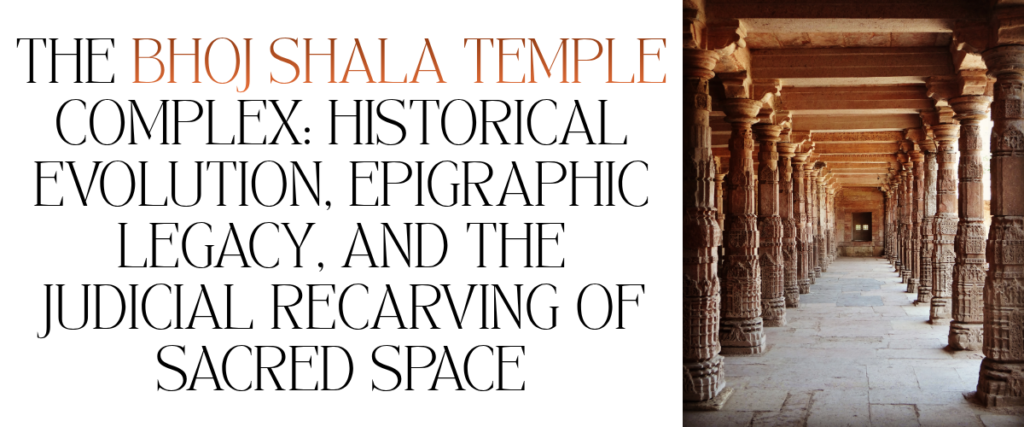
The Bhojshala monument in Dhar, Madhya Pradesh, occupies a singular and highly contested position in the cultural, architectural, and legal history of India.1 Originally established in the eleventh century as an imperial Sanskrit academy and a temple dedicated to the goddess Vagdevi (Saraswati) under the patron monarch Raja Bhoja of the Paramara dynasty, the complex underwent substantial structural alterations during the medieval period.1 These changes culminated in its dual identity as the Kamal Maula Mosque, named after the fourteenth-century Sufi saint Hazrat Maulana Kamaluddin Chishti.2
For decades, the site was managed under a shared-access compromise that attempted to balance the claims of both Hindu and Muslim devotees.1 However, a landmark decision by the Madhya Pradesh High Court on May 15, 2026, fundamentally redefined the status of the monument, declaring it a Hindu temple and quashing previous shared-access administrative orders.6 This decision has established a powerful new legal precedent regarding the intersection of archaeological science, constitutional law, and the preservation of historic monuments.8
Historical Origin and Intellectual Heritage
The origin of Bhojshala is tied to the golden age of the Malwa region under the Paramara dynasty, which ruled from the ninth to the fourteenth centuries.5 Raja Bhoja, who reigned from approximately 1010 to 1055 CE, was a celebrated monarch, military strategist, and polymath.2 He authored authoritative Sanskrit treatises on architecture (Samarangana Sutradhara), linguistics, philosophy, and grammar (Sarasvati-Kanthabharana).2 To establish his capital, Dhara (modern Dhar), as a preeminent seat of learning, Raja Bhoja founded a major university (shala) in 1034 AD.2 Historically described as the “ornament of eighty-four squares of Dharanagari,” this academic centre attracted scholars and poets from across the subcontinent.3
The physical architecture of the university was designed to serve as an active pedagogical tool.2 Engraved directly upon the stone pillars of the complex were the Sarpabandha (serpentine chart) inscriptions.5 These diagrams featured intricate grammatical guides: one pillar recorded the Sanskrit alphabet alongside the primary inflectional terminations of nouns and verbs, while a second mapped personal terminations for the ten tenses and moods of Sanskrit grammar.5
Further literary compositions were displayed on large stone slabs embedded in the walls.5 These included two distinct Prakrit odes, each consisting of 109 verses, dedicated to the Kurma-Avatara (the tortoise incarnation of Lord Vishnu).5 Additionally, slabs found behind the mosque’s western prayer niche (mihrab) recorded the text of the Parijatamanjari (also known as Vijayasri), a classical Sanskrit drama composed by the royal tutor Madana.13 Madana, a disciple of the prominent Jain scholar Ashadhara, composed the play during the reign of Arjunavarma Deva in the early thirteenth century.5 The drama, which was first performed in the temple of Saraswati (then termed Sharada Sadan), serves as a clear epigraphic record of the site’s primary academic and religious identity during the Paramara era.13
Medieval Conflict, Conversion, and Syncretic Architecture
The geopolitical landscape of Malwa shifted with the expansion of the Delhi Sultanate.2 The process of transition began in 1269 AD, when a Muslim missionary named Kamal Maulana entered Malwa.12 For thirty-six years, he gathered strategic information about the region before handing it over to the military forces of Alauddin Khilji.12 In 1305 AD, Khilji launched a destructive campaign against Dhar.12 In the ensuing battle, the Hindu monarch Raja Mahakaldev and his defending soldiers were defeated, and historical accounts indicate that approximately 1,200 students and teachers inside Bhojshala were executed upon refusing conversion to Islam.12
Over the next two centuries, successive Muslim rulers systematically altered the damaged remains of the temple and college.1 In 1401 AD, Dilawar Khan destroyed the nearby Vijay Mandir (Surya Martand temple) and converted a portion of the Saraswati temple into a dargah.12 Following the death of Hazrat Maulana Kamaluddin Chishti, who had spent decades preaching in the area, a tomb was erected next to the modified structure, which became known as the Kamal Maula Mosque.1 In 1514 AD, Mahmud Shah Khilji II further expanded the complex by constructing the Kamal Moulana Makbara on adjacent lands.12
A brief period of Hindu military resistance occurred in 1552 AD, when the Rajput knight Medaniray defeated Mahmud Khilji and occupied the Dhar fort, capturing 900 Muslim knights.12 However, on March 25, 1552, a soldier named Syed Masud Abdal Samarkandi reportedly released the prisoners through internal treachery, restoring Sultanate control.12
Architecturally, the resulting structure represents a rapid and opportunistic reuse of materials.15 Following the layout of early Sultanate mosques, such as the Quwwat-ul-Islam Mosque in Delhi, the building is designed as a square hypostyle court with cloisters on all four sides and an open-air courtyard in the centre.17 The builders repurposed 106 sandstone pillars and 82 pilasters salvaged from the dismantled Paramara temples.15
Many of these pillars were stacked vertically to achieve the structural height required for the Islamic prayer hall, leaving classical Hindu motifs—such as lotus medallions, kirtimukhas (gargoyle-like faces), and divine figures—highly visible, though often deliberately defaced.3 While Sultanate-era additions like the mihrab and prayer niches were introduced to orient the building toward the west, the domed ceilings retained their original concentric stone carvings, and classical Sanskrit slabs were used face-down to form the lining of the new walls.5
Historical Chronicle of the Bhojshala Complex
The timeline of key events, transitions, and discoveries associated with the Bhojshala complex spans nearly a thousand years of political and cultural change, as summarised below:
| Period / Year | Event and Description | Cultural and Structural Impact | Source Identifiers |
| 1034 AD | The founding of the Sanskrit academy and temple by Raja Bhoja of the Paramara Dynasty. | Established Dhara as a premier centre of grammar, science, and Saraswati worship. | 1 |
| 1269 AD | Entry of Sufi missionary Kamal Maulana into the Malwa region. | Commenced a 36-year reconnaissance, gathering political and regional data on Dhar. | 12 |
| 1305 AD | Invasion of Alauddin Khilji and fall of the Paramara kingdom. | Extensive damage to the academic complex and execution of defending scholars. | 12 |
| 1401 AD | Destruction of Vijay Mandir and early mosque conversion by Dilawar Khan. | Commencement of systematic architectural recycling of temple components. | 12 |
| 1514 AD | Construction of the Kamal Moulana Makbara by Mahmud Shah Khilji II. | Consolidated the site’s Islamic identity as a dargah and mosque complex. | 12 |
| 1552 AD | Capture of Dhar fort by Medaniray and subsequent restoration of Sultanate rule. | Highlighted regional military conflicts and the shifting control of the monument. | 12 |
| 1875 AD | Excavation of the Dhar City Palace ruins by Major General William Kincaid. | Discovery of the marble Ambika/Vagdevi sculpture and its transit to London. | 19 |
| March 1904 | The site was declared a protected monument under the Ancient Monuments Preservation Act. | Established legal custody of the monument under colonial and post-colonial law. | 1 |
| 1952 AD | Monument transferred to the Archaeological Survey of India (ASI). | Ignited modern civic and religious efforts to reclaim the site for Hindu worship. | 12 |
| 2003 AD | ASI issues an administrative shared-access compromise order. | Hindus permitted worship on Tuesdays; Muslims permitted Friday namaz. | 1 |
| March 2024 | Madhya Pradesh High Court orders a new comprehensive scientific survey. | Authorised a 98-day multidisciplinary survey to determine the site’s origins. | 4 |
| May 15, 2026 | Landmark judgment delivered by the Indore Bench of the High Court. | Declared the site a Hindu temple, quashed the 2003 shared-access order. | 6 |
The Vagdevi-Ambika Iconography and Colonial Relocation
During British colonial rule in 1875, excavations carried out during the reconstruction of the old city palace in Dhar uncovered a highly celebrated white marble sculpture.19 Discovered amid the debris, the 1.28-meter-tall sculpture was brought to the attention of Major General William Kincaid of the Indian Civil Service.19 Kincaid transported the sculpture to Britain in 1886, and in 1909, following his death, it formally became part of the British Museum’s collection under registration number 1909,1224.1.19
The identification of this sculpture is a subject of ongoing academic and religious discussion, as outlined below:
┌───────────────────────┴───────────────────────┐
▼ ▼
• Identified as Goddess Ambika • Identified as Goddess Vagdevi (Saraswati)
• Patron Yakshini of Neminath • Syncretic fusion of Vagdevi and Amba
• Supported by the 1981 Bhayani study • Affirmed by the MP High Court Verdict (2026)
• Base inscription names “Amba” • Focus of ongoing restitution efforts
The base of the sculpture contains an inscription in Sanskrit verse written in Nagari script, dated to the Vikrama Samvat year 1091 (1034-35 CE), during the reign of King Bhoja.20 The text identifies the donor as Soṣā, a lay follower of the Vidyadhari Jain lineage, and names the craftsmen as Maṇathala (son of Sahira) and the writer as the artisan Śivadeva.20
Jain scholars, supported by a 1981 linguistic study by H.C. Bhayani, argue that the sculpture depicts the Jain goddess Ambika, who serves as the attendant deity (yakshini) of the 22nd Jain Tirthankara, Neminath.1 This reading relies on the text’s explicit mention of fashioning “Ambā” and the standard iconographical conventions of Jain deities found in central India during the eleventh century.20
Conversely, popular Hindu tradition and early British administrators, such as O.C. Gangoly and former ASI Director General K.N. Dikshit, identified the sculpture as “Raja Bhoja’s Sarasvati from Dhar”.19 The base inscription reads:
vāgdevī[ṃ] prathama[ṃ] vidhāya jananī[ṃ]pas[c]āj jinānā[ṃ] trayīm | ambā[ṃ] nitya-phalādikāṃ vararuci[ṃ] m[ū]rtti[ṃ] s[u]bhā[ṃ] nirmmame || 20
“The lady Soṣā… having first installed Vāgdevī the Mother and subsequently a triad of Jinas, created this auspicious image of Ambā…” 20
This passage suggests that the donor commissioned a separate statue of Vagdevi (Saraswati) before creating this marble figure of Ambika.20
The Madhya Pradesh High Court resolved this difference in its 2026 ruling by declaring that Hinduism and Jainism are not separate entities under Indian law.1 The court held that Vagdevi and Amba represent different cultural expressions of the same divine concept of learning and wisdom.19 It officially designated the monument as a temple of “Goddess Vagdevi (Saraswati)” and directed the government to pursue diplomatic efforts for the repatriation of the original sculpture from the British Museum.6 Meanwhile, Hindu devotees in Dhar use a symbolic replica of the London sculpture, created by petitioner Kuldeep Tiwari’s group, for daily rituals.19
Post-Independence Contestation and the Shared-Access Era
Following the end of British rule, the monument was handed over to the central government in 1952 and placed under the protection of the ASI.12 Activists from the RSS, Hindu Mahasabha, and Arya Samaj worked to mobilise the local Hindu community and successfully stopped early attempts by some local residents to perform namaz outside of designated times.12 In the same year, the Maharaja Bhoj Smruti Vasantotsav Samiti was formed, and visits to the site on the festival of Vasant Panchami grew steadily.12
The dispute intensified following the demolition of the Babri Masjid in December 1992, leading to fresh petitions demanding exclusive Hindu worship rights.4 Tensions peaked in February 2003, when over one lakh Hindu devotees, supported by the VHP, gathered at the site.4 Clashes broke out when protesters tried to enter the complex, leading to police firing that resulted in several deaths and arrests.4
To restore order, the ASI issued an administrative compromise circular on April 7, 2003, allowing Hindus to worship on Tuesdays and during Vasant Panchami, while permitting Muslims to offer Friday prayers between 1:00 PM and 3:00 PM.4
This arrangement, however, remained a source of local friction.23 Whenever Vasant Panchami coincided with Friday prayers—as occurred in 2016 and 2026—the overlapping claims required massive police deployments and led to localised clashes and arrests.4
Scientific Deconstruction: The 2024 Archaeological Survey
To clarify the historical and physical layers of the monument, the Indore Bench of the Madhya Pradesh High Court ordered a fresh scientific survey on March 11, 2024.4 The survey was monitored by a committee representing both Hindu and Muslim communities and was assisted by three Muslim experts to ensure transparency.15 Submitted in July 2024, the resulting 2,000-page, 10-volume report provided key physical data regarding the site’s structural history.4
Architectural and Epigraphic Findings Uncovered in the 2024 Survey
The scientific survey documented a wide range of structural layers, epigraphic slabs, and historical modifications, as summarised in the comparison below:
| Architectural / Epigraphic Category | Description and Details of Findings | Cultural and Historical Significance | Source Identifiers |
| Sanskrit and Prakrit Inscriptions | Sarpabandha grammatical charts; odes to the Kurma-Avatara; slabs of the Parijatamanjari play. | Establishes the eleventh-century functioning of the site as a premier academy of learning. | 5 |
| Arabic and Persian Epigraphy | 56 Arabic and Persian inscriptions, including Quranic verses and a 1456 AD building record. | Documents Sultanate expansions, including a gallery and well constructed under Mahmud Shah I. | 4 |
| Chronological Debris Layers | Lower basalt/brick base; upper heterogeneous debris with modern conservation waste. | Confirms an eleventh-century base, while dismissing claims that modern trash compromised the survey. | 15 |
| Mutilated Sacred Imagery | 94 catalogued sculptural fragments of Ganesha, Brahma, and Narasimha with chiselled-out faces. | Shows the systematic modification of pre-existing temple figures to meet Islamic architectural rules. | 15 |
| Visitor Records | 43 ink-written records from the 16th to 20th centuries, including sub-engineer Syed Hussain (1905). | Highlights the continuous multivalent usage and regional administrative interest in the site. | 14 |
During the hearings, the Muslim side argued that the presence of modern plastic bottles and waste in the upper soil layers showed the survey process had been compromised.25 The High Court rejected this argument, noting that these items were found only in the uppermost heterogeneous debris layer, which consisted of modern dumped material and conservation debris from twentieth-century repairs.25
Instead, the court placed decisive weight on the lower stratigraphic layers and the 1455 CE inscription from the tomb of Abdullah Shah Changal, which documented the deliberate destruction of the original temple before its conversion into a mosque.15
The Jurisprudential Landscape: The High Court Verdict of May 15, 2026
On May 15, 2026, the Division Bench of the Madhya Pradesh High Court, consisting of Justices Vijay Kumar Shukla and Alok Awasthi, issued its final verdict, declaring the entire protected complex a Hindu temple.1 The ruling quashed the 2003 ASI shared-access order and granted Hindus unrestricted daily access to the site starting May 16, 2026.6
The court’s decision was shaped by several major arguments and legal interpretations:
- The Places of Worship Act, 1991: The Muslim respondents argued that Section 4 of the Places of Worship Act, 1991, froze the religious character of all places of worship as they existed on August 15, 1947, thereby barring any attempt to alter the site’s status.27 The High Court disagreed, noting that Section 4(3)(a) of the Act explicitly exempts ancient monuments and archaeological sites protected under the AMASR Act, 1958.29 Because Bhojshala had been protected under national antiquities law since March 1904, it fell outside the scope of the 1991 Act.6
- Writ Jurisdiction under Article 226: The court held that because the petitions were filed under Article 226 of the Constitution to protect fundamental religious rights under Article 25, its extraordinary writ jurisdiction could not be restricted by the legislative provisions of the 1991 Act.7
- Rejection of Waqf and 1935 Dhar State Claims: The court rejected claims that the site was registered as Waqf property.7 It held that under Islamic law, a valid Waqf requires the dedicator to be the lawful owner of the land.7 Since the site belonged to a Hindu deity and was modified using recycled temple materials, no valid Waqf could have been created.7 The court also dismissed the 1935 Dhar State administrative proclamation (Ailan) designating the site as a mosque, ruling that an administrative order could not override federal antiquities law or constitutional rights.6
- Arguments on Title and Evidence: Salman Khurshid, representing the Muslim side, argued that a property title cannot be determined solely on the basis of an archaeological survey, pointing to legal principles from the Ayodhya case.23 Conversely, Vishnu Shankar Jain, representing the Hindu petitioners, argued that once a property vests in a Hindu deity, it remains vested in perpetuity and cannot be extinguished by physical conversion or displacement.7
Comparison of Litigating Claims and High Court Determinations
The legal arguments presented by the key parties and the final determinations of the Madhya Pradesh High Court are compared below:
| Litigating Party | Core Argument / Claim | Underlying Legal Authority | High Court Final Ruling | Source Identifiers |
| Hindu Front for Justice | The site is an eleventh-century Sanskrit college and temple perpetually vested in the deity. | Article 25 of the Constitution; Section 16 of the AMASR Act, 1958. | Affirmed. The site’s primary character as a Saraswati temple remains legally active. | 7 |
| Kamal Maula Mosque Committee | Seven centuries of continuous namaz established customary and possessory Waqf rights. | The Places of Worship Act, 1991; The Waqf Act, 1995. | Rejected. The 1991 Act does not apply to protected monuments, and Waqf claims lack lawful ownership. | 7 |
| Jain Samaj Representatives | The monument operated as an eleventh-century Jain temple and Gurukul. | Historical records of donor Soṣā and Ambika iconography. | Dismissed. The claim was dismissed due to a lack of independent structural or ASI survey evidence. | 1 |
Following the verdict, the local administration took extensive security measures to maintain public order.4 Dhar City Superintendent of Police (CSP) Sujawal Jagga deployed nearly 1,200 police personnel and erected barricades around the complex.4 The local Muslim community cooperated with the directives, arranging to offer their Friday prayers peacefully at home, on rooftops, or in local neighbourhood mosques on May 22, 2026, without any reported incidents.32
Meanwhile, the All India Muslim Personal Law Board (AIMPLB) has declared the verdict “unacceptable” and announced that the Kamal Maula Mosque Committee will challenge the ruling in the Supreme Court, while Hindu petitioners have already filed a caveat in the apex court.24
Conclusion
The High Court’s May 15, 2026, verdict on Bhojshala has altered the legal balance between living religious usage and archaeological origins in property disputes.8 By holding that protected monuments are exempted from the Places of Worship Act under Section 4(3)(a), the court has established a precedent that could be applied to other historic sites across India, such as the Sambhal Jama Masjid, where similar disputes are pending.34
While the court sought to balance its ruling by recommending that the state government provide alternative land in Dhar for the construction of a new mosque, critics argue that this approach uses judicial authority to resolve complex historical and political questions.6 As the legal battle moves to the Supreme Court, the Bhojshala case remains a key test of the relationship between archaeological science, statutory law, and the preservation of composite heritage in India’s secular framework.8
Disclaimer
The findings and legal developments detailed in this report are based on public records, archaeological surveys, and judicial decisions available as of May 23, 2026. The landmark judgment delivered by the Indore Bench of the Madhya Pradesh High Court on May 15, 2026, is currently subject to appeal before the Supreme Court of India. Readers should note that the administrative arrangements, religious access rights, and legal status of the Bhojshala-Kamal Maula complex remain subject to further judicial review and final determination by the apex court. This report is compiled for informational and academic purposes and does not constitute formal legal counsel.
References
- Bhojshala – Wikipedia, accessed on May 23, 2026, https://en.wikipedia.org/wiki/Bhojshala
- Bhojshala-Kamal Maula Mosque Complex – ClearIAS, accessed on May 23, 2026, https://www.clearias.com/bhojshala-kamal-maula-mosque-complex/
- Bhojshala – GKToday, accessed on May 23, 2026, https://www.gktoday.in/bhojshala/
- HC says Bhojshala complex is Hindu temple; what’s the row all about?, accessed on May 23, 2026, https://thefederal.com/category/explainers-2/hc-says-bhojshala-complex-is-hindu-temple-whats-the-row-all-about-243249
- Bhojshala Complex Verdict: History & Significance – INSIGHTS IAS, accessed on May 23, 2026, https://www.insightsonindia.com/2026/05/16/the-bhojshala-complex/
- Bhojshala-Kamal Maula complex declared as temple by Madhya Pradesh High Court, accessed on May 23, 2026, https://www.thehindu.com/news/national/madhya-pradesh/madhya-pradesh-hc-declares-disputed-bhojshala-site-as-temple-suggests-alternate-land-for-mosque/article70982487.ece
- “Bhojshala Complex And Kamal Maula Mosque Is Held To Be …, accessed on May 23, 2026, https://www.verdictum.in/madhya-pradesh-high-court/2026mphcind-8805-hindu-front-for-justice-v-union-of-india-bhojshala-temple-1614059
- Bhojshala Temple-Kamal Maula Mosque ruling alters a fragile balance – Deccan Herald, accessed on May 23, 2026, https://www.deccanherald.com/opinion/editorial/bhojshala-ruling-alters-a-fragile-balance-4007770
- The Bhojshala Ruling Raises a Larger Question: Can Courts Reinterpret History?, accessed on May 23, 2026, https://www.thequint.com/opinion/bhojshala-verdict-could-weaken-the-places-of-worship-act
- Bhojshala verdict and the fragility of the Places of Worship Act – National Herald, accessed on May 23, 2026, https://www.nationalheraldindia.com/opinion/bhojshala-verdict-and-the-fragility-of-the-places-of-worship-act
- HC declares Bhojshala site as temple, scraps ASI namaz order; suggests separate land for mosque – The Tribune, accessed on May 23, 2026, https://www.tribuneindia.com/news/madhya-pradesh/hc-declares-bhojshala-site-as-temple-scraps-asi-namaz-order-suggests-separate-land-for-mosque/
- History of Bhojshala – Hindu Janajagruti Samiti, accessed on May 23, 2026, https://www.hindujagruti.org/save-temples/bhojshala/history-bhojshala
- Bhojshala | District Dhar, Government Of Madhya Pradesh | India – जिला धार, accessed on May 23, 2026, https://dhar.nic.in/en/bhojshala/
- What does the ASI report on the Bhojshala Kamal Maula Mosque say?, accessed on May 23, 2026, https://www.groundreport.in/viral/what-does-the-asi-report-on-the-bhojshala-kamal-maula-mosque-say/
- Beneath The Disputed Walls Of Bhojshala, Science Found What …, accessed on May 23, 2026, https://lawbeat.in/articles/beneath-the-disputed-walls-of-bhojshala-science-found-what-history-always-said-a-saraswati-temple-1592793
- Parijatamanjari Or Vijayasri : Madana : Free Download, Borrow, and Streaming – Internet Archive, accessed on May 23, 2026, https://archive.org/details/in.ernet.dli.2015.282570
- Exploring Bhojshala and Lat Masjid | PDF | Religion And Belief – Scribd, accessed on May 23, 2026, https://www.scribd.com/document/406112750/Bhojshala-by-Nirdesh-docx
- Bring Back Saraswati Idol From British Museum, Says Indian Court – IndiaWest, accessed on May 23, 2026, https://indiawest.com/bring-back-saraswati-idol-from-british-museum-says-indian-court/
- Goddess Vagdevi, Ambika, Saraswati: Where’s the idol at nub of the ‘Bhojshala is a temple’ verdict by Madhya Pradesh HC?, accessed on May 23, 2026, https://www.hindustantimes.com/india-news/goddess-vagdevi-ambika-saraswati-wheres-the-idol-at-nub-of-the-bhojshala-is-a-temple-verdict-by-madhya-pradesh-hc-101779009728571.html
- Ambika Statue from Dhar – Wikipedia, accessed on May 23, 2026, https://en.wikipedia.org/wiki/Ambika_Statue_from_Dhar
- Bhojshala declared a temple as MP High Court rules in favour of Hindu side, accepts ASI findings | Madhya-pradesh News – India TV, accessed on May 23, 2026, https://www.indiatvnews.com/madhya-pradesh/mp-high-court-grants-demands-of-hindu-side-declares-bhojshala-as-temple-2026-05-15-1041259
- figure | British Museum, accessed on May 23, 2026, https://www.britishmuseum.org/collection/object/A_1909-1224-1
- Dhar Bhojshala: The Power of Faith, accessed on May 23, 2026, https://openthemagazine.com/india/dhar-bhojshala-the-power-of-faith
- ASI grants Hindus unrestricted daily access to MP’s disputed Bhojshala complex, accessed on May 23, 2026, https://www.hindustantimes.com/india-news/asi-grants-hindus-unrestricted-daily-access-to-mp-s-disputed-bhojshala-complex-101779093141173.html
- Bhojshala Verdict Explained: How MP HC Declared It a Temple, accessed on May 23, 2026, https://indianexpress.com/article/explained/explained-law/mp-high-court-bhojshala-temple-verdict-explained-10692190/
- Kamal Maula Mosque at MP’s Bhojshala built using parts of ancient temples, says Archaeological Survey of India, accessed on May 23, 2026, https://timesofindia.indiatimes.com/legal/news/kamal-maula-mosque-at-mps-bhojshala-built-using-parts-of-ancient-temples-says-archaeological-survey-of-india/articleshow/128736237.cms
- 1991 law doesn’t apply to Bhojshala, rules Madhya Pradesh HC, accessed on May 23, 2026, https://www.hindustantimes.com/india-news/1991-law-doesn-t-apply-to-bhojshala-rules-madhya-pradesh-hc-101778908097971.html
- Madhya Pradesh: Citing Violation Of Places of Worship Act, AIMPLB To Move Supreme Court In Bhojshala Case, accessed on May 23, 2026, https://www.etvbharat.com/en/state/madhya-pradesh-citing-violation-of-places-of-worship-act-aimplb-to-move-supreme-court-in-bhojshala-case-enn26052001553
- Bhojshala-Kamal Maula Mosque | Hindu Front Alleges ASI Failed To Protect Hindu Character Of Site – LawBeat, accessed on May 23, 2026, https://lawbeat.in/news-updates/bhojshala-kamal-maula-mosque-hindu-front-alleges-asi-failed-to-protect-hindu-character-of-site-1589337
- Bhojshala Complex Dispute Explained: UPSC Current Affairs – IAS Gyan, accessed on May 23, 2026, https://www.iasgyan.in/daily-current-affairs/bhojshala-dispute-historical-context-and-high-court-verdict
- Bhojshala-Kamal Maula Mosque | MP High Court Delivers Verdict, Holds Bhojshala Temple Of Goddess…, accessed on May 23, 2026, https://lawbeat.in/news-updates/bhojshala-kamal-maula-mosque-mp-high-court-delivers-verdict-holds-bhojshala-temple-of-goddess-saraswati-1592051
- Bhojshala dispute: Muslim community prays at home after High Court rules the site as Hindu Temple – ANI News, accessed on May 23, 2026, https://www.aninews.in/news/national/general-news/bhojshala-dispute-muslim-community-prays-at-home-after-high-court-rules-the-site-as-hindu-temple20260523080755/
- AIMPLB says HC verdict in Bhojshala case to be challenged in Supreme Court, accessed on May 23, 2026, https://timesofindia.indiatimes.com/india/aimplb-says-hc-verdict-in-bhojshala-case-to-be-challenged-in-supreme-court/articleshow/131141190.cms
- Bhojshala verdict: How a narrow 1958 law was opened for a temple claim – The Federal, accessed on May 23, 2026, https://thefederal.com/the-federal-special/bhojshala-temple-mosque-madhya-pradesh-high-court-243414
- Not just Bhojshala, similar litigation underway in several courts from UP to Karnataka, accessed on May 23, 2026, https://www.hindustantimes.com/india-news/up-to-karnataka-similar-litigation-underway-in-several-courts-101778915361211.html