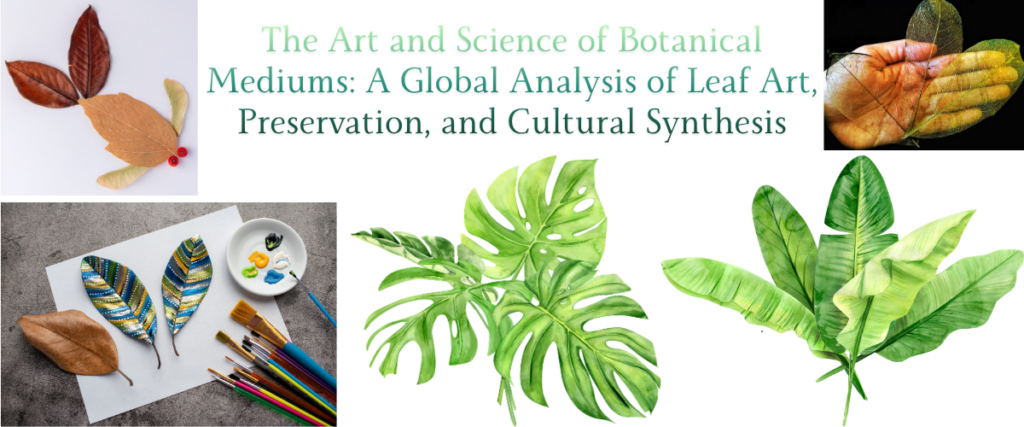
Foliage has long served as a vital canvas and inspiration for human creative expression, spanning the boundaries of utility, spiritual practice, and high-precision artistry. From prehistoric tool designs to the delicate micro-carvings of the modern era, the physical leaf is a complex biological structure that artists manipulate through physical, chemical, and mechanical means. This report provides an in-depth analysis of leaf art, examining its historical anthropological contexts, cultural and spiritual lineages, contemporary pioneers, technical modification methods, chemical preservation protocols, and the ecological responsibilities associated with harvesting botanical materials.
Historical Evolution and Functional Anthropological Contexts
Humanity’s aesthetic and functional relationship with leaves dates back to antiquity, where the morphology of the leaf inspired early survival technologies and decorative arts. During the Paleolithic era, some of the earliest stone and glass blades chipped by Homo sapiens and Neanderthals were intentionally shaped into lanceolate, leaf-like forms, establishing an early cognitive link between botanical structures and human utility.1 This morphological mimicry is similarly visible in historical protective gear. In East Africa, the Konso and Oromo cultures of Ethiopia traditionally manufactured moulded hide shields that tapered into leaf profiles.1 This structural design was highly functional, as the wider sections shielded the warrior’s torso while the narrowing ends optimised line-of-sight visibility and reduced overall weight during combat.1
Leaves have also served as essential, climate-resilient packaging materials throughout history. In Kenya, the Kikuyu culture utilised dried banana leaves to construct compact snuff packets.1 These leaves acted as an organic barrier, protecting the enclosed mixture of aromatic tobacco from the degrading effects of high ambient humidity.1 In the Americas, botanical motifs played a crucial role in navigating cultural preservation during periods of colonial expansion. In the late nineteenth and early twentieth centuries, Kewa potters of the Santo Domingo Pueblo in Arizona shifted from painting traditional, spiritually sensitive ceremonial symbols on their vessels to painting generic vegetal patterns, such as leaves, for commercial sale to Anglo-to-Anglo tourists.1 This strategic shift allowed indigenous artists to generate income while keeping their sacred iconography protected from outsiders.1
The earliest recorded physical leaf carving preserved in a museum context is housed at the Victoria and Albert Museum in London, dating back to 1835.2 Although the specific name of the artisan and the exact preservation techniques have been lost to time, this artifact confirms that delicate micro-carving on dry botanical surfaces was practised nearly two centuries before its modern revival.2
| Cultural/Historical Origin | Botanical Medium or Motif | Primary Functional or Aesthetic Purpose | Historical Era / Context |
| Paleolithic Cultures | Flint, obsidian, and stone 1 | Mimicked lanceolate leaf shapes to optimise blade aerodynamics and cutting edges.1 | Prehistory 1 |
| Kikuyu Culture (Kenya) | Banana leaf (Musa) 1 | Formed protective, moisture-resistant storage packets for tobacco snuff.1 | Early 1600s to 20th Century 1 |
| Konso & Oromo (Ethiopia) | Moulded animal hide 1 | Designed leaf-shaped shields to maximise torso coverage and preserve peripheral vision.1 | Early to mid-20th Century 1 |
| Santo Domingo Pueblo (USA) | Clay slip vessels 1 | Used generic leaf motifs to commodify pottery for tourists without exposing sacred symbols.1 | Late 19th to early 20th Century 1 |
| Unidentified Artisan (UK) | Undocumented tree leaf 2 | Earliest surviving museum-preserved specimen of high-detail leaf carving.2 | Circa 1835 2 |
Cultural Heritage and Spiritual Significance of Sacred Foliage
The sacred fig tree, known as the Peepal or Bodhi tree (Ficus religiosa), is central to the history of leaf painting in the Indian subcontinent.3 Native to India, Pakistan, and neighbouring regions, the Peepal leaf is easily recognised by its heart-shaped body that tapers into an elegant needle-point tip.3 This unique leaf profile was a prominent decorative element in the pottery of the Indus Valley civilisation over 5,000 years ago, long before it became associated with major world religions.6
In Hindu tradition, the Peepal tree represents the Holy Trinity, serving as a physical dwelling place for Lord Brahma, Lord Vishnu, and Lord Shiva.4 According to the Mahabharata, Lord Krishna equated himself directly to the sacred fig, describing its roots as Vishnu, its stem as Keshav, its branches as Narayan, and its leaves as Hari.4 The tree is also a symbol of domestic devotion; the legend of Vat Savitri describes how Savitri successfully pleaded with Yamraj, the god of death, to restore her husband Satyavaan’s life beneath a Peepal tree, a story commemorated today by married women who tie sacred threads around its trunk.4 Because the tree is exceptionally long-lived, it is viewed as a symbol of the eternal, immortal soul (atman) that survives the decay of the temporary physical body.4
“अश्वत्थ: सर्ववृक्षाणां देवर्षीणां च नारद: |
गन्धर्वाणां चित्ररथ: सिद्धानां कपिलो मुनि: ||”
“Amongst trees I am the peepal tree (sacred fig tree)…”
— Lord Krishna, The Bhagavad Gita
For Buddhists, the Peepal leaf is the ultimate symbol of spiritual awakening.3 Over 2,500 years ago, Siddhartha Gautama sat in deep meditation beneath a Peepal tree in Bodh Gaya, where he eventually attained supreme enlightenment and became the Buddha.3 The tree was subsequently named the Bodhi tree, or the “Tree of Enlightenment”.3
Historically, wandering ascetics and traditional healers known as Samanas utilised the medicinal properties of the Peepal tree, wearing its fibrous bark and using its heart-shaped leaves to treat wounds.6 Long before the advent of paper, dried Peepal leaves were prepared and used as writing sheets for recording sacred texts, administrative records, and early literature.3
The artistic practice of painting on Peepal leaves originated in the southern Indian state of Kerala.3 To prepare the canvas, artisans soak the leaves in water for several weeks to remove the soft green pulp, leaving behind a delicate, cream-colored vascular skeleton.4 Once dried, this structural lattice is resilient enough to hold rich paints.4 Traditional artists paint religious deities, rural life, elephants, and courtly scenes directly onto the leaf, utilising the intricate vein network as a natural background.4
Contemporary Pioneers and the Synthesis of Modern Leaf Sculpting
In the late twentieth and early twenty-first centuries, leaf art transformed from a traditional regional craft into a highly sought-after contemporary fine art. This modern renaissance was driven by international pioneers who adapted paper-cutting principles (kirigami and kirie) to the challenging medium of dried and fresh leaves.2
Huang Taisheng: The Pioneer of Modern Leaf Engraving
The origin of modern leaf engraving is credited to the Chinese artisan Huang Taisheng, who developed a highly specialised process in 1994 for engraving detailed landscapes and figures onto wet, fragile leaves.2 His work was recognised by the Guinness Book of World Records, which sparked global interest in leaf carving.7
Huang’s technique is highly complex, requiring a 60-step preparation process that includes boiling, hammering, chemical processing, and bleaching.2 He primarily used leaves from the Chinar tree (Platanus orientalis), native to India, Pakistan, and China.10 These leaves resemble maple leaves but feature a thicker cuticle and dense vein structures that are ideal for scraping and sculpting.7 Today, leaf engravers in Hong Kong continue to practice this craft, closely guarding their trade secrets.2
Lorenzo M. Durán: Slicing the Dry Medium
While leaf engraving involves scraping the surface of wet leaves, modern leaf carving is performed on completely dried and pressed leaves.2 The pioneer of this dry method is Spanish artist Lorenzo M. Durán, who began his practice in 2006.2
While sitting in his backyard, Durán observed a caterpillar eating a leaf, which gave him the idea to cut designs into dried foliage using the paper-cutting techniques he had previously practised.2 Through trial and error, Durán discovered that the leaves of the Catalpa tree (Catalpa bignonioides) were ideal for complex, large-scale compositions due to their generous surface area, while Maple leaves were best suited for geometric cuts.2
His process involves collecting, washing, pressing, and drying the leaves before pinning a paper sketch to the blade and carving the design with a surgical scalpel.2 He also developed a “selective skeletonising” technique, using miniature wire brushes to gently scrape away small sections of pulp to expose the delicate veins within a carved silhouette.2
Omid Asadi: Giving Voice to the Fallen
Former Iranian oil field engineer Omid Asadi, currently residing in England, began carving leaves in 2012.2 Asadi’s work is rooted in a deep environmental philosophy: he wanted to draw attention to things that are easily overlooked, such as fallen leaves that people step on without a second thought.11
Working alongside his wife, a professional miniature artist, Asadi developed a highly detailed carving style.2 He collects mature autumn leaves, dries and presses them for several months, and carves them using a magnifying glass, scalpel, and craft needle.2
His pieces often convey deep messages about global issues, poetry, and philosophy.2 A single carving can take Asadi anywhere from two weeks to two months to complete.2 To preserve his finished pieces, he carefully glues and presses them onto archival cardboard backing.2
Lito Leaf Art: Transforming ADHD into Focused Narratives
A prominent figure in contemporary leaf art is the Japanese creator Lito, born in Kanagawa in 1986.9 Diagnosed with Attention Deficit Hyperactivity Disorder (ADHD) as an adult, Lito sought an artistic outlet that would allow him to channel his capacity for intense hyperfocus.9 In 2020, after seeing Lorenzo M. Durán’s work online, he began experimenting with leaf cutting, adapting traditional Japanese kirie (cut-picture) techniques to fresh tree leaves.9
Unlike Durán and Asadi, who work with dried, stable leaves, Lito carves on fresh green leaves.9 Because fresh leaves dry out, curl, and decompose quickly, Lito must complete each piece within a tight two-hour window.9 This time constraint forces him to work with speed and precision.9
Lito carves highly detailed, playful narratives into a single leaf, always leaving the central midrib intact to provide structural support.9 His scenes feature whimsical animals, tributes to classic films like E.T., and children’s stories such as My Father’s Dragon and My Neighbor Totoro.9
By photographing his completed leaves against the sky, Lito captures a beautiful interaction between his carved stories, natural light, and the changing seasons.9 His work has gained a massive social media following and has been showcased in major Japanese department stores, culminating in his 2021 art book, I’ll Always Be with You.9
The Economics of Fine Leaf Art
The market for leaf art is highly specialised.7 Because of the intense labour and time required, the overall supply of genuine leaf carvings is low, and there are very few professional artists working in the field.7
Completed carvings typically sell for $99 to $200 apiece.11 Common commissions include portraits of celebrities, historical figures, spiritual imagery, and reproductions of famous paintings like the Mona Lisa.11
Technical Methodologies of Leaf Modification and Skeletonisation
Executing leaf art successfully requires an understanding of the botanical structure of the leaf. The leaf blade consists of three primary layers: the waxy outer cuticle, the soft parenchymal mesophyll (which contains the chlorophyll-rich pulp), and the tough, lignified vascular bundle (the veins).7
To expose the delicate veins of a leaf without breaking them, artists use chemical and mechanical techniques to break down the soft pulp while leaving the sturdy vascular tissue intact.17
<– Removed mechanically or chemically
=========================
[ Parenchymal Mesophyll ] <– Dissolved via alkaline hydrolysis
————————-
[ Lignified Vein Matrix ] <– Preserved (High cellulose/lignin)
There are three primary methods used to skeletonise leaves: the sodium carbonate (washing soda) method, the bicarbonate and baking powder method, and the natural water fermentation method.18
The Sodium Carbonate (Washing Soda) Method
This is the most common and effective chemical method for dissolving leaf pulp.17 Sodium carbonate ( ), also known as soda ash or super washing soda, is a highly alkaline substance.18 When heated in water, it breaks down the pectins and proteins holding the leaf’s mesophyll cells together.17 The tough, lignified cellulose walls of the leaf veins are highly resistant to this alkaline breakdown and remain fully intact.15
For artists who cannot source commercial washing soda, it can be created at home by spreading standard baking soda (sodium bicarbonate,  ) onto a baking tray and heating it in an oven at
  (
( ) for 30 minutes.18 This heat drives off water and carbon dioxide, leaving behind a grainy, dull, and highly alkaline sodium carbonate powder.18

Gentle Non-Toxic Alternatives and Fermentation
For delicate leaf varieties that might disintegrate in a strong washing soda bath, a gentler mixture of equal parts bicarbonate of soda and baking powder can be used.18 This solution has a lower pH, allowing the artist to slowly simmer fragile leaves over several hours without damaging the delicate vein structures.18
The oldest and most natural method is water fermentation.18 Leaves are placed in a glass or ceramic container, covered with water, and weighted down.18 The container is left to sit in a warm spot for three to four weeks.18
Over time, naturally occurring bacteria digest the soft plant tissues.18 To prevent mould from growing during this long fermentation process, artists often add a tablespoon of rubbing alcohol to the water.20 While this method is time-consuming and produces a strong, unpleasant odour, it is highly effective for preparing very delicate leaves that cannot withstand boiling.18
| Skeletonization Method | Chemical Formulation | Processing Time | Ideal Leaf Candidates | Structural Integrity & Finish |
| Super Washing Soda 18 | Sodium Carbonate () dissolved in boiling water (1:6 ratio).18 | 2 to 6 hours of active simmering.17 | Tough, waxy leaves (Magnolia, Camellia, Peepal).17 | High; completely strips the pulp to produce a clean, sturdy skeleton.17 |
| Bicarbonate & Baking Powder 18 | Equal parts sodium bicarbonate and baking powder in water.18 | 1.5 to 3 hours of gentle simmering.18 | Moderately fragile species (Hardenbergia, Maple, Oak).17 | Moderate; gentler on fragile veins but requires careful brushing.18 |
| Natural Water Fermentation 18 | Untreated tap water (with optional rubbing alcohol to prevent mould).18 | 3 to 4 weeks of cold soaking.18 | Extremely delicate or young leaves.18 | Beautifully preserved micro-veins; highly delicate and tedious to clean.18 |
Chemical Preservation and Stabilisation Techniques
Once harvested, leaves naturally begin to dry, oxidise, and decay.15 To keep leaves flexible and preserve their natural appearance, artists use chemical treatments to stabilise the organic tissues.15
Glycerin Preservation
The most reliable method for preserving a leaf’s natural flexibility is a glycerin bath.15 This process works via osmosis: the natural water content within the plant cells is replaced with a stable, non-evaporating glycerin solution.15
The preservation solution is prepared by mixing one part liquid glycerin with two parts warm water.23 For the best results, mature foliage should be collected in late summer before the leaves begin to change colour.15 Mature leaves contain higher levels of lignin—the compound that gives plant cell walls their rigidity—and have a well-developed waxy cuticle that helps prevent the leaf from shrivelling during treatment.15
Stems should be cut to lengths of 18 to 24 inches to ensure the glycerin solution can travel up through the plant’s vascular system before the tissue begins to break down.15 The stems are placed in a container with a few inches of the solution for six to ten days, or individual leaves are fully submerged in a shallow bath.22
As the glycerin replaces the water inside the leaf cells, the foliage turns a rich chocolate brown or deep golden hue and takes on a soft, leather-like texture.15 While highly effective, glycerin-preserved leaves can sometimes “weep” oily droplets under humid conditions, which can stain delicate backing papers or wooden frames.15
Barrier Coatings: Waxing, Laminating, and Acrylics
For projects where preserving bright autumn colours is a priority, artists use barrier coatings to seal the leaf and slow down oxidation 25:
- Wax Paper Pressing: Leaves are placed between two sheets of wax paper, covered with a protective cloth, and pressed with a warm iron for two to five minutes on each side.23 The heat melts the paraffin wax onto the leaf, creating a thin, protective seal that locks in moisture and prevents the leaf from becoming brittle.23
- Paraffin Wax Dipping: Leaves are dipped directly into a container of melted paraffin or soy wax and hung to dry.25 While this method preserves the leaf’s natural three-dimensional shape, the wax coating is fragile and can crack over time, and the leaf’s vibrant colours will eventually fade to a light brown.25
- PVA and Acrylic Sealants: Brushing the leaf with Polyvinyl Acetate (PVA) glue or spraying it with an archival acrylic sealant creates an airtight protective envelope.23 This is a popular method for three-dimensional collages, though low-quality glues can yellow over time, and the natural red pigments in the leaves will slowly turn to deep magenta or brown.25
Painting and Embellishing Preserved Foliage
Painting on leaves requires specialised techniques to ensure that the paint adheres well to the organic, waxy surface of the leaf.15 Acrylic paints are highly recommended for leaf art because they are durable, flexible when dry, and water-resistant, unlike watercolours, which can easily wash off or run.22
Core Brush Stroke Techniques
To paint clean, defined shapes on a leaf, artists use specific brush strokes to control paint delivery 27:
- The Scallop Stroke: Using a flat brush double-loaded with dark green on one side and a lighter green on the other, the artist taps the brush to create a “V” shape.28 By pressing the flat edge down and wiggling the brush while dragging it, they create a soft, rounded leaf half, lifting the brush to a sharp point at the tip to complete a realistic leaf design.28
- The Slider Leaf (Petal Stroke): This technique uses a flat or rounded filbert brush pressed onto the leaf surface at an angle rather than straight down.28 By touching, pressing, and lifting the brush while turning it slightly, the artist creates a smooth, rounded leaf shape that is perfect for filling in background details.28
Step-by-Step Galaxy Painting Guide
This tutorial outlines the steps to create a striking, multi-layered cosmic galaxy design on a preserved, pressed leaf, using a cardstock stencil to leave a clean, natural leaf shape in the centre.2
Step 1: Press the leaf flat for 3 days
Step 2: Tape the cardstock heart to the centre
Step 3: Paint the entire leaf black
Step 4: Flick white paint stars
(via toothbrush bristles)
Step 5: Dab acrylic colours
Step 6: Remove cardstock, seal with Mod Podge
- Preparation: Collect clean, intact leaves and press them flat between heavy books for two to three days to remove all residual moisture.26
- Masking: Cut a small heart or star shape out of cardstock paper and secure it to the centre of the leaf using light-tack tape.26
- The Base Coat: Paint the entire leaf with a solid coat of black acrylic paint, working carefully around the edges of the cardstock stencil.26 Let the paint dry completely.26
- Creating the Nebula: Using a round foam brush, dip lightly into blue, purple, or deep pink acrylic paint.26 Dab off the excess paint, then gently tap the foam brush onto the leaf to build up soft, cloud-like nebula textures.26
- Adding the Stars: Dilute a small amount of white acrylic paint with a few drops of water and apply it to the bristles of a toothbrush.26 Holding the toothbrush close to the leaf with the bristles facing downward, run a finger along the bristles to flick tiny specks of white paint across the surface to create a detailed starry background.26
- Highlighting and Detailing: Use a fine-tip detail brush or a nail dotting tool dipped in white paint to add larger, distinct stars, constellations, or a crescent moon.26
- Unveiling: Once the paint is completely dry, carefully peel away the cardstock stencil to reveal the clean, unpainted natural leaf tissue underneath.26 If needed, use a black paint marker to tidy up any paint bleed and create a sharp, clean edge.26
- Sealing: Protect the finished painting by brushing a thin layer of Mod Podge or applying a clear, archival acrylic spray sealer over the entire design.23
Ecological Stewardship and Conservation-Minded Foraging
The growing interest in leaf art makes it essential for artists to practice responsible, ethical harvesting to protect local ecosystems.21
The Critical Ecological Role of Leaf Litter
Fallen leaves are a vital resource for local ecosystems, not just waste material.30 The “Leave the Leaves” campaign, led by conservation groups like the Xerces Society, highlights how a layer of fallen leaves protects and insulates beneficial insects, moths, butterflies, and spiders during the winter months.30
These overwintering insects are a critical food source for birds and small mammals in the early spring.31 Additionally, as fallen leaves break down naturally, they act as an organic mulch and fertiliser, returning vital nutrients—including carbon, nitrogen, phosphorus, and potassium—back into the soil to nourish plants and retain soil moisture.30
/ \
v v
Provides winter insulation Decomposes into Carbon, Nitrogen,
for beneficial pollinators Phosphorus, and Potassium to
and essential soil organisms. nourish root systems.
Core Principles of Ethical Foraging
To minimise their impact on the environment, leaf artists should follow clear, conservation-minded harvesting guidelines 29:
- Prioritise Cultivated and Abundant Sources: Look for suitable leaves in backyard gardens, urban areas, or common weeds rather than sensitive natural habitats.33
- The 5% to 10% Foraging Rule: Never harvest more than 5% to 10% of any single healthy plant population, and do not forage from rare, threatened, or struggling plant stands.21
- Harvest Sustainably: Collect naturally fallen leaves or prune from storm-damaged branches rather than picking fresh leaves from a healthy tree.32 Avoid removing a tree’s terminal buds, as this is where the plant produces its new growth.32
- Use Proper Pruning Techniques: When cutting stems, use sharp, sterilised pruning shears to make clean cuts.29 For shrubs, cut at a 45-degree angle approximately one-quarter inch above an outward-facing leaf node to help the plant heal quickly and encourage healthy new growth.35
- Avoid Environmental Contamination: Do not harvest leaves from industrial areas, reclaimed sites, or within 100 to 200 feet of busy roads, as plants in these areas can absorb harmful heavy metals and chemical pesticides from the soil.29
- Practice Biosecurity: Clean and sterilise tools and hands with isopropyl alcohol between foraging sites to prevent the accidental spread of plant diseases, fungal spores, and invasive weeds.21
- Maintain Traceability: Keep a simple field journal to record the date, location, and plant species harvested, allowing for responsible monitoring of local foraging areas.21
Conclusion
Leaf art represents a beautiful intersection of botanical science, historical preservation, and contemporary creativity. By understanding the anatomy of the leaf, artists can utilise techniques like alkaline skeletonisation, osmotic glycerin preservation, and precise micro-carving to transform temporary foliage into long-lasting works of art.2
As this art form continues to grow, practising ethical foraging and respecting the ecological importance of fallen leaves ensures that contemporary creators remain in harmony with the natural systems that provide their canvas.21
Disclaimer
This report details various chemical and technical procedures that carry inherent safety risks.
- Chemical Handling: Sodium carbonate (washing soda) is a strong alkaline agent that can cause skin and eye irritation.18 Always wear protective gloves and safety goggles when handling dry washing soda or boiling alkaline solutions, and avoid inhaling any dust or steam.18
- Using Bleach: Household chlorine bleach is highly corrosive. Use it only in well-ventilated spaces, avoid skin contact, and never mix bleach with other household cleaners or acids.17
- Foraging Laws: Artists must comply with all local, state, and federal regulations regarding the collection of plant materials. Foraging is strictly prohibited in national parks and ecological reserves.34 It is the user’s responsibility to obtain permission before foraging on private land and to ensure they do not harvest any protected or endangered plant species.21
References
- Turning a New Leaf into Art – Collection Blog – Bowers Museum, accessed on May 25, 2026, https://www.bowers.org/index.php/collections-blog/turning-a-new-leaf-into-art
- WcI72 Bonus Photos – The Art of Leaf Carving – Woodcarving …, accessed on May 25, 2026, https://woodcarvingillustrated.com/wci72-bonus-photos-the-art-of-leaf-carving/
- Painting on Peepal Leaf (India – Wise Moves, accessed on May 25, 2026, https://wisemovesdance.co.uk/wp-content/uploads/2016/05/Painting-on-Peepal-Leaf-India-.pdf
- Know More About Leaf Art – 7Creation Art, accessed on May 25, 2026, https://7creationart.com/know-more-about-leaf-art/
- Pretty Popular Peepal Leaf Art For A Pristine Effect – Bored Art, accessed on May 25, 2026, https://www.boredart.com/2016/10/pretty-popular-peepal-leaf-art-for-a-pristine-effect.html
- History: The secret life of the peepal – Newspaper – DAWN.COM, accessed on May 25, 2026, https://www.dawn.com/news/1261112/history-the-secret-life-of-the-peepal
- Leaf carving art – Necessity eStore -A Modern Aesthetic Handicraft, accessed on May 25, 2026, https://necessityestore.in/leaf-carving-art/
- 10 vintage Indian examples of dried peepal leaf painting, including an elephant! | India, accessed on May 25, 2026, https://www.commoncrowbooks.com/pages/books/H14578/india/10-vintage-indian-examples-of-dried-peepal-leaf-painting-including-an-elephant
- Kirie Artist Carves Playful Narratives Into Tree Leaves | Spoon & Tamago, accessed on May 25, 2026, https://spoon-tamago.com/kirie-leaf-artist-lito/
- Leaf carving – Wikipedia, accessed on May 25, 2026, https://en.wikipedia.org/wiki/Leaf_carving
- How To Make Beautiful Leaf Carve Art – Tentree, accessed on May 25, 2026, https://www.tentree.com/blogs/environmentor/how-to-make-beautiful-leaf-carve-art
- The work of Japanese artist Lito, known otherwise by his moniker Lito Leaf. – Reddit, accessed on May 25, 2026, https://www.reddit.com/r/Damnthatsinteresting/comments/1fnxto9/the_work_of_japanese_artist_lito_known_otherwise/
- Japanese artist Lito transforms fallen leaves into beautiful cut-out artworks, this helps him manage and redirect his ADHD into true masterpieces : r/MadeMeSmile – Reddit, accessed on May 25, 2026, https://www.reddit.com/r/MadeMeSmile/comments/1ia78ho/japanese_artist_lito_transforms_fallen_leaves/
- Japanese Artist Creates Art by Cutting Leaves – Engoo, accessed on May 25, 2026, https://engoo.com/app/lessons/japanese-artist-creates-art-by-cutting-leaves/aD-irgMmEeut1jcO3fbI1Q
- Glycerin-Preserved Foliage | Mississippi State University Extension Service, accessed on May 25, 2026, https://extension.msstate.edu/publications/glycerin-preserved-foliage
- How to make skeleton leaves | Heart of England Forest, accessed on May 25, 2026, https://heartofenglandforest.org/how-make-skeleton-leaves
- Strip a leaf naked so you can examine the skeleton {Forest Science}, accessed on May 25, 2026, https://elementalscience.com/blogs/science-activities/leaf-skeletons
- Botanical project: leaf skeletons (non toxic) – Naomi Loves, accessed on May 25, 2026, https://www.naomiloves.com/blog/2017/11/19/how-to-make-leaf-skeletons-non-toxic
- How To Make Skeleton Leaves (with Printable Instructions) – The Kreative Life, accessed on May 25, 2026, https://thekreativelife.com/diy-color-tinted-skeleton-leaves/
- How to Make Skeleton Leaves! – The Graphics Fairy, accessed on May 25, 2026, https://thegraphicsfairy.com/how-to-make-skeleton-leaves/
- Ethical Wildcrafting: A Practical Guide to Sustainable Medicinal Plant Harvesting, accessed on May 25, 2026, https://ethnoleaflets.com/156-2/
- Preserve Leaves With Glycerin : 7 Steps (with Pictures) – Instructables, accessed on May 25, 2026, https://www.instructables.com/Preserve-Leaves-With-Glycerin/
- How to Preserve Leaves: 3 Methods | HST Life Science, accessed on May 25, 2026, https://learning-center.homesciencetools.com/article/how-to-preserve-leaves/
- How to Preserve Leaves: Fun Fall Craft for Kids – Buggy and Buddy, accessed on May 25, 2026, https://buggyandbuddy.com/3-ways-preserve-fall-leaves/
- 6 Ways to Preserve Leaves for DIY (Easy & Every Day Supplies) – Red Ted Art, accessed on May 25, 2026, https://www.redtedart.com/how-to-preserve-leaves-6-methods/
- Leaf Painting – How to Paint Galaxy Painted Leaves, accessed on May 25, 2026, https://colormadehappy.com/leaf-painting-how-to-paint-galaxy-painted-leaves-how-to-paint-leaves/
- How to Paint Leaves – The Social Easel Online Paint Studio, accessed on May 25, 2026, https://www.thesocialeaselonlinepaintstudio.com/how-to-paint-leaves/
- How to Paint Leaves in Acrylics – Pamela Groppe Art, accessed on May 25, 2026, https://www.pamelagroppe.com/how-to-paint-leaves/
- 9 Basic Principles Of Ethical Wildcrafting For Beginners – The Outdoor Apothecary, accessed on May 25, 2026, https://www.outdoorapothecary.com/ethical-wildcrafting/
- Leave the Leaves: Winter Habitat Protection – Xerces Society, accessed on May 25, 2026, https://xerces.org/leave-the-leaves
- Conservation Tips: Leave the Leaves – James River Association, accessed on May 25, 2026, https://thejamesriver.org/conservation-tips-leave-the-leaves/
- Ethical Wildcrafting | Redheaded Herbalist, accessed on May 25, 2026, https://redheadedherbalist.com/wildcrafting-ethics/
- The Nat | Making a Plant Collection – San Diego Natural History Museum, accessed on May 25, 2026, https://www.sdnhm.org/science/botany/resources/general-information/how-to-make-a-plant-collection/
- Your Essential Guide to Ethical and Sustainable Foraging – The Kitchen Apothecary, accessed on May 25, 2026, https://thekitchenapothecary.com/guide-to-ethical-and-sustainable-foraging/
- Wildcrafting Basics: Ethical Wildcrafting | The School of Forest Medicine, accessed on May 25, 2026, https://forestmedicine.net/ecological-intelligence-blog/2017/4/10/ethical-wildcrafting