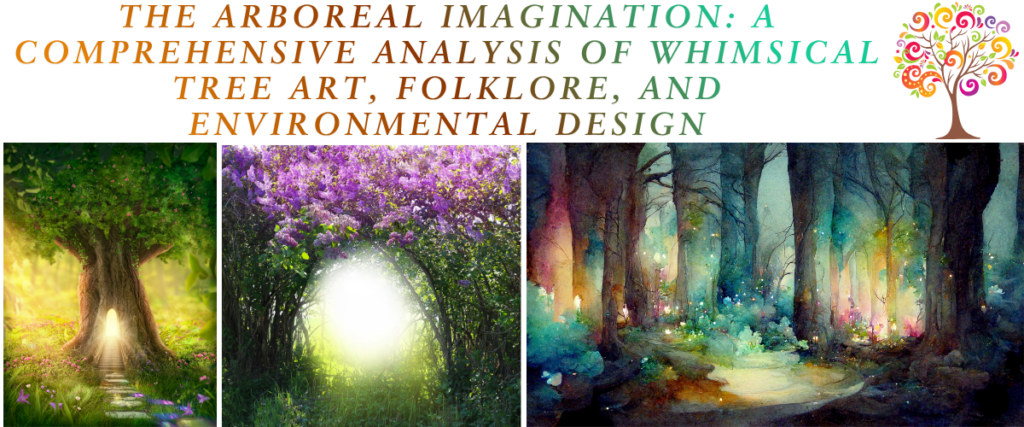
The human relationship with the tree is among the most ancient and profound connections in our shared history. Beyond their biological role as oxygen producers and carbon sinks, trees have served as the silent witnesses to human evolution, the primary scaffolding of our early architecture, and the central characters in our most enduring myths. In the contemporary artistic landscape, this relationship has manifested in a genre known as whimsical tree art. This field, which spans from the playful DIY fairy gardens of suburban yards to the monumental public installations found in global metropolises, seeks to re-enchant the natural world. It is a genre defined by an intentional departure from strict realism in favour of exaggerated forms, vibrant colour palettes, and anthropomorphic qualities that invite the viewer into a state of “soft fascination.” This report examines the technical, psychological, and cultural dimensions of whimsical tree art, tracing its roots from Celtic folklore to the cutting-edge digital and physical installations of the twenty-first century.
Historical and Folkloric Foundations: The Roots of the Enchanted Forest
Whimsical tree art does not exist in a vacuum; it is the modern descendant of a rich tradition of arboreal folklore that has permeated human cultures for millennia. To understand why a miniature door placed at the base of a maple tree evokes such immediate charm, one must look to the deep-seated cultural memories of the “fairy tree” and the sacred grove. In many indigenous and ancient traditions, trees were not seen as inert objects but as sentient beings or portals to other realms.1
The Celtic Tradition and the Sacred Trio
In the lore of Western Europe, particularly within Celtic culture, the landscape was believed to be inhabited by the sidhe, or fairies, who lived underground and within certain sacred trees. The Hawthorn, or “Fairy Thorn,” stands at the centre of this tradition. It is a tree associated with Beltane, the ancient festival marking the beginning of summer, where its branches were used to decorate homes to bring luck and ward off malevolent forces.2 The persistence of these beliefs is evident even in modern times, where farmers in Ireland remain reluctant to cut down a lone Hawthorn in a field for fear of the misfortune that might follow the disturbance of the fairies’ home.2 This cultural preservation has directly influenced the whimsical aesthetic, which often features trees with gnarled, protective shapes and hidden nooks.
The folklore identifies a specific hierarchy of trees, often referred to as the sacred trio of Oak, Ash, and Thorn. Each species carried a distinct symbolic weight that continues to inform artistic choices today. The Oak represented strength and ancient wisdom, its deep roots serving as a metaphor for the underworld while its branches reached for the heavens.1 The Ash was frequently seen as the “World Tree,” a connector of different planes of existence, while the Rowan, or “Quicken tree,” was believed to belong to the “Land of Promise,” bearing berries that could restore youth to a centenarian.1
| Tree Species | Folkloric Role | Modern Artistic Interpretation |
| Hawthorn (Thorn) | Home of the sidhe; associated with Beltane and protection 2 | Hidden fairy houses; protective, gnarled branch structures 3 |
| Blackthorn | Tree of ill omen; associated with warfare and protective hedges 2 | Stark, high-contrast imagery; themes of resilience and barriers 4 |
| Rowan | The “Land of Promise”; berries of youth and cheerfulness 1 | Vibrant red accents; themes of healing and rejuvenation 4 |
| Oak | The “King of the Forest”, symbol of endurance and sovereignty 1 | Grand, thick-trunked foundational pieces; historical grounding 5 |
| Ash | The “World Tree”, a conduit between heaven, earth, and underworld 1 | Vertical, reaching forms; themes of connectivity and systems 6 |
Anthropomorphism and the Narrative Tree
A central tenet of the whimsical style is anthropomorphism—the attribution of human traits to trees. This practice is rooted in the human brain’s hard-wired tendency to seek connection and agency in the natural world.7 In fairy tales, the forest is often a place of transformation where the normal rules of the town no longer apply; trees may whisper, grab at travellers with branch-arms, or even provide counsel.9 This narrative tradition is brought to life in whimsical art through expressive faces carved into trunks, “legs” formed by spreading roots, and “arms” that seem to beckon or ward off.10
The forest setting itself serves as a crucial narrative element. It represents the “unknown,” a realm outside normal experience where the imagination can run riot.9 By creating whimsical art within or about the forest, artists tap into these archetypal fears and wonders, transforming the woodland into a “theatre of miraculous events”.1 This is particularly evident in the works of artists like Arthur Boyd or Sidney Nolan, who used the Australian bush as a surrealist stage for exploring myths and icons.11
The Psychology of Whimsy: Biophilia and Soft Fascination
The appeal of whimsical tree art is not merely a matter of nostalgia or aesthetic preference; it is supported by significant psychological and neurological mechanisms. Modern environmental psychology highlights the “biophilic” connection—the innate attraction humans have toward natural forms and systems.13 As urban environments become increasingly clinical and disconnected from nature, whimsical art serves as a critical bridge, restoring a sense of equilibrium to the human cognitive state.
The Mechanism of Soft Fascination
One of the most vital functions of whimsical art is its ability to trigger “soft fascination.” Unlike the “directed attention” required for urban navigation or digital work—which is exhausting and leads to cognitive fatigue—soft fascination is a gentle, effortless form of attention.13 When a person views the fluid, natural patterns of a whimsical tree, the nervous system begins to relax. The brain associates these cues with safety and harmony, which can lead to measurable reductions in cortisol levels, blood pressure, and anxiety.13
This restorative quality is a primary reason why nature-based art is increasingly integrated into behavioural health environments. Corridors and waiting rooms lined with images of verdant landscapes or stylised trees help patients feel less clinical uncertainty.14 By providing a “positive distraction,” these artworks signal safety and foster a sense of refuge during difficult moments.14
Nature-Based Art Therapy (NBAT)
The integration of art and nature in therapeutic settings, known as Nature-Based Art Therapy (NBAT), has shown particularly strong outcomes for youth coping with trauma.15 By engaging in the creation of whimsical nature art, individuals can:
- Develop Environmental Literacy: Observing and interpreting the natural world through art builds a deeper cognitive understanding of ecosystems.15
- Support Emotional Regulation: The act of “making” provides a sense of agency and confidence, which is an early intervention for those at risk of mental health challenges.8
- Foster a Sense of Belonging: Creating environmental art helps individuals perceive themselves as a part of nature rather than separate from it.15
The “effort-driven rewards circuit” is a neurological pathway ignited when we use our hands to interact with the world, such as weaving willow branches or painting on foraged bark.8 This circuit provides a profound sense of satisfaction that digital consumption cannot replicate, making the process of creating whimsical art as beneficial as the final product.
Technical Execution: Mediums and Methods
Whimsical tree art is remarkably versatile, ranging from traditional oil and acrylic painting to complex digital vectors and sculptural installations. Each medium requires specific techniques to achieve the “whimsical” effect, often prioritising colour contrast and stylised movement over botanical accuracy.
Acrylic and Watercolour Painting Techniques
For beginners and experts alike, painting a whimsical tree involves a focus on vibrant palettes and rhythmic patterns. The goal is often to create a “pop” that distinguishes the tree from a standard landscape.16
The Blending of Atmosphere
The process typically begins with a blended background, often a sunset using colours like lavender, hot pink, coral, and yellow.16 To prevent “muddy” tones, artists must wash their brushes thoroughly when transitioning between cool and warm colours. Blending while the paint is wet ensures that there are no harsh straight lines, creating a dreamlike, hazy atmosphere that sets the stage for the whimsical subject.16
Trunk and Branch Formation
Whimsical trunks are rarely perfectly vertical. Using a round brush with black paint, the artist might create a trunk that “hooks” or curves, suggesting the tree is swaying in a breeze or possesses its own internal direction.16 To thicken the trunk without losing the delicate taper at the top, artists paint along the initial line until the desired width is reached at the base.16 Branches are then added using a “V” technique—pulling the stroke from inside the trunk and out into a tapering line.16
Foliage and Detailing
Instead of individual leaves, whimsical trees often feature concentric circles or “rings” of colour. These circles can overlap the branches to create a sense of depth.16 After the primary circles dry, smaller rings or dots of contrasting colours (like teal or gold) are added to make the image “pop”.16 A unique technical hack used in this genre is the “back-end dotting technique,” where the back of a paintbrush is dipped in white paint to create perfectly uniform polka dots or “fairy lights” throughout the canopy.16
| Painting Element | Recommended Palette | Technical Goal |
| Sunset Background | Lavender, Hot Pink, Coral, Yellow | Smooth gradient; prevents “muddy” browns 16 |
| Tree Structure | Black or Deep Brown | “Hooked” movement; “V” branch tapering 16 |
| Leaf Circles | Peacock Blue, Teal, Magenta | High contrast; layering for depth 16 |
| Accents | Metallic Gold, White | Adds “magic” and fine-detail highlights 16 |
Digital Vectors and Illustration
In the digital realm, whimsical tree art is characterised by clean lines, bold shapes, and explicit anthropomorphism. Vector art allows for “curly tops,” “leaning shapes,” and stylised silhouettes that are used in everything from fabric design to children’s book illustrations.10 Digital artists often draw inspiration from mid-century modern styles or even the cubism of Pablo Picasso to create trees that are both nostalgic and contemporary.17 Common motifs include smiling fruit trees, spruce trees with expressive eyes, and “candy trees” inspired by theatrical settings like Charlie and the Chocolate Factory.10
DIY Whimsy: Creating the Fairy Garden
One of the most accessible and popular forms of whimsical tree art is the “fairy tree garden.” This DIY practice involves adding unexpected charm to a front yard or a shady garden corner using natural, foraged materials.3 It is a low-pressure way to interact with the environment, where the imperfections of nature are seen as “character”.3
Selecting the Perfect Site
The best candidates for a fairy garden are mature trees with natural character—maples, oaks, or willows that have developed cavities or knotholes.3 A hollow at least 6 to 8 inches wide is ideal for a miniature dwelling. If no natural hollow is present, practitioners often use fallen logs, stumps, or even planters as a base.3 Safety is paramount when working with live trees; artists must check for active insect nests or rotting wood before beginning an installation.3
Materials for the Natural Exterior
The whimsical aesthetic is best achieved by blending handmade elements with the tree’s existing texture.
- Gourd Houses: A homegrown or store-bought dried gourd makes an excellent fairy house. It can be wrapped in birch bark and tucked into a tree crook.3
- Bark and Moss: Birch bark, collected from fallen trees, provides a sturdy, weathered exterior. Moss and lichen (either live or preserved) are then glued to the roof or the base to create an “aged” and “discovered” look.3
- Twigs and Branches: Small branches can be cut and wired together to form ladders, window frames, and fences. Using a cross pattern inside a frame can mimic the look of a paned window, with clear plastic from food packaging used to represent glass.3
- Lighting: Miniature, battery-operated fairy lights are essential for providing a magical glow during the evening hours.3
DIY Accessories Checklist
To create a fully realised whimsical world, practitioners often build a range of small-scale accessories.
| Accessory | Construction Method | Materials Used |
| Fairy Ladder | Wiring rungs to vertical branch supports | Thin branches, floral wire, moss 3 |
| Window Frames | Rectangular twig frames with moss edges | Twigs, hot glue, moss, plastic backing 3 |
| Garden Path | Meandering arrangement of smooth stones | Small pebbles, gravel 3 |
| Fairy Swing | Small bark seat suspended by twine | Bark, twine, sturdy branch 3 |
| Stepping Stones | Staggered “step” pattern on the trunk | Small wood slices, permanent glue 3 |
The philosophy of the fairy garden is to make the installation feel like it was “discovered” rather than built. Placing the display near ferns, flower beds, or stepping stones helps it integrate into the larger landscape.3
The Tree as Fine Art: Resilience, Renewal, and Social Commentary
In the world of fine art, the whimsical tree often takes on a more serious, symbolic role. Artists use the arboreal form to explore themes of resilience, urbanisation, and the relationship between the individual and society.
Nicholas Harding and the Tree of Life
The late Australian artist Nicholas Harding used the tree as a personal symbol of recovery and renewal. His painting Ikara-Wangarra (2022) depicts a central eucalyptus tree in the Ikara-Flinders Ranges as a “sentinel figure”.4 Having visited the region after a bushfire, and during his own battle with cancer, Harding saw the green saplings emerging from the charred remnants as a sign of nature’s “resurrective capacities”.4 He used thick impasto paint and palette knives to create “undulating ripples” that represent the vibrational energy of the scrub, turning the tree into a “tree of life” and an analogy for his own physical recovery.4
Ai Weiwei: The Collective Tree
In contrast to Harding’s personal symbolism, Chinese artist Ai Weiwei uses the tree to comment on societal structures. His Tree 2010 is a monumental sculpture assembled from dead branches, roots, and trunks gathered from across southern China.7 Although it mimics a real tree, the visible cuts and joins highlight the artificiality of its construction. This work serves as a metaphor for the relationship between the individual and society, as well as a critique of China’s rapid urbanisation and the resulting damage to the natural environment.7
Impressionism and the “Portrait” Tree
Other artists, such as Alex Katz and Tacita Dean, approach the tree from different philosophical angles. Katz’s work often presents “general impressions” of trees, captured for their patterns and shadows rather than their detail, giving them a “snapshot” feel that emphasises their transience.7 In contrast, Tacita Dean creates “portraits” of individual trees, recording every detail of their features with a sense of reverence and permanence.7 These varying approaches demonstrate how the “whimsical” or “stylised” representation of a tree can be used to convey vastly different emotional states, from melancholy to optimism.7
Public Installations and Monumental Whimsy in Australia
Australia is home to several major public art installations that utilise whimsical and organic tree-based forms to commemorate history and identity. These works often blend traditional materials like wood and stone with modern elements like steel and sound.
Edge of the Trees (Museum of Sydney)
Created by Janet Laurence and Fiona Foley, Edge of the Trees (1995) is a collaborative, site-specific installation located in the forecourt of the Museum of Sydney.5 It consists of 29 massive pillars made of ironbark and tallow wood, Sydney sandstone, and steel.5
The installation is rich with symbolic layers:
- The 29 Pillars: Each vertical pole corresponds to one of the 29 Aboriginal clans from around the Sydney region.5
- Embedded Memory: Windows in the wooden pillars contain organic materials like human hair, shells, bone, and feathers, memorialising the lives that lived around the site before and after European contact.5
- Linguistic Layers: The pillars are engraved with the names of botanical species in both Latin and Aboriginal languages, alongside the signatures of First Fleeters.5
- The Soundscape: As visitors walk between the pillars, they hear Koori voices reciting place names, creating a sensory encounter that celebrates a specific moment in time.5
The title refers to the moment of “first contact,” where the newcomers were met on the beaches by Indigenous people looking at them from the “edge of the trees”.5 This installation demonstrates how whimsical, organic forms can be used to address the most profound and difficult aspects of a nation’s history.
Yer’ung – Spirit Tree (Royal Botanic Garden Sydney)
In July 2024, the Royal Botanic Garden Sydney unveiled the Yer’ung – Spirit Tree, a “Welcome to Country” artwork created by Wiradjuri man Darren Charlwood in collaboration with Gadigal Elder Aunty Rhonda Dixon-Grosvenor.19 The sculpture is a 2.3-meter-high column carved by hand from a 1.2-tonne blackbutt log over the course of 120 hours.19
| Feature | Description | Cultural Significance |
| Crow’s Eye View | Artistic map of Sydney Harbour shoreline | Represents Waggan (the crow), the artist’s totem 19 |
| Oyster-Shell Inlays | Marking the meeting of land and water | References “lost middens” mined for early Sydney mortar 19 |
| Galgudya Resin | Coating of grasstree resin | Plant origin of the name “Gadigal” 19 |
| Gurawal (The Whale) | Carving of the saltwater ancestor | Permission from Gadigal Traditional Custodians 19 |
The Yer’ung – Spirit Tree serves as a permanent reminder of the 60,000 years of sustainable living by First Nations people and the importance of listening to Indigenous wisdom to achieve balance with nature.19
Veil of Trees (The Domain)
Located in The Domain near the Royal Botanic Garden, Veil of Trees by Janet Laurence and Jisuk Han is a 100-meter curvilinear passage that reflects on the botanical history of the area.21 The installation features red forest gums reintroduced to the site, each grown from the seeds of the original trees that existed before European settlement.21 These living trees are interspersed with glass panels containing minerals, seeds, ash, and resin, as well as inscribed poetry by Australian authors like Judith Wright and David Malouf.21 At night, LED lights within the panels create a poetic, fluid environment, turning the forest into a space where “memory is gathered”.21
Contemporary Landscape Artists and Arboreal Styles
The legacy of whimsical and impressionist tree art continues through several contemporary Australian artists, each bringing a unique flair to the portrayal of the continent’s topography.
The “Eminent” Landscapes of John Wilson
John Wilson is one of Australia’s most respected landscape artists, known for his oil paintings that blend meticulous precision with vibrant impressionism.22 His work often captures the “rainbow-hued majesty” of the Blue Mountains and the vast Australian plains. Wilson’s style invites the onlooker to immerse themselves in the “elusive charms” of the continent, using brushstrokes that suggest movement and light rather than static detail.22
The Subtle Inspirations of Tedd Lewis and Jeremy Western
Artists like Tedd Lewis and Jeremy Western focus on the “majestic arboreal portraits” of gum trees and river oaks.22 Lewis is inspired by the “tree-lined dirt lanes” and “blue hills” of the Ophir region, while Western uses cool and bold tones to capture the “ethereal beauty” of the Blue Mountains.22 Their work often highlights the textured bark and earthy tones of Australia’s iconic gum trees, adding a layer of “depth and realism” through stylized brushwork.22
The Rise of Palette Knife Paintings
Newer artists like Emily Persson and Johnny K are pushing the boundaries of landscape art with sumptuous palette knife paintings.11 This technique allows for the creation of “verdant blooms” and “chaotic tangles” of scrub that mirror the physical texture of the bush.4 By using palette knives to apply thick slabs of paint, these artists create works that are almost three-dimensional, capturing the “vibrational energy” of the landscape in a way that feels both modern and whimsical.
Scientific Illustration and the “Dinosaur Tree”
While whimsical art often takes liberties with form, it is sometimes inspired by the most extraordinary realities of the botanical world. The discovery of the Wollemi Pine (the “dinosaur tree”) in 1994 is a real-world example of a “fairy tale” discovery.23
The Wollemi Pine: A Living Fossil
The Wollemi Pine was thought to have gone extinct 2 million years ago until a small grove was found in a remote canyon of the Blue Mountains.23 This critically endangered species has distinctive “deep-red, bubbly bark” and fern-like foliage, growing up to 40 meters tall.23 Its discovery has inspired both scientific illustrators and whimsical artists to capture its unique form.
The Florilegium Society
The Florilegium Society at the Botanic Gardens of Sydney focuses on the high-standard, botanically accurate recording of the living collections.24 While these paintings are scientifically accurate, they are also described as “individual artistic responses to the subject”.24 This intersection of science and art represents a “gathering of flowers” (the literal meaning of florilegium) that seeks to record rare and endangered plants for future generations.24
Environmental Art and the Spiral Forest
Environmental art, or land art, often utilises trees on a monumental scale to create shapes that are visible only from the air or through extended interaction with the site.
Agnes Denes: A Forest for Australia
In 1998, environmental artist Agnes Denes created A Forest for Australia at the Altona Treatment Plant.25 This 400×80 meter land art project consists of 3,700 trees of several different species planted in five circular spirals.25 Over a quarter-century later, the forest is celebrated through the “Dear Agnes” project, which treats the installation as a “love letter” to the environment.25 This work demonstrates how the whimsical, spiral motif can be used to promote “environmental stewardship” and the cooling of urban heat islands through the creation of a thriving tree canopy.25
David Digapony and the Redwood Nests
In the California Redwood Forest of East Warburton, Victoria, the “orderly guards” of trees planted in the 1930s are home to the stick art of David Digapony.26 His giant woven nests and stick portals add a touch of “mystical whimsy” to the woodland, transforming a site originally used for Weed control and hydrological study into a magical realm that attracts thousands of visitors.26
Practical Considerations: Safety, Ethics, and Longevity
The creation of whimsical tree art, particularly in public or natural spaces, requires a commitment to ethical and safe practices. The goal is to enhance the environment without causing harm to the biological systems that sustain it.
Protecting Living Systems
When creating DIY fairy gardens or public installations, artists must ensure they do not interfere with the tree’s natural growth.
- Avoid Girdling: Do not wrap wire or non-flexible bands tightly around a trunk, as this can cut off the flow of nutrients.3
- Respect the Bark: Bark is the tree’s primary defence against disease. Nailing or screwing into a healthy tree should be avoided.3
- Foraging Ethics: Collect bark, moss, and twigs from the forest floor rather than stripping them from living specimens.3
Safety in Public Spaces
Public art installations must be designed with accessibility and maintenance in mind. Organisations like the Bland Shire or the Department of Planning in NSW oversee the safety and planning guidelines for public art to ensure they are liveable and prosperous for the community.27 For example, the Edge of the Trees installation is designed for tactile interaction, inviting the audience to touch and feel the textures of the materials in a safe, spatial encounter.5
Conclusion: The Enduring Legacy of the Arboreal Muse
Whimsical tree art is a testament to the enduring power of the forest as a source of human inspiration. It is a field that successfully merges the ancient mysteries of folklore with the modern needs of psychological restoration and environmental advocacy. From the minute, foraged ladders of a backyard fairy garden to the 29 soaring pillars of the Museum of Sydney, these works invite us to reconsider our relationship with the natural world.
The genre’s ability to trigger “soft fascination” offers a critical antidote to the cognitive stresses of modern life, while its narrative and anthropomorphic qualities provide a vessel for exploring identity, resilience, and recovery. As artists like Nicholas Harding have shown, a single tree can become a “tree of life,” representing the “resurrective capacities” of both nature and the human spirit.4 By re-enchanting the forest, whimsical tree art ensures that we continue to see the world through a lens of wonder, fostering a deep-seated commitment to the well-being of people and the planet.
Disclaimer
The information provided in this report is for educational, creative, and recreational purposes. While the DIY projects and artistic techniques described are intended to foster a connection with nature, participants should always exercise caution.
- Tree Health: Avoid any actions that may harm living trees, such as the use of toxic paints, permanent attachments that restrict growth, or the removal of bark from healthy specimens.
- Environmental Stewardship: When foraging for materials, adhere to local conservation laws and avoid disturbing sensitive habitats or protected species.
- Safety: DIY projects involving tools, wire, or climbing should be performed with appropriate safety gear. Battery-operated lights used outdoors should be rated for all-weather use to prevent fire hazards.
- Public Access: Information regarding public art installations is subject to change. Always verify current access, opening hours, and safety protocols with the relevant local councils or site managers.
- Mental Health: While nature-based art has documented psychological benefits, it is not a substitute for professional medical or mental health advice.
This report does not constitute professional advice in the fields of arboriculture, structural engineering, or clinical psychology. The author and publishers assume no liability for damages or injuries resulting from the application of the techniques or information contained herein.
References
- Faery Trees and Forests #Folklore – Ronel the Mythmaker, accessed on May 11, 2026, https://www.ronelthemythmaker.com/faery-trees-and-forests-folklore/
- Are Fairy Trees a Fairy Tale? – Donegal Square, accessed on May 11, 2026, https://donegalsquare.com/blog/are-fairy-trees-a-fairy-tale/
- Whimsical Fairy Tree Garden: A DIY Project for a Magical Yard …, accessed on May 11, 2026, https://www.cottageonbunkerhill.com/whimsical-fairy-tree-garden-a-diy-project-for-a-magical-yard/
- Trees of Life – National Gallery of Australia, accessed on May 11, 2026, https://nga.gov.au/stories-ideas/trees-of-life/
- Edge of the Trees – Wikipedia, accessed on May 11, 2026, https://en.wikipedia.org/wiki/Edge_of_the_Trees
- Trees (System), UAP, Urban Art Projects, accessed on May 11, 2026, https://www.uapcompany.com/projects/trees-system
- Trees Coursework Guide – Tate, accessed on May 11, 2026, https://www.tate.org.uk/art/student-resource/exam-help/trees
- Your Brain Loves This: How Art and Nature Rewire Us for Connection – Arts Midwest, accessed on May 11, 2026, https://artsmidwest.org/resources/guides-tools/your-brain-loves-this-how-art-and-nature-rewire-us-for-connection/
- Anatomy of a fairy tale: Elements and structure explained – National Library of Scotland, accessed on May 11, 2026, https://www.nls.uk/collections/stories/literature-and-poetry/fairy-tale-elements-and-structure/
- 688 Anthropomorphic Tree Stock Vectors and Vector Art – Shutterstock, accessed on May 11, 2026, https://www.shutterstock.com/search/anthropomorphic-tree?image_type=vector
- Great Australian Landscape Painters | Wentworth Galleries, accessed on May 11, 2026, https://www.wentworthgalleries.com.au/post/7597-great-australian-landscape-painters
- Australian Surrealism – National Gallery of Australia, accessed on May 11, 2026, https://nga.gov.au/exhibitions/australian-surrealism/
- Nature Paintings and the Psychology of Landscape Art: Why We’re Drawn to Serenity, accessed on May 11, 2026, https://artextured.com/blogs/info/nature-paintings-and-the-psychology-of-landscape-art-why-we-re-drawn-to-serenity
- Designing for Mental Wellness: Using Nature Art in Behavioral Health, accessed on May 11, 2026, https://kurtjohnsonphotography.com/designing-for-mental-wellness-using-nature-art-in-behavioral-health/
- Research Digest: Nature and art, accessed on May 11, 2026, https://www.childrenandnature.org/resources/research-digest-nature-and-art-2/
- Whimsical Tree Painting for Beginners, accessed on May 11, 2026, https://www.thesocialeaselonlinepaintstudio.com/whimsical-tree-painting-for-beginners/
- Whimsical Tree royalty-free images – Shutterstock, accessed on May 11, 2026, https://www.shutterstock.com/search/whimsical-tree
- Edge of Trees – Museums of History NSW, accessed on May 11, 2026, https://mhnsw.au/whats-on/exhibitions/edge-of-trees/
- New Welcome to Country artwork Yer-ung – Spirit Tree unveiled …, accessed on May 11, 2026, https://www.botanicgardens.org.au/discover-and-learn/watch-listen-read/new-welcome-country-artwork-yer-ung-spirit-tree-unveiled
- Yer’ung – Spirit Tree | Botanic Gardens of Sydney, accessed on May 11, 2026, https://www.botanicgardens.org.au/royal-botanic-garden-sydney/gadigal-country/yerung-spirit-tree
- Veil of trees – City of Sydney, accessed on May 11, 2026, https://www.cityofsydney.nsw.gov.au/installations/veil-of-trees
- 6 Current Australian Landscape Artists, accessed on May 11, 2026, https://www.australianpaintings.com.au/6-current-australian-landscape-artists/
- Wollemi pine | Australian threatened plants – NSW National Parks, accessed on May 11, 2026, https://www.nationalparks.nsw.gov.au/plants-and-animals/wollemi-pine
- The Florilegium Society | Botanic Gardens of Sydney, accessed on May 11, 2026, https://www.botanicgardens.org.au/our-science/our-collections/botanical-illustration/the-florilegium-society
- Community partnership celebrates iconic land art at Altona …, accessed on May 11, 2026, https://www.gww.com.au/about/news/community-partnership-celebrates-iconic-land-art-altona-treatment-plant
- Redwood Forest Tree Art in East Warburton – Atlas Obscura, accessed on May 11, 2026, https://www.atlasobscura.com/places/redwood-forest-tree-art
- Chainsaw Tree Sculpture | NSW Government, accessed on May 11, 2026, https://www.nsw.gov.au/visiting-and-exploring-nsw/locations-and-attractions/chainsaw-tree-sculpture