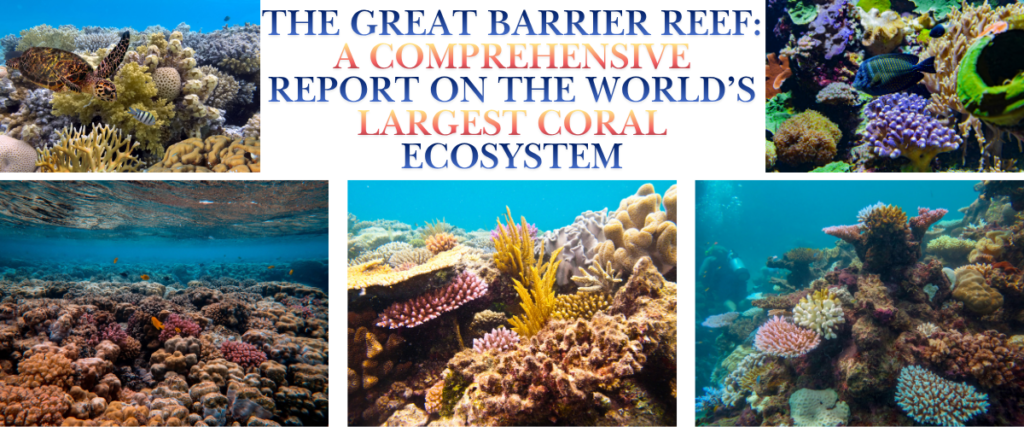
The Great Barrier Reef represents the most expansive and intricate coral reef system on the planet, serving as a singular icon of natural grandeur and biological complexity. Extending over 2,300 kilometres along the northeastern coast of Australia, this massive living structure is not merely a geographic feature but a dynamic entity composed of billions of individual organisms known as coral polyps.1 To comprehend the scale of this natural wonder, one must look beyond its visibility from outer space—a distinction shared by few other biological features—and consider its status as a mosaic of nearly 3,000 individual reefs and 900 islands.2 The reef covers an area of approximately 344,400 square kilometres, a footprint that exceeds the terrestrial landmass of nations such as New Zealand, Italy, or the United Kingdom.3 Recognised as a UNESCO World Heritage site since 1981, the Great Barrier Reef is celebrated for its “Outstanding Universal Value,” a term that encapsulates its ecological integrity, evolutionary history, and the profound cultural connection held by the Aboriginal and Torres Strait Islander peoples, who have served as its custodians for more than 60,000 years.3
Geological Evolution and Morphological Diversity
The emergence of the Great Barrier Reef is a story defined by the slow, persistent forces of plate tectonics and the dramatic fluctuations of global sea levels. Australia’s northward drift, occurring at a rate of approximately 7 centimetres per year since the Cenozoic era, eventually positioned the Queensland coastline within the tropical latitudes required for hermatypic, or reef-building, corals to thrive.2 This journey moved the continent away from the cool, temperate waters of the south and into the “thermal sweet spot” where sea surface temperatures consistently remain between  and .2
The architectural diversity of the reef is a direct consequence of this geological history. The system is categorised into several bioregions, each defined by its depth, proximity to the coast, and water chemistry.2 While the northern sections are characterised by unique ribbon reefs—narrow, elongated structures that form along the edge of the continental shelf—the southern regions feature more traditional platform reefs and coral cays.1
Chronology of Reef Formation
The modern Great Barrier Reef is a relatively young geological feature, despite its ancient roots. Most of the living coral we observe today has grown over the last 9,500 years, following the end of the last glacial maximum when sea levels rose and inundated the continental shelf.7 However, the foundations of these reefs are much older, with some limestone structures dating back as far as 600,000 years.7
| Epoch/Period | Key Geological and Biological Event | Impact on Reef Structure |
| Cenozoic Era | Australia begins its 7cm/year northward drift. | Moves the continent toward tropical waters.2 |
| 24 Million Years Ago | Queensland enters tropical waters. | Initially, sporadic coral growth begins.2 |
| 600,000 Years Ago | Formation of the first major reef structures. | Establishment of the modern GBR’s foundational footprint.7 |
| 20,000 Years Ago | Last Glacial Maximum (LGM). | Sea levels were ~120m lower; the modern reef area was dry land.7 |
| 9,500 Years Ago | Holocene Transgression begins. | Sea level rise floods the shelf, initiating the modern reef.7 |
| 6,000 Years Ago | Sea levels stabilise. | Vertical reef growth reaches the ocean surface.7 |
The physical growth of the reef is driven by the secretion of calcium carbonate ( ) by coral polyps. These polyps function as the “architects” of the sea, building limestone skeletons that accumulate over millennia.2 This process is energy-intensive and relies on a symbiotic relationship with zooxanthellae—microscopic algae that reside within the coral tissue and provide nutrients via photosynthesis. The rate of vertical accretion varies significantly, with some reefs growing up to 25 centimetres per year in ideal conditions, though the average is typically much lower.2
Biological Complexity: A Sanctuary of Biodiversity
The Great Barrier Reef is often referred to as the “rainforest of the sea” due to its staggering levels of biodiversity. It supports nearly 10% of the world’s total fish species and provides a vital sanctuary for numerous threatened and endangered animals.4 This diversity is not merely a matter of numbers; it is a complex web of ecological dependencies where every species, from the microscopic plankton to the 100-tonne whale, plays a specific role in maintaining the health of the system.3
The Diverse Denizens of the Coral Sea
The variety of life within the Marine Park is nearly unparalleled. While corals are the primary focus, they are accompanied by a vast array of marine life across multiple phyla. The reef serves as a critical habitat for 1,625 species of fish, over 3,000 species of mollusks, and 630 species of echinoderms, such as sea stars and sea cucumbers.4
| Category | Estimated Number of Species | Global Significance |
| Hard Corals | 450 – 600 | Foundation of the reef structure.4 |
| Fish | 1,500 – 2,000 | 10% of the world’s fish species.1 |
| Mollusks | 4,000 – 6,000 | Includes giant clams and diverse squid.4 |
| Marine Turtles | 6 | 6 of the world’s 7 marine turtle species.9 |
| Whales/Dolphins | 30 | Includes humpbacks and dwarf minke whales.4 |
| Seabirds | 20 nesting species | Critical breeding grounds on remote cays.4 |
The reef is particularly famous for its larger marine inhabitants. It is a critical breeding ground for humpback whales, which migrate from Antarctic waters to the warmer Coral Sea between July and October to give birth.1 Additionally, the northern Great Barrier Reef hosts the world’s only predictable gathering of dwarf minke whales, providing a unique opportunity for scientific study and tourism.10
Among the most charismatic residents are the six species of marine turtles that call the reef home: the green, hawksbill, loggerhead, flatback, leatherback, and olive ridley. Raine Island, a remote coral cay in the far northern region, is documented as the world’s largest nesting site for green turtles.1 These turtles are not only biological indicators of reef health but also hold immense spiritual significance for First Nations communities.13
Non-Coral Habitats: The Unsung Ecosystems
While coral reefs are the “celebrities” of the Marine Park, they comprise only about 7% of the total area of the World Heritage site.9 The remaining 93% is an extraordinary mix of deep oceanic waters, seagrass meadows, mangrove forests, and sponge gardens.4 These habitats are vital for the survival of the reef’s more famous residents.
Seagrass meadows, for instance, cover at least 5,000 square kilometres and act as the primary foraging grounds for one of the world’s most important populations of dugongs.1 These “sea cows” are gentle mammals that play a crucial role in maintaining the health of the seagrass beds. Mangroves, located along the coastlines of the islands and the mainland, serve as nurseries for juvenile fish, protecting them from predators until they are large enough to migrate to the outer reefs.9
Indigenous Stewardship: 60,000 Years of Sea Country
To Aboriginal and Torres Strait Islander peoples, the Great Barrier Reef is not a separate “wilderness” but a cultural landscape known as “Sea Country.” This concept represents a profound, reciprocal connection between people and the marine environment, where the health of the community is inextricably linked to the health of the land and sea.6 More than 70 Traditional Owner groups maintain an ongoing relationship with the reef, guided by oral traditions, customs, and lore that have been passed down for thousands of generations.4
Cultural Landscapes and Ancient Wisdom
Traditional Owners describe a time when the sea levels were much lower, and their ancestors walked upon what is now the seabed.6 As the ice ages ended and the sea levels rose, these communities adapted, developing sophisticated techniques for maritime navigation, sustainable harvesting, and seasonal management.6 This deep history is reflected in “Dreamtime” or “Creation Stories” that explain the formation of the islands and the origins of marine life.13
- The Rainbow Serpent: A powerful ancestral being believed to have carved out the riverbeds and coastal landscapes during its journey to the sea, eventually creating the coral reefs and islands of the Great Barrier Reef.13
- The Origin of Sea Turtles: First Nations stories often portray sea turtles as the spirits of ancestors transformed into protectors who guide their descendants through the ocean.13
- The Stingray Sisters: Three sisters who transformed into rays and shaped the coastline and sandy beaches through their movements.13
These stories are more than mythology; they are repositories of ecological data, marking the locations of specific species, the cycles of the seasons, and the ethical boundaries of resource use.13
The Strong Peoples-Strong Country Framework
In a significant shift toward co-management, the Great Barrier Reef Marine Park Authority (GBRMPA) and the Great Barrier Reef Foundation have partnered with Traditional Owners to implement the “Strong Peoples-Strong Country” framework.14 This framework is a holistic monitoring system that evaluates the reef’s condition based on Indigenous values rather than purely Western scientific metrics.14
| Hub (Thematic Area) | Cultural and Environmental Indicators |
| People’s Health | Social and emotional well-being, access to traditional medicine, and spirituality.14 |
| Country Health | “You to Country” health (the belief that presence is needed for the sea to thrive), and healthy animal populations.14 |
| Culture and Community | Strength of language, lore, ceremony, and kinship systems.17 |
| Heritage and Knowledge | Learning from elders, protection of sacred sites, and oral history preservation.17 |
| Empowerment and Economics | Traditional Owner-led businesses and employment on Country.17 |
| Education | Two-way sharing of knowledge between Western science and traditional ecological knowledge.17 |
This approach recognises that the reef cannot be fully understood or protected without acknowledging its human history. By integrating 60,000 years of Indigenous management with modern science, conservationists hope to build a more resilient ecosystem capable of withstanding contemporary pressures.19
Economic Imperatives: The Reef as a National Asset
While the Great Barrier Reef is priceless in terms of its biological and cultural value, it also represents a formidable economic engine for the Australian nation. A 2025 report by Deloitte Access Economics estimated the reef’s total economic, social, and icon asset value at $95 billion, a staggering 69% increase from its 2017 valuation.21 This rise in value reflects both a more sophisticated understanding of the reef’s contributions and a growing realisation of what the world stands to lose if the ecosystem continues to decline.
Direct and Indirect Economic Contributions
The reef contributes approximately $9 billion annually to the Australian economy and supports 77,000 full-time equivalent jobs.21 To put this into perspective, if the Great Barrier Reef were a business, it would rank as Australia’s fifth-largest employer.21
Tourism is the undisputed titan of the reef economy, generating $7.9 billion each year—nearly 90% of the reef’s total economic output.22 In Queensland alone, more than 30% of all leisure tourism spending is linked directly to the Great Barrier Reef region.22 Beyond tourism, the reef supports sustainable commercial fishing, recreational activities, and critical scientific research.22
| Value Type | Economic Contribution (2025 Estimates) | Key Insight |
| Total Asset Value | $95 Billion | Includes social, icon, and economic facets.22 |
| Annual Value Added | $9 Billion | Direct contribution to Australia’s GDP.21 |
| Employment | 77,000 Jobs | Equivalent to Australia’s 5th largest employer.21 |
| Tourism Value | $7.9 Billion | 89% of the reef’s total economic value.22 |
| Non-Use/Icon Value | $39 Billion | The value people place on the reef’s existence globally.22 |
The “Too Big to Fail” Economy
The concept of “non-use value” is particularly revealing. This describes the value that people who may never even visit the reef place on its continued existence. According to Deloitte, this value is estimated at $39 billion.22 Furthermore, the reef is a centrepiece of “Brand Australia,” with 65% of survey respondents identifying it as the nation’s most iconic natural feature, ranking it above Uluru or the Blue Mountains.22
However, this economic powerhouse is under threat. The 2025 report warns that long-term growth in the tourism sector has stagnated at 1.1% per year since 2007, compared to 1.7% for the rest of Queensland.22 This slowdown is largely attributed to global concerns regarding the reef’s health, underscoring the direct link between ecological integrity and economic stability. Proactive investment in reef resilience is estimated to offer a $124 billion economic opportunity over the next 50 years, whereas inaction could lead to catastrophic losses.22
Environmental Pressures: The Climate Crisis and Beyond
The Great Barrier Reef is currently facing its most perilous era in recorded history. While the ecosystem has survived geological upheavals and sea-level changes over millennia, the current rate of environmental transformation is unprecedented. Climate change stands as the single greatest threat to the reef, but it is compounded by a suite of localised pressures that erode the system’s natural resilience.3
The Mechanism of Mass Coral Bleaching
Coral bleaching is a stress response that has become a chillingly familiar sight on the reef. As ocean temperatures rise due to greenhouse gas emissions, the symbiotic relationship between the coral polyps and their resident zooxanthellae breaks down. When the water temperature remains as little as  above the seasonal maximum for several weeks, the algae begin to produce toxic compounds, prompting the coral to expel them.26
Without the zooxanthellae, the coral loses its primary source of nutrition and its vibrant colour, leaving the white limestone skeleton visible through its translucent tissue.26 While bleached corals are not dead, they are in a state of extreme vulnerability. If the water does not cool down within a critical window, the corals will starve to death and be overgrown by algae, leading to a permanent loss of habitat for the thousands of species that depend on them.26
Recent Bleaching History (2016–2025)
The frequency of mass bleaching events has accelerated dramatically. Between 1998 and 2015, the reef experienced only two mass bleaching events. Since 2016, there have been six.24
- The 2024 Event: This was the most spatially extensive bleaching ever recorded, affecting 74% of surveyed reefs across all regions—Northern, Central, and Southern.26 In the southern section, coral cover plummeted by a record 30.6% in a single year.28
- The 2025 Event: Marked only the second time in history that back-to-back bleaching occurred (following 2024). This event was primarily constrained to the northern reef, with aerial surveys showing medium to high bleaching on 41% of inshore reefs.28
The primary danger of consecutive events is that they close the “recovery window.” Corals typically need several years, or even decades, to fully recover from a severe bleaching event. When events occur annually or biannually, the ecosystem’s ability to repair itself is severely compromised.26
Local Pressures: Water Quality and Pests
While climate change is a global issue, several local threats are more manageable but no less dangerous:
- Agricultural Runoff: Rain washes fertilisers, pesticides, and sediments from Queensland farms into the reef lagoon. Excess nitrogen and phosphorus trigger “eutrophication,” which causes massive algal blooms that outcompete coral for light and oxygen.2
- Crown-of-Thorns Starfish (COTS): These large, venomous starfish are specialised coral predators. While they occur naturally, outbreaks can be catastrophic, with thousands of starfish devouring entire reef sections. These outbreaks are often fueled by nutrient-rich runoff, which increases the survival rate of starfish larvae.2
- Coastal Development and Mining: The destruction of coastal wetlands has removed the reef’s natural filters, allowing more toxins to reach the coral. Historical incidents, such as the discharge of nitrate-laden water from nickel mining in 2009 and 2011, highlight the ongoing risk of industrial pollution.2
Restoration and Adaptation: Engineering a Future for Coral
Faced with these mounting threats, scientists have moved from a strategy of passive protection to one of active intervention. The Reef Restoration and Adaptation Program (RRAP) is the world’s most ambitious effort to help a marine ecosystem resist, adapt to, and recover from climate change.30
Coral IVF and Seeding Technology
One of the most promising techniques developed is “Coral IVF.” During the annual mass spawning event—a “synchronised blizzard” of eggs and sperm released after a full moon in late spring—researchers collect spawn from healthy reefs.1 These reproductive bundles are reared in large, floating nursery pools until they develop into larvae. Once ready, these “baby corals” are settled onto damaged reefs to fast-track recovery.31
To improve the efficiency of this process, scientists use “Coral Clips”—stainless steel spring devices that allow divers to quickly and securely attach coral fragments to the reef without the need for chemical adhesives.31
The McLaren Partnership and Machine One
A groundbreaking collaboration between the McLaren Racing Formula 1 team and the Great Barrier Reef Foundation has brought high-performance engineering to the ocean floor.33 The partnership addressed a critical bottleneck: the manual assembly of “seeding devices” (small cradles that hold young corals).33
Before this collaboration, each cradle was assembled by hand, taking roughly 90 seconds. McLaren engineers developed “Machine One” (affectionately known as OSCAR), a semi-automated system that completes the task in just 10 seconds.33 This technological leap could increase the number of corals planted annually from 100,000 to over one million, significantly lowering costs and increasing the scale of restoration.33
Assisted Evolution and Cryopreservation
At the National Sea Simulator (SeaSim) in Townsville, researchers are engaged in “assisted evolution.” By selecting coral “parents” that have naturally survived past bleaching events, they hope to breed offspring with a higher inherent tolerance for heat.30 These heat-tolerant corals could serve as the “genetic foundation” for the reefs of the future.
Furthermore, scientists are building a “frozen zoo” of coral genetics through cryopreservation. By freezing coral sperm and embryonic cells in liquid nitrogen, researchers are creating a biological insurance policy against the extinction of vulnerable species.31
Citizen Science: Empowering the Global Community
The Great Barrier Reef is so vast that traditional monitoring by government agencies and scientists can only cover a fraction of its area. Citizen science has emerged as a vital tool, turning tourists, divers, and community members into “eyes on the reef”.37
Programs for Public Participation
Several programs allow the public to contribute directly to reef conservation:
- Eye on the Reef: An app-based program that allows anyone visiting the reef to record animal sightings, report bleaching, or document marine debris. This data provides reef managers with a “big picture” view of the ecosystem’s health.37
- The Great Reef Census: A global initiative where volunteers analyse thousands of underwater images to identify coral types and cover. This program has successfully surveyed a quarter of the reef since 2020.11
- CoralWatch: Founded by the University of Queensland, this program uses a simple colour-coded chart to allow snorkelers and divers to quantify coral health and bleaching levels.11
Remarkable Discoveries by Citizen Scientists
The power of citizen science was demonstrated in 2025 when a mother-and-daughter team participating in the Great Reef Census discovered what is believed to be the largest coral colony ever documented on the reef.40 The colony, a Pavona clavus coral located offshore from Cairns, measures approximately 111 meters in length and covers an area of nearly 4,000 square meters—roughly half the size of a soccer field.40 Scientists believe this “rolling meadow” of coral has survived for centuries, serving as a potential “hotspot of resilience” that could provide larvae to surrounding reefs.40
| Discovery/Program | Achievement | Impact |
| 111-meter Colony | Largest known coral on the GBR.41 | Highlights the existence of “resilience hotspots”.40 |
| Great Reef Census | Surveyed 25% of the reef since 2020.40 | Provides rapid, large-scale spatial reconnaissance.41 |
| 500m Tall Reef | Discovered in northern GBR in 2020.2 | Proof that much of the reef remains undocumented. |
| Deep Sea Discovery | New cold-water reefs found at 1,000m+ depth.42 | Expands the known range of coral life in the region. |
Management and Policy: The 2050 Plan
The long-term survival of the Great Barrier Reef depends on a robust framework of management and international cooperation. The “Reef 2050 Plan” serves as the overarching strategy for the Australian and Queensland governments to protect the reef’s Outstanding Universal Value.18
Zoning and Spatial Management
The Great Barrier Reef Marine Park is not a “look but don’t touch” reserve, but a multi-use area managed through a sophisticated zoning system.4 This system balances the needs of biodiversity with activities such as tourism, fishing, and shipping.
- General Use Zones (Light Blue): Most activities are permitted, provided they are sustainable.
- Habitat Protection Zones (Dark Blue): Prohibit activities that damage the seafloor, such as trawling.
- Marine National Park Zones (Green): “No-take” areas where fishing and extraction are prohibited. These zones are critical for protecting “mother fish” that repopulate the rest of the reef.4
- Preservation Zones (Pink): The strictest zones, where even entry is prohibited except for vital scientific research. These areas act as true “baselines” for a healthy ecosystem.5
Global Responsibility and UNESCO
As a World Heritage site, the reef is subject to international scrutiny. UNESCO has frequently expressed concern over the impact of climate change and water quality, at times threatening to list the reef as “in danger”.1 While such a listing is often viewed as a “shaming” of the host nation, it also serves as a global call to action.
The Australian government has responded with record investments, including a $1.2 billion package announced in 2025 to improve water quality, strengthen partnerships with Traditional Owners, and accelerate restoration research.21 However, as scientists repeatedly emphasise, local management can only do so much. The ultimate fate of the reef is tied to global carbon emissions and the world’s ability to limit warming to within  of pre-industrial levels.22
Conclusion
The Great Barrier Reef is a testament to the beauty and fragility of our natural world. It is a living masterpiece that has evolved over millions of years, supporting an incredible array of life and providing a cultural and spiritual foundation for Australia’s First Nations peoples. Yet, it now faces a challenge unlike any in its history. The data from 2024 and 2025 is a stark reminder that the reef is at a tipping point, with climate change pushing it toward its physiological limits.
The path forward is clear but difficult. It requires a Herculean effort to stabilise the global climate, combined with innovative technology to help the reef adapt and local management to reduce the burden of pollution and pests. The $95 billion valuation of the reef reminds us that it is “too big to fail” economically, but its true value lies in its role as a global treasure—a place where humans can still witness the untamed splendour of the ocean. Through the combined efforts of scientists, Traditional Owners, citizen scientists, and global policymakers, there remains a window of opportunity to ensure that the Great Barrier Reef continues to thrive for another 60,000 years.
Disclaimer
This report is a comprehensive synthesis of environmental, economic, and cultural data as of early 2026. The Great Barrier Reef is an extremely complex and rapidly changing ecosystem. Therefore, the findings regarding coral cover, bleaching severity, and economic valuations are subject to revision as new monitoring data and scientific peer reviews become available. While every effort has been made to ensure accuracy by citing authoritative sources such as the Australian Institute of Marine Science (AIMS), the Great Barrier Reef Marine Park Authority (GBRMPA), and UNESCO, the authors and affiliated organisations cannot be held liable for any direct or indirect loss or damage resulting from the use of this information. This report is intended for informational and educational purposes only and does not constitute official government policy or environmental management advice. Users are encouraged to consult official portals for real-time updates on reef zoning, safety warnings, and conservation status. All mention of commercial products or partnerships (e.g., McLaren Racing) is for the purpose of documenting conservation efforts and does not imply an endorsement of those entities’ unrelated commercial activities. Environmental conditions and biological responses can vary significantly across the 2,300 km length of the reef; local conditions should be assessed independently for diving or tourism purposes.
References
- Great Barrier Reef ecosystem | Environmental Sciences | Research Starters – EBSCO, accessed on May 11, 2026, https://www.ebsco.com/research-starters/environmental-sciences/great-barrier-reef-ecosystem
- Great Barrier Reef – Wikipedia, accessed on May 11, 2026, https://en.wikipedia.org/wiki/Great_Barrier_Reef
- About our Great Barrier Reef, accessed on May 11, 2026, https://www.detsi.qld.gov.au/great-barrier-reef/about
- Fascinating facts about the Great Barrier Reef, accessed on May 11, 2026, https://www2.gbrmpa.gov.au/learn/fascinating-facts-about-great-barrier-reef
- GREAT BARRIER REEF – World Heritage Datasheet – UNEP-WCMC, accessed on May 11, 2026, http://world-heritage-datasheets.unep-wcmc.org/datasheet/output/site/great-barrier-reef/
- Great Barrier Reef Traditional Owners | Reef Authority, accessed on May 11, 2026, https://www2.gbrmpa.gov.au/learn/traditional-owners/great-barrier-reef-traditional-owners
- Great Barrier Reef Timeline – GBR Biology, accessed on May 11, 2026, https://www.gbrbiology.com/knowledge-and-news/great-barrier-reef-timeline/
- How old is Australia’s Great Barrier Reef? · Creation.com, accessed on May 11, 2026, https://creation.com/en/articles/age-great-barrier-reef
- Facts – Great Barrier Reef Foundation, accessed on May 11, 2026, https://www.barrierreef.org/the-reef/facts
- 10 incredible facts about the Great Barrier Reef – Queensland, accessed on May 11, 2026, https://www.queensland.com/au/en/places-to-see/experiences/great-barrier-reef/facts-about-the-iconic-great-barrier-reef
- 5 citizen science projects that help the Great Barrier Reef, accessed on May 11, 2026, https://www.detsi.qld.gov.au/our-department/news-media/down-to-earth/5-citizen-science-projects-that-help-the-great-barrier-reef
- 10 Things You Didn’t Know About The Great Barrier Reef, accessed on May 11, 2026, https://www.greatvaluevacations.com/amp/travel-inspiration/10-things-you-didnt-know-about-the-great-barrier-reef
- Sea Country Great Barrier Reef First Nations People / MOUA / Museum of Underwater Art, accessed on May 11, 2026, https://www.moua.com.au/visit/sea-country
- Strong Peoples – Strong Country Indigenous Heritage Monitoring Framework – GBRMPA ELibrary, accessed on May 11, 2026, https://elibrary.gbrmpa.gov.au/jspui/retrieve/0ad86c24-9020-497b-bbd1-e4582da7f277/Strong-Peoples-Strong-Country.pdf
- Indigenous Culture Experiences | Cairns & Great Barrier Reef – Tropical North Queensland, accessed on May 11, 2026, https://tropicalnorthqueensland.org.au/indigenous-culture/
- Indigenous Tourism – GBR Biology, accessed on May 11, 2026, https://www.gbrbiology.com/reef-education/indigenous-tourism/
- The Strong Peoples-Strong Country framework – Great Barrier Reef Foundation, accessed on May 11, 2026, https://www.barrierreef.org/uploads/GRB5162-Fact-Sheet-3-AW4.pdf
- The Strong Peoples – Strong Country Framework – Sharing the important and inspiring stories that are reframing our narrative., accessed on May 11, 2026, https://www.ourreefstories.com.au/story/the-strong-peoples-strong-country-framework/
- Strong peoples – strong country: Indigenous heritage monitoring framework summary report, accessed on May 11, 2026, https://reefknowledgesystem.gbrmpa.gov.au/resource-hub/reports/strong-peoples-strong-country-indigenous-heritage-monitoring-framework-summary-report
- Traditional Owner-led conservation – Great Barrier Reef Foundation, accessed on May 11, 2026, https://www.barrierreef.org/what-we-do/projects/traditional-owner-led-conservation
- Great Barrier Reef valued at $95 billion, supports 77,000 jobs – DCCEEW, accessed on May 11, 2026, https://www.dcceew.gov.au/about/news/gbr-valued-95-billion-supports-77000-jobs
- At what cost? Safeguarding the Great Barrier Reef’s role in …, accessed on May 11, 2026, https://barrierreef.org/uploads/GBRValue-FullReport-Oct25.pdf
- 98% of Australians fear losing the Great Barrier Reef as new report reveals its $95 billion value, accessed on May 11, 2026, https://www.barrierreef.org/news/media-release/value-of-the-reef
- Year in Review 2024/25 – Great Barrier Reef Foundation, accessed on May 11, 2026, https://www.barrierreef.org/uploads/GBRF-Year-In-Review-2024-25.pdf
- Protecting the Great Barrier Reef – DCCEEW, accessed on May 11, 2026, https://www.dcceew.gov.au/parks-heritage/great-barrier-reef/protecting
- Great Barrier Reef Bleaching: Understanding the Crisis and Pathways Forward – Coral Vita, accessed on May 11, 2026, https://coralvita.co/coral-cafe/great-barrier-reef-bleaching/
- 11 amazing facts about the Great Barrier Reef!, accessed on May 11, 2026, https://greatbarrierreeftourscairns.com.au/blog/11-amazing-facts-about-the-great-barrier-reef/
- Annual Summary Report of Coral Reef Condition 2024/25 | AIMS, accessed on May 11, 2026, https://www.aims.gov.au/monitoring-great-barrier-reef/gbr-condition-summary-2024-25
- Coral bleaching events | AIMS – The Australian Institute of Marine Science, accessed on May 11, 2026, https://www.aims.gov.au/research-topics/environmental-issues/coral-bleaching/coral-bleaching-events
- Reef Restoration and Adaptation Program | AIMS, accessed on May 11, 2026, https://www.aims.gov.au/research/reef-recovery/RRAP
- Reef Restoration – Great Barrier Reef Foundation, accessed on May 11, 2026, https://www.barrierreef.org/what-we-do/projects/reef-restoration
- AIMS scientists help take Great Barrier Reef restoration approaches global, accessed on May 11, 2026, https://www.aims.gov.au/information-centre/news-and-stories/aims-scientists-help-take-great-barrier-reef-restoration-approaches-global
- How McLaren is using F1 technology to restore Great Barrier Reef – AugustMan, accessed on May 11, 2026, https://www.augustman.com/sg/gear/motoring/mclaren-great-barrier-reef-restoration-with-f1-technology/
- McLaren Racing and the Great Barrier Reef Foundation fast‑tracking reef recovery, accessed on May 11, 2026, https://www.barrierreef.org/news/media-release/McLaren-fast-tracking-reef-recovery
- McLaren Racing fast-tracks coral recovery – Divernet, accessed on May 11, 2026, https://divernet.com/scuba-diving/mclaren-racing-fast-tracks-coral-recovery/
- McLaren’s role in Great Barrier Reef restoration breakthrough – The Race, accessed on May 11, 2026, https://www.the-race.com/business/mclaren-racing-great-barrier-reef-restoration/
- Eye on the Reef | Reef Authority, accessed on May 11, 2026, https://www2.gbrmpa.gov.au/our-work/programs-and-projects/eye-on-the-reef
- How YOU can help keen an Eye on the Reef | Great Barrier Reef Marine Park Authority, accessed on May 11, 2026, https://www.youtube.com/watch?v=q9Xe8TIgg30
- Experience the Great Barrier Reef on a citizen science holiday – Queensland, accessed on May 11, 2026, https://www.queensland.com/au/en/places-to-see/experiences/great-barrier-reef/citizen-science-holidays-great-barrier-reef
- Citizen scientists discover a Great Barrier Reef coral giant ‘like a rolling meadow’, accessed on May 11, 2026, https://www.theguardian.com/environment/2026/feb/24/citizen-scientists-discover-great-barrier-reef-coral-giant-census
- Citizen scientists find largest known coral on Great Barrier Reef – Oceanographic Magazine, accessed on May 11, 2026, https://oceanographicmagazine.com/news/citizen-scientists-find-largest-known-coral-on-great-barrier-reef/
- One of the world’s largest deep-sea coral reefs discovered off Argentina – Mongabay, accessed on May 11, 2026, https://news.mongabay.com/2026/04/one-of-the-worlds-largest-deep-sea-coral-reefs-discovered-off-argentina/
- State Party Report on the Great Barrier Reef Provided to UNESCO, accessed on May 11, 2026, https://www2.gbrmpa.gov.au/news/state-party-report-great-barrier-reef-provided-unesco
- 2025 Reef Forum – Reef Authority, accessed on May 11, 2026, https://www2.gbrmpa.gov.au/our-work/programs-and-projects/2025-reef-forum