
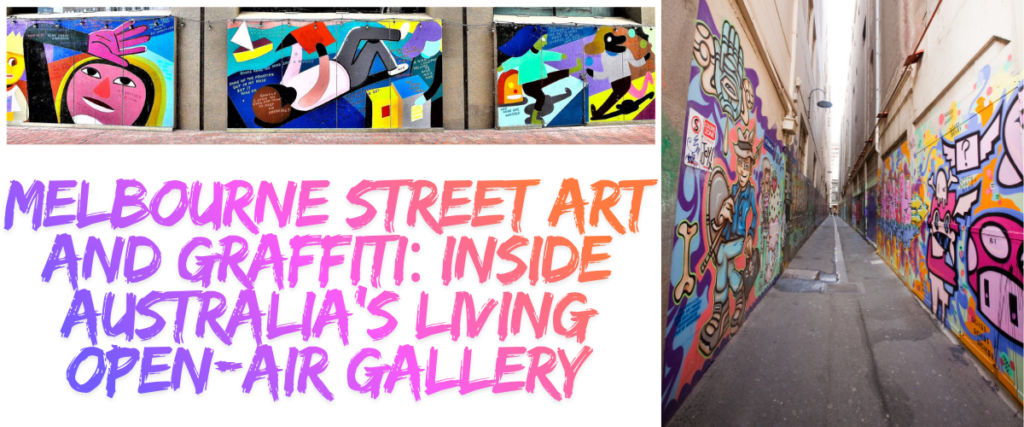
Walk down Hosier Lane on any given morning, and you can smell fresh aerosol paint before you even see the walls. Overnight, a hyper-realistic portrait may have gained a neon halo, a row of wheatpaste posters might have vanished beneath bold bubble lettering, and even the battered wheelie bins wear fresh coats of colour1. Melbourne has earned a global reputation as Australia’s street art capital—and one of the most celebrated urban art cities in the world—precisely because its concrete and bluestone surfaces never sit still4.
Yet look past the postcard-ready selfies, and you will find a far more complicated story. Melbourne’s street culture sits on a permanent fault line between rebellion and tourism, underground vandalism and council-backed placemaking1. The same city that uses laneway murals to promote international tourism also spent AUD 2.82 million in the 2025 financial year scrubbing unwanted graffiti off its walls, according to municipal expenditure figures cited by University of Melbourne researcher Dr Sabina Andron4. Meanwhile, celebrated muralists now scale 13-storey city towers with engineering permits and crane support, while unauthorised graffiti writers face maximum statutory penalties of up to two years in prison and fines exceeding AUD 50,000 under Victorian law9.
Understanding Melbourne street art and graffiti means looking at both halves of that coin. It is a four-decade journey stretching from 1980s suburban train lines to world-first stencil festivals, sprawling bayside mural precincts, and fierce 2026 debates over who truly owns the city’s walls1.
From Rail Corridors to Stencil Capital: How Melbourne Found Its Style
Long before Melbourne’s back alleys became tourist icons, its walls carried sharp, homegrown wit. In the 1970s, photographer Rennie Ellis documented the city’s earliest graffiti across three landmark books—Australian Graffiti (1975), Australian Graffiti Revisited (1979), and The All New Australian Graffiti (1985)—capturing cheeky political slogans and anti-billboard protests such as “NO STANDING, ONLY DANCING”1.
Everything shifted in 1983, when the energy of New York hip-hop and subway graffiti reached Victoria through music television, photography books, and films like Beat Street1. Because Melbourne sat oceans away from New York in the pre-internet era, local writers absorbed those influences and mutated them into something distinctly their own1. Throughout the mid-to-late 1980s, pioneering crews such as USA (United Street Artists), WCA, and DMA (Da Mad Artists)—featuring influential writers like Paris, Peril, New2, and Tame—turned suburban railway corridors and rolling train carriages into moving galleries, an era chronicled in the visual history Kings Way: The Beginnings of Australian Graffiti: Melbourne 1983–9315.
At the same time, Melbourne was discovering a broader appetite for public murals. In 1983, a culturally significant mural was painted outside the Aborigines Advancement League building4. The following year, on 6 March 1984, New York pop-art legend Keith Haring visited Melbourne and painted a vibrant mural on the eastern wall of the former Collingwood Technical College on Johnston Street1. Alongside beloved public commissions like Mirka Mora’s mosaic at Flinders Street Station, Haring’s visit signalled that street-level art belonged in the heart of Melbourne’s civic life16. Listed on the Victorian Heritage Register in 2004, Haring’s Collingwood wall underwent specialist conservation work led by Italian conservator Antonio Rava in 2013; according to Time Out Melbourne, it remains one of only 31 known surviving Haring murals worldwide and one of just three never painted over or altered in design21.
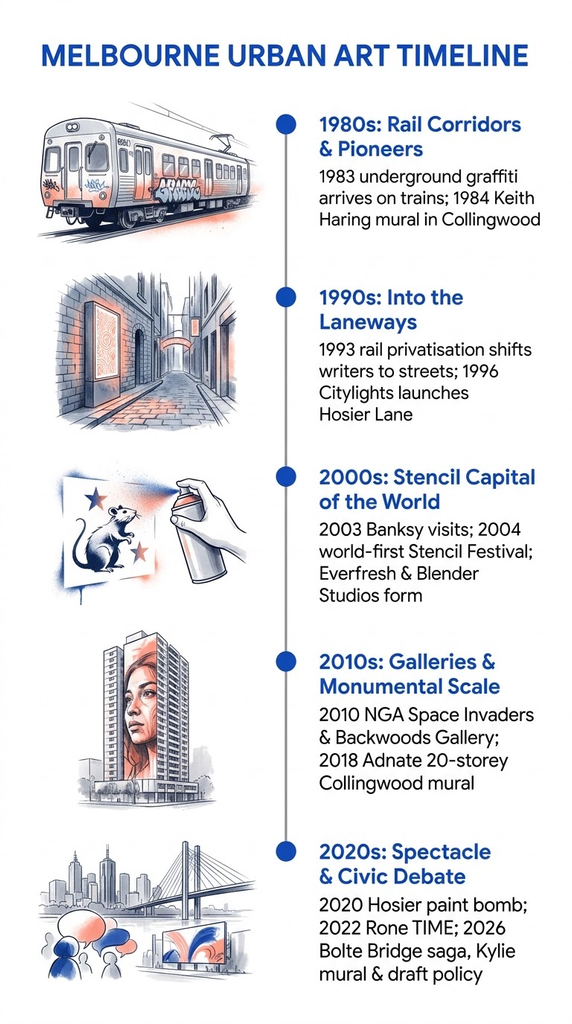
A structural turning point arrived in 1993, when Melbourne’s railways were privatised, and strict new security regimes tightened around train yards14. Pushed away from rail lines, many writers moved into inner-city streets and Melbourne’s dense web of Victorian-era bluestone laneways, tucked neatly out of sight1. During the 1990s, artists like Puzle, Merda, Duel, Mars, and Pest began blending traditional graffiti lettering with complex illustration16. Then, in 1996, the Citylights project installed public lightboxes in the CBD, helping transform an unassuming back alley—Hosier Lane—into a 24-hour gallery and drawing international names like Shepard Fairey and France’s Space Invader to Melbourne16. Hosier Lane received its first mural in 1998, setting the stage for an explosion7.
By the turn of the millennium, Melbourne was experiencing an organic artistic boom24. Aided by the arrival of European low-pressure spray paint brands like Montana, local artists embraced hand-cut stencils, wheatpaste posters, stickers, and street installations4. Pioneers such as Ha-Ha (Regan Tamanui), whose intricate multi-layered Ned Kelly stencils gained national acclaim, alongside Meek, Sync, Dlux, and Prism (founder of the global online hub stencilrevolution.com), forged a visual language that was sharper, more political, and more accessible than traditional tagging16.
International validation arrived fast. British artist Banksy spent several months painting in Melbourne in 2003, later praising it in 2006 as “the proud capital of street painting with stencils” whose back alleys dripped with graffiti “more diverse and original than any other city in the world”4. In 2004, Melbourne hosted the world’s first Stencil Festival in North Melbourne; by 2007, the annual event featured 75 artists from 12 countries and drew more than 4,000 visitors4. Around the same time, creative collectives including Everfresh Studio in Collingwood, Blender Studios in the CBD, and the AWOL Crew nurtured a generation of artists—Rone, Phibs, Reka, Meggs, Mike Makatron, and Matt Adnate among them—who bridged underground street painting and fine art16.
Not everyone welcomed the shift toward gallery polish. Underground purists like Jisoe (immortalised in Eddie Martin’s cult documentary) and the notorious 70K (“70s Kids”) crew—including writers Renks, Bonez, and Karl 123—deliberately pushed back against mainstream respectability4. In a 2024 Esquire Australia interview, Renks recalled facing 360 charges and becoming one of the first people in the country jailed for graffiti as 70K championed deliberately “ugly,” anti-capitalist, anti-authority work across tunnels, trains, and city buildings4.
By the 2010s and 2020s, Melbourne’s street art had firmly entered the cultural establishment. After a 2008 Lonely Planet poll named Melbourne’s laneway street art Australia’s top cultural attraction, the National Gallery of Australia staged its landmark Space Invaders exhibition in 2010, and street artists founded Collingwood’s Backwoods Gallery that same year4. Murals also scaled to architectural heights. In 2018, public art studio Juddy Roller commissioned Adnate to paint a 20-storey mural across the Collingwood Housing Estate—depicting four residents of diverse backgrounds and described by Juddy Roller as 62 metres tall and reported at completion as the tallest mural in the Southern Hemisphere34. During Melbourne’s pandemic lockdowns, Everfresh co-founder Rone secretly transformed the abandoned third-floor wing of Flinders Street Station into TIME, an immersive nostalgic installation that captivated audiences when it opened in 202236. In 2026, the momentum continued at full throttle: Adnate partnered with Juddy Roller and Oxfam Australia on a politically charged Fitzroy mural confronting extreme wealth inequality in January, before delivering a 13-storey portrait of Kylie Minogue opposite Flinders Street Station in September 2026 for a scheduled eight-week display ahead of the AFL Grand Final—going from initial phone call to finished portrait in just 21 days39.
Decoding the Walls: Graffiti, Street Art, and Melbourne’s Signature Styles
Walk through Melbourne’s laneways with a keen eye, and you will quickly realise that “graffiti” and “street art” are not interchangeable terms—even though they share brick walls, aerosol cans, and tangled roots1.
Traditional graffiti is primarily letter-based, subcultural, and unauthorised1. It speaks first and foremost to other graffiti writers, celebrating speed, risk, placement, and calligraphic mastery18. Street art, by contrast, grew outward from graffiti and punk DIY culture to embrace figurative imagery, illustration, stencils, paste-ups, sculpture, and large-scale murals1. It aims to converse directly with everyday passers-by—and today spans everything from guerrilla night-time paste-ups to multi-storey government commissions25. As Melbourne muralist Adnate puts it, the sharpest dividing line often comes down to consent: “One person has permission, and the other person doesn’t. That’s the line in the sand”8.
To read Melbourne’s walls like a local, it helps to recognise the distinct visual languages layered across the city:
| Style or Medium | Defining Characteristics | Cultural Role & Notable Melbourne Examples |
| Tagging and Handstyles | Quick, stylised calligraphic signatures applied with spray paint, markers, or etching tools42. | The foundation of graffiti identity and muscle memory; 1980s DMA pioneer Tame famously submitted a three-second tag as a self-portrait to the 2014 Archibald Prize18. |
| Throw-ups and Bombing | Rapidly painted bubble letters (often two colours) applied repeatedly across high-visibility surfaces42. | Built for maximum impact and visibility along rail corridors, rooftops, and city alleys; exemplified by relentless bombers like Nost and the 70K crew30. |
| Pieces and Wildstyle | Large, multicoloured letter-based aerosol artworks featuring complex shadows, outlines, and interlocking geometry42. | Showcases technical mastery and crew pride across legal and semi-legal walls such as Union Lane and Fitzroy’s back streets23. |
| Melbourne Style and Antistyle | Homegrown local graffiti aesthetics: “Melburne” style (a play on “burns”) is messy and aggressive, while “Antistyle” deliberately breaks conventional rules46. | Reflects Melbourne’s independent streak, carried by contemporary crews such as XX and WLS alongside echoes of 70K’s earlier anti-aesthetic rebellion31. |
| Stencil Art | Hand-cut or digitally designed templates sprayed in crisp single or multi-layered colours for rapid repetition25. | Put Melbourne on the global map in the 2000s; Regan Tamanui (Ha-Ha) uses up to 40 stencil layers for portraits like his Ned Kelly series, while Meek championed political commentary16. |
| Paste-ups and Stickers | Pre-painted or printed paper artworks adhered with wheatpaste, plus mass-produced sticker “slaps”1. | Allows intricate studio work to appear overnight; early paste-up icons include Rone’s haunting female faces, Reka, and Baby Guerrilla’s soaring human figures16. |
| Hyperrealist and Large-Scale Murals | Towering, often commissioned portraits and storytelling compositions painted freehand with spray paint or acrylics42. | Defines Melbourne’s modern skyline; standouts include Adnate’s chiaroscuro Indigenous and community portraits, Smug’s freehand photorealism, Rone’s muses, and Dvate’s native wildlife34. |
| 3D, Mixed-Media, and Post-Internet Art | Sculptures, ceramics, miniature dioramas, yarn bombing, fire-extinguisher painting, and viral meme murals1. | Pushes street art beyond flat paint: Mike Makatron’s 3D Bon Scott sculpture in AC/DC Lane, Presgrave Place’s framed curiosities, Tinky’s miniature worlds, and Lushsux’s provocative internet-meme murals28. |
That final category—post-internet meme murals—illustrates just how closely Melbourne’s walls now mirror digital culture52. Western-suburbs-raised artist Lushsux gained international notoriety (and earned comparisons as “Australia’s answer to Banksy”) by painting viral pop-culture jokes and celebrity mashups designed to travel across Instagram long after the paint dries52. His works also exposed the legal boundaries of provocation: in August 2016, Maribyrnong Council deemed his Footscray mural of a swimsuit-clad Hillary Clinton offensive under Victorian graffiti law, prompting him to paint a burqa over it before the wall was blacked out entirely52. That same year, after receiving a legal notice from Taylor Swift’s lawyers over a mural depicting the singer, he transformed it into a tribute to the gorilla Harambe55. As University of Melbourne scholar Lachlan MacDowall observed, Melbourne’s streets and phone screens have effectively merged into a single arena for public art54.
Beyond Hosier Lane: A Neighbourhood-by-Neighbourhood Guide
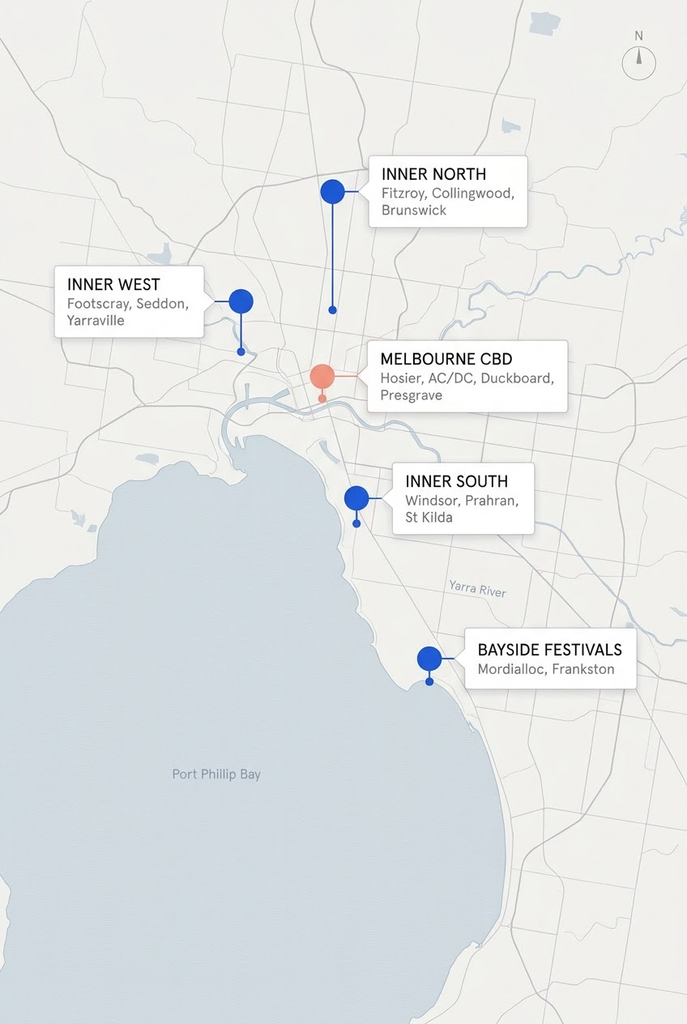
Many first-time visitors walk down Hosier Lane, snap a few photos, and assume they have seen Melbourne’s street art. In truth, the CBD laneways are only the doorway. Across Greater Melbourne, different postcodes carry completely different artistic moods—from the gritty, layered collage of central alleys to warehouse-sized murals in the inner north and curated street art festivals reaching all the way down Port Phillip Bay5.
The Melbourne CBD Laneways
The central city’s compact grid makes it ideal for a free, self-guided walking loop of roughly three kilometres—taking about two hours at a relaxed pace and sitting almost entirely within the Free Tram Zone58.
Hosier Lane and Rutledge Lane, directly opposite Federation Square, remain the pulsing heart of the scene22. Sometimes nicknamed “practice alley” because anyone can paint there without a permit, Hosier Lane shifts daily, layering quick tags and stencils beneath towering anchors such as Adnate’s 23-metre-high portrait of an Indigenous boy gazing toward the Yarra River22. Follow the lane as it hooks into horseshoe-shaped Rutledge Lane, where the artwork climbs right over dumpsters and upper-storey windows2.
Five minutes east off Flinders Lane sits AC/DC Lane (renamed from Corporation Lane in 2004 in honour of the rock band), a shrine to live music anchored by a portrait of Malcolm Young and Mike Makatron’s 3D sculpture of Bon Scott bursting out of the brickwork22. Loop immediately into Duckboard Place to spot Steen Jones’s tattoo-styled Melbourne tribute, Lukas Kasper’s playful characters, Fintan Magee’s towering portrait, and high-end dining rooms tucked behind sticker-bombed doors28.
For a sharper contrast, wander north toward Union Lane (linking Bourke Street Mall and Little Collins Street) and Croft Alley in Chinatown, both packed floor-to-ceiling with fast-moving aerosol pieces and colourful tags3. Then duck into Presgrave Place off Howey Place, where Melbourne’s scene shrinks to an intimate scale: entire walls covered in framed photographs, found objects, stickers, and quirky miniatures23. Elsewhere across the CBD, look for Drewery Lane (home to a moving handmade tile mosaic honouring Australian war veterans alongside Jaz Mishap’s glowing Flash Forward mural), Meyers Place (featuring Mike Makatron’s Jungle Funk botanical wall), Caledonian Lane (birthplace of the international Laneway Festival), Blender Lane (named after the influential studio collective that once incubated underground talent there), and the Upper West Side Street Art Precinct—launched in late 2017 on an old power station wall with large-scale works by Rone, Smug, and Dvate22.
The Inner North: Fitzroy, Collingwood, and Brunswick
Catch the Route 86 tram north of the CBD into Fitzroy and Collingwood—or the Route 19 tram up Sydney Road into Brunswick—and the walls grow dramatically larger58. Fitzroy and Collingwood form Melbourne’s true creative engine room, where old factories, pubs, and brick terraces provide sweeping canvases5. Along Johnston Street, you can visit Keith Haring’s restored 1984 heritage mural at Collingwood Yards (35 Johnston Street) before walking past the Night Cat’s iconic Everfresh “Sunny Fitzroy” facade49. On Cecil Street, the long-standing Fitzroy Faces wall showcases seven portraits by Australian greats including Cam Scale, Adnate, Dvate, Rone, Jason Parker, Heesco, and Sofles39. Nearby, Adnate’s 20-storey Collingwood Housing Estate mural dominates the skyline at the corner of Wellington and Vere Streets63, while Fitzroy’s Converse store features Gumbaynggirr artist Aretha Brown’s striking black-and-white First Nations mural made with paint claimed to absorb and store atmospheric carbon22.
This corridor also bridges the street and the gallery world. Backwoods Gallery (25 Easey Street, Collingwood)—founded in 2010 by Everfresh artists—and Outré Gallery (319 Smith Street, Fitzroy, and Elizabeth Street in the CBD) regularly showcase urban and new contemporary artists, while Everfresh Studio continues operating from its Perry Street hub29. Fresh work keeps arriving: early 2026 saw both Adnate’s Oxfam wealth-inequality mural in Fitzroy and a raw, self-funded Sofles mural on Smith Street backed by Juddy Roller to reignite the corridor’s uncommercial street art spirit39. Push further north into Brunswick along Sydney Road, and the tone becomes grittier and overtly political, mixing protest posters with murals like Buff Diss’s piece on the Retreat Hotel and Mike Maka’s dystopian Tram Kangaroo58.
The Inner West and Inner South
Five kilometres west of the CBD, Footscray, Seddon, and Yarraville offer walls that feel deeply woven into their working-class, multicultural neighbourhoods rather than polished for tourists5. Through Maribyrnong City Council’s StreetWORKS program—expanded in 2023–24 with State Government funding—Footscray now features 26 curated murals celebrating local diversity alongside Brook Andrew’s luminous Welcome to Footscray light installation at 88 Hopkins Street69.
South of the river, Windsor, Prahran, and South Yarra cluster their strongest works around industrial pockets off Chapel Street5. The standout landmark is the Melbourne Polytechnic building on High Street in Windsor, where all four walls are painted by heavyweights Reka One, Guido Van Helten, and Sofles71. Further along Chapel Street and down toward bohemian St Kilda and Balaclava, keep an eye out for works by Tom Gerrard, Beastman, Juzpop, Mike Makatron, Cam Scale, and Dvate5.
The Outer Southeast Festival Hubs: Mordialloc and Frankston
Some of Melbourne’s most ambitious street art now sits well outside the inner-city tram network, driven by outer-suburban councils embracing curated mural festivals. About 45 minutes southeast of the CBD, the industrial backstreets of Mordi Village in Mordialloc have become an unlikely international drawcard thanks to the Wall to Wall Festival, curated by Juddy Roller57. Returning in April 2024 and again in April 2025 to mark a decade of the festival, Wall to Wall doubled the precinct’s open-air gallery with major works by Smug, Drez, Minna Leunig, LA-based Lauren YS, Sofles, Ellen Porteus, Claudio Mantuano, Jason Parker, and Jasmine Crisp—all preserved as a free, self-guided public art trail12.
Further south on the bay, Frankston has quietly reinvented itself as a premier mural destination through the annual Big Picture Fest, running since 2018 with support from the Frankston Suburban Revitalisation Board76. Its laneways now boast over 80 murals along Frankston’s Street Art Tour—some enhanced with Augmented Reality—by international and Australian luminaries including Smug, Spain’s PichiAvo, US photorealist JEKS, Dutch veteran GOMAD, Peruvian-born Melbourne muralist Bronik, Vexta, Kitt Bennett, Danny Legs, and miniature artist Tinky53.
Practical Tips for Exploring Melbourne’s Street Art
- Arrive early for the CBD icons: Visiting Hosier Lane before 9:00 am gives you space to appreciate the layered details before midday crowds arrive58.
- Embrace Melbourne’s overcast skies: Flat, cloudy light eliminates harsh shadows and makes saturated spray-paint colours pop in photographs58.
- Look up, down, and behind you: Some of the city’s finest pieces sit several storeys overhead, squeezed onto downpipes, or framing the alley entrance behind you58.
- Respect working artists and local etiquette: Give painters room around ladders, never touch wet paint, avoid blocking laneway cafe entrances, and do not add your own tags to established murals58.
- Consider an artist-led tour: While self-guided walks are free, guided tours run by practising artists—such as those affiliated with Blender Studios—unpack hidden subcultural histories and often finish with a hands-on stencil workshop58.
The Legal Tightrope: Victorian Graffiti Laws, Council Policy, and Copyright
Behind the colour and creativity sits one of Australia’s toughest legal frameworks for unauthorised graffiti14. Anyone visiting Melbourne—or picking up a spray can—needs to understand the stark legal boundary separating sanctioned street art from criminal damage.
The Graffiti Prevention Act 2007 (Vic)
Under Victoria’s Graffiti Prevention Act 2007, marking publicly visible graffiti on property without the owner’s express consent is a criminal offence (Section 5)44. Notably, Section 6 goes even further: marking offensive graffiti that is visible from a public place is illegal even if the property owner consented, though “reasonable” political commentary is excluded from the offensive definition44.
The Act also regulates spray paint before a wall is even touched. It is an offence to possess a graffiti implement with intent to mark unlawful graffiti (Section 8), or simply to carry a spray can without a lawful excuse on or near public transport property or while trespassing (Section 7)82. Retailers cannot sell aerosol paint to anyone under 18 unless needed for verified employment (Section 10), nor advertise spray paint in a way intended to promote illegal graffiti (Section 9)82. Victorian police are also empowered to search suspected offenders for graffiti implements without a warrant (Section 13), and repeat or high-value damage can trigger additional criminal damage charges under the Summary Offences Act 1966 or the Crimes Act 19589.
Because Victorian maximum fines are tied to indexed penalty units—set at AUD 209.10 per penalty unit from 1 July 2026 to 30 June 2027 (up from AUD 203.51 in 2025–26)—the financial stakes are substantial10. Multiplying the statutory 240 penalty units by the 2026–27 unit rate means marking unauthorised or offensive graffiti carries a maximum penalty of 2 years’ imprisonment and/or AUD 50,1849.
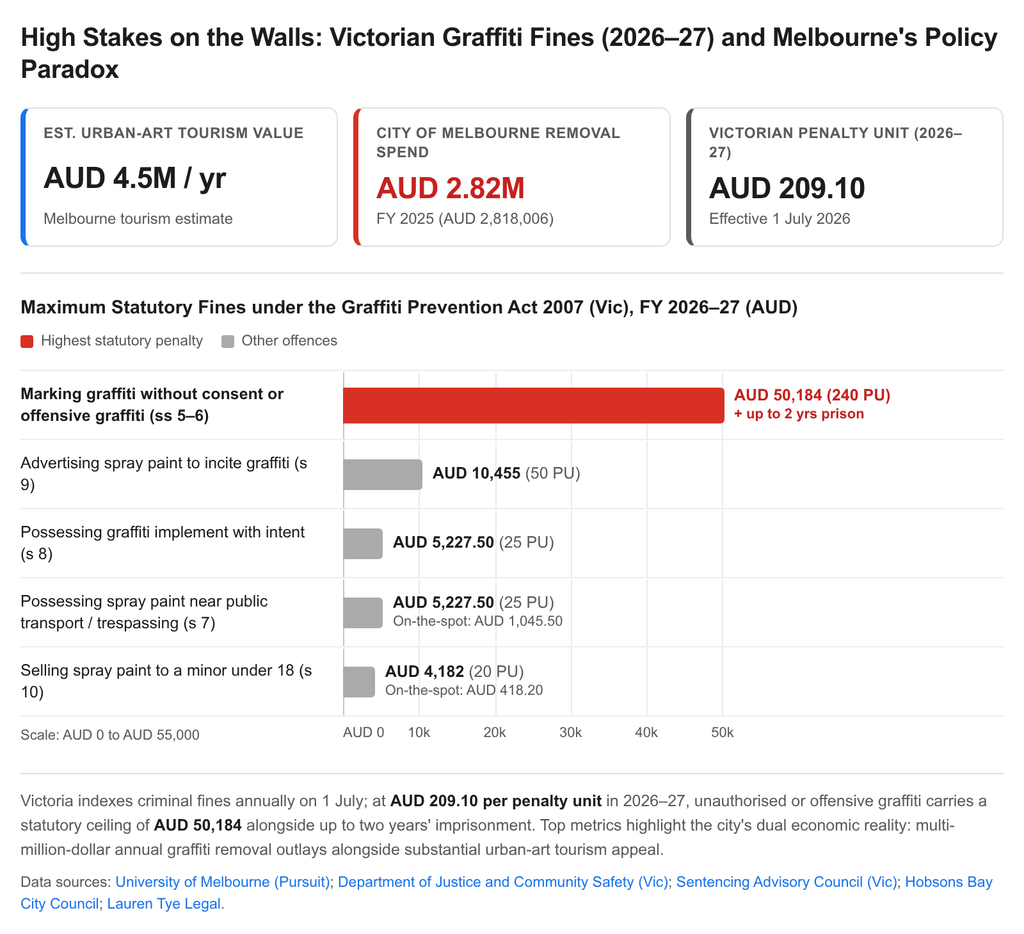
In practice, maximum penalties represent a statutory ceiling rather than a typical first-offence outcome; courts weigh the severity of the damage, prior history, and potential diversion programs when sentencing9. Still, the Act also grants local councils sweeping removal powers: councils can clean publicly visible graffiti off private properties from the street without entering the premises, provided they notify the owner and the owner does not opt out within the notice period—creating a 12-month ongoing removal authority, with no compensation payable for good-faith property damage during cleaning84.
City of Melbourne Permits and the 2026 Policy Overhaul
Within the City of Melbourne, legal street art generally requires two things: written consent from the property owner, and compliance with the Melbourne Planning Scheme, heritage overlays, and local laws59. Hosier Lane stands as the famous exception—a long-standing de facto “free-to-paint” zone where permits are not required, sustained by an informal truce among business owners, the City of Melbourne, Victoria Police, and Heritage Victoria59. Even in Hosier Lane, however, commercial advertising disguised as street art is banned and subject to removal and fines59.
In October 2026, the City of Melbourne moved to update its approach with the Draft Graffiti Management Policy 2026, designed to replace its 2021 policy and opened for community consultation across October and November 20268. The draft policy formalises rapid-response service standards: removing eligible publicly visible graffiti within 3 days in the Central City, within 12 days outside the Central City, and within 90 days for “Complex Works” such as murals above three metres or sites needing heritage or traffic approvals89. At the same time, it designates 8 official locations where street art is recognised as central to Melbourne’s identity and invites precincts to nominate future mural walls8. Yet the draft also sparked immediate pushback from urban researchers—most notably because it proposes deleting the 2021 policy’s “legal graffiti” category, raising questions about whether faster scrubbing and narrower definitions might squeeze out grassroots experimentation6.
Copyright, Moral Rights, and Australia’s Photography Quirk
Few people realise that Australian copyright law protects street art—even unauthorised pieces—under the Copyright Act 1968 (Cth)84. Alongside copyright ownership, street artists hold moral rights: the right to be credited as the creator, the right against false attribution, and the right of integrity, which protects artwork from “derogatory treatment” including destruction or mutilation84.
In reality, enforcing those rights depends heavily on whether the work was painted legally84. If a developer or brand paints over or commercially exploits a commissioned mural without permission, the artist stands on strong legal ground84. If the piece was painted illegally, however, stepping forward in court risks criminal prosecution or breaking anonymity, and property owners can readily invoke a “reasonableness” defence for removing trespassing work84.
There is also a surprising quirk for photographers and businesses regarding Freedom of Panorama (Section 65 of the Copyright Act). In Australia, the public exemption allowing unrestricted commercial photography and broadcasting of permanent public artworks applies only to 3D sculptures and works of artistic craftsmanship (such as metalwork or ceramic installations)—not to flat, two-dimensional painted murals84. While casual tourist photography in Melbourne’s laneways is enthusiastically welcomed, using a 2D Melbourne mural in an advertisement, book cover, or commercial merchandise without licensing it from the artist can still breach Australian copyright law58.
Culture Wars and Contested Concrete: Melbourne’s Love–Hate Paradox
Melbourne’s relationship with its painted walls has never been peaceful—and four recurring flashpoints reveal why the city continues arguing over what counts as culture and what counts as crime.
The Economics of Removal Versus Tourism
Culture is big business in Victoria: Tourism Research Australia data compiled by Creative Victoria shows the state attracted 11.5 million cultural visitors in the year ending December 2024, generating AUD 13.2 billion in total expenditure94. Within that broader cultural economy, street art is a headline magnet. Collector duo Sandra Powell and Andrew King’s street art exhibition The Outsiders drew 100,000 visitors in Melbourne, while University of Melbourne urban scholar Dr Sabina Andron cited an estimate in October 2026 that urban art brings AUD 4.5 million annually into Melbourne through tourism (and an RACV travel feature cited an estimate of 80,000 visitors a year to Hosier Lane alone)6.
Yet the council’s ledger tells a conflicted story. In the 2025 financial year, the City of Melbourne spent AUD 2,818,006 removing graffiti—a bill Andron questioned in Pursuit, pointing out that graffiti removal receives faster response targets than routine municipal services like street cleaning, rubbish, or public toilets, even though as little as 1 per cent of residents in some communities view graffiti as an issue6. As Andron argued, Melbourne’s challenge is balancing property protection with “the right to the surface” and genuine dialogue with informal graffiti communities6.
The Futility of Preservation: From Banksy to Demolished Landmarks
Can you freeze street art in amber without killing what makes it street art? Melbourne learned the hard way between 2008 and 2012. After the council bolted protective Perspex over Banksy’s 2003 Little Diver stencil in 2008, vandals simply poured silver paint behind the shield and scrawled “Banksy woz ere”4. Two years later, in April 2010, council cleaners sent to tidy Hosier Lane accidentally rolled thick battleship-grey paint straight over Banksy’s Parachuting Rat—then believed to be his last publicly visible work in the city—prompting embarrassed apologies from city leaders4. In May 2012, builders inadvertently drilled a bathroom drainpipe straight through another Melbourne Banksy rat27. By 2014, the City of Melbourne formally admitted in its policy plan that preserving uncommissioned street art was impractical4.
That impermanence still stings communities a decade later. In Frankston, Scottish-born photorealist Smug’s celebrated 2018 mural Skeleton and Bird vanished by March 2025 when the Park Lane building holding it was demolished97. In Hosier Lane, a deeply resonant mural commemorating 203 Australian women and children killed by domestic violence since January 2024 sparked public anger when it was painted over after surviving for more than 13 months98. Street art lives at the mercy of weather, wrecking balls, and the next person holding a roller.
Rebellion Against Commercialisation: Hosier Lane (2020) and “Pam the Bird” (2024–2026)
When street art becomes polished and profitable, underground writers frequently push back. That clash exploded into international headlines on the night of 8 February 2020, when a masked group marched into Hosier Lane with paint-filled fire extinguishers and weed sprayers, obliterating swathes of murals in minutes while a drone filmed from above43. Then-Lord Mayor Sally Capp condemned the raid as “vandalism,” particularly citing damage to the cobblestones, and the manager of streetwear store Culture Kings—which sits directly on the lane—called it “a real shame”99. Yet reactions inside the art world were sharply split. Rone told the ABC that Hosier Lane had already turned into a “free for all” and a “tourist trap” resembling an extension of Victoria Market, while commentators and graffiti writers praised the “colour bomb” as guerrilla performance art—a raw reset reminding the city that Hosier Lane was never meant to be a sanitised retail backdrop7.
More recently, the Pam the Bird phenomenon reignited the debate across Victoria6. Starting in 2024, a cheeky cartoon bird began appearing on seemingly unreachable landmarks—from the heritage-listed Flinders Street Station clock face (July 2024) and CityLink’s towering “Cheese Stick” column (October 2024, causing an estimated AUD 20,000 in damage) to Newport Railway Workshop and concrete silos in Geelong104. In January 2025, Victoria Police arrested 21-year-old Yarraville man Jack Gibson-Burrell, charging him with more than 50 offences linked to an estimated AUD 100,000-plus damage bill (charges to which he had not entered a plea as court proceedings progressed into 2026)106.
Then, on a freezing 4-degree winter morning in July 2026, the saga reached dramatic new heights: police were called to Melbourne’s 120-metre Bolte Bridge at 3:00 am after a giant cartoon bird was allegedly painted atop the eastern pylon, ending in an hours-long negotiation and the arrest of Gibson-Burrell, then 22105. Public reaction captured Melbourne’s split personality in miniature. Police condemned the dangerous climb and high public cost, yet nearly 10,000 people signed a petition asking authorities to leave Pam the Bird on the Bolte Bridge—before it was removed at a public cost exceeding AUD 100,0006.
Gentrification and Who Gets to Belong
Finally, Melbourne’s street art sits uneasily alongside the property boom it helped fuel. Artists have long brought creative cachet to gritty post-industrial neighbourhoods like Fitzroy and Collingwood—where Smith Street was named “World’s Coolest Street” in 2021—only to find themselves priced out as cafes, boutique offices, and mid-rise apartments follow111. Property developers have even hired street artists to paint live at apartment-launch “block parties” to sell real estate114. Adaptive reuse initiatives like Collingwood Yards have tried to counter that tide by carving out permanent creative spaces, though artists continue debating governance and genuine affordability111.
Even Hosier Lane holds deeper social layers than most visitors notice. Research documented in 2017 by University of Melbourne academic Chris Honig found that out of an estimated 247 rough sleepers in the city, more than a dozen regularly painted murals in Hosier Lane using donated aerosol cans or improvised tools, finding dignity, income from passers-by, and a tight-knit support community amid periodic council crackdowns on rough sleeping116. Behind the bright murals lies a constant question: who is allowed to take up space—and leave a mark—in the modern city?
Conclusion
Melbourne’s street art and graffiti scene endures not because the city solved the tension between art and vandalism, but because it has learned to live inside it. Over forty years, Melbourne has evolved from a geographically isolated outpost of 1980s New York rail-corridor graffiti into a layered, metropolitan-wide canvas spanning heritage-listed Keith Haring walls, 20-storey community portraits, bayside mural festivals, and stubbornly untamed back alleys1.
As Melbourne weighs its Draft Graffiti Management Policy 2026 and balances multi-million-dollar removal bills against global cultural cachet, Adnate’s warning from his time painting in Barcelona rings especially true: when a city cuts its legal walls from five down to one, it sterilises the very culture that made it magnetic in the first place6. Protecting public amenity and heritage matters, yet Melbourne’s walls stay electric only when there is still room for emerging voices, unpolished experiments, and the unexpected flash of colour waiting around the next bluestone corner.
Disclaimer
This article is provided for general informational and educational purposes only. While Victorian legislation (including the Graffiti Prevention Act 2007), Australian copyright principles (Copyright Act 1968), municipal policies (including the City of Melbourne’s Draft Graffiti Management Policy 2026), and statutory penalty unit figures (indexed at AUD 209.10 for the 2026–27 financial year) reflect publicly available information as of November 2026, nothing in this article constitutes legal advice. Readers seeking guidance on permits, copyright licensing, property rights, or criminal charges should consult a qualified legal practitioner or contact their local Victorian council directly.
Street art is inherently ephemeral; individual murals, laneway access, council policies, and festival trails described here may be altered, painted over, or removed without notice. References to ongoing or historical police investigations and court matters—including allegations surrounding the “Pam the Bird” graffiti series—reflect public news reporting of charges and do not imply guilt; all accused persons are presumed innocent unless proven guilty in a court of law. The author does not endorse illegal graffiti, trespassing, or dangerous climbing on public infrastructure.
References
- The evolution of street art in Melbourne – Peter Barrett, https://peterbarrett.com.au/2018/02/06/the-evolution-of-street-art-in-melbourne/
- Hosier Lane, Attraction, Melbourne, Victoria, Australia, https://www.visitvictoria.com/regions/melbourne/see-and-do/art-and-culture/public-art/vv-hosier-lane
- Best Melbourne Street Art: A Guide To The Famous Laneways, https://theroamingrenegades.com/melbourne-street-art-laneway-australia/
- Street art in Melbourne – Wikipedia, https://en.wikipedia.org/wiki/Street_art_in_Melbourne
- Melbourne Street Art Guide – The City Lane, https://thecitylane.com/melbourne-street-art-guide/
- Melbourne loves graffiti. So why is it spending millions to remove it?, https://pursuit.unimelb.edu.au/articles/melbourne-loves-graffiti.-so-why-is-it-spending-millions-to-remove-it
- Hosier and Rutledge Lanes—where anyone can go and make art, https://www.publicpedagogies.org/wp-content/uploads/2020/11/Qadri2020.pdf
- Graffiti vs street art: where do you draw the line? | City of Melbourne, https://www.melbourne.vic.gov.au/news/graffiti-vs-street-art-where-do-you-draw-line
- Criminal Damage & Arson Defence Lawyers Melbourne, https://laurentyelegal.com.au/services/property-damage-arson-lawyers/
- Fine – Sentencing Advisory Council, https://www.sentencingcouncil.vic.gov.au/about-sentencing/fine
- https://www.juddyroller.com.au/flinders-street-melbourne-mural-adnate-behind-the-scenes
- Mordi Village public art trail (2025) – Kingston Arts, https://www.kingstonarts.com.au/about/public-art/mordi-village-public-art-trail
- Future Melbourne Committee Meeting – 6 October 2026, https://www.melbourne.vic.gov.au/media/96711/download?inline
- (PDF) Placing Graffiti: Creating and Contesting Character in Inner, https://www.researchgate.net/publication/233203057_Placing_Graffiti_Creating_and_Contesting_Character_in_Inner-city_Melbourne
- Kings Way: Melbourne Graff History – Industry News – Sneaker Freaker, https://www.sneakerfreaker.com/news/kings-way-melbourne-graf-history
- A short history of Melbourne street art – Time Out, https://www.timeout.com/melbourne/art/a-short-history-of-melbourne-street-art
- Highlights – Sydney Rare Book Fair, https://sydneyrarebookfair.com/highlights
- Tame DMA enters the Archibald – Vandalog – A Street Art Blog, https://blog.vandalog.com/2014/07/05/tame-dma-enters-the-archibald/
- 3000 Podcast 127 : New2 DMA – YouTube, https://www.youtube.com/watch?v=nD2VNO3osVs
- History | MelbourneGraffiti.com – Australian Graffiti, https://www.melbournegraffiti.com/melbourne-graffiti_extras_history_discovering-graffiti.php
- The Melbourne Keith Haring Mural, https://melbourneharingmural.com.au/
- Graffiti lanes in Melbourne: where to find the best street art – Time Out, https://www.timeout.com/melbourne/art/where-to-find-the-best-street-art-in-melbourne
- MELBOURNE: STREET ART [2020] – breaking.the.borders, https://breaking-the-borders.com/en/melbourne-street-art/
- Then and Now: the evolving story of Melbourne’s street art, https://www.theguardian.com/artanddesign/australia-culture-blog/2014/may/16/then-and-now-the-evolving-story-of-melbournes-street-art
- A Short History of Stencil Art in Australia, https://australianstencilartprize.com/a-short-history-of-stencil-art-in-australia/
- SPACE INVADERS – | HAHA | Ned’s head triptych, https://digital.nga.gov.au/archive/exhibition/spaceinvaders/default.cfm%3Firn=198641&bioartistirn=33673&mystartrow=25&realstartrow=25&mnuid=3&galid=2&viewid=2.html
- Parachuting Rat – Wikipedia, https://en.wikipedia.org/wiki/Parachuting_Rat
- Street art walk – What’s On Melbourne, https://whatson.melbourne.vic.gov.au/things-to-do/walks/street-art
- Everfresh Studio, https://www.everfreshstudio.com/
- Rone – Black Mark – WordPress.com, https://melbourneartcritic.wordpress.com/tag/rone/
- History Of Graffiti In Australia: From Underbelly To The Pop Culture, https://esquire.com.au/how-graffiti-cracked-pop-culture/
- Melbourne’s love-hate relationship with being a ‘street art capital’, https://www.swinburne.edu.au/news/2017/06/melbournes-love-hate-relationship-with-being-a-street-art-capital/
- Backwoods Gallery – Wikipedia, https://en.wikipedia.org/wiki/Backwoods_Gallery
- Adnate’s Collingwood Mural | Melbourne Public Housing Art, https://www.juddyroller.com.au/collingwoodhousing
- Collingwood Housing Estate Mural by Adnate – Deano’s Travels, https://deanoworldtravels.wordpress.com/2018/12/09/collingwood-housing-estate-mural-by-adnate/
- About Australian Street Artist Rone, https://rone.art/pages/about-us
- Melbourne Artist Rone Announced as Lighthouse Foundation, https://www.lighthousefoundation.org.au/news/melbourne-artist-rone-announced-as-lighthouse-foundation-ambassador/
- Experiential Art – REMIX Summits | Culture x Technology x, https://www.remixsummits.com/experiential-art/
- Street Art Map — Fitzroy.com.au, https://fitzroy.com.au/street-art
- Kylie Minogue Mural by Adnate, Flinders Street Melbourne, https://www.juddyroller.com.au/kylie-minogue-mural-afl
- Kylie Minogue mural unveiled in Melbourne ahead of AFL Grand Final, https://switzer.com.au/kylie-minogue-mural-unveiled-in-melbourne-ahead-of-afl-grand-final/
- Street Art & Graffiti Explained: History, Styles and the Best Supplies, https://www.artshedonline.com.au/blog/art-shed-blog/art-education/street-art-graffiti-explained-history-styles-and-t/~-2442
- Guerrilla painters in Melbourne’s Hosier Lane expose our, https://www.theguardian.com/artanddesign/2020/feb/12/guerrilla-painters-in-melbournes-hosier-lane-expose-our-hypocritical-ideas-about-street-art
- BANYULE GRAFFITI STRATEGY, https://www.banyule.vic.gov.au/files/assets/public/_operating-images-amp-docs/documents/banyule-graffiti-strategy-2020-2024-web-version.pdf
- nost | graffiti | street art | artist – all those shapes, https://allthoseshapes.com/nost_graffiti_street-art/
- Contents, https://gallery.sssc.vic.edu.au/wp-content/uploads/2022/11/Chloe-Healy-Unit-1-media-zine.pdf
- Regan Tamanui aka Haha. Stencil Artist. Melbourne. – scrapbook., http://fantastic-dl.blogspot.com/2009/11/regan-tamanui-aka-haha-stencil-artist.html
- VANDALOG | “Young & Free” Interview #1 – RONE. – Ironlak, https://ironlak.com/vandalog-young-free-interview-1-rone/
- The best street art in Fitzroy and Collingwood – Inside my Melbourne, https://insidemymelbourne.com/the-best-street-art-in-fitzroy-and-collingwood
- Guide to Melbourne’s best street art, https://whatson.melbourne.vic.gov.au/article/street-art-guide-to-melbourne
- Street Art City Walks: Melbourne | Urban Art Guides, https://www.streetartbio.com/guides/street-art-city-walks-melbourne/
- Lushsux – Wikipedia, https://en.wikipedia.org/wiki/Lushsux
- Frankston Street Art Murals – Melbourne Playgrounds, https://www.melbourneplaygrounds.com.au/frankston-street-art-murals
- Meme wars: Lush, Hillary Clinton and graffiti on Instagram – ArtsHub, https://www.artshub.com.au/news/features/meme-wars-lush-hillary-clinton-and-graffiti-on-instagram-251968-2353352/
- Australian artist painted a semi-nude mural of Hillary Clinton and, https://indianexpress.com/article/trending/trending-globally/australian-street-artist-asked-to-cover-up-hillary-clinton-painting-2954870/
- Mire cómo un artista australiano modifica un mural de Hillary Clinton, https://www.infobae.com/america/mundo/2016/08/02/vea-como-un-artista-autraliano-modifica-su-mural-de-hillary-clinton-que-causo-un-escandalo/
- Wall To Wall Festival – Secret Melbourne, https://secretmelbourne.com/wall-to-wall-festival/
- Melbourne Street Art Tour: Self-Guided Route 2026 | MT, https://www.melbournetourism.org/melbourne-street-art-tour/
- Street art | City of Melbourne, https://www.melbourne.vic.gov.au/street-art
- Fitzroy street-art tour – Walking Maps, https://walkingmaps.com.au/walk/5
- Brunswick | Eyes on the Streets, https://eyesonthestreets.blog/2025/10/07/brunswick/
- Keith Haring Mural | Place, Yarra City Council, https://www.yarracity.vic.gov.au/things-to-do/arts/gallery/public-art/keith-haring-mural
- The Tools I Use · Matt Adnate, Graffiti Artist – The Design Files, https://thedesignfiles.net/2018/09/matt-adnate-street-art-graffiti-tallest-mural-southern-hemisphere
- Adnate Mural Collingwood, Attraction, Melbourne, Victoria, Australia, https://www.visitmelbourne.com/regions/melbourne/see-and-do/art-and-culture/public-art/vv-adnate-mural-collingwood
- Outré Gallery, https://www.outregallery.com/
- Backwoods Gallery – Melbourne – Visit Victoria, https://www.visitvictoria.com/regions/melbourne/see-and-do/art-and-culture/art-galleries/vv-backwoods-gallery
- Collinghood by Sofles – Street Art Cities, https://streetartcities.com/markers/6efa0b05-c029-4fbc-92e6-c7433e825aa1
- The Best Melbourne Street Art Guide – Sitchu, https://sitchu.com.au/melbourne/arts-culture/melbourne-street-art
- StreetWORKS – Footscray Street Murals – Visit Victoria, https://www.visitmelbourne.com/regions/melbourne/see-and-do/art-and-culture/public-art/streetworks—footscray-street-murals
- Download the Street Art Walking Map: Footscray(PDF, 8MB), https://www.maribyrnong.vic.gov.au/files/sharedassets/arts/v/1/streetworks-map.pdf
- The best street art in Prahran – Inside my Melbourne, https://insidemymelbourne.com/the-best-street-art-in-prahran-windsor-south-yarra
- The Best Street and Public Art in Windsor, Prahran and South Yarra, https://www.melbourneplaygrounds.com.au/the-best-street-and-public-art-in-windsor-prahran-and-south-yarra
- Wall to Wall by Smug – Street Art Cities, https://streetartcities.com/markers/9dd06dcd-c343-4be8-97be-3e6a84d1c1ae
- A town of street art welcomes the return of Wall to Wall Festival, https://www.artshub.com.au/news/news/a-town-of-street-art-welcomes-the-return-of-wall-to-wall-festival-2777669/
- Wall to Wall 2025 celebrates a decade of world-class street art with, https://beat.com.au/wall-to-wall-2025-celebrates-a-decade-of-world-class-street-art-with-mordialloc-block-party/
- Frankston Suburban Revitalisation Board, https://www.frankston.vic.gov.au/Council/Advocacy-and-Partnerships/Frankston-Suburban-Revitalisation-Board
- The Big Picture Fest, https://thebigpicturefest.com/
- Frankston 2024 – The Big Picture Fest, https://thebigpicturefest.com/event/frankston-2024/
- What To Do In Frankston – Iies, https://www.iies.gusec.edu.in/what-to-do-in-frankston
- Culture and cuisine in Melbourne – Business Events Australia, https://businessevents.australia.com/en/resources/programs/culture-and-cuisine-in-melbourne.html
- Alumni Awards finalists | Victoria University, https://www.vu.edu.au/partners-alumni/alumni/alumni-stories-events/alumni-awards/alumni-awards-finalists
- Graffiti Management Policy – Hobsons Bay City Council, https://www.hobsonsbay.vic.gov.au/files/assets/public/documents/council/policies/graffiti-management/graffiti_management_policy_and_strategy.pdf
- Graffiti Prevention Act 2007 (Vic) – BarNet Jade, https://jade.io/summary/mnc/2007/VICLegAct/59
- https://www.artslaw.com.au/information-sheet/street-art/
- Graffiti – Mornington Peninsula Shire, https://www.mornpen.vic.gov.au/The-Shire/Shire-property/Shire-maintenance/Graffiti
- Penalties and values – Department of Justice and Community Safety, https://www.justice.vic.gov.au/justice-system/fines-and-penalties/penalties-and-values
- Penalty Unit Victoria 2026-27: $209.10 | Commonwealth $364, https://melbournecriminaldefencelawyers.com.au/law-updates/penalty-units-2026-27/
- Managing graffiti | City of Melbourne, https://www.melbourne.vic.gov.au/managing-graffiti
- Draft Graffiti Management Policy 2026 | City of Melbourne, https://www.melbourne.vic.gov.au/media/96407/download?inline
- https://www.melbourne.vic.gov.au/graffiti-management-policy
- The Moral Rights of Graffiti Artists – Mallesons Pulse Blog, https://pulse.mallesons.com/ip-whiteboard/moral-rights-graffiti-artists/
- Commons:Copyright rules by territory/Australia, https://commons.wikimedia.org/wiki/Commons:Copyright_rules_by_territory/Australia
- Commons:Copyright rules by territory/Australia/oc – Wikimedia, https://commons.wikimedia.org/wiki/Commons:Copyright_rules_by_territory/Australia/oc
- Victoria’s cultural visitation, https://creative.vic.gov.au/resources/data-insights/victorias-cultural-visitation
- How Melbourne’s street art scene became world-famous – RACV, https://www.racv.com.au/royalauto/travel/victoria/melbourne-street-art-scene.html
- Banksy rat disappears down drain thanks to Australian builder, https://www.theguardian.com/artanddesign/2012/may/17/banksy-rat-drain-australian-builder
- Skeleton and Bird mural by SMUG, Park Lane, Frankston, Victoria, https://worldartutopia.com/artworks/skeleton-and-bird-smug-frankston/
- Hosier Lane – Street Art Cities, https://streetartcities.com/markers/1b673846-9a97-44df-940d-2e772734ae76
- masked group spray-paint over street art in Melbourne’s Hosier Lane, https://www.theguardian.com/australia-news/2020/feb/10/unacceptable-masked-group-spray-paint-over-street-art-in-melbournes-hosier-lane
- Masked spray painters destroy world-famous Melbourne street art, https://artlawandmore.com/2020/02/11/masked-spray-painters-destroy-world-famous-melbourne-street-art/
- Hosier Lane paint bombs: Is it art or vandalism? – The New Daily, https://www.thenewdaily.com.au/news/state/vic/melbourne/2020/02/10/hosier-lane-vandals
- The outrage on Hosier Lane and who has the right to the city, https://overland.org.au/2020/02/the-outrage-on-hosier-lane-and-who-has-the-right-to-the-city/
- Melbourne’s Hosier Lane Has Been Paint-Bombed by a Group of, https://concreteplayground.com/melbourne/arts-entertainment/art/hosier-lane-paint-bomb
- Man allegedly behind ‘Pam the Bird’ graffiti on Melbourne landmarks, https://www.theguardian.com/australia-news/2025/jan/31/pam-the-bird-graffiti-melbourne-flinders-street-man-charged-ntwnfb
- Pam the Bird: arrest ends hours-long standoff after graffiti painted on, https://www.theguardian.com/australia-news/2026/jul/07/melbourne-bolte-bridge-pam-the-bird-graffiti-police-ntwnfb
- Man accused of ‘Pam the Bird’ street art to face court – The Nightly, https://thenightly.com.au/australia/pam-the-bird-man-accused-of-melbourne-street-art-to-face-court-after-being-charged-with-dozens-of-offences-c-17564876
- Charges over Pam the Bird images – Geelong – bay 93.9, https://www.bay939.com.au/local-news/charges-over-pam-the-bird-images/
- Man Charged Re Pam Bird Graffiti | Mirage News, https://www.miragenews.com/man-charged-re-pam-bird-graffiti-1399789/
- ‘Pam’ swaps bird for Spider-Man as more charges laid – The New Daily, https://www.thenewdaily.com.au/news/state/vic/2025/07/24/pam-bird-charges-court-melbourne
- Police Said They Caught the Only Man Behind Melbourne’s Pam the, https://tastebueno.com/blogs/news/police-said-they-caught-the-only-man-behind-melbournes-pam-the-bird-graffiti-then-someone-climbed-a-140-meter-bridge-tower-and-painted-it-again
- An Arts Complex in Melbourne Pushes against the Tide of, https://metropolismag.com/projects/collingwood-yards-arts-complex-melbourne-gentrification/
- fears towers could loom over Brunswick and Smith streets, Fitzroy, in, https://www.reddit.com/r/melbourne/comments/on67qj/development_fears_towers_could_loom_over/
- Collingwood—an intersection of people and place – 116 Rokeby, https://116rokeby.com.au/collingwood-commercial-office/
- Gentrification, street art and the rise of the developer-sponsored, https://www.theguardian.com/australia-news/2017/oct/05/gentrification-street-art-and-the-rise-of-the-bogus-block-party
- 00155 – Collingwood Yards Melbourne gentrification – recessed.space, https://recessed.space/00155-Collingwood-Yards-Melbourne-gentrification
- Some rough sleepers are attracting tourists with their street art, https://findanexpert.unimelb.edu.au/news/4945-some-rough-sleepers-are-attracting-tourists-with-their-street-art