
Between 17 November and 24 November 2026, global geopolitics was defined by a stark collision between personalised great-power diplomacy and fraying multilateral institutions. In Shenzhen, Chinese President Xi Jinping, Russian President Vladimir Putin, and United States President Donald Trump held the first-ever trilateral summit of their three nations on the sidelines of the Asia-Pacific Economic Cooperation (APEC) meeting, generating historic optics alongside a brief communiqué that sidestepped active wars while attacking the International Criminal Court (ICC)1. On the very same day in The Hague, international law delivered a powerful counterweight when the International Court of Justice (ICJ) ruled 9–6 that Myanmar committed genocide against the Rohingya, marking the first time the World Court has held a sovereign state directly responsible for genocide4.
Across active theatres of conflict, the geography of warfare widened even as diplomatic efforts struggled for traction. Ukrainian naval drones sank a modern Russian stealth corvette in Benghazi, Libya—roughly 2,400 kilometres from the frontline—just days after Russian missiles and drones breached Polish and Moldovan airspace during heavy retaliatory barrages on Kyiv7. In the Middle East, the nine-month United States–Iran war saw renewed American airstrikes on Qeshm Island, Iranian attacks on Bahrain and Strait of Hormuz tankers, and Houthi ballistic missile launches towards Riyadh11. Defying these escalating kinetic risks, global crude markets weakened markedly: Brent crude recorded a third consecutive weekly decline and settled below USD 90 per barrel on 23 November as projected global supply surpluses outweighed geopolitical risk premiums11.
Multilateral diplomacy simultaneously suffered acute setbacks. The United Nations COP31 climate conference in Antalya—co-presided by Türkiye and Australia—ended on 22 November without an overarching political cover decision for the first time since 2009 after fossil-fuel producers blocked phase-out language and developed nations declined to endorse adaptation finance targets16. In Geneva, consensus rules similarly blocked negotiations for a binding treaty on lethal autonomous weapons20. Collectively, the week exposed a contested, transactional international landscape in which middle powers—from European leaders convening a Coalition of the Willing in Berlin to Australia balancing American technology pacts with a diplomatic thaw in China—are working intensively to hedge against superpower volatility22.
Great-Power Diplomacy and the Indo-Pacific Rebalance
The Shenzhen Trilateral and APEC’s Diplomatic Choreography
The week’s diplomatic centrepiece took place in Shenzhen, China, during the 33rd APEC Economic Leaders’ Meeting on 18–19 November26. Departing from decades of protocol, Xi Jinping personally welcomed Donald Trump on the tarmac of Shenzhen Bao’an International Airport on 18 November with a handshake and brief embrace, returning the gesture Trump extended at Joint Base Andrews in September28. The next day, Xi, Trump, and Vladimir Putin convened an unprecedented 90-minute trilateral summit that Trump hailed as “historic”1.
Despite pre-summit concerns among European and Indo-Pacific allies that the three leaders might attempt a “Yalta 2.0” sphere-of-influence settlement, analysts at the Council on Foreign Relations (CFR), the International Institute for Strategic Studies (IISS), and the Centre for Strategic and International Studies (CSIS) assessed that spectacle overwhelmingly eclipsed substance2. The trio issued a short, four-point “U.S.-Russia-China Heads of State Declaration toward Peace” calling for United Nations reform, pledging to increase production and supplies of refined petroleum products, proposing trilateral dialogue to reduce nuclear risks, and criticising the ICC for allegedly breaching state consent and official immunities2. Trump reinforced that rebuke publicly by describing the ICC as “out of control” and a “rogue globalist organisation”—pointed language given the court’s March 2023 war-crimes arrest warrant for Putin1.
Beneath the choreography, three strategic dynamics stood out. First, against the backdrop of the February 2026 expiration of the New START treaty—which had capped US and Russian deployed strategic warheads at 1,550 each—Beijing’s agreement to endorse trilateral “nuclear risk reduction” dialogue marked a modest concession from its long-held refusal to enter three-way arms talks, although no binding arms-control framework emerged1. Second, the declaration omitted any reference to the wars in Ukraine or Iran and left Taiwan off the formal agenda; even a separate Trump–Putin bilateral meeting, their first since August 2025, yielded no reported progress on Ukrainian territory or security guarantees1. Third, in their third face-to-face bilateral of 2026, Trump and Xi projected procedural calm while deferring core trade disputes to the G20 summit in Miami on 14–15 December, leaving little time before the October 2025 US–China trade truce expires on 10 January 2027 amid American complaints that Beijing is delivering only two-thirds of its pledged rare-earth exports3.
Elsewhere on the APEC sidelines, Beijing deployed targeted bilateral diplomacy. Canadian Prime Minister Mark Carney met Xi on 17 November to recalibrate ties and expand trade—while maintaining Ottawa’s tough stance on Russian sanctions27—and Papua New Guinean Prime Minister James Marape informed Xi that Port Moresby had closed Taiwan’s representative office27. South Korean President Lee Jae-myung welcomed an expansion of Seoul’s free trade agreement with China and met Putin to discuss easing Korean Peninsula tensions34. Conversely, Japanese Prime Minister Sanae Takaichi received an unmistakably cool reception, greeted on arrival by China’s former ambassador to Greece rather than a senior official and departing without a formal bilateral meeting with Xi amid ongoing friction over Taiwan and economic coercion36.
For Australia, Prime Minister Anthony Albanese navigated competing strategic pressures. Following domestic criticism from Ukrainian-Australian community groups over appearing in the APEC group photograph alongside Putin, Albanese used his 19 November plenary address to confront the Russian president directly, telling him to “end your war, end it now” and identifying the conflicts in Ukraine and the Middle East as primary drivers of global inflation and trade disruption39. On 20 November, Albanese held his fifth bilateral meeting with Xi, who praised a “full turnaround” in Australia–China ties42. Both sides agreed to hold structured talks on artificial intelligence governance and deepen agricultural cooperation, even as Canberra signed a US-led technology declaration designed to protect AI supply chains from Chinese interference and continued raising bilateral trade friction over beef tariffs and commercial access issues affecting Australian exporters such as BHP25.
Manila’s Quad Revival and the 2026 Asia Power Index
Prior to Shenzhen, Trump stopped in Manila on 17 November to meet Albanese, Indian Prime Minister Narendra Modi, and Japan’s Takaichi for the first in-person Quad Leaders’ Summit in two years23. Marking ten years since the late Japanese prime minister Shinzo Abe first articulated the “free and open Indo-Pacific” vision, the four leaders voiced “grave concerns about economic coercion, including through arbitrary export restrictions” and launched a slate of early-2027 initiatives: an inaugural Quad Business Leaders’ Forum; the first Quad-badged Indo-Pacific Maritime Surveillance Collaboration (IPMSC) exercise pairing P-8 and P-3C patrol aircraft; strengthened cybersecurity cooperation; and expanded Australian contributions to regional electricity and Indian Ocean undersea cable projects23. Their communiqué also affirmed the “Super Intelligence Accelerator”, accompanied by a footnote clarifying that in Australia, India, and Japan, “Super Intelligence” refers to artificial intelligence49.
Yet Trump’s broader Southeast Asian stopover highlighted regional unease over American engagement. He bypassed the formal 15–17 November ASEAN and East Asia Summit sessions in favour of an informal dinner, dismissed reporters’ questions about South China Sea disputes after meeting Philippine President Ferdinand Marcos Jr., and announced loosely defined trade deals with Manila and Thailand—whose commerce minister swiftly contradicted Trump’s assertion that all tariffs on American exports would be abolished28.
The structural backdrop to this mix of US military reach and diplomatic friction was captured on 22 November in the Lowy Institute’s 2026 Asia Power Index, which evaluated 27 countries and territories across 131 indicators51.
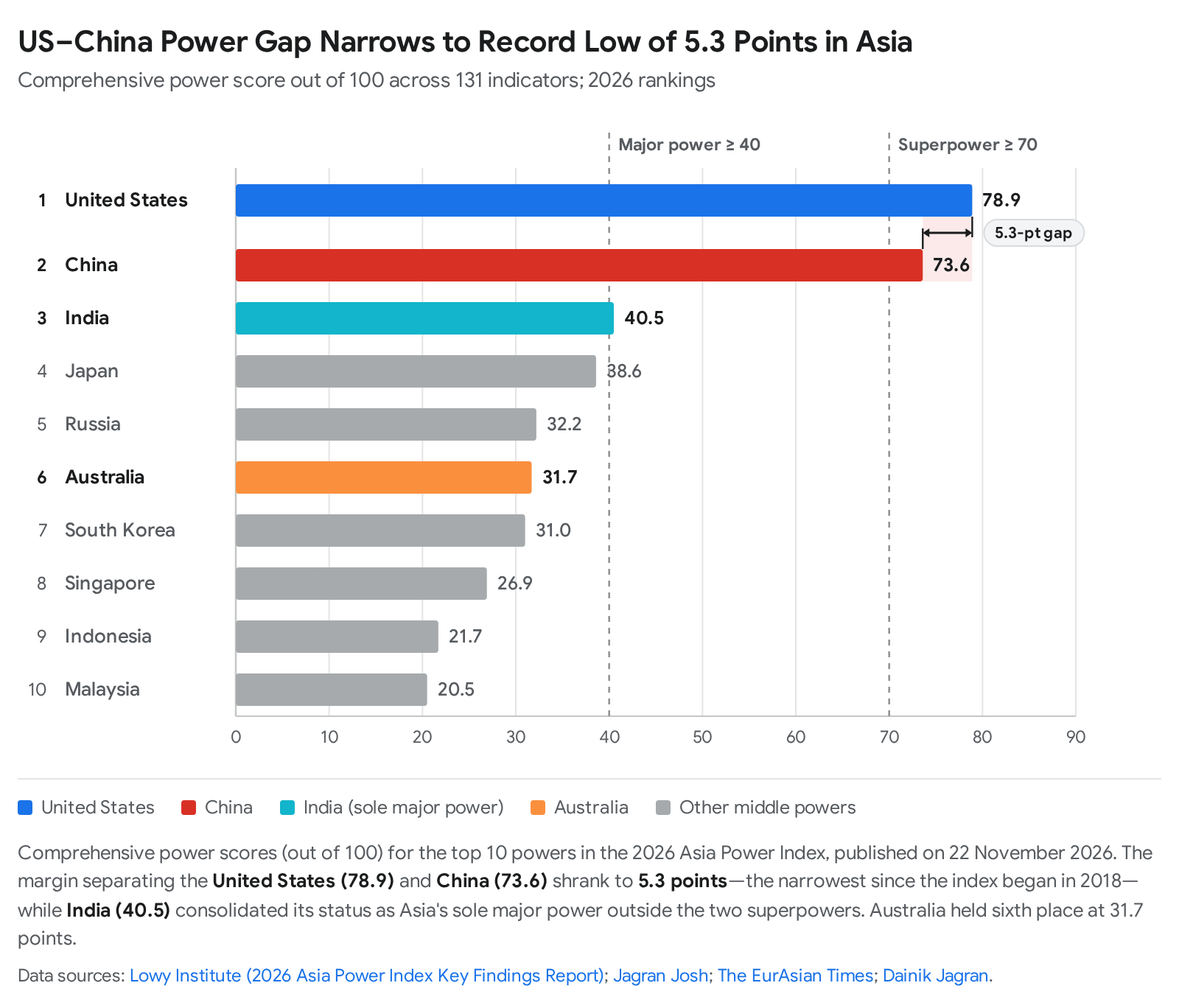
Notably, the Lowy Institute attributed the record-narrow 5.3-point US–China gap primarily to Washington’s policy missteps rather than major breakthroughs by Beijing51. US diplomatic influence suffered its steepest single-year drop on record following the Iran war, sweeping unilateral tariffs, and confrontations with multilateral bodies, leaving China first in regional diplomatic influence for a fourth consecutive year55. India strengthened its third-place standing on the back of stronger defence networks—bolstered by BrahMos missile exports to Southeast Asia—cultural reach, and rising future resources, despite a slight dip in economic capability57. Regional middle powers experienced what the report called a “middling moment”: South Korea slipped 0.5 points amid alliance strains with Washington and Indonesia dropped 5.5 points in diplomatic influence, even as US treaty allies deepened defence cooperation with one another while Washington’s attention remained pulled towards the Middle East24.
Semiconductor Export Controls, Nvidia’s Reversal, and Asian Security Signalling
Frontier artificial intelligence hardware dominated the week’s geo-economic agenda. On 19 November, a US Bureau of Industry and Security (BIS) rule took effect, tightening restrictions on remote access to advanced American AI chips through overseas data centres and adding new export-licensing requirements for Singapore, Malaysia, Thailand, Indonesia, and Brazil61. On 20 November, Taiwan Semiconductor Manufacturing Company (TSMC) reinforced those curbs by suspending affected advanced manufacturing orders for Chinese chip designers at 16 nanometres and below unless customers obtain US export licences, narrowing one of Beijing’s final routes to domestically designed high-end AI processors63.
The regulatory tightening occurred amid intense political scrutiny of Nvidia. Chief executive Jensen Huang had temporarily stepped down following allegations of an affair with an executive at Megaspeed—a Singapore-based company accused of letting Chinese firms remotely access Nvidia compute—and a House Foreign Affairs Committee disclosure showing Commerce Department approvals for over 850,000 Nvidia H200 and AMD MI325X chips to Chinese entities, several flagged by the Pentagon for military ties61. California served an investigative subpoena on Nvidia on 20 November, and congressional committees requested Huang’s testimony in early December65. On 23 November, however, Nvidia’s board unanimously reinstated Huang after consultations with US officials concluded his return posed no national security risk, sparking a sharp rebound on Wall Street that lifted the S&P 500 nearly 5% and the Nasdaq more than 6.7%61. US Treasury Secretary Scott Bessent stated that with remote access curtailed, “no further restrictions are needed”—signalling that the tighter containment approach favoured by Bessent and Secretary of State Marco Rubio had prevailed over Commerce Secretary Howard Lutnick’s earlier argument for keeping Chinese developers reliant on the US technology stack64.
Regional military and diplomatic developments elsewhere in Asia remained active. On 18 November, Pakistan’s army successfully test-fired its new Fatah-3 supersonic cruise missile to extend its conventional precision-strike range70. In New Delhi, Prime Minister Modi hosted Nepalese Prime Minister Balen Shah on his first bilateral trip since taking office in March, unveiling a USD 1.62 billion (approximately 15,000 crore Indian rupees) post-flood reconstruction and development package alongside eight memoranda of understanding spanning satellite communications, policing, forensics, healthcare, and agriculture72. On the Korean Peninsula, the International Atomic Energy Agency (IAEA) reported around 17 November that North Korea had again expanded its Yongbyon uranium enrichment plant, while Kim Jong-un inspected naval and eastern-coast construction sites35.
Europe and the Russo-Ukrainian War: Expanding Geography and Economic Escalation
Asymmetric Long-Range Warfare from the Baltic to Benghazi
Approaching its fifth year, the Russo-Ukrainian war illustrated how deeply asymmetric long-range warfare has outgrown the largely static eastern frontlines. On 23 November, an investigation by The Guardian based on leaked records identified more than 460,000 Russian deaths linked to the conflict between February 2022 and September 2026—part of a wider toll of nearly 500,000 documented Russian losses, including over 1,000 military suicides—underscoring massive attrition for modest territorial shifts74.
Targeting Russia’s military logistics and fuel revenues, Ukrainian forces struck the Kerch Strait Bridge on 18 November for the third time in one week8. On 19 November, Ukrainian drones hit the Kaleykino pumping station on Russia’s Druzhba oil pipeline in Tatarstan—part of a seven-day campaign against eight Russian oil infrastructure facilities—before subsequent reported strikes on a Russian National Guard (Rosgvardiya) directorate in Krasnodar Krai (22 November) and Russia’s specialised Rubikon S drone unit in Kursk (23 November)76.
Most strikingly, Kyiv extended its maritime drone operations into two distant seas. On 21 November, two Ukrainian drones struck the Russian military-logistics cargo vessel Sparta II in the Gulf of Finland, where NATO-member Finnish emergency crews assisted in extinguishing the fire79. A day later, on Sunday 22 November, seven Security Service of Ukraine (SBU) “Sea Baby” unmanned surface vessels struck Russian naval assets at Benghazi, Libya—a hub controlled by Russia-aligned commander Khalifa Haftar—sinking one of Russia’s newest Project 20380 stealth missile corvettes, the Merkury (commissioned in 2023), destroying an embarked Ka-27 combat helicopter, and damaging the US-sanctioned Russian arms-transport cargo ship MV Angara9. A Maltese-flagged commercial vessel was also struck off Benghazi hours later9. Confirming Ukrainian responsibility on 23 November, President Volodymyr Zelenskyy praised the “exemplary” operation conducted roughly 2,400 kilometres from Ukraine’s frontlines, while the SBU declared that Russian naval logistics face “no safe routes” even far beyond the Black Sea10. Eastern Libyan authorities wrote to the UN Security Council seeking an international investigation into allegations that the drones were staged from western Libya82.
Moscow countered with devastating aerial strikes across Ukraine. Overnight on 19–20 November, Russian forces launched their largest missile and drone assault of the month, striking energy infrastructure and three bridges in Kyiv and killing at least eight to nine people7; a day earlier, Russian drone debris had damaged the Dutch and Austrian embassies in the capital75. Fresh weekend strikes hit an apartment block near Kyiv, killing 11 people and lifting regional civilian fatalities across Kyiv and Zaporizhzhia to 17 by 23 November82.
NATO Airspace Breaches and the Berlin Coalition of the Willing
Russia’s overnight barrage on 20 November spilled directly into NATO territory when two Russian missiles and a drone intentionally crossed into Polish airspace, impacting roughly 60 kilometres (37 miles) from the Ukrainian border during an ongoing Coalition of the Willing military exercise at Nowa Dęba7. Two suspected Russian strike drones simultaneously violated Moldovan airspace7. Polish Prime Minister Donald Tusk condemned the incursion as a deliberate provocation and requested additional NATO air defence capabilities, though Warsaw declined to invoke NATO Article 4 consultations7.
Hybrid friction along NATO’s northeastern flank escalated in parallel. After blaming Russian military intelligence for an attempted arson attack at a defence facility near Tallinn, Estonia announced a six-month closure of five road checkpoints along its Russian border effective 1 December86. On 23 November, Moscow summoned Estonia’s Chargé d’Affaires—following earlier diplomatic summonses of Finland’s Chargé d’Affaires on 19 November and Romania’s ambassador on 20 November—accusing Tallinn of acting “on the verge of unleashing open war with Russia” and alleging attempts to obstruct Baltic shipping87. Finland reciprocated by summoning Russia’s ambassador over “dangerous and reckless actions”, as NATO Secretary General Mark Rutte warned on 23 November that alliance members are all targeted and “in this for the long term”89.
Seeking to prevent Washington and Moscow from dictating Ukraine’s future without European input, German Chancellor Friedrich Merz hosted nearly 40 delegations—including Zelenskyy, French President Emmanuel Macron, British Prime Minister Andy Burnham, Australian representatives, and US envoys Steve Witkoff and Jared Kushner—at the Federal Chancellery in Berlin on 19 November for the 18th Coalition of the Willing summit22. European leaders pressed for formal inclusion in US-mediated peace talks (which had yielded a prisoner-exchange framework in Abu Dhabi on 10–11 November) and refined proposals for post-war multinational reassurance forces22. US negotiators emphasised urgency ahead of January 2027, when Democrats—who captured at least 258 House seats in the November midterm elections—will take control of Congress91. Yet fundamental positions remained irreconcilable: Putin rejected European security guarantees at APEC, while Merz stated on 23 November that NATO had made “a mistake” in not admitting Ukraine in 200875. The UN Security Council underscored these humanitarian and strategic stakes on 23 November with a high-level briefing on protecting Ukraine’s energy infrastructure and Black Sea food corridors98.
Brussels’ 22nd Sanctions Package, Budget Friction, and the Brexit Reset
European institutions matched security anxieties with sweeping economic and diplomatic moves. On 23 November—one week after blacklisting 113 individuals and entities tied to Russian war financing, disinformation, and cyber operations—European Commission President Ursula von der Leyen unveiled a proposed 22nd EU sanctions package requiring unanimous member-state approval97. The draft seeks to remove roughly 60 more Russian banks from SWIFT; launch a Crypto Sanctions Task Force targeting third-country evasion networks (including cryptocurrency channels through Kyrgyzstan); blacklist over 70 additional “shadow fleet” vessels and ban all tankers insured in Russia; extend energy service prohibitions to electricity infrastructure for the first time; bar Russian ex-combatants from EU visas; prevent EU citizens from serving on Russian corporate boards; and ban Russian teams and athletes from competing under the Russian flag at EU sporting events101.
Financial support for Kyiv and the EU’s own long-term budget simultaneously tested bloc cohesion. On 18 November, the Commission proposed a EUR 45 billion loan (EUR 25 billion military and EUR 20 billion budget support) towards Ukraine’s EUR 70 billion 2027 financing gap, although Slovakia, Czechia, Hungary, and Bulgaria indicated they would not participate; separately on 23 November, Brussels disbursed EUR 7.9 billion in financial stability assistance and mobilised EUR 1 billion via the European Peace Facility33. On 21 November, European Council President António Costa proposed cutting EUR 204 billion (roughly USD 224 billion) from the Commission’s EUR 2 trillion 2028–2034 budget blueprint while reviving a 3% EU-wide digital tax on companies generating at least EUR 50 million in EU digital revenue and over EUR 750 million globally, anchoring a EUR 60 billion annual “own resources” package107. The draft drew rapid pushback from Ireland—European base for major US technology giants—as well as frugal states led by Germany and Sweden, France, and the European Parliament, while heightening transatlantic friction after Trump vowed US trade investigations into EU digital enforcement105.
Two major European political shifts rounded out the week. At the EU–UK summit in Brussels on 20 November, Prime Minister Andy Burnham, Costa, and von der Leyen announced a landmark Brexit reset removing most agri-food border checks, though Brussels conditioned implementation on the UK granting EU students domestic tuition fee parity—provoking sharp criticism from Reform UK leader Nigel Farage105. Meanwhile in Belgrade, MPs from the victorious youth-led Student List movement were sworn into Serbia’s National Assembly following the election that ousted Aleksandar Vučić, opening a new domestic reform era even as observers noted that immediate Serbian alignment with EU sanctions on Russia or recognition of Kosovo remains unlikely33.
The Middle East and Global Energy Markets: War Attrition Meets a Supply Glut
Strait of Hormuz Escalation, Gulf Strikes, and Yemeni Advances
Entering its ninth month since the 28 February 2026 US–Israeli airstrikes that killed Supreme Leader Ali Khamenei, the Iran war remained trapped between stalled negotiations—following unfulfilled talks under the June memorandum of understanding and inconclusive Muscat engagements—and persistent military exchanges12.
Kinetic incidents accelerated throughout the seven-day period. On 17 November, UK Maritime Trade Operations (UKMTO) reported an unknown projectile striking a tanker 13 nautical miles north of Khasab, Oman, as US fighter jets struck an Iranian missile site on Qeshm Island14. On 18 November, Bahrain reported intercepting multiple Iranian missile and drone attacks—its third strike in five days—prompting Manama to lodge formal UN Security Council filings (S/2026/924 on 19 November, following S/2026/911 on 16 November) to bolster legal claims under Resolution 281711. On 19 November, Iranian state media claimed two tankers struck naval mines and caught fire in the Strait of Hormuz, while Trump accused Tehran of pursuing chemical and biological weapons (a claim Tehran denied) and signalled he would decide on major new strikes only after 1 January if talks fail13.
Escalation continued into the weekend. On 20 November, Iranian media reported fresh US strikes on Qeshm Island, UKMTO logged another tanker hit, US–Saudi coalition aircraft bombed Hodeidah in Yemen, and Islamic Revolutionary Guard Corps (IRGC) spokesperson Brigadier General Hossein Mohebbi declared that Tehran would not tolerate indefinite attrition and stood ready to “settle the war once and for all”12. On 21 November, UKMTO reported two additional outbound tankers struck by unknown projectiles in Hormuz while Iran claimed to have downed an American drone over Qeshm14. Across the Arabian Peninsula, coalition defences intercepted three Houthi ballistic missiles over Riyadh, the Houthis claimed an attack on Saudi Arabia’s Rabigh refinery, and Houthi fighters advanced along Aden’s northern and western flanks in Yemen’s Lahij Governorate, threatening roughly 9,600 mostly Somali and Ethiopian refugees at the Kharaz camp12. Australia’s Smartraveller advisory upgraded Saudi Arabia to “Do not travel” on 21 November125.
Maritime data illustrates the operational strain. Since the conflict began, the International Maritime Organization (IMO) has verified 141 commercial shipping incidents and 25 seafarer deaths126. Although US naval escorts increased facilitated transits along the southern corridor to an average of 38.0 vessels per day between 19 and 21 November (reaching 655 transits month-to-date), Kpler tracking cited by Trading Economics showed Strait of Hormuz oil flows averaged 9.5 million barrels per day (bpd) over the 10 days to 19 November—a 22.1% drop from October’s 12.2 million bpd124.
Why Oil Fell Below USD 90 Despite Escalating Attacks
Counter-intuitively, intensifying Gulf hostilities failed to halt a sustained slide in crude prices. On Monday 23 November, Reuters reported that front-month ICE Brent January futures settled down USD 3.20 (-3.46%) at USD 89.37 per barrel—its lowest close since 31 August 2026 and a 21.2% decline from 30 October’s USD 113.43 settlement—following three consecutive weekly losses11. Front-month January West Texas Intermediate (WTI) futures fell 3.88% to settle at USD 80.17 per barrel (its lowest close since 10 August), widening the Brent–WTI spread beyond USD 915.
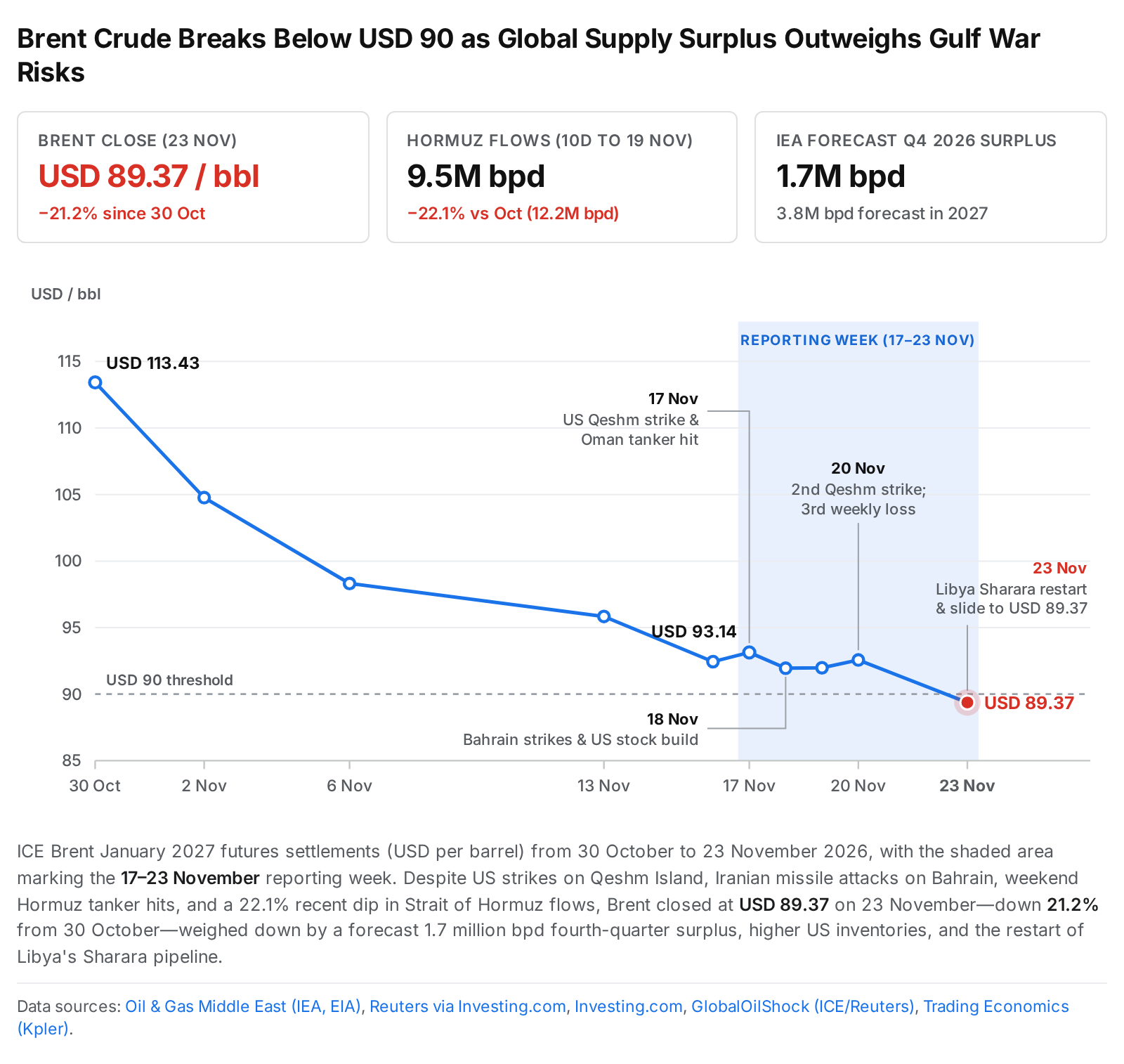
Three overlapping drivers explain this divergence. First, physical supply growth has outpaced demand: the International Energy Agency (IEA) projects a fourth-quarter global surplus of 1.7 million bpd expanding to roughly 3.8 million bpd in 2027, reinforced by October output increases from Saudi Arabia, Iraq, and Kuwait, US crude production exceeding 14.0 million bpd, a 3.4 million-barrel weekly build in US commercial crude stocks, and the 23 November restart of Libya’s Sharara oil pipeline11. Second, Trump’s signal that major new strikes on Iran would wait until at least January tempered fears of an immediate total shutdown, turning market attention towards whether OPEC+ will extend its roughly 2 million bpd cut layer at its 29 November meeting18. Third, broader financial liquidity tightened sharply: spot gold tumbled to 14-month lows near USD 3,525–3,535 per ounce during an AI-equity sell-off and 93% market pricing for a 25-basis-point Federal Reserve rate hike in December, before rebounding around 3% to reclaim levels above USD 3,630 on 23 November after Huang’s reinstatement at Nvidia and Bessent’s warning against excessive monetary tightening67. Even in Tehran, Acting Petroleum Minister Hamid Bovard acknowledged on 23 November that “selling oil is part of our tactics”, with Iranian crude output reported by local energy outlets to have fallen roughly 24% from pre-war levels to around 2.48 million bpd by mid-year132.
Gaza Ceasefire Erosion, Moscow Outreach, and Israeli Coalition Deadlock
In the Levant, the tenuous October 2025 Gaza ceasefire—overseen by the Trump-chaired Board of Peace—suffered fresh strain. Around 18–19 November, Israeli tanks advanced beyond the designated ceasefire line in central Gaza, with Palestinian medical authorities reporting fatal shelling and gunfire and the Arab Parliament condemning the offensive as a ceasefire violation133. On 20 November, the Board of Peace urged “all parties” to honour their commitments, while senior adviser Josh Gruenbaum publicly argued that Israeli intransigence was blocking tests of Hamas disarmament135. Seeking wider diplomatic backing, the Board of Peace’s High Representative for Gaza, Nickolay Mladenov, met Russian Foreign Minister Sergey Lavrov in Moscow on 23 November; Mladenov stressed Russia’s role as a permanent UN Security Council member in advancing security and recovery, while Lavrov reiterated Moscow’s support for a contiguous Palestinian state with East Jerusalem as its capital137.
Elsewhere across the theatre, Israeli forces conducted daily airstrikes, shelling, and home demolitions across southern Lebanon between 18 and 20 November140. In the occupied West Bank, the UN Humanitarian Country Team reported on 20 November that more than 400 Israeli settler attacks since September had damaged over 4,000 olive trees, though Israeli Attorney General Gali Baharav-Miara froze construction tenders in the E1 settlement area on 18 November pending the swearing-in of a new government133. That coalition-building effort following Israel’s 2026 election remained deadlocked: on 22–23 November, Yashar leader Gadi Eisenkot—who holds the coalition mandate until 6 December—and Likud leader Benjamin Netanyahu ended four hours of unity-government negotiations in Herzliya without a deal, as both Eisenkot and former prime minister Naftali Bennett refused to serve in a Netanyahu-led cabinet142.
Multilateral Institutions Under Strain: Climate Collapse, Legal Precedent, and Weapons Governance
COP31’s Fractious Conclusion in Antalya
The week’s most visible multilateral setback unfolded in Antalya, Türkiye, where the UN COP31 climate summit—hosted by Türkiye under President Murat Kurum, with Australian Climate Change Minister Chris Bowen serving as President of Negotiations—ran into overtime to become the longest COP on record before closing on Sunday 22 November without an overarching political cover decision16. It was the first UN climate summit since Copenhagen in 2009 to conclude without a political pact18.
The proposed “Antalya Pact” collapsed over two deep geopolitical divisions. First, following sustained resistance from fossil-fuel-producing states including Russia, Saudi Arabia, and the Arab Group, the presidency’s final drafts omitted any explicit mention of fossil fuels or a roadmap to phase them out, while inserting optional language on carbon capture17. Second, the text excised a USD 120 billion adaptation finance target sought by developing nations amid a 70% drop in public climate funding pledges during the conference19. In the closing plenary, more than 100 countries—led by the European Union, the United Kingdom, Panama, the Marshall Islands, Vanuatu, Belize, Norway, and the 44 Least Developed Countries (LDCs)—formally rejected the pact19.
Figures released during the talks highlighted the widening financing chasm: the Fund for Responding to Loss and Damage has received 176 requests from 119 developing nations totalling roughly USD 2.8 billion, compared with just USD 342 million allocated—meeting only 12.2% of demand and leaving a USD 2.46 billion shortfall127. Even so, UN Climate Change Executive Secretary Simon Stiell and Minister Bowen stressed that the 2023 Dubai commitment to transition away from fossil fuels and the Paris Agreement remain in force, and that meaningful technical outcomes survived16. Parties agreed to launch the Belém–Antalya Mechanism (BAM) for a Just Transition, adopted text on the Global Goal on Adaptation, established an LDC National Adaptation Plan implementation platform benefiting more than one billion vulnerable people, allowed the Adaptation Fund to draw a share of Paris Agreement carbon-trading proceeds, and advanced voluntary pledges targeting 35% electrification of final energy consumption by 203519. The unresolved fossil-fuel roadmap now moves to COP32 in Addis Ababa in November 2027146.
The ICJ’s Historic Myanmar Genocide Judgment and Geneva’s Autonomous Weapons Stall
In sharp contrast to Antalya’s breakdown, international law delivered a landmark ruling on 19 November. Voting 9–6 in The Gambia v. Myanmar—a case supported by 11 intervening states including Canada, France, Germany, the United Kingdom, and Ireland—the International Court of Justice found Myanmar legally responsible for committing genocide against the Rohingya during its 2016–2017 “clearance operations” in northern Rakhine State4.
The decision marks the first time under the 1948 Genocide Convention that the World Court has held a sovereign state directly culpable for genocide5. Crucially, the court rejected Myanmar’s claim that counter-insurgency objectives negated genocidal intent, affirming that genocidal intent can coexist with military operations—a legal standard analysts immediately noted will shape pending ICJ genocide cases, including South Africa v. Israel, Ukraine v. Russia, Nicaragua v. Germany, and DRC v. Rwanda4. The binding judgment ordered Myanmar to cease violations, prosecute those responsible, and provide comprehensive restitution (covering safe voluntary return, property restoration, and rehabilitation) alongside compensation, with two years to report back151. While the EU praised the ruling, the United States reacted cautiously150.
Arms control fared far worse in Geneva, where the Seventh Review Conference of the UN Convention on Certain Conventional Weapons (CCW) closed in the early hours of Saturday 21 November without adopting a mandate to negotiate a legally binding treaty on Lethal Autonomous Weapons Systems (LAWS), or “killer robots”20. Although nearly 100 nations, the International Committee of the Red Cross (ICRC), and UN Secretary-General António Guterres pressed for immediate treaty talks to preserve meaningful human control over lethal force, opposition from the United States and Russia under consensus rules limited the outcome to extending Group of Governmental Experts discussions until 2028—and blocked adoption of a formal Final Declaration reviewing the Convention20.
Summary of Major Diplomatic and Legal Arenas (17–24 November 2026)
| Forum & Location | Dates | Key Actors | Primary Outcome | Strategic Significance |
| Quad Leaders’ Summit (Manila) | 17 Nov | US, Australia, India, Japan | Announced 2027 maritime air patrol exercise (IPMSC), Business Forum, cyber & cable pacts23. | Revived Quad after two-year hiatus, though US engagement with wider ASEAN stayed transactional28. |
| APEC & Trilateral Summit (Shenzhen) | 18–19 Nov | US, China, Russia + APEC economies | Issued 4-point Peace Declaration on UN reform, nuclear dialogue, refined fuels & ICC critique2. | Historic optics but no breakthrough on Ukraine, Iran, or Taiwan; US–China trade talks deferred to Dec G203. |
| Coalition of the Willing (Berlin) | 19 Nov | Germany, Ukraine, France, UK, US envoys (~40 delegations) | Coordinated post-war security guarantees, air defence, and European role in peace talks22. | Signalled European resolve against a US–Russia bilateral deal reached over Kyiv’s head22. |
| ICJ Judgment (The Hague) | 19 Nov | The Gambia, Myanmar, 11 intervening states | 9–6 binding ruling holding Myanmar responsible for Rohingya genocide; extensive restitution ordered4. | First state genocide ruling in ICJ history; sets key intent precedent for South Africa v. Israel5. |
| EU–UK Summit (Brussels) | 20 Nov | UK (Burnham), EU (Costa, von der Leyen) | Landmark Brexit reset removing most agri-food checks, linked to EU student fee parity105. | Deepest UK–EU rapprochement since Brexit, facing domestic political pushback in Britain105. |
| CCW 7th Review Conf. (Geneva) | 16–21 Nov | 120+ States Parties, US, Russia, EU, ICRC | No binding treaty mandate on autonomous weapons; expert talks extended to 202820. | Consensus rules enabled US and Russian vetoes over nearly 100 pro-treaty nations21. |
| UN COP31 Summit (Antalya) | 9–22 Nov | Türkiye, Australia, 190+ Parties | No political cover decision (Antalya Pact rejected); salvaged Just Transition (BAM) & LDC adaptation19. | First COP collapse since 2009; exposes deep fossil-fuel and finance fissures ahead of COP3218. |
Regional Flashpoints in Africa and the Americas
Escalation Across Sudan, the Horn of Africa, and Eastern DRC
Severe regional crises deepened across Africa away from the global summit spotlight. In Sudan—where the UN Security Council met on 20 November, and International Rescue Committee data tracks 33.7 million people in humanitarian need—the Sudanese Armed Forces (SAF) pressed their most operationally significant westward advance in central Sudan since early 2025157. Following its 13 November capture of al-Khawai, the SAF advanced roughly 80 kilometres (50 miles) westward into West Kordofan along Sudan’s main highway, capitalising on a new wave of Rapid Support Forces (RSF) defections while deploying five combat units to the Blue Nile region bordering Ethiopia123. On 17 November, dozens of Sudanese civil society organisations also sent a memorandum to the UN, EU, US, and ICC demanding the immediate arrest of ousted president Omar al-Bashir and former official Ahmed Haroun for war crimes and genocide123.
Across the Ethiopian–Eritrean frontier, fears of renewed interstate war rose sharply. Reports on 19–20 November cited heavy troop mobilisations along the shared border, bombardment and a drone strike wounding four people near Badme, and sharp accusations by Eritrean Information Minister Yemane Gebremeskel that Ethiopian Army Chief Field Marshal Birhanu Jula was laying claim to sovereign Eritrean territory—prompting urgent UN diplomatic efforts to avert escalation123. Elsewhere in the Horn of Africa, Somalia prepared for December’s UN Security Council vote on extending the African Union Support and Stabilisation Mission in Somalia (AUSSOM)—following a 17 November Council meeting and Brussels coordination as Egypt readies roughly 1,091 troops—while Somalia’s president accused the United Arab Emirates of internal interference123.
In the eastern Democratic Republic of the Congo (DRC), security assessments on 19 November tracked the rapid territorial consolidation of the Front pour la Refondation de la Nation (FRN)—the successor movement to M23 announced by former president Joseph Kabila in mid-October157. Having seized the commercial centre of Bunyakiri in South Kivu earlier in November, FRN forces advanced along the RN3 highway towards North Kivu to sever Congolese army (FARDC) supply lines threatening mining hubs such as Rubaya157. Separately, European migration policy reverberated across East Africa, with five EU countries unveiling a Rwanda deportation plan and Uganda entering talks to host an EU migration hub123.
Washington’s Military Reset in Venezuela and Hemispheric Humanitarian Stress
In the Western Hemisphere, the week’s defining strategic shift took place in Caracas on 18–19 November, when US Defence Secretary Pete Hegseth made an unannounced visit to sign a military cooperation agreement with Venezuelan Acting President Delcy Rodríguez162. Restoring defence ties severed by Hugo Chávez in 2005—and arriving ten months after the 3 January 2026 US military raid that captured former president Nicolás Maduro—the pact establishes joint military training, intelligence sharing, operational equipment transfers, and coordinated operations against drug-trafficking networks162. The agreement deepens Washington’s post-Maduro footprint alongside State Department management of more than USD 12 billion in Venezuelan oil transactions during the first nine months of 2026 and an August deal granting a US-backed partnership long-term access to 17 oilfields holding roughly one-fifth of Venezuela’s reserves162. Hegseth followed his Caracas visit with security consultations in Colombia, including the delivery of a C-130 Hercules transport aircraft163.
Meanwhile, the UN Office for the Coordination of Humanitarian Affairs (OCHA) situation update on 20 November underscored acute security, climate, and public-health emergencies across Latin America and the Caribbean168. In Haiti, escalating gang violence around Port-au-Prince displaced another 7,900 people since mid-October, keeping nationwide displacement near 1.5 million after an estimated 4,200 violent deaths between January and September168. Severe El Niño weather extremes struck both ends of the region: drought wiped out 75–100% of maize harvests for nearly eight in ten surveyed households across Central America’s Dry Corridor—leaving an estimated 3.2 million people in Guatemala and 1.8 million in Honduras facing Crisis-level food insecurity—while heavy rains affected 62,000 people across all 24 provinces of Ecuador (causing 16 deaths) and prompted red alerts across nine northern Peruvian provinces on 19 November168. Compounding these pressures, the Pan American Health Organisation confirmed 58,213 measles cases across the Americas in 2026 (more than quadruple the 2025 rate), causing Bolivia, Mexico, and the United States to lose their measles elimination status, while Panama declared a national malaria health alert168.
Conclusion
The seven days from 17 November to 24 November 2026 crystallised a central tension of contemporary global politics: personalised superpower summits are generating striking optics without resolving entrenched wars, while consensus-based multilateral bodies face deepening paralysis. The Shenzhen trilateral between Trump, Xi, and Putin confirmed that the world’s three foremost nuclear powers remain willing to engage—and even jointly challenge international tribunals—yet remain unable or unwilling to halt active conflicts in Ukraine and the Middle East2. Similarly, the twin stalemates at COP31 in Antalya and the CCW Review Conference in Geneva illustrated how small blocs of veto-wielding states can stall collective agreements on climate action and autonomous weapons19.
At the same time, significant counter-currents emerged. The ICJ’s landmark genocide judgment against Myanmar reaffirmed that binding international legal norms retain substantial moral and jurisprudential authority, even amid great-power pushback5. Global oil markets demonstrated that rising non-Gulf supply and projected surpluses can blunt—though not eliminate—the macroeconomic leverage of maritime chokepoints such as the Strait of Hormuz11. Three immediate milestones will test these fault lines over the coming weeks: the 29 November OPEC+ production meeting, the 14–15 December G20 summit in Miami ahead of the expiring US–China trade truce on 10 January 2027, and the January 2027 seating of a Democratic-led US Congress, which is poised to reshape Washington’s posture on Ukraine, Iran, and technology controls3.
Disclaimer
This article is an independent geopolitical summary prepared solely for informational and analytical purposes, synthesising publicly available diplomatic, institutional, market, and media reporting covering the seven-day period from 17 November to 24 November 2026. Because armed conflicts, diplomatic negotiations, sanctions proposals, and financial markets evolve rapidly—and because battlefield claims, casualty estimates, and maritime incident reports are frequently contested by belligerent parties and subject to delayed independent verification—specific details and figures should be treated as accurate only as of 24 November 2026. Nothing in this report constitutes legal, financial, investment, security, or travel advice; readers making commercial, policy, or personal safety decisions should consult qualified professionals and official government advisories.
References
- Apec summit: Trump, Xi and Putin make ‘peace declaration’ but talks, https://www.theguardian.com/world/live/2026/nov/19/apec-summit-trump-xi-putin-meeting-shenzhen-china
- Impact and symbolism: Xi–Putin–Trump at APEC, https://www.iiss.org/online-analysis/online-analysis/2026/11/impact-and-symbolism-xiputintrump-at-apec/
- The Significance of Trump, Xi, and Putin’s First Trilateral Meeting, https://www.cfr.org/articles/six-experts-on-what-trump-xi-and-putins-first-trilateral-means
- What Gambia Helped the Rohingya Prove in The Hague, https://time.com/article/2026/11/23/rohingya-genocide-myanmar-icj-gambia-the-hague/
- ICJ Delivers Historic Judgment on Genocide Against the Rohingya, https://globalrightscompliance.org/icj-delivers-historic-judgment-on-genocide-against-the-rohingya/
- Gambia v. Myanmar: The Bottom Line – EJIL: Talk!, https://www.ejiltalk.org/gambia-v-myanmar-the-bottom-line/
- Russian Offensive Campaign Assessment, November 20, 2026, https://www.criticalthreats.org/analysis/russian-offensive-campaign-assessment-november-20-2026
- War in Ukraine | Global Conflict Tracker – Council on Foreign Relations, https://www.cfr.org/global-conflict-tracker/conflict/conflict-ukraine
- Albania denies launching drone attack on Russian warship in Benghazi, https://www.turkiyetoday.com/region/albania-denies-launching-drone-attack-on-russian-warship-in-benghazi-3233061
- Ukrainian drones hit Russian warship at naval base in Libya, says, https://www.lancashiretelegraph.co.uk/news/national/26752283.ukrainian-drones-hit-russian-warship-naval-base-libya-says-zelensky/
- Why oil prices are falling – Oil & Gas Middle East, https://www.oilandgasmiddleeast.com/news/why-oil-prices-are-falling
- UKMTO Reports 2 Tankers Hit by Projectiles Near Hormuz as Iran Claims Mines, https://houseofsaud.com/ukmto-2-tankers-projectiles-hormuz-iran-claims-mines-nov21/
- Conflict With Iran | Global Conflict Tracker, https://www.cfr.org/global-conflict-tracker/conflict/confrontation-between-united-states-and-iran
- Trump says he wants “permanent” deal with Iran; says next move may not come until 2027, https://www.cbsnews.com/live-updates/iran-war-trump-tehran-denies-chemical-weapons/
- Oil slumps to 3-month low on increased Middle East flows, Libyan, https://www.investing.com/news/commodities-news/oil-prices-fall-amid-equity-selloff-though-iran-war-attacks-limit-losses-5044242
- UN Climate Change Conference – Antalya, November 2026 | UNFCCC, https://unfccc.int/cop31
- Why the failure to reach a major deal at UN climate talks matters as extreme weather worsens, https://apnews.com/article/climate-un-turkey-fossil-fuels-global-warming-f6e36c4caf13ec6fed57c9f077cbd067
- COP31 Collapse Favors Long-Life Oil Producers Over Brent Futures Funds, https://www.cruxinvestor.com/posts/cop31-collapse-favors-long-life-oil-producers-over-brent-futures-funds
- COP31: Key outcomes agreed at the UN climate talks in Antalya, https://www.carbonbrief.org/cop31-key-outcomes-agreed-at-the-un-climate-talks-in-antalya
- UN arms conference falls short of treaty mandate on autonomous weapons due to US and Russia opposition, https://www.jurist.org/news/2026/11/un-arms-conference-falls-short-of-treaty-mandate-on-autonomous-weapons-due-to-us-and-russia-opposition/
- UN conference on killer robots closes in Geneva with no treaty mandate, https://pasqualepillitteri.it/en/news/36192/un-conference-on-killer-robots-closes-in-geneva-with
- Did the Ukraine Summit in Berlin Bring Progress? – Kyiv Post, https://www.kyivpost.com/post/90790
- The 2026 Quad Leaders’ Summit, https://www.pmc.gov.au/news/2026-quad-leaders-summit
- hunter marston jack sato 2026 key findings report, https://power.lowyinstitute.org/downloads/lowy-institute-2026-asia-power-index-key-findings-report.pdf
- Australia strikes deal on AI talks with China | Aaja News, https://news.aaja.co/articles/65450/
- Trump, Xi, and Putin: What to expect from the APEC summit, https://www.brookings.edu/articles/trump-xi-and-putin-what-to-expect-from-the-apec-summit/
- APEC China 2026 – Wikipedia, https://en.wikipedia.org/wiki/APEC_China_2026
- Experts React: Takeaways from President Trump’s Trip to Asia – CSIS, https://www.csis.org/analysis/experts-react-takeaways-president-trumps-trip-asia
- Statecraft, AI and newsworthy hugs: what happened at the landmark 2026 APEC meetings in Shenzhen, https://www.tatlerasia.com/power-purpose/business/apec-shenzhen-economic-leaders-meeting-review
- Trump, Xi, And Putin Make History, But No Breakthroughs, https://www.rferl.org/a/trump-xi-putin-summit-four-key-takeaways/33902100.html
- Global courts under attack and four more takeaways from the Trump, https://www.theguardian.com/world/2026/nov/19/five-takeaways-from-putin-trump-xi-apec-shenzhen-summit
- China, Russia and US agree peace declaration with no mention of Ukraine and Iran wars, https://www.theguardian.com/world/2026/nov/19/china-russia-us-agree-peace-statement-no-mention-ukraine-iran-wars
- All EU members should back €45bn loan for Ukraine, says von der Leyen – as it happened, https://www.theguardian.com/world/live/2026/nov/18/europe-ukraine-russia-eu-germany-serbia-latest-news-updates
- South Korea hopes to work with China for peace on Korean, https://www.thestandard.com.hk/china/article/348867/South-Korea-hopes-to-work-with-China-for-peace-on-Korean-Peninsula-president-says
- Xi-Trump Talks Set for Thursday Amid Calls for Tougher China Policy, https://monitor-the-situation.com/east-asia/xi-trump-talks-set-for-thursday-e34edefd
- China gives Japan PM frosty welcome at Apec amid fanfare for other, https://www.theguardian.com/world/2026/nov/19/china-gives-japan-pm-frosty-welcome-apec
- Takaichi stresses need for ‘stable’ ties with China after encounters with Xi, https://www.japantimes.co.jp/news/2026/11/19/japan/politics/xi-takaichi-apec-greeting-protocol/
- Takaichi and China’s Xi share cordial handshake in first encounter since explosive Taiwan remarks, https://www.japantimes.co.jp/news/2026/11/18/japan/politics/takaichi-xi-china-japan-apec/
- Anthony Albanese tells Putin directly to ‘end your war, end it now’ and holds fifth meeting with Xi at APEC, https://www.labourhome.co.uk/anthony_albanese_tells_putin_directly_to_end_your_war_end_it_now_and_holds_fifth_meeting_with_xi_at_apec
- Anthony Albanese defies critics for Apec summit photo with Vladimir, https://www.theguardian.com/australia-news/2026/nov/18/anthony-albanese-defies-critics-for-apec-summit-photo-with-vladimir-putin
- Albanese tells Putin to “end your war” in his APEC speech as he, https://realm.scopa1811.com/news/a5010001-2026-1120-0645-000000000004
- PM urges ‘eyes on the horizon’ for China relationship – Michael West, https://michaelwest.com.au/tough-act-to-follow-pms-xi-meeting-overshadowed/
- Xi declares ‘full turnaround’ in ties at Albanese meeting | Grafa, https://grafa.com/en/news/australia/xi-declares-full-turnaround-in-ties-at-albanese-meeting
- Xi Jinping says a ‘full turnaround’ has been achieved in Australia, https://www.australmeridian.com/news/2026/11/20/xi-jinping-says-a-full-turnaround-has-been-achieved-in-australia-china-d085a4/
- Xi says China-Australia relations have made a comprehensive, https://itsbrief.com/story/xi-says-china-australia-relations-have-made-a-comprehensive-2e39ef17
- Afternoon Briefing | tveeder – streaming live captions on the web, http://www.tveeder.com/560/byrange?&from=1795150800&to=1795154400
- Xi Jinping Hails Australia China Relations Turnaround in Shenzhen, https://demokratis.co.id/en/xi-australia-relations-turnaround
- Trump joins ‘Quad’ summit for first leaders’ meeting in two years, https://www.japantimes.co.jp/news/2026/11/17/japan/politics/quad-leaders-summit-takaichi-trump/
- Quad Leaders’ Summit Joint Press Release – The White House, https://www.whitehouse.gov/briefings-statements/2026/11/quad-leaders-summit-joint-press-release/
- Quad Leaders’ Summit Joint Press Release, https://www.pm.gov.au/media/quad-leaders-summit-joint-press-release
- 2026 Asia Power Index Report | Lowy Institute, https://www.lowyinstitute.org/publications/2026-asia-power-index-report
- India Ranks Third Most Powerful Country in Asia, Lowy Institute’s 2026 Index Shows; Score Rises to 40.5, https://english.dainikjagranmpcg.com/top-stories/-india-ranks-3rd-in-asia-power-index-2026/article-46023
- India leaps ahead of Russia and Japan in power. Will China be next?, https://m.economictimes.com/news/india/india-third-most-powerful-country-asia-lowy-institute-asia-power-index-2026-china/articleshow/136106109.cms
- India retains 3rd spot in Asia Power Index as gap with China narrows; see full rankings, https://www.wionews.com/india-news/india-retains-3rd-spot-in-asia-power-index-as-gap-with-china-narrows-see-full-rankings-1795414859654
- United States stumbles | Lowy Institute, https://www.lowyinstitute.org/publications/2026-asia-power-index-report/united-states-stumbles
- US-China power gap at record low due to American policy failures, Australian think tank says, https://mbiz.heraldcorp.com/article/10946675
- Lowy Institute Asia Power Index Highlights PM Modi’s Role, https://indtoday.com/lowy-institute-asia-power-index-highlights-pm-modis-role/
- India strengthens position as Asia’s 2nd most powerful country: Report, https://www.indiatoday.in/business/story/india-2nd-asia-power-index-2026-influence-us-china-power-race-gap-narrow-lowy-study-3044783-2026-11-23
- Lowy Institute Asia Power Index: Key Findings, https://power.lowyinstitute.org/
- Middle powers had a middling moment, https://www.lowyinstitute.org/publications/2026-asia-power-index-report/middle-powers-had-a-middling-moment
- Nvidia reinstates Jensen Huang as CEO as US probes alleged chip exports to China, https://www.voanews.com/a/nvidia-reinstates-jensen-huang-as-ceo-as-us-probes-alleged-chip-exports-to-china/8227038.html
- Addressing Remote Access to Advanced Semiconductors, https://www.federalregister.gov/documents/2026/11/19/2026-23529/addressing-remote-access-to-advanced-semiconductors
- Bessent says no further restrictions are needed for older Nvidia, https://www.taipeitimes.com/News/biz/archives/2026/11/23/2003868201
- Bessent says no further restrictions are needed for Nvidia chip exports to China, https://www.pbs.org/newshour/politics/bessent-says-no-further-restrictions-are-needed-for-nvidia-chip-exports-to-china
- Sullivan: Nvidia’s Jensen Huang Is “Too Big to Fail” After Trump-Backed Reinstatement, https://finance.biggo.com/news/f31128de7296d95d
- California investigates Nvidia over whether chip exports ended up in, https://www.theguardian.com/technology/2026/nov/20/california-investigates-nvidia-over-whether-chip-exports-ended-up-in-china
- Gold – Price – Chart – Historical Data – News – Trading Economics, https://tradingeconomics.com/commodity/gold
- Oil Glut Pricing Pushes War Risk to the Edge of the Market, https://www.investing.com/analysis/oil-glut-pricing-pushes-war-risk-to-the-edge-of-the-market-200692176
- The U.S-China AI Race Is About Much More than Nvidia, https://www.cfr.org/articles/the-u-s-china-ai-race-is-about-much-more-than-nvidia
- Pakistan Army Tests New Fatah-3 Supersonic Cruise Missile, https://www.israeldefense.co.il/en/node/73160
- Pakistan Army Tests New Fatah-3 Supersonic Cruise Missile to, https://www.armyrecognition.com/news/army-news/2026/pakistan-army-tests-new-fatah-3-supersonic-cruise-missile-to-extend-long-range-strike-capabilities
- PM Modi Meets Nepal PM Balen Shah: Check Key Takeaways From Rs 15,000-Crore Package, 8 Deals to New IIT, https://www.jagranjosh.com/general-knowledge/pm-modi-meets-nepal-pm-balen-shah-check-key-takeaways-aid-package-8-pacts-iit-ayodhyajanakpur-train-1820014072-1
- India’s missile sales put China on notice – bne IntelliNews, https://www.intellinews.com/india-s-missile-sales-put-china-on-notice-485544/
- Russia’s war dead: the hidden toll of the Ukraine conflict, https://www.theguardian.com/world/2026/nov/23/russia-war-dead-hidden-toll-ukraine-conflict
- Russian Offensive Campaign Assessment, November 19, 2026, https://understandingwar.org/research/russia-ukraine/russian-offensive-campaign-assessment-november-19-2026/
- Ukraine’s Defence Forces strike eight Russian oil infrastructure, https://www.ukrinform.net/rubric-ato/4187363-ukraines-defence-forces-strike-eight-russian-oil-infrastructure-facilities-in-one-week.html
- Russia’s Drone Hunters Become the Hunted as Ukraine Strikes Rubikon Unit and Tor Air Defense, https://united24media.com/war-in-ukraine/russias-drone-hunters-become-the-hunted-as-ukraine-strikes-rubikon-unit-and-tor-air-defense-24643
- Ukraine strikes key Druzhba oil pipeline station in Russia’s Tatarstan, https://kyivindependent.com/ukraine-strikes-key-druzhba-oil-pipeline-station-in-russias-tatarstan-general-staff-confirms/
- Russian Offensive Campaign Assessment, November 21, 2026, https://understandingwar.org/research/russia-ukraine/russian-offensive-campaign-assessment-november-21-2026/
- Zelensky: Russia Attacked Ukrainian Bridges More Than 100 Times Before Strike on Crimean Bridge, https://militarnyi.com/en/news/russia-attack-ukrainian-bridges-100-times/
- Russian warship sinks in Benghazi after suspected Ukrainian drone, https://www.theguardian.com/world/2026/nov/22/blast-russian-ship-suspected-drone-attack-benghazi-libya
- Ukrainian drones hit a Russian warship at a naval base in Libya, https://www.gpb.org/news/2026/11/23/ukrainian-drones-hit-russian-warship-at-naval-base-in-libya-zelenskyy-says
- ‘No safe routes’ — Russian corvette off Libyan coast sinks after, https://kyivindependent.com/no-safe-routes-ukraine-sinks-russian-corvette-in-drone-attack-off-libyan-coast/
- Ukraine sinks Russian warship Merkury off Libya, damages, https://www.cbsnews.com/news/ukraine-zelenskyy-2-russian-ships-libya/
- Suspected Ukrainian sea drones hit Russian warship at Benghazi, https://www.therepublic.com/2026/11/22/suspected-ukrainian-sea-drones-hit-russian-warship-at-benghazi-naval-base-libyan-officials-say/
- EU budget: Costa pitches more cuts, Big Tech tax to break deadlock, https://tert.am/en/news/2026/11/21/Ant%C3%B3nio%20Costa/4291222
- Russia threatens Estonia with a “boomerang” over border closure, https://glavnoe.in.ua/en/news-en/russia-threatens-estonia-with-a-boomerang-over-border-closure-accuses-it-of-aiding-ukrainian-drones
- News – The Ministry of Foreign Affairs of the Russian Federation, https://www.mid.ru/en/foreign_policy/news/
- EU sanctions package intended to ‘keep pressure’ on Russia and ‘strike harder’ at its ability to fund Ukraine war – as it happened, https://www.theguardian.com/world/live/2026/nov/23/russia-ukraine-war-zelenskyy-libya-benghazi-drone-attack-ship-merkury-un-nato-europe-latest-news-updates?page=with%3Ablock-6b0419be8f08d5509ceb7917
- EU sanctions package intended to ‘keep pressure’ on Russia and ‘strike harder’ at its ability to fund Ukraine war – as it happened, https://www.theguardian.com/world/live/2026/nov/23/russia-ukraine-war-zelenskyy-libya-benghazi-drone-attack-ship-merkury-un-nato-europe-latest-news-updates
- Volodymyr Zelensky says Vladimir Putin failed at China summit, Donald Trump pressures Ukraine for peace, https://www.jpost.com/international/article-915639
- Zelenskyy meets leaders of Germany, UK and France in Berlin, https://www.pravda.com.ua/eng/news/2026/11/19/8063666/
- Coalition of the willing (Russo-Ukrainian war) – Wikipedia, https://en.wikipedia.org/wiki/Coalition_of_the_willing_(Russo-Ukrainian_war)
- Zelensky in Berlin for Ukraine talks with Coalition of the Willing, https://mia.mk/en/story/zelensky-in-berlin-for-ukraine-talks-with-coalition-of-the-willing
- Remarks by USG DiCarlo to the Security Council on Ukraine [as delivered], https://dppa.un.org/en/news/remarks-by-usg-dicarlo-to-the-security-council-on-ukraine-as-delivered
- ‘Peace through strength’: Albanese and Trump hail progress on, https://www.theguardian.com/us-news/2026/nov/17/peace-through-strength-albanese-and-trump-hail-progress-on-quad-alliance
- EU expands its sanctions framework: New enforcement structures, https://sanctionsnews.bakermckenzie.com/eu-expands-its-sanctions-framework-new-enforcement-structures-and-russia-related-designations/
- Security Council, 10277th Meeting (AM) Ukraine, https://press.un.org/en/blog/sc16517
- Remarks at a UN Security Council Briefing on the Situation in Ukraine, https://usun.usmission.gov/remarks-at-a-un-security-council-briefing-on-the-situation-in-ukraine-7/
- Ukraine: High-level Briefing : What’s In Blue – Security Council Report, https://www.securitycouncilreport.org/whatsinblue/2026/11/ukraine-high-level-briefing-10.php
- Statement by the President on the 22nd package of sanctions, https://ec.europa.eu/commission/presscorner/detail/en/statement_26_2563
- EU proposes package of Russian sports sanctions, visa bans, and a, https://kyivindependent.com/eu-proposes-package-of-russian-sports-sanctions-visa-bans-and-a-krygyzstan-crypto-blockade/
- Banks, ships and athletes: Brussels unveils fresh sanctions against, https://euperspectives.eu/2026/11/russia-eu-22nd-sanctions-package-ukraine-war-peace/
- European Commission proposes 22nd round of sanctions against Russia, https://english.news.cn/europe/20261124/a46843a761254fa984c45191d778b18b/c.html
- European Union – The Irish Times, https://www.irishtimes.com/tags/european-union/
- Ursula von der Leyen presents 22nd package of EU sanctions, https://euneighbourseast.eu/news/latest-news/ursula-von-der-leyen-presents-22nd-package-of-eu-sanctions-against-russia/
- EU proposes Big Tech tax, €204B in budget cuts, https://www.philstar.com/business/2026/11/22/2571892/eu-proposes-big-tech-tax-204b-budget-cuts
- EU proposes tax on Big Tech to boost budget, https://www.nst.com.my/business/economy/2026/11/1583026/eu-proposes-tax-big-tech-boost-budget
- EU Budget: EU Mulls Tax on Big Tech to Boost Budget – Ground News, https://ground.news/article/eu-proposes-3-tax-on-big-tech-billing
- Trump says the US will investigate EU trade practices … – 巴士的報, https://www.bastillepost.com/global/article/6034638-trump-says-us-will-investigate-eu-trade-practices-claiming-the-bloc-unfairly-fined-tech-giants
- Costa expected to propose Big Tech tax for EU’s next budget, AFP reports, https://digg.com/world-business/738tnaj4
- EU mulls tax on Big Tech to boost budget, https://www.thedailystar.net/business/global-economy/news/eu-mulls-tax-big-tech-boost-budget-4330606
- How to fund the EU’s next budget? Brussels moots Big Tech tax, https://www.malaymail.com/news/world/2026/11/21/how-to-fund-the-eus-next-budget-brussels-moots-big-tech-tax/244241
- Burnham has agreed EU reset deal with tuition fees issue unresolved, says No 10, https://www.theguardian.com/politics/2026/nov/20/fallout-over-tuition-fees-may-snag-burnhams-eu-deal-say-insiders
- The Guardian view on Serbia’s new political era: a generational opportunity must not be wasted, https://www.theguardian.com/commentisfree/2026/nov/22/the-guardian-view-on-serbias-new-political-era-a-generational-opportunity-must-not-be-wasted
- 2026 Strait of Hormuz crisis – Wikipedia, https://en.wikipedia.org/wiki/2026_Strait_of_Hormuz_crisis
- 2026 Strait of Hormuz campaign – Wikipedia, https://en.wikipedia.org/wiki/2026_Strait_of_Hormuz_campaign
- “We will settle the war once and for all”: Iran tells US to accept its terms or face battlefield decision, https://www.aninews.in/news/world/middle-east/8220we-will-settle-the-war-once-and-for-all8221-iran-tells-us-to-accept-its-terms-or-face-battlefield-decision20261120105428
- Iran Update, November 18, 2026 | ISW, https://understandingwar.org/research/middle-east/iran-update-november-18-2026/
- Bahrain Files UN Letter, Saudi Arabia Warns Iran After Nov 21 Strike, https://houseofsaud.com/bahrain-unscr-saudi-warning-iran/
- Brent Crude Oil Price Today: $88.46 (20 Nov 2026) | GOS, https://globaloilshock.com/en/glossary/brent/
- Στενά του Ορμούζ: Πλήγματα σε δύο πετρελαιοφόρα από αδιευκρίνιστης προέλευσης βλήματα, https://www.newsbomb.gr/kosmos/story/1778060/stena-tou-ormoyz-pligmata-se-dyo-petrelaiofora-apo-adiefkrinistis-proelefsis-vlimata
- EEPA Situation Report, Horn of Africa, No. 781, 19 November 2026, https://martinplaut.com/2026/11/19/eepa-situation-report-horn-of-africa-no-781-19-november-2026/
- Brent oil – Price – Chart – Historical Data – News – Trading Economics, https://tradingeconomics.com/commodity/brent-crude-oil
- Destinations | Smartraveller, https://www.smartraveller.gov.au/destinations
- Iran Shipping Update – November 23, 2026, https://www.unitedagainstnucleariran.com/analysis/iran-shipping-update-november-23-2026
- unknown_url
- Crude Oil – Price – Chart – Historical Data – News – Trading Economics, https://tradingeconomics.com/commodity/crude-oil
- Oil price today: Brent slides over 3% below $90 as surplus fears build, https://www.tradingview.com/news/invezz:4da5802ad094b:0-oil-price-today-brent-slides-over-3-below-90-as-surplus-fears-build/
- Gold Price Today: XAU/USD Reclaims $3,600 | Mitrade AU, https://www.mitrade.com/au/insights/commodity-analysis/gold-price/gold-price-reclaims-3600
- Gold Price Charts & Historical Data – GoldPrice.org, https://goldprice.org/
- Brent Crude Posts 3rd Weekly Loss, Falls Below $89 for First Time Since August, https://houseofsaud.com/brent-third-weekly-loss-nov23/
- Palestine’s Legal Scene | Issue. 359 | 15 – 21 November 2026, https://law4palestine.org/palestines-legal-scene-issue-359-15-21-november-2026/
- Latest News – Israeli-Palestinian Conflict | Global Conflict Tracker, https://www.cfr.org/global-conflict-tracker/conflict/israeli-palestinian-conflict/alerts
- Board of Peace: ‘All parties’ must fulfill Gaza plan commitments – JNS, https://www.jns.org/news/israel-news/board-of-peace-israel-palestinians-must-fulfill-gaza-plan-commitments
- Board of Peace envoy discusses stalled Gaza rebuild efforts with, https://www.timesofisrael.com/liveblog_entry/board-of-peace-envoy-discusses-stalled-gaza-rebuild-efforts-with-russian-fm-in-moscow/
- Press release on Foreign Minister Sergey Lavrov’s meeting with, https://www.mid.ru/en/press_service/vizity-ministra/2166669/
- Russia Voices Support for Palestinian Statehood – The Jordan News Agency, https://petra.gov.jo/en/news/russia-voices-support-for-palestinian-statehood
- Николай Младенов се срещна със Сергей Лавров в Москва, https://nova.bg/news/view/2026/11/23/560317/%D0%BD%D0%B8%D0%BA%D0%BE%D0%BB%D0%B0%D0%B9-%D0%BC%D0%BB%D0%B0%D0%B4%D0%B5%D0%BD%D0%BE%D0%B2-%D1%81%D0%B5-%D1%81%D1%80%D0%B5%D1%89%D0%BD%D0%B0-%D1%81%D1%8A%D1%81-%D1%81%D0%B5%D1%80%D0%B3%D0%B5%D0%B9-%D0%BB%D0%B0%D0%B2%D1%80%D0%BE%D0%B2-%D0%B2-%D0%BC%D0%BE%D1%81%D0%BA%D0%B2%D0%B0/
- Conflict With Hezbollah in Lebanon | Global Conflict Tracker, https://www.cfr.org/global-conflict-tracker/conflict/political-instability-lebanon
- Security Council: Meetings Coverage, https://press.un.org/en/content/security-council/meetings-coverage
- Board of Peace’s Mladenov: Gaza deadlock, West Bank escalation, https://www.timesofisrael.com/liveblog_entry/board-of-peaces-mladenov-gaza-deadlock-west-bank-escalation-make-two-state-solution-impossible/
- Eisenkot-Netanyahu Gagal Berkoalisi, Pembicaraan 4 Jam Berakhir Buntu, http://internasional.kompas.com/read/2026/11/23/094111570/eisenkot-netanyahu-gagal-berkoalisi-pembicaraan-4-jam-berakhir-buntu
- Cop31 climate talks break down as key deal rejected – The Guardian, https://www.theguardian.com/environment/2026/nov/22/cop31-climate-talks-set-to-end-in-deep-division-as-key-deal-rejected
- Climate Deal Collapses in Chaotic End to COP31 – Asharq Al-Awsat, https://english.aawsat.com/business/5344377-climate-deal-collapses-chaotic-end-cop31
- COP31 ends without a political deal, but some decisions survive, https://www.climateaction.org/news/cop31-ends-without-a-political-deal-but-some-decisions-survive
- COP31 delivers progress that advances implementation of the Paris Agreement, but stalls on range of key issues, https://unfccc.int/news/cop31-delivers-progress-that-advances-implementation-of-the-paris-agreement-but-stalls-on-range-of
- International Court of Justice Judgment in Myanmar Genocide Case, https://www.hrw.org/news/2026/11/03/international-court-of-justice-judgment-in-myanmar-genocide-case
- With Genocide Ruling, Justice Finally Descends Upon Myanmar and the Rohingya, https://www.cfr.org/articles/with-genocide-ruling-justice-finally-descends-upon-myanmar-and-the-rohingya
- Myanmar ruling gives new relevance to genocide convention and is, https://www.theguardian.com/law/2026/nov/19/myanmar-ruling-new-relevance-genocide-convention-messages-israel
- The many meanings of the ICJ genocide ruling, https://www.justiceinfo.net/en/168873-the-many-meanings-of-the-icj-genocide-ruling.html
- “Called by its true name”: UN expert welcomes ICJ genocide verdict, https://www.ohchr.org/en/press-releases/2026/11/called-its-true-name-un-expert-welcomes-icj-genocide-verdict-myanmar
- SeventhReview Conference (2026) – UNODA Meetings Place, https://meetings.unoda.org/ccw-revcon/convention-on-certain-conventional-weapons-seventh-review-conference-2026
- Autonomous Weapon Systems: Frequently Asked Questions, https://www.un.org/en/peaceandsecurity/autonomous-weapon-systems-frequently-asked-questions
- Draft final document of the Seventh Review Conference, https://docs-library.unoda.org/Convention_on_Certain_Conventional_Weapons_-SeventhReview_Conference_%282026%29/CCW-CONF.VII-CRP.1-Rev.2.pdf
- Europe expects to join new Ukraine peace talks soon, says Merz, https://www.hindustantimes.com/world-news/us-news/europe-expects-to-join-new-ukraine-peace-talks-soon-says-merz-101795114233588.html
- Saf Approaches Key City In Central Sudan; Frn Takes Bunyakiri In, https://www.criticalthreats.org/analysis/rsf-saf-sudan-frn-fardc-drc
- 2026 EMERGENCY WATCHLIST: New World Disorder | 1, https://www.rescue.org/sites/default/files/2025-12/Watchlist%202026.pdf
- Programme of Work | Security Council – the United Nations, https://main.un.org/securitycouncil/en/content/programme-work
- Ethiopia, Sudan, DRC, Sahel as world’s top conflict hotspots, https://apanews.net/ethiopia-sudan-drc-sahel-as-worlds-top-conflict-hotspots/
- Brussels Meeting Signals Coordination Push Before AUSSOM, https://www.ftlsomalia.com/brussels-meeting-signals-coordination-push-before-aussom-mandate-decision/
- Hegseth, in Caracas, announces US-Venezuela military partnership agreement, https://www.militarytimes.com/news/pentagon-congress/2026/11/19/hegseth-in-caracas-announces-us-venezuela-military-partnership-agreement/
- Hegseth Announces Defense Partnership With Venezuela in, https://thedefensepost.com/2026/11/19/hegseth-defense-partnership-venezuela/
- US and Venezuela restore military ties after more than 20 years in, https://news.az/news/us-and-venezuela-restore-military-ties-after-more-than-20-years-in-historic-deal
- Instability in Venezuela | Global Conflict Tracker, https://www.cfr.org/global-conflict-tracker/conflict/instability-venezuela
- Pete Hegseth Announces U.S.-Venezuela Military Cooperation Deal, https://newscord.org/article/pete-hegseth-announces-us-venezuela-military-partnership-with-interim-government–Story_20261118_Hegsethmakessurpriseb713bb0b
- Hegseth announces new US-Venezuela military partnership agreement, https://www.koreatimes.co.kr/world/20261119/hegseth-announces-new-us-venezuela-military-partnership-agreement
- Latin America & The Caribbean Weekly Situation Update as of 20, https://www.unocha.org/publications/report/ecuador/latin-america-caribbean-weekly-situation-update-20-november-2026