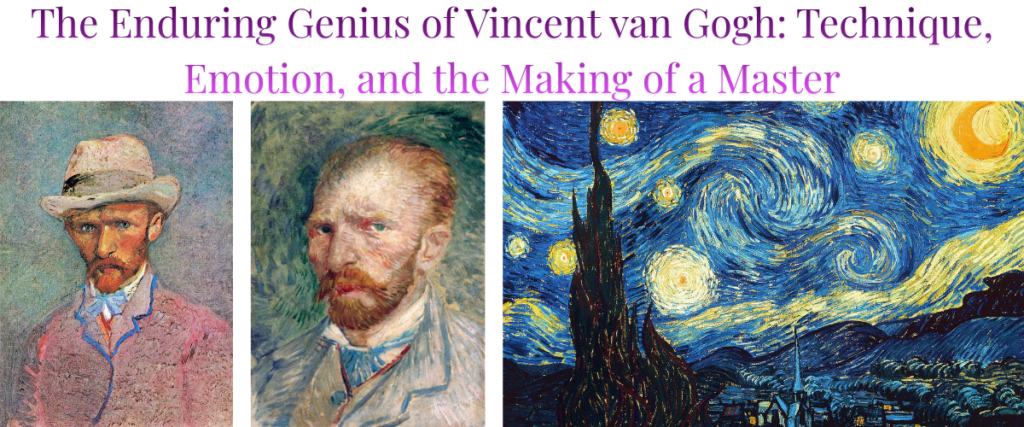
Introduction to a Posthumous Phenomenon
Vincent van Gogh exists in the global consciousness as the quintessential archetype of the misunderstood, tormented genius. An artist whose profound, kaleidoscopic vision was only truly recognised after his tragic and untimely death, Van Gogh irrevocably altered the trajectory of modern visual culture1. Producing an astonishing body of work that includes approximately 900 paintings and 1,100 drawings and sketches during a highly compressed decade-long career, his output was both prolific and revolutionary2. Today, his canvases are the crown jewels of international museum collections and command tens of millions of dollars at auction, a stark and melancholic contrast to a life characterised by relentless financial struggle, severe mental health crises, and relative public obscurity.
To understand precisely why Vincent van Gogh is universally considered one of the greatest painters in history requires an analytical examination that looks beyond the romanticised mythology of his severed ear and institutionalisation. His enduring legacy is deeply rooted in a revolutionary mechanical and theoretical approach to the canvas itself. Van Gogh dismantled the rigid, photographic academic principles of the nineteenth century, choosing instead to deploy colour, exaggerated form, and heavy texture as direct conduits for human emotion3. By bridging the expansive gap between external visual observation and internal psychological states, he laid the foundational groundwork for subsequent avant-garde movements, most notably German Expressionism and Fauvism, empowering future generations of artists to use colour and form subjectively rather than objectively3.
This comprehensive report explores the multifaceted dimensions of Van Gogh’s artistic genius. It investigates the evolution of his style from Dutch Realism to vivid Post-Impressionism, his mastery of colour theory, and his signature, sculptural impasto brushwork. It further examines the profound influence of Japanese ukiyo-e woodblock prints on his compositional philosophy, the tragic chemical degradation of his original 19th-century pigments, and the persistent medical myths surrounding his vision. Finally, it analyses the critical reception of his work during his lifetime and the monumental, tireless efforts of his sister-in-law, Johanna van Gogh-Bonger, who single-handedly engineered his posthumous rise to global prominence, ensuring his letters and art would forever change the world.
The Evolution of Vision: From the Dutch Countryside to the Parisian Avant-Garde
Van Gogh’s artistic journey was not a linear progression; it was a rapid, explosive evolution catalysed by geographical shifts and his sudden exposure to new intellectual and artistic currents. During his early period in the Netherlands, his palette was heavily dominated by sombre, earthy tones, influenced by the traditions of Dutch Realism and painters who focused on the harsh, unvarnished realities of peasant life7.
Masterpieces from this early era, such as The Potato Eaters (1885) and the poignant drawing Sorrow (1882), reflect a deep, empathetic desire to capture the gritty truth of the working class8. In The Potato Eaters, Van Gogh utilised dark browns, muted greens, and heavy shadows to convey the physical and emotional weight of agrarian existence, deliberately painting the figures with coarse, exaggerated features to emphasise their connection to the soil they worked8. This period was defined by a focus on character and narrative over aesthetic beauty, setting a foundation of intense emotional empathy that would persist throughout his life.
The pivotal, paradigm-shifting transformation in his style occurred when he relocated to Paris in 1886 to live with his brother Theo, a successful art dealer. The Parisian art scene was in the midst of a revolution. Here, Van Gogh was suddenly introduced to the vibrant, light-filled, en plein air canvases of the Impressionists, as well as the methodical, scientifically driven colour application of the Neo-Impressionists and Pointillists like Georges Seurat and Paul Signac9. Immersing himself in the Parisian avant-garde, Van Gogh rapidly absorbed these new methodologies. The muddy, sombre tones of his Dutch period were swiftly abandoned in favour of a radiant, high-key palette that sought to capture light not as a physical phenomenon, but as an emotional one10.
The Science and Emotion of Colour Theory
Van Gogh’s eventual mastery of colour was not merely an intuitive, unguided talent; it was heavily informed by rigorous academic study and relentless experimentation. He eagerly consumed literature on colour theory, particularly the writings of Professor Charles Blanc, whose theories expanded upon the scientific studies originally undertaken by French chemist Michel Eugène Chevreul and the artist Eugène Delacroix11.
The Law of Simultaneous Contrast
Central to Van Gogh’s new understanding was Chevreul’s Law of Simultaneous Contrast of Colours, which posited that colours appear fundamentally different and generate unique optical effects depending on the specific hues placed directly adjacent to them11. Understanding these principles, Van Gogh began to exploit the optical tension created by placing complementary colours side by side. He recognised that combining primary colours (red, blue, yellow) with their corresponding binary, or secondary, colours (green, orange, purple) resulted in a mutual amplification of luminosity that science deemed mathematically plausible11.
As he articulated in his correspondence to his brother Theo, placing a binary colour like orange next to its complementary primary colour, blue, heightens the absolute brilliance of both pigments11. Similarly, violet is heightened by the immediate proximity of yellow, and green is amplified by red11.
This scientific approach to chromatics became the driving emotional engine of his canvases. In his painting Still Life with Basket and Six Oranges, he deliberately set the orange fruit—created by mixing primary red and yellow—against a contrasting primary background to make the subjects visually vibrate and pop off the canvas11. During his later convalescence at the Saint-Rémy asylum, his magnificent painting of Irises served as a dedicated colour study. Here, he mixed red and blue to create a violet binary, placing it aggressively against a primary yellow background to maximise visual impact, generating a sense of floral vitality that borders on the aggressive11.
| Colour Pairing Strategy | Visual and Psychological Effect Achieved | Notable Examples in Van Gogh’s Oeuvre |
| Blue & Yellow/Orange | Intense luminosity, visual tension, celestial energy, atmospheric depth, and spatial warmth. | The Starry Night, Café Terrace at Night, Sunflowers |
| Red & Green | Visual vibration, psychological unease, dramatic and jarring contrast, representing human passions. | The Night Café |
| Violet & Yellow | Exaggerated brilliance, floral vitality, spatial push-and-pull, amplifying natural beauty. | Irises, The Sower |
Diverging from Pointillism toward Expressive Autonomy
While Van Gogh experimented with the Neo-Impressionist technique of Pointillism—employing tiny dots or dabs of pure colour to create a vibrating, dancing optical mixture in works like Interior of a Restaurant and Undergrowth—he refused to be confined by its rigid, mathematical methodology9. Where artists like Seurat used Pointillism exclusively and systematically, Van Gogh used it sparingly, often varying his brushwork across a single canvas to match the texture of the subject matter9. For instance, in his Lilac Bush painting, he combined Pointillist dabs with dark outlining and flat colour shapes, demonstrating a willingness to prioritise expression over strict scientific adherence9.
Van Gogh ultimately synthesised these colour theories with his own psychological intensity. He pushed colours as far as they could logically go without appearing garish, using richer blues for a clear midday sky, or exaggerated, brilliant greens for foliage9. As he famously declared in a letter to his brother Theo, “Instead of trying to reproduce exactly what I have before my eyes, I use colour more arbitrarily, in order to express myself forcibly”13. This declaration is arguably the most crucial key to his genius: in Van Gogh’s hands, colour was no longer a tool for photographic replication or atmospheric documentation; it was elevated to an instrument of raw, subjective human emotion.
The Architecture of Paint: The Mastery of Impasto
If colour was Van Gogh’s emotional vocabulary, the physical oil paint itself was his syntax. He is universally recognised for his pioneering, heavy use of the impasto technique. Derived from the Italian word for “dough”, “paste”, or “smooth”, impasto involves applying undiluted paint to the canvas with such a thick consistency that the brushstrokes, palette knife marks, or even fingerprints remain clearly visible and raised17.
While the impasto technique has a deep history spanning the Renaissance and the Baroque period—most notably utilised by Rembrandt, who built up ridges of lead white paint to catch the light on his late self-portraits—Van Gogh democratised and radicalised the technique17. Instead of reserving thick paint merely for facial highlights, he applied it across the entire canvas, embedding every square inch of the composition with rhythmic energy and turbulent movement.
Sculpting with Pigment
Van Gogh’s brushstrokes are highly directional; they twist, turn, and swirl, guiding the viewer’s eye on a deliberate, kinetic journey around the subject9. In monumental works like The Starry Night and Wheatfield with Crows, the impasto strokes literally dictate the flow of the wind, the radiation of the starlight, and the turbulent, rolling movement of the storm clouds20. He loaded his brushes, spatulas, and palette knives generously, sometimes squeezing oil paint directly from the tube onto the canvas and mixing it in situ, refusing to over-blend so that each colour retained its distinct integrity and maximum luminosity17.
The physical topography of a Van Gogh painting is critical to its visual reception. Because the paint sits in thick ridges—sometimes described as being spread as thickly as peanut butter on toast—it interacts dynamically with the ambient natural or artificial light in the room17. As the viewer shifts position, the raised globs of pigment cast tiny, shifting shadows and catch highlights, ensuring the painting feels physically alive, three-dimensional, and constantly in motion9. This sculptural quality explains why standard flat poster reproductions often fail to capture the true atmospheric depth of his work. Properly reproducing his heavy directional brushwork requires modern, high-resolution scanning and premium museum-grade 400–450 GSM canvas to simulate the pigment density and tonal layering that define his art21.
Speed, Passion, and Stylisation
Van Gogh painted with furious speed and fierce, almost obsessive concentration. He frequently completed complex canvases in a single, exhausting sitting, driven by an urgent need to capture the fleeting atmospheric effects of nature and his own transient emotional states9. He wrote to his brother in July 1889 of painting a wheat field under the summer heat with a “thick impasto like the Monticellis,” directly referencing the French painter Adolphe Monticelli, whose heavy, textured style he deeply admired and sought to emulate19. To achieve these textures without the paint wrinkling or cracking, historical impasto artists sometimes added thickening agents like wax, sawdust, or fine grit, though Van Gogh relied primarily on the sheer volume of his pigment17.
This incredible speed did not equate to carelessness; it required immense intuition, experience, and absolute mastery over his materials. To ensure certain subjects stood out against the chaotic energy of the impasto background, he utilised dark, thoughtful contours. These were not harsh, cartoonish black lines, but organic outlines in navy, forest green, or burnt sienna that emphasised shape and structure9. This expressive stylisation further distanced his work from the rigid confines of academic realism, solidifying his role as a foundational pillar of modernism.
Japonisme: The Influence of the Floating World
A comprehensive understanding of Van Gogh’s genius is impossible without examining the profound, paradigm-shifting impact of Japonisme—the late nineteenth-century European fascination with Japanese art and culture, specifically ukiyo-e woodblock prints. The term ukiyo-e roughly translates to “pictures of the floating world,” a genre that depicted the ephemeral pleasures, landscapes, theatres, and daily life of Edo-period Japan (modern-day Tokyo)22.
Following the opening of Japan to international trade in 1853, a wave of Japonisme swept through the West. Kimonos, lacquerware, and woodblock prints flooded European markets, deeply influencing avant-garde artists like Édouard Manet, Claude Monet, Edgar Degas, and Paul Gauguin24. While living in Paris, Van Gogh became an avid, obsessive collector of these prints, purchasing over 600 of them from the dealer Siegfried Bing for an average of 15 centimes each—barely more than the price of a cup of coffee24. These prints, characterised by their bold outlines, flat areas of unshaded colour, absence of traditional Western linear perspective, strong diagonals, and abrupt cropping of subjects, fundamentally rewired Van Gogh’s visual processing and compositional strategy23.
Copying to Innovate: Utagawa Hiroshige’s Influence
To absorb the mechanics of Japanese composition, Van Gogh undertook meticulous painted copies of works by the great ukiyo-e master Utagawa Hiroshige23. He focused specifically on two prints from Hiroshige’s monumental series One Hundred Famous Views of Edo: The Plum Garden at Kameido (1857) and Sudden Shower over Shin-Ōhashi Bridge and Atake (1857)22.
The creation of these original Japanese prints was a collaborative masterclass involving a publisher, an artist, a master woodblock cutter, and a printer22. The design was carved into hard mountain cherry tree wood—one block for the outlines (omohan) and separate blocks for each specific color22. Because thousands of prints were made, the blocks would warp or wear down, resulting in different “states” or variations of the print22. Furthermore, the vibrant plant dyes used for reds and yellows (like safflower and turmeric) were notoriously sensitive to light and faded quickly22. Modern research by the British Museum, utilising tracing paper marks left by Van Gogh, confirms he owned and traced a later “fourth-state” impression of The Plum Garden, but likely referenced an earlier, more vibrant first-state print he saw in a Parisian gallery to capture the rich red skies and blue shading22.
In his painted version, titled Flowering Plum Orchard (after Hiroshige), Van Gogh studied Hiroshige’s radical composition, which places the dark, angular trunk of a plum tree directly in the extreme foreground, deliberately obscuring the background orchard as if the viewer is gazing at something forbidden22. He also painted a copy of Sudden Shower, titled Bridge in the Rain, marvelling at Hiroshige’s ability to render a sudden downpour—or “white rain”—using sharp, dark parallel lines in two directions, a notoriously difficult skill in woodblock carving23.
However, Van Gogh did not merely duplicate these works; he translated them through his own intense Post-Impressionist lens. He intensified the colour palettes, replacing the subtle, flat plant dyes of the original woodblocks with high-contrast, brilliant oils based on his primary and secondary color theories23. He utilised conspicuous, energetic impasto brushstrokes rather than the smooth perfection of the Japanese prints23. To emphasise the exotic nature of the work, he framed his canvases with borders containing arbitrary Japanese characters—copied purely for their decorative appeal from other prints—painted in his favoured complementary red and green23. In another instance, he painted a copy of a print by Kensai Eisen depicting a courtesan, placing her in a water landscape surrounded by cranes (grue) and frogs (grenouille), utilising popular French slang words for prostitutes as visual puns27.
A New Philosophy of Space and Nature
The lessons of Japonisme permanently altered Van Gogh’s spatial philosophy. He began to employ abrupt cutoffs of motifs in the foreground, intentionally leaving the horizon out of view, and magnifying elements to create an immediate, sweeping depth without relying on traditional European linear perspective24. A drawing he made of the countryside near Montmajour prompted him to note that while it did not look overtly Japanese, it was “actually the most Japanese thing that I’ve done,” due to its non-Western arrangement of negative space and panoramic viewpoints24.
Furthermore, he adopted the Japanese reverence for nature, viewing it as an antidote to the melancholic gloom of industrialized Europe11. He wrote to Theo that studying Japanese art forces one to return to nature and become happier, noting that a Japanese philosopher studies “a single blade of grass,” which eventually leads to a profound understanding of all plants, seasons, landscapes, and humanity25. This synthesis of intense European impasto and Japanese spatial minimalism allowed Van Gogh to create a hybrid visual language that was entirely unprecedented in Western art.
The Fragile Canvas: Synchrotron Analysis of Pigment Degradation
While Van Gogh’s bold use of novel, industrially produced 19th-century pigments enabled the unprecedented vibrancy and emotional resonance of his work, it also introduced a tragic, hidden chemical instability. Modern scientific analysis reveals that Van Gogh’s masterpieces are not static historical artifacts locked in time; they are highly reactive chemical cocktails that are actively degrading and changing over the decades29.
For decades, art historians and conservators noted with alarm that some of Van Gogh’s most famous works, particularly those featuring bright yellows like his iconic Sunflowers series and Bank of the River Seine, were losing their luminosity. The vibrant yellows were visibly dulling into flat, chocolate-brown or orange-grey shades30. To understand this degradation at a molecular level, international teams of scientists have deployed advanced synchrotron X-ray technology at facilities like the European Synchrotron Radiation Facility (ESRF) in Grenoble, France, and DESY in Hamburg, Germany29.
The Photochemical Reduction of Chrome Yellow
Van Gogh heavily favoured chrome yellow (lead chromate), a newly invented synthetic industrial pigment that offered unparalleled brightness but was notoriously sensitive to light30. Using an X-ray beam one hundred times thinner than a human hair, scientists like Koen Janssens, Letizia Monico, and Marine Cotte analysed microscopic paint samples from Van Gogh’s canvases, focusing on the incredibly thin layer where the paint meets the varnish31.
The findings of this micro-investigation read like a chemical crime scene autopsy. Sunlight, specifically ultraviolet (UV) radiation, penetrates the top few micrometres of the impasto paint layer, triggering a complex, hitherto unknown photo-redox chemical reaction30. The highly toxic chromium in the chrome yellow undergoes a reduction process, altering its oxidation state from Cr(VI) to Cr(III)32. This reduction process results in the formation of Cr(III) compounds, such as chromium(III) oxide (Cr2O3), which manifest as a nanometer-thin brownish-green coating covering the original yellow pigment particles33.
Advanced techniques like X-ray fluorescence (XRF), X-ray absorption near edge structure (XANES), and electron energy loss spectroscopy proved that this degradation is exacerbated by the presence of barium and sulfur29. Van Gogh frequently blended his chrome yellow with white paints containing these compounds to create lighter shades, inadvertently accelerating the darkening of his own masterpieces32.
Cadmium Yellow, Geranium Lake, and Varnish Interactions
Similarly distressing discoveries were made regarding Van Gogh’s use of other pigments. In works like Flowers in a blue vase, the bright yellow flowers painted with cadmium yellow (cadmium sulphide) have developed an opaque, cracked, orange-grey crust29. Synchrotron analysis revealed that the cadmium sulphide is oxidising in the air. However, instead of forming a transparent cadmium sulphate layer as expected, the sulphate anions are chemically reacting with lead ions present in a posthumously applied protective varnish29. This disastrous reaction creates anglesite (lead sulphate) and cadmium oxalate right at the paint-varnish interface, entirely disfiguring the original colour on a macroscopic level29.
Furthermore, Van Gogh frequently utilised geranium lake, an eosin-based organic red dye, which is highly unstable and prone to severe fading under light exposure36. The fading of these organic red lakes has caused the vibrant pinks and reds in paintings like Irises and his bedroom scenes to turn white or pale blue over time36.
These scientific insights are vital for modern conservation efforts. They confirm that Van Gogh’s canvases must be meticulously shielded from UV light and carefully monitored to halt the degradation of his visionary palettes, ensuring that the colours he so passionately orchestrated are not lost to chemical entropy30.
| Pigment Used by Van Gogh | Chemical Composition | Degradation Trigger | Chemical Alteration | Visual Consequence on the Canvas |
| Chrome Yellow | Lead chromate (PbCrO4) | UV Light (Sunlight) | Reduction from Cr(VI) to Cr(III) compounds | Vibrant yellow dulls to a dark, chocolate-brown shade. |
| Cadmium Yellow | Cadmium sulphide (CdS) | Oxidation + Lead from varnish | Formation of anglesite and cadmium oxalate | Formation of an opaque, cracked, orange-grey crust. |
| Geranium Lake | Eosin-based organic dye | Light exposure | Breakdown of organic molecular structure | Vibrant pinks/reds fade to white or light grey. |
Debunking the Medical Myths: Digitalis, Xanthopsia, and Artistic Agency
The striking prevalence of yellow in Van Gogh’s later works, combined with his well-documented and tragic mental health struggles, has given rise to numerous medical theories attempting to pathologise his genius. One of the most pervasive and persistent myths in art history is that Van Gogh suffered from xanthopsia (yellow vision), a visual distortion resulting from digitalis toxicity38.
During his final months under the care of Dr. Paul Gachet in Auvers-sur-Oise, Van Gogh was reportedly prescribed digitalis—an extract of the foxglove plant—as a potential treatment for his presumed epilepsy or manic depression41. Proponents of the xanthopsia theory argue that the side effects of this medication caused him to literally see the world through a yellow-tinted lens, accompanied by visual coronas. They suggest this medical condition is the true reason for the haloed stars in The Starry Night and the overwhelming, vibrant golden hues of his Sunflowers and wheat fields38.
However, modern toxicologists, physicians, and art historians largely reject this hypothesis as highly improbable40. To experience visual side effects like xanthopsia, a patient must consume digitalis in highly toxic, nearly lethal doses over an extended period40. It is highly doubtful that Van Gogh could have sustained the immense physical stamina required to paint his complex, heavy-impasto canvases while suffering from severe digitalis toxicity, which induces profound nausea, dangerous cardiac arrhythmias, and debilitating weakness40. Furthermore, Dr. Gachet was a competent, modern physician who was well aware of the drug’s potent side effects and would likely have monitored the dosage to prevent systemic poisoning44.
More importantly, attributing Van Gogh’s masterful colour palette to a pharmaceutical side effect fundamentally undermines his artistic agency and deep understanding of colour theory. His use of yellow was a deliberate, highly calculated aesthetic and symbolic choice. Yellow represented warmth, the life-giving power of the sun, and divine love41. By dismissing the digitalis myth, we restore Van Gogh’s rightful status as a masterful colourist who controlled his palette to express intense emotion, rather than a passive victim of a medical anomaly.
Contemporary Recognition: Albert Aurier and the Symbolist Reading
A common historical misconception is that Van Gogh lived in complete artistic obscurity, utterly ignored and entirely unappreciated by the critics of his day. In truth, the murmurs of his genius had begun to permeate the Parisian avant-garde just months before his suicide. In January 1890, the painter, poet, and art critic Albert Aurier published a glowing, expansive review of Van Gogh’s work in the Mercure de France, a highly influential journal read by anyone with a serious interest in modern art46.
Titled Les Isolés: Vincent van Gogh (The Isolated Ones), Aurier’s review was the very first formal critical recognition of Van Gogh’s talent, highlighting the originality and intensity of his artistic vision46. Aurier, a passionate advocate for the nascent Symbolist movement, perfectly captured the overwhelming sensory experience of a Van Gogh canvas. He described the artist’s skies as being “moulded of infernal, hot, noxious, and blinding sulphurs,” radiating “torrid solar disks,” and turning light into a “conflagration”45. Aurier proclaimed Van Gogh a “deserving heir to the Dutch masters” and stated that he was the only painter who perceived colouration with such “metallic, gem-like quality”46.
Crucially, Aurier recognised that Van Gogh was not a mere naturalist attempting to copy landscapes, but a Symbolist who felt the “continual need to clothe his ideas in precise, ponderable, tangible forms, in intensely sensual and material exteriors”2. He viewed the thick, fleshy impasto not as a crude or clumsy technique, but as a “marvellous language destined to translate the Idea,” asserting that there was an essential, almost messianic thought beneath the matter of the paint45.
The Artist’s Humble Rebuttal
The recognition brought immense joy to Van Gogh’s brother, Theo, and his sister-in-law, Jo, who viewed it as validation of their unwavering support49. However, Van Gogh’s own reaction, penned in a tightly packed, multi-page letter to Aurier from the asylum in Saint-Rémy in February 1890, was characterised by extreme self-deprecation and humility46.
While Van Gogh politely praised Aurier’s writing as a “work of art in itself” and claimed the critic painted with words, he expressed severe discomfort with the individual praise lavished upon him2. He felt ill at ease and unworthy of the attention, insisting that Aurier’s accolades should rightfully be directed at his predecessors and contemporaries, specifically Adolphe Monticelli and Paul Gauguin2. “I am standing on the shoulders of others,” was the essence of his response, demonstrating an artist acutely aware of his place within the broader continuum of art history, rather than a solitary, arrogant genius50.
As a token of gratitude, Van Gogh promised to send Aurier a study of cypresses, a tree that Aurier had noted exposed a “nightmarish, flamelike” silhouette2. Given Van Gogh’s mental state, the choice of the cypress—traditionally associated with death and cemeteries—has been viewed by some historians as a sombre premonition of his own suicide just months later2. He warned the critic that the thick impasto of the painting would take at least a year to fully dry, a testament to the sheer physical volume of paint he applied to the canvas50.
The Architect of an Empire: The Monumental Legacy of Johanna van Gogh-Bonger
Despite Aurier’s highly positive review, Van Gogh remained commercially unsuccessful at the time of his death from a self-inflicted gunshot wound in July 189052. Compounding the tragedy, merely six months later, his devoted brother Theo—broken by grief, exhaustion, and illness—also passed away at the age of 3352. The monumental task of preserving and promoting Vincent’s legacy fell entirely onto the shoulders of Theo’s 28-year-old widow, Johanna (Jo) van Gogh-Bonger52.
Left with an infant son (named Vincent Willem), a small apartment in Paris, and a massive collection of over 200 unvalued, heavily impastoed paintings and hundreds of letters, Jo’s situation was dire52. The Van Gogh family advised her to burn the artwork and start her life over, while one art dealer callously offered to buy the canvases solely to scrape off the thick paint and resell them as blank canvas52. Instead, fueled by a profound devotion to her late husband’s belief in his brother’s visionary genius, she became the architect of one of the most successful, tireless posthumous marketing campaigns in the history of art52.
Strategic Exhibitions and Market Control
Jo relocated from Paris to the Dutch town of Bussum, opening a boarding house to support herself while strategically introducing Vincent’s work to the intellectual and artistic elite who frequented the area52. She initially faced universal rejection from established Parisian art dealers, yet she relentlessly persisted, bundling up smaller paintings and acting as his relentless agent52. She organised small sales exhibitions to boost visibility, making highly calculated, strategic decisions regarding which paintings to sell and to whom52. She prioritised selling to collections accessible to the public and museums around the world, ensuring that as many people as possible could experience Vincent’s work55.
Her supreme triumph occurred in 1905 when she successfully orchestrated the largest-ever retrospective of Van Gogh’s work at the Stedelijk Museum in Amsterdam, featuring over 480 artworks53. She managed every logistical detail, from selecting the works to paying the attendants55. While some critics still found the bright colours and expressive strokes too modern, this exhibition decisively shifted the public and critical consensus, rapidly driving up the prices and international demand for his paintings55. Over her lifetime, she sold nearly 200 works, occasionally making painful personal sacrifices, such as selling one of her beloved Sunflowers paintings to the National Gallery in London in 1924 purely “for the sake of Vincent’s glory”55. She also fostered relationships with other artists, such as the painter Isaac Israëls, who painted portraits of Jo and used Van Gogh’s masterpieces as backdrops in his own work, further cementing Van Gogh’s influence in the artistic community57.
The Publication of the Letters
Equally important to her exhibition strategy was her monumental work with Van Gogh’s literary legacy. A former English teacher with a highly educated background, Jo spent years meticulously reading, categorising, editing, and translating the hundreds of deeply personal letters Vincent had written to Theo54. When she finally published the letters in 1914, complete with a biographical introduction, she provided the world with the psychological key to unlocking his art52.
The letters revealed a highly articulate, deeply intellectual, and fiercely passionate man who read Dickens and possessed a profound philosophical outlook, entirely dispelling the myth of an incoherent, raving madman55. Through her translation work—which she continued until she died of Parkinson’s disease in 1925—Jo van Gogh-Bonger not only secured Van Gogh’s fame but humanised him, allowing global audiences to connect intimately with his struggles, his creative process, and his dreams52. Today, the Van Gogh Museum in Amsterdam, founded in 1973 by her son Vincent Willem, stands as the ultimate testament to her unyielding dedication to family and art52.
The Philosophy of Passion: In His Own Words
Van Gogh’s letters remain one of the most profound, articulate literary artifacts in the history of art, offering unparalleled insight into the creative philosophy that drove his technique. His approach to art was inherently intertwined with his philosophy of human existence, suffering, and perseverance.
He viewed painting as a spiritual, healing vocation, famously stating, “Art is to console those who are broken by life”58. His obsessive work ethic was a deliberate rebellion against mediocrity, convention, and despair. “Normality is a paved road: It’s comfortable to walk, but no flowers grow on it,” he wrote, summarising his willingness to endure poverty, isolation, and mental anguish in exchange for authentic creative expression58.
He understood that true artistic greatness required an excruciating alignment of vision and technical labour, noting that greatness is not achieved by sudden impulse, but by “patiently filing away the steel wall that separates what one feels from what one is capable of doing,” a metaphor for the relentless practice required to master his impasto and colour techniques61. When plagued by the self-doubt that often paralyses immense talent, his remedy was relentless, defiant action: “If you hear a voice within you say ‘you cannot paint,’ then by all means paint, and that voice will be silenced”58.
He possessed a poetic view of mortality, comparing death to a journey to the stars. “Just as we take a train to get to Tarascon or Rouen, we take death to reach a star,” he wrote, suggesting that terminal diseases were merely “celestial means of locomotion”60. This philosophy infused his starry skies with a sense of eternal hope rather than darkness.
Conclusion
Vincent van Gogh is considered one of the preeminent figures in the history of Western art because he fundamentally redefined the very purpose of painting. He did not seek to mimic the visual world with photographic accuracy; rather, he sought to externalise the internal human condition. By synthesising the scientific colour theories of Chevreul and Blanc with the spatial innovations and deep reverence for nature found in Japanese ukiyo-e prints, Van Gogh forged an entirely new, highly emotive visual vocabulary.
His key technique, the heavy, rhythmic application of impasto, transformed the flat canvas into a three-dimensional, sculptural entity that pulses with kinetic energy and vibrant life. While the inherent chemical fragility of his chosen 19th-century pigments presents a formidable, ongoing challenge to modern conservators, advanced synchrotron analysis continues to unlock the secrets of his materials, ensuring his vibrant visions can be understood and protected for future generations.
Yet, the survival and ultimate triumph of Van Gogh’s legacy cannot be attributed to his brush alone. It is the direct result of the prescient critical eye of Albert Aurier, who first articulated his Symbolist genius, and the indomitable will of Johanna van Gogh-Bonger, who forced a reluctant world to look at, and eventually revere, the paintings and words her husband had so cherished. Ultimately, Vincent van Gogh remains a titan of art because his canvases are not merely pictures; they are profound, unfiltered transcriptions of the human soul, executed by an artist who boldly declared, “I would rather die of passion than of boredom”59.
Disclaimer
This report is provided for informational and educational purposes only. The historical, technical, and scientific analyses detailed herein are intended for academic understanding and do not constitute professional art appraisal, authentication, or financial advice regarding the valuation, purchase, or conservation of fine art.
References
- Vincent van Gogh – Wikipedia, https://en.wikipedia.org/wiki/Vincent_van_Gogh
- Vincent van Gogh’s Letter to G. Albert Aurier (Mercure de France,, https://charleskeller.net/2015/05/vincent-van-goghs-letter-to-g-albert-aurier-mercure-de-france-1890/
- Exploring the Visionary World of Van Gogh – RedKalion, https://redkalion.com/blogs/vincent-van-gogh/exploring-the-visionary-world-of-van-gogh-the-enduring-legacy-of-an-iconic-artist
- Vincent van Gogh Paintings, Bio, Ideas – The Art Story, https://www.theartstory.org/artist/van-gogh-vincent/
- Van Gogh and his Influence on German Expressionism, https://thelondonmagazine.org/article/van-gogh-and-his-influence-on-german-expressionism/
- Vincent van Gogh (1853–1890) – The Metropolitan Museum of Art, https://www.metmuseum.org/essays/vincent-van-gogh-1853-1890
- Vincent van Gogh: The Life and Evolution of a Genius – 1001Canvas, https://1001canvas.com/blogs/famous-painters-and-paintings/vincent-van-gogh-life
- Van Gogh’s Dutch Period: An Exploration of His Early Artistic Journey, https://www.canvasprintsaustralia.net.au/van-goghs-dutch-period-an-exploration-of-his-early-artistic-journey/
- Exploring Vincent van Gogh’s Techniques and Processes, https://drawpaintacademy.com/vincent-van-gogh-techniques/
- Vincent van Gogh – Post-Impressionist, Paintings, Artwork | Britannica, https://www.britannica.com/biography/Vincent-van-Gogh/The-productive-decade
- Vincent van Gogh’s Use of Color – Vangoghology, https://vangoghology.com/vincent-van-goghs-use-of-color/
- Vincent’s Colours – Van Gogh Museum, https://www.vangoghmuseum.nl/en/art-and-stories/stories/vincents-colours
- Vincent van Gogh suicide – Artprints for sale, https://www.art-aruba.com/ourstorysuicide.html
- Showing all quotes that contain ‘van gogh’. – Goodreads, https://www.goodreads.com/quotes/search?commit=Search&page=38&q=van+gogh&utf8=%E2%9C%93
- Vincent van Gogh Quotes – Goodreads, https://www.goodreads.com/author/quotes/34583.Vincent_van_Gogh?page=13
- Art History: From The Classics To The Impressionists – GradesFixer, https://gradesfixer.com/free-essay-examples/art-history-from-the-classics-to-the-impressionists/
- Impasto – Old Holland Classic Colours, https://www.oldholland.com/academy/impasto/
- Van Gogh’s Painting Technique: Impasto |, https://blog.vangoghgallery.com/index.php/en/2012/12/17/van-goghs-painting-technique-impasto/
- Famous Impasto Paintings: 9 Built From Thick Paint, https://www.coolstoriesabout.art/p/famous-impasto-paintings
- Van Gogh techniques – Mont Marte Australia, https://www.montmarte.com.au/blogs/tips-techniques/van-gogh-techniques
- Van Gogh Canvas Prints & Impasto Texture Guide, https://www.canvasartprints.com.au/blogs/painting-guides/van-gogh-impasto-canvas-prints
- Tracking down the Plum Garden: Hiroshige, Van Gogh and the Edo, https://www.britishmuseum.org/blog/tracking-down-plum-garden-hiroshige-van-gogh-and-edo-instagram
- Sudden Shower over Shin-Ōhashi Bridge and Atake – Wikipedia, https://en.wikipedia.org/wiki/Sudden_Shower_over_Shin-%C5%8Chashi_Bridge_and_Atake
- Van Gogh’s love of Hiroshige, the Japanese master of the landscape, https://www.theartnewspaper.com/2025/08/01/van-goghs-love-of-hiroshige-the-japanese-master-of-the-landscape
- Van Gogh and Hiroshige: Plum Blossoms and Pink Skies, https://byronsmuse.wordpress.com/2021/03/12/van-gogh-and-hiroshige-plum-blossoms-and-pink-skies/
- A Closer Look: Episode 8 – Utagawa Hiroshige vs Vincent Van Gogh, https://www.limelight-arts-travel.com.au/a-closer-look/episode-8-hiroshige-vs-van-gogh
- Van Gogh Under the Spell of Japan, https://www.vangoghmuseum.nl/en/art-and-stories/stories/van-gogh-under-the-spell-of-japan
- Van Gogh and Japanese Art, Part 1 |, https://blog.vangoghgallery.com/index.php/en/2013/01/08/van-gogh-and-japanese-art-part-1/
- X-rays unravel mysterious degradation of a Van Gogh painting, https://www.desy.de/e428/e548/e4802/e98661/e107653/index_eng.html?preview=preview&printversion=1
- X-rays show why van Gogh paintings lose their shine – ScienceDaily, https://www.sciencedaily.com/releases/2011/02/110214142340.htm
- X-rays show why van Gogh paintings lose their shine, https://www.esrf.fr/news/general/van-gogh/van-gogh-paintings-lose-shine
- Van Gogh’s darkening legacy – Science in School, https://scienceinschool.org/wp-content/uploads/2014/11/issue19_vangogh.pdf
- X-Rays show why van Gogh paintings lose their shine – CNPEM, https://cnpem.br/x-rays-show-why-van-gogh-paintings-lose-their-shine/
- Evidence for Degradation of the Chrome Yellows in Van Gogh’s, https://pubmed.ncbi.nlm.nih.gov/26482035/
- Van Gogh’s Sunflowers: evidence of degradation of the chrome, https://www.esrf.fr/home/UsersAndScience/Publications/Highlights/highlights-2015/x-ray-nanoprobe/xnp08.html
- The Fading, Changing Paintings of Vincent Van Gogh – Academia.edu, https://www.academia.edu/3474598/The_Fading_Changing_Paintings_of_Vincent_Van_Gogh
- Chemical Alteration and Colour Changes in the Amsterdam … – IRIS, https://research.unipg.it/handle/11391/1611438
- Van Gogh’s vision. Digitalis intoxication? – PubMed, https://pubmed.ncbi.nlm.nih.gov/7007674/
- Van Gogh: Reason Behind Yellow Obsession – Serious Readers, https://www.seriousreaders.com/blogs/updates/was-van-gogh-s-obsession-with-yellow-an-eye-condition-or-an-artistic-choice
- Vincent van Gogh’s yellow vision – PMC – NIH, https://pmc.ncbi.nlm.nih.gov/articles/PMC3693787/
- The Chemistry of the Starry Night: Did Van Gogh See the World, https://blog.ksa.ee/the-chemistry-of-the-starry-night-did-van-gogh-see-the-world
- It was all yellow: did digitalis affect the way Van Gogh saw the world?, https://www.theguardian.com/science/blog/2017/aug/10/it-was-all-yellow-did-digitalis-affect-the-way-van-gogh-saw-the-world
- Episode 4: Why did Van Gogh paint with so much yellow?, https://curiousclinicians.com/2020/07/08/episode-2-why-did-van-gogh-use-so-much-yellow/
- Did digitalis affect Van Gogh’s painting? – SERB Pharmaceuticals, https://serb.com/insights/did-digitalis-affect-van-goghs-painting/
- The Isolated Ones: Vincent van Gogh, https://vggallery.com/misc/archives/aurier.htm
- The Art Critic Who Wrote the First Review of Van Gogh’s Paintings, https://www.vangoghgenova.it/first-reviewer-of-van-goghs-paintings.html
- Vmcent van Gogh’s Published Letters: Mythologizing the Modem Artist, https://journals.flvc.org/athanor/article/download/125454/124443
- The First Art Review of Vincent Van Gogh’s Painting – lidogallery, https://lidogallery.wordpress.com/2012/02/18/hello-world/
- What did critics think of Van Gogh in 1890?, https://www.vangoghstudio.com/what-did-critics-think-of-van-gogh-in-1890/
- A Letter Vincent van Gogh Sent to an Art Critic Was Acquired … – Artsy, https://www.artsy.net/article/artsy-editorial-letter-vincent-van-gogh-wrote-critic-praised-work-acquired-van-gogh-museum
- Van Gogh’s gushing letter to art critic goes on show in Amsterdam, https://www.theguardian.com/artanddesign/2019/may/09/van-goghs-gushing-letter-to-art-critic-goes-on-show-in-amsterdam
- Johanna Bonger: Saving the Legacy of Vincent van Gogh, https://strongwomeninhistory.com/2023/11/01/johanna-bonger-saving-the-legacy-of-vincent-van-gogh/
- Jo van Gogh-Bonger: The Woman Who Made Vincent van Gogh, https://www.dailyartmagazine.com/jo-van-gogh-bonger/
- Johanna van Gogh-Bonger – Wikipedia, https://en.wikipedia.org/wiki/Johanna_van_Gogh-Bonger
- The Woman Who Made Vincent Famous – Van Gogh Museum, https://www.vangoghmuseum.nl/en/art-and-stories/stories/stories-overview/the-woman-who-made-vincent-famous
- Johanna Van Gogh and Vincent’s Legacy, https://beyondvangogh.com/johanna-van-goghs-legacy/
- Captivated by Vincent – Van Gogh Museum, https://www.vangoghmuseum.nl/en/visit/whats-on/exhibitions/overview-past-exhibitions/captivated-by-vincent
- 15 Inspirational Quotes from Vincent van Gogh – Ruth Millington, https://ruthmillington.co.uk/quotes-van-gogh/
- Vincent Van Gogh on Art: 10 Quotes That Capture His Genius, https://beyondvangogh.com/vincent-van-gogh-quotes-about-art/
- From the Lips of Vincent: Life Lessons from Van Gogh | by Amy Burvall, https://medium.com/@amyburvall/from-the-lips-of-vincent-life-lessons-from-van-gogh-fec043108a44
- The 6 Most Inspiring Quotations from Vincent Van Gogh – Canvas, https://canvas.saatchiart.com/art/art-history-101/the-6-most-inspiring-quotations-from-vincent-van-gogh
- Vincent van Gogh Quotes – Goodreads, https://www.goodreads.com/author/quotes/34583.Vincent_van_Gogh