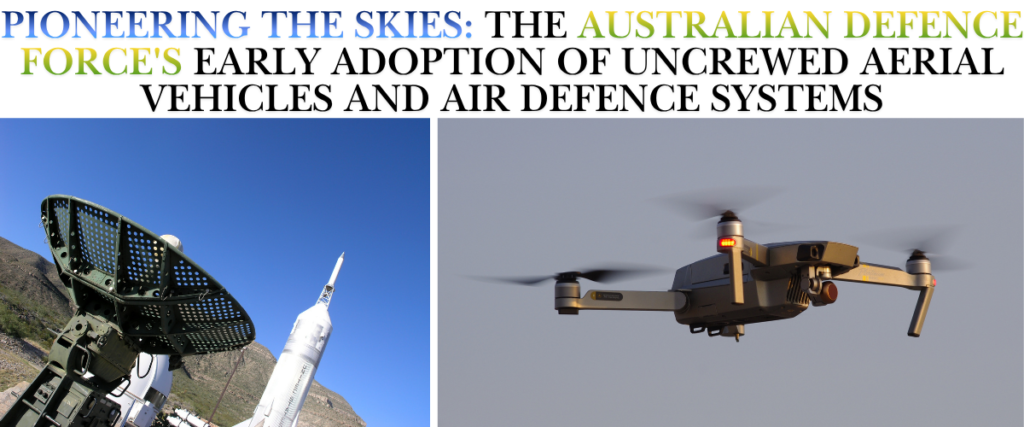
The evolution of the Australian Defence Force (ADF) over the past century has been heavily defined by the tyranny of distance and the strategic realities of defending a vast, sparsely populated continent. To protect the mainland and project power across the Indo-Pacific, Australian defence planners have historically sought technological force multipliers to offset demographic and numerical disadvantages. Two of the most critical domains where Australia exercised early, pioneering adoption were Uncrewed Aerial Vehicles (UAVs)—initially conceived as high-performance target drones—and integrated air and missile defence systems.
From the rapid, crisis-driven development of lightweight radar systems during the Second World War to the establishment of the largest land-based rocket testing range in the Western world, Australia positioned itself at the vanguard of aerospace technology. The subsequent decades saw the ADF pivot from British imperial reliance to American interoperability, navigating bespoke developmental failures and ultimately mastering off-the-shelf tactical deployments. This report provides an exhaustive analysis of the ADF’s historical journey through the development, procurement, and deployment of early drones and air defence systems, tracking the technological lineage that currently underpins Australia’s modern, networked battlespace.
The Crucible of the Second World War: Early Warning Radars and Anti-Aircraft Artillery
Prior to the Second World War, Australia possessed severely limited air defences, relying predominantly on coastal artillery and a small, increasingly obsolescent number of combat aircraft1. The vulnerability of the Australian mainland was catastrophically exposed on 19 February 1942, when Japanese carrier-based aircraft devastated the northern city of Darwin. The attacks highlighted a fatal flaw in the ADF’s early warning architecture, acting as an existential catalyst for sovereign technological development1.
The Genesis of Australian Radar and the Darwin Controversy
In early 1939, recognising the looming spectre of global conflict, the British government invited scientific delegations from Commonwealth nations, including Australia, to be briefed on highly secret radar developments. In response, the Australian Government allocated £80,000 for the Council for Scientific and Industrial Research (CSIR) to establish the Radiophysics Laboratory (RPL) at the University of Sydney3. Initially, the RPL focused on Shore Defence (SHD) radars to warn of approaching enemy naval vessels, successfully installing the first SHD system at Dover Heights near the entrance to Sydney Harbour2.
However, following the attack on Pearl Harbour, the strategic focus urgently shifted to air warning3. At the time of the first Darwin raid, the Royal Australian Air Force (RAAF) actually had an Air Warning (AW) radar set (assigned to 31 Radar Station) physically in Darwin, but it was not operational. Historical records reveal a bitter, protracted dispute between CSIR scientists and the RAAF regarding the failure to have the system online. The scientists, led by Dr. J.H. Piddington, claimed the RAAF technicians lacked the technical competence to assemble the complex electronic equipment in the short time available5. Conversely, RAAF personnel cited late and incomplete deliveries, noting that the final load of vital equipment, along with technical officers, did not arrive until 21 February, two days after the initial attack5.
Despite this initial failure, the urgency of the Japanese threat catalysed an extraordinary period of domestic innovation. Piddington and his team, utilising components from the earlier SHD radars, developed an experimental AW radar unit in less than six days. This rough but effective prototype provided Sydney with its first functional air warning system and proved that Australia possessed the sovereign industrial and scientific capacity to build complex aerospace infrastructure under extreme duress5.
The Light Weight Air Warning (LW/AW) System
The most successful radar to emerge from the RPL during the conflict was the Light Weight Air Warning (LW/AW) radar. Existing British and American systems were too heavy and cumbersome for the rapid island-hopping and jungle warfare campaigns of the South-West Pacific2. The ADF required a highly capable system that could be transported by air and deployed in harsh, humid, and corrosive tropical environments3.
The LW/AW was a marvel of utilitarian engineering and logistical foresight. It was designed so that no single component weighed more than 80 lb (36.2 kg), ensuring the entire system was man-portable and capable of fitting through the narrow cargo doors of a Douglas DC-2 transport aircraft or the blister of a PBY Catalina flying boat2.
| LW/AW Radar Specifications | Details |
| Developer | CSIR Radiophysics Laboratory (Australia) |
| First Operation | 8 November 1942 (New Guinea) |
| Maximum Component Weight | 36.2 kg (80 lb) |
| Packaging | Floating, man-portable transport cases |
| Operating Environment | Housed in a canvas tent, elevated rotating platform |
| Display Type | A-scope cathode-ray tube (range-only) |
| Total Produced | ~260 units |
The operator, transmitting equipment, and antenna all sat on an elevated, rotating platform. The operator manually turned this platform via a handwheel to change the direction of the radar’s view. This rudimentary but highly effective mechanical design allowed the radar to be used in a continuous search mode (scanning back and forth through an arc) or a track mode (continuously pointing at a specific radar return of interest)8. When packed for transport, the electronics cabinets were fitted with specialised ends that allowed the cases to float if accidentally dropped into water during amphibious landings8. The LW/AW was described by contemporary military commanders as the best system in the world for jungle, air transport, and beach-landing conditions, fundamentally altering the tactical air defence capabilities of Allied forces4.
The ingenuity fostered by this early radar program also had profound post-war scientific implications. In October 1945, RAAF radar operators at the Collaroy Plateau air and sea defence radar station, acting on instructions from CSIR scientists, utilised a 200 MHz COL radar in a reception-only mode to observe radio waves emitted from the Sun at sunrise. This successful experiment marked the birth of radio astronomy in Australia, directly linking military air defence technology to pioneering civilian space science3.
Anti-Aircraft Artillery (AAA) Networks
Simultaneously with the deployment of early warning radars, the Australian Army aggressively expanded its Anti-Aircraft Artillery (AAA) capabilities. Prior to the war, these assets were virtually non-existent, but by late 1942, an extensive anti-aircraft defence organisation had been developed. This network protected all major cities and key northern towns, encompassing two Heavy Anti-Aircraft (HAA) regiments, 32 static HAA batteries, 11 Light Anti-Aircraft (LAA) regiments, and 16 independent LAA batteries1.
The standard weaponry consisted of 3.7-inch anti-aircraft guns for high-altitude heavy defence (typically in fixed emplacements) and 40mm Bofors guns for mobile, low-altitude light defence1. For example, the defence of Brisbane—a critical staging ground for General Douglas MacArthur’s forces and the US New Farm submarine base—relied on 24 HAA guns, 12 LAA guns, and 33 mobile searchlights spread across 18 suburbs9.
Australian AAA units also saw extensive combat overseas. The 2/3rd Australian Light Anti-Aircraft Regiment, raised in Melbourne in 1940, deployed to the Middle East, serving in Palestine, Egypt, Libya, Tobruk, Crete, and Syria11. In a display of early tactical mobility, the regiment’s 8 Battery operated as an independent airborne unit, utilising the novel strategy of transporting dismantled 40mm Bofors guns and their crews in DC-3 aircraft to immediately defend newly captured airstrips11. As the immediate threat of Japanese air raids against the Australian mainland subsided toward the end of the war, manning of these anti-aircraft defences was increasingly taken over by the Volunteer Defence Corps and the Australian Women’s Army Service, releasing front-line troops for offensive operations in the Pacific1.
The Anglo-Australian Joint Project and the Woomera Rocket Range
In the immediate post-war era, the global strategic landscape was irreversibly reshaped by the advent of guided missiles and the dawn of the atomic age. The United Kingdom, having suffered heavily through the German V-1 and V-2 weapon campaigns, urgently required the capacity to develop long-range ballistic and guided weapons. However, the British Isles were far too small and densely populated to safely host extensive test ranges for experimental rockets13.
In 1946, the Chifley Government entered into the Anglo-Australian Joint Project, a highly secretive and ambitious Commonwealth weapons design and test program. The arrangement was mutually beneficial: Australia agreed to provide the land, the facilities, and the majority of the funding and base personnel, while the United Kingdom supplied the scientific equipment, the specialised engineering personnel, and the weapons to be tested14.
Geopolitical Imperatives and the Search for Space
In April 1946, a UK mission led by Lieutenant-General J.F. Evetts flew to the Mount Eba homestead to survey potential sites for a guided missile range. Because the remote interior of South Australia was largely unmapped for military purposes, the Army’s Australian Survey Corps conducted a gruelling topographical mapping program from Pimba north to the Musgrave Ranges14.
The chosen site was named Woomera, drawing its name from the Aboriginal Dharug word for a wooden spear-throwing device that extends the range a spear can be hurled. The name was suggested by RAAF Group Captain Alfred George Pither and formally adopted by the Board of the Long Range Weapons Establishment in April 194714.
Woomera grew into a colossal enterprise. At its absolute peak, the Woomera Prohibited Area (WPA) spanned an astonishing 270,000 square kilometres—an area roughly the size of the United Kingdom itself, or the US state of New Mexico—making it the largest land-based test range in the Western world13. At the height of the Cold War, Woomera recorded the second-highest number of rocket launches globally, trailing only NASA’s facilities at Cape Canaveral13.
Establishment, Security, and Societal Impact
The Joint Project was a foundational catalyst for Australian defence science. The Long Range Weapons Establishment (LRWE) was created in Salisbury, north of Adelaide, to support the Woomera range. This facility drew together aeronautical engineers, ballistics experts, and electronic specialists, laying the institutional groundwork for today’s Defence Science and Technology Group (DSTG)16.
However, the rapid establishment of Woomera occurred under the deep chill of Cold War paranoia. In June 1947, the federal parliament rushed through the Approved Defence Projects Protection Bill, effectively gagging critical commentary about the government’s defence policy. Transgressors faced massive fines of up to £5,000 or a 12-month prison sentence. Federal bans were imposed on union officials visiting the rocket range, declaring it a strict no-go area for anyone lacking military sanction20.
Furthermore, the expansion of the range had profound impacts on local Aboriginal populations. The WPA encompasses the traditional lands of several Aboriginal groups, including the Kokatha, Maralinga Tjarutja, Anangu Pitjantjatjara Yunkunytjatjara, Antakirinja Matu-Yankunytjatjara, Arabana, and Gawler Ranges people15. Woomera township itself was swiftly constructed on Kokatha lands. As testing expanded—particularly with the subsequent British nuclear weapons tests at Maralinga—Aboriginal people were forcibly relocated from their traditional lands, creating deep historical wounds that the Department of Defence has only recently begun to structurally address through co-management and heritage protection agreements15.
Leading the World in Uncrewed Flight: The GAF Pika and Jindivik
The most enduring, sovereign technological triumph to emerge from the early days of Woomera was the GAF Jindivik, a radio-controlled target drone that represents Australia’s most successful military aviation export.
In 1948, as the Anglo-Australian Joint Project gathered momentum, the British Ministry of Supply issued specification E.7/48. The specification called for an uncrewed aircraft capable of a 15-minute sortie at an altitude of 40,000 feet (12,200 metres) to serve as a high-speed, realistic target for the development of guided surface-to-air and air-to-air missiles21. The Australian Government Aircraft Factories (GAF) in Port Melbourne, led by chief designer Ian Fleming (supported by the Aeronautical Research Laboratory), won the contract and commenced development24.
From Pika to Jindivik
Because autonomous and remote-control jet flight was in its absolute infancy, the GAF engineering team first built two piloted prototypes to test the aerodynamics, engine performance, and proof-of-concept for the radio control systems. This manned version was named the Pika (an Aboriginal word meaning “flier”)21. First flown at Woomera in 1950, the Pika featured side air intakes to accommodate the pilot’s cockpit and utilised a small pneumatic retractable undercarriage21.
Once the aerodynamics were proven by the Pika, the uncrewed variant, the Jindivik (believed to mean “the hunted one” or “to burst asunder/destroy” in the Woiwurrung language), took its maiden flight on 28 August 195221. The Jindivik was a metal, low-wing cantilever monoplane. It replaced the pilot’s cockpit with a dorsal air intake and substituted the heavy conventional undercarriage with a single, retractable sprung skid for landing21.
| GAF Jindivik Specifications | Details |
| Primary Role | Target Drone |
| Manufacturer | Government Aircraft Factories (GAF), Australia |
| Length | 8.15 m (26 ft 9 in) |
| Wingspan | 6.32 m (20 ft 9 in) |
| Empty / Max Takeoff Weight | 1,315 kg (2,900 lb) / 1,451 kg (3,200 lb) |
| Powerplant (Mk 201) | 1 × Rolls-Royce Viper Mk.201 turbojet (12.36 kN / 2,780 lbf thrust) |
| Maximum Speed | 908 km/h (564 mph / 490 knots / Mach 0.85) |
| Service Ceiling | 17,375 m (57,000 ft) |
| Total Produced | 517 (Manufactured 1952–1986, 1997) |
Engineering, Control Mechanisms, and Launch
The initial Jindivik Mk. 1 (only 14 built) was powered by an Armstrong Siddeley Adder turbojet, originally developed as a disposable engine. The subsequent, mass-produced Mk. 2 and later variants were powered by the significantly more powerful Armstrong Siddeley (later Bristol Siddeley/Rolls-Royce) Viper engine, which was originally designed for a short operational lifespan of about 10 hours but proved far more durable21.
The Jindivik was not flown via direct, real-time stick-and-rudder input from a human ground controller. Instead, it utilised a highly sophisticated autopilot system manufactured by firms including Elliott Brothers, GEC, and McMichael. The autopilot received radio commands from the ground station; a controller could issue up to 18 specific flight commands, with six additional commands reserved for onboard equipment, such as cameras and flare dispensers21.
The launch and recovery procedures were highly innovative. The drone was mounted on a jettisonable, self-steering, three-wheeled trolley. As the aircraft accelerated down the runway to 110 knots (200 km/h), the drone automatically deployed its flaps, applied up-elevator, and released itself from the trolley, taking flight. For recovery, landing was made between 125 and 150 knots. Two ground controllers—one managing azimuth (runway alignment) and the other elevation (glide path)—guided the aircraft down. Upon touchdown, the aircraft rested on its central skid. If the drone banked, specialised wingtip “shoes” would contact the runway, automatically steering its path straight down the runway as it decelerated21.
Operational Success and Export Triumphs
Originally designed as an expendable target intended to be blown out of the sky, the Jindivik proved incredibly robust and reliable, with airframes frequently flying dozens of sorties without being destroyed. To preserve the airframes, they were often used to trail smoke, fire flares, or tow infrared and radio-frequency decoys behind them, allowing missiles to strike the decoy rather than the drone itself. To measure the accuracy of the incoming missiles, the Jindivik was equipped with Weapons Research Establishment Target Recorder (WRETAR) cameras, utilising fish-eye lenses designed by Australian scientists Bob Bonnell and Frank Dixon23.
The Jindivik was an extraordinary technological and commercial success. It was instrumental in the development of the UK’s Bristol Bloodhound, English Electric Thunderbird, and Seaslug surface-to-air missiles, as well as the de Havilland Firestreak air-to-air missile22. Between 1952 and 1986, 502 aircraft were produced. The platform was so indispensable that the production line was briefly reopened in 1997 to build another 15 units for Britain. Generating over $34 million in export sales to the UK, Sweden, and the US Navy (which acquired them via the Foreign Military Sales process), the Jindivik remains Australia’s most successful military aviation export21.
The Evolution of Naval Target Drones: Turana and Kalkara
While the Jindivik excelled at high-altitude operations, the ADF’s appetite for target drones expanded to include specialised naval air defence practice. In the late 1960s, the Royal Australian Navy (RAN) required a pilotless target that could be launched directly from warships to simulate the emerging threat of sea-skimming anti-ship missiles and hostile aircraft29.
The GAF Turana Misstep
To fulfil this need, GAF attempted to develop the Turana (an Aboriginal word meaning “rainbow”). Rather than designing a new airframe from scratch, GAF utilised the composite metal and fibreglass body of the Australian-designed Ikara anti-submarine missile as the baseline structure. Powered by a small Microturbo Cougar 022 turbojet engine (providing roughly 80 kg of thrust) and a detachable solid booster rocket, the Turana was designed to be launched directly from a warship’s existing Ikara missile launcher rails29.
Following its flight, the drone was intended to deploy a parachute and drop into the ocean, where it would be recovered, refurbished, and reused. The Microturbo engine was explicitly designed to survive submersion in salt water for up to an hour and remain viable for at least 10 subsequent flights30.
Despite a brilliant conceptual premise, the Turana project was plagued by a fatal flaw: the operating environment. While the engine could survive the water, engineers failed to adequately waterproof the delicate avionics. Severe water ingress during the ocean recovery phase caused catastrophic, recurring failures in the electronics30.
In 1971, the RAN prematurely ordered 12 units for $1.183 million before trials were even complete. Turana Technical Evaluation Trials conducted by HMAS Swan in 1974 and 1978 exposed persistent failures. By 1978, extensive redesign work had cost an additional $3.4 million, yet the fundamental water ingress issues remained unresolved. A subsequent federal audit lambasted the lack of communication between the Navy and GAF during the design stages, and the project was unceremoniously cancelled in September 1979 after only 23 units were produced29.
The BAE Kalkara and Forensic Science
Following the Turana debacle, the RAN was forced to rely on the aging Jindivik fleet—operating out of the Jervis Bay Range Facility—until 1998, when it was finally replaced by the BAE Kalkara uncrewed aerial target23. The Kalkara served faithfully, though it was not without its engineering challenges.
A notable incident occurred when a Kalkara was lost during an operational flight over the sea near Jervis Bay. After being fired upon by naval vessels during an exercise, the aircraft flew erratically and communication was suddenly lost. The automatic recovery parachute failed to deploy, and the aircraft vanished. Initial RAN investigations suggested the drone had been successfully hit by a missile and destroyed34.
Six months later, the aircraft washed ashore upside down on a beach 150 kilometres north of the target area, mostly intact but missing its port aileron, rudder, and plastic wing-tip caps. An exhaustive forensic investigation by the Defence Science and Technology Organisation (DSTO) highlighted Australia’s deep capacity for autonomous systems evaluation. DSTO scientists utilised the size and placement of marine growth (barnacles) to determine the exact timeline of component separation. The presence of large barnacles in the port aileron cavity proved it had detached mid-air, causing the crash, rather than breaking off on the beach34.
The forensic teardown revealed that the port aileron had detached because a locking bolt had been improperly installed. Witness marks (scratches) indicated that despite the aileron being removed several times for maintenance, a new bolt with an undeformed locking strip had been forcibly screwed through the port and starboard bushes only once, stripping the threads and allowing the aileron to tear free under aerodynamic load. This deep forensic capability demonstrated that while Australia was no longer solely manufacturing its own drones, its technical capacity to test, evaluate, and investigate autonomous systems remained world-class34.
Strategic Air Defence: The Bristol Bloodhound Era
While drones were being perfected at Woomera for testing, the ADF was simultaneously forced to modernise its operational air defence networks to counter Cold War threats. In the late 1950s and 1960s, the RAAF faced the looming threat of Indonesian Tupolev Tu-16 ‘Badger’ bombers—supplied by the Soviet Union—potentially intruding into northern Australian airspace during the period of geopolitical tension known as Konfrontasi (Confrontation)35.
To counter this high-altitude threat, the RAAF purchased the Bristol-Ferranti Bloodhound Mk 1 surface-to-air missile (SAM)37. The Bloodhound was a massive, ramjet-powered missile capable of reaching Mach 2.2 at an altitude of 70,000 feet, guided by a continuous-wave semi-active radar homing system37.
No. 30 Squadron RAAF became the first and only RAAF unit to operate a SAM system, deploying to RAAF Base Williamtown, NSW, in January 196139. In May 1965, the Minister of Defence approved the assignment of Bloodhound Detachment ‘A’ to Darwin to protect the vulnerable No. 2 Control and Reporting Unit (2CRU) radar site from bomber attacks36. The Darwin installation eventually featured eight missile pads and associated control buildings located at Lee Point36.
Technological Flaws and the Deterrent Facade
The Bloodhound Mk 1 deployment is a fascinating study in strategic deterrence versus tactical reality. Officially, the system was a cutting-edge shield. Unofficially, it suffered from a catastrophic design flaw that rendered the system virtually useless in a combat scenario.
The Mk 1 missiles utilised mid-20th-century vacuum tubes (valves) for their radar receivers and homing electronics40. To launch the 2,000 kg missile, four solid-fuelled Gosling booster rockets were attached to the fuselage. These boosters burned for a violent 2.75 seconds to rapidly accelerate the missile to the required speed for the twin Bristol Thor ramjet engines to ignite37.
The raw kinetic violence, extreme acceleration, and intense vibration generated by the four Gosling boosters routinely crushed the fragile internal vacuum tubes. Consequently, while the Mk 1 missiles functioned perfectly during ground readiness checks and in static simulators, the moment they were physically launched, the guidance systems were destroyed by the acceleration forces. Video footage of Woomera test launches demonstrated the missiles flying in straight, unguided lines because the homing electronics had shattered40. (The British resolved this in the Bloodhound Mk II by utilising solid-state electronics, but Australia only purchased the Mk I38).
Despite both the British manufacturers and the RAAF knowing the Mk 1 system was effectively flawed, the Darwin deployment went ahead as a psychological deterrent. The British reportedly supplied the RAAF with gliders and equipment to establish gliding clubs on RAAF bases as a means of placating the service and limiting adverse publicity regarding the flawed purchase40.
Strategically, however, the deception worked. The visible presence of the massive missiles on their launchers successfully altered adversary flight patterns, acting as a potent deterrent against Indonesian bomber overflights across northern Australia35. By the end of 1968, the Bloodhounds were retired and disbanded, replaced by the high-altitude interception capabilities of the newly acquired Dassault Mirage III fighters35.
The Naval Pivot: American Interoperability and the Perth-Class
Simultaneous to the RAAF’s acquisition of the Bloodhound, the Royal Australian Navy underwent a fundamental doctrinal and geopolitical shift in its approach to air defence. In the early 1960s, anticipating the future phase-out of the aircraft carrier HMAS Melbourne as a dedicated strike platform, the RAN urgently required guided-missile destroyers to provide area fleet air defence42.
Historically, the RAN relied almost exclusively on British ship designs built either in the UK or under license in Australia. The initial plan was to acquire a heavily modified British County-class destroyer armed with the Sea Slug missile. However, the British Admiralty refused to accommodate Australian modifications—most notably the RAN’s desire to transition from a combined steam and gas propulsion system to a pure steam plant. Furthermore, the British Sea Slug was widely viewed by naval planners as a dated, interim technology42.
Faced with a Hobson’s choice, the Australian Government made a watershed decision, opting to purchase American warships for the first time43. The RAN selected the Charles F. Adams-class guided-missile destroyer, equipped with the superior Tartar surface-to-air missile system, which the US Navy intended to standardise for future development42.
| Perth-class Destroyer Specifications | Details |
| Vessels | HMAS Perth, HMAS Hobart, HMAS Brisbane |
| Builder | Defoe Shipbuilding Company (Michigan, USA) |
| Displacement | 4,618 tons (Full load) |
| Propulsion | 2 × General Electric steam turbines (70,000 shp) |
| Primary Air Defence | Mark 13 launcher firing Tartar missiles (later Standard Missile SM-1) |
| ASW Integration | Australian Ikara anti-submarine missile system |
| Combat Deployments | Vietnam War (1967–1971), Gulf War (1991) |
The three Australian ships—HMAS Perth, HMAS Hobart, and HMAS Brisbane—became known as the Perth-class destroyers. They successfully fused American air defence systems with Australian sovereign technology. Specifically, the RAN replaced the standard American ASROC anti-submarine system with the superior, Australian-designed Ikara anti-submarine missile, which boasted double the range through active in-flight targeting44.
Operationally, the Perth-class destroyers were a resounding success. Between 1967 and 1971, all three vessels rotated through deployments in the Vietnam War, fully integrating with the United States Seventh Fleet. They provided critical screening escorts for US aircraft carriers and conducted extensive naval gunfire support during Operations Market Time and Sea Dragon42. The Perth-class validated the ADF’s shift toward US interoperability, cementing a technological and strategic alliance that persists as the cornerstone of Australian naval doctrine today45.
Ground-Based Air Defence: The 16th Regiment, Royal Australian Artillery
While the RAAF and RAN focused on strategic and fleet-level defence, the Australian Army developed robust Ground-Based Air Defence (GBAD) capabilities to protect deployed field units, logistical hubs, and forward air bases. This capability has been continuously managed by the 16th Regiment, Royal Australian Artillery, the Army’s only dedicated GBAD unit48.
The regiment has its genesis in the amalgamation of two previously independent batteries. On 2 June 1969, the 111th Light Anti-Aircraft (LAA) Battery and the 110th LAA Battery were grouped together at Woodside Barracks in South Australia to form the 16th Light Anti-Aircraft Regiment48. Both batteries had extensive prior service; the 111th was raised in 1957 and deployed to RAAF Base Butterworth during the Indonesian Confrontation, eventually being relieved by the 110th in 196648.
The regiment’s technological evolution mirrors the rapid advancement of tactical anti-aircraft technology over the late 20th century:
- Guns (1950s–1970s): The regiment initially operated the manually aimed 40mm Bofors anti-aircraft guns. During the Vietnam War, the regiment deployed small detachments of personnel to operate these Bofors guns upon the landing craft of the Royal Australian Engineers’ 32nd Small Ships Squadron48.
- MANPADS (1973): As aircraft became faster and more heavily armoured, the Bofors guns were retired in 1973. They were replaced by the American Redeye, Australia’s first man-portable air-defence system (MANPADS), introducing infantry-level, infrared-guided missile capabilities48.
- Rapier (1979): The regiment upgraded its area-defence capabilities with the British Rapier system. The Rapier provided all-weather, radar-guided area defence and served as the backbone of the Army’s air defence network for 25 years48.
- RBS-70 (1987): The Swedish RBS-70 laser-guided MANPADS replaced the Redeye. The RBS-70 proved highly versatile, with detachments from the 111th Battery deploying aboard the naval vessels HMAS Success and Westralia to provide point defence during the 1991 Gulf War48.
Today, the 16th Regiment is undergoing its most significant technological leap in decades, transitioning from the RBS-70 to the National Advanced Surface-to-Air Missile System (NASAMS), representing a quantum leap in network-centric, beyond-visual-range air defence48.
The 21st Century Tactical UAV Renaissance
By the late 1990s and early 2000s, the global utility of drones fundamentally shifted. While Australia had pioneered the use of drones as high-speed targets (Jindivik), the new era demanded persistent Intelligence, Surveillance, and Reconnaissance (ISR) platforms capable of loitering over battlefields for hours or days51. The Australian Army sought to acquire Tactical Unmanned Aerial Systems (TUAS) through Project NINOX (Land 53), leading to the highly convoluted and ultimately troubled Joint Project 129 (JP129)52.
The JP129 Saga and the I-View Cancellation
In the early 1990s, the Army conducted initial trials with IAI Scout and Searcher UAVs, demonstrating the viability of robotic ISR platforms52. In December 2006, the ADF officially selected the Israel Aerospace Industries (IAI) I-View 250, partnered with Boeing Australia, as the winning tender for the JP129 requirement54.
However, the project quickly succumbed to the classic pitfalls of bespoke defence procurement. Over three years of contract negotiations and initial development, the aircraft grew 50 per cent in weight, the project required the release of contingency funds as costs spiralled, and the prime contractors faced insurmountable technical difficulties integrating the required systems53.
Recognising that the ADF could not afford a capability gap while heavily engaged in combat operations in Iraq and Afghanistan, the Defence Materiel Organisation (DMO) took decisive action. In a rare display of procurement pragmatism, Defence Minister Joel Fitzgibbon cancelled the $50 million contract in September 2008 before a single airframe was delivered, with Boeing mutually agreeing to refund the government $6 million54.
The “80% Solution”: ScanEagle and Shadow 200
Rather than pursuing another high-risk developmental project, the ADF adopted the “80% solution” by leasing proven, off-the-shelf systems already operating in active warzones53.
Starting in 2007, prior to the official cancellation of the I-View, the ADF leased Boeing Insitu ScanEagle UAVs55. Operated largely by the 20th Surveillance and Target Acquisition Regiment (Royal Australian Artillery), the ScanEagles were a phenomenal operational success. Over a five-year period in Afghanistan, Australian ScanEagles flew over 6,200 missions, logging approximately 32,000 flight hours57. Maintaining an astonishing average of 22 hours in the air per day, the ScanEagles provided critical route clearance, target acquisition, and situational awareness for the Reconstruction Task Force and Special Operations Task Group57.
Building on this operational success, the ADF purchased the AAI RQ-7B Shadow 200 TUAS in August 2010 for $175 million to formally fulfil the JP129 requirement55. The Shadow 200, deeply integrated into US Army and Marine Corps operations, featured the WESCAM 11SST payload. This sensor captured seven video frames per second, stitching them together to create high-resolution digital imagery over a large area (up to 300 km² per hour)59.
| Shadow 200 TUAS Specifications | Details |
| Manufacturer | AAI Corporation (Textron Systems) |
| Primary Role | Intelligence, Surveillance, Reconnaissance (ISR) |
| Targeting Range | Up to 125 km |
| Payload Capacity | 27.2 kg (Including EO/IR cameras and laser designators) |
| Endurance | 6 to 9 hours (with extended wingspan) |
| Propulsion | UEL AR 741 rotary engine (28.3 kW) |
Operational in Afghanistan by 2012, the Shadow 200 validated the ADF’s pivot away from bespoke platforms toward highly mature, interoperable systems, allowing the Army to recognise and identify targets from an altitude of 10,000 feet57.
Sovereign Innovation, Autonomous Systems, and Integrated Battle Management
Today, the distinction between uncrewed aerial systems and air defence is fundamentally blurring. Modern warfare is defined by Robotic and Autonomous Systems (RAS) that must be countered by, and integrated into, massive, data-driven battle management networks61. The Defence Science and Technology Group (DSTG) leads this conceptual charge, defining RAS as systems that perform functions either physically remote from a human operator or by performing cognitive-like functions via Artificial Intelligence61.
To counter the proliferation of low-cost adversary drones, DSTG and the RAAF have developed sovereign detection systems like the Windtalker, portable electronic kits designed to detect uncrewed aerial vehicles and provide a real-time picture of the airspace around military assets63. Concurrently, Australian industry is producing novel autonomous logistics systems, such as the SYPAQ Corvo family of drones, enhancing the Army’s organic surveillance and resupply capabilities64.
AIR6500: The Joint Air Battle Management System
To manage this increasingly complex and saturated airspace, the ADF has initiated Project AIR6500, a landmark multi-billion dollar investment to deliver a Joint Air Battle Management System (JABMS)65.
Contracted to Lockheed Martin Australia, AIR6500 represents the ‘brains’ of the ADF’s future Integrated Air and Missile Defence capability. It is designed to move away from isolated, platform-specific defence silos. Instead, AIR6500 will fuse data from all ADF platforms—including F-35 stealth fighters, naval Aegis combat systems, Army NASAMS batteries, and sovereign radar networks—into a single, scalable, resilient, and allied-interoperable command and control architecture65. This system ensures that a threat detected by a naval destroyer can be instantly engaged by an Army missile battery or an Air Force fighter, maximising the lethality and survivability of the joint force68.
The MQ-28 Ghost Bat: Full Circle
Simultaneously, Australia’s drone capabilities have come full circle. Having started its aerospace journey by manufacturing the Jindivik target drone in the 1950s, Australia is now producing the Boeing MQ-28 Ghost Bat. Representing a new class of Collaborative Combat Aircraft (CCA), the MQ-28 is the first military combat aircraft to be designed, engineered, and manufactured in Australia in over 50 years.
Designed to fly alongside crewed fighters like the F-35 and F/A-18F Super Hornet, the MQ-28 utilises artificial intelligence to act as a highly lethal, autonomous “loyal wingman.” In late 2025, an MQ-28 achieved a historic milestone during an air-to-air combat test. Guided by a target designation handoff from an E-7A Wedgetail airborne early warning aircraft, the MQ-28 autonomously fired an AIM-120 AMRAAM, successfully shooting down a “fighter-class” jet-powered target drone70.
This achievement signifies the ultimate evolution of Australian uncrewed systems: transitioning from passive targets built to be destroyed by human operators, to intelligent, autonomous combatants capable of offensive air defence in their own right.
Conclusion
The Australian Defence Force’s adoption of drones and air defence systems is a testament to a nation continuously leveraging technological innovation to overcome the constraints of geography and demography. From the rapid, desperate innovation of the LW/AW radar during the existential crisis of 1942, to the establishment of the vast Woomera testing grounds, Australia proved it possessed the sovereign capability to host, test, and develop world-leading aerospace technology.
The legacy of the GAF Jindivik established Australia as a pioneer in remote-controlled flight, long before the term “drone” entered the public lexicon. While subsequent projects like the Turana and the I-View highlighted the inherent dangers of bespoke engineering, the successful integration of the Perth-class destroyers, the tactical triumph of the ScanEagle and Shadow 200, and the continuous evolution of the 16th Regiment demonstrate a mature, highly capable defence apparatus. As the ADF moves decisively into the era of the AIR6500 Joint Air Battle Management System and the MQ-28 Ghost Bat, it builds upon a century of hard-won engineering and operational excellence, ensuring the skies over the Indo-Pacific remain secure.
Disclaimer
This report is provided for historical and informational purposes only. It traces the technological and operational history of Australian military systems based on historical records and is not intended to represent current classified operational doctrines, force postures, or technical schematics.
References
- Anti-aircraft defences of Australia during World War II – Wikipedia, https://en.wikipedia.org/wiki/Anti-aircraft_defences_of_Australia_during_World_War_II
- Light Weight Air Warning Radar – Wikipedia, https://en.wikipedia.org/wiki/Light_Weight_Air_Warning_Radar
- Radar and the birth of radio astronomy in Australia at Collaroy Plateau, https://csiropedia.csiro.au/radar-and-the-birth-of-radio-astronomy-in-australia-at-collaroy-plateau/
- (PDF) Defence radar development in Australia: 1939 to the present, https://www.researchgate.net/publication/3278222_Defense_radar_development_in_Australia_1939_to_the_present
- 31 RADAR STATION, DARWIN, 1942, http://radarreturns.net.au/archive/CMacK%20X.pdf
- NRAO ONLINE 9: Darwin 31RS (Radar Station), 1942, https://science.nrao.edu/about/publications/pawsey/NRAO%20ONLINE.9.Darwin%20Radar%20Station%201942.rh5-29.pdf
- Royal Australian Air Force (RAAF) 44/56 Radar Station, https://www.anzacsquare.qld.gov.au/historic-places/queensland-wwii-history-map/royal-australian-air-force-raaf-4456-radar-station
- Light Weight Air Warning Radar, http://www.airwaysmuseum.com/LWAW%20radar%20internal.htm
- 6 (390th) Australian Heavy Anti-Aircraft (HAA) Battery, https://www.anzacsquare.qld.gov.au/historic-places/queensland-wwii-history-map/6-390th-australian-heavy-anti-aircraft-haa-battery
- 1st then 2nd/1st / later ‘Composite’ Anti Aircraft Regiment, https://vwma.org.au/explore/units/2841
- 2/3rd Australian Light Anti-Aircraft Regiment | Places of Pride, https://placesofpride.awm.gov.au/stories/187396/2-3-aust-laa-regt
- Regiment Structure – Home, https://www.antiaircraft.org.au/regiment-members/regiment-structure/
- Woomera: The Desert Range That Built a Space Club, https://bricksin.space/history-of-space-exploration/woomera-test-range/
- RAAF Woomera Range Complex – Wikipedia, https://en.wikipedia.org/wiki/RAAF_Woomera_Range_Complex
- History of the Woomera Prohibited Area | Defence Activities, https://www.defence.gov.au/bases-locations/sa/woomera/about
- Edinburgh Airfield 70 Years Ago – AFA-SA, https://afasa.org.au/raaf-in-sa/edinburgh/edinburgh-airfield
- Woomera, South Australia – Wikipedia, https://en.wikipedia.org/wiki/Woomera,_South_Australia
- William Alan Butement – Australian Dictionary of Biography, https://adb.anu.edu.au/biography/butement-william-alan-12274
- Fire Across the Desert – Woomera – Defence Science and Technology, https://www.dst.defence.gov.au/sites/default/files/publications/documents/Fire%20Across%20the%20Desert.pdf
- the shameful history of British nuclear tests in Australia – Red Flag, https://redflag.org.au/article/70-years-operation-hurricane-shameful-history-british-nuclear-tests-australia/
- GAF Jindivik – Wikipedia, https://en.wikipedia.org/wiki/GAF_Jindivik
- WT Live // Images by ComradeKatty, https://live.warthunder.com/post/491636/en/
- GAF Jindivik Pilotless Target Aircraft – Sea Power Centre, https://seapower.navy.gov.au/history/units/gaf-jindivik-pilotless-target-aircraft
- GAF Jindivik Target Aircraft – Museums Victoria Collections, https://collections.museumsvictoria.com.au/articles/3668
- Jindivik | DST – Defence Science and Technology Group (DSTG), https://www.dst.defence.gov.au/innovation/jindivik
- Top Ten Australian Aircraft | Hush-Kit Aviation World, https://hushkit.net/2020/04/13/top-ten-australian-aircraft/
- GAF Jindivik A92-492 – Moorabbin Air Museum, https://www.aarg.com.au/jindivik.html
- SLIPSTREAM – Fleet Air Arm Association of Australia, https://www.faaaa.asn.au/wp-content/uploads/2022/09/Slipstream-Vol-33-No-3-Sep22.pdf
- GAF Turana Guided Missile – Museums Victoria Collections, https://collections.museumsvictoria.com.au/articles/3663
- 1/35 GAF TURANA Target Drone – RAN – Southern Sky Models, https://www.southernskymodels.com.au/GAFTURANATargetDrone-5882.html
- GAF Turana – Military Wiki | Fandom, https://military-history.fandom.com/wiki/GAF_Turana
- GAF Turana – Wikipedia, https://en.wikipedia.org/wiki/GAF_Turana
- Turana Target Drone – HARS Aviation Museum, https://hars.org.au/display/turana-target-drone/
- Kalkara Investigation | ASASI, https://asasi.org/wp-content/uploads/2021/05/Kalkara-Investigation.pdf
- A PRIVATE RAAF BLOODHOUND MISSILE, https://downunderaviationnews.wordpress.com/a-private-bloodhound-missile/
- Bloodhounds freshen up – RAAF Base Darwin, https://aviationspottersonline.com/bloodhounds-freshen-up-raaf-base-darwin/
- Bristol-Ferranti Bloodhound Missile – Museums Victoria Collections, https://collections.museumsvictoria.com.au/articles/3627
- Bloodhound (missile) – Wikipedia, https://en.wikipedia.org/wiki/Bloodhound_(missile)
- Bristol Bloodhound Mk1 | Fighterworld, https://fighterworld.com.au/aircraft/bristol-bloodhound-mk1/
- RAAF Radschool Association Magazine – Vol 41 – The Bloodhound., https://www.radschool.org.au/magazines/Vol41/pdf/Page10.pdf
- Alliances and experience keep missile testing on target – Defence, https://www.defence.gov.au/news-events/news/2023-01-23/alliances-experience-keep-missile-testing-target
- Perth-class destroyer – Wikipedia, https://en.wikipedia.org/wiki/Perth-class_destroyer
- The Adams-class guided-missile destroyers and the RAN, https://www.aspistrategist.org.au/the-adams-class-guided-missile-destroyers-and-the-ran/
- Perth-class Guided Missile Destroyer, HMAS Perth (II) (D38) (1967), https://forum.warthunder.com/t/perth-class-guided-missile-destroyer-hmas-perth-ii-d38-1967/326374
- Charles F. Adams Perth-class destroyers and the Ikara missile system, https://www.navy.gov.au/about-navy/history/history-milestones/charles-f-adams-perth-class-destroyers-ikara-missile-system
- Perth-class | Sea Power: Naval Combat in the Missile Age Wiki, https://sea-power-naval-combat-in-the-missile-age.fandom.com/wiki/Perth-class
- HMAS Hobart D39 – Nepean Naval Museum, https://www.nepeannavalmuseum.org/post/hmas-hobart-d39
- 16th Regiment, Royal Australian Artillery – Wikipedia, https://en.wikipedia.org/wiki/16th_Regiment,_Royal_Australian_Artillery
- Future of remains unclear – Asia Pacific Defence Reporter, https://asiapacificdefencereporter.com/wp-content/uploads/2021/05/APDR_June_2021_New.pdf
- Post World War II – Australian Air Defence Artillery Association, https://aadaa.com.au/air-defence-wiki/air-defence-history/post-world-war-ii/
- USE OF UNMANNED SYSTEMS BY THE AUSTRALIAN DEFENCE, https://www.aph.gov.au/DocumentStore.ashx?id=7f6210ae-58bd-4f53-a3c9-de159ada93cb&subId=303202
- the australian army and unmanned aerial vehicles… 2o years and, https://icas.org/icas_archive/ICAS2012/PAPERS/176.PDF
- Editors’ picks for 2024: ‘The beauty of an 80 percent solution, https://www.aspistrategist.org.au/editors-picks-for-2024-the-beauty-of-an-80-percent-solution-lessons-from-the-rq-7b-program/
- IAI I-View – Military Wiki | Fandom, https://military-history.fandom.com/wiki/IAI_I-View
- Australia’s JP129 Phase 2 UAV Contract: i-View Out, Shadow In, https://www.defenseindustrydaily.com/iais-iview-uav-partners-wins-australias-jp129-contract-updated-01620/
- Boeing Australia’s JP 129 TUAV contracted terminated, https://www.australiandefence.com.au/375A57B0-F807-11DD-8DFE0050568C22C9
- Australia’s New Shadow 200 Enhance ISR Support in Afghanistan, https://defense-update.com/20120504_australian_shadow_operational.html
- 20th Regiment, Royal Australian Artillery – Wikipedia, https://en.wikipedia.org/wiki/20th_Regiment,_Royal_Australian_Artillery
- Shadow 200 RQ-7 Tactical Unmanned Aircraft System, https://www.army-technology.com/projects/shadow-200-uav/
- AAI Shadow 200 | PDF | Unmanned Aerial Vehicle – Scribd, https://www.scribd.com/document/186910336/AAI-Shadow-200
- Concept for Robotic and Autonomous Systems – Defense.info, https://defense.info/wp-content/uploads/2021/06/ADF-Concept-Robotics.pdf
- DST SUPPORT OF AEROSPACE CAPABILITY, http://dstoutlook.com.au/wp-content/uploads/sites/2/2019/07/optDefence-Science-and-Technology-Outlook-2018.pdf
- Defence designs and builds drone-detection systems | DST – DSTG, https://www.dst.defence.gov.au/news/2021/06/30/defence-designs-and-builds-drone-detection-systems
- SYPAQ | Success stories – Defence, https://defence.vic.gov.au/success-stories/sypaq
- AIR6500 | Lockheed Martin Australia, https://www.lockheedmartin.com/en-au/products/air-6500.html
- $2.4 billion investment in air and missile defence, https://www.minister.defence.gov.au/media-releases/2026-09-09/24-billion-investment-air-missile-defence
- Air Defence Systems – Australian Government Directory, https://www.directory.gov.au/portfolios/defence/department-defence/capability-acquisition-and-sustainment-group/air-domain/air-defence-and-space-systems/air-defence-systems
- Lockheed Martin secures $950M Australian air battle management, https://breakingdefense.com/2026/09/lockheed-martin-secures-950m-australian-air-battle-management-contract/
- Joint Air Battle Management System for the ADF – Defense.info, https://defense.info/re-shaping-defense-security/2024/08/joint-air-battle-management-system-for-the-adf/
- Australian MQ-28 CCA Downs Drone in Milestone Air-to-Air Test, https://www.airandspaceforces.com/australian-mq-28-cca-downs-drone-air-to-air-test/