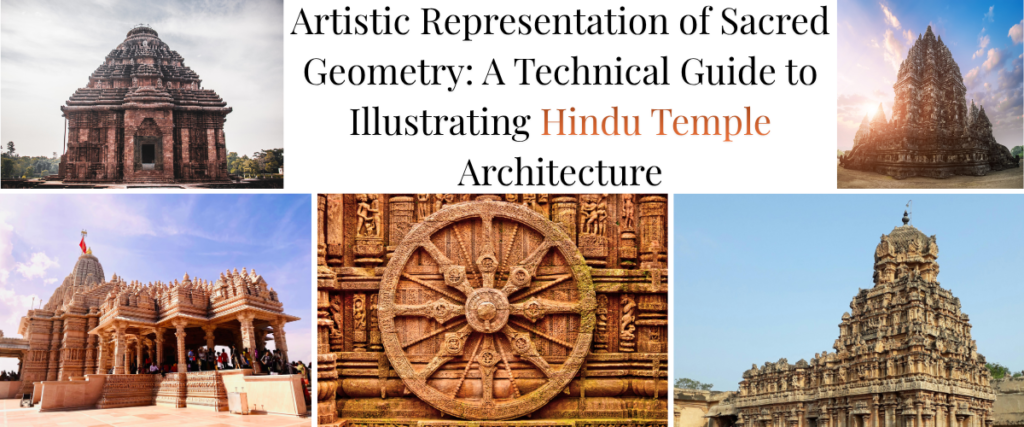
The Cosmic Architecture of Hindu Temples
The classical Hindu temple represents a profound synthesis of art, mathematics, and spiritual cosmology, serving as a physical manifestation of the Hindu way of life1. Historically governed by the principles of the Shilpa Shastras and Vastu Shastras, these structures function as a Tirtha—a sacred zone of pilgrimage where the human spirit connects with the cosmic order1. Every architectural element, from the layout of the foundation to the crowning point of the spire, is designed to reflect a holonomic universe, where each individual fragment contains the symbolic information of the entire cosmos3.
To illustrate these structures accurately, the draughtsman must understand their historical evolution and structural development. Archaeological evidence reveals that the earliest temples were simple, square chambers constructed from perishable materials like wood and mud, held together with iron nails and supported by wooden pillars anchored in post-holes1. Over centuries, this simple plan evolved into monumental stone structures4. These stone monuments were built either by excavating pillared halls directly into natural rock faces or by carving away the surrounding rock to expose monolithic shrines1.
Classical temple art did not rely on traditional Western optical perspective5. Instead, traditional builders visualised scenes from an analytical and qualitative viewpoint, placing each architectural and sculptural detail in conformity with its metaphysical function rather than its optical position5. For the modern illustrator, the challenge lies in translating this qualitative, multi-layered geometry into a cohesive, three-dimensional perspective drawing while preserving the sacred proportions of the original design6.
The Sacred Geometry of the Ground Plan
A temple illustration must begin with its underlying planimetric framework, which is rooted in the Vastu Purusha Mandala2. As a mystical diagram or Yantra, the mandala establishes the mathematical proportions of the building2. This design methodology aligns with the philosophical concept that the human mind must first construct abstract geometric forms before finding them reflected in the material world9.
The foundation of the plan is the square, which represents the stable, divine earth, while the circumscribing circle represents the dynamic universe, suggesting timelessness and infinity8. Within this square, a grid of smaller squares, known as padas, is laid out symmetrically around a central core8. The most common configurations are the 64-square Manduka (or Bhekapada) grid and the 81-square Parama Sayika grid4. The central region, known as the Brahma padas, houses the Garbhagriha (the unadorned inner sanctum or womb-chamber), where the primary deity (Murti) resides1.
+—————————————+
| OUTERMOST RING |
| (Wall Thickness of Shrine) |
| +——————————-+ |
| | INNER RING | |
| | (Pradakshina Patha) | |
| | +———————–+ | |
| | | GARBHAGRIHA | | |
| | | (12 Padas) | | |
| | | +—————+ | | |
| | | | BRAHMA PADA | | | |
| | | | (Central 4) | | | |
| | | +—————+ | | |
| | +———————–+ | |
| +——————————-+ |
+—————————————+
When drafting the ground plan, the illustrator must allocate the grid coordinates according to these traditional spatial divisions:
| Grid Layout | Total Divisions (Padas) | Structural Grid Allocation | Metaphorical Meaning |
| Manduka / Bhekapada Plan[cite: 8] | 64 Squares (8 \times 8 Grid)8 | Central 4 padas house the deity; surrounding 12 padas form the inner sanctum walls; subsequent 16 to 28 padas define the circumambulatory path (Pradakshina Patha)9. Used in standard structures like the Kandariya Mahadeva Temple8. | Represents the balanced union of cosmic and terrestrial forces within a compact, stable framework8. |
| Parama Sayika Plan[cite: 4] | 81 Squares (9 \times 9 Grid)4 | Expanded concentric squares accommodating wider ceremonial corridors and multiple subsidiary shrines2. | Represents a highly complex, multi-tiered cosmological hierarchy designed for grand ceremonial complexes4. |
| Subsidiary Grids[cite: 8] | 9, 16, 36, or 49 Squares8 | Simplified grids used for smaller accessory shrines, pavilions, or entrance porches within the temple complex8. | Represents localised cosmic points supporting the primary spiritual axis of the temple8. |
While square grids dominate classical layouts, certain structures, such as the Bateswar group and the circular Mitawali Chausath Yogini Temple, utilise concentric circular plans8. This variation requires the illustrator to construct a circular mandala, dividing the circumference into equal angular sectors to place the shrines symmetrically around the central courtyard8.
Anatomy and Regional Typologies of the Superstructure
The vertical profile of the temple rises from the flat ground plan into a tapering spire that represents a spiritual ascent from the physical world to the infinite8. This vertical dimension is divided into three major layers representing different levels of reality: the lowest layer represents the physical world, the middle layer represents the astral world, and the apex represents the spiritual world10.
Architectural styles are divided into regional typologies, each defined by the shape and decoration of its spire:
| Spire Style | Regional Association | Geometric Silhouette | Structural Features & Variants |
| Nagara[cite: 1, 4] | Northern & Eastern India2 | Curvilinear, convex spire (Shikhara)4. | Features a cruciform plan with graduated projections (Rahas) carried vertically to the top4. Variants include: • Latina: Single curvilinear tower covered in ogee arch tracery (chandrashalas)11. • Shekhari: Central spire flanked by clustered miniature half-spires11. • Bhumija: Flat central bands with quadrants filled with rows of miniature shrines11. |
| Dravida[cite: 1, 4] | Southern India2 | Pyramidal, stepped tower (Vimana)4. | Built of progressively smaller, stepped storeys (Bhumis) decorated with miniature pavilions (Kutus and Salas)4. Features a dome-shaped crowning cap (Shikhara) and towering entrance gateways (Gopurams)2. |
| Vesara[cite: 1, 4] | Deccan Region (Chalukyan)1 | Hybrid curvilinear-pyramidal silhouette2. | A fusion style developed under the Badami Chalukyas (500–753 CE), combining the curvilinear profile of the Northern Shikhara with the stepped, pillared mandapa layout of the Southern Dravida style1. |
| Kerala[cite: 1] | Southwestern Coastal India1 | Sloping, multi-tiered roofs1. | Adapted to high rainfall, featuring steep wooden roofs covered in metal sheets or tiles, reflecting Dravida structural influences on a localised wooden medium1. |
| Kathkuni[cite: 1] | Himachal Pradesh (Western Himalayas)1 | Alternating timber and stone layers1. | A rustic, seismically resilient style featuring Nagara-influenced spires built using alternating layers of deodar wood and dry-stone masonry without mortar1. |
In addition to these spires, the main temple complex includes a sequence of halls arranged along a central axis3. The devotee moves from the outer Mukhamandapa (entrance porch) through the Ardhamandapa (half-height hall) and the Maha Mandapa (grand congregation hall) before reaching the dark, enclosed Mulaprasada, which houses the Garbhagriha3.
The illustrator must arrange these structures in a clear hierarchy, ensuring the tallest spire rises directly above the inner sanctum to establish a strong focal point2.
[Vimana/Shikhara]
(Spire)
||
[Garbhagriha] <— [Antarala] <— [Maha Mandapa] <— [Ardhamandapa] <— [Mukhamandapa]
(Inner Sanctum) (Vestibule) (Grand Hall) (Half Hall) (Entrance Porch)
Technical Setup: Instrumentation, Line Styles, and Compositional Form
Translating a highly ornamented temple into a precise illustration requires a disciplined technical setup12. The illustrator can work either digitally using Computer-Aided Design (CAD) software or manually with traditional drawing tools on paper13.
Digital CAD Drawing Guidelines
When working in a digital CAD environment, the artist must maintain strict drafting discipline to manage the geometric complexity of the temple13:
- Drafting Scale: The illustrator must always draw at a true 1:1 scale in model space, adjusting the final scale only when exporting the drawing to a PDF or layout sheet13.
- Level of Detail (LOD): The level of detail must match the final output scale13. For an overview layout exported at 1:100, there is no need to draw small stone joints or individual facial features on sculptures; instead, focus on the clean lines of the primary mouldings and column silhouettes13.
- Organisational Layers and Groups: The drawing must be organised into distinct layers, with each layer assigned a specific line weight, colour, and type (e.g., separating structural walls, decorative friezes, and shadow hatching)13. Use blocks for repeating elements, such as identical columns or decorative panels, so that editing one block updates all instances across the canvas13.
- Vector Accuracy: Ensure all vector lines snap together precisely to maintain closed shapes, which prevents gaps when applying digital shadow fills or hatching13.
Traditional Hand-Drawing Guidelines
For manual sketching, specific motor skills and physical materials are essential to ensure precision and prevent smudging13:
- Material Selection: Tracing paper is used to build the illustration in layers, allowing the artist to refine the base geometry on a lower sheet before tracing clean, final lines onto the top sheet13. The artist must keep their hands clean and dry to avoid smudging soft graphite across the paper13.
- Pen and Pencil Mechanics: The illustrator should relax the hand grip, holding the drawing tool slightly away from the nib to allow for fluid, expressive strokes13. Long, continuous lines must be drawn by moving the entire arm from the elbow and shoulder rather than just pivoting the wrist13. The pen should be pulled across the page rather than pushed, keeping the eye focused on the destination point of the line13.
- Line Quality and Corners: Every line must be drawn in a single, intentional pass13. At the corners where two stone surfaces meet, the lines should touch or cross slightly to define the intersection clearly13.
To maintain clarity, the illustrator should follow these standard technical line styles and symbols:
| Line Type / Symbol | Technical Standard | Application in Temple Drawing |
| Solid Line[cite: 13] | Thick, continuous line13. | Defines visible structural edges, outer walls, and projecting columns13. |
| Dashed Line[cite: 13] | Broken, evenly spaced segments13. | Indicates hidden structures, such as interior pathways behind walls or high ceilings13. |
| Dotted Line[cite: 13] | Row of close, fine points13. | Used as an alternative to dashed lines for low-priority structural indicators13. |
| Dash-Dot-Dash Line[cite: 13] | Alternating long dashes and small dots13. | Establishes the primary symmetry axes and alignment grids of the temple plan13. |
| Break Line[cite: 13] | Continuous line with a sharp zig-zag13. | Indicates where a high spire or long colonnade has been cropped to fit the page13. |
| North Arrow[cite: 13] | Symmetrical directional arrow13. | Placed on ground plans, oriented to align with the temple’s eastern entrance4. |
| Scale Bar[cite: 13] | Segmented horizontal reference bar13. | Provides a visual scale for measuring plan coordinates and vertical dimensions13. |
Drafting the Perspective and Core Volumes
To construct the illustration, the artist must translate these structural elements into a clear perspective framework6. This process is executed in a systematic, seven-step sequence that moves from large, simple volumes to fine decorative details7.
+————————————————————-+
| [Step 1: Picture Plane & Horizon Line Setup] |
| Establish ground line, eye height, and vanishing points. |
+————————————————————-+
|
v
+————————————————————-+
| [Step 2: Basic Volumetric Blocking (Under-drawing)] |
| Draft cubes for Mandapas and a tall block for the sanctum. |
+————————————————————-+
|
v
+————————————————————-+
| [Step 3: Axis & Core Symmetry Alignment] |
| Draw centerlines to align the spires with the ground plan. |
+————————————————————-+
|
v
+————————————————————-+
| [Step 4: Primary Structural Projections (Rathas)] |
| Carve out stepped projections and recessed bays along the axis.|
+————————————————————-+
|
v
+————————————————————-+
| [Step 5: Architectural Openings & Columns] |
| Draw doorways, pillar shafts, and window lattices. |
+————————————————————-+
|
v
+————————————————————-+
| [Step 6: Miniature Fractal Superstructures] |
| Add repeating rows of smaller spires and shrines. |
+————————————————————-+
|
v
+————————————————————-+
| [Step 7: Ornamental Carvings & Texturing] |
| Render fine stone reliefs, foliage, and high-contrast ink. |
+————————————————————-+
Step 1: Setting the Picture Plane and Horizon Line
The drawing begins by establishing the Picture Plane (an imaginary glass sheet through which the scene is viewed) and drawing a horizontal line (HL) representing the observer’s eye height6. Setting the HL low on the page (at a simulated height of 3 to 5 feet) forces the temple’s spires to tower over the horizon, emphasising their monumental scale6. The illustrator marks the vanishing points on the HL where the parallel, receding lines of the structure will converge6.
Step 2: Blocking out the Core Volumes
Using a hard, light pencil (such as a 4H), the artist blocks out the main structural volumes7. Draw the Jagati (raised platform) as a wide, low rectangular block17. Atop this platform, sketch a series of connected boxes for the Mandapas, followed by a tall, vertical block for the Garbhagriha3. This light under-drawing ensures that the entire temple fits within the composition before the artist commits to permanent lines12.
Step 3: Aligning the Structural Axis
The illustrator draws a central vertical line through the Garbhagriha block7. This line acts as the sacred axis of the temple, ensuring that the crowning elements—the Amalaka and Kalasha—remain perfectly aligned with the centre of the inner sanctum below4.
Step 4: Carving out the Rathas (Projections)
Following the cruciform plan of Nagara architecture, the artist projects the central faces of the blocks outward, creating stepped recesses along the walls2. These vertical projections run from the base of the plinth all the way up the height of the Shikhara, creating the stepped Rekha Shikhara silhouette4.
Step 5: Placement of Openings and Pillars
Draw the deep recess of the eastern doorway leading into the sanctum, along with the columns supporting the Mandapa roofs2. These columns should be drawn with a strong vertical orientation, ensuring their bases align with the perspective lines of the floor grid6.
Step 6: Developing the Miniature Superstructures
Before rendering fine details, draft the secondary, repeating structures3. For a Nagara temple, this involves sketching the outlines of the smaller Urushringas (subsidiary spires) clustering around the central tower2. For a Dravida temple, sketch the horizontal bands representing the stepped levels, blocking out the small, repeating shapes of the pavilions (kutus) on each tier4.
Drawing the Ornate Stellate Facades of Hoysala Temples
The temples of the Hoysala Empire (11th to 14th centuries CE) in Karnataka represent a peak of sculptural complexity, requiring specialised drawing techniques to capture their unique geometry17. Built in the Karnata Dravida style, these structures are characterised by star-shaped layouts, highly detailed wall carvings, and polished, lathe-turned pillars17.
Drafting the Stellate (Star-Shaped) Plan
To draw the star-shaped (stellate or astha-bhadra) plan of a Hoysala sanctum, the illustrator must use a precise geometric technique17:
- Using a light pencil, draw a square around the central axis of the sanctum8.
- Draw a series of identical squares rotated at regular angular increments (such as 45 degrees) around the same central point18.
- Connect the outermost corners of these overlapping squares to form a star-shaped outline with sharp, acute angles18.
- Project these sharp corners vertically upward to form the zigzag walls of the Vimana17. This zigzag surface profile creates a dramatic, rhythmic pattern of light and shadow across the facade of the building18.
Representing Lathe-Turned Pillars
Hoysala temples are famous for their dark, monolithic pillars made of soapstone (chlorite schist)18. Historically, these stone blocks were mounted vertically on a wheel and rotated against a chisel, turning them like timber to produce sharp, circular mouldings18. To draw these pillars:
- Sketch two parallel vertical lines to define the outer shaft of the column6.
- Along the shaft, draw a series of closely spaced horizontal ellipses to represent the rounded mouldings and ring-like bands18.
- To capture the highly polished, metallic quality of the soapstone, the artist must shade the outer edges of the cylinder deeply with soft graphite (4B or 6B), leaving a bright, vertical strip of white paper down the centre of the column to suggest a sharp, reflective highlight19.
- Crowning these pillars, draw the four bracket capitals supporting the Madanika or Salabhanjika figures—graceful female sculptures carved in dynamic dancing poses19.
Rendering the Frieze Bands of the Plinth
The base of a Hoysala temple features a series of continuous, horizontal frieze bands that wrap around the entire zig-zag profile of the building18. When drawing these, the illustrator must preserve their traditional vertical sequence18:
+————————————————————-+
| BAND 5: HAMSA (Sacred Geese – Grace and Spiritual Purity) |
+————————————————————-+
| BAND 4: SCENIC NARRATIVES (Ramayana, Mahabharata Friezes) |
+————————————————————-+
| BAND 3: YALIS / KIRTHIMUKHAS (Mythical Monsters – Ganges) |
+————————————————————-+
| BAND 2: SCROLLWORK & FOLIAGE (Organic Vitality of Nature) |
+————————————————————-+
| BAND 1: ELEPHANTS (Strength, Stability and Earthly Support) |
+————————————————————-+
- Lowest Band: Processions of carved elephants, which signify strength, stability, and support for the temple structure18.
- Second Band: Delicate scrollwork and foliage patterns, representing the organic vitality of nature18.
- Third Band: Processions of Yalis (mythical, hippopotamic monsters representing the sacred River Ganges and warding off evil) and grotesque Kirthimukha (sun-faces)18.
- Fourth Band: Narrative reliefs depicting scenes from the Ramayana, Mahabharata, and Puranas20.
- Crowning Band: A continuous pattern of Hamsas (legendary geese), symbolising grace and spiritual purity18.
Because these bands follow the zigzag outline of the walls, the illustrator must draw them receding and projecting in perspective, using darker shading in the inner recesses to make the outer corners stand out18.
Impressionistic Simplification of Sculptural Reliefs
A major challenge when illustrating a Hindu temple is the sheer density of its carvings, which can cover almost every square inch of stone18. Attempting to draw every individual figure with absolute precision will clutter the illustration and obscure the temple’s primary architectural form12. The artist must therefore employ an impressionistic approach to simplify these details7.
To achieve this:
- The Squinting Technique: The illustrator should squint at the subject or reference photo12. This reduces the scene to basic shapes and values, allowing the artist to see where the heaviest shadows fall and where highlights occur, ignoring individual faces or limbs12.
- Suggestive “Squiggles”: For flat wall reliefs and ornamental panels, avoid drawing clear outlines for every figure12. Instead, use loose, organic “squiggles” and gestural pen strokes to suggest the presence of carved textures12. The human eye naturally interprets these patterns as detailed carving when viewed in the context of the larger temple structure5.
- Negative Space Outlining: When depicting projecting sculptures, such as the Madanika bracket figures or statues in wall niches, focus on the negative space created by the background wall or sky behind them12. Drawing the boundary of this empty space results in a highly accurate silhouette that captures the lifelike, kinetic poses of the figures12.
- The “Sandalwood” Aesthetic: The soft soapstone used in Hoysala temples allowed sculptors to deeply undercut their carvings, leaving figures standing free from the background wall19. To represent this “plastic exuberance,” the illustrator must draw a deep, solid black shadow behind the main figures, making the brightly lit stone sculptures stand out in high contrast19.
Shading, Texturing, and Finish
With the structural layout and simplified carvings established, the final stage is to apply shading and texture to give the temple a sense of volume, weight, and age14.
Shading and Texturing Techniques
- Stippling (Pointillism): This technique involves applying clusters of tiny dots to the paper22. It is highly effective for replicating the grainy, weathered texture of sandstone or granite22. Areas where the dots are dense will appear deeply shadowed, while sparse stippling creates a gentle transition into highlighted stone22.
- Frottage (Texture Rubbing): For manual drawings, the artist can place the paper over a rough, textured surface (such as natural stone or coarse wood) and lightly rub a soft pencil over it24. This transfers the organic texture directly to the page, providing an excellent base layer for rock-cut temple surfaces24.
- Broken Cross-Hatching: Unlike traditional cross-hatching, where lines overlap, broken cross-hatching utilises short, parallel strokes drawn at perpendicular angles without intersection24. This technique is ideal for representing the rough, irregular joints of ancient stone blocks or eroded brick masonry24.
- Stone Cracks and Erosion: Old stone surfaces are rarely perfect. The illustrator should draw fine, wobbly lines to represent cracks, using a soft pencil to shade one side of the crack to give it depth14. Branching hairline cracks should fade out from the main fracture, mimicking the natural weathering of the stone over centuries24.
Managing Paper Tooth and Medium Hardness
The selection of paper and drawing tools has a significant impact on the texture of the illustration22:
- Rough-Textured Paper: Coarse paper naturally catches dry graphite, creating a speckled effect under light pencil pressure22. This is ideal for representing the rough, weathered surfaces of ancient temples22.
- Smooth Paper (Bristol Board): Smooth surfaces are perfect for precise ink work and clean, fluid pencil gradients22. This is the preferred choice for detailed CAD exports or clean architectural elevations13.
- Pencil Grade Selection: The artist should use hard pencils (such as 2H or H) for light construction grids and fine, background details13. Transition to softer pencils (such as 2B, 4B, and 6B) to render deep shadows, dark niches, and the bold silhouettes of foreground elements14.
Earthy Colour Palette Selection
For artists adding colour to their illustrations, a traditional, limited colour palette helps evoke the warm, spiritual atmosphere of Indian temple sites15:
+————————————————————-+
| TRADITIONAL COLOR PALETTE |
+————————————————————-+
| • Earth Saffron/Orange: Represents sacred clay and stone. |
| • Natural Sienna: Warm, golden-brown undertones. |
| • Transparent Red Oxide: Rich, deep shadows in red stone. |
| • Ultramarine Blue: Deep sky and cool shadows. |
+————————————————————-+
- Saffron Orange: A warm, earthy hue that represents the sacred clay and sandstone used in many Indian structures26.
- Monte Amiata Natural Sienna: Provides a warm, golden-brown base layer that mimics the sunlit surfaces of weathered granite15.
- Transparent Red Oxide: A deep, reddish-brown pigment used to wash over shadow areas, replicating the rich, iron-bearing stones of Northern and Central Indian temples2.
- French Ultramarine Blue: Mixed with sienna or red oxide, this cool blue creates deep, natural shadows under eaves and doorways, contrasting beautifully with the warm, sunlit stone14.
Conclusion
Drawing a portrait of a Hindu temple is an artistic exploration of sacred geometry, structural engineering, and ancient cosmology2. By mastering the foundational layout of the Vastu Purusha Mandala and the vertical proportions of regional styles like the Nagara, Dravida, and Hoysala traditions, the illustrator can build an accurate compositional framework4.
The complex, dense carvings of these monuments are made manageable through impressionistic simplification, allowing the artist to suggest rich detail through suggestive line work and high-contrast shading12. Whether using digital CAD systems or traditional manual drafting on paper, applying these structured techniques allows the draughtsman to capture the timeless, monumental beauty of these architectural masterpieces12.
Disclaimer
This technical illustration guide is intended solely for educational, artistic, and historical reference. The structural plans, geometric layout techniques, and architectural analyses presented herein are simplified for illustrative representation and must not be used as technical blueprints or engineering designs for actual construction, masonry work, or structural restoration projects.
References
- Hindu temple architecture – Wikipedia, https://en.wikipedia.org/wiki/Hindu_temple_architecture
- Hindu Temple Architecture: 5 Regional Styles Across India – The Architects Diary, https://thearchitectsdiary.com/hindu-temple-architecture-5-regional-styles-across-india/
- Role of Fractal Geometry in Indian Hindu Temple Architecture – International Journal of Engineering Research & Technology, https://www.ijert.org/research/role-of-fractal-geometry-in-indian-hindu-temple-architecture-IJERTV4IS050709.pdf
- INDIAN TEMPLE ARCHITECTURE, https://www.mcrhrdi.gov.in/army/week4/syndicate/group1.pdf
- Shapes, Patterns and Meanings in Indian Temple Architecture, https://pubs.sciepub.com/ajcea/6/5/6/index.html
- Architectural Sketching in Perspective | PDF – Scribd, https://www.scribd.com/document/446355333/architectural-sketching-and-drawing-in-perspective-1906-pdf
- My approach to sketching architecture – Liz Steel, https://www.lizsteel.com/my-approach-to-sketching-architecture/
- Square and Circle of Hindu Temple Architecture – Viewpoints which Matter, https://chaturvedimayank.wordpress.com/2023/03/20/square-and-circle-of-hindu-temple-architecture/
- The Geometry of Hindu Temple | PDF – Scribd, https://www.scribd.com/document/476618457/The-Geometry-of-Hindu-Temple-1
- ANCIENT INDIAN TEMPLE STRUCTURE: SHIKHARA – Best journals in India – John Foundation %, https://www.johnfoundation.com/journals/sparkling/sijmrsv7i2-2024/s-111/
- Shikhara | North Indian Temple Design & History – Britannica, https://www.britannica.com/technology/shikhara
- How to Sketch Complicated Architecture – Urban Sketching World, https://urbansketchingworld.com/sketch-complicated-architecture/
- Architectural Drawing: The Architect’s Guide – Green Mat Workshop, https://greenmatworkshop.com/learn/architectural-drawing
- Sketching Tutorial: How to Create Stone Textures With Pens and Markers | Domestika, https://www.domestika.org/en/blog/5945-sketching-tutorial-how-to-create-stone-textures-with-pens-and-markers
- Lots of tips for sketching classical architecture (Live demo replay) – Liz Steel, https://www.lizsteel.com/lots-of-tips-for-sketching-classical-architecture-live-demo-replay/
- How to Draw an Indian Temple: One Point Perspective – YouTube, https://www.youtube.com/watch?v=xaUAULurLh4
- Hoysala architecture – Wikipedia, https://en.wikipedia.org/wiki/Hoysala_architecture
- Hoysala Architecture: Key Features | PDF | Temple – Scribd, https://www.scribd.com/document/627018362/Hoysala-architecture
- Hoysaleswara Temple Layout and Design | PDF – Scribd, https://www.scribd.com/document/878794848/Hoysala-Temples-hoa
- An Empirical Analysis of Role and Structure of Architecture Under Hoysala Empire – IJRSSH, https://ijrssh.com/admin/upload/13%20Dr.%20Mahesh%20Kumar%20D.H.%2002018.pdf
- ART AND ARCHITECTURE OF THE HOYSALA PERIOD, https://cec.nic.in/webpath/curriculum/Module/FART/Paper27/7/downloads/script.pdf
- Texture In Pencil: Drawing & Techniques – StudySmarter, https://www.studysmarter.co.uk/explanations/art-and-design/drawing-techniques-art-and-design/texture-in-pencil/
- Hoysala Architecture and Art Overview | PDF – Scribd, https://www.scribd.com/document/202430134/Hoysala-Architecture
- Techniques for creating drawing texture – Mont Marte, https://www.montmarte.com/blogs/tips-techniques/techniques-for-creating-drawing-texture
- How to Draw Realistic Stone & Coral Texture | Ink Liners + Colored Pencil Step-by-Step Art Tutorial – YouTube, https://www.youtube.com/watch?v=bgby_d8BJs4
- How to draw a Hindu Temple – YouTube, https://www.youtube.com/watch?v=RxRrmKznzPc