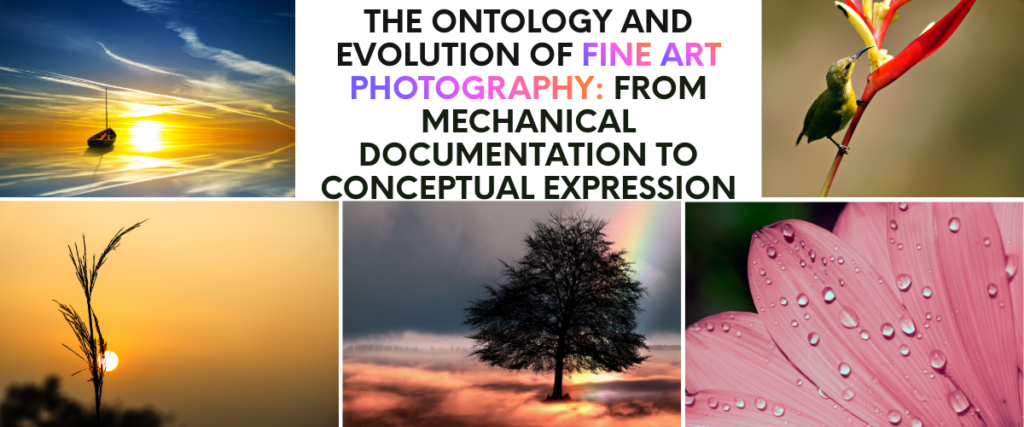
The historical trajectory of photography as a fine art represents a profound shift in the perception of the mechanical image, transitioning from a tool of objective documentation to a sophisticated medium for subjective exploration. In its nascent stages during the early nineteenth century, the camera was viewed primarily as a scientific instrument—a “recording angel” tasked with capturing reality with a verisimilitude that bypassed the limitations of the human hand.1 However, as the medium matured, a deliberate movement toward intentionality emerged, wherein the camera was repurposed not merely to record a scene, but to communicate an internal vision, an abstract concept, or a profound emotional state.4 This evolution has elevated photography to a status comparable to painting and sculpture, where the primary objective is the exploration of beauty, meaning, and resonance rather than utility or literal representation.6
Defining the Artistic Boundary: Intent and Subjectivity
The foundational distinction between fine art photography and its commercial or documentary counterparts lies in the locus of intent. Fine art photography is characterised by the primacy of the artist’s vision and a pursuit that is uncommissioned and independent of external commercial mandates.4 While commercial photography serves the utilitarian needs of a client—promoting products, services, or brands through clarity and market appeal—fine art focuses on personal expression and the evocation of thought.4 Similarly, while photojournalism and documentary photography prioritise an unfiltered, objective truth to record social conditions or historical events, fine art photography embraces subjectivity.8
In the realm of fine art, the image functions as a standalone work that invites the viewer into a dialogue with the photographer’s internal world. This process often involves the exploration of themes such as identity, societal norms, or the abstract qualities of nature.1 The success of a fine art photograph is not measured by its clarity of message or its descriptive accuracy, but by its “resonance”—the degree to which it holds attention and stirs a lasting emotional response.10
| Feature | Fine Art Photography | Commercial Photography | Documentary Photography |
| Primary Intent | Personal expression and vision | Promoting products or services | Capturing reality and truth |
| Motivation | Self-propelled and uncommissioned | Client-driven and market-focused | Narrative-driven and journalistic |
| Aesthetic Goal | Subjective, evocative, conceptual | Clear, practical, appealing | Authentic, raw, unadorned |
| Primary Venue | Galleries, museums, and art books | Advertising, fashion, and catalogues | News, archives, social records |
| Context | Art for art’s sake | Utility and transaction | Education and social record |
| 4 |
The artistic process in this genre often begins with an idea, a feeling, or a question, which the camera is then used to bring into physical form.10 Every decision—from the position of the photographer to the choice of what to exclude from the frame—is a deliberate act of interpretation.10 Consequently, a fine art portrait is less about the likeness of the individual and more about the “essence” the artist chooses to project, just as a landscape is less about the geography and more about the emotional language of light and shadow.10
The Historical Genesis of the Photographic Art Form
The legitimisation of photography as a fine art was a contentious process that spanned over a century. Early commentators frequently debated whether a mechanical process could ever achieve the aesthetic status of traditional media.2 In the mid-nineteenth century, the formation of groups like the Photographic Society in London (1853) and the Société Française de Photographie in Paris (1854) began to frame photography as an aesthetic medium.3 A critical early proponent, Sir William Newton, suggested that photographers could align their work with the “acknowledged principles of Fine Art” by throwing subjects slightly out of focus to emulate a painterly quality.3
The Pictorialist Revolution
The first widespread international movement to formalise photography as art was Pictorialism, which flourished from the late nineteenth century into the early twentieth century.13 Pictorialists argued that the medium possessed artistic merit beyond its functional benefits, positioning it as a vehicle for personal creative expression.13 They actively “seceded” from standard practices that viewed photography as a mere hobby or scientific tool.13
Pictorialism was characterised by a “painterly” language, achieved through heavy intervention in the darkroom. Artists utilised complex hand-application processes, such as bromoil, gum-bichromate, and platinum printing, to ensure that each print bore the “hand of the artist”.13 These techniques produced atmospheric, soft-focus images that emphasised mood and emotion over clinical detail.1 Alfred Stieglitz, a central figure in this movement, promoted these ideals through his quarterly journal, Camera Work (1903–1917), and his influential Gallery 291 in New York City.3
The Transition to Modernism and Straight Photography
By the 1920s, a new generation of photographers began to reject the artificiality and darkroom manipulation of Pictorialism.3 Influenced by the dawning era of Modernism, these artists sought to embrace the “uniquely photographic” qualities of the medium—its capacity for precision, sharp detail, and stark tonal range.3 This shift gave rise to “Straight Photography,” championed by figures such as Paul Strand and Edward Weston.3
| Historical Era | Period | Focus | Movement/Group |
| Invention | 1839–1880s | Documentation, precision, science | Daguerreotype, Calotype |
| Pictorialism | 1890s–1910s | Painterly, soft-focus, emotion | Photo-Secession, Linked Ring |
| Modernism | 1920s–1950s | Sharp detail, objectivity, form | Group f/64, New Objectivity |
| Post-War | 1960s–1980s | Identity, social norms, and conceptual | Düsseldorf School, Pop Art |
| Contemporary | 1990s–Present | Digital manipulation, AI, diversity | Post-Digital, NFT, Global Art |
| 1 |
Straight photography emphasised the inherent properties of the camera and film, rejecting retouching or staged settings in favour of what Peter Henry Emerson termed the “illusion of truth”.3 The formation of Group f/64 in 1932, which included Ansel Adams and Edward Weston, further codified this approach by advocating for large-format cameras and small apertures to achieve maximum depth of field and texture.16 This period established the standard for the modern photographic print, emphasising technical mastery alongside artistic vision.1
The Taxonomy of Fine Art Expression: Genres and Stylistic Niches
Fine art photography is an expansive discipline that overlaps with various traditional styles, yet it is distinguished by the interpretive approach of the artist.5 Within this realm, several distinct genres have evolved, each utilising the medium to explore specific conceptual or aesthetic goals.
Fine Art Landscape and Nature
Unlike standard landscape photography, which may focus on geographical documentation, fine art landscape photography seeks to convey the artist’s emotional response to the natural world.11 Mastery of timing and light—particularly the “golden hour”—is used to create mood, depth, and a sense of awe.12 For practitioners like Peter Lik, the goal is to wait for the brief alignment of natural elements that tells a story beyond words.7 This genre often involves post-processing manipulation to serve an artistic purpose, effectively transforming a scene into a meditation on scale and stillness.10
Conceptual and Surrealist Photography
In conceptual photography, the image exists as a vessel for a specific idea or message.8 This genre often prioritises the thought process over representational accuracy, using the camera to illustrate complex themes of identity, social commentary, or psychological states.6 Surrealist photography takes this a step further by using techniques like multiple exposures, digital compositing, and surreal staging to create images that challenge the viewer’s perception of reality.11 Artists such as Cindy Sherman utilise self-portraiture within a conceptual framework to critique gender and media stereotypes.17
Fine Art Portraiture and the Human Condition
Fine art portraiture is a fusion of the artist’s vision and the “essence” of the subject, aiming to reveal character, identity, or emotion rather than mere likeness.11 Unlike commercial headshots, these portraits are often unposed or meticulously staged to tell a story or evoke a specific mood.11 Notable figures like Richard Avedon redefined this genre by using stark backgrounds and raw, revealing portraits to capture the vulnerability of his subjects.17
Abstract and Minimalist Approaches
Abstract photography focuses on non-literal depictions, emphasising shapes, patterns, textures, and colours.11 The objective is to create images that provoke thought or curiosity through the “defamiliarisation” of everyday objects.6 Minimalist photography employs simplicity and negative space to focus the viewer’s attention on a singular subject or concept, often evoking feelings of solitude or serenity.6
The Creative Process: From Inspiration to Final Print
The production of a fine art photograph is a deliberate, multi-stage journey that blends technical expertise with emotional insight.24 Behind every memorable image lies a process that transforms a fleeting idea into a compelling visual narrative.24
Inspiration and Conceptualisation
The creative cycle begins with an initial spark, often drawn from nature, personal experience, or abstract concepts like nostalgia or solitude.24 Many photographers cultivate this vision by maintaining visual journals or mood boards to record colour palettes and locations.24 Once inspired, the artist refines the concept by determining the specific story they wish to tell and the emotions they want to evoke.24 This planning phase may include selecting equipment, determining the optimal time of day for lighting, and even creating digital mockups or storyboard sketches.24
Execution and Mastering Light
During the shooting phase, technical skill meets instinct.24 Light is viewed as the “soul” of the photograph; it is used to shape the subject and define the mood.24 Photographers experiment with direction (front, side, or backlighting), intensity, and colour temperature to create depth and atmosphere.24 Hard light is often employed to create dramatic contrast and emotional tension, while soft, diffused light can impart a dreamlike or intimate quality.25
| Lighting Type | Effect on Mood | Technical Application |
| Hard Light | Drama, tension, focus | Single source, high contrast, sharp shadows |
| Soft Light | Subtlety, intimacy, calm | Diffused source, gentle shadows, low contrast |
| Backlighting | Mystery, ethereal, halo | Light source behind subject, silhouettes |
| Warm Tones | Nostalgia, passion, energy | Golden hour (3000K–3500K), warm filters |
| Cool Tones | Serenity, melancholy, chill | Twilight, overcast skies (6000K+), blue grading |
| 25 |
Post-Processing and Refinement
Post-processing is considered an integral part of the storytelling process in fine art, rather than a method of “fixing” mistakes.24 Using software such as Adobe Photoshop or Lightroom, artists refine details, balance exposure, and adjust colour palettes to amplify the intended mood.24 Techniques such as black-and-white conversion, composite layering, and selective sharpening allow the artist to reinterpret the captured moment to better align with their original vision.24 For artists like Alice Zilberberg, whose work is surrealistic, this stage can involve weeks or even months of digital painting and manipulation.20
Presentation and Storytelling
The meaning of a photograph is finalised when it is shared with an audience.24 Presentation—whether in a physical gallery, a printed book, or a digital portfolio—influences the viewer’s experience.24 Sequencing images to create a narrative flow and choosing specific printing materials (such as metal, canvas, or archival paper) are critical decisions that shape the final story.24 The choice of size also plays a pivotal role; while smaller prints offer intimacy, large-scale prints (e.g., 40×60 inches) provide a “wow factor” that can command an exhibition space.28
The Visual Language: Psychology and Narrative
The effectiveness of fine art photography relies on an understanding of how visual elements interact with human psychology. Composition, colour, and lighting act as a “visual language” that directs the viewer’s gaze and influences their emotional response.23
The Psychological Impact of Composition
Composition is the visual architecture of photography.24 Classical guidelines such as the rule of thirds, leading lines, and symmetry help create balance and guide the viewer’s eye toward the focal point.23 For instance, placing a subject off-centre using the rule of thirds can create a sense of intrigue or imbalance, prompting the viewer to engage more actively with the image.26 Negative space is another powerful tool, used to emphasise isolation or simplicity, often evoking strong feelings of solitude or contemplation.23
Colour as an Emotional Palette
Colour is capable of eliciting a wide range of psychological associations.26 Warm tones (reds and yellows) are generally associated with warmth, passion, and energy, while cool tones (blues and greens) convey serenity and introspection.26 By carefully selecting and manipulating colour temperature, a photographer can profoundly impact the emotional tone of a piece.26 In black-and-white photography, the absence of colour allows the artist to focus entirely on texture, contrast, and form, which can add a timeless or dramatic quality to the work.17
Symbolism and Visual Narrative
Visual storytelling in photography often relies on symbolism and metaphor to convey powerful messages without words.27 A single figure in a vast landscape might represent human isolation, while vibrant colours can convey joy or vitality.27 Contextual elements—such as the environment, cultural references, and body language—all contribute to the depth of the narrative.27 This approach transforms the image from a simple document into a “dialogue” between the artist, the subject, and the viewer.12
The Market and Professional Landscape: Galleries, Editions, and Fairs
The fine art photography market is built on the concepts of rarity, authenticity, and craftsmanship.28 Collectors and institutions value work that demonstrates technical brilliance alongside artistic depth.6
Editions and Scarcity
One of the primary ways artists create value and scarcity is through “limited editions”.29 A limited edition means that only a certain number of prints will ever be produced for a specific photograph, and each is numbered sequentially (e.g., 5/10).28 Limited edition prints retain their value because once the run is complete, the original plate or digital file is often retired or “destroyed” to ensure no further pieces are created.29
| Print Type | Description | Market Value | Numbering |
| Limited Edition | A restricted number of prints were produced | High / Collectible | Sequential (e.g., 2/25) |
| Artist Proof (AP) | Prints reserved for the artist’s personal use | Very High | Labelled “AP” |
| Open Edition | No limit on the number of prints | Low / Decorative | Not numbered |
| Reproduction | Facsimiles or copies (e.g., posters) | Negligible | None |
| 21 |
The size of an edition varies: emerging artists may produce runs of 200 to 500, while established artists might limit a run to as few as two.29 Smaller editions are generally perceived as being closer to the artist’s original intention and thus command higher prices.29
The Role of Art Fairs and Fairs
International art fairs serve as the primary marketplace and networking hub for fine art photography. Paris Photo, held at the Grand Palais, is the world’s leading fair dedicated to the medium, attracting collectors, curators, and photography lovers globally.30 The fair returns annually to exhibit works from over 170 international galleries, spanning the history of the medium from nineteenth-century innovators to radical contemporary artists.31
| Fair Sector | Focus | Participating Content |
| Main Sector | Historical and Contemporary | Canonical names and major players |
| Emergence | New Talent | Solo shows from emerging photographers |
| Digital | Innovative Tech | AI-generated works, NFTs, and digital art |
| Voices | Thematic Curation | Landscape and portraiture curated paths |
| Book Sector | Editorial | Photobooks, signatures, and talks |
| 31 |
Events like Paris Photo have also made concerted efforts to increase diversity within the field. Programs such as “Elles x Paris Photo” have significantly increased the representation of women artists at the fair, growing from 20% in 2018 to nearly 40% in recent years.30 These fairs are not only for sales but also function as sites for “thought-provoking conversations” and the celebration of the photobook as an art form.30
The Digital Frontier: AI, NFTs, and the Crisis of Authenticity
The advent of digital technology and artificial intelligence has once again revolutionised the landscape of fine art photography, sparking intense debates about authorship, originality, and the nature of truth.34
Digital Manipulation and the “Post-Truth” Era
Digital manipulation has expanded the boundaries of photographic art, enabling new forms of creative expression that challenge traditional notions of photography as a medium for capturing reality.34 The transition from chemical to pixel-based workflows allowed for unprecedented control but also “blurred the lines” between photography, graphic design, and digital art.34 This shift has redefined authenticity; some argue that truth in photography is now tied more to the transparency of the editing process or the photographer’s intent rather than a lack of manipulation.34
Generative AI and the Future of Authorship
The integration of Generative AI has significantly altered workflows, offering tools that can create entirely new images from huge datasets.35 This capability raises fundamental questions about the role of the photographer: will artistic vision and the human touch remain crucial, or will the focus shift toward “collaborative creativity” between humans and machines?.35 At Paris Photo 2024, the inclusion of an AI agent named “Solienne” as an exhibiting artist illustrated this transformation, suggesting that collaboration between human aesthetic mastery and synthetic pattern recognition can produce works that neither could create alone.31
Blockchain and NFT Photography
Non-Fungible Tokens (NFTs) have emerged as a game-changer for digital artists by providing a secure and verifiable way to establish ownership and provenance in a digital environment.37 When an artist mints a photograph as an NFT, they generate a unique cryptographic token that acts as a certificate of authenticity.38 This has empowered digital photographers to monetise their work directly through marketplaces and receive royalties from secondary sales.37 Despite environmental concerns associated with blockchain technology, the NFT ecosystem has democratized art collection, allowing a broader audience to participate in a market traditionally dominated by physical galleries.38
Legal and Ethical Frameworks in Fine Art Photography
As a professional discipline, fine art photography is subject to various legal protections and ethical considerations that ensure the rights of artists and the privacy of subjects.
Copyright and Intellectual Property
Copyright is automatically granted to an artist the moment they publish original work.39 An effective copyright notice—including the symbol ©, the name of the author, and the year of publication—helps inform the public that the content is protected.40 Copyright protects the artist’s right to reproduce, distribute, and sell their work, and any unauthorised commercial use is considered an infringement.39 In the photography industry, copyright ownership typically remains with the artist even after a physical print is sold, unless there is a specific contract stating otherwise.39
Liability and Professional Disclaimers
For photographers running a business, liability disclaimers are essential. These clauses clarify that the photographer is not responsible for injuries or accidents that may occur during a shoot, or for “acts of God” such as bad weather that might force a cancellation.42 Furthermore, “photo quality” disclaimers are often used to state that the photographer cannot guarantee perfect results in every shot, as factors like poor venue lighting or uncooperative subjects are beyond their control.42
Privacy and Image Rights
In the context of public events, organisations often use photo and video disclaimers to inform participants that their likeness may be recorded and used for promotional or educational purposes.44 To ensure the privacy of individuals, images are often not identified using full names without written approval.44 These frameworks are crucial for maintaining ethical standards while allowing for the documentation of communal experiences.44
Conclusion: The Enduring Power of the Intentional Image
The transformation of photography from a mechanical curiosity into a cornerstone of the fine arts is a testament to the medium’s profound expressive potential. From the soft-focus romanticism of the Pictorialists to the clinical precision of the Modernists, and finally to the conceptual and digital complexities of the contemporary era, photography has continually redefined itself through the lens of human intention. It is a medium that does not merely “take” pictures, but “makes” them, using light as a brush to interpret the world rather than simply documenting it.
As we move further into a post-digital age where AI and blockchain technology challenge our definitions of authorship and ownership, the core tenets of fine art photography—vision, craft, and emotional resonance—remain more relevant than ever. The success of a photographic work of art ultimately lies not in its technical perfection or its adherence to reality, but in its ability to stir the human spirit, provoke curiosity, and reveal a deeper truth about the shared human experience.
Disclaimer
The information contained in this report is intended for educational and professional guidance purposes only. While every effort has been made to ensure the accuracy and currency of the information provided, the field of fine art photography is subject to rapid technological and market changes. The technical advice, pricing strategies, and legal considerations mentioned—such as copyright and liability—do not constitute formal legal or financial counsel. Readers are encouraged to consult with qualified legal professionals regarding intellectual property rights and contracts. All artists, galleries, and exhibitions referenced are for illustrative purposes and do not imply an endorsement. The author and publisher are not liable for any personal or property damage resulting from the implementation of photography techniques or business strategies discussed in this document. Copyright for all referenced artworks remains with the respective artists or their estates. Any reproduction of the contents of this report for commercial gain without written permission is prohibited. Owners of copyrighted material who wish to have their information removed or corrected are invited to contact the administrator. Participation in photography events or the use of online portfolios is subject to the individual terms and conditions of the respective hosting platforms. Professional ethics in photography, especially regarding the use of AI and the documentation of public subjects, should always be guided by local laws and industry standards of transparency.
References
- Photography as Fine Art in the 20th and 21st Centuries – Overview – StudyGuides.com, accessed on March 30, 2026, https://studyguides.com/study-methods/overview/clz74h0ci116xs73rudvsi1pt
- 12.3: Photography- From Pictorialism to “Straight” – Humanities LibreTexts, accessed on March 30, 2026, https://human.libretexts.org/Bookshelves/Art/American_Encounters%3A_Art_History_and_Cultural_Identity_(Miller_Berlo_Wolf_and_Roberts)/04%3A_Late_Colonial_Encounters-_The_New_World_Africa_Asia_and_Europe_1735-1797/12%3A_The_Arts_Confront_the_New_Century-_Renewal_and_Continuity_1900-1920/12.03%3A_Photography-_From_Pictorialism_to_Straight
- History of photography – Artistic Expression, Camera Technology, Darkroom Techniques | Britannica, accessed on March 30, 2026, https://www.britannica.com/technology/photography/Photography-as-art
- Fine Art Photography Vs. Commercial Photography – What’s The Difference?, accessed on March 30, 2026, https://blog.edinchavez.com/fine-art-vs-commercial-photography-differences/
- Fine art photography: A beginner’s guide – Adobe, accessed on March 30, 2026, https://www.adobe.com/uk/creativecloud/photography/discover/fine-art-photography.html
- What Is Fine Art Photography? – Beyond Print, accessed on March 30, 2026, https://beyondprint.co.uk/2025/08/01/what-is-fine-art-photography/
- Fine Art Photography: What It Is, Why It Matters & How to Enjoy It – Peter Lik, accessed on March 30, 2026, https://lik.com/blogs/journal/what-is-fine-art-photography-why-it-matters
- What is Fine Art Photography? – Rise Art, accessed on March 30, 2026, https://www.riseart.com/guide/2506/what-is-fine-art-photography
- Documentary and Fine Art Photography | Bobby Izquierdo, accessed on March 30, 2026, https://bobbyizquierdophoto.com/exploring-the-difference-between-documentary-and-fine-art-photography-2/
- What Is Fine Art Photography Definition in the Era of AI-Generated Art – Dan Kosmayer, accessed on March 30, 2026, https://dankosmayer.com/ko/blogs/%EB%B2%BD-%EC%95%84%ED%8A%B8/what-is-fine-art-photography-definition-in-the-era-of-ai-generated-art
- Fine Art Photography: 53 Genres, Styles & Techniques, accessed on March 30, 2026, https://martinvorel.com/blog/fine-art-photography-complete-guide/
- Best Photography Techniques Used by Master Photographers – Peter Lik, accessed on March 30, 2026, https://lik.com/blogs/journal/best-photography-techniques-used-by-master-photographers
- 5 things to know about Pictorialism, fine art photography | Christie’s, accessed on March 30, 2026, https://www.christies.com/en/stories/pictorialism-guide-birth-of-fine-art-photography-531d89f6a3a74fa0a7d6a330cc9daf05
- The Position of “Straight Photography” in Contemporary Art – 1x.com, accessed on March 30, 2026, https://1x.com/forum/photography/the-position-of-ldquostraight-photographyrdquo-in-contemporary-art
- Digital art is going mainstream | Art Basel, accessed on March 30, 2026, https://www.artbasel.com/stories/digital-art-boom-gen-z-collectors
- A-Z of Modernist Photography | Tate, accessed on March 30, 2026, https://www.tate.org.uk/art/art-terms/p/photography/a-z
- 20 Most Important Photographers to Study to Improve Your Art | – Sessions College, accessed on March 30, 2026, https://www.sessions.edu/notes-on-design/20-most-important-photographers-to-study-to-improve-your-art/
- 28 types of photography: Styles and genres – Adobe, accessed on March 30, 2026, https://www.adobe.com/creativecloud/photography/type.html
- Genres of photography – Index for beginners, accessed on March 30, 2026, https://www.theschoolofphotography.com/tutorials/genres-of-photography
- My Creative Process Breakdown | Art Photography by Alice Zilberberg, accessed on March 30, 2026, https://alicezilberberg.com/creative-process-breakdown/
- Top 30 Fine Art Photography Artists in the World — CAI, accessed on March 30, 2026, https://www.contemporaryartissue.com/top-25-fine-art-photography-artists-in-the-world/
- 49 Most Influential Photographers in History | Frames Express Blog, accessed on March 30, 2026, https://www.pictureframesexpress.co.uk/blog/art-topics/influential-photographers-in-history/
- The Art of Visual Storytelling: How to Use Photography to Capture Emotion – Ulleo, accessed on March 30, 2026, https://ulleo.com/blog/the-art-of-visual-storytelling-how-to-use-photography-to-capture-emotion
- The Art and Science of Photography’s Creative Process, accessed on March 30, 2026, https://sabrinamulverhillcowling.com/the-art-and-science-of-photographys-creative-process/
- How to Master Mood With Lighting and Shadows in Photography – Tamron, accessed on March 30, 2026, https://tamron-americas.com/blog/how-to-master-mood-with-lighting-and-shadows-in-photography/
- Photography and Psychology: Decoding the Visual Language, accessed on March 30, 2026, https://llacademy.org/blog/photography-and-psychology-decoding-the-visual-language
- Creating Engaging Visual Narratives: Storytelling in Photography – Mastering the Art of Impactful Imagery – PRO EDU, accessed on March 30, 2026, https://proedu.com/blogs/photoshop-skills/creating-engaging-visual-narratives-storytelling-in-photography-mastering-the-art-of-impactful-imagery
- How to Sell Your Photography at Art Fairs and Exhibitions – 42West – Adorama, accessed on March 30, 2026, https://www.adorama.com/alc/sell-photography-art-fairs/
- Limited Edition Fine Art Prints Why & How They Retain Value – Andrew Shoemaker, accessed on March 30, 2026, https://www.andrewshoemaker.com/gallery/limited-edition-fine-art-prints/
- Paris Photo 2025 – Artpil, accessed on March 30, 2026, https://artpil.com/news/paris-photo-2025/
- Photography’s Past and Future Hung in Tense Harmony at Paris Photo – Observer, accessed on March 30, 2026, https://observer.com/2025/11/paris-photo-photography-past-future-art-fair-report/
- What does Paris Photo 2025 have in store? – 1854 Photography, accessed on March 30, 2026, https://www.1854.photography/2025/10/paris-photo-2025-anna-planas/
- Paris Photo 2025: A Global Lens on Image, Memory, and Transformation – Whitewall, accessed on March 30, 2026, https://whitewall.art/art/paris-photo-2025-a-global-lens-on-image-memory-and-transformation/
- Digital manipulation and authenticity | History of… – Fiveable, accessed on March 30, 2026, https://fiveable.me/history-of-photography/unit-12/digital-manipulation-authenticity/study-guide/0fdi6naXonGzI3Kk
- The Impact of AI on Transforming Concepts in Contemporary Photography, accessed on March 30, 2026, https://fmkjournals.fmk.edu.rs/index.php/AM/article/view/588
- The Impact of AI Technology on Visual Arts and Photography – IPKEY, accessed on March 30, 2026, https://ipkey.eu/sites/default/files/ipkey-docs/2024/IPKEY-SEA_2024_Day2_4_Impact-AI-Technology-Visual-Arts-Photography.pdf
- The Rise of NFT Photography: Exploring the Intersection of Art and Technology – Medium, accessed on March 30, 2026, https://medium.com/@content_24464/the-rise-of-nft-photography-exploring-the-intersection-of-art-and-technology-8a429f2d8bb2
- The Evolution of Digital Art and the Role of NFTs – Insistrum, accessed on March 30, 2026, https://www.insistrum.com/post/the-evolution-of-digital-art-and-the-role-of-nfts
- Copyright Notices and Clauses for Photography Websites – TermsFeed, accessed on March 30, 2026, https://www.termsfeed.com/blog/copyright-photography-websites/
- What is a copyright disclaimer and how to write it – Iubenda, accessed on March 30, 2026, https://www.iubenda.com/en/blog/copyright-disclaimer/
- Copyright & Disclaimer – Japingka Aboriginal Art Gallery, accessed on March 30, 2026, https://japingkaaboriginalart.com/info/copyright/
- 9 Photography Disclaimers Most Photographers Miss (Until It Costs Them), accessed on March 30, 2026, https://selenethelawyer.com/blog/photography-disclaimers
- Disclaimer – Photography by Tim Ellis, accessed on March 30, 2026, https://www.photographybytimellis.com/disclaimer/
- Photo and Video Disclaimer – AASLD, accessed on March 30, 2026, https://www.aasld.org/photo-and-video-disclaimer