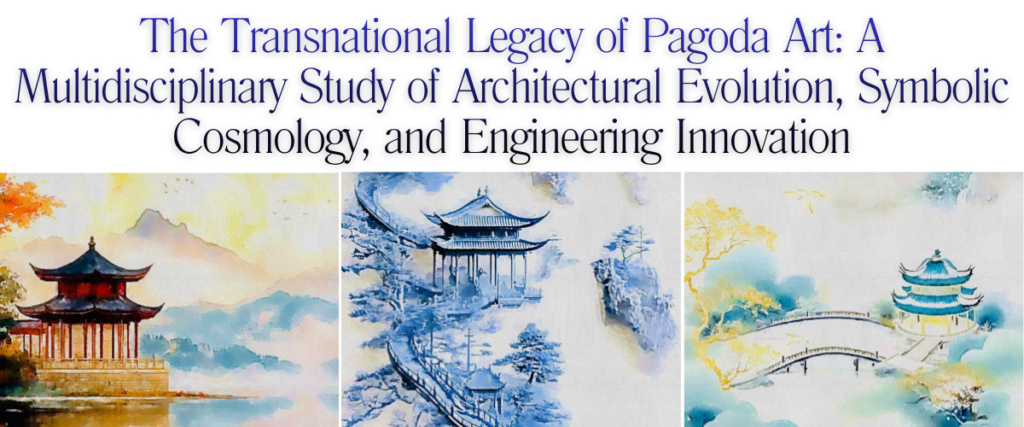
The architectural phenomenon of the pagoda represents one of the most sophisticated syntheses of religious devotion, aesthetic refinement, and structural engineering in human history. As a central fixture of the East Asian landscape, the pagoda serves as a vertical manifestation of the Buddhist journey toward enlightenment, evolving from the simple earthen mounds of ancient India into the multi-tiered, earthquake-resistant towers that define the skylines of China, Japan, Korea, and Vietnam.1 This structure is not merely an object of aesthetic appreciation; it is a repository of sacred relics, a map of the Buddhist cosmos, and a testament to the adaptive ingenuity of diverse cultures along the Silk Road.4
The Ancestral Root: The Indian Stupa and the Sacred Reliquary
The genealogy of the pagoda begins with the Indian stūpa, a hemispherical monument initially designed as a commemorative mound to house the sacred remains of Shakyamuni Buddha and other esteemed teachers.4 The term stūpa, derived from Sanskrit, signifies a “heap” or “mound,” and its origins are rooted in pre-Buddhist burial traditions in India.2 Following the Buddha’s parinirvana, his ashes were distributed among eight kingdoms, leading to the construction of the first monumental stūpas as focal points for veneration.4
The transformation of the stūpa into a sophisticated architectural form occurred primarily under the patronage of Emperor Ashoka of the Mauryan Empire in the 3rd century BCE.8 Ashoka is credited with redistributing the Buddha’s relics into thousands of smaller stūpas across the subcontinent, with the “Great Stupa” at Sanchi serving as the definitive model for subsequent Buddhist architecture.2 The Sanchi prototype featured a circular base supporting a solid dome known as the anda (egg), which symbolised the universe and the womb of creation.2 Crowning the dome was the harmika, a square railing that enclosed a central mast, or yasti, which supported tiered umbrellas (chattra) representing spiritual sovereignty and royalty.2
As Buddhism spread northwest through the Kushan Empire in the 1st century CE, the stūpa encountered the influence of Gandharan art, which integrated Greek, Persian, and indigenous Indian aesthetic traditions.4 In this region, the stūpa began to acquire more verticality; the base became higher and more tiered, while the dome became more attenuated.2 The structure transitioned from a symbol of the Buddha’s tomb to a sophisticated carrier for Buddha statues and eventually a representation of Mount Sumeru, the mythical axis of the universe.4 This gradual attenuation of the upper portion provided the architectural seed that would eventually bloom into the East Asian pagoda.2
The Sinification of the Stupa: Architectural Synthesis in China
The arrival of Buddhism in China during the Han Dynasty (206 BCE – 220 CE) marked a pivotal moment in the history of religious art.4 As Buddhist missionaries travelled along the Silk Road, they brought the concept of the stūpa into contact with a well-developed Chinese architectural tradition characterised by multi-storied timber pavilions (lou) and watchtowers.2 The resulting synthesis, a process scholars refer to as sinification, transformed the hemispherical Indian stūpa into a towering, tiered structure that integrated the verticality of Chinese palace architecture with the sacred function of the relic mound.5
During the Northern Wei and Sui dynasties (386–618 CE), architects began experimenting with materials beyond timber, including brick and stone, to ensure the longevity of these sacred monuments.11 The earliest styles of Chinese pagodas were characterised by square or circular bases, but octagonal designs emerged and became dominant between the 5th and 10th centuries.6 One of the most significant shifts in temple layout occurred during the Sui and Tang dynasties; while pagodas were originally placed at the centre of the temple complex—following the tradition of the White Horse Temple—they were eventually moved beside or behind the main Buddha hall, which rose in ritual importance.11
| Era | Architectural Evolution and Regional Patterns |
| Han Dynasty | Stūpas were concentrated in western frontier regions like Shanshan; simple domed forms were dominant. |
| Wei & Jin | Expansion across a wider region; transition from domed stūpas to more diverse, tiered structures. |
| Tang Dynasty | Standardisation of the Gaochang-centred pattern; pagoda moves to the periphery of the Buddha hall. |
| Song Dynasty | Highest point of development; increased focus on intricate façade decoration and glazed brickwork. |
| Ming & Qing | Diversification into specialised types like Lama pagodas and Vajra Throne pagodas; dominance of masonry. |
4
Typology and Materiality in Chinese Pagoda Art
Chinese pagodas are classified by their structural forms and the materials used in their construction, each reflecting the aesthetic values and technological constraints of its time.12 While early timber structures have largely been lost to fire and rot, the surviving masonry and glazed pagodas offer a comprehensive timeline of Chinese craftsmanship.6
The Close-Eaved Pagoda
The close-eaved style (miyan) represents one of the earliest and most visually striking forms of the Chinese pagoda.12 These structures are characterised by a tall, often unadorned first story and a series of closely stacked upper eaves that decrease in size as they taper toward the top.12 The interior of such pagodas is typically hollow but lacks functional floors or staircases, as the primary goal was to emphasise soaring verticality and the symbolic representation of multiple levels of heaven.2 The Songyue Pagoda in Henan, built in 523 CE, is the oldest surviving brick pagoda of this type; its 12-sided, 40-meter-tall frame features 15 rows of tightly arranged eaves, standing as a testament to Northern Wei brick masonry.2
The Tower Pagoda and the Mastery of Timber
The tower pagoda (louge) is perhaps the most iconic Chinese form, designed with functional interior floors and staircases that allow practitioners to ascend the levels.12 The pinnacle of this style is the Sakyamuni Pagoda of Fogong Temple, also known as the Yingxian Wooden Pagoda.8 Built in 1056 during the Liao Dynasty, this 67.31-meter-tall octagonal structure is the oldest and tallest surviving all-wood pagoda in the world.8 It was constructed without a single metal nail, relying instead on 50 to 60 different types of dougong (bracket sets) to distribute the massive weight of the 3,000 tons of timber.12
Glazed Tiles and the Seven Treasures
As ceramic technology advanced, the use of glazed tiles became a hallmark of elite pagoda construction, particularly during the Ming and Qing dynasties.13 In Buddhist scripture, glaze is listed as one of the “Seven Treasures,” and its application to pagodas served to protect the brick core while providing a brilliant, multicoloured façade.13 The “Iron Pagoda” of Kaifeng, built in 1049, is actually a brick structure covered in brown-glazed tiles that mimic the appearance of cast iron.11 Fully glazed pagodas, such as the Feihong Pagoda in Shanxi, feature intricate ceramic sculptures of Buddhas, lions, and celestial beings embedded directly into the exterior walls.13
| Material Type | Structural Characteristics | Famous Example |
| Timber | Flexible, seismic-resistant, uses complex dougong brackets. | Sakyamuni Pagoda (Yingxian) |
| Brick | Durable, fireproof, allows for close-eaved tapering. | Songyue Pagoda (Henan) |
| Stone | High durability, often features detailed bas-reliefs. | Four Gates Pagoda (Shandong) |
| Glazed Tile | Aesthetic brilliance symbolises “Seven Treasures,” weather-resistant. | Iron Pagoda (Kaifeng) |
| Iron/Bronze | Rare, usually smaller scale, reflects technological prestige. | Wenchang Pagoda models |
11
Japan: Timber Innovation and Seismic Engineering
When Buddhism reached Japan in the 6th century, the archipelago’s architects adopted the pagoda form with a specific focus on timber construction and earthquake resilience.15 Japanese pagodas, almost exclusively wooden, evolved into a standard five-story model (gojunoto) that serves as a cornerstone of Japanese Buddhist temple layouts.7
The Central Pillar and the Dancing Tower
The most significant Japanese contribution to pagoda art is the engineering of the shinbashira, or heart pillar.15 This massive central column extends from the base to the top of the finial but is often not structurally connected to the floors through which it passes.15 During a seismic event, the shinbashira acts as a seismic damper; the various stories of the pagoda are free to sway independently in a “twisting” or “dancing” motion.15 This flexibility allows the structure to absorb and dissipate the energy of the earthquake rather than resisting it through rigid force. This ancient design is so effective that fewer than a dozen wooden pagodas have collapsed from earthquakes in Japan’s history, a record that modern skyscraper engineers now study to safeguard contemporary towers.15
Sectarian Variations in Japanese Pagodas
The aesthetic and numerical design of Japanese pagodas often reflects the specific philosophical leanings of the Buddhist sect that commissioned them.2 A clear distinction exists between the Shingon and Tendai sects regarding pagoda geometry:
- The Shingon Sect: Founded by the monk Kukai, this sect favours the number five and the circle.17 Consequently, they are associated with the five-storied pagoda and the Gorinto (five-element stone pagoda), where each level represents an element of the universe.17
- The Tendai Sect: Founded by Saicho, this sect favours the number three and the square.17 They are typically associated with three-storied pagodas and the Hokyointo style, which serves as a substitute for the three-tiered wooden structure.17
The oldest extant wooden pagoda in Japan is located at the Hōryū-ji Temple complex, reconstructed around 680 CE.2 This five-story structure remains a global benchmark for timber joinery, featuring eaves that project far beyond the walls to protect the wood from the elements while providing a balanced silhouette that signifies spiritual stability.2
Korea: The Granite Heritage of Silla and Baekje
While China and Japan emphasised brick and wood, Korea developed a unique architectural language centred on the mastery of stone, specifically granite.2 Korean pagodas are renowned for their refined proportions and the subtle elegance of their stone eaves, which mimic the curves of traditional timber roofs.2
The Three Kingdoms period, particularly the Silla and Baekje dynasties, saw the construction of monumental stone pagodas that acted as symbols of state protection and religious devotion.2 The five-story stone pagoda of Jeongrimsa Temple is a prime example of Baekje craftsmanship, dating to the 7th century and standing as a hallmark of Buyeo’s cultural heritage.2
At the Bulguksa Temple in Gyeongju, two distinct pagodas—Seokgatap and Dabotap—embody the Silla people’s refined artistic sensibilities.22 Seokgatap is a masterpiece of unadorned, masculine proportions, representing the historical Shakyamuni Buddha.22 In contrast, Dabotap is an intricately carved, highly decorative structure representing the Prabhutaratna Buddha, who appeared in a jewelled stūpa to listen to the Buddha’s teachings.22 Together, they symbolise the harmony between the absolute and the manifested truth in Buddhist philosophy.22
Vietnam: Tropical Adaptation and the Five Elements
Vietnamese pagoda art, known as chùa, represents a fascinating synthesis of East Asian influences and indigenous responses to a tropical environment.23 Vietnamese pagodas often feature complex, low-lying compounds rather than isolated tall towers, integrating gardens, lotus ponds, and communal houses into a single spiritual landscape.24
The Integration of Feng Shui and Five Elements
The layout and material composition of Vietnamese pagodas are deeply influenced by the Five Elements framework (Ngu Hanh), ensuring that the sacred space is in harmony with natural energies.26 This application is reflected in the specific materials used:
| Element | Architectural Application in Vietnamese Pagodas | Symbolic Meaning |
| Wood | Pillars, beams, and intricate carvings of dragons and lotuses. | Life, growth, and spiritual flexibility. |
| Fire | Red-lacquered tiles, lanterns, and burning incense. | Transformation, vitality, and enlightenment. |
| Earth | Stone foundations, brickwork, and courtyard paving. | Stability, grounding, and the ancestral connection. |
| Metal | Bronze statues, bells, and incense burners. | Clarity, wisdom, and the “voice” of the Dharma. |
| Water | Lotus ponds, lakes, and reflective ritual surfaces. | Calm, purity, and the flow of merit. |
26
The Thien Mu Pagoda in Hue, built in 1601, is one of Vietnam’s most iconic structures, featuring a seven-story octagonal tower that overlooks the Perfume River.24 In contrast, the One Pillar Pagoda in Hanoi, built in the 17th century, is a unique architectural marvel that rests on a single stone pillar in the centre of a lotus pond, designed to resemble a blooming lotus flower—the ultimate symbol of Buddhist purity.25
Southeast Asia: The Stupa-Pagoda Hybrid
In the Theravada Buddhist nations of Myanmar, Thailand, Cambodia, and Laos, the pagoda form followed a different evolutionary path, remaining closer to the hemispherical Indian stūpa while developing elongated, bell-shaped, or conical silhouettes.2
Myanmar and the Shwedagon Tradition
In Myanmar, the pagoda (often called a zedi) is a solid, gilded monument intended primarily for circumambulation.2 The Shwedagon Pagoda in Yangon is the quintessential example, standing nearly 100 meters tall and covered in gold leaf and precious gemstones.29 Its structure consists of a base of terraces, a bell-shaped body, and a crowning umbrella (hti) encrusted with diamonds.29 This form is not a building to be entered but a sacred mountain to be circled, reflecting the belief that the monument itself is a physical embodiment of the Buddha’s enlightened mind.7
Thailand and the Needle-Spire Chedi
Thai architecture is defined by the chedi, a variant of the pagoda characterised by a slender, needle-like spire.2 The Phra Pathom Chedi in Nakhon Pathom is the tallest of its kind, featuring a vast, bell-shaped base that reflects the influence of Sri Lankan dagobas.2 In Thailand, pagodas are often part of a wat (temple complex) that includes an ordination hall (bot) and an assembly hall (viharn), where the chedi serves as the reliquary anchor for the entire community.7
Engineering the Sacred: Dougong, Masonry, and Foundations
The artistic value of a pagoda is inextricably linked to its structural logic. As these towers grew taller and more complex, architects developed innovative systems to handle vertical loads and lateral stresses.
The Dougong Bracket System
A defining feature of East Asian timber architecture is the dougong bracket system.12 This mechanism consists of wooden bearing blocks (dou) and bow-shaped bracket arms (gong) that distribute the weight of the massive overhanging eaves across the columns and beams.14 By avoiding rigid connections and using interlocking joinery, dougong allows the structure to flex during typhoons and earthquakes, acting as a structural shock absorber.14 In the Yingxian Wooden Pagoda, more than 50 different bracket configurations were used to support the multi-tiered rooflines, creating a sophisticated structural lattice that has stood for nearly a millennium.12
Masonry and the “Dragon Palace”
As Chinese architecture shifted toward brick and stone, the reliquary function of the pagoda became more subterranean.2 Architects developed the “dragon palace” (longgong) or “dragon cave,” an underground, brick-lined room at the base of the pagoda used to house sacred relics and funerary objects.2 These chambers were often decorated with murals and held multiple nesting containers for the relics, symbolising the protected, hidden heart of the Buddha’s presence.2
Foundations and Soil Engineering
Building massive masonry towers on soft alluvial soil required advanced foundation techniques. For the construction of the Giant Wild Goose Pagoda and later the Jin Mao Tower, engineers utilised deep pile foundations.12 Ancient Chinese builders used rammed earth and stone terraces to provide a stable base, while the modern Jin Mao Tower utilises high-capacity steel piles driven 83.5 meters into the ground to compensate for Shanghai’s soft upper-strata soil.31
Iconography, Murals, and Ornamentation
The pagoda is a canvas for a wide range of decorative arts, from stone bas-reliefs and terracotta plaques to intricate murals and cast-metal ornaments.33 These elements serve to instruct the faithful and glorify the Buddhist teachings.
The Narrative Reliefs of the Ananda Temple
The Ananda Temple in Bagan, Myanmar, contains one of the most extensive collections of stone sculptures in Southeast Asia.33 Over 1,400 bas-reliefs decorate the corridors and terraces, illustrating the career of the Buddha and the Jataka stories of his previous incarnations.34 These carvings are arranged in two rows of niches, guiding the pilgrim through a visual narrative as they perform circumambulation.34 The figures within these groups are scaled by importance, and many were originally gilded or painted, creating a vivid, immersive spiritual environment.34
Guardian Creatures and Symbolic Animals
Pagoda roofs and gateways are frequently adorned with zoomorphic figures that serve as spiritual protectors.7 The most common motifs include:
- Dragons (Long): Representing imperial power, transformation, and control over water; they are often found on roof ridges to protect against fire.26
- Chiwen (Ridge-Devouring Beasts): A mythological son of the Dragon King, placed at the ends of the main roof ridge to summon rain and extinguish fires.36
- Lions (Shi): Symbolising strength and divine guardianship, stone lions typically guard the entrances to temple and palace complexes.35
- Phoenixes (Fenghuang): Symbolising rebirth and beauty, often paired with dragons to represent the balance of yin and yang.24
Murals and Internal Decoration
In China, the internal walls of brick pagodas and the ceilings of timber towers were often covered with murals and “caissons” (sunken panels).14 These murals depicted the Buddhas of the Four Directions, scenes from the Pure Land, and intricate floral patterns.14 The use of colour was highly symbolic; red signified vitality and good fortune, while gold and yellow represented royalty and the radiant light of the Buddha.21
The Finial: A Microcosm of the Cosmos
Crowning every pagoda is the finial, a complex decorative ornament that evolved from the Indian chattra.2 In Japan, this is known as the sorin, a bronze spire that can reach up to 10 meters in height and is rich in elemental symbolism.8
The Layers of the Sorin
The sorin is divided into several distinct sections, each representing a different aspect of the universe and the spiritual path:
- Roban (Dew Basin): The square base that sits on the top roof, representing the element of Earth and the foundation of the spiritual world.17
- Ukebana (Lotus Petals): A decorative layer symbolising purity and the awakening of the mind.8
- Kururin (Nine Rings): Representing the nine levels of heaven or the stages of Buddhist attainment, they act as a vertical staircase for the soul.17
- Suien (Water Flame): Ornate, wing-like carvings designed to ward off fire—the greatest threat to wooden pagodas.15
- Ryu-sha (Dragon Wheel): Symbolising the motion of the Dharma and the sun.17
- Hoju (Sacred Jewel): An onion-shaped bulb at the very top, representing the Chintamani, the wish-granting jewel of enlightenment and the element of Space/Void.8
In the Japanese five-story pagoda, each level of the tower also corresponds to one of the five elements: Earth (base), Water, Fire, Wind, and Void (finial), creating a structure that is a complete physical map of the Buddhist universe.2
The Pagoda in the Modern Era: Skyscrapers and Sustainability
The influence of pagoda art has not waned in the modern world; rather, it has been reimagined through the lens of contemporary architecture and engineering.
The Jin Mao Tower: A Neo-Chinese Classic
Completed in 1999, the Jin Mao Tower in Shanghai is an architectural hymn to the pagoda form.40 Its 88 stories—a number chosen for its auspicious connection to prosperity—taper as they rise, mimicking the rhythmic retreats of an ancient pagoda.31 The building’s proportions revolve around the number 8, with an octagonal shear wall core and eight exterior composite supercolumns.31 Behind its stainless steel and glass façade lies a structural spine designed to flex during typhoons and earthquakes, a modern application of the seismic flexibility found in the Horyu-ji Temple.15
Contemporary Design and Interior Aesthetics
Beyond skyscrapers, pagoda motifs have influenced modern product design and luxury home décor.42 The “Japandi” style—a fusion of Japanese minimalism and Scandinavian functionality—frequently utilises pagoda silhouettes to create calming, nature-integrated environments.42 Miniature wooden, ceramic, or resin pagodas are popular as interior accents, valued for their vertical rhythm and cultural depth.42 Contemporary architects also draw inspiration from traditional eaves and tiered roofs to create sustainable, energy-efficient buildings that use natural ventilation and shading principles pioneered by ancient pagoda builders.14
Preservation and Digital Futures
The survival of ancient pagodas is threatened by natural degradation, climate change, and human activity.29 In response, heritage organisations are turning to digital preservation techniques.
3D Scanning and the Metaverse
High-resolution 3D scanning and VR (Virtual Reality) allow for the precise documentation of every carving and structural element in a pagoda.29 Projects like the digital reconstruction of the Mireuksa Temple pagodas in Korea use historical data to virtually restore lost structures, providing an educational and experiential tool that transcends physical limitations.45 In Myanmar, 3D models of the Shwedagon Pagoda preserve the intricate symbolism of its sacred elements for future generations, ensuring that the “museum of ancient pagoda art” remains accessible even as the physical materials weather over time.29
Traditional Craftsmanship in the 21st Century
Despite the rise of digital tools, the physical preservation of pagodas still relies on the dedication of traditional craftsmen.15 In Japan, a “partial restoration” approach is favoured, where original timbers are meticulously repaired and reused to maintain the historical integrity of the structure.15 This commitment to preserving ancient techniques ensures that the “living history” of the pagoda continues to resonate in the modern world.15
Conclusion
The pagoda is more than an architectural monument; it is a vertical history of Asian civilisation. From its origins as a simple Indian burial mound to its transformation into a multi-tiered tower of brick, wood, and glaze, the pagoda has adapted to the aesthetic, religious, and environmental needs of every culture it touched. Its design embodies a profound understanding of balance—both spiritual and physical—coupling the soaring aspirations of the soul with the grounded engineering of earthquake-resistant pillars and bracketed roofs. As we move into the future, the pagoda continues to serve as a bridge between tradition and modernity, a timeless symbol of humanity’s quest for enlightenment amid the flux of the material world.
Disclaimer
This article is for informational and educational purposes. The architectural and historical details provided are based on researched materials and academic interpretations of Buddhist art and engineering. Many of the sites mentioned are sacred religious monuments and UNESCO World Heritage sites; travellers and researchers are encouraged to respect local customs and conservation protocols when visiting these landmarks. The information regarding seismic technology and modern skyscraper design is illustrative of architectural influence and should not be used as a primary engineering reference.***
Reference
- accessed on February 5, 2026, https://diluo.digital.conncoll.edu/Asianart/uncategorized/deconstructing-modern-renditions-of-the-chinese-pagoda/#:~:text=The%20pagoda%2C%20which%20originally%20developed,stupas%20to%20multi%2Dtiered%20pagodas.
- Pagoda | History, Design & Construction | Britannica, accessed on February 5, 2026, https://www.britannica.com/technology/pagoda
- Soaring Spirits: The Symbolic Towers of Asia’s Pagodas – Buddha Groove, accessed on February 5, 2026, https://buddhagroove.com/blogs/balance/soaring-spirits-the-symbolic-towers-of-asias-pagodas
- Architectural Evolution of Stupas in the Western Regions During the Han and Tang Dynasties – MDPI, accessed on February 5, 2026, https://www.mdpi.com/2075-5309/15/7/1056
- (PDF) From Stupa to Pagoda: Re-Examining the Sinification and Transformation of Buddhist Monuments from Indian Origins – ResearchGate, accessed on February 5, 2026, https://www.researchgate.net/publication/380836395_From_Stupa_to_Pagoda_Re-Examining_the_Sinification_and_Transformation_of_Buddhist_Monuments_from_Indian_Origins
- The Influence of Architectural Culture on The Development of Religious Heritage, accessed on February 5, 2026, https://isocarp.org/app/uploads/2025/03/ISOCARP_2024_Shang_7.pdf
- Buddhist Temples | Types, Architecture & Examples – Study.com, accessed on February 5, 2026, https://study.com/academy/lesson/buddhist-temples-types-architecture-examples.html
- Lotus Bud Finial Asana Pose The Great Stupa at … – FSU MoFA, accessed on February 5, 2026, https://mofa.fsu.edu/wp-content/uploads/sites/3/2018/05/Pagoda-Replica-Anna-Freeman-Brendan-Little.pdf
- Indian Pagoda Architecture: Key Features, accessed on February 5, 2026, https://architecturehelper.com/blog/indian-pagoda-architecture-key-features/
- Pagoda-Style Temples: A Glimpse into Spirituality | YS Builders Construction Company, accessed on February 5, 2026, https://www.ysbuilders.com.np/pagoda-style-temples.html
- Pagoda – Wikipedia, accessed on February 5, 2026, https://en.wikipedia.org/wiki/Pagoda
- Chinese Architectures – Stupas and Pagodas – China Odyssey Tours, accessed on February 5, 2026, https://www.chinaodysseytours.com/chinese-things/architecture-pagodas.html
- Study on the Classification of Chinese Glazed Pagodas – MDPI, accessed on February 5, 2026, https://www.mdpi.com/2075-5309/14/12/4084
- Chinese Architecture: Roofs and Bracketing – ForestSong, accessed on February 5, 2026, https://www.forestsong.inkedblade.net/architecture/PhilaU/History-1/Chinese%20Architecture/report.html
- Japanese Pagoda Architecture: Exploring the Timeless Strength and Beauty of Japan’s Five-Story Towers, accessed on February 5, 2026, https://www.tanukistories.jp/post/japanese-pagoda-architecture
- What is a Pagoda: The Ultimate Deep Dive – Sakuraco, accessed on February 5, 2026, https://sakura.co/blog/what-is-a-pagoda-the-ultimate-deep-dive
- TRACING THE ORIGIN OF JAPANESE PAGODAS ALONG THE SILK ROAD, accessed on February 5, 2026, https://www.mukogawa-u.ac.jp/~iasu2012/pdf/iaSU2012_Proceedings_002.pdf
- Architectural genius behind the five-storied Pagoda – Ikidane Nippon, accessed on February 5, 2026, https://ikidane-nippon.com/en/features/a00159
- In search of gojunoto, the five element Japanese pagoda, accessed on February 5, 2026, https://elementaljapan.com/2019/03/18/in-search-of-gojunoto-the-five-element-japanese-pagoda/
- What is Pagoda Temple? History, Origin, Regional Variation – Holidays to Nepal, accessed on February 5, 2026, https://www.holidaystonepal.in/blog/pagoda-temples
- How would you describe the differences between traditional Chinese Korean and Japanese architecture styles? – Reddit, accessed on February 5, 2026, https://www.reddit.com/r/architecture/comments/1cv14mo/how_would_you_describe_the_differences_between/
- In Gyeongju, past and present breathe as one – The Korea Herald, accessed on February 5, 2026, https://www.koreaherald.com/article/10606044
- Differences in pagoda architecture in some Asian countries – OPPO Community, accessed on February 5, 2026, https://community.oppo.com/thread/1610732092319072260
- Vietnam temples and pagodas guide – TNK Travel, accessed on February 5, 2026, https://www.tnktravel.com/blogs/vietnam-temples-and-pagodas-complete-spiritual-travel-guide/
- Exploring Vietnamese Architecture: From Ancient Temples to Modern Skyscrapers, accessed on February 5, 2026, https://sungetawaystravel.com/vietnamese-architecture/
- Discover Vietnam Pagoda Architecture: Meanings of Symbols in …, accessed on February 5, 2026, https://vietpowertravel.com/blog/vietnam-pagoda-architecture.html
- Vinh Trang Pagoda – An ancient relic with unique architecture – VinWonders, accessed on February 5, 2026, https://vinwonders.com/en/wonderpedia/news/vinh-trang-pagoda-vietnam/
- Exploring Vietnam’s Iconic Pagodas: A Journey Through History and Spirituality, accessed on February 5, 2026, https://asiamystika.com/blog/pagoda-vietnam
- A metaverse based digital preservation of temple architecture and heritage – PMC, accessed on February 5, 2026, https://pmc.ncbi.nlm.nih.gov/articles/PMC12049536/
- Dragon palace | Chinese architecture – Britannica, accessed on February 5, 2026, https://www.britannica.com/topic/dragon-palace
- Jin Mao Tower – Wikipedia, accessed on February 5, 2026, https://en.wikipedia.org/wiki/Jin_Mao_Tower
- Jin Mao Tower Skywalk 88: Shanghai’s 420m Pagoda-Inspired Skyscraper – Travel Into China, accessed on February 5, 2026, https://www.intotravelchina.com/en/attractions/shanghai_attraction/The-Jin-Mao-Tower.html
- Andagu Stone Carvings Image and Its Styles | Buddhist Art, accessed on February 5, 2026, https://www.buddhist-art.com/andagu-stone-carvings/andagu-stone-carving/
- Stone Sculptures in the Ananda Temple in Pagan – Photo Dharma, accessed on February 5, 2026, https://photodharma.net/Myanmar/Ananda-Stone-Sculptures/index.htm
- The Chinese Art of Stone Sculpture and Carving – Advantour, accessed on February 5, 2026, https://www.advantour.com/china/culture/stone-sculptural-arts.htm
- Chinese Unique Architectures, accessed on February 5, 2026, https://www.idcpc.org.cn/english2023/chinadelights/arts/architecture/202307/t20230727_157782.html
- Chinese – RELIEF WITH DESIGN OF DRAGONS – Dayton Art Institute, accessed on February 5, 2026, https://www.daytonartinstitute.org/exhibits/chinese-relief-with-design-of-dragons/
- Pagoda and Transformation: The Making of Medieval Chinese Visuality, accessed on February 5, 2026, https://openpublishing.psu.edu/ahd/content/pagoda-and-transformation-making-medieval-chinese-visuality
- Why Pagodas Symbolize Earth, Water, Fire, Air, Space – Architecture Helper, accessed on February 5, 2026, https://architecturehelper.com/blog/why-pagodas-symbolize-earth-water-fire-air-space/
- Jin Mao Tower Guide – Foresyte, accessed on February 5, 2026, https://foresyteapp.com/jin-mao-tower-shanghai/
- Clone of Shanghai: High-Rise Architecture and the Remaking of China’s Gateway to the World | SFO Museum, accessed on February 5, 2026, https://www.sfomuseum.org/exhibitions/clone-shanghai-high-rise-architecture-and-remaking-chinas-gateway-world/gallery
- How to Choose the Best Pagoda Home Decor for Your Space – Plant Care – Alibaba, accessed on February 5, 2026, https://plantin.alibaba.com/buyingguides/pagoda-home-decor
- Pagoda Furniture – Etsy, accessed on February 5, 2026, https://www.etsy.com/market/pagoda_furniture
- The Graceful Architecture of Pagodas: A Journey Through Time and Culture – Oreate AI Blog, accessed on February 5, 2026, https://www.oreateai.com/blog/the-graceful-architecture-of-pagodas-a-journey-through-time-and-culture/0613b64a4b2dd89277cfa416b3e386c5
- The Pagodas of the Mireuksa Temple Site: Interpretations and Presentations of Three Memories of Cultural Heritage in a Single Site – MDPI, accessed on February 5, 2026, https://www.mdpi.com/2071-1050/17/24/11098
- Shaolin Pagoda Forest: Stones of a monastic legacy – YouTube, accessed on February 5, 2026, https://www.youtube.com/shorts/A6uUzVEknX8