The Great Deceleration
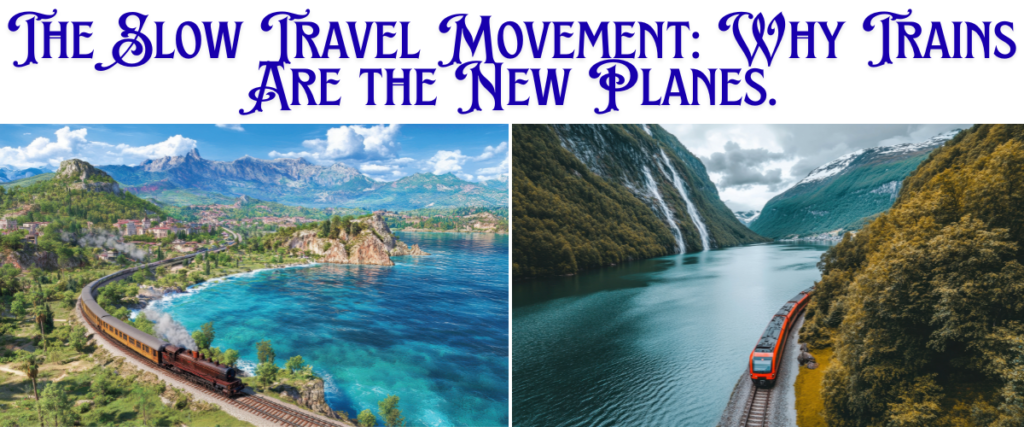
The trajectory of global travel in the twenty-first century has undergone a profound and unexpected curvature. For the better part of five decades, the dominant narrative of human mobility was defined by the conquest of time. The jet engine, a marvel of mid-century engineering, shrank the globe, turning transcontinental journeys that once took weeks into mere hours. Velocity was the currency of the modern age; the destination was the product, and the journey was merely a friction cost—a logistical hurdle to be minimised, accelerated, and ultimately ignored. However, as we stand in 2025 and look toward 2026, a paradigm shift of seismic proportions is reshaping the way the world moves. We are witnessing the end of the era of hyper-acceleration and the dawn of the Slow Travel Movement.
This report provides an exhaustive analysis of this phenomenon. It is not a trend born of nostalgia, though it borrows the aesthetic of the golden age of rail. Rather, it is a movement driven by a complex convergence of technological innovation, environmental urgency, and a fundamental psychological reorientation of the traveller. The “Slow Travel” ethos—prioritising the quality of the journey over the speed of arrival—has moved from a niche subculture to a dominant market force. At the heart of this movement is the renaissance of the railway. From the steppes of Central Asia to the urban corridors of Western Europe, and most notably in the rapidly modernising landscape of India, trains are reclaiming their status as the primary mode of civilised transport.
The train is no longer the poor relation of the aeroplane. It is the “new plane,” offering a synthesis of digital connectivity, physical comfort, and environmental responsibility that aviation, for all its speed, cannot match. This report will explore the multifaceted dimensions of this shift. We will examine the economic distortions that still favour dirty skies over green rails in Europe, the aggressive technological leapfrogging of the Indian Railways with its Vande Bharat platform, the sheer velocity of China’s high-speed expansion, and the experiential luxury of the world’s great heritage lines. We will dissect the rise of the “digital nomad” who views the train carriage not as a seat, but as a mobile office, and we will confront the infrastructural challenges that threaten to derail this momentum.
As we delve into the specifics—analysing the aerodynamic breakthroughs of China’s CR450, the “hotel-on-wheels” concept of the Vande Bharat Sleeper, and the culinary diplomacy of Australia’s The Ghan—a singular theme emerges: The world is learning to slow down, not to stop, but to see.
The Philosophy and Psychology of Slow Travel
The Shift from Destination to Journey
The Slow Travel movement is often mischaracterised as a mere preference for leisure. In reality, it represents a deeper cognitive pivot in how modern societies value time and experience. By 2025, the travel industry observed a palpable fatigue among consumers regarding “fast-paced, photo-op-heavy tourism”.1 The post-pandemic years served as a global reset button, prompting a collective introspection about the purpose of movement. The frantic desire to “tick boxes”—to touch down in Rome, snap a photo of the Colosseum, and fly to Paris the same evening—has been replaced by a yearning for depth.
Research by Hilton in their 2025 trends report illuminates this shift, noting that travellers are increasingly driven by a desire to “build connections with others and their surroundings.” The data is compelling: 74% of travellers now explicitly seek recommendations from locals, and 73% of global travellers prioritise authentic, local experiences, especially when travelling with children.2 This desire for immersion is structurally incompatible with the hermetically sealed experience of air travel. An aeroplane teleports a passenger; a train transports them. The rail journey cuts through the topography of a nation, exposing the traveller to the gradual shifts in architecture, landscape, and climate. It allows for the “discovery travel” dimension identified in studies of luxury tourism, where the act of transit becomes a vehicle for cultural comprehension rather than just displacement.3
The Mental Health Imperative
Beyond culture, there is a physiological dimension to the rail renaissance. The modern airport experience has devolved into a high-stress gauntlet of security theatres, invasive screenings, baggage weight anxiety, and the biological strain of pressurised cabins. In contrast, the Slow Travel movement champions the “mental health and wellbeing” benefits of rail.1
The rhythmic motion of a train has long been cited for its meditative qualities, but in the context of the 2020s, it serves a more functional purpose: the restoration of agency. On a train, a passenger can walk, dine, and socialise. The “social cohesion” identified by researchers like Tarquini and Klaus in the context of slow yachting applies equally to the railcar.3 The layout of a train carriage—with facing seats, dining cars, and communal spaces—fosters interaction in a way that the forward-facing, isolated seating of an aircraft cannot. For a generation grappling with digital isolation, the train offers a rare physical “third place” between home and destination.2
Sustainability as a Core Value
While the psychological drivers are potent, the moral spine of the Slow Travel movement is the climate crisis. “Flygskam” (flight shame), a term that originated in Sweden, has evolved by 2025 into a broader “train pride.” The environmental mathematics are irrefutable. Transport accounts for approximately one-quarter of global CO2 emissions, and for the individual traveller, the choice of mode is the single most significant variable in their carbon footprint.4
A 2025 comparative analysis confirms that flights are, on average, five times more polluting than railways per passenger-kilometre.5 On specific high-efficiency routes, the difference is even more staggering. For instance, choosing the Eurostar over a short-haul flight between London and Paris reduces a traveller’s carbon emissions by approximately 97%.4 This is not a marginal gain; it is an order-of-magnitude difference. For the eco-conscious traveller, the train is the only ethically viable option for continental travel. The movement has thus transitioned from a “nice to have” luxury to a “must-do” imperative for a growing demographic concerned with their personal contribution to planetary warming.6
The Environmental and Economic Battlefield
The Carbon Chasm: Planes vs. Trains
To understand the gravity of the modal shift, one must look at the hard data. The environmental superiority of rail is not merely about direct emissions but also about energy efficiency and land use.
Table 1: Comparative Environmental Impact of Travel Modes (2025 Data)
| Transport Mode | Relative CO2 Emissions | Efficiency Notes |
| Train (Electric) | Baseline (1x) | Highly efficient; regenerative braking; increasing use of renewable grid energy. |
| Domestic Flight | ~5x – 7x Rail | High fuel burn during takeoff/landing; radiative forcing at altitude amplifies the warming effect. |
| Car (ICE) | ~4x – 5x Rail | Inefficient for single occupants; congestion adds to emissions. |
| Short-Haul Int’l Flight | ~20x – 26x Rail | Extreme inefficiency for short hops (e.g., London-Paris) compared to high-speed rail. |
4
The data from the UK Government’s Department for Energy Security and Net Zero underscores that for medium-length distances, taking a train instead of a car reduces emissions by around 80%, and replacing a domestic flight cuts them by 86%.4 The “radiative forcing” effect of high-altitude aviation emissions further compounds the damage of flying, a factor often omitted in simple CO2 comparisons but increasingly recognised by climate-literate travellers.
The Price of Virtue: Europe’s Economic Distortions
Despite the clear environmental imperative, the economic reality of 2025 presents a significant barrier to the Slow Travel movement, particularly in Europe. A scathing report by Greenpeace released in August 2025 reveals a “distorted travel pricing” system that actively penalises climate-friendly choices. The report analysed 112 cross-border routes across Europe and found that rail travel is more expensive than flying on 71% of these routes.7
The disparities can be grotesque. The analysis highlighted the Barcelona to London route as an extreme example, where the train ticket was found to be up to 26 times more expensive than a low-cost flight.7 A traveller might pay €15 for a Ryanair flight but face a staggering €389 for the equivalent train journey.9 This creates a situation where sustainable travel is a privilege reserved for the wealthy, while the budget-conscious are forced into the most polluting option.
The Policy Failure: Subsidising Pollution
This price gap is not an accident of the free market but a result of deliberate policy choices. The aviation industry in Europe benefits from historical tax exemptions that rail does not share:
- Kerosene Tax Exemption: Airlines pay no tax on kerosene fuel for international flights, a subsidy worth billions annually.7
- VAT Exemptions: International air tickets are often exempt from Value Added Tax (VAT), whereas train tickets in many countries are subject to VAT and energy taxes.7
- Track Access Charges: Rail operators must pay high fees to access the infrastructure (tracks), whereas airlines pay relatively low costs for the use of airspace.5
This “political system that still rewards polluters” has led to calls for radical reform, including the introduction of “climate tickets” across Europe (modelled after Austria’s Klimaticket or Germany’s Deutschlandticket) and the abolition of short-haul flights where rail alternatives exist.7 France has been a pioneer in this regard, passing a bill to ban short-haul flights where a train alternative of 2.5 hours or less exists.10 This legislative intervention is the first major crack in the aviation industry’s dominance and signals a future where the “right to fly” is balanced against the “duty to protect.”
India’s Rail Revolution – A Global Case Study
While Europe wrestles with pricing and legacy systems, India is in the midst of the most aggressive railway modernisation program in its history. The Indian Railways, a colossal network that moves Australia’s population every single day, is transforming from a slow, utilitarian utility into a modern, high-speed, and aspiration-driven service. The centrepiece of this revolution is the “Vande Bharat” platform.
The Vande Bharat Express: A Symbol of “New India”
The Vande Bharat Express (originally Train 18) is a semi-high-speed, self-propelled trainset designed and manufactured indigenously at the Integral Coach Factory (ICF) in Chennai. It is a potent symbol of the “Make in India” initiative, showcasing the country’s engineering prowess to the world.11
Engineering and Performance
Unlike traditional Indian trains that are pulled by a separate locomotive, the Vande Bharat uses distributed traction power (like a subway train or the Shinkansen), allowing for faster acceleration and deceleration.
- Speed: The trains are designed for speeds of 160 km/h, with operational speeds currently capped at 130 km/h on most routes due to track conditions. However, the rapid acceleration significantly reduces travel time, cutting hours off journeys between cities like Mumbai and Gandhinagar or Delhi and Varanasi.12
- Safety (Kavach): A critical feature is the integration of Kavach, an indigenous Automatic Train Protection (ATP) system. This technology prevents collisions by automatically applying brakes if the pilot fails to react to a red signal and assists in safe operations during adverse weather like dense fog.13 This addresses a historic safety concern in the Indian rail network.
- Ride Quality: The trains feature improved suspension systems and air-tight gangways to reduce noise and vibration. While early reviews noted some vibration (the “shaking tea” test), newer iterations (2.0 and beyond) have refined the ride quality considerably.11
The Onboard Experience: Redefining Comfort
The Vande Bharat is explicitly designed to compete with airlines and road travel for the growing Indian middle class.
- Interiors: The train features two classes: Chair Car and Executive Class. The Executive Class boasts 180-degree rotating seats, allowing passengers to face the direction of travel or their companions. Amenities include airline-style tray tables, individual reading lights, and footrests.14
- Amenities: Automatic sliding doors, bio-vacuum toilets (similar to aeroplanes), and GPS-based passenger information screens are standard. The large panoramic windows are a defining feature, designed to offer expansive views of the Indian landscape, reinforcing the “slow travel” ethos of connecting with the environment.12
- Passenger Feedback: Reviews are generally positive, highlighting the “European feel” and cleanliness. However, there are teething issues typical of rapid deployment. Some passengers have complained about the comfort of seats for long durations (8+ hours) and the maintenance of high-tech features like charging ports.16 The food service, while ambitious with localised menus, has received mixed reviews regarding consistency.18
The Next Frontier: Vande Bharat Sleeper (2026)
While the chair car trains revolutionised day travel, the Indian market is heavily dependent on overnight journeys. Enter the Vande Bharat Sleeper, scheduled for a massive commercial rollout in January 2026.19
- Launch & Route: The first service is confirmed to operate between Kolkata (Howrah) and Guwahati, a vital corridor connecting West Bengal to the Northeast. Prime Minister Narendra Modi is expected to flag off the train in mid-January 2026.20
- Concept: This train is designed to be a “hotel on wheels.” It aims to capture the market of travellers who would otherwise take an evening flight or a long drive. By travelling overnight in comfort, passengers save on a hotel bill and arrive at their destination fresh.
- Features: The sleeper trains will feature hermetically sealed gangways to eliminate dust and noise—a major upgrade from legacy sleeper coaches. Interiors will use crash-worthy materials, and the train will include designated berths for passengers with disabilities, sensor-based lighting, and advanced odour control systems in the toilets.22 The design speed is being pushed towards 220 km/h for future track upgrades, with current operations targeted at 160 km/h.24
Democratizing Speed: The Amrit Bharat Express
India’s rail modernisation is not elitist. Recognising that the Vande Bharat price point is out of reach for many, the government introduced the Amrit Bharat Express.
- Push-Pull Technology: These trains use a locomotive at both ends (one pulling, one pushing). This eliminates the time-consuming process of engine reversal at terminal stations and provides Vande Bharat-like acceleration at a fraction of the cost.25
- The “Aam Aadmi” (Common Man) Focus: These are non-air-conditioned sleeper and general coaches but with significantly improved amenities: cushioned seats, mobile charging points, LED lights, and aesthetically pleasing interiors. It ensures that the benefits of “slow travel”—comfort and dignity—are accessible to the masses.26
Infrastructure: The Backbone of the Renaissance
The shiny new trains are supported by a massive overhaul of the physical infrastructure, often the “invisible” part of the slow travel movement.
- Amrit Bharat Station Scheme: As of December 2025, 155 stations have been fully modernised. These are not just paint jobs; they involve creating “roof plazas,” integrating multimodal transport (bus/taxi), and ensuring accessibility for disabled passengers.13 The station is being reimagined as a city centre hub, much like the great stations of Europe.
- Electrification & Tracks: The entire network is being electrified in “mission mode” to reduce the carbon footprint. Furthermore, tracks are being upgraded to support speeds of 130-160 km/h, which is the primary bottleneck for the new trains.24
- The Bullet Train: The Mumbai-Ahmedabad High-Speed Rail (MAHSR) project continues to progress, promising to bring true Shinkansen technology to India. While debates about its cost versus utility persist 28, it remains the aspirational horizon for Indian rail, with completion targets shifting but construction visible on the ground.24
The European Rail Renaissance – Night Trains and Cross-Border Struggles
While India focuses on speed and volume, Europe’s slow travel narrative is dominated by the romantic and practical resurgence of the night train.
The Return of the Sleeper Network
For years, European night trains were in decline, killed off by budget airlines. By 2025, they are back with a vengeance. The Austrian Federal Railways (ÖBB) has been the visionary leader here, expanding its Nightjet network to connect major capitals like Vienna, Paris, Brussels, and Berlin.
- The “100-City” Vision: The goal is a network connecting Europe’s metropolises overnight, allowing business travellers to sleep while they move and arrive in the city centre ready for a meeting, saving the cost of a hotel and the stress of an early morning flight.29
- New Entrants: It is not just state operators. European Sleeper, a Dutch-Belgian cooperative, has launched routes connecting Brussels and Amsterdam to Berlin and Prague, and is eyeing expansion into Southern Europe. These services target a younger, eco-conscious demographic that views the journey as a social event.30
Growing Pains: The Paris-Berlin Saga
The path to a unified rail Europe is not smooth. The high-profile Nightjet service between Paris and Berlin, a symbol of the rail revival, faced discontinuation in late 2025 due to funding cuts by the French government and extensive track maintenance works.29 While it is slated to return with a different operator in 2026, this volatility highlights the fragility of cross-border operations. National interests, differing technical standards (signalling systems, voltage), and funding squabbles often hamper international connectivity.
The Luxury Segment: Rails of Opulence
At the other end of the spectrum, luxury rail cruising is booming.
- La Dolce Vita Orient Express: Launching in Italy, this train offers a “slow travel” experience through vineyards and coastlines, using refurbished vintage carriages. It is less about transport and more about a rolling theatre of Italian heritage.30
- Britannic Explorer: In the UK, Belmond has launched the first luxury sleeper train for England and Wales, catering to high-net-worth individuals who want to see the Cornish coast or the Lake District in the style of the 1920s.30
Disruption and Resilience
The European network is also on the front lines of climate change impacts. “Storm Goretti” in early 2025 caused widespread chaos, grounding flights and halting trains across Northern Europe.32 While trains are generally more robust than planes, they are vulnerable to fallen trees, flooding, and icing. The reliability of the “slow travel” option is contingent on massive investments in climate-resilient infrastructure.
Asian Velocity – China and Japan
China: The Velocity of Ambition
China’s high-speed rail network is a league of its own, both in scale and speed. By 2035, the network is projected to reach 70,000 km.33 The focus here is not just “slow travel” in terms of experience, but making the train faster than the plane for increasingly long distances.
- The CR450: The technological pinnacle of 2025/2026 is the CR450 trainset. With a design speed of 450 km/h and an operational speed of 400 km/h, it completely redefines the math of intercity travel.34 At these speeds, a 1,000 km journey takes 2.5 hours—faster than the total door-to-door time of a flight.
- Integration: In 2026, Hong Kong’s high-speed integration with the mainland deepens with 16 new direct routes, creating a “one-hour living circle” for the Greater Bay Area. This is geopolitical integration through steel wheels, binding the financial hub closer to the industrial hinterland.36
Japan: Reimagining the Shinkansen
Japan, the pioneer of the bullet train, is innovating in utility rather than just raw speed.
- Hako-Bun (Freight on Rail): Facing a severe labour shortage in the trucking industry and a need to decarbonise logistics, JR East has launched “Hako-Bun.” This service uses Shinkansen trains to transport high-value, time-sensitive freight (like fresh seafood from Sendai) into Tokyo.38
- The “Slow Food” Connection: This logistical innovation directly supports the slow travel/slow food ethos. A tourist in Tokyo can eat fish caught that morning in a remote province, transported by the same green infrastructure that brought them to the city. It represents a holistic view of rail as the circulatory system of the nation.39
- Operational Changes: To accommodate changing travel patterns, Japan has reduced non-reserved seating on its fastest “Nozomi” trains during peak periods, pushing travellers towards pre-booked, assured seating—a move towards the European model of reservation-only high-speed travel.40
The Luxury and Experience Sector
For a specific subset of the Slow Travel movement, the train is not a means to an end, but the destination itself. This is “Land Cruising.”
The Ghan (Australia): A Continental Odyssey
The Ghan is one of the world’s great rail journeys, bisecting the Australian continent from Adelaide in the south to Darwin in the north.
- Culinary Diplomacy: The train’s “Queen Adelaide Restaurant” serves as a showcase for Australian produce. The menu features grilled kangaroo fillet and saltwater barramundi, paired with wines from the very regions the train is traversing (e.g., McLaren Vale, Barossa Valley).41 This literal “taste of the land” reinforces the connection between the traveller and the environment.
- Digital Detox: In an era of hyper-connectivity, The Ghan markets its remoteness. As the train crosses the vast, empty Red Centre, Wi-Fi is often non-existent. This enforced disconnection is framed as a luxury—a chance to engage with fellow travellers in the “Outback Explorer Lounge” without the distraction of notifications.43
Rocky Mountaineer (Canada): The Theatre of Nature
Operating in Western Canada and the American Southwest, the Rocky Mountaineer has perfected the “daylight only” model. The train stops at night, and passengers sleep in hotels, ensuring not a single mile of scenery is missed in the dark.
- GoldLeaf Service: This is the pinnacle of the experience. Passengers travel in custom-built bi-level coaches. The upper level features an all-glass dome for 360-degree views of the Canadian Rockies. The lower level is a dedicated dining room.44
- The Narrative: Onboard hosts provide storytelling, pointing out wildlife (bears, elk) and historical landmarks. It transforms the journey into a curated documentary, offering an immersion that a flight over the mountains simply cannot provide.46
The Digital Nomad on Rails
The rise of remote work has created a new demographic: the Digital Nomad. For this group, the train is a mobile office. The “Slow Travel” aspect allows them to work a full day while transiting between cities, effectively reclaiming the “lost time” of travel.
The Connectivity Reality Check
The viability of the “train office” depends entirely on connectivity, and the reality in 2025 is mixed.
- Europe: On paper, trains like the ÖBB Railjet offer “Business Class” with quiet zones and tables. However, user reviews frequently cite the “Wi-Fi lottery” as a major frustration. Reliance on 4G/5G repeaters means that tunnels and rural dead zones can drop critical video calls, forcing nomads to work offline or rely on unstable hotspots.47
- India: The Vande Bharat trains are marketed to the business traveller, with charging points at every seat and onboard Wi-Fi. While a massive improvement over older trains, the bandwidth is often insufficient for heavy cloud computing, leading experienced nomads to rely on their own 5G dongles where coverage exists.14
The Nomad Hubs
Certain countries have positioned themselves as “rail-nomad” paradises.
- Portugal: With its “Digital Nomad Visa” and affordable cost of living, Portugal is a top destination for 2025. The rail network connecting Lisbon, Porto, and the Algarve allows nomads to “slow travel” the country, working from a different city each week.49
- Thailand: The train journey from Bangkok to Chiang Mai remains a rite of passage. While the Wi-Fi on the older trains is non-existent, the journey itself—transitioning from the chaotic capital to the misty northern mountains—is seen as a necessary decompression period for the overworked nomad.50
Comparative Analysis – Plane vs. Train
To provide a decision-making framework for the modern traveller, we present a detailed comparison of the two dominant modes on key global routes.
Table 2: The London to Paris Corridor (2025)
| Metric | Eurostar (Train) | Short-Haul Flight |
| Total Time | ~2.5 Hours (City Center to City Center). | ~4+ Hours (Includes airport transit, security, and boarding). |
| Productivity | High. Large tables, usable Wi-Fi, and the ability to walk around. | Low. “Tray table” restrictions, electronics ban during takeoff/landing. |
| Stress | Low. Show up 30 mins before. Keep shoes on. | High. Security queues, liquid bans, gate anxiety. |
| Carbon | ~4 kg CO2. (97% reduction vs flight). | ~100+ kg CO2. High impact per km. |
| Cost | High. £150+ for flexible tickets. | Variable. £30-£50 on budget airlines (hidden costs for bags). |
| Luggage | 2 Large Bags + Hand Luggage. No liquid limits. | Strict limits. Heavy fees for checked bags. |
Table 3: The Tokyo to Osaka Corridor (2025)
| Metric | Shinkansen (Nozomi) | Domestic Flight |
| Frequency | Every 10 mins. “Turn up and go” convenience. | Hourly. Requires booking and airport transit. |
| Reliability | Near Perfect. Average delay <1 minute. | Weather Dependent. Subject to ATC delays. |
| Experience | Seamless. Tokyo Station is the city centre. | Fragmented. Haneda/Itami are convenient but still require transit. |
| Price | Fixed. ~¥14,720 (rarely discounted). | Dynamic. Can be as low as ¥6,000-¥10,000 with advance purchase. |
52
Challenges and Future Outlook
Despite the optimism, the Slow Travel movement faces structural hurdles that must be addressed to ensure mass adoption.
The Booking Window Friction
A major pain point for international travellers is the disparity in booking horizons. Airlines release schedules 11 months in advance. Many railways, including major European operators and Indian Railways, often release tickets only 3 to 4 months out.56 This makes long-term planning for holidays difficult, forcing risk-averse travellers back to airlines.
The “Last Mile” and Infrastructure Decay
While high-speed backbones are robust, regional connectivity remains a challenge. In the US, the rail infrastructure suffers from decades of underinvestment, with wooden ties and aging tracks causing “unplanned outages” that tank reliability.57 In Europe, the fragmentation of ticketing systems means that booking a cross-border trip often requires visiting three different websites, whereas a flight can be booked on a single aggregator in seconds.5
The Cost of Green
As noted in the Greenpeace analysis, the price of sustainable travel remains the single biggest barrier. Unless governments intervene to level the playing field—through carbon taxes on aviation or subsidies for rail—the Slow Travel movement risks remaining a luxury for the affluent rather than a solution for the masses.7
Conclusion: The Journey is the Destination
The Slow Travel movement of 2025/2026 is a correction. It is a correction of the mistaken belief that speed is the only metric of value in transport. It is a correction of the environmental negligence that allowed the aviation industry to externalise its costs for decades. And it is a correction of the modern lifestyle that alienates the traveller from the physical reality of the world they traverse.
From the executive cabins of the Vande Bharat Express speeding across the Indian plains to the glass-domed carriages of the Rocky Mountaineer climbing the Canadian peaks, the train offers a different promise. It promises that the time spent moving is not lost time, but found time. It offers a space to think, to work, to connect, and to see.
As we look to the future—with the Vande Bharat Sleeper set to redefine overnight travel in India, the CR450 pushing the boundaries of physics in China, and the Nightjet network knitting Europe back together—it is clear that the golden age of rail is not in the past. It is arriving now, on Platform 1.
Disclaimer
The information presented in this report is based on data, schedules, and pricing available as of late 2025 and early 2026. Travel regulations, visa requirements (particularly regarding Digital Nomad visas), and transport schedules are subject to rapid change. Carbon emission calculations are averages and may vary based on specific vehicle types and load factors. Readers are strongly advised to verify all details with official operators and government consulates before making travel arrangements.
Reference
- Slow Travel Is the New Luxury: Why It’s Taking Over in 2025 – Thafael, accessed on January 13, 2026, https://thafael.com/blogs/travel-news/slow-travel-is-the-new-luxury-why-it-s-taking-over-in-2025
- Slow Travel | 2025 Hilton Trends Report, accessed on January 13, 2026, https://stories.hilton.com/2025trends/slow-travel-the-growing-desire-to-travel-like-a-local
- Full article: Slow Tourism Development and Planning: A Sustainable Form of Tourism?, accessed on January 13, 2026, https://www.tandfonline.com/doi/full/10.1080/21568316.2025.2464984
- Which form of transport has the smallest carbon footprint? – Our World in Data, accessed on January 13, 2026, https://ourworldindata.org/travel-carbon-footprint
- Report Finds European Tax System Favors Carbon-Intensive Air Travel Over Rail, Undermining Climate Goals – Earth.Org, accessed on January 13, 2026, https://earth.org/absurd-report-finds-european-tax-system-favors-carbon-intensive-air-travel-over-rail-undermining-climate-goals/
- 15 reasons trains are better than planes – Rail Europe, accessed on January 13, 2026, https://www.raileurope.com/en-us/blog/travel-trains-vs-planes
- Flying cheap, paying dear: How airlines undercut rail and fuel the climate crisis, accessed on January 13, 2026, https://greenpeace.at/uploads/2025/08/greenpeace-analysis-flight-vs-trains-2025.pdf
- “Promoting pollution”: Low-cost flights up to 26 TIMES cheaper than trains, new report reveals – Greenpeace UK, accessed on January 13, 2026, https://www.greenpeace.org.uk/news/low-cost-flights-up-to-26-times-cheaper-than-trains/
- When trains are pricier than planes, there’s a heavy social, financial and environmental cost, accessed on January 13, 2026, https://www.theguardian.com/environment/2025/oct/23/down-to-earth-climate-travel-train-plane
- Planes vs. Trains: A Comparison of Convenience and Sustainability – Northeast Maglev, accessed on January 13, 2026, https://northeastmaglev.com/2025/07/01/planes-vs-trains/
- Traveller Reviews Made-In-India Vande Bharat Trains, Is Amazed By Revolving Seats, Food & The Price – YouTube, accessed on January 13, 2026, https://www.youtube.com/watch?v=HWez7uvlggA
- Vande Bharat Express Routes 2025: Complete list of all routes, travel times, distances and key details you must know, accessed on January 13, 2026, https://m.economictimes.com/news/new-updates/vande-bharat-express-routes-2025-complete-list-of-all-routes-travel-times-distances-and-key-details-you-must-know/articleshow/125221059.cms
- Ministry of Railways: Year End Review 2025 – PIB, accessed on January 13, 2026, https://www.pib.gov.in/PressReleasePage.aspx?PRID=2209199®=3&lang=1
- Vande Bharat Express: A Rail fan’s perspective on the Executive Class – Team-BHP, accessed on January 13, 2026, https://www.team-bhp.com/news/vande-bharat-express-rail-fans-perspective-executive-class
- My first time experience with vande bharat express. : r/indianrailways – Reddit, accessed on January 13, 2026, https://www.reddit.com/r/indianrailways/comments/190lb2x/my_first_time_experience_with_vande_bharat_express/
- How was your experience travelling first time in Vande Bharat? : r/indianrailways – Reddit, accessed on January 13, 2026, https://www.reddit.com/r/indianrailways/comments/1mw1139/how_was_your_experience_travelling_first_time_in/
- Ur Views on Vande bharat (sitting 8hrs straight) ? : r/SoloTravel_India – Reddit, accessed on January 13, 2026, https://www.reddit.com/r/SoloTravel_India/comments/1hemvsh/ur_views_on_vande_bharat_sitting_8hrs_straight/
- Thoughts on Vande Bharat? : r/hyderabad – Reddit, accessed on January 13, 2026, https://www.reddit.com/r/hyderabad/comments/14svpes/thoughts_on_vande_bharat/
- Vande Bharat sleeper train route announced: Check launch date, fare and other details, accessed on January 13, 2026, https://m.economictimes.com/industry/transportation/railways/vande-bharat-sleeper-train-route-announced-check-launch-date-fare-and-other-details/articleshow/126285231.cms
- India’s 1st Vande Bharat Sleeper Train: Airline-style fares, no waitlists, routes, and why it’s premium – Gulf News, accessed on January 13, 2026, https://gulfnews.com/world/asia/india/indias-1st-vande-bharat-sleeper-train-airline-style-fares-no-waitlists-routes-and-why-its-premium-1.500406254
- From Berths to Coaches: Inside Vande Bharat Sleeper Train – Pics That Say It All, accessed on January 13, 2026, https://www.etnownews.com/infrastructure/from-berths-to-coaches-inside-vande-bharat-sleeper-train-pics-that-say-it-all-photo-gallery-153393903
- Vande Bharat Sleeper Train 2025: First look, features, routes & launch details, accessed on January 13, 2026, https://timesofindia.indiatimes.com/life-style/travel/news/vande-bharat-sleeper-train-2025-first-look-features-routes-launch-details/articleshow/124630399.cms
- Best Sleeper Train in India: A Complete Guide to the Vande Bharat Train – Yatri Restro, accessed on January 13, 2026, https://www.yatrirestro.com/blog/vande-bharat-sleeper-train
- Future of rail transport in India – Wikipedia, accessed on January 13, 2026, https://en.wikipedia.org/wiki/Future_of_rail_transport_in_India
- Amrit Bharat Express – Wikipedia, accessed on January 13, 2026, https://en.wikipedia.org/wiki/Amrit_Bharat_Express
- From Vande Bharat to Amrit Bharat: How Modi govt’s rail push is transforming Odisha’s connectivity, accessed on January 13, 2026, https://odishatv.in/odisha/from-vande-bharat-to-amrit-bharat-how-modi-govts-rail-push-is-transforming-odishas-connectivity-10991020
- Vande Bharat, Amrit Bharat, and Namo Bharat trains – the advanced modern train services of Indian Railways – Trayaan, accessed on January 13, 2026, https://www.trayaan.com/2025/10/vande-bharat-amrit-bharat-and-namo-bharat-advanced-modern-train-services-of-indian-railways.html
- What if Bullet Train can’t beat the airlines, in terms of fares and time taken? – Moneylife, accessed on January 13, 2026, https://www.moneylife.in/article/what-if-bullet-train-cant-beat-the-airlines-in-terms-of-fares-and-time-taken/51897.html
- Europe Night Trains 2025-2026 – New Sleeper Routes, 100-City Network & How to Ride, accessed on January 13, 2026, https://www.thetraveler.org/europe-night-trains-2025-2026-new-routes-network-guide/
- Everything you need to know about rail travel in 2026, accessed on January 13, 2026, https://www.nationalgeographic.com/travel/article/everything-you-need-to-know-about-rail-travel-in-2026
- Where do you want to travel on the night train? – Nightjet, accessed on January 13, 2026, https://www.nightjet.com/en/
- Travel trade faces rebooking surge as Storm Goretti disrupts European energy and transit, accessed on January 13, 2026, https://www.traveldailymedia.com/travel-trade-faces-rebooking-surge-as-storm-goretti-disrupts-european-energy-and-transit/
- Xinhua Headlines: Expanding high-speed rail network puts China’s high-quality development on fast track, accessed on January 13, 2026, https://english.news.cn/20251223/d0aaa416d4bc4c84a939632ad1eab8ab/c.html
- China Railway CR450AF – Wikipedia, accessed on January 13, 2026, https://en.wikipedia.org/wiki/China_Railway_CR450AF
- CR450 By China: Next-Gen High-Speed Train To Set Global Benchmark, accessed on January 13, 2026, https://www.travelandleisureasia.com/hk/news/china-unveils-cr450-worlds-fastest-train-with-450kmh/
- Hong Kong’s High-Speed Rail Network Reaches Milestone with 16 New Direct Routes, Enhancing Connectivity for Tourists and Businesses to Key Mainland Destinations, accessed on January 13, 2026, https://www.travelandtourworld.com/news/article/hong-kongs-high-speed-rail-network-reaches-milestone-with-16-new-direct-routes-enhancing-connectivity-for-tourists-and-businesses-to-key-mainland-destinations/
- HK high-speed rail to expand mainland links with 16 new destinations, accessed on January 13, 2026, https://www.chinadailyasia.com/article/626836
- Japan’s Shinkansen Is About to Change Travel in an Unexpected Way, accessed on January 13, 2026, https://livejapan.com/en/article-a0005845/
- Launch of New Transportation Service “JAL de Hako-byun” Integrating Shinkansen and Air Cargo Networks, accessed on January 13, 2026, https://www.jal.co.jp/jp/en/jalcargo/inter/news/20251224-01/
- NEW Shinkansen Updates for 2025: Know before traveling to Japan – YouTube, accessed on January 13, 2026, https://www.youtube.com/watch?v=bkvUkZyJbOg
- Queen Adelaide Restaurant – Journey Beyond Rail, accessed on January 13, 2026, https://www.journeybeyondrail.com.au/guest-information/food-beverage/queen-adelaide-restaurant/
- Riding the Ghan: Small Kitchen, Good Food – Line on Travel, accessed on January 13, 2026, https://lineontravel.com/riding-the-ghan-small-kitchen-good-food/
- 8 Unforgettable Heritage Train Tours for 2025, accessed on January 13, 2026, https://traintours.com.au/heritage-train-tours/
- Rocky Mountaineer Gold Leaf – Canadian Train Vacations, accessed on January 13, 2026, https://canadiantrainvacations.com/explore/goldleaf-service-rocky-mountaineer
- Canadian rail gold leaf menu, accessed on January 13, 2026, https://assets-global.website-files.com/6754db09002c67bac5c61db6/681c6d8adfab3bdb851a1514_kepoj.pdf
- Rocky Mountaineer GoldLeaf Service Explained, accessed on January 13, 2026, https://keywesttravelandtours.com/rocky-mountaineer-guidebook/services/goldleaf/
- Comfort and service – ÖBB, accessed on January 13, 2026, https://www.oebb.at/en/tickets-kundenkarten/businessreisen/komfort-service
- How’s the Wi-Fi quality on board the Railjet trains? : r/drehscheibeAT – Reddit, accessed on January 13, 2026, https://www.reddit.com/r/drehscheibeAT/comments/1lh4qou/wie_ist_die_wlan_qualit%C3%A4t_an_bord_der_railjet_z%C3%BCge/?tl=en
- 9 Popular Digital Nomad Destinations in 2025, accessed on January 13, 2026, https://nomadsembassy.com/digital-nomad-destinations-in-2025/
- What’s the best country to visit as a nomad in 2025? : r/digitalnomad – Reddit, accessed on January 13, 2026, https://www.reddit.com/r/digitalnomad/comments/1ohcbd8/whats_the_best_country_to_visit_as_a_nomad_in_2025/
- The 5 Best Cities with Lightning-Fast Internet for Digital Nomads – Goats On The Road, accessed on January 13, 2026, https://www.goatsontheroad.com/best-cities-with-lightning-fast-internet-for-digital-nomads/
- How to Get from London to Paris: Comparing Train, Flight, and Bus Options – Klook, accessed on January 13, 2026, https://www.klook.com/blog/paris-from-london/
- London vs Paris by Train or Plane: What’s the Better Option? – The Traveling Taylors, accessed on January 13, 2026, https://thetravelingtaylors.world/england/london-vs-paris-train-or-plane/
- Shinkansen vs Plane in Japan: Which Is Faster and Cheaper? – Tiny Tot In Tokyo, accessed on January 13, 2026, https://tinytotintokyo.com/shinkansen-vs-plane-japan
- Tokyo to Osaka: Price for Shinkansen, Bus, Train, Airplane Travel – MATCHA, accessed on January 13, 2026, https://matcha-jp.com/en/1447
- 50 Largest Challenges to Travel Agencies, Tour Operators & Activity Providers in 2025, accessed on January 13, 2026, https://mytrip.ai/50-largest-challenges-to-travel-agencies-tour-operators-activity-providers-in-2025/
- Railroad Infrastructure Facing Critical Challenges – Industrial Equipment News, accessed on January 13, 2026, https://www.ien.com/supply-chain/blog/22954435/americas-railroad-infrastructure-faces-a-critical-modernization-challenge