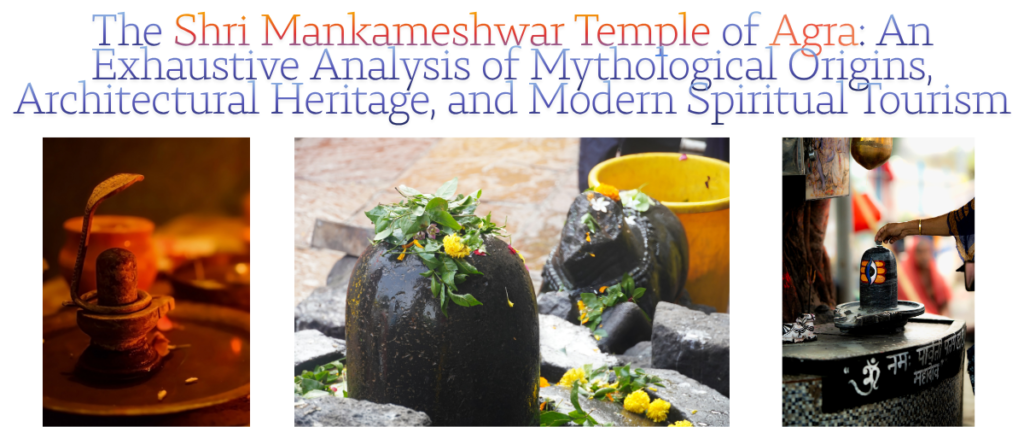
Introduction to the Spiritual Topography of Agra
The urban and cultural geography of Agra, located along the serpentine banks of the Yamuna River in the northern Indian state of Uttar Pradesh, is predominantly defined by its monumental Mughal architecture. Internationally acclaimed structures such as the Taj Mahal, the Agra Fort, and the meticulously planned, albeit abandoned, capital city of Fatehpur Sikri consistently overshadow the city’s ancient spiritual roots1. These UNESCO World Heritage Sites frame Agra in the global consciousness almost exclusively as a relic of the Islamic Mughal Empire. However, a deeper archaeological and sociological examination reveals an underlying, ancient religious infrastructure that predates the imperial era by millennia. Situated firmly within the broader Braj Mandal—a sacred geographical zone deeply associated with Hindu mythology and the life of Lord Krishna—Agra hosts a vibrant ecosystem of ancient shrines4.
At the very core of this ancient religious matrix stands the Shri Mankameshwar Temple, one of the most revered and historically significant Hindu temples in northern India6. Located strategically in the bustling, densely populated commercial district of Rawatpara, less than a kilometre from the imposing Agra Fort and in close proximity to the Jama Masjid, the Mankameshwar Temple serves as the spiritual anchor of the old city1. While the grand mausoleums of Agra draw millions of global tourists seeking historical and aesthetic enrichment, the Mankameshwar Temple operates as an active, breathing epicentre of daily devotion, drawing countless regional pilgrims who seek divine intervention, spiritual solace, and the manifestation of their deepest desires7.
This comprehensive report offers an exhaustive analysis of the Shri Mankameshwar Temple, exploring its profound theological foundations, its mythological inception during the Dwapara Yuga, and its complex historical evolution through centuries of dynastic shifts. The analysis further dissects the temple’s architectural syntax, its stringent ritualistic protocols, and its pivotal role in the civic and cultural life of Agra. Finally, the report investigates the temple’s emerging prominence within the Uttar Pradesh government’s contemporary push for spiritual tourism, illustrating how this ancient shrine is currently reshaping Agra’s modern identity.
Etymological Significance and Theological Foundations
To understand the enduring sociological pull of the Mankameshwar Temple, one must first analyse its nomenclature, which reveals the core theological premise of the shrine. The name “Mankameshwar” is a Sanskrit portmanteau seamlessly blending two profound concepts: Man, which translates to the human “mind” or “heart,” and Kameshwar, meaning the “Lord of desires” or “the supreme entity who fulfils wishes”7.
Within the expansive Hindu pantheon, Lord Shiva is traditionally characterised by a profound duality. He is simultaneously the ultimate, detached ascetic—meditating in the desolate, freezing peaks of Mount Kailash—and the deeply compassionate householder and granter of boons (Ashutosh) who is easily pleased by the pure devotion of his followers. The foundational belief that drives the relentless stream of pilgrims to the Mankameshwar Temple is the absolute conviction that prayers offered at this specific geographical coordinate, with absolute sincerity and purity of heart, will inevitably result in the materialisation of heartfelt wishes (manka ki iccha)12.
The primary object of veneration within the temple is not a sculpted idol, but a Swayambhu Shivalinga. In Hindu theology, a Swayambhu is an aniconic representation of the divine that is believed to be self-manifested, rather than carved or installed by human hands12. This self-manifested nature imbues the site with a concentrated, localised divine energy, transforming the temple from a mere place of congregation into a direct metaphysical conduit to the divine.
Mythological Genesis: The Dwapara Yuga Narrative
The origins of the Mankameshwar Temple are not anchored in documented historical timelines but are deeply embedded in the rich mythological tapestries of the Dwapara Yuga. According to Hindu cosmology, the Dwapara Yuga is the third of the four cosmic ages, most notably defined by the incarnation of Lord Vishnu as Krishna6. The foundational legend of the temple represents a fascinating theological convergence, illustrating the profound mutual reverence between the two principal deities of Hinduism: Lord Shiva (Shaivism) and Lord Krishna (Vaishnavism).
The Divine Descent and the Vow
Regional mythological narratives assert that upon acquiring cosmic knowledge of the birth of Lord Krishna in the nearby city of Mathura, Lord Shiva was overcome with an intense desire to witness the divine child8. Descending from his celestial Himalayan abode, Shiva traversed the northern plains toward Gokul, the pastoral village where the infant Krishna was being fostered by Nanda and Yashoda to protect him from his tyrannical uncle, Kamsa.
During this monumental transit, Lord Shiva halted his journey at the site of present-day Agra—specifically the forested area that would eventually become the urban sprawl of Rawatpara—to rest and engage in meditation overnight8. Before resuming his journey, Shiva made a solemn vow: if his profound desire to hold the infant Krishna in his arms was fulfilled, he would return to this exact geographic coordinate to establish a Shivalinga as a permanent marker of his gratitude8.
The Encounter in Gokul
When Lord Shiva finally arrived at the courtyard of Yashoda’s home in Gokul, he presented himself not as a radiant deity, but in his customary, fierce ascetic form. His body was smeared with pale cremation ashes, his hair was matted into coarse dreadlocks, and he was adorned with living serpents12. Naturally protective of her newborn, Mother Yashoda was terrified by the ascetic’s formidable appearance. Fearing that the strange, wild yogi would frighten or curse the child, she flatly refused him entry12.
Dejected but maintaining his divine composure, Lord Shiva retreated to the quiet outskirts of the village. Finding a large, ancient banyan tree, he sat beneath its sprawling canopy and entered a state of deep, silent meditation, hoping his spiritual concentration would reach the child12.
The Divine Play (Leela)
Sensing the presence, devotion, and disappointment of his divine visitor, the infant Krishna initiated a leela—a divine, theatrical play orchestrated for a higher cosmic purpose. Without warning, the infant began to weep inconsolably. He refused nourishment, rejected the pacification of Yashoda and the village attendants, and continuously pointed his tiny fingers toward the direction of the meditating ascetic under the banyan tree14.
Exhausted and realising that the child’s sudden distress was inextricably linked to the wandering yogi she had turned away, Yashoda relented. She summoned Shiva from the outskirts and, with great trepidation, placed the crying infant into the ash-covered arms of the ascetic. The moment Krishna made physical contact with Shiva, the divine play concluded; the child instantly calmed down, gazed at the ascetic, and smiled12.
The Manifestation of Mankameshwar
Overjoyed by the fulfilment of his ultimate desire, Lord Shiva returned to his resting spot in Agra. Keeping the vow he had made the previous night, he manifested a Shivalinga at the site12. According to the temple’s enduring doctrine, Shiva proclaimed a universal blessing upon the land: just as his deepest wish was fulfilled through his journey from this spot, the heartfelt desires of all true devotees who worshipped at this Linga would similarly be granted8. Consequently, the deity enshrined here became eternally known as Mankameshwar, the fulfiller of desires.
Historical Evolution and Dynastic Patronage
Tracing the empirical history of the Mankameshwar Temple presents the typical historiographical challenges associated with ancient Indian heritage sites, where myth, oral tradition, and documented history frequently intertwine. The history of Agra itself is highly stratified. The ancient settlement on the east bank of the Yamuna finds explicit mention in the epic Mahabharata as Agreva, meaning the border of the forest1. However, the ancient Hindu infrastructure of the city suffered catastrophic destruction during the invasions of Mahmud of Ghazni in the 11th century, leading to a long period of obscurity2.
The city re-emerged as a seat of power in 1504 when Sultan Sikandar Lodi rebuilt Agra, and it reached its zenith of global prominence starting in 1558 under the Mughal Emperor Akbar1. Against this volatile backdrop of violent invasions and shifting dynastic powers, the survival and continuous operation of the Mankameshwar Temple is a testament to its deep sociological roots.
The Lineage of the Caretakers
While comprehensive historical records from the pre-Mughal era are fragmented, local traditions and generational oral histories assert that the site has hosted continuous, unbroken worship for millennia8. Mahant Yogesh Puri, the current head priest and administrator of the temple, represents the 28th consecutive generation of his family tasked with overseeing the shrine. According to the temple’s internal records and the assertions of the Mahant, the sacred site boasts an antiquity of over 5,500 years, tracing its functional lineage directly back to the Mahabharata era4.
Mughal and Rajput Patronage
During the Mughal period, Agra transformed into a cosmopolitan hub of art, culture, theology, and global commerce. Contrary to the narrative of pervasive religious suppression, the Mankameshwar Temple actually experienced significant structural maintenance and enhancement during this era. Historical narratives indicate that Raja Man Singh I of Amber—a prominent Rajput ruler, the brother-in-law of Emperor Akbar, and one of the esteemed Navaratnas (Nine Jewels) in the Mughal court—played a critical role in the structural expansion and patronisation of the temple4.
Furthermore, some historical accounts suggest that Emperor Akbar himself, renowned for his broad policies of religious syncretism (Din-i-Ilahi) and his deep intellectual curiosity regarding Hinduism, permitted and possibly facilitated the renovation of the temple4. This period highlights a remarkable era of peaceful coexistence, wherein a major Hindu shrine was allowed to thrive and expand within the very heart of the Islamic empire’s bustling capital.
The Maratha Resurgence
The temple’s prominence was further consolidated during the decline of Mughal hegemony and the subsequent rise of the Maratha Empire (1758–1818). During this period, prominent Maratha leaders took an active interest in reclaiming and restoring Hindu heritage sites across northern India. Records highlighted by the Tourism Guild of Agra note that Mahadji Scindia and the legendary queen Ahilyabai Holkar—famous for her extensive philanthropy and reconstruction of major Hindu temples from Kashi to Somnath—helped resurrect, fund, and patronise numerous Shiva temples in the broader Agra and Bateshwar region, firmly securing Mankameshwar’s structural and financial future4.
Modern Additions
The structural and theological evolution of the temple has continued into the contemporary era. In 2004, acting to solidify the mythological link to its founding narrative, a new idol of Lord Krishna was formally installed within the temple complex. This addition was guided by the spiritual principles of Sri Nanaji and Sri Dwarikadeesh Nath from the neighbouring holy city of Mathura8. Today, the temple stands as a layered historical artifact, representing a synthesis of ancient mythology, medieval Rajput-Mughal patronage, Maratha restoration, and modern devotional practices.
Architectural Syntax and Spatial Dynamics
The Mankameshwar Temple exemplifies traditional North Indian Hindu temple architecture, specifically adhering to the Nagara style. This architectural tradition is characterised by towering, curvilinear spires and a highly specific spatial layout designed to guide the devotee from the chaotic external world into a state of deep internal focus11. While it does not feature the colossal physical scale or the intricate marble pietra dura inlay work of its Mughal neighbours like the Taj Mahal, the temple’s architecture is profoundly symbolic and psychologically effective.
Integration into the Urban Fabric
The temple seamlessly integrates into the dense, historic urban fabric of Rawatpara. This district is a bustling, chaotic commercial zone renowned as one of Agra’s oldest and most famous wholesale markets, trading in fresh spices, dry fruits, and traditional Agra sweets such as petha, mawa, and milk cake6. This juxtaposition of the sacred and the profane—a serene, ancient temple nestled securely within a high-energy mercantile environment—is a defining hallmark of ancient Indian city planning.
The Shikhara, Exterior, and Mandapa
The temple complex is crowned by a modest yet elegantly constructed Shikhara (upper dome or tower)8. In the Nagara architectural tradition, the Shikhara is not merely a roof; it represents Mount Meru, the cosmic mountain at the centre of the universe, and symbolises the human soul’s upward ascension toward divine realization12.
The exterior walls and the main entrance of the temple are crafted from stone and feature intricate carvings that depict various scenes from Hindu mythology, particularly those associated with the life, manifestations, and family of Lord Shiva12. Upon passing through the ornately carved main entrance, visitors step into a spacious Mandapa (congregational hall)8. This hall is designed for communal prayer, meditation, and waiting before entering the sanctum. The walls of the Mandapa are richly adorned with detailed sculptures and paintings of Shiva, Goddess Parvati, Lord Ganesha, and various other divine entities, establishing an atmosphere charged with spiritual energy11. Positioned strategically in front of the pathway to the main sanctum is a prominent, beautifully carved stone statue of Nandi, the sacred bull and Lord Shiva’s divine vehicle (vahana), serving as the eternal gatekeeper of the Lord8.
The Descent into the Garbha Griha
The most striking architectural and psychological feature of the Mankameshwar Temple is its Garbha Griha, or inner sanctum sanctorum. Unlike many modern or South Indian temples where the sanctum is elevated on a high plinth, the Garbha Griha at Mankameshwar is situated in a subterranean or basement-like level. Devotees are required to descend a score of stairs to reach the innermost chamber9.
This architectural choice creates a profound physiological and psychological shift. The physical descent into the earth symbolises a journey inward, pulling the devotee away from the sensory overload of the Rawatpara market above and into the deep recesses of the self. Furthermore, the thick stone walls of the subterranean chamber naturally regulate the temperature, keeping the inner sanctum cool, quiet, and serene, completely insulated from the blistering heat of the Agra summer6.
At the centre of this subterranean sanctum resides the primary deity: the Swayambhu Shivalinga. Crafted originally from black stone, the massive Linga is completely encased and covered in pure silver6. The visual impact of the silver deity, illuminated by the flickering, golden light of traditional oil lamps within the dark stone chamber, is highly mesmerising. The Linga is closely surrounded by smaller idols representing the typical Shiva family (Parvati, Ganesha, and Kartikeya)9.
Adding to the mystical ambience of the sanctum is the presence of eleven Akhanda Jyotis (eternal lamps). These lamps are fueled exclusively by pure ghee and are maintained to burn continuously, never being allowed to extinguish12. Devotees whose wishes have been fulfilled frequently return to sponsor the lighting and maintenance of these lamps as a profound gesture of gratitude, with financial contributions scaling from modest amounts to vast sums depending on the devotee’s capacity14.
Satellite Shrines
Behind the main subterranean shrine, the complex opens up to reveal a network of smaller, secondary temples. These satellite shrines accommodate a diverse array of deities, effectively creating a microcosm of the Hindu pantheon and allowing devotees to perform comprehensive worship without leaving the complex. A large, sacred banyan tree within the complex serves as a living, botanical monument to the temple’s founding myth, marking the exact spot where Shiva is said to have meditated12.
| Deity/Shrine | Significance within the Complex |
| Goddess Ganga | Represents purity; essential for Shaivite worship as Ganga resides in Shiva’s hair.9 |
| Goddess Saraswati | Goddess of knowledge, music, and learning.9 |
| Goddess Gayatri | The personification of the sacred Gayatri Mantra, representing spiritual illumination.9 |
| Lord Hanuman | The ultimate devotee of Rama, representing strength, devotion, and protection.9 |
| Kaila Devi | A regional manifestation of the Goddess, deeply venerated in the Braj and Rajasthan areas.8 |
| Lord Narasimha | The fierce, half-man, half-lion avatar of Vishnu, worshipped for the removal of obstacles.9 |
| Lord Rama & Krishna | Integrating the Vaishnavite tradition, honouring the core founding myth of the temple.8 |
Ritualistic Framework, Purity, and the Dress Code
Hindu temple worship is meticulously governed by ancient texts known as the Agama Shastras, which dictate the precise protocols for temple construction, idol consecration, and daily ritual worship19. At the Mankameshwar Temple, the rules governing physical purity and sartorial presentation are strictly enforced by the temple authorities and pandits. These rules apply specifically to those who wish to descend into the Garbha Griha and approach the silver-plated Vigraha directly, rather than viewing it from the peripheral galleries6.
The Absolute Prohibition of Leather
One of the most rigid and universally enforced rules at Mankameshwar is the absolute prohibition of leather items within the inner sanctum. Devotees are strictly forbidden from wearing or carrying leather belts, wallets, jackets, watch straps, or purses9.
This mandate stems directly from the fundamental Hindu principle of Ahimsa (non-violence) and the deep cultural and religious reverence for the cow. Leather, being the byproduct of a slaughtered or deceased animal, is considered ritually impure (ashudh). Introducing such materials into the Garbha Griha is believed to violently disrupt the sacred, consecrated energy of the deity and the meditative atmosphere of the space19. Visitors are required to deposit all leather goods at designated areas outside the temple or with trusted vendors in the surrounding market before entering.
The Sartorial Mandate
While casual visitors and tourists can view the Shivalinga from a distance regardless of their attire, physical proximity to the deity in the inner sanctum is strictly conditional upon wearing traditional, culturally appropriate Indian clothing9.
The temple explicitly prohibits “English style pants” (trousers, jeans), pyjamas, and even certain modern styles of salwar suits for those wishing to approach the Vigraha9. Entry to the innermost sanctum mandates that men wear an unstitched dhoti, and women wear a traditional sari12. Similar stringent dress codes have been implemented at other prominent Mankameshwar temples, such as the shrine in Prayagraj (Allahabad), which recently instituted formal bans on Western attire, torn jeans, and short clothing during the holy Shravan month to maintain spiritual decorum21.
The theological and psychological reasoning behind these sartorial mandates is profound and multi-layered. According to temple tradition, tight, synthetic, or Western clothing is viewed as restrictive, unhygienic, and incongruent with the spiritual environment. Traditional, natural-fibre, unstitched garments like the cotton dhoti or silk sari are highly breathable, hygienic, and specifically designed for the physical demands of traditional temple worship, such as sitting cross-legged on stone floors for extended periods or performing full-body prostrations (dandavat pranam)19.
More importantly, the strict dress code serves a powerful egalitarian and psychological purpose. When a devotee dons the traditional dhoti or sari—the exact same garments worn by millions of worshippers across thousands of years—they visually and psychologically shed their modern socio-economic status, their professional identity, and their ego. The uniform dress code dissolves individuality, seamlessly transforming the singular person into a collective, humble entity of devotion before the immense presence of the divine19.
Universal Temple Etiquette
| Etiquette Rule | Theological / Practical Reasoning |
| Removal of Footwear | Shoes carry physical dirt and spiritual impurities from the secular world. Removing them marks the transition into a sacred, consecrated space and demonstrates deep humility.19 |
| Modesty in Dress | Shoulders, chests, and knees must be completely covered. Revealing clothing is considered a distraction to the meditative state of fellow devotees and deeply disrespectful to the deity.19 |
| No Photography in Sanctum | Photography disrupts the sacred atmosphere, turns a spiritual experience into a tourist spectacle, and violates the privacy of devotees in deep prayer.19 |
| Clockwise Circumambulation | Known as Pradakshina, walking clockwise around the deity aligns the devotee with the natural cosmic energy flows and shows respect by keeping the deity to the right side.20 |
Sacred Time: The Rhythm of Festivals and the Agra Parikrama
The spiritual life of the Mankameshwar Temple is not static; it is highly rhythmic, dictated by daily astronomical timings and the broader Hindu lunar calendar. The temple operates on a strict daily schedule, opening its doors to devotees from 5:00 AM until 10:00 PM (and occasionally extending to 11:00 PM on Mondays, the day most sacred to Shiva)6.
Daily Rituals and Aartis
The day is punctuated by morning and evening Aartis (elaborate rituals involving the offering of light, incense, and sound). The morning Aarti occurs shortly after opening, around 5:30 AM, serving to spiritually awaken the deity12. The evening Aarti, held around 7:30 PM, is a spectacular, highly sensory event. The subterranean sanctum fills with the resonant, collective chanting of “Om Namah Shivaya,” the rhythmic ringing of heavy brass bells, and the thick, intoxicating fragrance of camphor and incense7. Throughout the day, priests and devotees perform Abhishekam—the ritual bathing of the silver Linga with sacred elements such as holy water from the Ganges, raw milk, honey, bel leaves (bilva), dhatura, and bhang7.
| Temple Schedule | Timing Details |
| General Opening Hours | Sunday – Saturday: 5:00 AM to 10:00 PM (Mondays open till 11:00 PM)6 |
| Morning Aarti | Approximately 5:30 AM12 |
| Afternoon Break (Darshan closed) | 12:00 PM to 4:00 PM12 |
| Evening Aarti | Approximately 7:30 PM12 |
The Month of Shravan (Sawan)
The spiritual intensity at Mankameshwar reaches its absolute zenith during the Hindu holy month of Shravan or Sawan (typically falling across July and August), a period entirely dedicated to the veneration of Lord Shiva7. During this month, the temple experiences a massive, unrelenting influx of devotees. Special, highly complex rituals, including extensive Rudrabhishek (a continuous bathing ritual accompanied by the chanting of complex Vedic mantras) and the Mahamrityunjaya Jaap (powerful chants for overcoming death, disease, and suffering), are performed daily12.
Mondays during Sawan (Sawan Somvar) are considered exceptionally auspicious. On these days, the temple is filled far beyond its normal physical capacity. Devotees observe strict dietary fasts and carry pots of holy water from the Ganges (Jalabhishek) to pour over the Linga7. The atmosphere in Rawatpara becomes electric, charged with deep devotion and the collective, vibrant energy of thousands of pilgrims.
The Agra Parikrama and Sawan Melas
A unique cultural and religious phenomenon exclusive to the city of Agra is the tradition of the Sawan Melas (fairs) and the gruelling Agra Parikrama (circumambulation). Geographically, the city of Agra is spiritually guarded by four ancient Shiva temples situated at the four cardinal corners of the city.
Throughout the four Mondays of Sawan, a massive civic fair is held sequentially at each of these four peripheral temples. These fairs are monumental events that physically take over the city; national highways are frequently blocked to accommodate the crowds, huge temporary amusement parks are erected, and local government offices and courts officially recognise a holiday on the third Monday to allow citizens to participate24.
| Sawan Monday | Designated Temple for the Mela |
| First Monday | Rajeshwar Mahadev Temple24 |
| Second Monday | Balkeshwar Temple24 |
| Third Monday | Kailash Temple (Features a major local holiday and free entry to Akbar’s Tomb at Sikandra)24 |
| Fourth Monday | Prithvinath Temple24 |
On the Sunday night preceding the second Monday, tens of thousands of devotees undertake the Parikrama—an arduous, all-night barefoot pilgrimage that spans the entire perimeter of the city, visiting the Shiva temples one by one25. As the most central and historically prominent Shiva temple, Mankameshwar serves as the spiritual anchor for this city-wide devotion. When the lunar calendar occasionally yields a month of Sawan with a rare fifth Monday, the culminating grand fair is hosted at the Mankameshwar Temple itself, unequivocally highlighting its supreme status among the city’s Shaivite shrines24.
Mahashivratri and the Ram Baraat Procession
Beyond the monsoon month of Sawan, the temple celebrates Mahashivratri (The Great Night of Shiva) with unparalleled fervour. The festival commemorates the divine cosmic marriage of Lord Shiva and Goddess Parvati8. Devotees observe strict night vigils (jagaran), and the temple remains open continuously through the night, beautifully decorated with flowers and lights, and humming with classical musical performances and special aartis7.
Furthermore, the Mankameshwar Temple plays a foundational role in Agra’s celebration of the Ramleela, a deeply Vaishnavite festival. As the monsoon recedes and winter approaches, the city enacts the epic Ramayana. The episode of Lord Rama’s marriage to Goddess Sita is celebrated with a massive, night-long procession known as the Ram Baraat. Historically and traditionally, this grand, highly orchestrated procession—which includes decorated elephants, massive illuminated floats, brass bands, and thousands of participants—commences directly from the Mankameshwar Temple before winding its way through the city to ‘Janakpuri’ (a designated neighbourhood elaborately decorated to represent the bride’s kingdom)25. This event firmly intertwines the ancient Shaivite temple with the city’s broader Vaishnavite traditions and massive civic celebrations.
Modern Resurgence: The “Agra Beyond Taj” Paradigm
For the past century, the domestic and international tourism narrative of Agra has been overwhelmingly monopolised by the Taj Mahal and the legacy of the Mughal Empire. While this hyper-focus on Islamic architecture has brought global recognition and massive economic benefit to the city, it has historically eclipsed Agra’s rich, indigenous Hindu heritage. In recent years, however, there has been a concerted, heavily funded paradigm shift spearheaded by the Uttar Pradesh state government, heritage societies, and local tourism guilds. The goal is to rebrand, diversify, and expand Agra’s identity by aggressively highlighting its ancient spiritual roots5.
Grassroots Advocacy and Symposiums
Organisations such as SPHEEHA (Society for Preservation of Health Environment and Ecology and Heritage of Agra), working in close partnership with the Tourism Guild of Agra, have begun hosting high-profile annual symposiums titled “Agra Beyond Taj.” These academic and civic events aim to deliberate the chronology, historical importance, and tourism potential of Shiva temples in Agra and the nearby Bateshwar region (famous for its 101 Shiva temples along the Yamuna bend)5. Environmental activists, academic historians, and prominent hoteliers are actively advocating for Agra to be recognised not just as a grand Mughal city, but as a premier “hub of Shiva bhakti” and a heritage city defined equally by its centuries-old temples4.
Conclusion
The Shri Mankameshwar Temple is far more than a historical footnote overshadowed by the sweeping marble domes of the Mughal era; it is the pulsating, ancient spiritual heart of Agra. From its mythological genesis in the Dwapara Yuga—where the fierce ascetic Lord Shiva sought the pure joy of holding the infant Krishna, blending Shaivite and Vaishnavite traditions—to its current, prominent status as a focal point of Uttar Pradesh’s massive spiritual tourism renaissance, the temple represents an unbroken continuum of human faith and resilience.
Its unique architectural features, specifically the subterranean Garbha Griha and the silver-covered Swayambhu Shivalinga illuminated by the mesmerising glow of eternal ghee lamps, offer devotees an intimate, highly sensory spiritual experience. The rigid adherence to ancient Agama Shastras regarding traditional dress codes and ritual purity ensures that the sacred atmosphere of the inner sanctum remains entirely uncorrupted by the hyper-modernity and chaos of the outside world. Meanwhile, massive civic traditions like the gruelling Agra Parikrama, the monumental Sawan Melas, and the vibrant Ram Baraat procession inextricably link the temple’s daily rhythm to the very pulse of the city itself.
As Agra looks toward the future, actively seeking to balance its global identity between a medieval architectural marvel and an ancient pilgrimage site, the Mankameshwar Temple stands as a vital, unshakeable anchor. It serves as a powerful reminder to residents and visitors alike that long before Agra was the capital of conquering emperors, it was the resting place of gods, where the deepest, most heartfelt desires of humanity have been whispered into the cool stone of the sanctum for thousands of years.
Disclaimer
The information provided regarding temple timings, festival schedules, specific rituals, and strict dress codes is for general informational and educational purposes. As with all active religious and heritage sites, these protocols and timings are subject to change based on the lunar calendar, local administrative decisions, and religious authorities. Travellers and devotees are advised to verify current guidelines with local authorities prior to visiting.
References
- Agra to Salon – Jagdamba Tourism, https://www.jagdambatourism.com/routes-directory/Agra-to-Salon
- Agra – Wikipedia, https://en.wikipedia.org/wiki/Agra
- (PDF) AGRA- VISION 2030 – ResearchGate, https://www.researchgate.net/publication/328953933_AGRA-_VISION_2030
- Never mind Taj Mahotsav, Agra to be hub of Shiv bhakti – National Herald, https://www.nationalheraldindia.com/national/agra-to-promote-spiritual-tourism-now
- agra to promote spiritual tourism now – Tripuratimes, https://tripuratimes.com/ttimes/agra-to-promote-spiritual-tourism-now-14318.html/
- Shri Mankameshwar Temple, Agra, Agra, India – Reviews, Ratings, Tips and Why You Should Go – Wanderlog, https://wanderlog.com/place/details/4383/shri-mankameshwar-temple-agra
- Mankameshwar Temple, Agra: History, Timings & Must-Visit Attractions – +Rajasthan Tour Package, https://www.aagmanrajasthantours.com/blog/agra/mankameshwar-temple-agra-history-timings-must-visit-attractions/
- Mankameshwar Temple, Agra – Timings, Festivals, History, Darshan, Pooja Timings, https://www.trawell.in/uttar-pradesh/agra/mankameshwar-temple
- Mankameshwar Temple – Wikipedia, https://en.wikipedia.org/wiki/Mankameshwar_Temple
- Destinations in Agra, https://avantikasangle.wordpress.com/2015/05/07/destinations-in-agra/
- Mankameshwar Temple: A Complete Guide to History, Timings, and Must-Visit Attractions, https://discoverindiabycar.com/mankameshwar-temple/
- Maa Mankameshwar Temple Agra: History, Timings, Significance & Darshan Guide, https://www.srimandir.com/articles/temple/maa-mankameshwar-temple-agra?lang=en
- Mankameshwar Mahadev Temple – History & Darshan Timings – Mahakal.com Blogs, https://mahakal.com/blog/en/mankameshwar-mahadev-temple-history-darshan-timings
- Shri Mankameshwar Ji Shringar Aarti Darshan Agra – YouTube, https://www.youtube.com/watch?v=6wnTaBjsitQ
- Shri Mankameshwar Temple, Agra – Timings & Entryfee – My Holiday Happiness, https://myholidayhappiness.com/place/uttar-pradesh/agra/shri-mankameshwar-temple
- Agra to promote spiritual tourism now – AP7AM, https://www.ap7am.com/en/75606/agra-to-promote-spiritual-tourism-now
- Agra Spice Markets and Old Bazaars | Complete Guide, https://www.tajwithguide.com/blog/agra-spice-markets-and-old-bazaars/
- Agra Hidden Gems Heritage Tour by Tuk-Tuk with Local Guide, https://www.tripspoint.com/india/agra/tour/city-tours/agra-hidden-gems-heritage-tour-by-tuk-tuk-with-local-guide/16483
- Temple Dress Code in India – Complete Guide for All Major Temples (Men & Women), https://hindutempleguide.com/temple-dress-code-india-complete-guide/
- Temple Etiquette: 9 Tips on Visiting India’s Holy Places – Greaves India, https://greavesindia.co.uk/temple-etiquette-9-tips-on-visiting-indias-holy-places/
- No short clothes, selfies: Prayagraj temple enforces strict rules for devotees – India Today, https://www.indiatoday.in/india/story/mankameshwar-temple-dress-code-shravan-prayagraj-rudrabhishek-attire-2949673-2026-07-17
- ‘dress Code’ For Devotees In Mankameshwar Temple | Prayagraj News – The Times of India, https://timesofindia.indiatimes.com/city/allahabad/dress-code-for-devotees-in-mankameshwar-temple/articleshow/100952269.cms
- Hindu Temple Etiquette – Adventurous Women, https://www.adventurouswomen.com.au/adventurous-women-blog/hindu-temple-etiquette
- First Monday of Sawan brings festivities to Taj city – Hindustan Times, https://www.hindustantimes.com/cities/others/first-monday-of-sawan-brings-festivities-to-taj-city-101721660654266.html
- Fairs & Festivals of Agra – India Tour Packages, https://www.samedaytours.in/agra-tour-packages/fairs-&-festivals-of-agra.html
- August | 2021 | Memories and Such, https://memoriesandsuch.com/2021/08/
- UP launches review of 80 tourism, religious projects worth Rs 500 crore | Agra News, https://timesofindia.indiatimes.com/city/agra/up-launches-review-of-80-tourism-religious-projects-worth-rs-500-crore/articleshow/132520967.cms
- UP launches ground audit of ₹500-crore tourism projects – Hindustan Times, https://www.hindustantimes.com/cities/lucknow-news/up-launches-ground-audit-of-500-crore-tourism-projects-101784576674609.html
- UP begins ground review of tourism, culture projects – The Statesman, https://www.thestatesman.com/india/up-begins-ground-review-of-tourism-culture-projects-1503618850.html
- Religious heads condemn Dhaka attack | Agra News – The Times of India, https://timesofindia.indiatimes.com/city/agra/religious-heads-condemn-dhaka-attack/articleshow/53067547.cms