
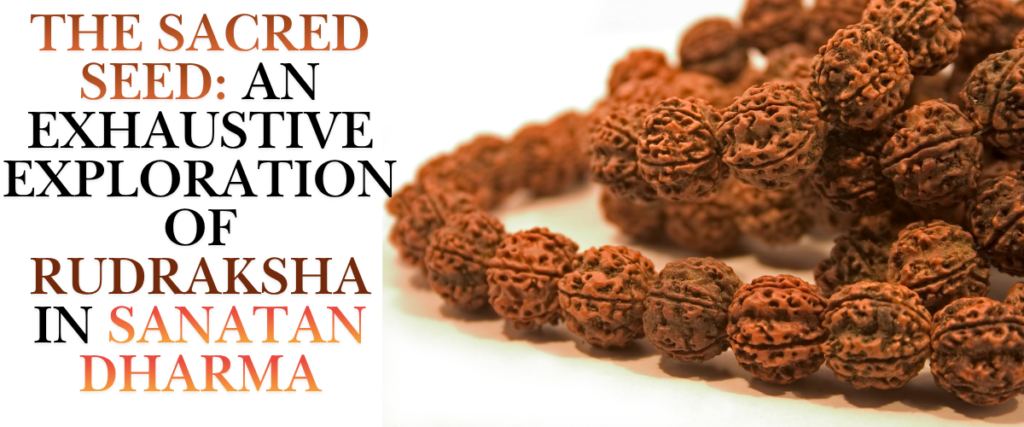
Introduction to the Divine Manifestation
Within the profound, multidimensional tapestry of Sanatan Dharma, few sacred objects command the absolute reverence, universal recognition, and sustained devotion accorded to the Rudraksha. Botanically classified under the genus Elaeocarpus, with Elaeocarpus ganitrus being the most highly venerated species, this extraordinary seed transcends its physical botanical identity1. In the vast spiritual landscape of Hinduism, the Rudraksha is not merely an inert ritualistic accessory or a symbolic emblem of faith; rather, it is recognised as a living, bio-energetic conduit designed to bridge the chasm between the Jivatma (the individual, mortal soul) and the Paramatma (the supreme, universal consciousness)4.
The etymology of the term itself reveals its supreme metaphysical positioning within Vedic and Puranic theology. The word is a synthesis of two ancient Sanskrit roots: “Rudra,” which is the fierce, primordial, and transformative epithet for Lord Shiva, and “Aksha,” which translates to eyes or tears2. Therefore, the Rudraksha literally translates to “The Tears of Shiva”4. For millennia, these intricately faceted seeds have been sought after and worn by ascetic yogis deep within the Himalayan caves, great monarchs governing vast empires, and ordinary householders navigating the complexities of worldly life2. Across the traditions of Shaivism, Shaktism, and various esoteric ascetic lineages, the seed is understood to be a highly active spiritual technology. It is prescribed as an indispensable instrument to harmonise the physical body’s energetic centres (chakras), systematically incinerate accumulated karmic imprints, and construct an impenetrable bio-spiritual shield against malevolent forces5.
The physical human body, according to Sanatan Dharma, is a sacred vessel intended for the ultimate pursuit of Moksha, or spiritual liberation. In this pursuit, the Rudraksha acts as an anchor. This comprehensive analysis explores the Rudraksha through the multi-layered lenses of traditional Hindu thought, examining its mythological origins meticulously recorded in the Puranas, the scriptural mandates found within the Upanishads, the complex anatomy of its various facets (Mukhis), the sacred mathematics governing the 108-bead Japa Mala, its remarkable biophysical properties documented by traditional and modern sciences, and the precise, rigorous ritualistic processes required to awaken its dormant divine energy.
The Genesis of the Sacred Seed: Mythological Narratives in the Puranas
In the cosmological framework of Sanatan Dharma, historical events, psychological realities, and spiritual truths are seamlessly woven into the grand narratives of the Puranas. The origin of the Rudraksha is chronicled across several major scriptural texts, most notably the Shiva Purana, the Devi Bhagavata Purana, and the Skanda Purana. While the contextual details of these sacred narratives offer different lenses, they universally converge upon a single, undeniable theological truth: the Rudraksha is the direct, physical crystallisation of divine emotion descending into the material plane8.
The Meditation of Boundless Compassion
The most universally accepted and widely recited account of the seed’s origin is found within the Vidyeshvara Samhita of the Shiva Purana. According to this ancient text, Lord Shiva, the supreme ascetic who continuously sustains the energetic equilibrium of the cosmos, entered a state of absolute, unmoving meditation on Mount Meru8. This prolonged period of intense penance, stretching across thousands of divine years, was not undertaken for His personal spiritual evolution, for He already embodies absolute enlightenment. Instead, He meditated out of a profound, overwhelming compassion for the immense suffering of all living beings hopelessly trapped in the cyclical wheel of Samsara (birth, death, and rebirth)5.
When Lord Shiva finally brought this epochal meditation to a close and opened His lotus-shaped eyes, the sheer magnitude of His compassion and His acute awareness of the world’s endless afflictions caused a steady stream of tears to cascade down His divine face8. These tears did not simply evaporate into the ether; rather, upon making contact with the sacred soil of the Himalayan ranges, the Sitsail hills, and other consecrated lands across the earth, they miraculously crystallised and sprouted into the first great forests of the Rudraksha tree5. The Shiva Purana explicitly notes that these sacred seeds were purposefully distributed across the earth as a divine gift to mankind. They serve as physical remnants of divine empathy, designed specifically to alleviate human misery, grant material abundance, and ultimately guide earnest seekers toward spiritual liberation5. A parallel narrative within the same text suggests that during a different period of intense meditation on Mount Kailash, the sheer kinetic energy generated by Shiva’s concentration caused drops of sweat to fall from His forehead, which similarly transformed into the sacred trees, emphasising the seeds’ link to immense spiritual power5.
The Annihilation of Tripurasura and the Tears of Cosmic Relief
An equally significant and dramatic origin narrative is chronicled in the Devi Bhagavata Purana, which situates the birth of the Rudraksha within the violent context of a cataclysmic cosmic war1. The texts describe a highly ambitious and immensely powerful Asura (demon) named Maya, who, alongside his brothers, collectively became known as Tripurasura9. Through decades of impossibly severe austerities, Tripurasura managed to secure an unparalleled boon from Lord Brahma, allowing for the construction of three impregnable, flying fortress cities constructed entirely of gold, silver, and iron9. These cities could only be destroyed by a single, perfectly aimed arrow at the exact moment they aligned in the sky—an astronomical improbability occurring only once every thousand years8.
Empowered by this near-invincibility, Tripurasura unleashed an era of unprecedented terror across the universe, effortlessly subjugating the Devas (celestial beings), looting the heavenly treasures, and usurping the cosmic throne of Indra9. Rendered helpless, the celestial trinity of Brahma and Vishnu approached Lord Shiva, begging for divine intervention to save creation9. Responding to their desperate pleas, Shiva assumed His fierce, destructive aspect, known as Aghora or Rudra, and prepared for an apocalyptic confrontation2. The cosmos itself volunteered to serve as His armaments: the earth morphed into His chariot, the sun and moon became the wheels, Lord Brahma took the reins as the charioteer, and Lord Vishnu Himself manifested as the lethal tip of Shiva’s arrow9.
When the three demonic cities finally aligned, Lord Shiva unleashed the devastating Aghora weapon. The weapon, blazing with the combined strength and fire of all the Devas, instantaneously incinerated the flying cities and eradicated the demonic forces, thereby restoring order to the universe2. The unfathomable concentration required to summon and direct this unimaginable destructive force forced Shiva to keep His eyes unblinkingly wide open for a thousand divine years1. Following the successful release of the weapon, tears streamed profusely from His strained, burning eyes2. Some theological interpretations suggest these were tears of wrathful exhaustion, while others view them as tears of immense relief for a cosmos finally permitted to exhale5. From the exact locations where these potent tears touched the earth, the great forests of the Rudraksha tree sprang forth2.
The Tears of Devastating Grief
A third narrative thread, heavily prevalent in specific Shakta traditions, traces the origin of the tears to the tragic, heartbreaking death of Shiva’s first consort, Goddess Sati8. Following Sati’s self-immolation in the sacrificial fire of her father, Daksha—who had deeply insulted Shiva and purposefully excluded Him from a grand cosmic sacrifice—the Lord was consumed by an all-encompassing, world-shattering grief5. As He wandered the universe in a state of inconsolable mourning, carrying the charred remains of His beloved, His tears of profound sorrow fell to the earth, immediately transmuting into the sacred seeds5. This narrative carries a drastically different emotional register. It frames the Rudraksha not as a byproduct of abstract universal compassion or martial exertion, but as the physical manifestation of the most personal kind of pain and a love capable of breaking the Supreme Being8. The Rig Veda subtly hints at this transformative power by referring to Rudra as the one who eradicates misery (“Rukha Dravyati Iti Rudra”), possessing the unique capability to convert tears of agonising sorrow into tears of eternal joy5.
Regardless of the narrative variance—whether rooted in compassion, cosmic duty, or intimate grief—the theological essence remains unyieldingly identical: the Rudraksha is the ultimate intersection of the divine and the material, capturing the raw, transcendent emotion of the Supreme Being in a physical, tangible form that humans can hold in their hands5.
Scriptural Authority, the Upanishads, and the Varna Classifications
The supreme reverence for the Rudraksha is not limited to mythological storytelling; it is strictly codified in an extensive array of Vedic and Puranic literature. Beyond the Shiva Purana and the Devi Bhagavata Purana, the bead is meticulously analysed and categorised in the Padma Purana, the Skanda Purana, and most significantly, the Rudrakshajabala Upanishad2.
The Esoteric Teachings of the Rudrakshajabala Upanishad
The Rudrakshajabala Upanishad stands as a major foundational text within the Shaiva tradition. It is structurally composed as a highly esoteric dialogue between Kalagni Rudra, a formidable and radiant manifestation of Lord Shiva, and the venerable sage Sanatkumara (sometimes referred to alongside Sage Bhusunda)10. In this sacred exchange, Kalagni Rudra elaborates extensively on the metaphysical properties of the beads, detailing the origins, the specific spiritual benefits of wearing them, and prescribing the exact Vedic mantras required for their use11. The Upanishad unequivocally confirms that simply viewing, touching, or wearing the bead initiates a profound spiritual cleansing10. The text asserts that the beads act as a catalyst for dissolving the deepest layers of negative karma accumulated over countless lifetimes, accelerating the wearer’s journey toward self-realisation.
The Thirty-Eight Varieties and the Metaphysics of Varna
According to the extensive details provided in the Devi Bhagavata Purana, specifically within the teachings imparted by Lord Shiva to His son Kartikeya, the divine tears birthed a total of thirty-eight distinct varieties of the Rudraksha tree1. These varieties did not emerge uniformly; they sprang from different aspects of Shiva’s divine gaze, each carrying a unique elemental and symbolic signature:
The right eye, known as the Surya Netra, represents the radiant, life-giving energy of the Sun God. From the tears of the Surya Netra, twelve varieties of yellow-colored Rudraksha seeds were produced1. The left eye, known as the Soma Netra, represents the cooling, emotional, and intuitive energy of the Moon. The tears from this eye generated sixteen varieties of white-colored seeds1. The third eye, situated on the forehead and known as the Agni Netra, represents the subtle fire of absolute wisdom and destruction of ignorance. From this eye, ten varieties of deeply colored red and black seeds emerged1.
In ancient historical contexts, these colours were symbolically mapped to the four Varnas (the foundational societal structures) of the Vedic period to guide devotees1. The white beads, associated with purity and the moon, were deemed most suitable for Brahmanas, the scholars, priests, and custodians of spiritual knowledge1. The red beads, carrying the fiery energy of the third eye, were assigned to Kshatriyas, the warriors, kings, and administrators who required courage and martial prowess1. The yellow beads, linked to the sun and material manifestation, were prescribed for Vaishyas, the merchants and agriculturalists1. Finally, the black beads were designated for Shudras, the artisans, labourers, and bedrock of societal infrastructure1.
However, as the spiritual sciences evolved, the scriptures explicitly clarified that this classification is purely symbolic and educational, rather than restrictive. Lord Shiva explicitly proclaimed that humans of all castes, all genders, and all stations in life—as well as those earnestly on the path to liberation regardless of their societal background—are completely free to wear any colour of Rudraksha to attain divine grace2. The Padma Purana takes this inclusivity even further, stating unequivocally that wearing the beads benefits even staunch atheists and unrepentant sinners9. The inherent divine energy of the seed operates on universal laws of biophysics and spiritual resonance, and therefore, it does not discriminate based on the wearer’s current state of belief or enlightenment9.
The Anatomy of Consciousness: An Exegesis of the Mukhis
The surface of a genuine, mature Rudraksha seed is traversed by deep, natural clefts or lines that run vertically from the top (the mouth) to the bottom (the tail). These natural grooves divide the seed into distinct segments known in Sanskrit as Mukhis, meaning faces or facets4. In the profound spiritual science of Sanatan Dharma, the number of Mukhis on a particular seed is not a mere botanical curiosity; it dictates the exact vibrational frequency of the bead13. This frequency determines the seed’s ruling deity, its corresponding planetary energy (Graha) in Vedic astrology, and the highly specific physiological, psychological, and spiritual benefits it confers upon the wearer13.
The classical texts identify and expound upon Mukhis ranging primarily from one to fourteen, with each facet serving as a specialised spiritual key designed to unlock different dimensions of human potential13.
The 1 Mukhi Rudraksha is universally acknowledged within the scriptures as the most profound, sacred, and rarest of all manifestations. Serving as the direct embodiment of pure consciousness and Lord Sadashiva himself, this singular facet acts as a conduit to the Parabrahman, the ultimate reality13. Governed by the Sun (Surya), it corresponds directly to the Sahasrara (Crown) chakra, making it the ultimate tool for ascetics and serious seekers engaged in deep meditation13. It induces intense detachment from worldly illusions, dissolves the deepest karmic blockages, and bestows supreme leadership qualities drawn from inner spiritual clarity13.
Moving from absolute unity to duality, the 2 Mukhi Rudraksha represents Ardhanarishvara, the divine, unified androgyne form of Lord Shiva and Goddess Parvati13. This bead symbolises the perfect synthesis of masculine and feminine energies within the universe. Governed by the Moon (Chandra), it is widely prescribed for healing severe emotional turbulence, dissolving deep-seated anxieties, and fostering profound harmony and loving understanding in marital, familial, and social relationships13.
The 3 Mukhi Rudraksha is blessed by Agni Dev, the God of Fire, and is governed by the volatile and dynamic planet Mars (Mangal)13. Just as physical fire indiscriminately purifies all that it touches, the energy of the 3 Mukhi incinerates past karmas, deep-seated guilt, and chronic lethargy13. It is highly recommended for individuals suffering from low self-esteem or depression, as it restores the bold decisiveness, physical vitality, and inner courage required to achieve material and spiritual triumphs13.
Representing the creative force of the universe, the 4 Mukhi Rudraksha is blessed by Lord Brahma, the creator, and Goddess Saraswati, the patron of knowledge13. Ruled by Mercury (Budh), the planet governing intellect and communication, this bead is renowned for sharpening memory, enhancing creative expression, and dissolving blocks in public speaking or writing13. It has served for centuries as the traditional talisman for students, scholars, scientists, and journalists seeking excellence in knowledge-based pursuits13.
The 5 Mukhi Rudraksha is the most universally abundant, accessible, and widely recommended bead in Sanatan Dharma, considered entirely safe and beneficial for men, women, and children of all ages without requiring strict astrological consultation13. Representing Kalagni Rudra, the fierce fire of time, and ruled by the expansive planet Jupiter (Guru), it systematically balances the five elements (Pancha Mahabhutas) within the human body13. It is primarily worn to lower blood pressure, alleviate chronic stress, ensure general holistic well-being, and provide a foundational shield of spiritual protection during daily life13.
Associated with the martial prowess of Lord Kartikeya, the warrior son of Shiva, the 6 Mukhi Rudraksha is ruled by the planet Venus (Shukra)7. This bead fundamentally grounds the wearer, instilling immense willpower, unshakeable focus, and fearless confidence16. It is highly beneficial for the youth, career-driven professionals, and individuals seeking to overcome past traumas, emotional instability, or a lack of motivation16.
The 7 Mukhi Rudraksha represents the benevolent Goddess Mahalakshmi, the deity of wealth, abundance, and auspiciousness, and is governed by the stern planet Saturn (Shani)7. In Vedic astrology, Saturn can bring periods of immense hardship; thus, this bead is specifically worn to counteract the severe astrological periods such as Sade Sati14. It is universally renowned for attracting financial prosperity, stabilising volatile careers, and providing relief from chronic, lingering physical ailments14.
Blessed by Lord Ganesha, the beloved remover of obstacles, the 8 Mukhi Rudraksha is ruled by the shadow planet Rahu15. It is worn specifically by individuals facing unexpected delays, continuous failures, or insurmountable difficulties in their lives. The bead brings profound steadiness, grounding energy, and guaranteed success in new business ventures while entirely neutralising the chaotic, malefic effects associated with a poorly placed Rahu in the birth chart15.
The 9 Mukhi Rudraksha embodies the fierce, protective, and invincible energy of Goddess Durga in her Navadurga form14. Governed by the descending lunar node, Ketu, this bead grants the wearer an impenetrable shield of courage, boundless vitality, and absolute fearlessness14. It is particularly recommended for women seeking empowerment in challenging environments, as well as those struggling with severe, irrational phobias or spiritual insecurities14.
Standing uniquely among the beads, the 10 Mukhi Rudraksha represents Lord Vishnu, the preserver of the universe, specifically encompassing the protective energies of His ten incarnations (Dashavatar)16. Unlike other facets, it is not ruled by a single, specific planet; instead, it acts to harmonise and pacify the energies of all nine planets (Navagrahas) simultaneously17. It functions as a powerful Raksha Kavach (protective armour), neutralising the effects of black magic, the evil eye, jealousy, and deeply entrenched psychological anxieties14.
The 11 Mukhi Rudraksha symbolises the combined power of the Ekadash Rudras and the supreme devotion of Lord Hanuman14. It blesses the wearer with immense physical and mental strength, unwavering courage, and strict self-discipline14. It is the favoured bead of advanced yogis and practitioners undergoing intense spiritual vows (Sadhana), as it guarantees success in yoga, meditation, and the attainment of higher states of awareness14.
Also known as the Aditya Rudraksha, the 12 Mukhi represents Surya Dev, the radiant Sun God16. This bead directly invokes the life-giving, commanding power of the Sun, bestowing upon the wearer natural authority, administrative prowess, name, fame, and an unshakeable inner brilliance16. It is traditionally sought after by political leaders, high-level administrators, and those seeking to leave a lasting legacy in society16.
The 13 Mukhi Rudraksha is a highly rare bead blessed by Lord Indra, the king of the heavens, and Kamadeva, the God of Love14. Ruled by Venus, it is known as the ultimate bead of physical and emotional manifestation. It draws worldly pleasures, unparalleled charm, social charisma, and the fulfilment of deep-seated desires14. It is often worn by public figures, performing artists, and those seeking to enhance their magnetic influence over others14.
Finally, the 14 Mukhi Rudraksha, reverently known as the Deva Mani (The Divine Gem), represents the supreme, piercing intuition of Lord Shiva’s third eye alongside the unwavering, pure devotion of Lord Hanuman14. Governed jointly by the heavy energies of Saturn and Mars, it is considered one of the most powerful, transformative, and highly valued beads in existence. It awakens the Ajna (Third Eye) chakra, granting the wearer profound intuition, glimpses of past and future karmic threads, razor-sharp judgment, and an absolute, unshakeable fearlessness in the face of adversity7.
Summary Matrix of the Mukhi Hierarchy
| Mukhi (Faces) | Ruling Deity | Ruling Planet (Graha) | Primary Benefit in Sanatan Dharma |
| 1 Mukhi | Lord Shiva (Sadashiva) | Sun (Surya) | Spiritual liberation (Moksha), detachment, supreme consciousness. |
| 2 Mukhi | Lord Ardhanarishvara | Moon (Chandra) | Harmony in relationships, emotional balance, unity. |
| 3 Mukhi | Lord Agni | Mars (Mangal) | Destruction of past karmas, renewed confidence, vitality. |
| 4 Mukhi | Lord Brahma & Saraswati | Mercury (Budh) | Enhanced intellect, memory, creativity, and communication. |
| 5 Mukhi | Lord Kalagni Rudra | Jupiter (Guru) | Universal well-being, blood pressure regulation, deep peace. |
| 6 Mukhi | Lord Kartikeya | Venus (Shukra) | Grounded willpower, focus, youthfulness, courage. |
| 7 Mukhi | Goddess Mahalakshmi | Saturn (Shani) | Financial prosperity, relief from Sade Sati, material stability. |
| 8 Mukhi | Lord Ganesha | Rahu | Removal of severe obstacles, success in new ventures. |
| 9 Mukhi | Goddess Durga | Ketu | Fearlessness, immense energy, protection for women. |
| 10 Mukhi | Lord Vishnu (Dashavatar) | All Planets | Ultimate protection against negative energies and evil eye. |
| 11 Mukhi | Lord Hanuman (Ekadash Rudras) | All Planets | Unwavering courage, discipline, success in intense spiritual vows. |
| 12 Mukhi | Lord Surya | Sun (Surya) | Leadership, charisma, radiance, societal influence. |
| 13 Mukhi | Lord Kamadeva & Indra | Venus (Shukra) | Fulfilment of desires, magnetism, artistic success. |
| 14 Mukhi | Lord Shiva & Hanuman | Saturn & Mars | Awakening of the Third Eye, supreme intuition, ultimate protection. |
The Ultimate Spiritual Armour: The Architecture of the Siddha Mala
For the most dedicated spiritual practitioners, ascetics, and those suffering from severe, complex multi-planetary afflictions in their astrological charts, ancient Vedic tradition recommends the meticulous creation of a “Siddha Mala” (also referred to as the Sarva Siddha Mala)7. This is not a standard rosary; it is an incredibly powerful, synergised instrument comprising exactly one authentic bead of every Mukhi from 1 through 147.
Because each facet corresponds to a highly specific Graha and ruling deity, stringing the 1 to 14 Mukhis together on a single thread creates an all-encompassing, multi-layered bio-electromagnetic shield. When worn against the skin, this continuous circuit is believed to instantaneously neutralise the doshas (malefic astrological flaws) of every planet in the wearer’s Kundli (birth chart)7. The Siddha Mala acts as an esoteric shortcut to activating all seven chakras, facilitating a flow of energy from the grounding Muladhara (Root) chakra up to the enlightened Sahasrara (Crown) chakra7.
The construction of the Siddha Mala requires deep adherence to geometric and energetic principles. Fourteen specialty beads placed adjacently would create an overwhelming and discordant energetic frequency for a mortal wearer. Therefore, 5-Mukhi beads are interspersed between the higher Mukhis as spacers15. Because the 5-Mukhi is governed by Jupiter, it introduces an element of benefic, harmonising, and safe energy that tempers and grounds the intense frequencies of the rarer beads15. Advanced, premium variations of the Siddha Mala finalise the energetic circuit by adding a Gauri Shankar bead (a naturally conjoined twin bead representing the unbroken union of Shiva and Parvati, enhancing marital and domestic harmony) and a Ganesh bead (featuring a natural trunk-like protrusion, ensuring obstacles are continuously cleared)7. Traditions vary on the arrangement; some string the beads in an ascending order from 1 to 14, symbolising the expansion from singular consciousness into the complexity of creation, while others use a descending order, guiding the practitioner from the multiplicity of worldly protection (14) down to the singular, concentrated realisation of the divine (1)15.
The Sacred Mathematics of 108 and the Science of Japa Yoga
While individual Rudraksha beads of specific Mukhis are worn as personal talismans or amulets, the seed is most extensively utilised across Sanatan Dharma in the form of a Japa Mala—a rosary specifically designed for counting the repetitions of a sacred mantra9. In Hindu tradition, the standard, complete Japa Mala contains exactly 108 beads, plus one additional, slightly larger leading bead known as the Meru or Guru bead19. During the practice of Japa, the practitioner rotates the 108 beads using the thumb and middle finger to count the mantras, but strictly never crosses over the Meru bead. Upon reaching the Meru, the mala is physically flipped to begin the next round, serving as a constant tactile reminder of the boundary between the endless cycle of material repetition and the realisation of the ultimate Guru or divine teacher20.
The number 108 is not a random, arbitrary figure chosen for convenience; it is recognised as a divine mathematical code that forms the structural and energetic blueprint of the Vedic cosmos. When a practitioner completes a full round of 108 recitations, they are not merely performing a religious chore; they are mathematically aligning their personal micro-cosmos with the macro-cosmic rhythm of the universe21.
The Astronomical and Linguistic Geometry
Ancient Vedic astronomers, possessing profound observational wisdom, recognised that the physical universe functions on the harmonic resonance of 108. They observed that the distance between the Earth and the Sun is approximately 108 times the diameter of the Sun21. Similarly, the distance between the Earth and the Moon is approximately 108 times the diameter of the Moon21. In the complex science of Vedic astrology (Jyotisha), the cosmic map of human destiny is constructed by multiplying the 12 zodiac signs (Rashis) by the 9 planets (Navagrahas), resulting in 108 distinct karmic combinations that dictate the flow of human events20.
This sacred geometry extends into linguistics. The Sanskrit language, revered as the vibrational language of the cosmos wherein the sound of a word is identical to its fundamental reality, contains 54 primary letters (Aksharas)21. Each of these letters possesses both a masculine (Shiva) and a feminine (Shakti) energetic aspect. Therefore, 54 multiplied by 2 yields precisely 10821. By completing a full cycle on a 108-bead mala, the devotee effectively honours the entire vibrational spectrum of creation. The profound sanctity of this number is further woven into the very architecture of Sanatan Dharma, which recognises 108 principal Upanishads containing the core of Vedantic philosophy, 108 Divya Desams (sacred Vishnu temples), 108 Shakti Peethas (consecrated seats of the Goddess), 108 names and forms of Lord Shiva, and 108 forms of Goddess Durga22.
The Physiology of the Soul and Cardiovascular Resonance
In the highly detailed yogic anatomy of Sanatan Dharma, the physical body is understood to be animated by a subtle, underlying energy body comprised of 72,000 Nadis (energy channels)22. According to the ancient texts, exactly 108 of these vital, life-giving nadis converge centrally at the Anahata (the Heart Chakra)21. To sit in meditation and chant a mantra 108 times using a Rudraksha mala is to systematically send a pulse of divine vibrational energy down each of these converging channels, effectively clearing blockages, purifying the heart, and awakening the centre of boundless compassion20. Furthermore, traditional Ayurveda identifies exactly 108 Marma points—vital intersections of life force spread across the physical and subtle bodies that are crucial for deep healing and martial arts22.
Fascinatingly, modern medical science has begun to document the physiological impact of this ancient practice. Groundbreaking research indicates that when a practitioner engages in rhythmic mantra chanting (Japa) using a mala, their respiration naturally and effortlessly settles to exactly six breaths per minute21. This specific respiratory rate is not coincidental; it is the exact resonant frequency of the human cardiovascular system. Sustaining this breathing pattern results in synchronised autonomic cardiovascular rhythms, a significant reduction in blood pressure, and heightened baroreflex sensitivity—the exact medical state required to achieve the deep mental peace and absolute stillness of mind described millennia ago in the Puranas21.
Strictures of Japa: The Rules of Chanting
The effectiveness of chanting with a Rudraksha mala is highly dependent on adhering to traditional Shastra-based rules of preparation and execution23.
- Deha Shuddhi (Physical Purification): The practitioner must bathe before handling the mala, or at minimum perform achamana (ritual sipping of water) and wash their hands and feet, ensuring the body is free from Tamasic (dull) vibrations23.
- Mano Shuddhi (Mental Purification): The mind must be cleared of anxieties and worldly plans through breath observation, as a mantra recited by a turbulent mind is compared to a seed cast upon barren stone23.
- Sankalpa (Resolve): A formal declaration of intent must be made, claiming the karma of the Japa for a specific spiritual or material goal23.
- Mauna (Silence): The practitioner must maintain strict outer and inner silence regarding worldly matters during the Japa session to prevent the dissipation of the generated energy23.
While 108 is the standard, tradition allows for alternative counts based on specific circumstances, as illustrated below.
| Japa Count | Mathematical Significance | Prescribed Usage in Tradition |
| 108 | 12 Rashis x 9 Grahas | The foundational minimum for daily sincere sadhana (practice) and regular mantras. |
| 1008 | 108 x ~9.33 (Nine full malas) | Used for reciting Sahasranamas (thousand names of a deity) on special, highly auspicious days. |
| 54 | Half-mala (54 Sanskrit letters) | Used in the evening when time is limited, or for beginners building up their concentration. |
| 27 | Quarter-mala (27 Nakshatras/stars) | Used for quick morning routines or during intense anushthanas requiring segmented intervals. |
| 10 | Minimum ritually valid count | A prayaschitta (atonement) count utilised only during severe illness, emergencies, or travel to maintain the vow. |
Bio-electromagnetic Resonance: The Intersection of Ayurveda and Biophysics
While the profound spiritual significance of the Rudraksha is deeply grounded in Puranic theology, traditional Ayurvedic science has long posited that the seeds possess distinct electromagnetic and biophysical properties that directly, tangibly influence the human nervous and cardiovascular systems3. Modern scientific investigations and biophysical analyses of Elaeocarpus ganitrus have recently begun to validate the ancient claims that these seeds act as highly effective bio-electrical regulators6.
The human body operates fundamentally as a complex, continuous circuit of bioelectric energy. This energy is generated by the rhythmic beating of the heart, the circulation of blood, muscle contraction, and most importantly, the high-speed conduction of sensory and motor nerves19. When an individual experiences prolonged stress, anxiety, emotional trauma, or physical illness, this delicate bioelectric flow is severely disrupted, leading to irregular heartbeats, hypertension, insomnia, and a lack of mental focus6.
Chemical analyses reveal that the Rudraksha bead is composed primarily of carbon (approx. 50%), oxygen (30%), hydrogen (17%), and nitrogen (under 1%), along with critical trace elements of aluminium, iron, copper, and zinc19. This unique composition endows the seed with measurable electrical properties—specifically resistance, capacitance, and inductance—that interact directly with the human bio-field when worn against the skin19.
Capacitance, Inductance, and Resistance
Extensive research demonstrates that the Rudraksha acts as an effective dielectric material, essentially functioning as a free-space capacitor for the human body6. It possesses the extraordinary capacity to absorb and store excess bioelectric energy when the body’s systems are overactive (such as during bouts of extreme anger, stress, or hypertensive episodes) and seamlessly release that energy back into the nervous system when the body’s energy is depleted by fatigue or illness6. Laboratory analyses have accurately measured the capacitance of the Rudraksha biomaterial at approximately 1.03 µF (microfarads)26.
Furthermore, the seed exhibits significant inductive properties (measured at roughly 10.1 mH) and a measurable electrical resistance (approximately 3.1 KΩ)26. In biophysics, an inductor resists sudden, chaotic changes in the flow of electrical current. When worn consistently, the Rudraksha provides a steadying impedance to erratic bio-electrical spikes, helping to streamline and stabilise the bio-electromagnetism of the human body. This provides profound rhythmicity to the heart and calms the autonomic nervous system6. This modern scientific framework rigorously validates the ancient Ayurvedic prescription of wearing a Rudraksha (particularly the 5-Mukhi) to lower high blood pressure, reduce heart palpitations, and instantly calm a turbulent, overactive mind6.
The Ritual of Awakening: Prana Pratishtha and Observances
In the esoteric traditions of Sanatan Dharma, possessing a sacred object is insufficient; the object is not considered fully active, protective, or beneficial until it is ritually awakened. An un-energised Rudraksha is frequently compared by priests to a highly complex piece of electrical machinery that has not yet been plugged into a power source; it holds potential, but yields no output27. While the bead possesses intrinsic botanical and latent energetic properties, it strictly requires the elaborate ritual of Prana Pratishtha (the formal infusion of divine life force) to unlock its dormant spiritual potential and synchronise its frequency with the specific karmic blueprint of the wearer27.
The Prana Pratishtha Vidhi (Consecration Ritual)
The activation of a Rudraksha is a meticulous, deeply meditative process. It is ideally performed on a Monday (the day governed by Lord Shiva) or during highly auspicious astrological periods such as Maha Shivaratri or the holy month of Shravan, when cosmic energies are most receptive7.
The process begins with Initial Cleansing (Shuddhi Karan). The bead is first washed thoroughly with pure water to remove physical dirt and botanical impurities, followed by a gentle immersion in Ganga Jal (sacred water from the river Ganges) to execute a deep spiritual cleansing29.
Next is the Panchamrit Snan (Ritual Bath). The bead is submerged in Panchamrit—a sacred, alchemical concoction comprising five pure elements: raw cow’s milk, fresh curd, pure ghee (clarified butter), honey, and sugar7. This bath physically nourishes the wooden husk of the seed while energetically purging it of any subtle negative vibrations acquired during harvesting or transit29.
Crucial to the ritual is the Sankalpa (Declaration of Intent). The practitioner takes water, rice, and flowers in their right hand and formally declares their intent to the cosmos23. This declaration includes the practitioner’s name, their ancestral lineage (Gotra), and the exact spiritual or material purpose for wearing the bead23. This step ensures that the divine energy and karma generated by the ritual are directed precisely and exclusively to the wearer, forming an unbreakable bond23.
This is followed by the Swasti Vachan and Kalash Pooja, where sacred Vedic chants are recited to invoke Lord Ganesha (to remove obstacles to the ritual) and summon the cosmic elements to bear witness to the consecration28. The bead is then placed near a Shiva Linga for the Shiva Pooja and Shringar. It is reverently anointed with sandalwood paste (Chandan), Bhasma (sacred ash), and offered white flowers alongside Bel Patra (bilva leaves), which are highly favoured by Lord Shiva28.
The culmination of the ritual is the Mantra Japa. The practitioner holds the bead in the right hand and chants the Shiva Moola Mantra (Om Namah Shivaya) exactly 108 times29. Depending on the specific Mukhi being energised, its unique seed syllable (Beej Mantra) must also be chanted 108 times (for instance, Om Hreem Namah for a 4 Mukhi, or Om Hreem Namah Shivaya for a 5 Mukhi)7. Only after this rigorous, multi-stage process is complete is the Rudraksha considered a “living” talisman, fully receptive to the wearer’s energy and capable of shielding them from malefic forces28.
The Debate on Dietary and Lifestyle Observances
A recurring, often contentious debate regarding the Rudraksha involves the strict dietary and lifestyle rules imposed upon the wearer. Chapter 25 of the Vidyeshvara Samhita (within the Shiva Purana) lists items such as meat, liquor, onion, and garlic as substances a Shaiva devotee should strictly abstain from consuming30. These items are traditionally classified in Ayurveda as Tamasic (inducing severe lethargy, ignorance, and decay) or Rajasic (inducing unbridled passion, aggression, and restlessness). Consumption of these items drastically disrupts the Sattvic (pure, peaceful, and luminous) state of consciousness required for deep spiritual absorption and interaction with divine energies30.
However, a highly nuanced theological understanding of the texts reveals that these strictures are primarily directed at the internal discipline of the ascetic, the priest, or the devotee undergoing a specific temporary vow (Vrata). They do not imply that the bead itself is permanently corrupted by the wearer’s diet30. The Devi Bhagavata Purana, addressing this exact concern, explicitly states that the divine grace of the Rudraksha extends to all humans, completely irrespective of their momentary lapses, dietary habits, or societal standing30.
Consequently, Sanatan tradition provides a broad, compassionate spectrum of practice: highly orthodox households abstain entirely from these items; intermediate practitioners abstain strictly during worship, holy days, and specifically when performing Japa; while others observe no specific dietary rules, placing their absolute trust in the unconditional, purifying grace of Lord Shiva30.
Practical physical rules, however, are universally and strongly advised. The Rudraksha must not be exposed to harsh chemical soaps, alcohol-based perfumes, or extreme temperatures, as these rapidly degrade the physical botanical husk of the seed and cause it to crack, rendering it unusable29. Furthermore, traditional manuals advise removing the bead during intimate relations or when visiting places of extreme physical or energetic impurity (such as a crematorium), primarily to maintain the psychological sanctity, respect, and energetic purity of the talisman15.
Conclusion
The Rudraksha stands as the quintessential emblem of Sanatan Dharma’s profound, unmatched ability to seamlessly merge the highest metaphysical truths with the tangible material world. It is a botanical marvel that functions simultaneously as a mythological artifact born from divine emotion, an astrological corrective mechanism mapping the heavens, a biophysical regulator stabilising the human nervous system, and a direct conduit to the supreme consciousness. From the compassionate tears of the supreme ascetic mourning the inescapable suffering of humanity, to the intricately structured 14-faceted geometries that govern the planetary bodies, the Rudraksha encapsulates the entirety of the cosmic architecture in a single seed.
By deeply understanding the scriptural mandates of the Shiva Purana and the Upanishads, engaging reverently with the sacred mathematics of the 108 Japa Mala, and executing the rigorous Prana Pratishtha to awaken its dormant power, the spiritual seeker activates a timeless technology of consciousness. Ultimately, the Rudraksha stands not just as a cultural symbol of devotion to Lord Shiva, but as a living, vibrating, and actively protective testament to the eternal human pursuit of physical harmony, mental absolute peace, and ultimate spiritual liberation (Moksha) within the grand tradition of Sanatan Dharma.
Disclaimer
The information provided in this article regarding the origins, spiritual significance, and associated benefits of the Rudraksha is intended strictly for educational and informational purposes. The content is rooted in the ancient scriptures, mythology, and religious traditions of Sanatan Dharma, including texts such as the Shiva Purana, the Devi Bhagavata Purana, and the Upanishads.
While traditional Ayurvedic sciences and some biophysical studies suggest that Elaeocarpus ganitrus (Rudraksha) may exhibit specific bio-electromagnetic properties capable of influencing the human nervous system and cardiovascular rhythms, this article does not constitute professional medical advice. The wearing or usage of Rudraksha beads is not a substitute for professional medical diagnosis, psychiatric therapy, or prescribed medical treatments. Individuals experiencing physical ailments, mental health issues, or cardiovascular abnormalities should always seek the counsel of a certified healthcare professional.
Furthermore, the astrological and material benefits attributed to various types of Rudraksha (Mukhis)—such as the neutralisation of planetary doshas, the clearing of karmic blockages, or the attraction of financial prosperity—are entirely matters of personal faith, traditional Vedic astrology, and spiritual belief. They do not guarantee specific life outcomes, financial success, or psychological changes. The effects of wearing a Rudraksha or participating in related rituals, such as Prana Pratishtha or Japa, are highly subjective and vary from individual to individual.
References
- Essence Of Devi Bhagavatha Purana Significance of – Kamakoti.org, https://www.kamakoti.org/kamakoti/details/devibhagvatpurana77.html
- History of Origin – Rudraksha Nepal, https://rudrakshanepal.com/history-of-origin
- Physical, Physicochemical, and Structural Characteristics of Three, https://www.researchgate.net/publication/361049800_Physical_Physicochemical_and_Structural_Characteristics_of_Three_Four_and_Five_Mukhi_Rudraksha
- Rudraksha Origin Story: Shiva’s Tears – Divine Hindu, https://www.divinehindu.in/blogs/news/rudraksha-origin-story
- Legends of Rudraksha and Their Spiritual Significance, https://www.rudraksha-ratna.com/articles/legend-of-rudraksha
- (PDF) Electrical behavior of Plant based Material – ResearchGate, https://www.researchgate.net/publication/366137735_Electrical_behavior_of_Plant_based_Material
- 1 to 14 Mukhi Rudraksha Mala: Complete Combination Guide, https://satyuglifestyle.com/blogs/satyug-soul/1-to-14-mukhi-rudraksha-mala
- Rudraksha Story: Myth, History & Divine Science – Archyam, https://archyam.com/blogs/news/rudraksha-origin-myth-history-sacred-science
- Reference of Rudraksha in ancients texts – Devshoppe, https://www.devshoppe.com/blogs/articles/reference-of-rudraksha-in-ancients-texts
- Rudrakshajabala Upanishad: Significance and symbolism, https://www.wisdomlib.org/concept/rudrakshajabala-upanishad
- Rudraksha Jabala Upanishad Overview | PDF – Scribd, https://www.scribd.com/document/495947458/Rudrakshajabala-Upanishad-Wikipedia
- Rudraksha Jabala Upanishad PDF in Hindi, English, & Sanskrit, https://www.rudraksha-ratna.com/articles/rudraksha-jabala-upanishad
- 1 to 14 Mukhi Rudraksha Benefits, Recommendation – Shubh Gems, https://www.shubhgems.com/rudraksha-benefits
- Rudraksha Wearing Method: Know Types, Benefits of 1 to 14 Mukhi, https://praarthana.app/en/blog/lord-shiva/rudraksha-dharan-vidhi-mukhi-rudraksha-mahatva
- Siddha Mala: The 1-to-14 Mukhi Rudraksha Guide – Naksham, https://nakshamastro.com/learn/siddha-mala-guide
- 1 to 14 Mukhi Rudraksha: Complete Chooser Guide – Divine Hindu, https://www.divinehindu.in/blogs/news/rudraksha-mukhi-guide-1-to-14
- Types of rudraksha and it’s benefits, https://www.ekarudraksha.com/blog/types-of-rudraksha-and-its-benefits
- Rudraksha – Wikipedia, https://en.wikipedia.org/wiki/Rudraksha
- Electronic and bioelectric properties of Elaeocarpus Ganitrus, https://www.researchgate.net/publication/304945617_Electronic_and_bioelectric_properties_of_Elaeocarpus_Ganitrus
- Rudraksha Beads: Categories, Mukhi, Malas, Spiritual Sig, https://lovenspire.com/blogs/lovenspire-blog-corner/rudraksha-beads-categories-mukhi-malas-spiritual-significance-and-108-power-of-rudraksha
- The Science of Japa Mala Meditation: How 108 Beads Rewire the, https://omshivoham.com/blogs/blog/the-science-of-japa-mala-meditation-how-108-beads-rewire-the-brain
- Why 108 Is a Holy Number | Spiritual, Cosmic & Yogic Significance, https://rrudraksha.com/blogs/blog/why-108-is-a-holy-number-spiritual-cosmic-and-yogic-significance
- Mantra Chanting Vidhi – Rules, Japa Types, Mala Guide – SevaCart, https://sevacart.com/wisdom/mantra-chanting-vidhi
- How to Use Mala Beads for Meditation Practice – CannElevate, https://www.cannelevate.com.au/article/mala-beads-meditation-counting-tools-modern-wellness-practice/
- Elaeocarpus Ganitrus Bead & Bio Electricity – IJFMR, https://www.ijfmr.com/research-paper.php?id=42807
- bioelectrical and mineralogical properties of elaeocarpus ganitrus, https://www.researchgate.net/publication/337651756_BIOELECTRICAL_AND_MINERALOGICAL_PROPERTIES_OF_ELAEOCARPUS_GANITRUS_RUDRAKSHA_BEAD
- Pranpratistha Ceremony On Yantra – Rudraksha Ratna, https://www.rudraksha-ratna.com/articles/pranpratistha-ceremony-on-yantra
- Rudraksha Prana Pratishtha Pooja – Step By Step Process, https://rudrakshalovers.com/rudraksha-prana-pratishtha-pooja/
- How to Purify Rudraksha & Energize Your Beads: A Devotee’s Guide, https://www.dharmiklife.com/blogs/rudraksha-mala/rudraksha-purification-guide
- Eat Non-Veg While Wearing Rudraksha? – Divine Hindu, https://www.divinehindu.in/blogs/news/eat-non-veg-rudraksha
- Can Shaivaites or Devotees of Shiva eat meat?, https://hinduism.stackexchange.com/questions/8362/can-shaivaites-or-devotees-of-shiva-eat-meat