
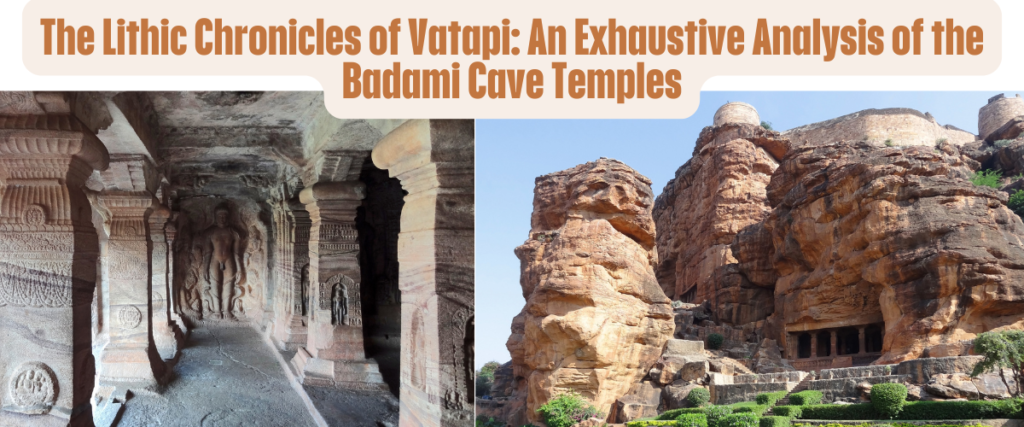
The Red Sandstone Escarpment
In the geological heart of the Deccan Plateau, where the arid landscape of northern Karnataka fractures into dramatic ravines and precipitous cliffs, lies the ancient settlement of Badami. Known in antiquity as Vatapi or Vatapipuri, this site represents one of the most significant confluences of geology, theology, and political ambition in the history of the Indian subcontinent.1 Carved into the amygdaloidal red sandstone of the Kaladgi basin—a geological formation that imbues the landscape with a vibrant, ruddy hue reminiscent of almonds (badam), from which the modern name is likely derived—the Badami Cave Temples stand as the foundational monuments of the Early Western Chalukya dynasty.1
This article offers a comprehensive, expert-level examination of the Badami complex, synthesising historical epigraphy, architectural theory, iconographic analysis, and the phenomenology of the site. The scope of this inquiry extends beyond the mere cataloguing of shrines; it seeks to reconstruct the intellectual and artistic milieu of the 6th and 7th centuries CE, a period often described as the “cradle of Indian temple architecture”.6 It is within this ravine, flanking the artificial Agastya Tirtha lake, that the distinct architectural vocabularies of North India (Nagara) and South India (Dravida) were first brought into a deliberate and experimental dialogue, eventually birthing the hybrid Vesara style that would define the Deccan’s artistic identity for a millennium.1
The significance of Badami is not merely aesthetic but deeply political. The transformation of the intractable living rock into elaborate pillared halls and sanctums was a statement of imperial power. By carving their gods into the mountains, the Chalukya monarchs—Pulakeshin I, Kirtivarman I, and Mangalesha—asserted a dominion that was intended to be as immutable as the stone itself.1 This report will navigate the complex interplay between the royal patrons, the guild of architects (sthapathis) who executed their vision, and the religious pluralism that allowed Shaivism, Vaishnavism, and Jainism to flourish side by side in a shared sacred geography.6
Geological and Mythological Setting
The Kaladgi Basin and the “Almond” Stone
The geological substrate of Badami is the Kaladgi series, a sedimentary formation characterised by horizontally stratified sandstone cliffs that rise abruptly from the plains.2 This sandstone is distinct from the basaltic trap rock found at the earlier and contemporary cave sites of Ajanta and Ellora in Maharashtra.1 The Badami sandstone is softer, allowing for finer, more intricate detailing in the sculptural reliefs, yet it possesses a durability that has withstood fifteen centuries of weathering. The distinct reddish-orange colour of the stone, often streaked with purple and brown, changes dramatically with the angle of the sun, contributing to the “experience” of the site as a living entity.12
The etymology of “Badami” is inextricably linked to this geology. While some scholars propose a derivation from the Sanskrit Vatapi (related to the wind or a demon), the prevailing linguistic theory links it to the Kannada word Badam, meaning almond, a direct reference to the colour of the sandstone cliffs.4 This connection suggests that the landscape itself dictated the identity of the settlement long before the Chalukyas fortified it.
The Legend of Agastya and the Demon Siblings
Before it was a capital, the ravine was a tirtha—a sacred crossing place—sanctified by myth. The local Puranic tradition identifies Badami as the setting for the story of the sage Agastya and the Asura brothers, Vatapi and Ilvala.5 According to the legend, the demon Ilvala had the magical power to recall the dead. He would transform his brother Vatapi into a ram (or goat), cook him, and feed the meat to unsuspecting mendicants. After the meal, Ilvala would call out, “Vatapi, come out!” (Vatapi, atra gachha), and Vatapi would tear his way out of the guest’s stomach, killing them.5
The reign of terror ended when the sage Agastya arrived. Forewarned of the trick, Agastya ate the meal and, before Ilvala could summon his brother, rubbed his stomach and uttered the mantra, “Vatapi, be digested” (Vatapi jirno bhava).17 Vatapi was dissolved, and the enraged Ilvala was subsequently destroyed by the sage’s spiritual gaze (or fire from his eyes).17
The landscape of Badami is interpreted through this myth: the two sheer cliffs that flank the reservoir are said to be the petrified bodies of the two demons, forever subdued by the sage.5 The lake itself, the Agastya Tirtha, is believed to have been created by the sage and is renowned in local folklore for its healing properties.9 This mythopoetic layer serves a crucial function: it Sanskritizes the local geography, integrating the Deccan site into the broader pan-Indian Aryan narrative, and symbolically represents the triumph of Vedic order (Agastya) over the chaotic, indigenous forces (the Asuras).20
Historical Context: The Chalukyas of Vatapi
The Rise of Pulakeshin I and the Fortification of Vatapi
The political history of Badami begins in the mid-6th century CE with the decline of the Kadambas of Banavasi, the preceding regional power. Pulakeshin I (c. 543–566 CE), a chieftain of the Chalukya lineage, seized the opportunity presented by the power vacuum. Recognising the defensive potential of the ravine at Vatapi—protected on three sides by vertical cliffs and possessing a secure water source—he established his capital there around 543 CE.8
Pulakeshin I is credited with the construction of the hill fort (the North and South Forts), transforming the natural escarpment into an impregnable citadel.9 To legitimise his newfound sovereignty, he performed the Ashvamedha (horse sacrifice), a Vedic ritual reserved for paramount sovereigns, signalling his intent to expand the Chalukya hegemony across the Deccan.9 This act marked the transition of the Chalukyas from feudatories to an imperial dynasty that would eventually style themselves as the “Lords of the Three Oceans”.1
The Regency of Mangalesha and the Golden Age
While Pulakeshin I founded the city, the artistic legacy of Badami belongs largely to his sons, Kirtivarman I (c. 566–597 CE) and Mangalesha (c. 597–610 CE).1 Kirtivarman I, known as the “Night of Destruction” to his enemies, expanded the kingdom but died leaving a minor heir, Pulakeshin II. Consequently, his younger brother Mangalesha assumed the throne as regent.10
It was under Mangalesha’s patronage that the excavation of the cave temples reached its zenith. The most critical document in Badami’s history is found in Cave 3: a rock-cut inscription dated to the Saka year 500 (578/579 CE).13 This inscription records the dedication of the cave—referred to as a Mahavishnu-griha (House of the Great Vishnu)—by Mangalesha. It details a land grant of the village Lanjishvara to the temple for the maintenance of the shrine and the Brahmins serving it.23
The inscription serves multiple historical functions:
- Chronology: It provides a fixed date (578 CE) for the completion of Cave 3, allowing art historians to anchor the chronology of Early Chalukya art and, by extension, the development of the Dravida and Vesara styles.13
- Patronage: It explicitly links the royal house to the Vaishnava sect, although the dynasty also patronised Shaivism (Cave 1) and Jainism (Cave 4), reflecting a policy of competitive pluralism.3
- Political Legitimacy: Mangalesha uses the dedication to assert his own status and piety, possibly to consolidate his position against the growing claim of his nephew, Pulakeshin II, which would eventually lead to a civil war.10
The Eclipse and Restoration
The glory of Vatapi faced a catastrophic interruption in 642 CE. Pulakeshin II, the greatest of the Chalukya monarchs who had defeated Emperor Harsha of the North, was defeated and killed by the Pallava King Narasimhavarman I (“Mamalla”).2 The Pallavas occupied Badami for thirteen years, a period during which the famous icon of “Vatapi Ganapati” was allegedly taken as a war trophy to Tamil Nadu.3 The city was left in ruins until Vikramaditya I restored Chalukya power in 655 CE.4 This tumultuous history is written into the architecture; the shift from rock-cut caves (predominantly 6th century) to structural temples (7th and 8th centuries) roughly corresponds to the pre- and post-Pallava occupation periods, marking a shift in resource allocation and artistic preference.6
Architectural Theory: The Vesara Laboratory
The Transition from Rock-Cut to Structural
The Badami Cave Temples represent the final flourishing of the rock-cut tradition in the Deccan before the decisive shift to structural masonry temples.2 The “cave” (guha) was conceptually viewed not merely as a shelter but as a womb (garbha), a return to the primal earth. The excavation process was one of “subtraction”—removing stone to reveal the form that was theoretically already present within the rock—as opposed to the “addition” of structural building.6
However, the Chalukya architects (sthapathis) at Badami and the nearby sites of Aihole and Pattadakal were also experimenting with structural forms. Badami is unique because it preserves both types of monuments in close proximity, allowing for a comparative study of how architectural forms were translated between media.2 The structural temples at the site (such as the Malegitti Shivalaya) show the early crystallisation of the Dravida vimana, while the caves experiment with column types and bracket figures that would later become standard elements in masonry temples.13
Defining the Vesara Style
Badami is celebrated as the crucible of the Vesara style. In classical Indian architectural treatises (Vastu Shastra), temple styles are categorised geographically: Nagara (Northern, curvilinear towers), Dravida (Southern, pyramidal towers), and Vesara (Hybrid, associated with the Deccan).24
The Vesara style is not a chaotic mixture but a deliberate synthesis. At Badami, this is manifested in:
- Plan: The combination of the star-shaped or orthogonal plans of the North with the ambulatories of the South.
- Elevation: The superimposition of Nagara decorative motifs (like the amalaka or northern creepers) onto Dravida structural skeletons (the storied vimana).7
- Iconography: The juxtaposition of northern deities (e.g., specific forms of Surya or the River Goddesses Ganga and Yamuna) with southern iconographic conventions.15
Cave 3 is often cited as the earliest example where Nagara and Dravida elements coexist explicitly. The pillar brackets feature northern Gupta-style motifs, while the layout and the treatment of the facade anticipate the southern Pallava style.1 This synthesis was a visual manifestation of the Chalukya political ambition to rule as universal monarchs, bridging the Aryavarta (North) and the Dakshinapatha (South).8
Architectural Layout of the Caves
The four main caves follow a standardised architectural syntax, though they vary in scale and elaboration. The general plan consists of three sequential spaces, moving from the profane to the sacred 6:
- Mukhamandapa (Veranda): An open, pillared porch that overlooks the Agastya Lake. This is the zone of public interaction and features the most elaborate narrative reliefs.
- Sabhamandapa (Main Hall): A large, square, pillared hall used for congregational worship (Puja). In the Badami caves, these halls are often hypostyle, with rows of columns dividing the space into aisles.
- Garbhagriha (Sanctum Sanctorum): A small, cubical cell cut deep into the rear wall of the cave. This houses the primary deity (a Shiva Linga in Cave 1, Vishnu images in Caves 2 and 3, and a Tirthankara in Cave 4).
The “architecture” of the caves is strictly sculptural. The pillars are not load-bearing in the structural sense; the mountain supports itself. This allowed the architects to design columns with complex shapes—fluted, multi-faceted, or adorned with yali (mythical beast) brackets—that would have been difficult to achieve in a structural building of that era.26
Detailed Analysis: Cave 1 – The Shaiva Sanctum
Orientation and Significance
Cave 1 is the lowest in the sequence, carved into the northwestern face of the cliff, about 50 feet above the ground level of the town.13 Dedicated to Shiva, it is generally dated to around 550 CE, making it the earliest of the excavated group.1 Its position at the entry point of the ascent sets the theological tone for the complex: a reverence for the destructive and regenerative powers of the cosmos.
The 18-Armed Nataraja: A Iconographic Masterpiece
The most iconic image in Cave 1—and arguably in all of Badami—is the relief of the eighteen-armed Dancing Shiva (Nataraja) carved on the cliff face to the right of the entrance.3 This sculpture predates the famous Chola bronzes of the Ananda Tandava by several centuries and presents a distinct iconographic tradition.
- The Arms: The eighteen arms are arranged in a radial, geometric pattern that creates a sense of rhythmic motion. Swiss art historian Alice Boner analysed this composition as a “time division symbolising the cosmic wheel”.28 The arms do not merely hold weapons; they express specific Natya mudras (dance gestures) derived from the Natya Shastra. Some hands hold the damaru (drum of creation), the trishula (trident), the serpent, and the torch, while others are engaged in graceful movements across the body.13
- The Pose: Shiva stands in a variation of the Chatura pose, grounded yet dynamic. Unlike the Chola Nataraja, who crushes the dwarf Apasmara, the Badami Shiva dances with Ganesha (his son) and the bull Nandi by his side. The skeletal sage Bhringi is often depicted mimicking the dance, emphasising the hypnotic power of the divine performance.28
- Significance: This image is not just a statue; it is a treatise on dance carved in stone. It suggests that the Chalukya court was deeply familiar with classical dance treatises, and the sculptors possessed the technical virtuosity to translate ephemeral movement into permanent sandstone.13
Harihara and Ardhanarishvara: The Theology of Synthesis
Inside the veranda, the walls feature large reliefs of Harihara and Ardhanarishvara, which reinforce the theme of non-duality (advaita).
- Harihara: Located on the left wall, this 7.75-foot-tall sculpture depicts a fused deity: the right half is Shiva (Hara) and the left half is Vishnu (Hari).13 The differentiation is achieved through iconography: the Shiva side wears a tiger skin and holds a battle-axe, while the Vishnu side wears a pitambara (yellow garment) and holds a conch. The attendants similarly reflect this duality: Nandi and Parvati stand on the Shiva side, while Garuda and Lakshmi stand on the Vishnu side.13 This image served a potent socio-religious function, harmonising the potentially rival sects of Shaivism and Vaishnavism under the royal umbrella.11
- Ardhanarishvara: On the opposite wall is the “Lord who is Half-Woman.” This composite image of Shiva (right) and Parvati (left) is a masterclass in anatomical sculpture. The artist seamlessly transitions from the masculine musculature and square shoulder of Shiva to the sloping shoulder, breast, and curvaceous hip of Parvati.13 It symbolises the inseparability of the male (Purusha) and female (Prakriti) principles in the generation of the universe.
The Nagaraja Ceiling
The ceiling of the veranda contains a magnificent relief of a coiled serpent deity, Nagaraja. The upper half of the figure is human, rising from a coiled serpentine lower body, protected by a five-hooded cobra canopy.3 The coils are rendered in high relief, creating a vortex-like effect. This image is significant as it represents the earth/water spirits (nagas) that were worshipped in the region prior to the arrival of Puranic Hinduism, here integrated into the Brahmanical temple complex.30
Detailed Analysis: Cave 2 – The Vaishnava Threshold
Elevation and Layout
Cave 2 is reached by a climb of 64 steps from Cave 1, situated to the east and at a higher elevation.31 Excavated in the late 6th century, it is dedicated to Vishnu. While smaller in scale than Cave 1 and Cave 3, it shares the same basic floor plan: a veranda, a pillared hall (33 feet wide), and a sanctum.22
The Guardians of Peace
A distinctive feature of Cave 2 is the pair of dvarapalas (door guardians) flanking the entrance. Unlike the fierce, weapon-wielding guardians of Shaiva temples, these figures hold flowers and wear benign expressions.31 This shift in iconography signals the devotee’s entry into the preservationist and compassionate realm of Vishnu.
The Trivikrama and Varaha Panels
The veranda features four major panels, but two stand out for their narrative power:
- Trivikrama (Vamana Avatar): This relief depicts the moment Vishnu, incarnated as the dwarf Vamana, transforms into the cosmic giant Trivikrama to reclaim the universe from the demon king Mahabali. Vishnu is shown with one leg kicked high, measuring the heavens, while the other remains on earth.32 The diagonal composition creates a tremendous sense of energy and expansion. The panel captures the awe of the onlookers—both gods and demons—witnessing the divine manifestation.22
- Varaha (Boar Avatar): This image depicts Vishnu as a boar rescuing the Earth Goddess (Bhudevi) from the cosmic ocean. Varaha stands in the alidha (archer’s) pose, lifting Bhudevi on his elbow. The contrast between the massive, animalistic head of the boar and the delicate, terrified-yet-grateful figure of the goddess highlights the protective aspect of the deity.1 As the royal emblem (lanchana) of the Chalukyas, the Varaha image carried political weight, symbolising the king’s role in rescuing the earth from chaos.1
The Cosmic Wheel (Matsya Chakra)
On the ceiling of the veranda is a unique and enigmatic carving: a wheel with sixteen spokes, where the spokes are formed by fish, set within a square frame.1 This motif is rare in Indian art. It likely references the cosmic ocean or the cycle of time (kala), possibly connected to the Matsya (fish) avatar of Vishnu. The geometric precision of the wheel contrasts with the fluid, organic forms of the surrounding flying couples (gandharvas), suggesting the order of cosmic law (dharma) amidst the flux of existence.13
Detailed Analysis: Cave 3 – The Magnum Opus of Mangalesha
The Inscriptional anchor
Cave 3 is the undisputed masterpiece of the complex. It is the largest, most elaborately carved, and historically most important cave, dating specifically to 578 CE via Mangalesha’s inscription.13 Facing north, its facade is nearly 70 feet wide, supported by six colossal pillars with extensive sculptural ornamentation.13 It is here that the Chalukya art reaches its “classic” phase.
Monumental Statuary
The sculptural program of Cave 3 represents a significant evolution from Caves 1 and 2. The figures are carved in deeper relief, almost detaching from the wall, and possess a monumental gravity.22
- The Great Trivikrama: The Trivikrama image in Cave 3 is even larger and more complex than in Cave 2. It dominates the eastern wall. The composition is dense with celestial figures, and the anatomy of Vishnu is rendered with powerful naturalism. The scene emphasises the virat rupa (cosmic form) of the deity.13
- Narasimha (The Man-Lion): Unlike the fierce, disembowelling depictions found elsewhere, the Narasimha of Cave 3 is shown standing (Sthanaka) in a majestic, almost regal pose. He leans casually on a giant club (gada), his lion face radiating a controlled power rather than uncontrolled rage. The figure is flanked by attendants who look up in reverence, emphasising his status as a divine king.27
- Anantasayana (Vishnu Reclining): This relief depicts Vishnu sleeping on the coils of the serpent Shesha (Ananta) during the cosmic dissolution (pralaya). The serenity of the reclining figure, floating on the “ocean” of the rock wall, creates a mood of profound stillness that contrasts with the dynamic energy of the other panels.27
- Harihara: The syncretic image appears again here, refined and elegant, reinforcing the continuity of the theological message across the caves.27
The Fresco Paintings
Cave 3 preserves rare fragments of 6th-century fresco paintings, among the earliest surviving in India alongside Ajanta.27 Located on the vaulted cornice, these paintings were executed in tempera on lime plaster.
- Subjects: One clearly identifiable scene is the wedding of Shiva and Parvati (Kalyanasundara), attended by the gods Indra and Indrani.34 Another fragment depicts a royal court scene, possibly Mangalesha himself witnessing a dance performance.
- Artistic Merit: The paintings show a sophisticated use of colour (green, ochre, black, white) and perspective. The dancers are depicted in the prishtha-svasta pose (viewed from the back), a difficult angle that demonstrates the artist’s mastery of spatial depth.34 These fragments remind us that the caves were originally vibrant, colourful interiors, not the monochrome stone we see today.
Pillar Brackets and “Mithunas”
The pillars of Cave 3 are adorned with bracket figures (shalabhanjikas) depicting mithunas—amorous couples.23 These couples are shown in various stages of courtship and intimacy, standing under stylised trees. They are celebrated for their intricate hairstyles, jewellery, and costumes, which provide a window into the fashion and social life of the Chalukya aristocracy.28 The mithuna is an auspicious symbol in Indian art, representing fertility, abundance, and the joy of union, serving as a metaphor for the union of the soul with the divine.
Detailed Analysis: Cave 4 – The Jaina Asceticism
Chronology and Context
Cave 4 is located at the highest point of the main cluster, to the east of Cave 3. It is a Jain sanctuary dedicated to the Tirthankaras.13 While the exact date is debated, it is generally considered the latest of the four (7th–8th century), though its location suggests it was part of the original conception of the site.35 The presence of this cave confirms the status of Jainism as a major religion in the Chalukya state, supported by the mercantile community and respected by the Hindu kings.6
Iconography of Stillness
The aesthetic of Cave 4 shifts from the kinetic energy of the Hindu caves to a profound stillness.
- Mahavira: The sanctum houses an image of Mahavira, the 24th Tirthankara, seated in the Padmasana (lotus posture). He is seated on a lion throne, flanked by chauri (fly-whisk) bearers, with a triple umbrella (chhatra) above his head symbolising his spiritual sovereignty over the three worlds.36 The image is carved from the back wall, exuding a sense of immovable calm.
- Bahubali (Gommateshwara): On the left wall is a standing image of Bahubali, the son of the first Tirthankara. He is depicted in the Kayotsarga (body-abandonment) posture, meditating for so long that vines have grown up his legs and snakes have gathered at his feet.35 This sculpture is a precursor to the colossal monolithic Bahubali statues later carved at Shravanabelagola and Karkala.37 It emphasises the Jain ideal of rigorous asceticism and detachment from the physical body.
- Parshvanatha: Facing Bahubali is Parshvanatha, the 23rd Tirthankara, protected by the multi-hooded serpent Dharanendra. The verticality of the snake hoods and the standing figure creates a powerful architectural line.35
The Structural Landscape: Temples of the Agastya Tirtha
The Evolution to Structural Forms
While the caves are the most famous, the structural temples of Badami are equally critical for understanding the evolution of Indian architecture. They represent the moment the Chalukyas moved out of the rock to build freestanding monuments.6
The Bhutanatha Group
Located on the eastern bank of the Agastya Lake, the Bhutanatha Group is a picturesque cluster of sandstone temples that seem to rise directly from the water.15
- Main Bhutanatha Temple: This temple is an architectural palimpsest. The inner shrine and mantapa (hall) were built in the Early Chalukya period (late 7th century), characterised by squat, massive pillars and heavy stone eaves. However, the outer mantapa facing the lake was added much later by the Kalyani Chalukyas (11th century).38 This later addition features the “Phamsana” style—stepped pyramidal roofs—and angled eaves, creating a visual dialogue between two distinct phases of Chalukya history separated by four centuries.38
- Significance: The location of the temple at the water’s edge links it to the worship of the spirits of nature (Bhuta-natha = Lord of the Spirits/Elements). Locals still believe the lake has healing powers, and the temple serves as a focal point for rituals involving the water.15
The Shivalayas and Fortifications
Perched on the sandstone tables of the North and South hills are the Shivalaya temples, which served as both places of worship and strategic lookouts.40
- Malegitti Shivalaya: Located on the North Fort, this temple (c. 7th century) is one of the finest surviving examples of the Early Dravida style. Its vimana (tower) is octagonal, crowned by a dome-shaped shikhara. The walls are relatively plain but punctuated by elegant pilasters and kudu arches, demonstrating a refined, minimalist aesthetic compared to the baroque exuberance of later temples.40
- Upper Shivalaya: Originally a Vaishnava temple, it retains friezes depicting the Krishna Lila and the Ramayana. Its high vantage point offers a panoramic view of the entire valley, allowing it to function as a watchtower for the capital.41
- The Forts: Connecting these temples are the ruins of the massive fortification walls built by Pulakeshin I. Constructed of large, dry-laid sandstone blocks, these walls encompass granaries, secret passages, and magazines, reminding the visitor that Badami was a military stronghold as much as a religious centre.21
The Experiential Dimension: Stone, Water, and Light
Sensory Immersion in the Red Valley
A visit to Badami is a multisensory experience defined by the interplay of the elements.
- Visual: The dominant colour is the rust-red of the sandstone, which changes mood throughout the day. At sunrise, the east-facing cliffs glow with an intense, fiery orange; at sunset, the rock deepens to a sombre purple.14 The contrast between the red stone, the green water of the Agastya Lake, and the bright blue Deccan sky creates a vivid, painterly landscape.30
- Auditory: The caves are naturally resonant spaces. The silence of the interiors is often punctuated by the chanting of mantras by visiting pilgrims or the chatter of tourists. However, the most pervasive sound is often the call of the monkeys—bonnet macaques and langurs—who inhabit the cliffs in large troops.44
- Tactile: The experience of Badami is tactile. The sandstone is coarse and grainy, yet the floors of the caves and the pillars have been worn smooth by centuries of bare feet and hands. The climb to the caves—steep, uneven rock-cut steps—demands a physical engagement with the terrain, mimicking the arduous spiritual ascent.21
The Monkey Menace and Conservation
The presence of monkeys is a defining, if sometimes problematic, aspect of the Badami experience. The troops of macaques are aggressive and have learned to snatch food and cameras from tourists.44 While they add a “living” element to the ruins—evoking the Vanara armies of legend—they pose a challenge for the Archaeological Survey of India (ASI) in terms of visitor safety and conservation. The monkeys, along with erosion from wind and water, are the primary threats to the fragile sandstone carvings.1
The Agastya Tirtha: A Living Tradition
The Agastya Lake is not a dead monument; it remains a centre of daily life. Women from the town wash clothes on the ghats, creating splashes of colour with their drying saris. Pilgrims bathe in the water to purify themselves before entering the temples.15 This continuity of usage connects the modern visitor to the ancient inhabitants of Vatapi, bridging the gap of 1,500 years. The lake acts as a mirror, reflecting the temples and the cliffs, doubling the visual impact of the architecture and creating a sense of symmetry that is central to Indian aesthetics.15
Conclusion: The Legacy of the Chalukyas
The Badami Cave Temples are a testament to a moment of supreme confidence in Indian history. The Early Western Chalukyas, by carving their capital into the living rock, asserted that their reign was part of the natural order. They created a site that was simultaneously a fortress, a city, and a cathedral.
The legacy of Badami lies in its role as a crucible. It was here that the grammar of South Indian temple architecture was written. The experiments with the Vesara style—the blending of the northern curve and the southern storey—would be refined at Pattadakal and perfected by the later Hoysalas.1 The iconographic innovations—the eighteen-armed Shiva, the standing Narasimha, the meditating Bahubali—created templates that would be followed by artists across the subcontinent for centuries.
Badami remains a place where the boundaries between the human and the divine, the political and the religious, and the natural and the architectural are blurred. To stand in the veranda of Cave 3, reading the inscription of Mangalesha while looking out over the Agastya Lake, is to witness the enduring power of a vision that sought to turn the ephemeral red dust of the Deccan into the eternal house of god.
Disclaimer
The information provided in this article is for educational and general informational purposes only. While every effort has been made to ensure the accuracy of the historical and architectural details, archaeological interpretations can vary, and site regulations (such as entry fees or visiting hours) may change over time. Visitors are advised to check with the Archaeological Survey of India (ASI) or official local tourism boards for the most current information before planning their trip.
Table 1: Chronology of Key Early Chalukya Rulers and Monuments
| Ruler | Reign (approx.) | Key Contributions to Badami |
| Pulakeshin I | 543 – 566 CE | Founded Vatapi capital; Built North/South Forts; Performed Ashvamedha sacrifice. |
| Kirtivarman I | 566 – 597 CE | Likely initiated the cave excavations; Consolidated the empire. |
| Mangalesha | 597 – 610 CE | Dedicated Cave 3 (578 CE inscription); Patron of Vaishnava art; Regent ruler. |
| Pulakeshin II | 610 – 642 CE | Height of empire; Defeated Harsha; Likely patronised Upper Shivalaya; Killed by Pallavas. |
| Vikramaditya I | 655 – 680 CE | Restored the empire after Pallava occupation; Patronized structural temples (Mallikarjuna group). |
Table 2: Comparative Analysis of the Four Main Caves
| Cave | Sect/Deity | Est. Date | Key Iconographic Features |
| Cave 1 | Shaivism (Shiva) | c. 550 CE | 18-armed Nataraja; Harihara; Ardhanarishvara; Nagaraja ceiling. |
| Cave 2 | Vaishnavism (Vishnu) | Late 6th C. | Trivikrama; Varaha; Matsya (Fish) Wheel on ceiling; Dvarapalas with flowers. |
| Cave 3 | Vaishnavism (Vishnu) | 578 CE | Giant Trivikrama; Standing Narasimha; Anantasayana; Fresco paintings; Inscription. |
| Cave 4 | Jainism (Tirthankaras) | 7th-8th C. | Seated Mahavira; Standing Bahubali (Gommateshwara); Parshvanatha with snake hood. |
Table 3: The Vesara Synthesis at Badami
| Feature | Nagara Influence (North) | Dravida Influence (South) | Vesara Outcome (Badami Style) |
| Plan | Orthogonal, star-shaped plans. | Rectangular, ambulatory paths. | Fusion plans are seen in structural temples. |
| Decoration | Amalaka (ribbed disk), floral creepers. | Kudu (arches), Vimana storeys. | Nagara motifs on Dravida structural frames. |
| Pillars | Gupta-style bracket figures. | Pallava-style lion bases. | Complex, multi-faceted pillars with mithuna brackets. |
Works cited
- Badami Cave Temples: A Legacy of Masterpiece in Rock-Cut Architecture – Turuhi, accessed on January 23, 2026, https://turuhi.com/story/the-temple-legacy-at-badami
- Badami Cave Temples | Encyclopedia of Art – MAP Academy, accessed on January 23, 2026, https://mapacademy.io/article/badami-cave-temples/
- BADAMI : MAGNIFICENT CAVES OF ANCIENT INDIA – GOPS Creativ, accessed on January 23, 2026, https://gops.org/?p=973
- Meaning of the name Badami, accessed on January 23, 2026, https://www.wisdomlib.org/names/badami
- Badami, some of the earliest Hindu temples – magik india, accessed on January 23, 2026, https://magikindia.com/en/badami/
- The Splendour of Chalukyan Art and Architecture: Badami, Aihole and Pattadakal, accessed on January 23, 2026, https://www.asatours.com.au/chalukyan-art-architecture-badami-aihole-pattadakal/
- (PDF) STUDY OF ADMINISTRATIVE AND CULTURAL DEVELOPMENTS IN THE ERA OF BADAMI CHALUAKYAS – ResearchGate, accessed on January 23, 2026, https://www.researchgate.net/publication/385284908_STUDY_OF_ADMINISTRATIVE_AND_CULTURAL_DEVELOPMENTS_IN_THE_ERA_OF_BADAMI_CHALUAKYAS
- Rock-cut shrines of Badami: Unique synthesis of styles – The Hindu, accessed on January 23, 2026, https://www.thehindu.com/features/friday-review/badami-rockcut-shrines-in-karnatakas-bagalkote-district-unique-synthesis-of-styles/article7180698.ece
- Visit to Badami – Pattadakkal and Aihole – Raju’s Temple Visits – WordPress.com, accessed on January 23, 2026, https://shanthiraju.wordpress.com/2017/02/26/badami/
- Mangalisha, a great patron of Badami Chalukya art – The New Indian Express, accessed on January 23, 2026, https://www.newindianexpress.com/opinion/2021/Apr/14/mangalisha-a-great-patron-of-badami-chalukya-art-2289818.html
- A Monument to Multiple Faiths — the Majestic Rock-Cut Cave Temples of Karnataka, accessed on January 23, 2026, https://www.asiaresearchnews.com/content/monument-multiple-faiths-%E2%80%94-majestic-rock-cut-cave-temples-karnataka
- Time comes to a standstill at the ancient cave temples of Badami. – Indulge Express, accessed on January 23, 2026, https://www.indulgexpress.com/life-style/travel/2017/Feb/24/time-comes-to-a-standstill-at-the-ancient-cave-temples-of-badami-72.html
- Badami cave temples – Wikipedia, accessed on January 23, 2026, https://en.wikipedia.org/wiki/Badami_cave_temples
- Exploring the Ancient Cave Temples of Badami: History, Tips, and Photography Guide, accessed on January 23, 2026, https://booked.ai/city-blogs/exploring-the-ancient-cave-temples-of-badami-history-tips-and-photography-guide
- Visit Badami’s Historic Bhutanatha Temple – Incredible India, accessed on January 23, 2026, https://www.incredibleindia.gov.in/en/karnataka/badami/bhutanatha-temple
- Ilvala and Vatapi – Wikipedia, accessed on January 23, 2026, https://en.wikipedia.org/wiki/Ilvala_and_Vatapi
- The Rakshasa Brothers: Vatapi and Ilvala – Amar Chitra Katha, accessed on January 23, 2026, https://www.amarchitrakatha.com/mythologies/the-rakshasa-brothers-vatapi-and-ilvala/
- Rakshsa brothers Atapi and Vatapi from Hindu mythology. Re-imagined in * not so * stereotypical form. Artwork by me 🙂 (An abbreviated version of their story from Mahabharata is in the comments) – Reddit, accessed on January 23, 2026, https://www.reddit.com/r/mythology/comments/i1n3fl/rakshsa_brothers_atapi_and_vatapi_from_hindu/
- Vatapi and Agastya – Katha Kids, accessed on January 23, 2026, https://kathakids.com/mythology-for-children/vatapi-and-agastya/
- Agasthya the Hindu Sage who drank the oceans – Hinduwebsite.com, accessed on January 23, 2026, https://www.hinduwebsite.com/hinduism/concepts/agasthya.asp
- Family Adventures Await: Your Complete Guide to Banashree Badami and Beyond, accessed on January 23, 2026, https://www.sterlingholidays.com/blog/family-adventures-await-your-complete-guide-to-banashree-badami-and-beyond/
- Badami Caves 2 and 3 – MAP Academy, accessed on January 23, 2026, https://mapacademy.io/article/badami-caves-2-and-3/
- Chalukya Temple Trail – Badami 3 – matriwords, accessed on January 23, 2026, https://matriwords.com/2020/07/31/chalukya-temple-trail-badami-3/
- Badami Chalukya architecture – Wikipedia, accessed on January 23, 2026, https://en.wikipedia.org/wiki/Badami_Chalukya_architecture
- Vesara Temple Architecture: Nagara-Dravida Fusion in Deccan | UPSCBriefs, accessed on January 23, 2026, https://www.thebulletinbriefs.in/upscbriefs/art-culture/vesara-temple-architecture-bridging-nagara-and-dravida-styles
- Badami Cave 1 – MAP Academy, accessed on January 23, 2026, https://mapacademy.io/article/badami-cave-1/
- Cave Temples of Badami – Rare Photos by Viki Pandit, accessed on January 23, 2026, https://www.vikipandit.com/cave-temples-of-badami/
- Badami Cave Temples – Wikipedia | PDF | Hindu Deities – Scribd, accessed on January 23, 2026, https://www.scribd.com/document/513503991/Badami-Cave-Temples-Wikipedia
- File:An 1853 sketch of Ardhanarishvara (left, half Shiva and half Parvati) and Harihara (half Vishnu and half Shiva) at Cave 1, Badami Hindu Cave Temple Karnataka.jpg – Wikimedia Commons, accessed on January 23, 2026, https://commons.wikimedia.org/wiki/File:An_1853_sketch_of_Ardhanarishvara_(left,_half_Shiva_and_half_Parvati)_and_Harihara_(half_Vishnu_and_half_Shiva)_at_Cave_1,_Badami_Hindu_Cave_Temple_Karnataka.jpg
- In Malaprabha Valley – Badami Trip 1 – The pilgrims blog, accessed on January 23, 2026, https://orupilgrimsdiary.wordpress.com/2025/01/14/in-malaprabha-valley-badami-trip-1/
- 2 / Lord Vishnu manifested as dwarf or Trivikrama in Cave | Bagalkote District – YouTube, accessed on January 23, 2026, https://www.youtube.com/watch?v=Wg4aG1bQf74
- Badami Cave Number 2 | Varaha | Trivikrama | Vamana Avatar | Vishnu Reliefs | Chalukya Architecture – YouTube, accessed on January 23, 2026, https://www.youtube.com/shorts/Nf1IdccyzQs
- Badami Cave Temples- A guide for the sculptures, accessed on January 23, 2026, https://www.pickpackgo.in/2016/08/badami-cave-temples-guide-for-sculptures.html
- Badami Murals – MAP Academy, accessed on January 23, 2026, https://mapacademy.io/article/badami-murals/
- Badami Cave 4 – MAP Academy, accessed on January 23, 2026, https://mapacademy.io/article/badami-cave-4/
- Badami rock-cut temples Cave-4 – Journeys across Karnataka, accessed on January 23, 2026, https://karnatakatravel.blogspot.com/2023/01/badami-rock-cut-temples-cave-4.html
- Bahubali – Wikipedia, accessed on January 23, 2026, https://en.wikipedia.org/wiki/Bahubali
- Bhutanatha Group of Temples, Badami – CHALUKYAS, accessed on January 23, 2026, http://chalukyandynasty.blogspot.com/2013/11/bhutanatha-group-of-temples-badami.html
- The Bhutanatha Group of Temples, Badami – The Heritage Guru – WordPress.com, accessed on January 23, 2026, https://theheritageguru.wordpress.com/2022/03/26/the-bhutanatha-group-of-temples-badami/
- Explore the Ancient Malegitti Shivalaya Fort in Badami – Incredible India, accessed on January 23, 2026, https://www.incredibleindia.gov.in/en/karnataka/badami/malegitti-shivalaya-fort
- Badami Shivalaya – Wikipedia, accessed on January 23, 2026, https://en.wikipedia.org/wiki/Badami_Shivalaya
- Exploring The Badami Cave Temples – The Backpacksters, accessed on January 23, 2026, https://www.backpacksters.com/india/badami-cave-temples-karnataka/
- Romancing the stone – The Tramp –, accessed on January 23, 2026, https://amlanthetramp.com/2021/12/31/badami/
- Badami – Cave temples and more – Musings of a Wandering Mind, accessed on January 23, 2026, https://www.paintedstork.com/blog/2008/02/badami.html
- Monkeys harass visitors to Badami caves | Hubballi News – Times of India, accessed on January 23, 2026, https://timesofindia.indiatimes.com/city/hubballi/monkeys-harass-visitors-to-badami-caves/articleshow/34171435.cms
- Tracing History in The Rocks of Badami – Photography by Pratap J, accessed on January 23, 2026, https://pratapj.in/travel/tracing-history-rocks-badami/

_and_Harihara_(half_Vishnu_and_half_Shiva)_at_Cave_1,_Badami_Hindu_Cave_Temple_Karnataka.jpg)