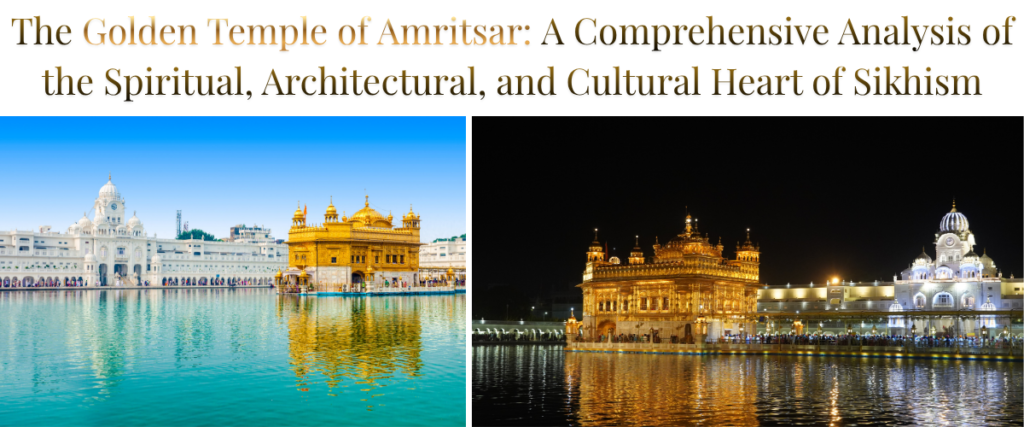
The Sri Harmandir Sahib, known globally as the Golden Temple, stands as the preeminent spiritual anchor for the Sikh faith and one of the most significant architectural landmarks in the Indian subcontinent. Located in the heart of Amritsar, Punjab, this sacred precinct is not merely a religious site but a living monument to the principles of equality, humility, and universal brotherhood.1 The temple, which derives its popular name from the 24-karat gold leaf that adorns its upper stories, functions as a sanctuary where the spiritual and the temporal meet, offering a unique insight into the evolution of Sikh identity and the institutionalisation of selfless service.3 To understand the Golden Temple is to explore a narrative of resilience, where a structure repeatedly destroyed by invaders was consistently rebuilt with greater splendour by a community committed to its sacred legacy.3
Historical Genesis and the Founding of Amritsar
The origins of the Golden Temple are inextricably linked to the early development of the Sikh faith and the lineage of its Gurus. While the third Guru, Guru Amar Das, originally conceived the idea of a central place of pilgrimage, the actual founding of the city of Amritsar was executed by the fourth Guru, Guru Ram Das, in 1577.3 The site chosen was a low-lying area surrounded by dense jungle, featuring a small pond that was believed to have ancient spiritual significance.7 Historical traditions suggest that this pond was a site where Guru Nanak, the founder of Sikhism, and even the Buddha had once meditated.9
The land acquisition for the temple complex is a subject of varying historical accounts. One version, recorded in gazetteers, states that Guru Ram Das purchased the land from the residents of the village of Tung for a sum of 700 rupees.3 Another prevalent tradition suggests that the land was gifted by the Mughal Emperor Akbar to Bibi Bhani, the daughter of Guru Amar Das, following the emperor’s visit to the Guru’s kitchen, where he was impressed by the egalitarian practice of communal dining.3 Regardless of the specific mode of acquisition, the site became known as “Guru Da Chakk” or “Ramdaspur”.3 Guru Ram Das initiated the excavation of the holy tank, or Sarovar, and invited merchants and artisans from 52 different trades to settle in the burgeoning town, laying the foundations for Amritsar to become a major commercial and spiritual hub.3
The Vision of Guru Arjan Dev
The transition from a sacred pool to a monumental temple structure occurred under the stewardship of the fifth Sikh Guru, Guru Arjan Dev. It was he who envisioned the Sri Harmandir Sahib as a central place of worship that would serve as a distinct identity for the Sikh community while remaining open to all of humanity.5 In 1581, construction on the temple building began in the centre of the pool.3 Guru Arjan Dev’s architectural choices were deliberately symbolic, intended to contrast with the religious structures of the time.2
In a profound gesture of interfaith respect, Guru Arjan Dev invited the Muslim Sufi saint, Hazrat Mian Mir of Lahore, to lay the foundation stone of the temple in December 1588.7 This act sent a powerful message of pluralism, signifying that the temple was a house of God for all, irrespective of religious affiliation.12 Although some later historical texts suggest Guru Arjan Dev may have laid the stone himself, the narrative of Mian Mir remains a vital part of the temple’s heritage of inclusivity.3
| Milestones in Early History | Year (A.D.) | Key Significance |
| Excavation of the Amrit Sarovar | 1577 | Establishment of the “Pool of Nectar” 3 |
| Construction of the Temple Structure | 1581–1601 | Physical realisation of the central shrine 5 |
| Laying of the Foundation Stone | 1588/1589 | Inter-religious participation by Hazrat Mian Mir 7 |
| Compilation of the Adi Granth | 1604 | Gathering of spiritual hymns into a single volume 8 |
| Installation of the Adi Granth | 1604 | Sanctification of the temple as a house of the Word 1 |
The physical construction was a communal effort, overseen by figures such as Baba Buddha and Bhai Gurdas, and completed in 1601.8 The final sanctification occurred in 1604 when Guru Arjan Dev installed the newly compiled Adi Granth, the Sikh holy scripture, within the temple.1 Baba Buddha was appointed as the first Granthi, or head priest, marking the beginning of the temple’s role as the primary custodian of Sikh scripture.8
Architectural Philosophy and Symbolism
The architecture of the Sri Harmandir Sahib is a profound physical manifestation of Sikh theology, prioritising humility, accessibility, and the rejection of hierarchy.2 Unlike contemporary Hindu temples that were often built on high plinths to evoke majesty, or mosques that typically featured a single primary entrance, Guru Arjan Dev designed the Harmandir Sahib to be built at a level lower than the surrounding ground.2
The Symbolism of Descent and Direction
The requirement for visitors to descend steps to enter the temple is a deliberate architectural metaphor.2 It signifies that one must approach God with humility, shedding worldly pride and ego before entering the sacred space.2 This design choice reinforces the spiritual lesson that enlightenment is achieved through modesty and submissiveness to the Divine will.2
Furthermore, the temple features four entrances, one on each of its cardinal sides.2 This layout was revolutionary in a society deeply divided by the caste system, where religious sites often restricted access based on birth.2 The four doors symbolise that the Sikh faith welcomes people from all four corners of the world and all social backgrounds—traditionally referred to as the four castes—without distinction.2
The Centrality of the Sarovar
The temple sits in the centre of the Amrit Sarovar, a square pool measuring approximately 150 meters on each side.9 The structure is reached via a 60-meter-long marble causeway, which serves as a bridge between the temporal world and the spiritual sanctuary.9 This positioning suggests that just as the temple is surrounded by water, the soul is surrounded by the “ocean of existence,” and the path to the Divine is a direct, focused crossing.2 The walkway around the pool, known as the Parikrama, is composed of white marble and offers devotees a path for circumambulation, encouraging reflection and prayer as they approach the inner sanctum.3
Architectural Style: The Sikh School
The aesthetic of the Golden Temple is characterised by a unique synthesis of styles, combining the arched windows and domes of Mughal (Indo-Islamic) architecture with the kiosks and balconies of Rajput (Hindu) design.5 This amalgamation evolved into a distinct Sikh school of architecture, sometimes described as “Indian Rococo” for its elaborate ornamentation and delicate detail.9
| Architectural Feature | Symbolic Meaning | Physical Description |
| Lower Elevation | Humility and ego-effacement | Built in a depression, the entrance requires descending steps.2 |
| Four Entrances | Universal inclusivity | Doors on all four sides welcome all castes/faiths.4 |
| Central Location | Spiritual island in the world | Situated in the middle of the Sarovar pool.2 |
| Inverted Lotus Dome | Purity amidst worldliness | The dome is shaped like an inverted lotus, a symbol of detachment.9 |
The Akal Takht: The Seat of Temporal Authority
Directly facing the entrance to the causeway of the Harmandir Sahib stands the Akal Takht, the “Throne of the Timeless One”.5 Established in 1606 by the sixth Sikh Guru, Guru Hargobind, the Akal Takht represents the temporal (worldly) authority of the Sikh community.16 Its founding marked a critical turning point in Sikh history, following the martyrdom of Guru Arjan Dev.22
The Doctrine of Miri and Piri
Upon his succession, Guru Hargobind introduced the concept of Miri-Piri.6 He famously wore two swords: one representing Piri (spiritual authority) and the other representing Miri (temporal or political power).6 This doctrine established that while the Harmandir Sahib was the centre for spiritual guidance, the Sikh community also required a seat of governance to address social justice, self-defence, and political sovereignty.16
The Akal Takht was originally built as a simple 12-foot-high platform, intentionally exceeding the three-foot limit imposed by the Mughal Emperor Jahangir for any throne other than his own.6 This act was a bold assertion of Sikh independence.6 Over the centuries, the structure evolved into a five-story building with a gold-leafed dome, serving as the highest of the five Takhts (seats of authority) in Sikhism.21 It is from the Akal Takht that Hukamnamas (divine edicts) are issued to the global Sikh community, and it remains the headquarters for major Sikh political and religious decisions.6
The Golden Transformation and the Era of Maharaja Ranjit Singh
While the temple has been a spiritual centre since 1604, its iconic “golden” appearance was a result of patronage in the 19th century.4 Throughout the 1700s, the temple faced repeated destruction by invading Afghan forces, most notably by Ahmed Shah Abdali.3 After each attack, the Sikh community rebuilt the shrine, but it was Maharaja Ranjit Singh, the founder of the Sikh Empire, who transformed it into the shimmering monument seen today.4
Following his conquest of Lahore and the unification of the Punjab, Ranjit Singh contributed significant wealth—reportedly 500,000 rupees—to the renovation of the Harmandir Sahib.9 He commissioned the overlaying of the upper stories with gilded copper plates and the decoration of the lower levels with white marble.3 This patronage was not merely decorative but a statement of the triumph and sovereignty of the Sikh Empire.4
Materials and Renovations
The initial gilding used approximately 750 kilograms of 24-karat gold.9 However, the temple has undergone several renovations since the 19th century.5 In the 1990s, a major restoration project used 500 kilograms of gold to re-plate the structure, ensuring that it remains “golden” despite the effects of pollution and weather.17
| Structural Element | Material and Craftsmanship |
| Upper Stories | Gilded copper plates covered with 24-karat gold leaf.3 |
| Lower Stories | White marble slabs decorated with semi-precious stone inlays.6 |
| Inner Sanctum Floor | Marble tiles covered with intricate carpets.5 |
| Doors | Shisham wood with silver-plated fronts and ivory inlays.9 |
Artistry and Interior Ornamentation
The interior of the Harmandir Sahib is a showcase of traditional craftsmanship, where every wall and ceiling reflects a deep spiritual devotion through art.11 The artwork is predominantly mural-based, utilising techniques that have been passed down through generations of Sikh artists, most notably the family of Gian Singh Naqqash, who worked on the temple for over three decades.24
Frescoes and Mural Techniques
The temple walls are adorned with Mohrakashi (fresco paintings), a technique where pigments are applied to wet lime plaster, allowing the colours to become a permanent part of the wall.24 There are approximately 300 unique patterns throughout the shrine, ranging from floral arrangements to animal motifs.9
- Dehin Style: A specialised form of fresco where the artist creates idealised forms of flowers and life from their imagination, often twisting them together into complex, harmonious patterns.24
- Gharwanjh: A decorative device within Dehin that depicts animals, such as lions or cobras, in knotted or interlocking patterns.18
- Human Figures: While most designs are floral or abstract to maintain a focus on the Divine, a rare mural behind the northern stairway depicts Guru Gobind Singh on horseback.9
The Shish Mahal and Inlay Work
The second story of the temple houses the Shish Mahal, or “Mirror Room”.9 This area is characterised by Tukri work, which involves the skilful inlay of thousands of small mirror pieces into a plaster base (Gach) to create sparkling floral designs.18 The ceiling of the Shish Mahal is particularly renowned for its intricate mirror patterns, which reflect the light from below to create a celestial atmosphere.9
On the lower exterior walls, the technique of Jaratkari (or pietra dura) is employed.18 This involves carving designs into white marble and filling them with hand-cut semi-precious stones such as lapis lazuli, onyx, and mother-of-pearl.6 These inlays create vibrant floral patterns that are remarkably durable and have survived for nearly two centuries.24
Guru-ka-Langar: The World’s Largest Community Kitchen
A visit to the Golden Temple is incomplete without experiencing the Guru-ka-Langar, the free community kitchen that embodies the Sikh concept of Seva (selfless service).25 Initiated by Guru Nanak and formally established by Guru Amar Das, the Langar was designed to break the barriers of the caste system by forcing everyone to sit and eat together as equals.25
Logistics and Statistics
The scale of the operation at the Golden Temple is staggering, feeding upwards of 100,000 people daily, and nearly double that number during festivals.25 The kitchen operates entirely on donations and volunteer labour.25
| Resource | Daily Average Consumption |
| Wheat Flour | 100 – 120 Quintals 25 |
| Dal (Lentils) | 18 – 25 Quintals 25 |
| Rice | 10 – 14 Quintals 25 |
| Milk | 5,000 Litres 25 |
| Sugar and Ghee | 10 Quintals and 5 Quintals respectively 25 |
| LPG Gas | 100 Cylinders 25 |
The meals are strictly vegetarian to ensure that people of all faiths—including those with religious dietary restrictions—can eat together without conflict.26 A typical meal consists of roti (flatbread), dal (lentils), a seasonal vegetable dish, and kheer (rice pudding).26 While much of the food is prepared in massive vats by hand, an automatic roti-making machine can produce 25,000 rotis per hour during peak times.20
The Volunteer Experience
The heartbeat of the Langar is the Sewadars (volunteers).26 On any given day, hundreds of people from all walks of life can be found peeling garlic, rolling rotis, or washing the stainless steel plates that are used by the thousands.26 This communal effort is viewed as a form of meditation, where the physical act of service helps to cleanse the ego and foster a sense of belonging to a global family.27
The Sacred Sarovar and Kar Seva
The Amrit Sarovar, the “Pool of Nectar,” is more than a decorative body of water; it is a central feature of the temple’s spiritual and physical ecosystem.10 The maintenance of this vast tank is a significant communal undertaking known as Kar Seva (service with the hands).19
Ecology and Filtration
The Sarovar holds approximately 31,000 gallons of water and is now fed by the Upper Bari Doab canal of the Ravi River, ensuring a constant supply regardless of rainfall.10 To maintain the water’s purity, a sophisticated filtration and aeration system was installed in 2004.10 Additionally, the pond is home to several species of fish, such as Rohu and Common Carp, which naturally control the growth of algae.10
Historical Desilting Events
While the walkway is cleaned daily, the complete emptying of the tank to remove accumulated silt is a rare and historic event that galvanises the global Sikh community.10
- 1923: The first major Kar Seva after the formation of the Shiromani Gurdwara Parbandhak Committee (SGPC).19
- 1973: A massive cleaning effort where volunteers from across the world participated.10
- 2004: The most recent major Kar Seva, which celebrated the 400th anniversary of the installation of the Adi Granth.10 During this event, hundreds of thousands of volunteers worked together to remove mud, using golden spades and silver bowls provided by donors to launch the service.34
Daily Rituals and the Spiritual Rhythm
The spiritual life of the Golden Temple is governed by a continuous cycle of prayer and music that has remained largely unchanged for centuries.11
The Palki Sahib Ceremony
One of the most moving experiences for visitors is the Palki Sahib ceremony, which takes place twice daily.37
- Prakash (Morning): In the early morning (between 3:00 AM and 5:00 AM), the Guru Granth Sahib is carried in a flower-adorned golden palanquin from the Akal Takht to the Harmandir Sahib.36 This signifies the “awakening” of the Guru’s word for the day.36
- Sukhasan (Night): In the evening (usually between 9:30 PM and 10:30 PM), the scripture is ceremoniously closed and carried back to the Akal Takht for its nightly rest.36 The procession is accompanied by the rhythmic chanting of hymns, the blowing of bugles, and the intense devotion of the crowds.28
Kirtan and Amrit Vela
Throughout the day and night, the temple is filled with the sounds of Gurbani Kirtan—the singing of hymns from the scripture.35 Professional musicians (Ragis) perform these hymns in classical ragas, accompanied by the harmonium and tabla.31 The “Amrit Vela” (the hours before dawn) is considered the most spiritually potent time to visit, as the atmosphere is tranquil and the focus is entirely on meditation and prayer.35
Visitor Etiquette and Practical Information
The Golden Temple is one of the few spiritual sites in the world that remains open 24 hours a day, 7 days a week, to people of all backgrounds.35 To maintain the sanctity of the shrine, visitors are expected to follow specific guidelines.42
Mandatory Customs
- Head Covering: All visitors must cover their heads with a scarf or turban. Free scarves are provided at the entrance.20
- Removal of Shoes: Footwear must be deposited at the free storage counters. Visitors then walk through a shallow pool of water to wash their feet before entering the complex.20
- Prohibited Items: Tobacco, alcohol, and drugs are strictly forbidden. Photography is permitted in the outer walkway but is strictly prohibited inside the main sanctum.9
- Modesty: Visitors should dress modestly, avoiding shorts or revealing clothing.42
Planning the Visit
While the temple is spectacular at any time, the evening illumination offers a different perspective as the gold plates reflect off the dark waters of the Sarovar.20 The winter months (November to February) are the most comfortable for exploring the complex due to the pleasant weather.36
| Time Period | Atmosphere and Highlights |
| 3:00 AM – 6:00 AM | Amrit Vela is very spiritual, peaceful, and is witnessing the Prakash ceremony.35 |
| 8:00 AM – 5:00 PM | Bustling energy; ideal for viewing the intricate frescoes and the museum.20 |
| 7:00 PM – 10:30 PM | Beautiful night illumination and the Sukhasan ceremony.35 |
Conclusion
The Golden Temple of Amritsar is more than a religious monument; it is a physical manifestation of a spiritual philosophy that prioritises humanity above all divisions.1 From its inception under Guru Ram Das and Guru Arjan Dev to its golden transformation under Maharaja Ranjit Singh, the temple has served as a beacon of resilience and hope.3 Its architectural features—the four doors, the lower level, and the surrounding water—all serve to remind the visitor of the core Sikh values of humility, equality, and peace.4
Through institutions like the Guru-ka-Langar and rituals like Kar Seva, the temple demonstrates that faith is not a passive pursuit but an active commitment to the welfare of others.25 Whether viewed through the lens of history, art, or spirituality, the Sri Harmandir Sahib remains a singular destination where the “nectar of immortality” can be found not just in the water of its pool, but in the spirit of service and devotion that permeates its every stone.1
Disclaimer
This article is intended for informational and educational purposes only. The information provided is based on historical records, religious traditions, and contemporary visitor guidelines. While every effort has been made to ensure accuracy, religious practices and administrative rules at the Sri Harmandir Sahib are subject to change by the Shiromani Gurdwara Parbandhak Committee (SGPC). Readers are encouraged to verify current visiting protocols and ceremony timings before planning a visit. The historical accounts of land acquisition and the foundation stone vary across different sources and are presented here as part of the multifaceted tradition of the site.
References
- Golden Temple, Amritsar, Sri Harmandir Sahib, Darbar Sahib, Hari Mandir, Sikhism, Famous Temples of India, Ancient Temples of India, Temples India, Darbar Sahib, Swaran Mandir, accessed on April 13, 2026, https://www.goldentempleamritsar.org/
- Spirituality Behind the Architectural Brilliance of the Golden Temple | by Amrit Pal Singh, accessed on April 13, 2026, https://medium.com/know-thyself-heal-thyself/spirituality-behind-the-architectural-brilliance-of-the-golden-temple-a905356d2b1f
- Golden Temple – Wikipedia, accessed on April 13, 2026, https://en.wikipedia.org/wiki/Golden_Temple
- Golden Temple (Architecture) – Study Guide | StudyGuides.com, accessed on April 13, 2026, https://studyguides.com/study-methods/study-guide/cmk5dtgmg70tg01d5kq8m0tc2
- Golden Temple: For a Once-in-a-Lifetime Experience of Spirituality and Unity – PB Zero, accessed on April 13, 2026, https://www.pbzero.net/blogs/posts/golden-temple-for-a-once-in-a-lifetime-experience-of-spirituality-and-unity
- Akal Takht | Sikhism, Golden Temple, 5 Takhts, Punjab, & Amritsar | Britannica, accessed on April 13, 2026, https://www.britannica.com/topic/Akal-Takht
- History of Sri Darbar Sahib Amritsar (The Golden Temple), accessed on April 13, 2026, https://www.goldentemple.amritsarcity.co.in/famous-temples-in-india/amritsar/golden-temple/about/history.php
- History of Darbar Sahib – Golden Temple, accessed on April 13, 2026, https://www.goldentempleamritsar.org/famous-temples-in-india/amritsar/golden-temple/history.php
- Golden Temple in Amritsar – stunning … – Art and Architecture, mainly, accessed on April 13, 2026, http://melbourneblogger.blogspot.com/2017/12/golden-temple-in-amritsar-stunning.html
- Do You Know How the Golden Temple Sarovar is Kept Clean and Clear?, accessed on April 13, 2026, https://www.sikhdharma.org/do-you-know-how-the-golden-temple-sarovar-is-kept-clean-and-clear/
- Golden Temple Amritsar – Indian Panorama, accessed on April 13, 2026, https://www.indianpanorama.in/spiritual/sikh-pilgrimage/golden-temple.php
- Who was invited to lay the foundation stone of the Harimandir Sahib? – Testbook, accessed on April 13, 2026, https://testbook.com/question-answer/who-was-invited-to-lay-the-foundation-stone-of-the–6889d5364530a7330c677767
- Guru Arjan Dev and Mian Mir: A Tale of Love and Friendship between two Sufi masters, accessed on April 13, 2026, https://sufiways.com/2015/01/19/guru-arjan-dev-and-mian-mir-a-tale-of-love-and-friendship-between-two-sufi-masters/
- Who Laid the Foundation Stone of Darbar Sahib? – Sikhi Vichar Forum, accessed on April 13, 2026, https://sikhivicharforum.org/2017/03/09/who-laid-the-foundation-stone-of-darbar-sahib/
- Guru Granth Sahib – Wikipedia, accessed on April 13, 2026, https://en.wikipedia.org/wiki/Guru_Granth_Sahib
- History of the Akal Takhat | SikhNet, accessed on April 13, 2026, https://www.sikhnet.com/pages/history-akal-takhat
- Intresting Facts About The Golden Temple That You Can’t Miss, accessed on April 13, 2026, https://staybloom.com/chapters/about-golden-temple
- Golden Temple: A Fusion of Styles | PDF | Architectural Design – Scribd, accessed on April 13, 2026, https://www.scribd.com/document/313721125/cross-culture-influence
- Amritsar Sarovar, Pool of Nectar Amritsar, Golden Temple Sarovar, accessed on April 13, 2026, https://www.goldentempleamritsar.org/famous-temples-in-india/amritsar/five-sacred-sarovars/amrit-sarovar.php
- Visiting the Golden Temple in Amritsar: What You Need to Know – Happy Days Travel Blog, accessed on April 13, 2026, https://happydaystravelblog.com/post/visit-the-golden-temple-amritsar
- Akal Takht – Wikipedia, accessed on April 13, 2026, https://en.wikipedia.org/wiki/Akal_Takht
- Discover The History Of Akal Takht – Radisson Hotels, accessed on April 13, 2026, https://www.radissonhotels.com/en-us/blog/art-culture/akal-takht
- Akal Takhat: Core of Sikh Leadership – Dasvandh Network, accessed on April 13, 2026, https://dvnetwork.org/page/akal-takhat-core-of-sikh-leadership
- Amritsar’s Heart of Gold & Art. The Mesmeric Beauty Of “ Sri Harmandir… – Itihaas Chronicles, accessed on April 13, 2026, https://itihaaschronicles.medium.com/amritsars-heart-of-gold-art-3b6008ef88ae
- World’s Largest Community Kitchen | Langar Hall | Guru Ka Langar | Food Timings – Golden Temple, accessed on April 13, 2026, https://www.goldentempleamritsar.org/best-places-to-visit/india/golden-temple/guru-ka-langar.php
- Guru Ka Langar (ਲੰਗਰ) Golden Temple Amritsar Langar, World’s Largest Kitchens | interesting facts about india free kitchens guru ka langar golden temple | how much food prepared in guru ka langar golden temple | | guru ka langar at a Glance | Fast Facts of India community kitchen | Interesting and Amazing Facts about guru ka langar | quick, accessed on April 13, 2026, https://www.goldentemple.amritsarcity.co.in/famous-temples-in-india/amritsar/golden-temple/community-kitchen-india/facts-about-langar-at-golden-temple-amritsar.php
- The Langar at the Golden Temple: A Feast Beyond Food | by Jasveer S Dangi | Medium, accessed on April 13, 2026, https://jasveersinghdangi-87442.medium.com/the-langar-at-the-golden-temple-a-feast-beyond-food-346460516ebe
- The Golden Temple in Amritsar | Il Circolo Blog, accessed on April 13, 2026, https://www.ilcircolo.org.uk/the-golden-temple-in-amritsar/
- Langar in Golden Temple – Facts About World’s Largest Kitchen – Holidify, accessed on April 13, 2026, https://www.holidify.com/pages/langar-in-golden-temple-1871.html
- 10 Facts about the Langar at the Golden Temple of Amritsar – The Better India, accessed on April 13, 2026, https://thebetterindia.com/53531/golden-kitchen-10-things-didnt-know-langar-golden-temple-amritsar/
- The Golden Temple – Among the Most Positive Places in the World – India Someday Travels, accessed on April 13, 2026, https://indiasomeday.com/en/the-golden-temple-positive-places-in-the-world/
- Golden Temple’s Langar Hall – The Largest Free Kitchen in the World – Sodha Travel, accessed on April 13, 2026, https://www.sodhatravel.com/blog/golden-temple-langar-hall
- Sikhs perform a voluntary service of cleaning the Sarovar, the holy… News Photo – Getty Images, accessed on April 13, 2026, https://www.gettyimages.ae/detail/news-photo/sikhs-perform-a-voluntary-service-of-cleaning-the-sarovar-news-photo/2157557063
- All set for ‘kar seva’ at Golden Temple | Chandigarh News – The Times of India, accessed on April 13, 2026, https://timesofindia.indiatimes.com/city/chandigarh/all-set-for-kar-seva-at-golden-temple/articleshow/578806.cms
- Best time to visit Golden Temple – Tips for Your Visit, accessed on April 13, 2026, https://www.goldentempleamritsar.org/famous-temples-in-india/amritsar/golden-temple/best-time-to-visit.php
- Golden Temple Best Time to Visit – Complete Harmandir Sahib Guide, accessed on April 13, 2026, https://frenzyholidays.com/golden-temple-best-time-to-visit
- accessed on April 13, 2026, https://www.goldentempleamritsar.org/famous-temples-in-india/amritsar/golden-temple/best-time-to-visit.php#:~:text=The%20most%20spiritually%20fulfilling%20time,and%20Naam%20Japna%20without%20distractions.
- Golden Temple Night Experience – Witness the Palki Ceremony in Amritsar, Punjab – Trip Canvas – AAA, accessed on April 13, 2026, https://www.aaa.com/tripcanvas/thing-to-do/golden-temple-night-experience-witness-the-palki-ceremony-294040P6
- Palki Sahib Ceremony at the Golden Temple, Amritsar – Reserving.com, accessed on April 13, 2026, https://activities.reserving.com/d/amritsar/palki-sahib-ceremony-at-the-golden-temple-lst5QM680
- Golden Temple Night Ceremony: Sacred Rituals: Book Tours & Activities at Peek.com, accessed on April 13, 2026, https://www.peek.com/amritsar-punjab-india/r0pm34/golden-temple-night-ceremony-sacred-rituals/a05pzern
- 5 Senses Amritsar Tour | Golden Temple, Wagah Border & Punjabi Food Experience, accessed on April 13, 2026, https://tajwithguide.com/5-senses-amritsar-tour.html
- 7 Reasons to Visit Golden Temple Day vs Night – Tata Neu, accessed on April 13, 2026, https://www.tataneu.com/pages/travel/hotels/7-reasons-to-visit-golden-temple-day-vs-night
- Journey to the Heart of Sikhism: Sri Darbar Sahib Amritsar – Golden Temple, accessed on April 13, 2026, https://www.goldentempleamritsar.org/famous-temples-in-india/amritsar/golden-temple/visiting-information.php