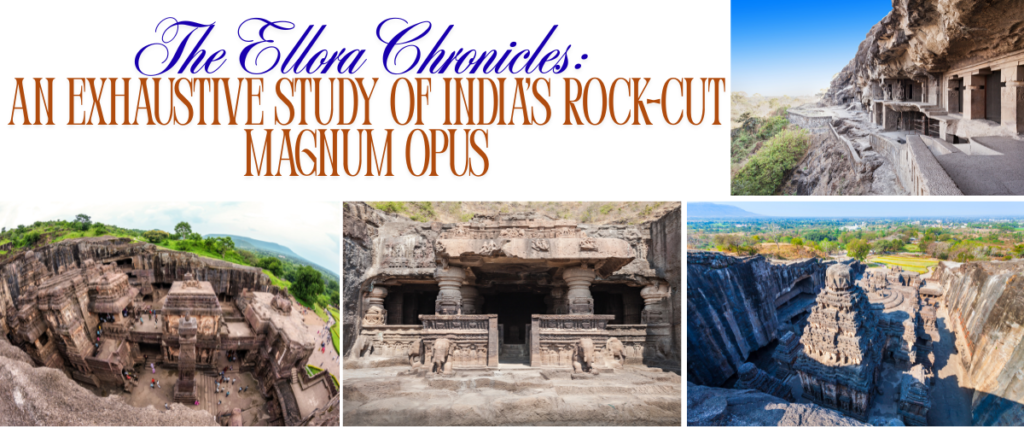
The Symphony in Stone
In the heart of the Deccan Plateau, where the Sahyadri hills rise in stark, volcanic majesty against the Maharashtrian sky, lies a testament to human perseverance that defies the conventional logic of architectural history. The Ellora Caves, a UNESCO World Heritage Site located approximately 30 kilometres northwest of Chhatrapati Sambhajinagar (formerly Aurangabad), represent not merely a collection of temples but a frozen timeline of Indian religious thought, artistic evolution, and engineering audacity.1 Spanning a period from roughly 600 CE to 1000 CE, these thirty-four accessible excavations—and nearly one hundred in total—stand as a monolithic documentation of a unique era in civilisation where three distinct faiths—Buddhism, Hinduism, and Jainism—coexisted, flourished, and shared the same canvas of living rock.1
Unlike the structural temples of Greece or the pyramids of Egypt, which were constructed by stacking stone upon stone, the monuments of Ellora were created through a process of subtraction. They were not built; they were liberated from the mountain. The artisans of Ellora, working under the patronage of dynasties such as the Rashtrakutas, Kalachuris, Chalukyas, and Yadavas, treated the volcanic cliffs of the Deccan Trap not as a foundation, but as the material itself.1 The result is an architectural complex that feels organic, born from the earth rather than imposed upon it.
The significance of Ellora extends beyond its visual grandeur. It sits on an ancient trade route, the Dakshinapatha, which connected the commercial centres of the north with the ports of the western coast.1 This location ensured a steady flow of wealth, ideas, and pilgrims, transforming the site into a cosmopolitan hub where merchants, monks, and monarchs converged. The caves serve as a documentary in stone, recording the shift in religious dominance in the Deccan, the evolution of iconographic standards, and the sophisticated advancements in rock-cut technology that culminated in the world’s largest monolithic structure, the Kailasa Temple (Cave 16).5
This report aims to provide an exhaustive analysis of the Ellora Caves. It will traverse the historical currents that shaped them, dissect the architectural theories that governed their creation, and offer a cave-by-cave examination of their artistic treasures. From the serene, meditative halls of the Buddhist viharas to the dynamic, shadow-filled galleries of the Hindu pantheon, and finally to the intricate, lace-like carvings of the Jain basadis, we will explore the depths of Ellora. We will also examine the practicalities of visiting this colossal site, debunk enduring myths, and contextualise Ellora within the broader tapestry of World Heritage.
The Geological Canvas: The Deccan Traps
To understand the art of Ellora, one must first understand the medium. The caves are excavated into the vertical face of the Charanandri Hills, which are formed of Deccan Trap basalt.1 This volcanic rock, created by massive lava flows millions of years ago, possesses specific characteristics that made the miracle of Ellora possible. It is hard enough to support the immense weight of the mountain overhead, yet fine-grained enough to allow for the carving of intricate details—jewellery on a statue, the curl of a demon’s hair, or the petals of a lotus.3
The basalt cliffs at Ellora are layered, presenting alternate bands of vesicular and massive trap rock. The ancient architects, displaying a profound understanding of geology, chose the massive trap layers for the pillars and structural elements, avoiding the vesicular or amygdaloidal layers that were prone to weathering.6 This geological intuition is the primary reason these caves have survived for over a millennium, resisting the monsoons that batter the Western Ghats annually.
However, the rock is not uniform. Flaws, cracks, and varying densities posed constant challenges. An error in judgment could lead to the collapse of a ceiling or the fracture of a deity’s face. The fact that the Kailasa Temple, excavated top-down, exists without major structural failure is a testament to the master planners who could visualise the finished temple inside the solid mountain before a single chisel struck stone.7
The Spirit of Tolerance
One of the most profound insights Ellora offers is into the social fabric of ancient India. In a world often fractured by religious conflict, Ellora stands as a monument to syncretism. The site is not segregated by high walls or distant geography. The Buddhist caves (1–12) lie to the south, the Hindu caves (13–29) in the centre, and the Jain caves (30–34) to the north.1
For centuries, scholars believed these groups were excavated strictly sequentially—Buddhists first, then Hindus, then Jains—reflecting the rise and fall of these religions in the region. However, modern research and closer analysis of iconography and inscriptions suggest a more fluid reality. There appears to have been a period of overlap, particularly between the late Buddhist and early Hindu phases, and later between the Hindu and Jain phases.3 This “simultaneous excavation” theory implies that the artisan guilds may have worked on different caves at the same time, perhaps even sharing techniques and workmen. A sculptor might have carved a Bodhisattva in the morning and a Shiva in the afternoon, applying the same aesthetic principles to different theologies. This proximity suggests a society where religious competition was intellectual and artistic rather than violent, a “spirit of tolerance” that UNESCO cites as a key component of Ellora’s Outstanding Universal Value.2
Historical Context and Patronage
The creation of Ellora was not a singular event but a continuous process spanning nearly five centuries. While the exact dates of excavation are often debated due to a lack of precise foundation inscriptions for every cave, the general chronology aligns with the major dynasties that ruled the Deccan.
The Dynastic Timeline
The political stability provided by powerful dynasties was essential for a project of Ellora’s scale. Rock-cut architecture requires immense resources—armies of labourers to remove the debris, skilled sculptors to carve the rock, and priests to consecrate the shrines.
| Period (Approx.) | Dynasty | Religious Focus | Key Contributions & Architectural Evolution |
| c. 550 – 600 CE | Traikutakas / Vakatakas | Buddhist / Early Hindu | Possible initiation of the earliest caves; continuation of the Ajanta tradition. The Vakatakas were instrumental in Ajanta, and as their power waned, the guilds likely migrated to Ellora.1 |
| c. 550 – 620 CE | Kalachuris | Hindu (Shaivite) | Patronage of early Shaivite caves (e.g., Cave 21, 29); focus on Pasupata Shaivism. The Kalachuris of Mahishmati brought a distinct monumental style seen in the massive Dumar Lena.1 |
| c. 600 – 730 CE | Chalukyas of Badami | Buddhist / Hindu | Consolidation of the Buddhist group; early Hindu excavations. Their architectural influence is visible in the structural layouts adapted for rock-cut caves.1 |
| c. 753 – 982 CE | Rashtrakutas | Hindu / Jain | The Golden Age of Ellora. Under Kings Dantidurga and Krishna I, the site saw its most ambitious projects, including the Kailasa Temple (Cave 16) and the Dashavatara Cave (Cave 15).1 |
| c. 850 – 1000 CE | Yadavas of Devagiri | Jain | Final phase of excavation; elaborate Jain temples like Indra Sabha (Cave 32) and Jagannatha Sabha (Cave 33), characterised by intricate detailing.1 |
The Shift from Ajanta to Ellora
A fascinating historical dynamic exists between the Ajanta Caves and Ellora. Ajanta, located about 100 kilometres away, is exclusively Buddhist and famous for its paintings.11 Activity at Ajanta ceased around 480–500 CE. Conventional history suggests a migration of artisans. As patronage at Ajanta dried up with the decline of the Vakataka dynasty, the guilds likely moved to Ellora, where new patrons (the Kalachuris and Chalukyas) were emerging.1
This migration explains the stylistic continuity. The earliest Buddhist caves at Ellora (Caves 1–5) show a roughness and experimentation that suggests a “restart,” but by the time we reach Cave 10 (Vishvakarma), the sophistication of Ajanta has been reclaimed and adapted to the basalt medium. However, unlike Ajanta, which was a secluded retreat for monks during the monsoon, Ellora was a public site, located near a major city (Elapura) and trade routes. This accessibility influenced its character; while Ajanta is introverted and focused on monastic life, Ellora is extroverted, monumental, and designed to impress the lay visitor and the pilgrim alike.1
The Rashtrakuta Intervention
The most significant phase of Ellora belongs to the Rashtrakuta dynasty. Dantidurga, the founder of the empire, is associated with the Dashavatara Cave (Cave 15), which contains an inscription detailing his conquests.10 However, it was his uncle and successor, Krishna I (r. c. 756–773 CE), who immortalised the dynasty by commissioning the Kailasa Temple.9
The Rashtrakutas were fierce rivals of the Pallavas of Kanchipuram in the south. When the Rashtrakutas defeated the Pallavas, they didn’t just bring back gold; they brought back architectural ideas. The Kailasa Temple shows distinct traces of the Dravidian style prevalent in the Pallava territories (like the Kailasanatha temple in Kanchipuram), fused with the sturdy, rock-cut traditions of the Deccan.9 This cross-pollination of styles—North Indian (Nagara) and South Indian (Dravidian)—makes Ellora a pivotal site in the history of Indian temple architecture.
Architectural Theory: The Monolithic Technique
To fully appreciate the descriptions of the caves that follow, one must grasp the “Subtractive Method” of architecture.
In structural architecture (building up), if a pillar is too short, you add another stone. If a wall is in the wrong place, you move it. In monolithic rock-cut architecture (carving down), there is no “undo” button. Once a piece of rock is chipped away, it is gone forever. This required a level of planning that borders on the miraculous.
The Excavation Process
- Marking the Plot: The architects would designate a section of the cliff face.
- Trenching: For the massive monolithic temples like Kailasa, three huge trenches were dug into the hillside to isolate a central block of rock.16
- Top-Down Carving: Work began at the very top (the Shikhara or spire) and moved downwards. This eliminated the need for scaffolding, as the rock itself served as the platform for the workers.15
- Simultaneous Sculpting: The rough hewing of the architecture and the fine detailing of the sculptures often happened in quick succession. As the stone cutters moved down to the next level, the sculptors would finish the level above.15
This method meant that the roof was finished before the floor was even exposed. It also implied that the plan had to be perfect from the start. The architect, known in legends as Kokasa, had to visualise the complex 3D geometry of staircases, pillared halls, and hidden shrines entirely within the uncarved mountain.9
The Buddhist Group: Caves 1–12 (c. 600–730 CE)
The Buddhist caves are located at the southern end of the escarpment. These are the earliest excavations at Ellora and belong to the Vajrayana phase of Buddhism, which involves a complex pantheon of Bodhisattvas and female deities (Taras), marking a departure from the simpler Hinayana or Mahayana iconography found in early Ajanta.2
General Characteristics
Unlike the intricate prayer halls of Ajanta, the Buddhist caves at Ellora are primarily Viharas (monasteries). They are multi-storied, vast, and spacious, designed to house large numbers of monks. The scale here is grander, but the ornamentation is often more restrained than in the later Hindu caves.6
Cave 10: The Vishvakarma Cave (The Carpenter’s Cave)
Cave 10 is the jewel of the Buddhist group and the only Chaitya Griha (prayer hall) among them.18
- The Name: It is locally known as the “Sutar-ki-jhopari” or Carpenter’s Hut. This name stems from the architectural style of the ceiling, which mimics wooden ribs. The stone cutters carved the basalt to look like wooden beams, a skeuomorphic retention from the days when prayer halls were made of timber.6
- The Facade: The entrance is grand, featuring a large horseshoe-shaped arch (sun window) that allows light to flood the interior, illuminating the Stupa at the far end.
- The Interior: The hall is divided into a central nave and two side aisles by 28 octagonal pillars.
- The Stupa and Buddha: At the apsidal end of the hall sits a large Stupa (reliquary mound). However, unlike early Buddhist stupas, which were plain, this one features a colossal seated Buddha carved into the front of the mound. The Buddha is in the Vyakhyana Mudra (teaching pose), seated on a lion throne, flanked by Bodhisattvas.18
- Acoustics: The curved, ribbed ceiling is not just aesthetic; it creates a powerful acoustic effect, ideal for the chanting of mantras. Standing at the base of the Stupa, a whisper can carry through the hall.
Caves 11 and 12: Do Tal and Teen Tal
These caves represent the peak of monastic rock-cut architecture.
- Cave 12 (Teen Tal): Paradoxically named “Three Floors,” it is a massive three-story monastery. It was excavated by sinking a courtyard into the rock and then carving three levels of halls. It houses cells for monks, a large sanctuary, and rows of Buddha images. The sheer cubic volume of rock removed for Cave 12 is staggering, rivalling even the Kailasa temple, though it remains a cave (interior space) rather than a monolith (exterior structure).2
- Cave 11 (Do Tal): Originally thought to have two stories (hence “Do Tal”), excavation later revealed a third basement level. It serves as a transition point, showing the increasing complexity of the Buddhist pantheon with images of Bodhisattvas like Avalokitesvara and deities like Jambhala (god of wealth).2
Insight: The Buddhist Decline?
The Buddhist caves at Ellora are among the last major rock-cut Buddhist monuments in India. Their scale suggests that Buddhism was still powerful and well-funded in the 7th and 8th centuries, contrary to theories of a rapid decline. However, the iconography shows a heavy influence of Tantricism, which may indicate the blurring lines between Buddhist and Hindu practices that eventually led to Buddhism’s absorption into the broader Hindu fold in India.2
The Hindu Group: Caves 13–29 (c. 600–870 CE)
Moving north from the Buddhist group, the energy of the site changes. If the Buddhist caves are defined by serenity and static repetition, the Hindu caves are defined by dynamism, energy, and dramatic mythology. These caves are mostly dedicated to Lord Shiva, though Vaishnavite themes are also present.1
The Early Hindu Phase: Caves 21 and 29
Before the Rashtrakuta masterpiece of Kailasa, earlier dynasties (Kalachuris and Chalukyas) left their mark.
- Cave 29: Dhumar Lena: This cave is stylistically very similar to the Elephanta Caves near Mumbai. It is a massive hall with a cross-shaped plan.
- The Great Fall: It features a natural waterfall (active during monsoons) that cascades over the “Sita-ki-nahani” (Sita’s Bath) area near the cave, integrating nature with the divine.19
- The Guardians: The doorways are guarded by colossal Dvarapalas (gatekeepers), and the interior houses huge panels of Shiva in various forms: as the cosmic dancer (Nataraja) and as the destroyer of Andhaka (Andhakasuravadha).19
- Cave 21: Rameshwar Cave: Famous for its exquisite carvings of river goddesses. On the facade, the goddesses Ganga and Yamuna ride their respective vehicles (the crocodile and the tortoise). The sculptures here are celebrated for their voluptuous grace and detailed ornamentation, marking a high point in early Ellora art.1
Cave 15: The Dashavatara Cave
This cave is a crucial link in Ellora’s history.
- Conversion: Architectural evidence suggests Cave 15 started as a Buddhist monastery (similar to Caves 11 and 12) but was converted into a Hindu temple. The layout resembles a vihara, but the iconography is undeniably Hindu.3
- The Narasimha Avatar: One of the most powerful sculptures in all of Indian art is found here. It depicts Vishnu as Narasimha (the Man-Lion) destroying the demon king Hiranyakashipu.
- Artistic Analysis: The sculpture is not a static portrait but a captured moment of action. Narasimha captures the demon, who is shown grimacing in agony. The artist has expertly conveyed the sheer physical power of the god and the violent end of the demon. The composition is diagonal, creating a sense of movement and tension that is rare in stone.20
Cave 16: The Kailasa Temple – A Mountain within a Mountain
We now arrive at the magnum opus of Ellora, the Kailasa Temple (Cave 16). It is not merely a cave; it is a multi-story structural temple carved entirely out of a single rock. It is estimated that 200,000 to 400,000 tons of rock were scooped out to create this wonder.15
The Legend of Kokasa
Local folklore preserves the memory of the architect, Kokasa. The legend says the Rashtrakuta Queen Manikavati fell ill. She vowed to build a temple to Shiva and fast until she saw the shikhara (finial) of the temple. The architects told the King (Krishna I) that such a temple would take years, and the Queen would die of starvation. Kokasa stepped forward and promised the Queen she would see the shikhara in a week. He did this by carving the temple from the top down. He finished the spire first, the Queen broke her fast, and the work continued downward for decades. This legend, while mythic, accurately describes the unique top-down construction method.9
Architectural Layout
The temple is designed to resemble Mount Kailash, the Himalayan abode of Lord Shiva.5
- Gopuram: The entrance is a two-story gatehouse, screening the sacred interior from the outside world.7
- Nandi Mandapa: Upon entering, one faces a pavilion housing Nandi, the sacred bull of Shiva.
- The Bridge: A rock-cut bridge originally connected the Nandi Mandapa to the main temple porch, a fragile link of stone that has survived for 1,200 years.9
- The Main Temple (Vimana): The central shrine stands on a high plinth. This plinth is carved with a frieze of life-sized elephants, lions, and mythical beasts, giving the illusion that the entire massive temple is being carried on their backs.7
- The Courtyard: Surrounding the main temple is a U-shaped courtyard cut deep into the cliff. The vertical walls of the cliffs are carved with galleries (cloisters) filled with large relief panels of Shiva, Vishnu, and the Mother Goddesses.24
The Masterpiece Relief: Ravana Shaking Mount Kailash
On the southern base of the main temple is a relief often cited as the zenith of Indian dramatic sculpture: Ravananugrahamurti.25
- The Narrative: The demon king Ravana, in his arrogance, attempts to lift Mount Kailash. The mountain shakes.
- The Depiction:
- Parvati: Shiva’s consort, Parvati, is shown clinging to Shiva’s arm in fear. Her body language is fluid, panicked, and incredibly human.25
- The Attendants: The ganas (attendants) are shown running or freezing in shock.
- Shiva: In stark contrast to the chaos, Shiva sits calm and poised. He simply presses down with his big toe, crushing Ravana’s pride and pinning him beneath the mountain.
- Ravana: At the bottom, in the dark recess, Ravana is shown with multiple arms straining against the weight of the rock.
- Insight: This sculpture is a masterclass in psychological contrast—the panic of the world vs. the calm of the divine. The use of deep relief creates shadows that make Ravana look like he is truly in the depths of the earth.26
Traces of Painting
The Kailasa temple was originally covered in white plaster (to look like the snowy Mount Kailash) and brightly painted. Traces of these paintings remain on the ceilings of the porch and the mandapa. They depict battle scenes, elephants, and geometric patterns. While faded, they offer a glimpse into the vibrant, technicoloured reality of ancient Indian temples, which were never the bare grey stone we see today.2
The Jain Group: Caves 30–34 (c. 800–1000 CE)
The final phase of Ellora belongs to Jainism. Located about a kilometre north of the Kailasa temple, these caves are smaller but characterised by exceptionally detailed, intricate carving that resembles ivory work.2
Cave 30: Chhota Kailasa
As the name suggests, this cave is a smaller, unfinished imitation of the great Kailasa Temple. It was an attempt to replicate the monolithic grandeur of Cave 16 for the Jain faith. While it lacks the scale of the original, it possesses a charm of its own and marks the transition into the Jain phase.29
Cave 32: The Indra Sabha
This is the finest of the Jain series.
- The Name: “Indra Sabha” (Assembly of Indra) is a misnomer. The early historians mistook the Yaksha Matanga (a Jain guardian deity) for the Hindu god Indra. Despite the error, the name stuck.28
- Architecture: It is a two-story cave entered through a rock-cut gateway. The courtyard features a monolithic shrine and a monolithic elephant, echoing the layout of the Kailasa temple but on a more intimate scale.30
- The Interior: The upper hall is supported by pillars that are fluted and highly polished. The carvings here are dense—every inch of surface is decorated with flowers, garlands, and geometric motifs.
- Iconography: The cave contains statues of the Tirthankaras (Jain spiritual teachers), including Mahavira, Parshvanatha (canopied by a multi-headed serpent), and Gomateshwara (Bahubali).
- Bahubali: The statue of Gomateshwara is depicted standing in deep meditation in a forest. Vines are shown creeping up his legs, and animals gather at his feet, symbolising the immense length of time he has stood still in penance.3
- Paintings: The ceiling of the Indra Sabha retains significant patches of painting, featuring lotus motifs and celestial figures. These are some of the best-preserved paintings at Ellora.1
Comparative Analysis: Ajanta vs. Ellora
Visitors often struggle to decide between these two monumental sites or understand their relationship. A comparison clarifies their distinct identities.
| Feature | Ajanta Caves | Ellora Caves |
| Primary Religion | Exclusively Buddhist (Hinayana & Mahayana). | Buddhist, Hindu, and Jain (Tri-religious). |
| Timeline | 2nd Century BCE – 5th Century CE. | 6th Century CE – 11th Century CE. |
| Location | Secluded horseshoe gorge; introverted. | Open basalt escarpment on a trade route; extroverted. |
| Key Attraction | Paintings: World-famous murals and frescoes (Jataka tales). | Sculpture & Architecture: Massive rock-cut structures and reliefs. |
| Architecture | Mostly caves (interior spaces). | Includes monolithic structures (exterior buildings carved from rock). |
| Preservation | Delicate (light sensitivity concerns). | Robust (stone structural integrity). |
| Atmosphere | Quiet, monastic, retreat-like. | Grand, monumental, celebratory. |
| Best For | Art lovers, painting enthusiasts. | Architecture buffs, sculpture lovers, and general history buffs. |
Insight: Ajanta is about the interior world—the soul, meditation, and delicate brushstrokes. Ellora is about the exterior world—power, cosmology, and the physical reshaping of the earth.12
The Preservation Challenge
While the basalt of Ellora is durable, it is not invincible. The site faces threats from water seepage, which weakens the rock and damages the remaining paintings. In the past, bat guano caused chemical damage to the artwork.31 The Archaeological Survey of India (ASI) actively manages these threats, using gentle cleaning methods and controlling water runoff. The sheer footfall of tourists also poses a risk of abrasion and vandalism. As responsible visitors, it is crucial not to touch the paintings or carvings to preserve them for future generations.
Conclusion
The Ellora Caves are more than just a tourist destination; they are a psychological marvel. They force us to confront a time when time itself was measured differently—not in hours or days, but in generations. The artisan who began the Kailasa temple knew he would not live to see it finished. He carved for a vision he would never behold.
This site serves as a permanent reminder of the power of faith and the capacity of the human spirit to mould the natural world into shapes of divine beauty. Whether it is the quiet resonance of the “Om” in the Buddhist Carpenter’s Cave, the terrifying power of Shiva in the Hindu halls, or the intricate perfection of the Jain Indra Sabha, Ellora speaks a universal language. It tells us that while empires fall and kings turn to dust, art—hewn from the living heart of the earth—remains.
Disclaimer
This report is based on research data available as of January 2026. Entry fees, timings, and local regulations are subject to change by the Archaeological Survey of India (ASI). Visitors are advised to check official ASI sources before planning their trip. The historical interpretations presented here reflect the current academic consensus but may be subject to evolution as new archaeological evidence emerges.
Reference
- Ellora Caves – Wikipedia, accessed on January 5, 2026, https://en.wikipedia.org/wiki/Ellora_Caves
- Ellora Caves – UNESCO World Heritage Centre, accessed on January 5, 2026, https://whc.unesco.org/en/list/243/
- The multireligious caves at Ellora – Smarthistory, accessed on January 5, 2026, https://smarthistory.org/the-multireligious-caves-at-ellora/
- Ajanta Ellora India: UNESCO Caves Travel Guide, History & Tips, accessed on January 5, 2026, https://emkaytravelsolution.com/ajanta-ellora-india-unesco-caves-travel-guide-history-tips/
- Ellora Caves: UNESCO World Heritage Site Travel Guide, accessed on January 5, 2026, https://www.worldheritagesite.org/list/ellora-caves/
- Ellora Sub Circle (Ellora Caves) – Archaeological Survey Of India, Aurangabad Circle, accessed on January 5, 2026, https://www.asiaurangabadcircle.com/monument_detail.php?id=49
- Kailasa Temple, Ellora- The Ancient rock-cut temple – RTF | Rethinking The Future, accessed on January 5, 2026, https://www.re-thinkingthefuture.com/rtf-design-inspiration/a2055-kailasa-temple-ellora-the-ancient-rock-cut-temple/
- Kailasa Temple – Unresolved Construction Methods : r/UnwrittenHistory – Reddit, accessed on January 5, 2026, https://www.reddit.com/r/UnwrittenHistory/comments/1j89xcn/kailasa_temple_unresolved_construction_methods/
- Kailasa Temple, Ellora – Wikipedia, accessed on January 5, 2026, https://en.wikipedia.org/wiki/Kailasa_Temple,_Ellora
- Dashavatara Cave, Ellora – MAP Academy, accessed on January 5, 2026, https://mapacademy.io/article/dashavatara-cave-ellora/
- Ajanta and Ellora Caves – The Essential Guide – Deliciously Directionless, accessed on January 5, 2026, https://deliciouslydirectionless.com/ajanta-and-ellora-caves-the-essential-guide/
- How to compare Ajanta vs. Ellora tour packages before booking? – Saibaba Travels, accessed on January 5, 2026, https://saibabatravels.com/blog/how-to-compare-ajanta-vs-ellora-tour-packages-before-booking.html
- Exploring the Ellora Caves – Wandering Veena, accessed on January 5, 2026, https://wanderingveena.com/blog/ellora-caves
- What are the major differences between the Ajanta and Ellora caves? – Quora, accessed on January 5, 2026, https://www.quora.com/What-are-the-major-differences-between-the-Ajanta-and-Ellora-caves
- Kailasa Temple Ellora | Indian Heritage Architecture – Inheritage Foundation, accessed on January 5, 2026, https://inheritage.foundation/blog/heritage/kailasa-temple-ellora
- ELLORA – Vanamali Ashram, accessed on January 5, 2026, https://www.vanamaliashram.org/ELLORA.html
- Kokasa – Wikipedia, accessed on January 5, 2026, https://en.wikipedia.org/wiki/Kokasa
- Seated Buddha, Vishvakarma Cave, Ellora – MAP Academy, accessed on January 5, 2026, https://mapacademy.io/article/seated-buddha-vishvakarma-cave-ellora/
- The Ellora Caves: The Ultimate Guide – Sailingstone Travel, accessed on January 5, 2026, https://sailingstonetravel.com/ellora-caves-guide/
- Ellora – Cave 15, The Dasavatara – India That Was, accessed on January 5, 2026, https://www.indiathatwas.com/2012/12/ellora-cave-15-the-dasavatara/
- Ellora Caves – 7 Wonders, accessed on January 5, 2026, https://7wonders.org/asia/india/aurangabad/ellora-caves/
- Kailasa Temple: Sculpted out of a mountain – 5 Senses Tours, accessed on January 5, 2026, https://5sensestours.com/kailasa-temple/
- Kailasa Temple, Ellora – ALSphere Foundation, accessed on January 5, 2026, https://alsphere.org/kailasa-temple-ellora/
- Ellora Cave Temples & Sculptures : A Confluence of Tri – religious Heritage, accessed on January 5, 2026, https://www.natureandheritage.org/post/ellora-cave-temples-sculptures-a-confluence-of-tri-religious-heritage
- Ravana Shaking Mount Kailasa | Cleveland Museum of Art, accessed on January 5, 2026, https://www.clevelandart.org/art/1971.173
- Ravananugrahamurti – MAP Academy, accessed on January 5, 2026, https://mapacademy.io/article/ravananugrahamurti/
- Manifestation of the Unmanifested: Shiva Sculptures of Kailash Temple, Ellora – Sahapedia, accessed on January 5, 2026, http://www.sahapedia.org/manifestation-unmanifested-shiva-sculptures-kailash-temple-ellora
- Ellora – Cave 32, The Indra Sabha – India That Was, accessed on January 5, 2026, https://www.indiathatwas.com/2014/07/ellora-cave-32-the-indra-sabha/
- Ellora – Cave 30, The Chota Kailas – India That Was, accessed on January 5, 2026, https://www.indiathatwas.com/2013/03/ellora-cave-30-the-chota-kailas/
- Cave 30 / Chhota Kailash, Ellora Caves – Timings, History, Architecture, Best Time to Visit, accessed on January 5, 2026, https://www.trawell.in/maharashtra/ellora-caves/cave-30-chhota-kailash
- Nilay’s Exploration of Ellora Caves – Archaeology & Society – The Claremont Colleges Pressbooks, accessed on January 5, 2026, https://pressbooks.claremont.edu/archandsoc/chapter/pangrekar/
- 19 Ellora Cave 32 Stock Photos, High-Res Pictures, and Images, accessed on January 5, 2026, https://www.gettyimages.com/photos/ellora-cave-32
- Ellora Caves Aurangabad (Timings, Entry Fee, History, Location, Images & Facts), accessed on January 5, 2026, https://aurangabadtourism.in/ellora-caves-aurangabad
- Best Time to Visit Ajanta Caves – Plan Your Perfect Trip, accessed on January 5, 2026, https://www.noblehousetours.com/best-time-to-visit-ajanta-caves/
- Ellora Caves – Archaeological Survey of India, accessed on January 5, 2026, https://asi.nic.in/pages/WorldHeritageElloraCaves
- accessed on January 5, 2026, https://realitytoursandtravel.com/ajanta-and-ellora-caves-travel-guide/
- Discover the Best Time to Visit Ellora Caves: Expert Tips – Tata Neu, accessed on January 5, 2026, https://www.tataneu.com/pages/travel/hotels/discover-the-best-time-to-visit-ellora-caves-expert-tips
- Kailasa Temple Ellora: History, Mystery & Travel Guide – Capture A Trip, accessed on January 5, 2026, https://www.captureatrip.com/blog/kailasa-temple
- India Travel | Forum: Maharashtra – Photography in ajenta ellora, accessed on January 5, 2026, https://www.indiamike.com/india/maharashtra-f37/photography-in-ajenta-ellora-t12175/
- accessed on January 5, 2026, https://www.trawell.in/maharashtra/ellora-caves/ghrushneshwar-grishneshwar-jyotirlinga-temple
- Ellora Leni and Ghrishneshwar Jyotirlinga Temple, Verul | District Chhatrapati Sambhajinagar | India, accessed on January 5, 2026, https://chhatrapatisambhajinagar.maharashtra.gov.in/en/tourist-place/ellora-leni-and-ghrishneshwar-jyotirlinga-temple-verul/