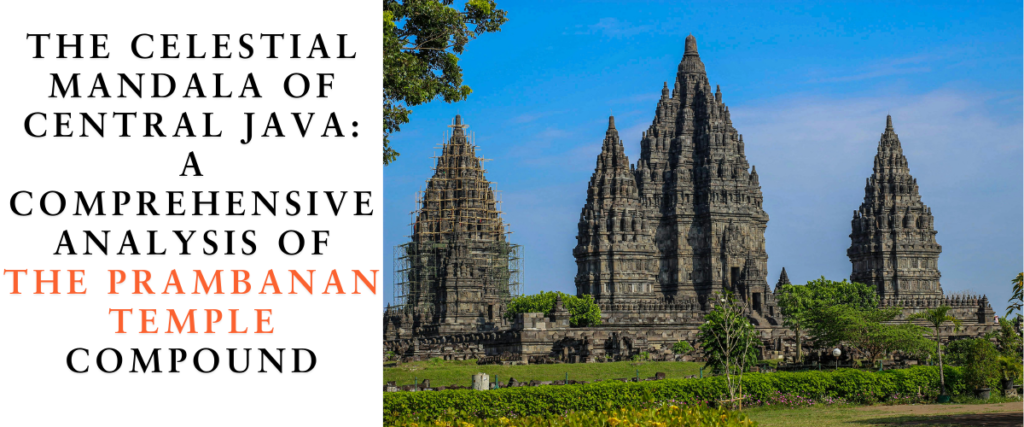
The central plains of Java, Indonesia, serve as a silent witness to one of the most sophisticated spiritual and architectural endeavours of the first millennium. Rising from the volcanic soil of the Prambanan Plain, the 9th-century Hindu temple compound of Prambanan, also known locally as Candi Prambanan or Loro Jonggrang, stands as a monumental testament to the Sanjaya dynasty’s religious devotion and political authority.1 Dedicated to the Trimurti—the expression of the divine as the Creator (Brahma), the Preserver (Vishnu), and the Destroyer (Shiva)—the complex is not merely a collection of stone structures but a physical manifestation of Hindu cosmology, designed to mirror the sacred Mount Meru, the abode of the gods.1 As the largest Hindu temple site in Indonesia and the second-largest in Southeast Asia after Angkor Wat, Prambanan represents a pinnacle of classical Javanese art and architecture, reflecting a period where spiritual philosophy and advanced engineering converged to create an enduring legacy of stone.5
Historical Foundations and the Sanjaya Resurgence
The genesis of Prambanan is inextricably linked to the socio-political shifts of 9th-century Central Java. For several decades prior to its construction, the region had been dominated by the Sailendra dynasty, which championed Mahayana Buddhism and commissioned the grand stupa of Borobudur.2 The emergence of Prambanan marked a significant pivot in the Mataram court’s patronage, signalling a return to Shaivite Hinduism under the Sanjaya dynasty.2
Historical records, specifically the Shivagrha inscription dated to 12 November 856 CE, identify King Rakai Pikatan as the visionary who initiated the project around 850 CE.2 The inscription meticulously records the dedication of the temple, originally named Shivagrha (House of Shiva) or Shivalaya (Realm of Shiva), to the god Shiva.2 Scholars suggest that the construction of this massive Hindu complex was a direct aesthetic and political response to the Buddhist monuments of the Sailendras, intended to legitimise the Sanjaya dynasty’s return to power and assert Hindu sovereignty over the fertile plains of Java.2
The transition was not characterised solely by rivalry; the marriage of the Hindu prince Rakai Pikatan to the Buddhist princess Pramodhawardhani of the Sailendra dynasty suggests a nuanced period of religious reconciliation and cultural synthesis.1 This harmony is reflected in the proximity of Prambanan to Buddhist sites like Candi Sewu, located just 800 meters away, illustrating a past of peaceful religious cohabitation.9 Following Rakai Pikatan, the complex was expanded and refined by successive Mataram kings, including King Lokapala, Balitung Maha Sambu, Daksa, and Tulodong, who oversaw the addition of hundreds of ancillary temples, effectively creating a sprawling divine city.2
| Historical Timeline of Prambanan | Period / Date | Key Event |
| Initial Construction | c. 850 CE | Project initiated by King Rakai Pikatan.2 |
| Official Inauguration | 12 November 856 CE | Completion of the main Shiva temple is recorded in the Shivagrha inscription.2 |
| Major Expansion Phase | Late 9th – Early 10th Century | Addition of 224 Pervara temples by Kings Balitung and Daksa.2 |
| Mysterious Abandonment | c. 930 – 950 CE | Capital shifted to East Java by Mpu Sindok, likely due to Merapi.1 |
| Colonial Discovery | 1811 CE | Site documented by Colin Mackenzie under Stamford Raffles.5 |
| Systematic Restoration | 1918 CE | Formal Dutch-led reconstruction efforts begin.5 |
| UNESCO Recognition | 1991 CE | Inscribed as a World Heritage Site.6 |
Cosmological Architecture and the Three Realms
The architectural design of Prambanan follows the rigorous principles of Vastu Shastra, the ancient Indian tradition of sacred architecture, while incorporating local Javanese aesthetic adaptations.2 The complex is laid out according to a mandala—a geometric plan representing the universe—and is structured into three concentric zones that correspond to the hierarchical realms of Hindu cosmology.2 These zones, known as Loka, represent the journey from the mundane to the divine.2
Bhurloka: The World of Mortals
The outermost zone, or the Bhurloka, is represented by the outer courtyard and the base (foot) component of each temple.4 In Hindu and Buddhist belief systems, this realm is the world of common mortals, animals, and demons, characterised by earthly desires and the struggle for existence.7 Architecturally, this base provides the foundation upon which the sacred structures rise, grounding the celestial spires in the physical reality of the earth.4
Bhuvarloka: The Realm of the Wise
The middle courtyard and the central body of the temples represent the Bhuvarloka, the middle realm.4 This zone is the abode of holy people, sages, wise men, and lesser deities who have begun to see the truth and detach themselves from worldly impulses.7 Within the Prambanan complex, this middle zone originally contained four rows of 224 identical Pervara (ancillary) temples, symbolising the vast retinue of divine beings that surround the central gods.7
Svarloka: The Holiest Realm
The innermost courtyard and the towering roofs (heads) of the temples constitute the Svarloka, or Svargaloka, the highest and holiest realm dedicated to the gods.4 This is the celestial kingdom where the Trimurti resides. The roofs of the temples are topped with ratna (jewels) shaped like vajras (diamonds), which serve as the Hindu counterpart to the Buddhist stupa, marking the point where the earthly structure touches the heavens.2 The central Shiva temple, soaring to 47 meters, serves as the ultimate “peak” of this architectural mountain, a representation of Mount Mahameru, the centre of the cosmos.1
The Inner Sanctum: Shrines of the Trimurti
The heart of the Prambanan complex is the inner courtyard, an elevated square platform that houses sixteen major temples.9 Dominating this space are the three grand shrines dedicated to the Trimurti, arranged in a north-south line and facing east.16
The Shiva Mahadeva Temple
As the central and most imposing structure, the Shiva temple stands 47 meters tall and 34 meters wide, signifying Shiva’s role as the supreme deity in the Javanese Shaivite tradition.1 The temple features a sophisticated vertical design with steep stairs leading to four chambers oriented to the cardinal directions.9
Inside the central chamber, the garbhagriha, resides the 3-meter-tall statue of Shiva Mahadeva.2 Depicted with four arms and standing on a lotus pedestal atop a square yoni, the statue is believed by archaeologists to have been modelled after King Balitung, representing his deification after death.2 The presence of a square yoni—a symbol of the divine feminine—beneath the anthropomorphic statue of Shiva is a unique Javanese stylistic choice.20
The other three chambers house essential figures of the Shaivite pantheon:
- Agastya (South): The great Hindu sage and teacher of the Vedas, portrayed as a bearded hermit with a prominent stomach, carrying a water vessel and a trident.11
- Ganesha (West): The elephant-headed son of Shiva and Parvati, the remover of obstacles and god of wisdom.9
- Durga Mahisasuramardini (North): The goddess who defeated the buffalo demon Mahishasura. This statue is locally revered as the petrified form of Princess Rara Jonggrang from the famous temple legend.9
The Brahma and Vishnu Temples
Flanking the Shiva temple are the shrines of Brahma, the Creator (to the south) and Vishnu, the Preserver (to the north).14 Both temples reach a height of 33 meters.9
- The Brahma Temple houses a four-headed statue of the creator god, representing the four directions and the four Vedas.9
- The Vishnu Temple contains a four-armed statue of Vishnu holding his traditional attributes: the conch shell (shankha), the discus (chakra), the mace (gada), and the lotus flower.9 Like the Shiva statue, Vishnu stands on a lotus placed atop a yoni, reflecting a consistent iconographic theme across the complex.20
Attendant Shrines: Vahanas and Minor Temples
Directly opposite the Trimurti temples are three smaller shrines dedicated to their vahanas, or celestial vehicles, which serve as mounts for the gods.4
- Nandi Temple: Situated opposite the Shiva temple, it houses a large, polished stone statue of Nandi, the bull.14 This temple also features figures of the moon god Chandra and the sun god Surya.13
- Hamsa Temple: Facing the Brahma temple, it is dedicated to the sacred swan, Brahma’s mount.4
- Garuda Temple: Located opposite the Vishnu temple, it is dedicated to the mythical bird-like creature that carries Vishnu.4 Though the Garuda statue is currently missing, the temple remains a vital part of the complex’s symbolic symmetry.7
In addition to these six primary shrines, the inner zone includes:
- Apit Temples: Two “in-between” temples located on the north and south between the rows of Trimurti and Vahana shrines.4 While their specific dedication is debated, some believe they were dedicated to goddesses or served as ritual transition points.2
- Kelir and Patok Temples: Eight small shrines—four at the gates (Kelir) and four at the corners (Patok)—that serve as spiritual guardians of the inner sanctuary.4
| Temple Category | Quantity | Primary Dedication |
| Trimurti Temples | 3 | Shiva, Brahma, Vishnu.4 |
| Vahana Temples | 3 | Nandi (Bull), Hamsa (Swan), Garuda (Eagle).4 |
| Apit Temples | 2 | Located between the main rows.4 |
| Kelir Temples | 4 | At the inner zone gates.4 |
| Patok Temples | 4 | At the inner zone corners.4 |
| Pervara Temples | 224 | Arranged in four concentric squares.7 |
The Narrative Tapestry: Ramayana and Krishnayana Reliefs
Prambanan is celebrated for its exquisite narrative bas-reliefs, which transform the cold volcanic stone into a vivid storytelling medium. These reliefs are carved along the inner balustrade walls of the galleries surrounding the three main temples.2 To follow the stories, pilgrims perform pradaksina (circumambulation), walking clockwise to keep the inner sanctum on their right.2
The Epic of Rama
The Ramayana narrative is a massive undertaking, spanning 54 panels across the Shiva and Brahma temples.25
- Shiva Temple (Panels 1-24): The story begins with Lord Vishnu in the Tushita heaven preparing to take human form to defeat Ravana.25 The panels depict Rama’s youth, his marriage to Sita after breaking King Janaka’s bow, the intrigue in the court of Ayodhya leading to his 14-year exile, and the tragic abduction of Sita by Ravana in the forest.25
- Brahma Temple (Panels 25-54): The narrative continues with the search for Sita, the alliance with the monkey king Hanuman, the construction of the stone bridge to Lanka, and the climactic battle where Rama kills the ten-headed Ravana.18 Interestingly, the Prambanan version follows a Javanese adaptation where Rama initially doubts Sita’s purity, leading to her Survival of the fire ordeal and the eventual birth of their sons, Kusa and Lawa, in the forest.25
The Chronicles of Krishna
On the balustrades of the Vishnu Temple, 30 panels depict the Krishnayana, the story of Lord Krishna.25 This sequence details the life of Krishna and his brother Balarama, from their miraculous birth to their struggle against the evil King Kamsa, their maternal uncle.25 The reliefs illustrate Krishna’s childhood exploits, his divine protection of his followers, and his eventual triumph over tyranny.25
The “Prambanan Panel”: Lion and Kalpataru
Beyond the narrative epics, the lower outer walls of the temples feature a recurring decorative motif known as the “Prambanan panel”.2 This motif consists of a central lion (sinha) housed in a small niche, flanked by two kalpataru (wish-fulfilling) trees.2 These sacred trees are further flanked by pairs of kinnaras (celestial beings with bird-like bodies) or various animals like deer, monkeys, birds, and horses.2 This pattern creates a rhythmic aesthetic that reinforces the temple’s identity as a heavenly paradise.2
Advanced Engineering: The Opak River Diversion
One of the most remarkable aspects of Prambanan’s construction was the large-scale hydraulic engineering project described in the Shivagrha inscription.2 Geomorphological evidence confirms that the Opak River, which now flows on the western side of the complex, originally ran closer to the main temples, potentially threatening the integrity of the foundations.2
To facilitate the expansion of the site and protect it from volcanic mudflows (lahar) from Mount Merapi, 9th-century engineers rerouted the river to follow a straight north-to-south axis along the temple’s outer wall.2 The former riverbed was filled and levelled to create space for the hundreds of Pervara shrines.2 This intervention demonstrates that the builders of Prambanan possessed not only architectural genius but also sophisticated urban planning and environmental management skills.8
The Legend of Rara Jonggrang
While history speaks of kings and inscriptions, Javanese folklore offers a different origin for the ruins. The Legend of Rara Jonggrang (The Slender Virgin) remains a beloved part of the local culture.21 According to the tale, Prince Bandung Bondowoso, possessing supernatural powers, wished to marry the beautiful Princess Rara Jonggrang.28 She, however, set an impossible task: he must build 1,000 temples in a single night.21
With the help of a host of spirits, Bondowoso nearly completed the task, finishing 999 temples.17 To thwart him, the princess ordered the village women to pound rice and burn straw, tricking the roosters into crowing and the spirits into believing dawn had arrived.21 Upon discovering the trick, a furious Bondowoso cursed the princess, turning her into stone.28 In the eyes of locals, she became the final statue that completed the complex—the Durga statue in the north chamber of the Shiva temple.17
Decline, Abandonment, and the 2006 Earthquake
The glory of Prambanan as a royal religious centre lasted only about a century. By the mid-10th century, the temple was abandoned as the centre of power shifted to East Java under King Mpu Sindok.1 This exodus is attributed to a combination of political shifts and environmental factors, most notably a massive eruption of Mount Merapi that covered the central Javanese plains in ash and lahar.1
Over the centuries, neglect and frequent seismic activity led to the collapse of the unmortared stone structures.5 A major earthquake in the 16th century caused significant destruction, leaving the site as a vast field of rubble until its formal rediscovery by the British and later restoration by the Dutch in the 20th century.5 Even in modern times, the site remains vulnerable; the earthquake of 27 May 2006 caused extensive damage to the restored temples, necessitating years of renewed reconstruction and structural reinforcement.13
Modern Restoration and Global Heritage
Today, Prambanan is a vibrant symbol of Indonesia’s cultural heritage. Restoration is an ongoing and meticulous process governed by UNESCO standards, ensuring that original materials are preserved while modern engineering provides seismic stability.11
In recent years, the complex has seen a resurgence in both tourism and active religious practice. The “Chandi Nusantara” mission, launched by the Javanese Hindu community, aims to revitalise the spiritual legacy of the region.33 Furthermore, international support has bolstered conservation efforts; as of 2025, 22 temples within the complex have been successfully restored.33 Prime Minister Narendra Modi of India (Bharat) announced a partnership to extend support for the complex’s ongoing conservation, highlighting the shared historical and spiritual bonds between the two nations.33
Conclusion
Prambanan stands as more than a mere collection of ancient stones; it is a profound intersection of theology, art, and engineering. From its origins as a political statement of the Sanjaya dynasty to its role as a vessel for the epic tales of the Ramayana and Krishnayana, the complex reflects the spiritual depth and technical prowess of 9th-century Java. While the forces of nature have often sought to reclaim it, the enduring efforts of archaeologists and the local community have ensured that this celestial mandala remains a living legacy. It serves as a reminder of a period of profound cultural synthesis, where the divine was mirrored in the earthly and where the stories of the gods were carved into the very landscape of the island.
Disclaimer
This article is intended for informational and research purposes based on available archaeological and historical documentation. The interpretations of folklore and the identification of historical figures in statues are subjects of ongoing scholarly debate. While every effort has been made to ensure accuracy, visitors and researchers should consult official UNESCO and Indonesian Ministry of Education and Culture records for the most current conservation status and archaeological findings. No responsibility is assumed for any discrepancies in third-party research materials cited within this narrative.
References
- Prambanan Temple: Discovering the Mysteries – PeMad, accessed on March 10, 2026, https://pemad.or.id/prambanan-temple-discovering-the-mysteries/
- Prambanan – Wikipedia, accessed on March 10, 2026, https://en.wikipedia.org/wiki/Prambanan
- Prambanan Temple: The History, The Legend, The Ballet, The Present-Day – Explore Sunda, accessed on March 10, 2026, https://www.exploresunda.com/prambanan-temple.html
- Prambanan Temple, Indonesia – RTF | Rethinking The Future – Architecture Awards, accessed on March 10, 2026, https://www.re-thinkingthefuture.com/case-studies/a8741-prambanan-temple-indonesia/
- REFURBISHING The PRAMBANAN | PDF – Scribd, accessed on March 10, 2026, https://www.scribd.com/document/675209857/REFURBISHING-the-PRAMBANAN
- Explore Prambanan Temple – YKExplore, accessed on March 10, 2026, https://www.ykexplore.com/prambanan
- Prambanan Facts for Kids, accessed on March 10, 2026, https://kids.kiddle.co/Prambanan
- Prambanan Temple Compounds Yogyakarta | Indian Heritage …, accessed on March 10, 2026, https://www.inheritage.foundation/blog/heritage/prambanan-temple-compounds
- History and Architecture of the Temples of Prambanan Compound – Steemit, accessed on March 10, 2026, https://steemit.com/travelfeed/@h2odigital/history-and-architecture-of-the-temples-of-prambanan-compound
- Prambanan Temple: Is it truly from the Story of Roro Jonggrang and Bandung Bondowoso? Here are 10 Facts About It! – Kementerian Pariwisata, accessed on March 10, 2026, https://kemenpar.go.id/en/articles/prambanan-temple-is-it-truly-from-the-story-of-roro-jonggrang-and-bandung-bondowoso-here-are-10-facts-about-it
- Prambanan: A Towering Tribute to the Hindu Trinity – The Not So Innocents Abroad, accessed on March 10, 2026, https://www.thenotsoinnocentsabroad.com/blog/prambanan-a-towering-tribute-to-the-hindu-trinity
- Prambanan Temple Compounds – UNESCO World Heritage Centre, accessed on March 10, 2026, https://whc.unesco.org/en/list/642/
- The Temples of Prambanan – The Elements Unearthed, accessed on March 10, 2026, https://elementsunearthed.com/2017/12/14/the-temples-of-prambanan/
- Prambanan Temple – Indonesia’s 9th Century Hindu Marvel – Sindh Renaissance, accessed on March 10, 2026, https://sindhrenaissance.com/%F0%9F%9B%95-prambanan-temple-indonesias-9th-century-hindu-marvel/
- Candi Prambanan – Linette Kang – Prezi, accessed on March 10, 2026, https://prezi.com/r82fqpap1gh9/candi-prambanan/
- The Unique Architectural Design of Prambanan Temple Indonesia – Jotuu, accessed on March 10, 2026, https://jotuu.com/blogs/the-architectural-design-of-prambanan-temple-indonesia
- PRAMBANAN TEMPLE: LAYOUT, ARCHITECTURE, LEGENDS, NEARBY RUINS, accessed on March 10, 2026, https://factsanddetails.com/indonesia/Places/sub6_10b/entry-6774.html
- Prambanan Reliefs And Ramayana Story – Raheem Tabet Blog – WordPress.com, accessed on March 10, 2026, https://raheemtabet.wordpress.com/page/7/
- Trimurti Temple Complex at Prambanan, Central Java – Photo Dharma, accessed on March 10, 2026, https://photodharma.net/Indonesia/26-Prambanan/index.htm
- Storytelling Ruins Of Prambanan Temple, Java – Inditales, accessed on March 10, 2026, https://inditales.com/storytelling-ruins-prambanan-temple-java/
- Candi Prambanan: Warisan Sejarah dan Legenda Roro Jonggrang – Indonesia Travel, accessed on March 10, 2026, https://www.indonesia.travel/gb/en/travel-ideas/heritage/candi-prambanan/
- Storytelling Ruins Of Prambanan Temple, Java – Inditales, accessed on March 10, 2026, https://www.inditales.com/storytelling-ruins-prambanan-temple-java/
- Exploring Prambanan’s Towering Temples – twobrownfeet, accessed on March 10, 2026, https://twobrownfeet.com/2018/08/22/exploring-prambanans-towering-temples-local-folklore/
- accessed on March 10, 2026, https://en.wikipedia.org/wiki/Prambanan#:~:text=Originally%2C%20there%20were%20a%20total,gods%3B%20Nandi%2C%20Garuda%20and%20Hamsa
- Ramayana Epic Story – Indonesian World Cultural & Natural Heritage, accessed on March 10, 2026, https://hgunarto.wordpress.com/2017/07/07/ramayana-epic-story/
- Ramayana reliefs candi siwa, prambanan – Repositori Institusi Kemendikdasmen, accessed on March 10, 2026, https://repositori.kemendikdasmen.go.id/27592/2/Ramayana%20Reliefs%20Candi%20Siwa%20Prambanan.pdf
- Prambanan Bas-Reliefs – YatrikaOne, accessed on March 10, 2026, https://yatrikaone.com/indonesia/prambanan/prambanan-bas-reliefs/
- Rara Jonggrang: Legend of Prambanan | PDF | Religion & Spirituality – Scribd, accessed on March 10, 2026, https://www.scribd.com/document/582319903/The-Legend-Of-Prambanan-Temple-2
- The Legend of Rara Jonggrang – Java Heritage Tour, accessed on March 10, 2026, https://www.javaheritagetour.com/the-legend-of-rara-jonggrang/
- 6 tips for visiting Prambanan – The Travel Temple, accessed on March 10, 2026, https://www.thetraveltemple.com.au/tips-visiting-prambanan/
- All You Need to Know About the Prambanan Temple Indonesia – Tripperhood, accessed on March 10, 2026, https://tripperhood.com/all-you-need-to-know-about-the-prambanan-temple-indonesia/
- Prambanan: Unesco World Heritage Site Travel Guide, accessed on March 10, 2026, https://www.worldheritagesite.org/list/prambanan/
- Indonesia Reshapes Spiritual Landscape: 12 Hindu Temples …, accessed on March 10, 2026, https://www.vsktelangana.org/Encyc/2025/7/14/Indonesia-Reshapes-Spiritual-Landscape-Hindu-Temples-Restored.html