
Between 13 November and 20 November 2026, India and Australia navigated one of the busiest weeks in Indo-Pacific security diplomacy and military modernisation in recent memory. In Manila, Prime Ministers Narendra Modi and Anthony Albanese sat down for bilateral talks before joining United States President Donald Trump and Japanese Prime Minister Sanae Takaichi for the first leader-level Quadrilateral Security Dialogue (Quad) summit in more than two years1. That meeting produced a landmark commitment to fly Quad maritime patrol aircraft together for the first time in 2027, alongside deeper cooperation on cybersecurity, counterterrorism, and undersea infrastructure1.
Away from the Manila summit table, both nations moved rapidly to strengthen regional partnerships and upgrade frontline hardware. India broke new strategic ground in Tokyo on 19 November by agreeing to let Japanese forces conduct live-fire missile training on Indian ranges for the first time next year6. At home, New Delhi signed an INR 1,976.40 crore naval missile upgrade with Israel, advanced its nationwide Mission Sudarshan Chakra air-defence blueprint, and drew a hard line on integrating homegrown weapons onto future French Rafale fighter jets9. Australia, meanwhile, signed a sweeping new defence pact with the Philippines, welcomed newly arrived Seahawk and Apache helicopters, reaffirmed its AUKUS submarine and Hunter-class frigate timelines under an expanded funding pipeline, and launched an AUD 22 million veteran brain-injury programme13. At the same time, Canberra found itself in a heated parliamentary clash over proposed domestic counter-drone and “defence security zone” laws18.
While official statements from New Delhi and Canberra projected momentum, the week’s announcements also underscored tough operational trade-offs. India is racing to close a 13-squadron Air Force shortfall and overcome supply-chain delays on indigenous aircraft, while Australia is balancing ambitious long-range naval investments against domestic debates over civil liberties and shrinking its sprawling property footprint14.
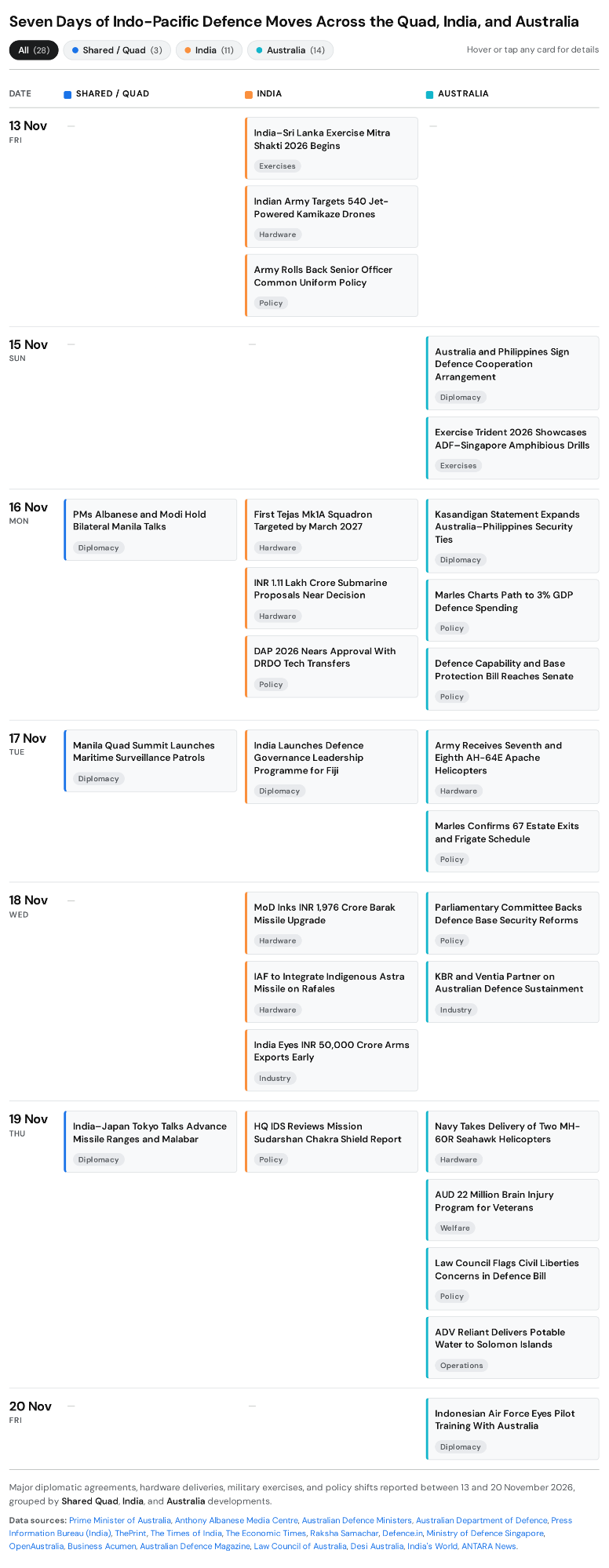
The Shared Indo-Pacific Stage: Quad Revival and Manila Diplomacy
For both New Delhi and Canberra, the diplomatic centrepiece of the week unfolded in the Philippine capital on the sidelines of the 49th Association of Southeast Asian Nations (ASEAN) Summit2. On the evening of 16 November, Prime Minister Anthony Albanese met Prime Minister Narendra Modi to discuss expanding bilateral ties across defence, trade, education, and critical minerals3. Although neither government published a formal readout of their private discussions, the encounter built directly on recent field cooperation: earlier in November, the Indian and Australian armies wrapped up the fifth edition of Exercise AUSTRAHIND 2026 in Kerala (with New Zealand joining as an observer for the first time), and both navies took part in the 30th annual Malabar naval exercise near Japan23.
The following day, 17 November, Modi and Albanese joined US President Donald Trump and Japanese Prime Minister Sanae Takaichi for the 2026 Quad Leaders’ Summit1. It was the grouping’s first leader-level gathering since September 2024—after scheduling hurdles delayed a planned 2025 summit in India—and the first Quad summit Trump had attended across both of his presidential terms2. The timing carried unmistakable geopolitical weight: the four leaders met just 48 hours before Trump flew to Shenzhen, China, for a historic trilateral meeting with Chinese President Xi Jinping and Russian President Vladimir Putin on 19 November4. Marking the tenth anniversary of the “Free and Open Indo-Pacific” concept, the leaders used the Manila session to show that the Quad remains intact despite shifting great-power dynamics1. Australia is scheduled to take over the Quad chair in 20272.
On the defence and security front, the summit delivered a notable operational step forward. The four nations announced the Indo-Pacific Maritime Surveillance Collaboration (IPMSC) and agreed to hold their first joint maritime exercise involving P-8 and P-3C anti-submarine and maritime patrol aircraft in a Quad context in 20271. Indian Foreign Secretary Vikram Misri indicated the initial activity is expected to run alongside Exercise Sea Dragon in Guam in March 2027, focusing on shared maritime domain awareness against challenges such as illegal fishing and illicit trafficking5. During the talks, Trump highlighted the growing strategic weight of anti-submarine warfare and pointed to US collaboration with Australia and the United Kingdom on nuclear-powered submarines under AUKUS4.
Beyond maritime surveillance, the Manila joint statement laid out several wider security and economic resilience priorities relevant to both India and Australia1:
| Quad Summit Initiative (17 Nov 2026) | Core Commitment | Specific Relevance for India and Australia |
| Maritime Surveillance Collaboration | First Quad-context P-8 and P-3C patrol aircraft exercise in 2027, expected alongside Sea Dragon in March 20271. | Deepens shared maritime awareness across the Indian Ocean and Western Pacific without creating a formal mutual-defence treaty5. |
| Quad Cybersecurity Cooperation | Expanded joint efforts to secure cyberspace against a rapid increase in the number and scale of regional cyberattacks1. | Complements Australia’s and India’s parallel bilateral cyber dialogues with Southeast Asian and East Asian partners30. |
| Counterterrorism | Unequivocal condemnation of terrorism and violent extremism in all forms, explicitly including cross-border terrorism1. | A key diplomatic priority for New Delhi in the first Quad leaders’ meeting since the 2025 Pahalgam terror attack29. |
| Cable Connectivity and Resilience | Expansion of secure undersea telecommunications work to include electricity cables and upcoming Indian Ocean cable projects1. | Australia is expanding its contribution to focus on electricity cables, while Indian Ocean projects bolster India’s external digital links1. |
| Super Intelligence (SI) Accelerator and Supply Chains | Coordinating trusted artificial intelligence deployment, opposing arbitrary export restrictions, and launching a Quad Business Leaders’ Forum in early 20271. | Mumbai will host the inaugural business forum, aiming to link Australian mining expertise and Japanese technology with Indian manufacturing and US capabilities5. (A joint-statement footnote clarified that in Australia, India, and Japan, “Super Intelligence” refers to artificial intelligence1.) |
Strategic analysts greeted the Manila announcements with cautious realism. Commentators observed that staging a Quad-branded patrol-aircraft exercise crosses a symbolic threshold and reassures frontline states such as the Philippines, yet several defence experts noted that the drill remains modest in scope, lacks finalised operational details, and should not be mistaken for an “Asian NATO”32. Speaking to reporters in Manila on 18 November ahead of his own visit to China, Albanese struck a measured tone, explaining that military exercises are routine and transparent, aimed at maritime security and regional peace rather than directed at any single nation33.
India’s Defence Week: Historic Access for Japan, Air-Defence Overhauls, and Indigenous Firepower
Tokyo 2+2 Breakthrough: Live-Fire Access and Naval Co-Development
Immediately after Manila, India’s diplomatic focus shifted to Tokyo, where Defence Minister Rajnath Singh and External Affairs Minister S. Jaishankar met their Japanese counterparts, Defence Minister Shinjiro Koizumi and Foreign Minister Toshimitsu Motegi, on 19 November for the fourth India–Japan 2+2 Foreign and Defence Ministerial Dialogue8. It was the third meeting between Singh and Koizumi in four months, reflecting how steadily the two Asian democracies are turning strategic alignment into practical defence ties26. Upon arriving in Tokyo on 18 November, Singh toured the Japan Maritime Self-Defense Force base at Yokosuka and inspected the stealth Mogami-class frigate JS Natori34.
The headline outcome of the Tokyo talks was a signed Letter of Intent allowing the Japan Self-Defense Forces (JSDF) to conduct live-fire training—including surface-to-ship missile firings—at firing ranges in India for the first time, starting in 20276. Given Japan’s constrained domestic geography for long-range missile drills, access to Indian firing ranges resolves a real training bottleneck while signalling deep strategic trust; Koizumi called the arrangement a “major step strategically”7.
Industrial and maritime collaboration advanced alongside range access. Both sides pledged to fast-track agreements on the UNICORN stealth naval mast system under a “Design with Japan, Make in India” framework, with India expected to grant Acceptance of Necessity (AoN) by February 202726. The ministers also backed closer research and development between India’s Defence Research and Development Organisation (DRDO) and Japan’s Acquisition, Technology & Logistics Agency (ATLA) in underwater, missile, and specialised technologies, tasked a Joint Secretary/Director General-level working group with following up on mine countermeasures, air domain awareness, and potential joint naval shipbuilding, affirmed the need for an early Maritime Ship Repair Arrangement (MSRA), and agreed to renew their cybersecurity memorandum of cooperation26. Framing the wider regional stakes in Tokyo, Jaishankar warned against the growing “weaponisation” of resources and the erosion of global rules31.
Shielding the Skies and Seas: Barak-1 Upgrades, Mission Sudarshan Chakra, and Submarines
On the domestic procurement front, India made major moves between 16 and 19 November to harden both its naval air defences and its long-term national missile shield. On 18 November, the Ministry of Defence (MoD) signed an INR 1,976.40 crore contract with Israel Aerospace Industries (IAI) for comprehensive hardware and software upgrades, as well as obsolescence management, for the Indian Navy’s Barak Point Defence Missile System (known in service as Barak-1)9. Although the Barak-1 is an older platform compared with newer Barak-8 interceptors deployed on Kolkata-class destroyers, Indian defence analysts noted the upgrade is a practical operational measure to keep frontline warships defended against modern aerial threats9.
Looking further ahead, Indian defence media reported on 19 November that the MoD has completed a formal report on Mission Sudarshan Chakra—the nationwide, multi-layered Integrated Air and Missile Defence (IAMD) shield first announced by Prime Minister Modi on 15 August 2025—and submitted it to Headquarters Integrated Defence Staff (HQ IDS) for detailed review9. According to defence news portal Defence.in, the architecture envisions a two-phase rollout: Phase 1 by 2030 to establish a foundational sensor grid, initial interceptors, and artificial intelligence-driven command modules, followed by Phase 2 by 2035 to deliver a full-spectrum shield incorporating advanced interceptors and expanded satellite surveillance, while urgent acquisitions continue without waiting for formal report sign-off12. Key building blocks are already taking shape: Bharat Electronics Limited (BEL) recently completed core technologies for an AI-native upgrade to the Indian Air Force’s Integrated Air Command and Control System (IACCS), which now links with the Army’s Akashteer air-defence network and the Navy’s Trigun maritime awareness network following operational experience in Operation Sindoor12.
Beneath the surface, India’s long-awaited submarine recapitalisation also moved closer to a decision. Speaking at the ANI National Security Summit 3.0 in New Delhi on 16 November, Defence Secretary Rajesh Kumar Singh confirmed that internal procurement processes are nearing completion for a major underwater fleet expansion43. Indian defence media reported that two major proposals—building six advanced conventional submarines under Project-75(I) at Mazagon Dock Shipbuilders Limited (MDL) with Germany’s Thyssenkrupp Marine Systems (TKMS), and constructing three additional French-designed Scorpene (Kalvari-class) submarines at MDL—are awaiting final approval from the top leadership44. Media reports place the combined estimated value around INR 1.11 lakh crore, though separate outlets cite individual project estimates of roughly INR 80,000 crore for Project-75(I) and INR 36,000 crore for the three Scorpenes, with final official figures pending Cabinet sign-off45. Meanwhile, the Navy plans to start retrofitting existing Kalvari-class submarines with DRDO’s indigenous Air Independent Propulsion (AIP) system during refits from mid-2027 to extend their underwater endurance45.
Rebuilding Air Power, Armoured Forces, and an Export-Ready Industry
India’s air-power challenges drew candid public attention during the week. On 16 November, Chief of the Air Staff Air Chief Marshal Ashutosh Dixit acknowledged that the Indian Air Force (IAF) is operating with 29 active fighter squadrons against a sanctioned strength of 42—its lowest level in 60 years21. Even so, Dixit said that despite earlier setbacks caused by delayed F404-IN20 engine deliveries from US manufacturer GE Aerospace, the IAF expects to form its first squadron (typically 18 jets) of the indigenous Tejas Light Combat Aircraft (LCA) Mark-1A by the end of March 2027 at the latest, with initial handovers potentially starting in January21. Out of 180 Tejas Mk1A jets on order, this first squadron will offer a vital boost while development continues on the Tejas Mark-2 and the fifth-generation Advanced Medium Combat Aircraft (AMCA)21. Speaking the same day, Dixit described India’s unresolved border with China as a “no peace, no war” environment, adding that the Air Force is monitoring Chinese moves closely and has deterrence plans in place48.
In a notable push for sovereign weapons autonomy, ThePrint reported on 18 November that India has set two non-negotiable conditions for its proposed purchase of 114 additional Rafale fighter jets from France: the unilateral freedom to integrate homegrown weapons—beginning with India’s indigenous Astra beyond-visual-range air-to-air missile—without foreign approval, and seamless integration into the IAF’s own secure data networks11. Access to specialised ground test benches would allow the IAF to fit Indian munitions across both the new aircraft and its original 36 Rafales ordered in 2016, potentially lowering long-term weapons bills11. Separately, Indian defence portal defence.in reported that DRDO has completed certification of its indigenous passive Infra-Red Search and Track (IRST) sensor earmarked for the Tejas Mk2 and AMCA38.
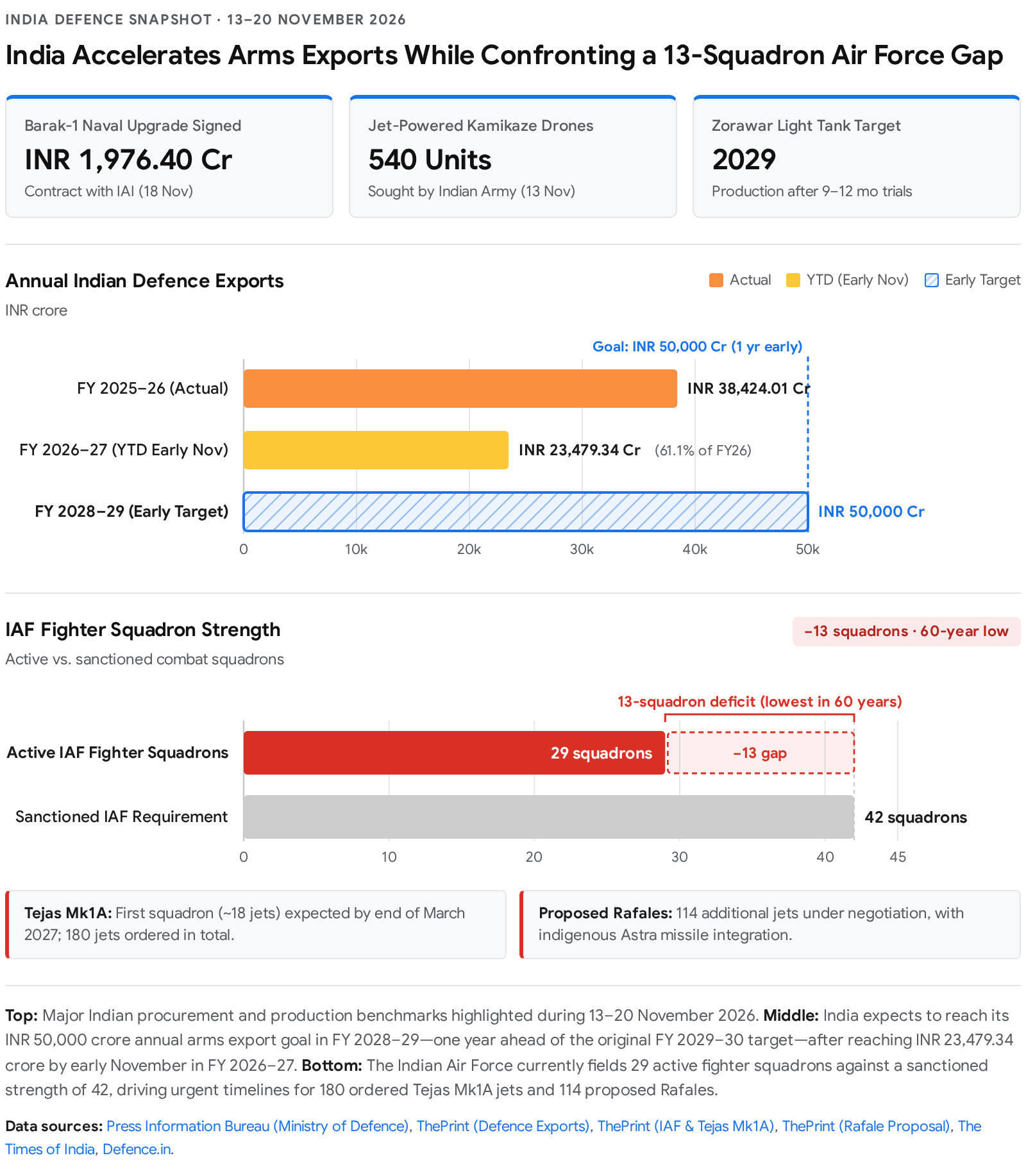
Domestic defence manufacturing and export ambitions were another defining theme of the week. Speaking at a Federation of Indian Chambers of Commerce and Industry (FICCI) event on 18 November, Defence Secretary Rajesh Kumar Singh said India could reach its INR 50,000 crore annual arms export target in the 2028–29 financial year—a year ahead of its original 2029–30 deadline—after posting INR 38,424.01 crore in 2025–26 and already reaching INR 23,479.34 crore by early November in 2026–2747. While artillery shells driven by the war in Europe have been the biggest export performer so far, Singh said multiple overseas talks are underway for high-value systems such as the Indo-Russian BrahMos supersonic cruise missile47. Confirming that demand, Indian defence outlet India Sentinels reported on 19 November that the Philippines—which purchased three shore-based BrahMos batteries under a 2022 deal—is exploring additional BrahMos systems, Akash air-defence missiles to protect them, Pinaka multi-barrel rocket launchers, and satellite cooperation with India38.
To build on that industrial base, Singh confirmed on 16 November that India’s Draft Defence Acquisition Procedure (DAP) 2026 is in the final stages of approval, focusing on technology transfers from 24 DRDO laboratories and enabling conventional missile technology transfers to eligible Indian firms50. Indian business and defence media noted that opening tactical missile manufacturing to private companies under DAP 2026 marks a structural shift away from state-run Bharat Dynamics Limited’s (BDL) longstanding monopoly52. Speaking on the same day, Singh added that Washington is showing openness to co-producing military equipment in India instead of relying strictly on off-the-shelf sales, though he made clear that the United States must conform to “Make in India” rules like any other partner43.
Private Indian defence manufacturers moved quickly to highlight progress across land and aerial systems. Between 17 and 19 November, Larsen & Toubro (L&T) Vice-President Satish Bharathan announced that the 25-tonne indigenous Zorawar light tank, co-developed with DRDO for mountain warfare, has completed developer trials in Ladakh and desert terrain and is ready for 9 to 12 months of Army user trials, with production targeted for 202953. L&T is simultaneously awaiting the government’s decision on competitive bids—opened on 1 November alongside contenders including Tata and Bharat Forge—for the INR 15,000 crore AMCA stealth fighter prototype race9. Reflecting the rapid shift toward high-speed unmanned strike weapons, The Times of India reported on 13 November that the Indian Army is seeking 540 jet-powered kamikaze drones—with domestic systems such as the 450-kilometre-per-hour Agniveg offering a faster, harder-to-intercept option than propeller-driven loitering munitions56. Smaller domestic firms also recorded wins, with SG Defence securing a Pinaka MK-I rocket nozzle contract on 19 November and Tonbo Imaging winning an INR 35.62 crore MoD order9. Speaking on 16 and 18 November, Chief of Defence Staff (CDS) General N. S. Raja Subramani cautioned that “there is no front and rear” in modern conflicts, urging Indian private industry to own critical intellectual property and pair sophisticated platforms with mass-produced low-cost drones35.
Rounding out India’s week were regional training missions, an internal Army cultural change, and a neighbourhood missile watch. On 13 November, a 170-member Indian Defence Forces contingent—drawn primarily from a Rajputana Rifles battalion alongside Indian Air Force personnel—departed for Maduru Oya, Sri Lanka, for the 12th edition of Exercise Mitra Shakti 2026 (running 13 to 26 November), focused on counter-terrorism operations in semi-urban environments under a United Nations mandate59. On 17 November, India also launched its first Global Leadership Programme in Defence Governance and Public Administration for officers from Fiji’s Ministry of Defence61. At home, an internal Indian Army directive dated 13 November reversed an August 2023 uniform standardisation rule, allowing senior officers of Brigadier rank and above under Army Chief General Dhiraj Seth to restore their traditional regimental headgear and insignia from 1 December63. Finally, Indian security observers took note of a regional missile test on 18 November, when WION reported that Pakistan successfully test-fired its Fatah-3 supersonic cruise missile64.
Australia’s Defence Week: Southeast Asian Pacts, New Helicopters, and a Security-Law Showdown
Deepening Ties in Manila, Queensland, and the Pacific
Australia’s defence diplomacy was equally active throughout the week, led by a major upgrade in security relations with the Philippines. On 15 November in Manila, following a visit aboard the Royal Australian Navy replenishment ship HMAS Stalwart, Prime Minister Anthony Albanese witnessed the signing of the new Australia–Philippines Defence Cooperation Arrangement by Philippine Secretary of National Defence Gilberto Teodoro Jr. and Australian Ambassador Marc Innes-Brown13. Marking the 80th anniversary of diplomatic relations, the arrangement builds on an existing Memorandum of Understanding to streamline joint air, land, and maritime operations, deepen information-sharing, and advance shared defence infrastructure13. One day later, on 16 November, both leaders issued the Kasandigan Leaders’ Statement, extending cooperation into cyber defence, critical infrastructure protection, and supply-chain resilience30.
Alongside the Manila pact, Canberra announced increased investment in its Southeast Asia Maritime Partnerships, though the official release did not disclose a specific dollar figure13. Under the programme, Australia will supply regional partners with aerial and surface drones, secure communications support, and operator training to strengthen maritime domain awareness and cyber resilience across busy South China Sea shipping lanes that carry the majority of Australia’s maritime trade13. Albanese emphasised that the new pact “isn’t aimed at any one country” and is focused on supporting national sovereignty and the international law of the sea, while Deputy Prime Minister and Defence Minister Richard Marles underscored its role in building collective regional capability and interoperability13.
Elsewhere across the region, Australia kept a busy operational tempo. At the Shoalwater Bay Training Area in Queensland, more than 1,600 personnel from the Australian Defence Force (ADF) and the Singapore Armed Forces (SAF) participated in the 11th edition of Exercise Trident 2026 (running 6 to 22 November)68. Singapore’s Defence Minister Chan Chun Sing visited the troops on 15 November to observe amphibious ship-to-shore assaults from Singapore’s landing ship RSS Persistence, CH-47F and AH-64D helicopter operations, Singapore’s first Trident deployment of the Orbiter 4 unmanned aerial vehicle, and joint manned-unmanned teaming and heat-resilience trials run with Australia’s Defence Science and Technology Group (DSTG)68. Closer to Australia’s northern and Pacific approaches, Indonesian state news agency Antara reported on 20 November that the Indonesian Air Force is exploring a pilot-training partnership with Australia69. On 19 November, Australian Defence also highlighted two hands-on Pacific missions: the Pacific support vessel ADV Reliant delivered 535,000 litres of potable water to drought-affected communities in the Solomon Islands’ Western Province, while ADF mentors continued helping the Papua New Guinea Defence Force (PNGDF) rebuild its PAC-750 military aviation capability70.
Hardware Arrivals, AUKUS Milestones, and the 3 Per cent Spending Horizon
On Australian soil, Defence celebrated two major helicopter milestones within 48 hours. On 17 November, a US Air Force C-17A Globemaster III touched down at RAAF Base Townsville carrying the Australian Army’s seventh and eighth AH-64E Apache attack helicopters17. Just one year after the Apache entered Australian Army service, the force has taken delivery of eight of its planned 29 airframes (scheduled to complete delivery by 2029)—slightly over one-quarter of the fleet17. Brigadier Fern Thompson, Commander of the 16th Aviation Brigade, said the 1st Aviation Regiment is already “baring its teeth,” preparing for its second live-fire certification of the year with 30mm cannons, rockets, and Hellfire missiles, while testing field deployments during Exercise Possum Guns17.
Two days later, on 19 November, Richard Marles and Defence Industry Minister Pat Conroy welcomed two new MH-60R Seahawk naval helicopters (airframes 25 and 26) at HMAS Albatross in Nowra14. After working with Lockheed Martin to navigate global supply-chain delays, Australia raised its operational Seahawk fleet from 23 to 2514. The pair are the first of a 13-aircraft tranche—with the remaining 11 slated to roll out over the next two years—that will grow the Royal Australian Navy’s anti-submarine and maritime surveillance helicopter fleet to 36 aircraft14. Once Australian-specific modifications are completed, the two new Seahawks are expected to enter operational service in April, and the 13-aircraft expansion will support 75 new high-tech sustainment jobs at Sikorsky Australia in Nowra on top of roughly 275 existing staff14.
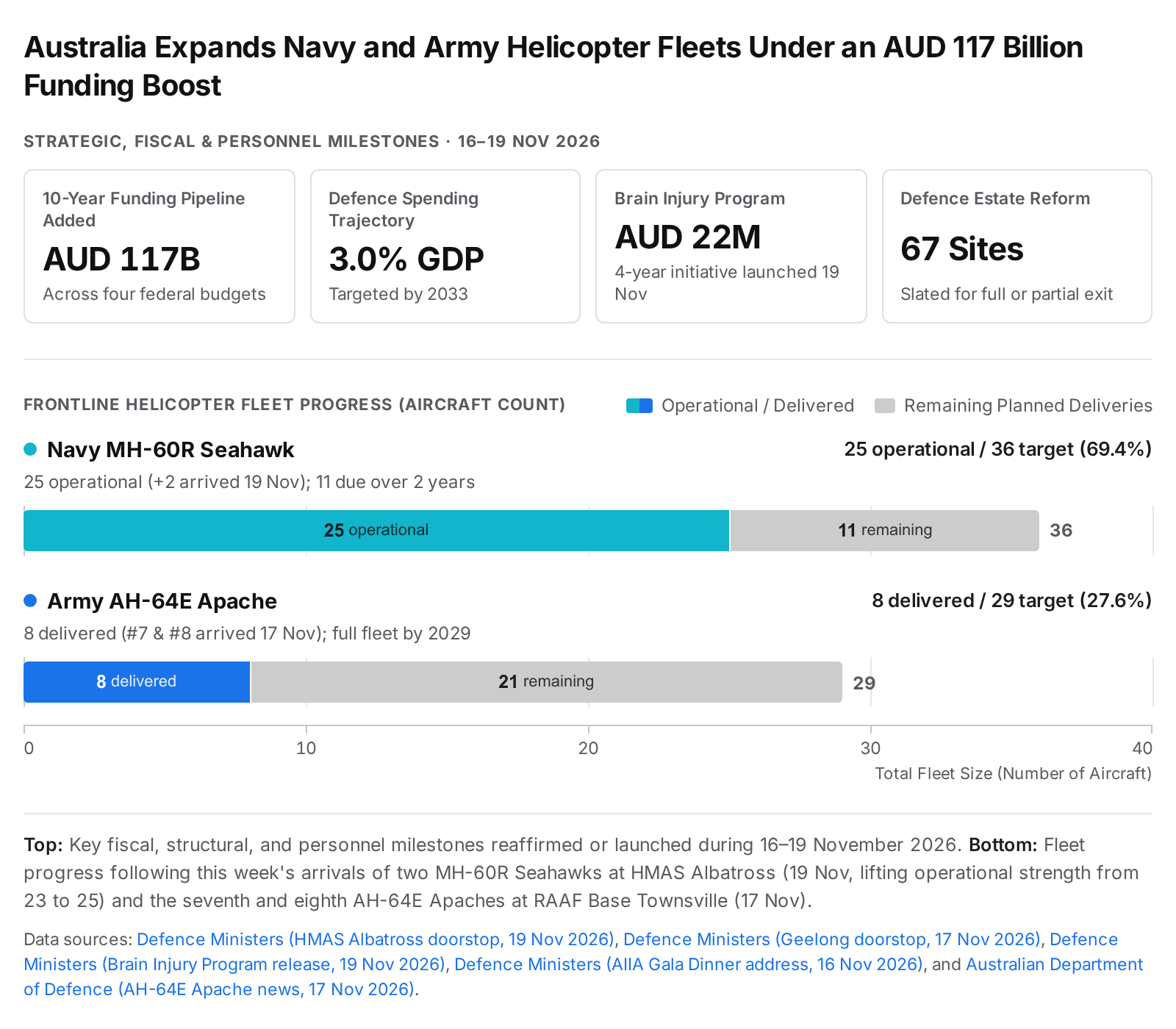
These deliveries fit inside a wider strategic roadmap laid out by Richard Marles in an address to the Australian Institute of International Affairs (AIIA) on 16 November, reinforced by media briefings in Geelong on 17 November and Nowra on 19 November14. Warning that the Indo-Pacific is experiencing the largest conventional military build-up since the Second World War—and stressing that Australia’s primary strategic vulnerability is disruption to its sea lines of communication, given that more than 90 per cent of its liquid fuels are imported—Marles outlined how Canberra is funding a force built for “impactful projection”74. Across four federal budgets, the government has added AUD 117 billion to the 10-year Defence funding pipeline (including AUD 30 billion over the next four years), placing Australia on track to lift defence expenditure to 3 per cent of GDP by 203374. To tighten project management and cost control, a new Defence Delivery Group will transition into an independent Defence Delivery Agency on 1 July 202774.
Marles also gave concrete status updates on Australia’s flagship naval programmes. He confirmed that Submarine Rotational Force–West (SRF-W) remains on track to begin at HMAS Stirling in Western Australia by the end of 2027, stressing that Stirling remains an Australian sovereign base under Australian command14. The US Navy Virginia-class submarine USS Colorado is currently at Stirling for maintenance—the fourth nuclear-powered submarine serviced there in two years, alongside USS Hawaii, USS Vermont, and HMS Anson—while 60 of 250 Australian tradespeople placed at Pearl Harbor have returned home15. Land boundaries for Western Australia’s Henderson Defence Precinct have been finalised, and steel-cutting for Australian-built nuclear-powered submarines at Adelaide’s Osborne Naval Shipyard remains scheduled for the end of the decade, while any decision on an East Coast submarine base is deferred to the 2030s14. On the surface fleet, Marles reaffirmed the government’s full commitment to building six Hunter-class anti-submarine warfare frigates—noting construction of the first hull is on its reprofiled schedule at Osborne—alongside new general-purpose frigates developed in partnership with Japan entering service by the end of the decade15.
At the same time, Defence is trimming overhead to pay for frontline capability. Following the 2023 Defence Estate Audit, Defence confirmed it will fully or partially exit 67 underused sites, transferring them to the Department of Finance rather than spending hundreds of millions of dollars maintaining unused facilities—such as Victoria Barracks Sydney, which would otherwise require AUD 200 million over ten years—while commissioning the Australian War Memorial to interpret and preserve historic sites kept in public hands14. In smaller capability and industry updates during the week, Defence welcomed 10 Air Force and Navy graduates into its dedicated space workforce on 16 November, and KBR (whose Mission Technology Solutions unit plans to spin off as Trinzic in January 2027) entered a strategic Defence sustainment collaboration with Ventia on 18 November72. Marles also clarified on 19 November that unlike several European nations, Canberra is not issuing public “grab-and-go” emergency kit directives14.
A Domestic Flashpoint: Counter-Drone Laws and “Defence Security Zones”
While hardware arrivals drew broad support, new legislation moving through Canberra triggered a heated domestic debate over national security and civil liberties. On 16 November, the Defence Legislation Amendment (Accelerating Capability and Protecting Bases) Bill 2026—having already passed the House of Representatives—entered the Senate18. Drafted in part to address recent uncrewed-system incursions at military bases, the bill gives Defence clearer legal authority to counter aerial, surface, and maritime drones (C-UAS), streamlines capability testing with industry partners, and empowers ministers and senior officials to declare “defence security zones”18.
On 18 November, the Parliamentary Joint Committee on Defence backed the bill’s passage while recommending five oversight and transparency measures: listing declared security zones in Defence’s annual reports, proactively notifying the Committee and the Inspector-General of the Australian Defence Force whenever classified declarations are made, widening independent statutory reviews, reporting back on implementation in 12 months, and publishing plain-English explanations for affected communities19.
Legal bodies and digital-rights groups remained sharply critical. On 19 November, the Law Council of Australia warned that urgency must not override proper parliamentary due diligence20. President-Elect Elizabeth Shearer criticised the compressed consultation window—just three business days for public submissions on a 231-page bill, and only two in Victoria due to the Melbourne Cup public holiday—and raised alarms over executive powers that allow “defence security zones,” including mobile and emergency zones, to extend over privately owned facilities with criminal penalties for non-compliance20. She also noted that the broad definition of “defence security officials” could extend security powers to non-ADF personnel, including federal police, industry partners, and foreign military personnel20. In a separate opinion piece in The Guardian published on 18–19 November, Digital Rights Watch head of policy Tom Sulston warned the powers could allow commercial artificial intelligence data centres linked to defence contractors to be declared defence security zones, potentially restricting public protests81.
People, Veterans, and a 128-Year-Old Naval Discovery
Australia’s week also brought notable investments in personnel health and a rare milestone in naval heritage. On 19 November, Minister for Defence Personnel and Veterans’ Affairs Matt Keogh announced an Australian-first AUD 22 million, four-year Brain Injury Program for serving Defence members and veterans experiencing neurocognitive concerns16. Directly responding to Recommendation 61 of the Royal Commission into Defence and Veteran Suicide, the programme provides non-liability medical treatment—allowing veterans to access care for diagnosed brain injuries without having to formally prove a link to military service—alongside GP education, dedicated brain-health assessments, and self-assessment tools rolling out in 2027 ahead of full operation in early 202816. The initiative runs alongside ongoing Defence research measuring the effects of repetitive low-level blast overpressure exposure during routine weapons training16.
Earlier in the week, on 17 November, Marles joined Special Envoy for Social Housing Josh Burns in Geelong to highlight the V Satellite project, funded through the Housing Australia Future Fund to deliver 10 transitional social housing units paired with Vasey wraparound counselling and support services for veterans adjusting to civilian life15. Closing the week on a historic note, the Royal Australian Navy and heritage agencies announced on 19 November that—supported by the crew of the minehunter HMAS Diamantina—maritime archaeologists had discovered the shipwreck of Ex-HMCS Spitfire, Australia’s first Australian-built warship, off the Queensland coast on the exact 128th anniversary of its sinking83.
Conclusion
Taken together, the developments of 13 to 20 November 2026 reveal a clear strategic convergence between India and Australia despite their very different geographies and force structures. Neither country is sitting back and waiting for great-power diplomacy—highlighted by the 19 November Trump–Xi–Putin trilateral in Shenzhen—to define the Indo-Pacific’s future. Instead, both New Delhi and Canberra are actively weaving a denser web of practical partnerships: restarting Quad leader-level cooperation with a first-of-its-kind maritime patrol aircraft exercise, upgrading defence ties with the Philippines, and expanding hands-on training access with trusted regional partners such as Japan and Singapore.
At the same time, both nations face the demanding work of turning policy ambitions into day-to-day military capability. India is combining rapidly rising arms exports and bolder private-sector acquisition reforms with urgent measures to narrow its fighter squadron deficit, modernise legacy naval defences, and secure full autonomy over indigenous weapons integration. Australia is translating a major multi-budget funding boost into newly arrived helicopters, submarine infrastructure, and Southeast Asian maritime resilience packages, even as it works through sensitive domestic debates over defence real estate and the civil-liberties boundaries of modern base security. Across both countries, the week’s news underscores a shift from broad diplomatic declarations to sustained, practical military transformation.
Disclaimer
This article is provided for general informational and journalistic purposes only. It draws on publicly available government press releases, parliamentary records, official transcripts, and independent defence media reporting published between 13 November and 20 November 2026 (with limited earlier background clearly dated). Defence procurement budgets, draft legislation, export projections, and bilateral negotiations described here remain subject to parliamentary scrutiny, cabinet approval, budgetary changes, and shifting geopolitical events. Nothing in this article constitutes legal, financial, investment, or official government policy advice; readers should consult primary government sources or qualified professionals before making decisions based on this information.
References
- Quad Leaders’ Summit Joint Press Release, https://www.pm.gov.au/media/quad-leaders-summit-joint-press-release
- 1st leader-level Quad meeting in 2 years brings US, Australia, India, Japan together, https://aa.com.tr/en/politics/1st-leader-level-quad-meeting-in-2-years-brings-us-australia-india-japan-together/4127683
- Albanese Meets Narendra Modi in Manila as Australia Strengthens Trade and Security Ties across Asia, https://desiaustralia.com/news/australia/albanese-meets-narendra-modi-in-manila-as-australia-strengthens-trade-and-security-ties-across-asia/
- Japan, U.S., Australia, India agree on first antisubmarine drill, https://qazinform.com/news/japan-us-australia-india-agree-on-first-antisubmarine-drill-da199a
- Explainer: The Quad’s Manila Summit | India’s World, https://indiasworld.in/explainer-the-quads-manila-summit/
- Japan, India agree to enhance military and defense industry, https://japantoday.com/category/politics/japan-india-agree-to-enhance-military-and-defense-industry-cooperation
- Japan to use Indian ranges for missile tests as New Delhi-Tokyo move to boost defence ties, https://theprint.in/diplomacy/japan-to-use-indian-ranges-for-missile-tests-as-new-delhi-tokyo-move-to-boost-defence-ties/3103282/
- Japan to conduct first-ever live-fire military drills in India, test surface-to-ship missiles, https://timesofindia.indiatimes.com/defence/news/japan-to-conduct-first-ever-live-fire-military-drills-in-india-test-surface-to-ship-missiles/articleshow/135996426.cms
- Indian Defence News, https://www.indiandefensenews.in/
- MoD inks Rs 1976.40 crore contract with Israel Aerospace Industries, https://www.pib.gov.in/PressReleasePage.aspx?PRID=2338016®=48&lang=1
- Exclusive: Astra to go on Rafale as IAF insists on freedom to fit weapons, own-network link for 114 jets, https://theprint.in/defence/exclusive-astra-to-go-on-rafale-as-iaf-insists-on-freedom-to-fit-weapons-own-network-link-for-114-jets/3102401/
- HQ IDS Examines Completed Mission Sudarshan Chakra Report as, https://defence.in/threads/hq-ids-examines-completed-mission-sudarshan-chakra-report-as-india-advances-planned-2035-integrated-defence-shield.19168/
- https://anthonyalbanese.com.au/media-centre/enhancing-defence-cooperation-and-maritime-security-in-southeast-asia
- https://www.minister.defence.gov.au/transcripts/2026-11-19/doorstop-hmas-albatross
- https://www.minister.defence.gov.au/transcripts/2026-11-17/doorstop-geelong
- https://www.minister.defence.gov.au/media-releases/2026-11-19/australian-first-brain-injury-program-defence-personnel-veterans
- https://www.defence.gov.au/news-events/news/2026-11-17/new-army-chopper-already-baring-its-teeth
- ADM Podcast 203 – New legislation to facilitate Defence C-UAS, https://www.australiandefence.com.au/podcasts/adm-podcast-203-new-legislation-to-facilitate-defence-c-uas-operations-at-bases-and-randd
- Defence Committee supports passage of Defence capability and, https://www.businessacumen.biz/index.php/news/7843-defence-committee-supports-passage-of-defence-capability-and-security-reforms
- https://www.lawcouncil.au/media/media-releases/urgency-shouldn-t-override-due-diligence-where-far-reaching-defence-bill-raises-questions-about-civil-liberties
- First Tejas Mk1A squadron to be formed by end of March 2027, says IAF chief Dixit, https://theprint.in/defence/first-tejas-mk1a-squadron-to-be-formed-by-end-of-march-2027-says-iaf-chief-dixit/3099856/
- Momen Prabowo Hadiri Gala Dinner KTT ke-49 ASEAN di Manila, https://www.liputan6.com/news/read/8336463/momen-prabowo-hadiri-gala-dinner-ktt-ke-49-asean-di-manila
- AUSTRAHIND 2026: India-Australia Joint Army Exercise, https://www.nationpathindia.com/defence/austrahind-2026-india-australia-joint-military-exercise
- India and Australia conclude joint military exercise, https://www.myanmaritv.com/news/india-and-australia-conclude-joint-military-exercise
- Trump pushes AI, military cooperation at Quad summit; India pushes safety of seafarers, https://theprint.in/diplomacy/trump-pushes-ai-military-cooperation-at-quad-summit-india-pushes-safety-of-seafarers/3101276/
- https://www.pib.gov.in/PressReleseDetailm.aspx?PRID=2338701
- 2026 Quad Leaders’ Summit, https://www.pmc.gov.au/quad/2026-quad-leaders-summit
- Modi-Trump set to meet at Quad summit in Manila, right before US President’s trilateral with Xi & Putin, https://theprint.in/diplomacy/modi-trump-set-to-meet-at-quad-summit-in-manila-right-before-us-presidents-trilateral-with-xi-putin/3100198/
- First Quad leaders’ summit since Pahalgam terror attack condemns cross-border terrorism, https://theprint.in/diplomacy/first-quad-leaders-summit-since-2025-pahalgam-terror-attack-condemns-cross-border-terrorism/3101456/
- Kasandigan: Philippines-Australia Leaders’ Statement on Expanded, https://anthonyalbanese.com.au/media-centre/kasandigan-philippines-australia-leaders-statement-on-expanded-security-and-defense-cooperation
- Rajnath seeks deeper cooperation in underwater, missile tech – The, https://timesofindia.indiatimes.com/defence/news/22-tokyo-dialogue-jaishankar-flags-weaponisation-of-resources-rajnath-seeks-deeper-cooperation-in-underwater-missile-tech/articleshow/136004510.cms
- Quad military exercise: Revival or Trump’s power play?, https://theprint.in/talk-point/quad-military-exercise-revival-or-trumps-power-play/3103103/
- Doorstop – Manila, Philippines | Prime Minister of Australia, https://www.pm.gov.au/media/doorstop-manila-philippines
- India, Japan to finalise use of Indian ranges to test Japanese missile, https://www.wionews.com/world/india-japan-to-finalise-use-of-indian-ranges-for-japanese-missile-1795074397928
- External Affairs News, Defence Security Headlines Updates, https://www.business-standard.com/external-affairs-defence-security
- Japan to test surface-to-ship missiles in Indian ranges as Delhi, Tokyo firm up defence ties, https://www.wionews.com/world/japan-to-test-surface-to-ship-missiles-in-india-as-delhi-tokyo-firm-up-defence-ties-1795105515578
- India, Japan Agree to Fast-Track UNICORN Defence Pacts, Deepen Maritime and Technology Cooperation, https://ddnews.gov.in/en/india-japan-agree-to-fast-track-unicorn-defence-pacts-deepen-maritime-and-technology-cooperation/
- Defence News India – Read Latest Updates on Indian Defence, https://defence.in/
- Defence Ministry signs Rs 1,976.40 crore contract with Israel Aerospace Industries to upgrade Barak Missile Systems, https://ddnews.gov.in/en/defence-ministry-signs-rs-1976-40-crore-contract-with-israel-aerospace-industries-to-upgrade-barak-missile-systems/
- India signs Rs 1,976 crore deal with Israel to upgrade Barak missile defence systems, https://www.businesstoday.in/india/story/india-signs-rs-1976-crore-deal-with-israel-to-upgrade-barak-missile-defence-systems-568277-2026-11-18
- MISSION SUDARSHAN CHAKRA – MP-IDSA, https://idsa.in/wp-content/uploads/2026/01/book-MISSION-SUDARSHAN-CHAKRA-2026.pdf
- Battle-tested in Operation Sindoor, now getting an AI upgrade: India’s air defence system is set to get smarter, https://timesofindia.indiatimes.com/defence/news/battle-tested-in-operation-sindoor-now-getting-an-ai-upgrade-indias-air-defence-system-is-set-to-get-smarter/articleshow/135824620.cms
- US showing openness to co-producing military equipment but must conform to Make in India—Defence Secy, https://theprint.in/defence/us-showing-openness-to-co-producing-military-equipment-but-must-conform-to-make-in-india-defence-secy/3100350/
- Defence Secretary Confirms Internal Clearance for TKMS and, https://defence.in/threads/defence-secretary-confirms-internal-clearance-for-tkms-and-scorpene-submarine-deals-awaiting-final-nod-from-top-leadership.19144/
- भारतीय नौसेना को मिलेंगी 9 नई पनडुब्बियां? 1.11 लाख करोड़ के दो प्रोजेक्ट, https://www.rakshasamachar.com/indian-navy/indian-navy-submarine-project-p75i-scorpene-1-11-lakh-crore/
- Indian Defence Secretary Confirms ₹80,000 Crore Submarine, https://indianmasterminds.com/news/defence/india-rs-80000-crore-project-75i-submarine-deal-project-final-stage-238639/
- Rs 50,000 cr arms export target may be met in 2028-29, multiple BrahMos talks on, says Defence Secretary, https://theprint.in/defence/rs-50000-cr-arms-export-target-may-be-met-in-2028-29-multiple-brahmos-talks-on-says-defence-secretary/3102672/
- Air Chief Marshal Ashutosh Dixit says keeping tabs on China, will be, https://theprint.in/defence/air-chief-marshal-ashutosh-dixit-says-keeping-tabs-on-china-will-be-able-to-deter-aggression/3099815/
- Philippines in talks with India for Akash, Pinaka and more BrahMos, https://www.indiasentinels.com/diplomacy/philippines-in-talks-with-india-for-akash-pinaka-and-more-brahmos-missiles-as-defence-ties-widen-7707
- Defence Acquisition Procedure 2026 Nears Approval As DRDO, https://www.indiandefensenews.in/2026/11/defence-acquisition-procedure-2026.html
- Defence Secy says 24 DRDO labs, missile tech transfers in focus, https://m.economictimes.com/news/india/dap-2026-nears-final-approval-defence-secy-says-24-drdo-labs-missile-tech-transfers-in-focus/videoshow/135881270.cms
- india-tactical-missile-production-private-firms-bdl-monopoly, https://www.kotakneo.com/news/market-news/india-tactical-missile-production-private-firms-bdl-monopoly-ends-dap-2026/
- Indian defence firms push indigenous systems and export deals, https://drones.economictimes.indiatimes.com/news/industry-partnerships/indian-defence-firms-push-indigenous-systems-and-export-deals/135953255
- L&T Eyes Zorawar Light Tank Production by 2029; Tank Ready for 9–12 Month User Trials After High-Altitude and Desert Testing, https://defence.in/threads/l-t-eyes-zorawar-light-tank-production-by-2029-tank-ready-for-9-12-month-user-trials-after-high-altitude-and-desert-testing.19148/
- AMCA Breakthrough: Is This India’s Biggest Defence Win? – YouTube, https://www.youtube.com/watch?v=0YGvOFTdLYE
- Three times faster, harder to intercept: Indian Army sets sights on 540 jet-powered kamikaze drones, https://timesofindia.indiatimes.com/defence/news/three-times-faster-harder-to-intercept-indian-army-sets-sights-on-540-jet-powered-kamikaze-drones/articleshow/135795634.cms
- Venky’s India In Focus As Country Introduces First H5N1 Vaccine On, https://www.sahi.com/news/venky-s-india-in-focus-as-country-introduces-first-h5n1-vaccine-on-november-20-2026
- ‘Nobody is safe’ : CDS Gen Subramani on the growing arena of, https://theprint.in/defence/nobody-is-safe-cds-gen-subramani-on-the-growing-arena-of-battle-ai-data-at-ani-summit/3099733/
- indian defence forces contingent departs for india–sri lanka joint, https://www.pib.gov.in/PressReleseDetailm.aspx?PRID=2335826®=3&lang=1
- India–Sri Lanka Joint Military Exercise Mitra Shakti 2026 – Drishti IAS, https://www.drishtiias.com/daily-updates/daily-news-analysis/india-sri-lanka-joint-military-exercise-mitra-shakti-2026
- DHTI launches first Global Leadership Programme in Defence, https://www.pib.gov.in/PressReleaseIframePage.aspx?PRID=2337268®=48&lang=2
- DHTI launches first Global Leadership Programme in Defence, https://www.pib.gov.in/PressReleseDetailm.aspx?PRID=2337268®=3&lang=1
- Army rolls back 2023 common uniform policy, to restore regimental identity for officers of rank Brigadier & above from Dec 1, https://timesofindia.indiatimes.com/defence/news/army-rolls-back-2023-common-uniform-policy-to-restore-regimental-identity-for-officers-of-rank-brigadier-above-from-dec-1/articleshow/135958790.cms
- India Intercepted Fatah-2 Over Sirsa. Now Pakistan Tests Fatah-3, https://www.youtube.com/watch?v=iFmL2CSYElc
- Australia And The Philippines Sign Landmark Defence Pact On, https://www.sydneytimes.net.au/city-of-sydney-news/australia-and-the-philippines-sign-landmark-defence-pact-on-sidelines-of-asean-summit/
- Daily Update – Capital Monitor, https://capitalmonitor.com.au/static/whatsnew.html
- Kasandigan: Philippines, Australia Expand Security Ties, https://www.miragenews.com/kasandigan-philippines-australia-expand-1777857/
- https://www.mindef.gov.sg/news-and-events/latest-releases/15nov26-nr/
- Indonesian Air Force eyes pilot training partnership with Australia, https://en.antaranews.com/amp/news/443959/indonesian-air-force-eyes-pilot-training-partnership-with-australia
- From one aircraft to air capability | Defence, https://www.defence.gov.au/news-events/news/2026-11-19/from-one-aircraft-air-capability
- Pacific support vessel fills Solomon’s cup – Defence, https://www.defence.gov.au/news-events/news/2026-11-19/pacific-support-vessel-fills-solomons-cup
- News and events – Defence, https://www.defence.gov.au/news-events
- Additional MH-60R Seahawks strengthen Australia’s maritime security, https://www.minister.defence.gov.au/media-releases/2026-11-19/additional-mh-60r-seahawks-strengthen-australias-maritime-security
- https://www.minister.defence.gov.au/speeches/2026-11-16/address-australian-institute-international-affairs-gala-dinner
- KBR and Ventia collaborate on Defence sustainment, https://www.australiandefence.com.au/news/news/kbr-and-ventia-collaborate-on-defence-sustainment
- Graduates strengthen Defence space capability, https://www.defence.gov.au/news-events/news/2026-11-16/graduates-strengthen-defence-space-capability
- Defence Legislation Amendment…: 16 Nov 2026: Senate debates, https://www.openaustralia.org.au/senate/?id=2026-11-16.185.1
- Defence Legislation Amendment…: 18 Nov 2026: Senate debates, https://www.openaustralia.org.au/senate/?id=2026-11-18.210.1
- Defence Creates Federal Militarised Zones to Supersede State and, https://www.sydneycriminallawyers.com.au/blog/defence-creates-federal-militarised-zones-to-supersede-state-and-territory-laws/
- Defence Committee Backs Capability, Security Reforms, https://www.miragenews.com/defence-committee-backs-capability-security-1779047/
- Australia has a reputation for being the most secretive democracy in, https://www.theguardian.com/commentisfree/2026/nov/19/australia-has-a-reputation-for-being-the-most-secretive-democracy-in-the-world-new-laws-could-make-it-worse
- $22m to support personnel with brain injuries – Defence, https://www.defence.gov.au/news-events/news/2026-11-19/22m-support-personnel-brain-injuries
- Shipwreck of Australian warship found off Queensland coast, https://www.defence.gov.au/news-events/releases/2026-11-19/shipwreck-australian-warship-found-off-queensland-coast
- CONTACT magazine – Australia’s best free military news site, https://contactairlandandsea.com/