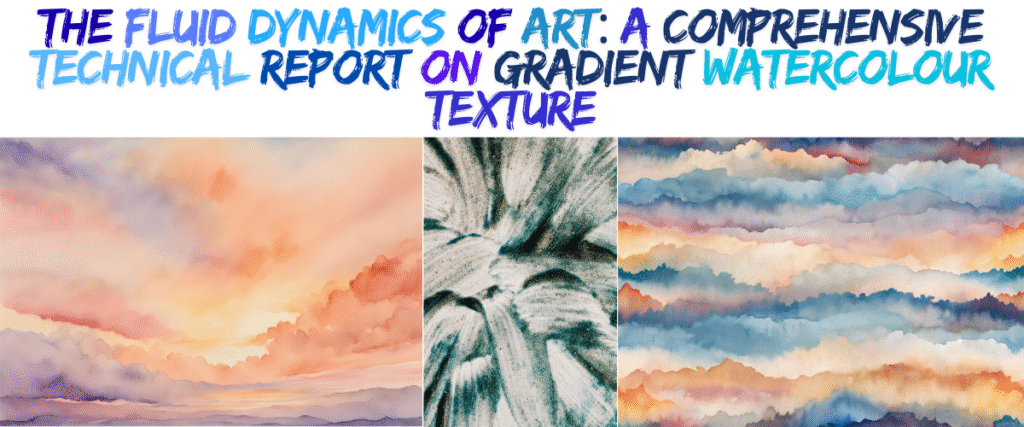
The Intersection of Chemistry and Aesthetics
Watercolour painting, often perceived as a delicate and whimsical medium, is fundamentally an exercise in fluid dynamics and particulate physics. Unlike the relatively static nature of acrylics or the viscous controllability of oils, watercolour relies on the unpredictable agency of water. It is a medium where the artist acts not as a dictator of form, but as a conductor of natural forces—gravity, evaporation, surface tension, and sedimentation. Within this discipline, the creation of Gradient Watercolour Textured Art represents a sophisticated fusion of two opposing principles: the seamless, ethereal transition of the gradient wash and the chaotic, tactile disruption of texture.
This report serves as an exhaustive technical manual and artistic guide designed to deconstruct the mechanisms behind these effects. It moves beyond the superficial “how-to” to explore the “why”—why certain blue pigments cluster into microscopic granules while others stain the paper evenly; why salt crystals create starburst patterns only at specific humidity levels; and how the topography of paper influences the behaviour of a wash. By understanding the underlying science of these materials—from the specific gravity of minerals like Hematite and Lapis Lazuli to the hygroscopic properties of sodium chloride—artists can transition from happy accidents to intentional mastery.
The following analysis is derived from a rigorous synthesis of technical data, expert methodology, and material science, offering a definitive roadmap for mastering the atmospheric depth and organic complexity that define contemporary gradient watercolour art.
The Mechanics of the Gradient Wash
The gradient wash is the backbone of atmospheric painting. It simulates the natural diffusion of light, the curvature of the sky, and the recession of space. However, achieving a flawless gradient—a “seamless transition” free from banding, streaking, or backruns—requires a precise manipulation of hydrodynamics.1
The Physics of the “Bead”
The fundamental unit of a successful watercolour wash is the “bead.” This is a reservoir of active liquid—a mix of water and suspended pigment—that forms at the base of a brushstroke due to surface tension and gravity.
- Formation and Gravity: When a brush loaded with aqueous pigment contacts the paper, it deposits a film of liquid. If the painting surface is inclined—typically between 15 to 30 degrees—gravity pulls the excess liquid to the bottom edge of the stroke. Here, surface tension holds the liquid in a convex ridge, known as the bead.3
- The Continuous Flow Mechanism: The bead acts as a live edge. To extend the wash, the artist must reload the brush and apply the next stroke horizontally, overlapping the bead. This action breaks the surface tension of the previous bead, allowing the liquid to flow down into the new stroke. This continuous migration of the liquid reservoir ensures that the pigment settles evenly without drying lines.1
- Failure State (The Streak): If the artist works too slowly, or if the ambient humidity is too low, the bead may evaporate before the next stroke connects. When this happens, the pigment particles are deposited permanently at the edge of the drying line. A subsequent stroke cannot re-dissolve this dried edge seamlessly, resulting in a hard, unwanted line known as a “streak” or “banding”.1
Gradient Architectures
Gradients are not monolithic; they are categorised by their tonal and chromatic transitions, each presenting unique fluid challenges.
The Monochrome Graded Wash
This is a transition of value, moving from saturation to transparency.
- Technique: The artist begins with the pigment at its maximum concentration (masstone). As the wash progresses down the paper, the artist progressively adds clean water to the brush or the mixing well. This dilutes the ratio of pigment to vehicle (water) in the bead.
- Optical Physics: As the wash dries, the transparent binder (Gum Arabic) allows the white of the paper to reflect light through the thinning pigment layer, creating the illusion of luminosity.1
- Strategic Dilution: A critical error is adding water too aggressively, which can “shock” the wash and cause a bloom. The dilution must be gradual to maintain the integrity of the surface tension.1
The Variegated Wash (Polychrome Gradient)
This involves a transition of hue, blending two or more distinct colours (e.g., Cerulean Blue to Quinacridone Rose).
- The Transitional Zone: The challenge here is chemical and optical mixing. If a yellow pigment is blended directly into a violet pigment, the result is a desaturated, muddy grey/brown due to complementary colour mixing.
- The “Pure-Mix-Pure” Protocol: To achieve a clean gradient between two colours, the artist must create an intermediate mixture on the palette. The progression on paper follows a strict sequence: Pure Colour A $\rightarrow$ Mixed Transition Zone $\rightarrow$ Pure Colour B. This prevents the muddying that occurs when pure pigments collide uncontrolled on the paper.1
The “Ultimate Wash” Technique
For large-scale backgrounds where brushstrokes must be invisible, the “Ultimate Wash” technique is employed.
- Kinetic Application: This method utilises a large flat brush and a continuous, serpentine motion. The brush moves across the paper, travels down, and moves back across without lifting.
- The Loop: At the end of each stroke, the brush performs a small curl or loop to carry the bead to the next level. This maintains unbroken hydraulic connectivity across the entire sheet.4
Troubleshooting Hydrodynamic Anomalies
Even with proper technique, fluid dynamics can be unpredictable.
| Anomaly | Cause | Scientific Mechanism | Correction |
| Banding / Striping | Insufficient water volume in the brush. | The pigment is deposited faster than the vehicle can flow, preventing the formation of a bead. | Load the brush heavily (“juicy” wash). Ensure the paper is inclined to aid gravity.1 |
| Backruns (Blooms) | Introduction of water into a drying wash. | Differential drying rates create a capillary action where fresh water pushes semi-dry pigment outward, forming a fractal edge (the “cauliflower”). | Wait for the wash to dry completely, or dry the brush thoroughly before touching up a damp area.2 |
| Muddy Gradients | Overworking the transitional zone. | Agitating the paper surface lifts the underlying pigment, causing all distinct hues to mix into a neutral sludge. | Lay the stroke and leave it. Do not scrub. Allow the water to facilitate the blend.1 |
The Science of Granulation and Pigment Texture
While the gradient wash provides the smooth, ethereal backdrop, the “texture” in this art form is often derived from the intrinsic physical properties of the pigments themselves. This phenomenon is known as granulation (or sedimentation).
The Physics of Pigment Sedimentation
Watercolour paints consist of microscopic pigment particles suspended in a binder (usually gum arabic) and water. However, not all pigments behave identically.
- Staining (Non-Granulating) Pigments: Modern synthetic organic pigments, such as the Phthalocyanines (e.g., Phthalo Blue, PB15) and Quinacridones (e.g., Quinacridone Rose, PV19), are ground to extremely fine, uniform particle sizes. These particles are light and have a low specific gravity. They remain suspended in the water longer and penetrate deep into the cellulose fibres of the paper, resulting in smooth, uniform washes with no visible texture.6
- Granulating (Sedimentary) Pigments: These are typically inorganic, mineral-based pigments, such as the Ultramarines, Cobalts, and Earth oxides. Their particles are larger, heavier, and irregular in shape. As the water in a wash evaporates, these heavy particles succumb to gravity and settle into the “valleys” of the paper’s texture. This creates a reticulated, speckled appearance where the pigment is visible as distinct grains rather than a continuous film.8
Pigment Families and Textural Profiles
For the artist seeking to create textured gradients, the selection of pigment is the single most important variable. The research identifies several key families of granulating pigments.
The Cobalt Family
The Cobalts are renowned for their heavy, distinctive granulation. They are essential for painting skies, as their texture mimics atmospheric particulate matter.
- Cobalt Violet (PV14): A weak tinter but a “monster” granulator. It settles into a delicate lace-like pattern.7
- Cobalt Teal / Turquoise (PG50): A heavy pigment that separates dramatically from other colours, often used in “super-granulating” mixes.7
- Cobalt Blue (PB28): The standard for textured skies.7
The Iron Oxides and Earths
- Lunar Black / Mars Black (PBk11): This is a synthetic iron oxide that is highly magnetic and heavy. It granulates so intensely that it looks like charcoal dust or sediment. It is often mixed with non-granulating colours to force them to separate.10
- Burnt Sienna (PBr7): A classic earth tone that granulates moderately. When mixed with Ultramarine Blue, the two granulating pigments separate slightly, creating a “split-tone” grey that is far more lively than a pre-mixed grey.9
The Primatek® and Mineral Series
Manufacturers like Daniel Smith have pioneered paints made from authentic ground semi-precious stones. These minerals often possess unique crystalline structures that reflect light or settle unpredictably.
- Sodalite Genuine: A deep inky blue that granulates heavily, creating a “stormy” texture.12
- Hematite Genuine: Ground form of iron oxide; creates black granulation with magnetic-like patterns.14
- Amethyst Genuine: Contains actual gemstone particles that sparkle slightly.15
“Super-Granulating” Formulations
Companies like Schmincke have engineered “Super-Granulating” lines (e.g., “Galaxy,” “Glacier,” “Deep Sea”). These are not new pigments but intelligent formulations that combine at least two granulating pigments with different specific gravities.
- Mechanism: For example, a “Galaxy” colour might mix a heavy, dark pigment (like Mars Black) with a lighter, floating pigment (like Cobalt Blue). As the wash dries, the black sinks to the bottom of the paper’s tooth, while the blue settles on top or floats to the edges, creating a dual-tone, 3D effect automatically.7
Artificially Inducing Granulation
If an artist lacks specific granulating paints, chemistry can intervene.
- Granulation Medium: This is an additive available from manufacturers (e.g., Winsor & Newton). It causes pigment particles to flocculate (clump together) chemically. Adding this to a smooth pigment like Phthalo Blue will force it to mimic the texture of a sedimentary pigment.8
- Hard Water: Some artists report that using hard water (high mineral content) encourages flocculation more than distilled water.8
The Substrate Analysis – Paper Engineering
In gradient watercolour art, the paper is not merely a passive surface; it is an active participant in the texturing process. The interaction between the paper’s topography (tooth) and the pigment’s sediment is what generates the final visual effect.
Surface Textures and Their Impact
Watercolour paper is classified by its surface finish, which is determined by how the paper is pressed during manufacturing.
| Surface Type | Description | Suitability for Gradient Texture |
| Hot Press | Ultra-smooth, hard surface. Compressed between hot rollers. | Poor. Because there are no “valleys,” granulating pigments have nowhere to settle. The wash sits on top, drying flat. Good for detail, bad for texture.16 |
| Cold Press (Not) | Medium texture. Pressed through cold felt rollers. | Excellent. The industry standard. It possesses enough “tooth” to catch granulating particles and create sparkle, but is smooth enough to allow for controlled gradients.16 |
| Rough | Highly textured, deep pits. Minimal pressing. | Superior. The deep valleys trap heavy pigments, maximising the granulation effect. Ideal for loose, expressive landscapes and heavy textural effects.5 |
Fibre Composition: Cotton vs. Cellulose
- 100% Cotton (Rag): Professional-grade paper (e.g., Arches, Saunders Waterford) is made from cotton linters. Cotton fibres are long, hollow tubes that absorb water uniformly. This uniform absorption is critical for gradients; it allows the bead to move smoothly and prevents pooling. Cotton is also durable, withstanding scrubbing and masking techniques.17
- Cellulose (Wood Pulp): Student-grade paper (e.g., Canson XL) is made from wood pulp. These fibres are shorter and less absorbent. The sizing (water-resistant coating) often sits heavily on the surface. Consequently, washes tend to “float” and dry with hard edges or “backruns” more easily. While cheaper, it makes achieving a flawless, smooth gradient significantly harder.18
Paper Weight and Hydro-Deformation
The immense amount of water used in gradient washes exerts stress on the paper fibres, causing them to expand.
- 90 lb (185 gsm): Thin paper. It will buckle (warp) severely when wet, creating “hills and valleys” where paint pools in the valleys, ruining the evenness of a gradient. Not recommended for this technique.19
- 140 lb (300 gsm): The standard weight. It offers a balance of stability and cost. It may buckle slightly under heavy “wet-on-wet” washes, but can be flattened. It is sufficient for most gradient applications.19
- 300 lb (640 gsm): Heavy board-like paper. It absorbs massive amounts of water without buckling. For artists who use heavy texturing agents (like salt or plastic wrap) that require the paper to stay wet for hours, this weight is ideal, though expensive.19
External Texturing Agents – Chemical and Kinetic Methods
Beyond the inherent properties of paint and paper, the “textured” aspect of gradient art is often achieved through the introduction of external agents. These materials disrupt the drying process, creating patterns that are impossible to achieve with a brush alone.
The Salt Technique (Hygroscopic Texturing)
The application of salt is perhaps the most iconic watercolour texture technique. It creates starbursts, snowflakes, and fern-like fractals.
The Mechanism
Salt (sodium chloride) is hygroscopic, meaning it has a strong affinity for water. When a crystal of salt lands on a damp watercolour wash, it begins to dissolve. As it does, it aggressively pulls the surrounding water—and the pigment suspended within it—toward the crystal.
- The “Star” Effect: The area immediately surrounding the crystal becomes lighter as the pigment is sucked inward. The pigment then concentrates in a ring or spot around the dissolved salt grain. When the water evaporates, this pigment distribution is locked in place.20
Critical Variable: Timing
The success of the salt technique depends entirely on the moisture level of the paper at the moment of application.
- Too Wet: If the paper has standing pools of water, the salt dissolves instantly and spreads too far. The pigment flows back into the cleared area, and no texture is visible.21
- Too Dry: The salt sits on the surface. It cannot dissolve or pull pigment, resulting in zero effect.22
- The “Sweet Spot”: The salt should be applied when the wash has lost its watery gloss and has a “dull sheen” or satin finish. The paper is damp but not flowing. This typically occurs 30–60 seconds after painting, depending on humidity.20
Salt Varieties and Textural Outcomes
- Table Salt: Fine, uniform crystals. Creates small, starry, blizzard-like textures. Ideal for snow scenes or subtle noise.23
- Sea Salt / Rock Salt: Large, irregular crystals. These take longer to dissolve and pull more pigment, creating massive, organic, cauliflower-like blooms. Perfect for lichen, rocks, or abstract floral backgrounds.20
The Plastic Wrap Technique (Physical Displacement)
Cling film (Saran Wrap) creates texture by physically trapping water and forcing pigment into specific topological shapes.
The Mechanism
Plastic is impermeable. When crinkled plastic wrap is placed on a wet wash, it creates barriers.
- Contact Points: Where the plastic touches the paper, the paint is physically pushed away/displaced.
- Air Pockets: Where the plastic bubbles up, the paint pools and remains wet.
- Differential Drying: Because the plastic prevents evaporation in the covered areas, the paint dries at different rates. The pooled paint in the bubbles eventually dries into hard-edged, crystalline shapes.25
Application Protocol
- The “Juicy” Wash: This technique requires a very wet, pigment-rich wash. If the paint is too dry, it won’t move when the plastic is applied.25
- Manipulation: The artist places the plastic and then manipulates it with fingers, pinching it to create ridges (veins) or broad flat areas. The plastic can be twisted to mimic rock strata or floral shapes.27
- Drying Time: The plastic must remain in place until the paint is bone dry. Removing it early will cause the wet paint to flood back into the lighter areas, erasing the texture. This often requires leaving the piece overnight.25
Alcohol Disruption (Hydrophobic Repulsion)
Isopropyl alcohol (rubbing alcohol) creates a violent, repulsive reaction when introduced to watercolour.
- Mechanism: Alcohol has a lower surface tension than water and mixes rapidly. However, it also acts as a solvent that repels the water-gum arabic matrix. When dropped into a wash, it forces the water away, pushing the pigment to the rim of the drop.
- Visual Result: It creates perfect, hard-edged circular “cells” or “eyes” with a light centre and a dark rim. This is distinct from water blooms (which are soft) and is often used for high-contrast stars or underwater bubbles.29
Kinetic Texturing: Splattering and Spraying
- Clean Water Splatter: Flicking drops of clean water onto a drying wash (satin stage) creates “backruns.” The fresh water disturbs the settling pigment, pushing it outward to create soft, glowing orbs. This is excellent for bokeh effects.30
- Pigment Splatter: Using a stiff brush or toothbrush to flick darker paint adds “noise” or grit. This is commonly used in landscape painting to suggest sand, gravel, or debris.24
Step-by-Step Project Methodologies
The following projects integrate the theoretical knowledge of gradients, pigments, and texturing agents into practical artistic workflows.
Project 1: The “Super-Granulating” Sunset (Pigment-Driven Texture)
This project relies on the natural specific gravity of pigments to create texture, requiring minimal manual intervention.
Objective: Create a sunset gradient that transitions from blue to pink to orange, utilising granulation to create “cloud” textures automatically.
Materials: Rough Paper (300 gsm), French Ultramarine (Granulating), Quinacridone Rose (Staining), Burnt Sienna (Granulating Earth).
- The Canvas Prep: Tape the paper to a board. Tilt the board at approximately 20 degrees to facilitate the gradient flow.3
- The Sky Gradient (Wet-on-Wet): Wet the entire paper with clean water until it glistens.
- The Blue Zone: Load a large brush with French Ultramarine. Apply it to the top third of the paper. Allow the bead to flow down. The heavy blue particles will begin to settle into the paper’s tooth immediately.1
- The Transition: Rinse the brush. Pick up Quinacridone Rose. Blend it into the bottom edge of the blue.
- Insight: Do not over-mix on the paper. Allow the colours to mingle. The heavy Ultramarine will sink, while the lighter Quinacridone will float, creating a vibrating violet where the blue “specks” sit inside a pink wash.31
- The Horizon: Rinse again. Pick up Burnt Sienna. Blend this into the Rose near the bottom.
- Insight: When Burnt Sienna meets French Ultramarine (from the mix), they form a “Granulating Grey.” The blue and brown particles will separate upon drying, creating the texture of distant, dusty clouds without painting them explicitly.1
- Drying: Allow to dry flat. The result is a seamless gradient with complex, sandy textures inherent to the mineral interactions.
Project 2: The Cosmic Galaxy (Chemical Texture)
This project utilises the Salt Technique to create a starry nebula effect.
Objective: Create a deep, high-contrast galaxy background with starburst textures.
Materials: Cold Press Paper, Phthalo Blue (Staining), Dioxazine Purple, Lamp Black or Indigo, Table Salt, White Gouache.
- The Chaos Wash: Pre-wet the paper randomly, leaving some dry patches (stars).
- Colour Saturation: Drop in concentrated Phthalo Blue and Purple. Let them bleed. This technique relies on “Wet-in-Wet” chaos rather than a smooth linear gradient.
- The Void: Drop heavy Black or Indigo into the corners and edges to vignette the image, creating depth.32
- The Salt Application: Watch the drying process closely. Wait for the “dull sheen” stage (approx. 2 mins). Sprinkle table salt sparingly over the transition zones between the dark and light colours.
- Tip: Do not salt the pure black areas heavily; salt shows up best in mid-tones.20
- The Wait: Allow the paper to dry completely (air dry is best).
- The Reveal: Rub off the salt. You will see light starbursts where the salt absorbed the pigment.
- The Stars (Opaque): Watercolour cannot paint “white” over dark. You must use Gouache (opaque watercolour). Dilute white gouache to a creamy consistency. Tap the brush handle against a finger to spray fine white dots over the dark void. Use a gel pen for specific bright stars.32
Project 3: The Geological Abstract (Plastic Wrap Texture)
Objective: Create a textured surface resembling sandstone or cracked ice.
Materials: 300 lb Paper (to prevent buckling), High-staining colours (Phthalo Blue, Alizarin Crimson), Plastic Wrap.
- The Wash: Paint a strong, variegated gradient from Blue to Crimson. Use a “juicy” mix—puddles of water are necessary for this technique.25
- The Wrap: Immediately lay a sheet of plastic wrap over the wet paint. It must be applied while the paint is pooling.
- Manipulation: Pinch and twist the plastic.
- Design: Create long, diagonal ridges to mimic rock strata. Or, scrunch it centrally for a floral effect. Ensure the plastic makes contact with the paper in the “valleys” of the plastic folds.27
- The Long Wait: Leave it overnight.
- The Reveal: Peel off the plastic. The result is a crystalline effect with sharp, darker lines where the paint pooled in the air pockets and lighter shapes where the plastic pushed the paint away.26
Troubleshooting and Restoration
Even experienced artists encounter issues with fluid media. Understanding the cause allows for correction.
Correcting “Mud”
Symptoms: The gradient looks dull, brown, or opaque.
Cause:
- Over-mixing: Scrubbing the paper lifts the first layer of pigment, mixing it with the new layer into a sludge.1
- Complementary Clashing: Mixing Orange and Blue directly without a buffer colour.
Solution: - Prevention: Use the “Pure-Mix-Pure” layout. Limit the palette to 3 colours. Use transparent pigments for the main gradient and reserve opaque granulating pigments for accents.
- Fix: Mud cannot be easily fixed. It is often best to wash the paper under a tap (if using good cotton paper) to lift the pigment and start over, or turn the mud into a “shadow” area.2
The “Backrun” (Cauliflower)
Symptoms: Fractal-edged blooms disrupting a smooth sky.
Cause: Adding wet paint to a semi-dry area.
Fix:
- Camouflage: Turn the bloom into a cloud, a bush, or a texture feature. In textured art, blooms are often desirable “happy accidents”.5
- Lifting: If caught early, use a damp “thirsty” brush to suck up the excess water causing the bloom.
Flattening Warped Paper
Heavily textured techniques (like the Galaxy or Plastic Wrap) often warp 140lb paper.
Restoration Protocol:
- Wait until the painting is fully cured (dry).
- Place the painting face down on a clean towel.
- Mist the back of the painting lightly with a spray bottle of clean water. Do not soak it; just dampen the fibres.
- Place a board on top, then weigh it down with heavy books.
- Leave for 24 hours. The fibres will relax and dry in a flat position.36
Safety, Toxicology, and Studio Protocol
While watercolour is often viewed as a “safe” medium suitable for children, professional-grade pigments involve chemistry that requires respect.
Pigment Toxicity
Many pigments are derived from heavy metals.
- Cadmium (Reds/Yellows/Oranges): Historical cadmium pigments are toxic if inhaled (in powder form) or ingested. Modern “Cadmium Hues” are often safer synthetics, but authentic Cadmium is still sold.
- Cobalt (Blues/Teals/Violets): Contains cobalt, which can be a skin irritant or toxic if ingested in large quantities.
- Manganese: A respiratory hazard in raw powder form.
Labelling Standards (ASTM)
Artists should learn to read the tubes.
- AP (Approved Product): Contains no materials in sufficient quantities to be toxic to humans. Safe for general use.
- CL (Cautionary Label): Contains ingredients that are toxic. These products should be handled with care.37
- Prop 65: California’s warning system often flags Cobalt and Cadmium paints as potential carcinogens.
Studio Best Practices
To maintain a safe environment:
- No Oral Contact: Never lick brushes to point them. This is the most common vector for pigment ingestion.
- Food Separation: Do not eat while painting. Do not use your paint water cup for drinking.
- Pet Safety: Keep paints away from pets. Cadmium and Cobalt paints can be harmful if a dog chews a tube or a cat licks wet paint from a palette.37
- Disposal: Do not pour heavy sediment (sludge) from your water jar down the drain if it contains heavy metals. Allow the sediment to settle, pour off the clear water, and wipe the sludge into the trash.
Conclusion
Gradient Watercolour Textured Art is a discipline that rewards the balance between control and surrender. The “Gradient” represents the artist’s intention—the desire to depict light, volume, and space through controlled fluid dynamics. The “Texture” represents the medium’s voice—the granular settling of ancient minerals, the crystalline patterns of drying salts, and the fluid chaos of water.
Mastery of this art form does not come from forcing the medium to behave like oil or acrylic, but from understanding the physics of the bead, the geology of the pigment, and the chemistry of the drying process. By selecting the right paper, timing the salt application to the second, and choosing pigments that separate and dance on the page, the artist creates work that is not just a picture, but a record of a physical event—a frozen moment of fluid alchemy.
Disclaimer
The information provided in this report regarding safety, toxicity, and chemical interactions is for educational purposes only and is based on general artistic practices. It does not constitute medical or legal advice. Always read the specific Material Safety Data Sheets (MSDS) provided by the manufacturer of your art supplies. The author and publisher disclaim any liability for adverse effects resulting from the use of materials or techniques described herein. If medical issues arise, seek professional advice immediately.
Reference
- How to Create Watercolour Gradients the Easy Way | Emily Wassell, accessed on December 2, 2025, https://www.emilywassell.co.uk/watercolour-for-beginners/list-of-techniques/watercolour-gradients/
- Creating washes and gradients | Painting I Class Notes – Fiveable, accessed on December 2, 2025, https://fiveable.me/painting-foundations/unit-9/creating-washes-gradients/study-guide/dvfF5lBdOZxJ7gvg
- Complete guide to watercolor wash techniques, accessed on December 2, 2025, https://www.watercoloraffair.com/complete-guide-to-watercolor-wash-techniques/
- Essential Watercolour Technique for beginners ~ Painting a Gradient Wash – YouTube, accessed on December 2, 2025, https://www.youtube.com/watch?v=oWdoeRVP8vw
- 4 Techniques for Creating Texture in Watercolour Painting – Kerrie Woodhouse, accessed on December 2, 2025, https://www.kerriewoodhouse.com/blog/watercolour-texture-techniques
- Help needed with gradient technique : r/Watercolor – Reddit, accessed on December 2, 2025, https://www.reddit.com/r/Watercolor/comments/1anatg8/help_needed_with_gradient_technique/
- Adjusting granulation – Dragonfly Spirit Studio, accessed on December 2, 2025, https://www.dragonflyspiritstudio.com/adjusting-granulation/
- What’s granulation in watercolour & how to use it – Emily Wassell Art, accessed on December 2, 2025, https://www.emilywassell.co.uk/watercolour-for-beginners/list-of-techniques/what-is-granulation-granulating-paints/
- Granulating colours | Royal Talens, accessed on December 2, 2025, https://www.royaltalens.com/blogs/watercolour-paint/granulating-colours
- I’m giving Schmincke super granulating colours a miss – Parka Blogs, accessed on December 2, 2025, https://www.parkablogs.com/picture/im-giving-schmincke-super-granulating-colours-miss
- Favorite highly granulating paints for landscapes? : r/Watercolor – Reddit, accessed on December 2, 2025, https://www.reddit.com/r/Watercolor/comments/1jhklyn/favorite_highly_granulating_paints_for_landscapes/
- Daniel Smith Extra Fine Watercolor, Granulating Bundle, 15 mL – St. Louis Art Supply, accessed on December 2, 2025, https://shop.stlartsupply.com/products/daniel-smith-extra-fine-watercolor-granulating-bundle-15-ml
- Daniel Smith watercolour – full range – updated – Jane Blundell Artist, accessed on December 2, 2025, https://janeblundellart.blogspot.com/2017/04/daniel-smith-watercolour-full-range.html
- Daniel Smith granulating pigments, mixes, abstracts | Calico Art, accessed on December 2, 2025, http://calico-art.com/daniel-smith-granulating-pigments-mixes–abstracts
- DANIEL SMITH Granulating Watercolors, accessed on December 2, 2025, https://danielsmith.com/daniel-smith-granulating-watercolors-chart/
- Texture, Weight, Sizing in Watercolor Paper – Rileystreet Art Supply, accessed on December 2, 2025, https://www.rileystreet.com/blogs/art/watercolor-paper
- How to Choose the Best Watercolour Paper – Sandy Kurt, accessed on December 2, 2025, https://sandykurt.com/how-to-choose-the-right-watercolour-paper/
- The Ultimate Guide to Watercolor Papers for Beginners | Susan Chiang, accessed on December 2, 2025, https://susanchiang.com/blog/the-ultimate-guide-to-watercolor-papers-for-beginners
- Watercolor Paper Weight Explained (Find Out What’s Best), accessed on December 2, 2025, https://www.watercoloraffair.com/watercolor-paper-weight-explained/
- Experimenting with Salt in Watercolour Painting: A Textured Effect, accessed on December 2, 2025, https://www.louisedemasi.com/tips/2024/10/26/experimenting-with-salt-in-watercolour-painting
- SALT – House of Watercolor, accessed on December 2, 2025, http://www.houseofwatercolor.com/salt
- accessed on December 2, 2025, https://chidanandm.substack.com/p/exploring-the-salt-technique-for#:~:text=%F0%9F%8E%A8%20Step%202%3A%20Wait%20for,it%20won’t%20create%20texture.
- Watercolor for Beginners: Table Salt Tip with Jan Fabian Wallake – YouTube, accessed on December 2, 2025, https://www.youtube.com/watch?v=hgABvfvPAYs
- How do you create visual texture in a watercolour painting …, accessed on December 2, 2025, https://www.louisedemasi.com/tips/2023/5/31/9-watercolour-texture-techniques
- Fun Watercolor Technique – Paint Flowers With Plastic Wrap — Kerrie Woodhouse – Easy, Expressive Watercolour for Beginners, accessed on December 2, 2025, https://www.kerriewoodhouse.com/blog/fun-watercolor-technique-plastic-wrap
- A Must-Try Technique for Creating Texture – American Watercolor, accessed on December 2, 2025, https://americanwatercolor.net/a-must-try-technique-for-creating-texture/
- Plastic Wrap Texture | Kathleen Roling Iowa Chalk Artist – WordPress.com, accessed on December 2, 2025, https://kathleenrolingart.wordpress.com/2015/06/03/plastic-wrap-texture/
- Plastic Wrap Watercolor – Splitcoaststampers – Tutorials, accessed on December 2, 2025, https://www.splitcoaststampers.com/resources/tutorials/plasticwrapwatercolor/
- 6 Ways to Add Texture to Watercolor Paintings (Without Fancy Supplies) – Jenna Rainey, accessed on December 2, 2025, https://jennarainey.com/how-to-add-texture-to-watercolor-paintings/
- How to create texture in watercolour painting – 11 techniques – Emily Wassell Art, accessed on December 2, 2025, https://www.emilywassell.co.uk/watercolour-for-beginners/list-of-techniques/create-texture-in-watercolour/
- My Simple Approach To Painting Gradient Watercolor Skies | Susan …, accessed on December 2, 2025, https://susanchiang.com/blog/simple-gradient-watercolor-skies
- How to Paint a Watercolor Galaxy – Allison Marie, accessed on December 2, 2025, https://allisonmariealexander.com/2022/02/25/how-to-paint-a-watercolor-galaxy/
- How to paint a watercolor galaxy – Gathered, accessed on December 2, 2025, https://www.gathered.how/arts-crafts/art/watercolor-galaxy
- How to Paint a Galaxy Step By Step Easily – Smiling Colors, accessed on December 2, 2025, https://www.smilingcolors.com/how-to-paint-a-galaxy/
- How to Do Plastic Wrap Painting with Watercolors – The Artful Parent, accessed on December 2, 2025, https://artfulparent.com/geometric-watercolor-art/
- Best way to flatten a somewhat warped watercolor painting (on paper)? – Reddit, accessed on December 2, 2025, https://www.reddit.com/r/ArtistLounge/comments/qvq0l6/best_way_to_flatten_a_somewhat_warped_watercolor/
- Are Watercolors Toxic ? (The Truth about Toxic Watercolor Pigments …, accessed on December 2, 2025, https://www.watercoloraffair.com/are-watercolors-toxic-the-truth-about-toxic-watercolor-pigments/