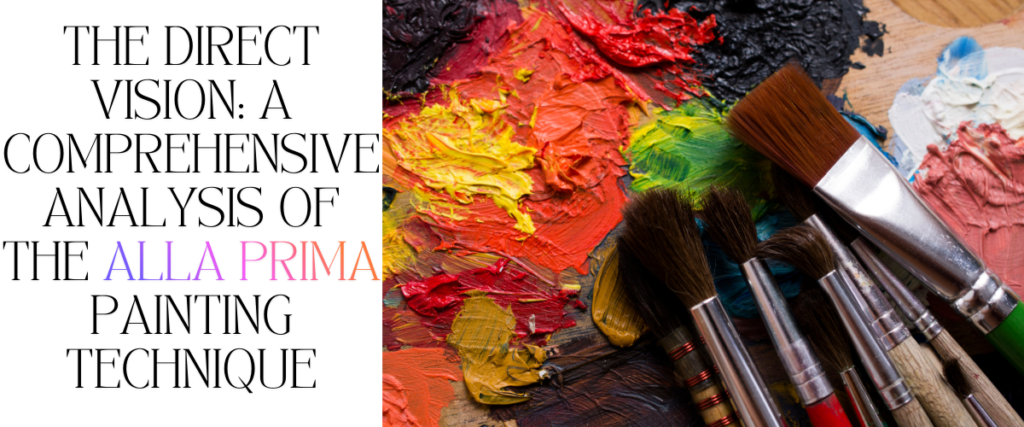
The evolution of Western representational art is fundamentally a history of the interaction between the artist’s vision and the material constraints of the medium. Among the various methodologies developed to bridge this gap, alla prima—literally meaning “at first attempt” in Italian—stands as a singular, transformative approach. Often referred to as “wet-on-wet,” “direct painting,” or the French “au premier coup,” this technique prioritises the completion of a painting in a single session while the paint remains wet.1 Unlike the traditional indirect method, which relies on a slow, multi-layered buildup of dried paint films, alla prima demands a synthesis of drawing, value, and colour into a unified, immediate performance.3 This article provides an exhaustive investigation into the historical, technical, and chemical dimensions of alla prima, analysing its rise from a niche tool of the Old Masters to the dominant practice of the modern era.
The Philosophical and Technical Foundations of Direct Painting
The core philosophy of alla prima is rooted in the concept of immediacy. Traditionally, oil painting was a process of careful construction. Artists would spend weeks establishing a monochromatic underpainting (grisaille or brunaille), allowing it to dry completely, and then applying thin, transparent glazes of colour.4 While this indirect method produces a characteristic luminosity and depth, it separates the technical challenges of painting into discrete, sequential steps.3
Alla prima collapses these steps into a singular event. When an artist paints wet-on-wet, they are not merely applying colour; they are managing a fluid dynamic where every new brushstroke interacts with the previously applied, still-pliant layer.1 This necessitates a high degree of confidence and a pre-planned strategy, as the wet surface is unforgiving of indecision.2 The aesthetic outcome of this approach is often characterised by a “loose” style, visible brushwork, and a palpable sense of movement and energy.4
| Feature | Alla Prima (Direct) | Indirect Painting |
| Primary Goal | Capturing essence and immediacy 4 | Building luminous depth and detail 4 |
| Layering Strategy | Wet-in-wet, single-layer focus 1 | Dry-on-dry, multiple glazes 4 |
| Temporal Demand | Single session (1-4 hours) 2 | Multiple sessions (days to months) 1 |
| Edge Treatment | Blended, “lost and found” edges 3 | Precise, sharp-defined detail 3 |
| Structural Integrity | Dries as a single cohesive film 12 | Risk of cracking if layers dry unevenly 13 |
Historical Evolution: From the Early Netherlandish to the Digital Age
The common misconception that alla prima is a strictly modern or Impressionist invention ignores the technical nuances of the Old Masters. Direct painting has existed as a viable technique since the inception of oil painting in the 15th century, though its role in the studio has shifted dramatically over the centuries.1
The Early Netherlandish School and the Baroque Shift
In the 15th century, masters like Jan van Eyck and Rogier van der Weyden pioneered the use of oils in Northern Europe. While their works are largely indirect, they frequently utilised alla prima passages to achieve specific textures, such as the intricate details in the Arnolfini Portrait.1 During this era, direct painting was a specialised tool used within a broader, highly controlled system.1
The Baroque period marked the first significant move toward direct painting as a primary style. Artists like Diego Velázquez and Caravaggio began to explore the expressive potential of bravura brushwork—bold, visible strokes that highlighted the artist’s hand.9 However, the Dutch master Frans Hals is perhaps the most critical figure in this lineage. Hals’s portraits, characterised by their “slashing” brushstrokes and textural immediacy, were often seen as “sloppy” by traditionalists who valued the polished finish of fellow Dutch masters like Vermeer.8 Hals recognised that the speed of alla prima could capture the psychological vitality of a sitter in a way that slow, methodical layering could not.9
The 19th-Century Revolution and the Impressionist Breakthrough
The 19th century witnessed a radical transformation in the status of direct painting. This shift was fueled by a growing rebellion against the rigid standards of the French Academy, which demanded highly finished, “licked” surfaces where no brushstrokes were visible.9 Édouard Manet served as a bridge between the Old Masters and the moderns, using direct painting in controversial works like Le Déjeuner sur l’herbe to challenge traditional aesthetics.9
The Impressionist movement, led by Claude Monet, Edgar Degas, and Camille Pissarro, fully institutionalised alla prima.7 Their primary objective was the depiction of light and its fleeting effects on the landscape—a goal that necessitated speed.14 Because atmospheric conditions change by the minute, the slow process of indirect painting was functionally incompatible with plein air (outdoor) work.6 Impressionism thus redefined alla prima as not just a technique, but a philosophical commitment to the “snapshot” of nature.19
The Industrialization of Art: The Role of the Portable Paint Tube
The 19th-century embrace of alla prima was not solely an artistic choice; it was facilitated by a massive technological leap. Before the mid-1800s, oil painting was an immobile, studio-bound craft due to the instability of the materials.
The Limitation of Pig Bladders
Historically, painters mixed their own pigments with linseed oil in the studio. This fresh paint had to be stored in animal bladders, typically from pigs, which were tied shut with string.18 To use the paint, an artist would pierce the bladder with a tack, squeeze out a small amount, and then plug the hole with a puncture repair kit.18 These bladders were permeable, prone to bursting, and smelled poorly, making them entirely impractical for travel or outdoor use.18
The Invention of the Tin Tube
In 1841, American painter John Goffe Rand patented the collapsible tin paint tube.19 This invention, later refined by the addition of the screw cap by Winsor & Newton, provided artists with a portable, airtight vessel for pre-mixed paint.18 The impact was immediate and profound. Pierre-Auguste Renoir famously stated that without paint in tubes, there would have been no Impressionism.19
The paint tube acted as a “technology passport,” allowing artists to carry a full palette into the countryside.18 Furthermore, the factory-produced paint in tubes often had a thicker, more “buttery” consistency than hand-ground paint, which encouraged the development of the heavy impasto and direct textural effects central to alla prima.21
Technical Mechanics: The Science of Wet-on-Wet Application
Successful direct painting requires an advanced understanding of the physical properties of oil paint and how it interacts with the support surface. The primary technical challenge is the management of the “wet” surface to prevent muddying and loss of form.
Understanding Paint Viscosity and “Mud”
“Mud” is a colloquial term for dull, lifeless colour mixtures that occur when too many pigments are blended on the canvas or when the colour temperature is inappropriate for the light source.8 In alla prima, every new stroke carries the risk of picking up and intermixing with the layer beneath it.6
Professional painters employ several strategies to maintain colour purity:
- The Three-Colour Pile: Artists are advised to limit mixtures to no more than three pigments.23 Excessive “ingredients,” particularly earth tones, lead to a loss of chroma and a heavy, greyed-out appearance.23
- Strategic Temperature Management: As noted by master painter Richard Schmid, mud is often a failure of colour temperature rather than pigment choice.23 Placing a cool blue in a warm shadow, for instance, results in a discordant and “dirty” visual effect.23
- The “Loaded Brush” Principle: To lay a new colour over a wet surface without disturbing the bottom layer, the brush must be heavily loaded with paint.2 The paint should “fall” from the brush onto the canvas.6 A poorly loaded brush will act like a squeegee, dragging up the previous layer and mixing it into the new stroke.2
The Modified “Fat Over Lean” Rule
The foundational rule of oil painting is “fat over lean,” which dictates that each successive layer should contain more oil (fat) than the one beneath it.12 This is critical in indirect painting to ensure that the outer layers remain flexible while the inner layers dry and contract.13
In alla prima, because the entire work is completed while wet, the layers effectively meld into a single, cohesive paint film.12 This creates a high level of structural stability, making alla prima works some of the least likely to crack over time.15 However, artists still utilise a “fat over lean” hierarchy for practical control:
- Lean Start: The initial block-in is often done with paint thinned with mineral spirits or a lean medium to allow for rapid coverage and quick setup.11
- Fat Finish: Final highlights and impasto accents are applied with tube paint or paint enriched with a small amount of oil, ensuring they “sit” on top of the leaner underlayers.12
Essential Materials for the Direct Painter
The choice of tools in alla prima is dictated by the need for speed, control, and the ability to move heavy volumes of paint across a wet surface.
Brushes and Palette Knives
Stiff brushes are the workhorses of direct painting. Synthetic or natural hog bristle brushes are preferred for their “spring” and ability to hold their shape when loaded with thick pigment.8
- Flats and Filberts: These shapes are favoured for their versatility. Flats allow for sharp, chisel-like marks, while filberts provide a softer touch for organic shapes and transitions.6
- Large Brushes: Beginners are often encouraged to use the largest brush possible for the majority of the session.2 Large brushes force the artist to simplify the subject into major shapes and prevent premature focus on detail.2
- Palette Knives: Beyond mixing paint on the palette, knives are used in alla prima to apply bold, textural strokes and to scrape away unsatisfactory areas of wet paint down to the canvas weave, allowing for a “fresh start” in localised areas.6
Supports and Toning
Direct painting can be performed on stretched canvas, canvas boards, or rigid panels.6
- Canvas: The texture (weave) of the canvas provides “tooth” that helps grip heavy paint applications.6
- Panels: MDF or aluminium panels provide a smooth, slick surface that allows paint to be moved around fluidly.6
- Toning (Imprimatura): Most alla prima artists begin by toning the white ground with a thin wash of colour, such as burnt sienna.11 This established a mid-tone value, allowing the artist to judge the lightest lights and darkest darks with greater accuracy from the first stroke.5
A Comprehensive Step-by-Step Methodology
Mastery of alla prima requires a disciplined workflow that moves from broad, general shapes to specific, refined details.
1. Preparation and Toning
The surface is primed with gesso and then toned with a lean wash.5 This removes the “blank canvas” intimidation and provides a unified colour temperature for the work.11
2. Compositional Sketch
Using charcoal or a thin, dark paint mixture, the artist sketches the major proportions.11 This is not a detailed drawing but a map of where the major elements will reside.11
3. Establishing Values (The Block-In)
The artist identifies the lightest light and the darkest dark in the scene.11 These “value boundaries” guide the placement of mid-tones.24 Large brushes are used to fill in these value masses quickly, establishing the overall “notan” or light/dark design.11
4. Edge Management and Colour Refinement
As the canvas is covered, the artist begins to manipulate the edges where shapes meet.3 “Softening” edges by gently blending wet paint into wet paint creates a sense of atmosphere, while “hard” edges draw the viewer’s eye to the focal point.6
5. Final Accents and Bravura Marks
The session concludes with the application of high-chroma colours and thick, impasto highlights.6 These marks are applied with maximum confidence and are rarely touched again, preserving the vitality of the brushstroke.23
| Stage | Focus | Material Used |
| Stage 1: Tone | Establish mid-tone 5 | Thinned paint (Burnt Sienna/Umber) 11 |
| Stage 2: Sketch | Compositional map 11 | Charcoal or lean paint 11 |
| Stage 3: Block-In | Value relationships 11 | Large brushes, lean paint 2 |
| Stage 4: Refine | Edge control and color 6 | Medium brushes, tube-consistency paint 6 |
| Stage 5: Accent | Focal points and texture 17 | Small brushes/knives, thick impasto 6 |
Media Adaptations: Acrylics and Watercolours
While alla prima is most naturally suited to oil painting due to its long drying time, the technique has been adapted to faster-drying media.
The Challenge of Acrylics
Acrylics dry primarily through evaporation, a process that can take only minutes for thin layers.34 To perform alla prima with acrylics, artists must utilise specialised tools:
- Stay-Wet Palettes: These utilise a damp sponge and permeable paper to keep paint workable for hours or even days.34
- Retarders and Open Acrylics: Chemical additives or specialised paint lines (like Golden Open) extend the drying time, allowing for wet-on-wet blending more akin to oils.34
- Misting: Artists frequently use a fine-mist spray bottle to keep both the palette and the canvas surface damp during the session.34
The Unpredictability of Watercolours
In watercolour, alla prima is often referred to as the “wet-into-wet” technique.1 It requires a high degree of finesse and a willingness to embrace “accidents,” as the paint will bloom and spread in unpredictable ways.1 Unlike oils, where the artist has absolute control over the placement of the pigment, the watercolourist must work with the flow of the water, making the technique a collaboration between the artist’s intent and the physics of the medium.1
Occupational Health and Studio Safety: A Critical Overview
The materials associated with alla prima—specifically in the context of oil painting—pose significant health risks if not handled with professional care. These risks include inhalation of toxic vapours, ingestion of heavy metals, and physical hazards such as fire.
Toxicology of Solvents
Solvents such as turpentine and Odourless Mineral Spirits (OMS) are lipophilic, meaning they can dissolve in fats and easily enter the human bloodstream.36
- Acute Hazards: Inhalation of high concentrations of solvent vapours can lead to “narcosis,” characterised by dizziness, headaches, loss of coordination, and respiratory irritation.36
- Chronic Hazards: Long-term exposure to turpentine is linked to kidney damage and severe allergic reactions, while general solvent exposure can lead to chronic behavioural changes and brain damage.36
- Mitigation: Professional studios must be equipped with active ventilation systems. An easel should be positioned near a window with an exhaust fan to pull vapours away from the artist’s breathing zone.36
Heavy Metals in Pigments
Traditional professional-grade paints often contain heavy metals that are toxic upon ingestion or inhalation.36
- Lead (Flake White): While increasingly rare, lead white is still valued by some for its structural properties. It is a potent neurotoxin.5
- Cadmium and Cobalt: These are common in vibrant reds, yellows, and blues. Cadmium is a known carcinogen and can cause lung cancer if inhaled as dust (e.g., when sanding a dried painting).36
- Prevention: Artists must avoid eating or drinking in the studio, wash hands meticulously, and never “point” a brush with their lips.36
The Hazard of Spontaneous Combustion
One of the most dangerous physical risks in the oil painting studio involves the disposal of linseed oil-soaked rags.36
- The Mechanism: Drying oils like linseed oil dry through oxidation—a chemical reaction with oxygen that produces heat.13
- The Risk: When oil is concentrated on a porous material like a crumpled rag, the heat buildup can reach the flashpoint of the cloth, leading to a fire without any external spark.40
- Standard Protocol: All oil-soaked rags must be spread out flat to dry in a safe location or stored in a fireproof metal container filled with water.36
Professional Optimisation and Efficiency Strategies
Alla prima is as much about the economy of movement as it is about the application of paint. Professional artists focus on maximising efficiency to complete the work within the “golden window” of wet-on-wet workability.
Palette Organization
Efficiency begins with an organised palette. Artists typically lay out their colours in a consistent order—often from warm to cool or light to dark—so they can find them intuitively while focusing on the canvas.23
- Limited Palettes: Using a limited range of colours (such as the Zorn palette) reduces decision fatigue and naturally encourages colour harmony.25
- Ample Paint: One of the most common mistakes for beginners is putting out too little paint.2 Professionals mix large piles of their dominant colours before the first brushstroke touches the canvas.2
Cognitive Load and Speed
While alla prima appears fast, professionals emphasise that it should be “comfortable,” not frantic.30 The speed of the process is a byproduct of decisive decision-making rather than physical haste.8 By focusing on value accuracy over detail, the artist simplifies the visual information, allowing them to remain in control of the composition as it evolves.2
Synthesis and Conclusion
The alla prima technique is a bridge between the historical rigour of the Old Masters and the expressive freedom of contemporary art. It is a methodology that honours the material reality of paint—its viscosity, its drying time, and its ability to record the direct physical gesture of the artist.9
Historically, the shift toward alla prima represented a liberation of the artist from the studio and the rigid hierarchies of the Academy, a movement facilitated by the industrial invention of the paint tube.9 Technically, it remains a supreme challenge, requiring a simultaneous mastery of drawing, value, and colour within a limited temporal window.3
For the modern practitioner, alla prima is more than a way to save time; it is a way to achieve a specific kind of truth in painting—one that captures the vitality, emotion, and immediacy of a single moment in time.7 As digital media and fast-paced technological advances continue to reshape the visual landscape, the tactile, unedited nature of the alla prima brushstroke remains a powerful testament to the authentic human hand in art.9
Disclaimer
This article is intended for informational and professional education purposes only. The practice of oil painting involves the use of toxic solvents (such as mineral spirits and turpentine) and pigments containing heavy metals (such as lead, cadmium, and cobalt), which pose serious risks to human health and the environment. All painting sessions should be conducted in well-ventilated areas following OSHA or equivalent safety standards. Proper disposal of hazardous waste and oil-soaked rags is mandatory to prevent environmental damage and spontaneous combustion. The author and publisher assume no liability for the misuse of these materials or for any health or safety incidents arising from the application of the techniques described herein. Always consult Safety Data Sheets (SDS) and local fire codes before beginning a practice in oil media.
Reference
- Wet-on-wet – Wikipedia, accessed on February 26, 2026, https://en.wikipedia.org/wiki/Wet-on-wet
- David Lussier Gallery — Alla Prima Notes, accessed on February 26, 2026, https://www.davidlussiergallery.com/alla-prima-notes
- Alla Prima vs Indirect Painting: What’s the Difference?, accessed on February 26, 2026, https://www.schoolofrealistart.com/blog/alla-prima-vs-indirect-painting
- Monday Morning Art School: what is alla prima painting? | Carol L. Douglas, accessed on February 26, 2026, https://www.watch-me-paint.com/monday-morning-art-school-what-is-alla-prima-painting/
- Study Guide – Oil Priming (Painting Technique) – StudyGuides.com, accessed on February 26, 2026, https://studyguides.com/study-methods/study-guide/cml26znix91b00192j3hz7b7m
- A complete guide to alla prima painting – Artists & Illustrators, accessed on February 26, 2026, https://www.artistsandillustrators.co.uk/how-to/oil-painting/a-complete-guide-to-alla-prima-painting/
- Wet-on-wet or alla prima technique, what’s that? – Carola Caprice, accessed on February 26, 2026, https://carolacaprice.com/en/nat-in-nat-of-alla-prima-techniek-wat-is-dat/
- Alla Prima Painting – What Is the Technique of Alla Prima? – Art in Context, accessed on February 26, 2026, https://artincontext.org/alla-prima-painting/
- Painting Fast and Loose: The Comeback of Alla Prima in Contemporary Practice, accessed on February 26, 2026, https://www.invaluable.com/blog/painting-fast-and-loose-alla-prima/
- Direct (Alla Prima) vs Indirect Painting – Art Classes, accessed on February 26, 2026, https://artspeaksstudio.com/blog/f/direct-alla-prima-vs-indirect-painting
- Mastering Alla Prima Painting: A Step-by-Step Guide for Artists of All …, accessed on February 26, 2026, https://www.chuckblackart.com/blogs/the-painters-block/mastering-alla-prima-painting-a-step-by-step-guide-for-artists-of-all-levels
- When does the fat over lean rule apply? : r/oilpainting – Reddit, accessed on February 26, 2026, https://www.reddit.com/r/oilpainting/comments/1bi68nc/when_does_the_fat_over_lean_rule_apply/
- The Fat Over Lean Rule in Oil Painting: The Complete Guide – Craft and Canvas, accessed on February 26, 2026, https://craftandcanvas.co.uk/blogs/thoughts-of-a-art-and-yarn-shop-owner/the-fat-over-lean-rule-in-oil-painting-the-complete-guide
- Technique Tuesdays: Alla Prima – Principle Gallery, accessed on February 26, 2026, https://principlearttalk.com/2015/03/24/technique-tuesdays-alla-prima/
- Oil Painting Fat Over Lean, As Easy As 1,2,3 – Rebekah Griffith, accessed on February 26, 2026, https://rebekahgriffithartist.com/oil-painting-fat-over-lean-as-easy-as-123/
- An Explanation of the Fat Over Lean Rule – Drawing & Painting Classes, accessed on February 26, 2026, https://www.schoolofrealistart.com/blog/fat-over-lean-rule
- What is Alla Prima Painting? – Emilie Swanson, accessed on February 26, 2026, https://emilieswanson.com/what-is-alla-prima-painting/
- The Invention Path to Plein Air and Impressionism | Cape Ann Cosmos, accessed on February 26, 2026, https://www.capeanncosmos.com/feature-articles/the-invention-path-to-plein-air-and-impressionism-lbctm
- The history of the metal paint tube by Winsor & Newton – Opus Art Supplies, accessed on February 26, 2026, https://opusartsupplies.com/blogs/resource-library/the-history-of-the-metal-paint-tube-by-winsor-newton
- The history of the metal paint tube – Winsor & Newton, accessed on February 26, 2026, https://www.winsornewton.com/blogs/articles/history-metal-paint-tube
- The Impressionists and innovations in artists’ tools | NGV, accessed on February 26, 2026, https://www.ngv.vic.gov.au/the-impressionists-and-innovations-in-artists-tools/
- The History of the Paint Tube – Loxley Art Supplies, accessed on February 26, 2026, https://loxleyarts.com/blogs/news/history-of-the-paint-tube
- Oil Painting Lesson: 10 Ways to Avoid Muddy Color – Realism Today, accessed on February 26, 2026, https://realismtoday.com/oil-painting-lesson-10-ways-to-avoid-muddy-color-mixing/
- Fast Plein Air Painting – 6 Step Alla Prima Painting Process – Virtual Art Academy, accessed on February 26, 2026, https://www.virtualartacademy.com/alla-prima/
- Tips for alla prima with transparent colours? : r/oilpainting – Reddit, accessed on February 26, 2026, https://www.reddit.com/r/oilpainting/comments/1po0vyk/tips_for_alla_prima_with_transparent_colours/
- Mastering Oil Painting: Techniques, Tools & Tips for Stunning Artwork – Alabama Art Supply, accessed on February 26, 2026, https://www.alabamaart.com/blogs/studionotes/mastering-oil-painting
- How to Start an Oil Painting: 5 Methods – Fine Art Tutorials, accessed on February 26, 2026, https://finearttutorials.com/guide/how-to-start-an-oil-painting/
- Tutorial 1-5 – Painting! – Artist’s Helper, accessed on February 26, 2026, https://www.artistshelper.com/p/tutorial-1-5.html
- Monday Morning Art School: avoid muddy colors | Carol L. Douglas, accessed on February 26, 2026, https://www.watch-me-paint.com/monday-morning-art-school-avoid-muddy-colors/
- Alla Prima (Wet on Wet) Painting Tips – Draw Paint Academy, accessed on February 26, 2026, https://drawpaintacademy.com/alla-prima-painting-tips/
- Materials List for “Alla Prima Portrait Painting in Oils” Oregon Society of Artists Joanne Mehl, Instructor joannemehl@comca, accessed on February 26, 2026, https://www.osartists.org/images/classes/2020ClassSupplyLists/Joanne_Mehl_-_Mat_LIst_Alla_Prima_Portrait_Painting_in_OIls.pdf
- What do “indirect” and “alla prima” mean? | Carol L. Douglas, accessed on February 26, 2026, https://www.watch-me-paint.com/what-do-indirect-and-alla-prima-mean/
- Alla Prima Portrait Study in Oils – Damian Osborne, accessed on February 26, 2026, https://www.damianosborne.com/alla-prima-portrait-study-in-oils
- Painting Alla Prima with Acrylics and Tips to Get Started …, accessed on February 26, 2026, https://trembelingart.com/painting-alla-prima-with-acrylics-and-tips-to-get-started/
- Beginner’s Guide to Acrylic Painting Techniques – Lori Oswald – The Outdoorsy Artist, accessed on February 26, 2026, https://theoutdoorsyartist.com/beginner-acrylic-painting-techniques/
- Painting Safety in the Arts : Environmental Health & Safety : UMass …, accessed on February 26, 2026, https://www.umass.edu/ehs/painting-safety-arts
- Make Healthy: An Art Materials Safety Guide – Pratt Institute, accessed on February 26, 2026, https://www.pratt.edu/administrative-departments/student-affairs/health-wellness/resilience-wellness-and-well-being-center/resources/make-healthy-an-art-materials-safety-guide/
- Art Safety: Painting and Drawing | Compliance and Risk Management | Kent State University, accessed on February 26, 2026, https://www.kent.edu/compliance/art-safety-painting-and-drawing
- THE UNIVERSITY OF NORTH CAROLINA, accessed on February 26, 2026, https://vpa.uncg.edu/wp-content/uploads/2024/05/painting.pdf
- General Procedures for Art Materials and Hazardous Substances | Kremer Pigmente Online Shop, accessed on February 26, 2026, https://www.kremer-pigmente.com/en/information/safety/general-procedures-for-art-materials/
- The Benefits and Practice of Indirect, Direct, and Alla Prima Painting Techniques – Steemit, accessed on February 26, 2026, https://steemit.com/painting/@jameszenartist/6umtkx-the-benefits-and-practice-of-indirect-direct-and-alla-prima-painting-techniques
- Why Ultra-Contemporary Artists Are So Obsessed With Old Masters | Artnet News, accessed on February 26, 2026, https://news.artnet.com/art-world/ultra-contemporary-old-masters-2744796