Welcome to the World of Abundance
Picture a gallery space. In one room, a single, perfectly sculpted chair sits in the centre of a vast, white expanse. The walls are bare, the light is even, and the air is still with a sense of quiet contemplation. This is the world of Minimalism, an aesthetic of serene reduction. Now, step into the adjacent room. Here, the walls are covered in a riot of floral wallpaper, against which hangs a dense constellation of paintings, photographs, and mirrors in ornate frames. A velvet sofa in a deep jewel tone is piled high with cushions of clashing patterns and textures. Every surface holds a story—a collection of antique books, a cluster of hand-blown glass, a souvenir from a distant land. This is the world of Maximalism, and it is anything but quiet.1
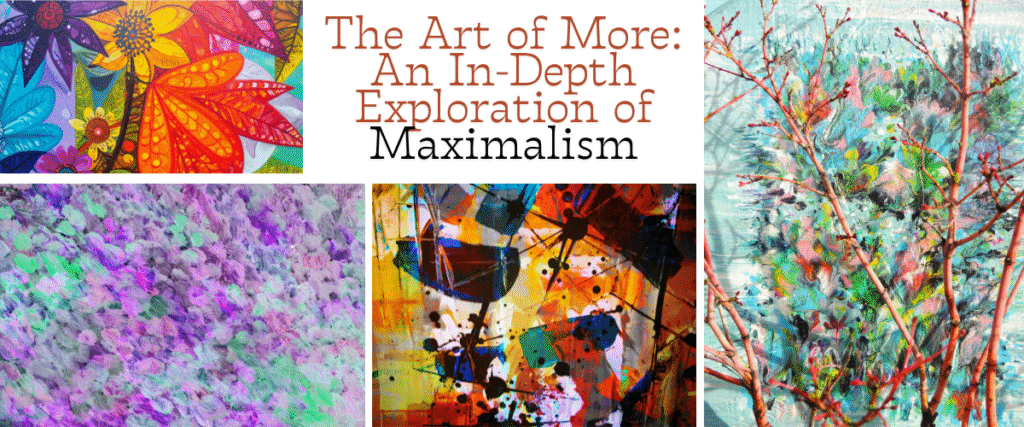
At its heart, Maximalism is an artistic and design philosophy that operates under the defiant mantra, “more is more”.3 It stands as a direct and exuberant reaction against the minimalist principle of “less is more,” celebrating abundance, complexity, and unapologetic self-expression.4 But to dismiss it as mere clutter or a penchant for accumulation is to miss the point entirely. Maximalism is a philosophy of vibrant addition, a practice of layering meaning, and an aesthetic that embraces the richness and chaos of life itself.3 This report will journey deep into this world of abundance, exploring its complex philosophy, tracing its rich historical lineage, deconstructing its key characteristics, and examining its application across the creative arts. From its roots in Baroque palaces to its resurgence on social media feeds, we will uncover why this love of “more” is an enduring and deeply human impulse.
The Philosophy of Plenty: Deconstructing “More is More”
The phrase “more is more” is a deceptively simple summary for a deeply nuanced philosophy. It is not an invitation to mindless hoarding or chaotic disorganisation. Instead, true Maximalism is an exercise in what can be described as “curated chaos” or “thoughtful curation”.1 It is the artful arrangement of abundance, where a multitude of elements are brought together to create a cohesive, intentional, and deeply personal whole, often unified by a recurring theme, colour story, or feeling.7 This practice requires a keen eye and the ability to edit—not to remove, but to compose. The skills needed to balance a maximalist space, such as understanding colour theory, scaling patterns effectively, and creating visual harmony among disparate objects, are fundamentally the same disciplines a minimalist employs. The critical difference lies in the objective: while the minimalist edits aim to achieve clarity through reduction, the maximalist edits aim to achieve richness through composition. This elevates Maximalism from a simple decorative preference to a highly skilled artistic practice, where the line between a masterful composition and a cluttered mess is defined by intent and execution.8
A central tenet of this philosophy is the power of personal narrative. Maximalism provides a stage for storytelling, transforming a space or an artwork into a rich tapestry of an individual’s life and identity.9 The aesthetic encourages the prominent display of travel souvenirs, cherished collections, family heirlooms, and objects imbued with personal meaning.5 In doing so, a home becomes more than a dwelling; it becomes a living museum of its inhabitants’ tastes, histories, and passions, creating an environment that is emotionally resonant and uniquely enriching.1
Furthermore, Maximalism is an act of liberation. It is a philosophy born from a rejection of rigid rules, traditional hierarchies of style, and the austere principles of earlier modernist movements.12 It champions freedom of expression, embraces diversity, and encourages spontaneity, blurring the lines between high and low art, reality and fantasy.13 By fusing seemingly contradictory elements—the old with the new, the refined with the kitsch, the local with the global—Maximalism creates a visual language that is dynamic, daring, and deeply individualistic.6
A Rich Tapestry: The Historical Roots of Excess
While the term “Maximalism” is a relatively recent invention, the human impulse toward aesthetic abundance has deep historical roots, often reflecting the social, economic, and technological capacities of its era.
Ancient Precursors and the Wunderkammer
The maximalist spirit can be traced back to the 16th-century European tradition of the Wunderkammer, or “cabinet of curiosities.” These were rooms or cabinets filled with an eclectic mix of natural marvels, exotic artifacts, scientific instruments, and artworks brought back from the far corners of a newly explored world.15 The Wunderkammer was a microcosm of the world, a dense and layered collection designed not for minimalist contemplation but to provoke awe, spark conversation, and display the owner’s worldliness and wealth.4 This historical precedent established a crucial link between collecting, knowledge, and an aesthetic of curated abundance that remains central to Maximalism today.
The Drama of the Baroque and Rococo
In the 17th century, the Baroque style swept across Europe, establishing a powerful visual language of opulence and grandeur. Characterised by deep colours, exuberant detail, dramatic movement, and a theatrical sense of awe, Baroque art and architecture—epitomised by the Palace of Versailles—created immersive, sensory-rich environments.17 In the 18th century, this evolved into the Rococo style, which, while lighter and more playful with its pastel palettes and asymmetrical flourishes, was equally ornate and decorative.17 Together, these periods laid the foundational aesthetic for modern Maximalism, celebrating ornamentation and rejecting restraint in favour of a full-bodied, emotionally charged experience.20
Victorian Splendour and Industrial Abundance
The Victorian era (1837–1901) marked a pivotal moment when maximalist sensibilities became more accessible to the burgeoning middle class. Fueled by the prosperity of the Industrial Revolution, mass production made decorative goods affordable for the first time.4 Homes were filled with patterned wallpaper, heavy drapery, ornate furniture, and collections of objects that served as powerful forms of self-expression and status display.4 This period cemented the idea of the home as a personal sanctuary filled with things that tell the story of its inhabitants.
The Postmodern Revolt
Maximalism as a formal movement emerged in the late 20th century, particularly during the 1960s and 1970s, as part of the broader postmodern cultural shift.12 It was a direct and conscious reaction against the perceived coldness, impersonality, and rigid doctrines of Modernism and its aesthetic offspring, Minimalism.3 This new movement reflected the life of the postmodern individual, who was increasingly inundated with a wealth of information and cultural references.13 Architect Robert Venturi, a vocal critic of pure modernism, captured the spirit of this revolt with his now-famous declaration, “Less is boring,” a phrase that became a rallying cry for a new generation of artists and designers who sought to re-embrace complexity, ornamentation, and historical reference.13 This history reveals that Maximalism is not merely a recurring taste but an aesthetic that is intrinsically linked to the technological and social conditions of its time. The “more” that is being expressed evolves: from the rare physical objects of the Wunderkammer, to the mass-produced goods of the Victorian parlour, to the abundance of information and cultural capital that defines the digital age and finds its expression on social media.4
The Anatomy of Abundance: Key Characteristics of Maximalist Art
Maximalism communicates through a distinct and vibrant visual language. Understanding its core components is essential to appreciating the artistry behind its “curated chaos.”
A Symphony of Colour and Pattern
- Colour: Maximalism is fearless in its use of colour. Palettes are typically bold, rich, and saturated, often featuring intense jewel tones like emerald, sapphire, fuchsia, and ruby.6 The style embraces daring and unexpected colour combinations, using contrast and even clashing hues to create a dynamic, joyful, and visually stimulating environment. A maximalist space is not defined by a single accent colour but by a spectrum of tones working in concert.7
- Pattern: Pattern is a fundamental element, used generously and with confidence. A hallmark of the style is the layering of multiple, often contrasting, patterns within a single composition.21 It is common to see floral prints mixed with geometric motifs, animal prints alongside abstract squiggles, or traditional damasks paired with modern stripes.22 This mixture creates a visually rich, multifaceted look that invites the eye to linger and explore.26
The Art of Layering and Texture
- Layering: Layering is perhaps the most crucial technique in the maximalist toolkit. It is the process of building up depth and creating an immersive experience by combining diverse elements—layering rugs on the floor, pillows on a sofa, art on the walls, or visual components in a digital collage.6 This thoughtful arrangement of layer upon layer is what distinguishes a curated maximalist design from a simple accumulation of objects.1
- Texture: To complement the visual complexity, Maximalism employs a rich variety of textures that engage the sense of touch. The aesthetic thrives on contrast, pairing plush and soft materials like velvet and silk with rougher, more tactile surfaces like jute, rough-hewn wood, or woven seagrass.1 Gleaming metals, smooth resins, and chunky knits are combined to add a tactile dimension that enhances the overall sensory experience, making a space feel warm, inviting, and lived-in.7
Eclecticism and the Blending of Worlds
Maximalism is inherently eclectic, celebrating diversity by freely combining styles, influences, and objects from different cultures, historical periods, and artistic movements.1 A maximalist interior might feature an antique Victorian chair next to a mid-century modern lamp, with art on the walls that references both Japanese pop culture and African tribal patterns.13 This fusion of the old and the new, the traditional and the contemporary, creates a rich tapestry of references that feels both familiar and daringly innovative.6
Ornate Detailing and Statement Pieces
In a maximalist composition, every detail matters. The style revels in ornate and intricate detailing, turning every element into an opportunity for creative expression.12 This can manifest as gilded picture frames, elaborate carvings on furniture, decorative hardware, or complex typography in graphic design.22 To anchor the visual richness and provide a focal point, maximalist designs often incorporate bold, eccentric, and oversized statement pieces. This could be a grand crystal chandelier, a brightly colored and unconventionally shaped sofa, or a massive piece of artwork that commands attention and sparks conversation.17
Maximalism in Practice: A World of Vibrant Expression
The principles of Maximalism are not confined to a single medium; they are applied across a wide range of creative disciplines, each adapting the “more is more” philosophy to its own language.
Living in Abundance: Maximalism in Interior Design
Maximalist interior design is about creating a space that is a theatrical and deeply personal reflection of its inhabitant.9 It goes beyond decoration to craft an immersive environment. Common techniques include creating floor-to-ceiling gallery walls that mix art, photographs, and personal mementos; using bold, patterned wallpaper on all four walls and even the ceiling—the “fifth wall”—to create a cocoon-like effect; and layering multiple rugs with different patterns and textures to add depth and warmth to a room.4 Furniture is eclectic, often mixing styles and periods, and every available surface becomes a canvas for displaying curated collections of books, vases, sculptures, and personal treasures.28 The key is to achieve a balance where the space feels full and vibrant yet remains cohesive and functional, avoiding the descent into overwhelming clutter.10
Decorating the Self: Maximalism in Fashion
In fashion, Maximalism is a celebration of opulence, individuality, and sartorial drama. Its history is one of flamboyant excess, from the legendary extravagance of royals like Marie Antoinette to the power-dressing of the 1980s, a decade defined by designers like Gianni Versace and Jean-Paul Gaultier who championed daring prints, bold silhouettes, and glamorous embellishments.30 Defining features of maximalist fashion include the fearless mixing of vibrant colours and bold, often clashing prints; the use of exaggerated silhouettes with dramatic shapes and volume; and the application of lavish embellishments like sequins, crystals, and intricate embroidery.32 The style also encourages the artful layering of different fabrics, textures, and accessories to create a complex and deeply personal look. Contemporary expressions include the vibrant and eclectic street style of Japan’s Harajuku district and the recent trend of “dopamine dressing,” where clothing is chosen specifically to elevate mood through joyful colour and pattern.34
Visual Storytelling: Maximalism in Graphic Design and Beyond
Maximalism in graphic design rejects the clean, corporate simplicity that has dominated branding for decades. Instead, it embraces complexity to tell a richer visual story.25 This is evident in intricate logos that incorporate multiple layers of illustration and typography, and in dense, visually engaging posters and album covers. A key historical touchstone is the psychedelic concert poster art of the 1960s, which used swirling patterns, kaleidoscopic colours, and experimental, often illegible, typography to create an immersive visual experience that mirrored the music and the countercultural ethos of the era.21 The aesthetic’s influence extends to other arts as well; in literature, the dense, digressive, and reference-laden novels of authors like David Foster Wallace and Thomas Pynchon are often described as maximalist, while in music, the complex, multi-layered compositions of artists like Frank Zappa and Charles Ives embody the same “more is more” spirit.3
The Great Divide: A Comparative Analysis of Maximalism and Minimalism
To fully grasp the essence of Maximalism, it is essential to view it in relation to its aesthetic opposite, Minimalism. The two are not merely different styles; they represent contrasting worldviews and fundamentally different approaches to art, design, and life.12 Minimalism seeks to find beauty and calm in reduction, clarity, and order. It operates on the belief that by stripping away the non-essential, one can arrive at a purer, more functional, and more tranquil state.1 Maximalism, conversely, seeks to find beauty and joy in abundance, complexity, and energy. It believes that life is rich and messy, and that our environments should reflect that vibrancy.2
This philosophical divide manifests in every aesthetic choice. While Minimalism favours neutral, monochromatic colour palettes, clean lines, and an emphasis on negative space, Maximalism embraces bold, saturated colours, ornate forms, and the filling of every available space with meaning and visual interest.2 The emotional goal of a minimalist space is often tranquillity and focus, whereas a maximalist space aims to evoke excitement, creativity, and joy.1 However, the dialogue between these two extremes is not always one of opposition. A significant trend in contemporary design is the synthesis of the two: using a clean, minimalist foundation (such as neutral walls and streamlined furniture) as a backdrop for carefully chosen maximalist accents—a vibrant piece of art, a collection of eclectic objects, or a boldly patterned rug. This hybrid approach allows for a balanced aesthetic that captures both the calm of simplicity and the expressive joy of abundance.2
Maximalism vs. Minimalism at a Glance
| Feature | Maximalism | Minimalism |
| Core Philosophy | “More is more”; Celebration of abundance, complexity, and excess 3 | “Less is more”; Emphasis on simplicity, functionality, and essentialism 2 |
| Aesthetic Focus | Layering, ornamentation, eclecticism, sensory richness 1 | Negative space, clean lines, reduction of elements, clarity 1 |
| Color Palette | Bold, saturated, vibrant, often clashing and contrasting 6 | Neutral, monochromatic, limited, harmonious 1 |
| Use of Pattern | Layered, intricate, mixed (e.g., floral with geometric) 21 | Subtle, geometric, often absent in favour of solid colours and textures 37 |
| Emotional Impact | Joy, energy, creativity, excitement, potential overwhelm 1 | Calm, tranquillity, focus, order, potential coldness or sterility 1 |
| Form of Expression | Personal narrative, storytelling, individuality, cultural history 7 | Universal principles, functional clarity, quiet restraint 2 |
Faces of the Movement: Key Maximalist Artists and Designers
Throughout its history, Maximalism has been shaped and defined by visionary artists who have pushed the boundaries of aesthetic expression.
Historical Forerunners
While the term did not exist in his time, Austrian Symbolist painter Gustav Klimt is a key forerunner of the maximalist spirit. His works, such as the monumental The Beethoven Frieze (1902) and the iconic The Tree of Life (1909), are renowned for their lavish detail, intricate patterns, and shimmering application of gold leaf.12 Klimt redefined ornament not as mere decoration but as a powerful vehicle for emotion, creating immersive, mythic worlds that envelop the viewer in a transportive aesthetic experience.39
Pioneers of Postmodern Maximalism
In the mid-20th century, several artists created work that prefigured the formal maximalist movement. Jackson Pollock’s “drip paintings,” like Autumn Rhythm (Number 30) (1950), are often seen as a precursor. Their chaotic, all-over compositions, where every mark on the canvas seems to hold equal importance, embody a kind of abstract maximalism that rejects traditional composition in favour of raw energy.38 Later, American artist Frank Stella challenged minimalist orthodoxy with massive, complex works like Jarama II (1982), a convoluted and vibrant installation of geometric shapes and vivid colours that demands the viewer’s active exploration.38
Contemporary Icons
Today, Maximalism is a vibrant and global phenomenon, championed by a diverse group of contemporary artists.
- Yayoi Kusama: The Japanese artist is a master of immersive Maximalism. Her celebrated Infinity Mirrored Room installations plunge the viewer into a kaleidoscopic world of endless reflection, pattern, and light, creating a profound experience of sensory overload that is a hallmark of the aesthetic.38
- Jean-Michel Basquiat: Basquiat’s graffiti-inspired paintings from the 1980s, such as Untitled (1981), represent a raw, urban form of Maximalism. His canvases are chaotic yet captivating compositions of bold brushstrokes, layered imagery, and cryptic text that embody the complexity and energy of the city.38
- Njideka Akunyili Crosby: The Nigerian-born artist uses a maximalist approach to explore complex narratives of cultural identity. Her large-scale works layer paint with collage, photographic transfers, and prints to create dense, intimate scenes that query postcolonial history and personal memory.39
- Other significant contemporary figures include Takashi Murakami, whose “Superflat” style bursts with characters and colors drawn from Japanese pop culture; Anselm Kiefer, whose massive, textured canvases incorporate materials like straw and lead to delve into history and myth; and Amir H. Fallah, whose vibrant, pattern-rich portraits obscure his subjects’ faces, allowing their stories to be told through the objects and textiles that surround them.38
The Psychology of Plenty: Why We Love (and Sometimes Fear) Abundance
Maximalism is more than a collection of visual traits; it is a sensory experience that can have a profound psychological impact on our mood, creativity, and sense of self.
The Aesthetics of Joy and Self-Expression
At its best, Maximalism is an aesthetic of joy. The abundant use of vibrant colours, engaging patterns, and rich textures can create a dynamic and energetic environment that stimulates the senses and sparks creativity.1 Surrounding oneself with personally meaningful objects—cherished collections, family heirlooms, art that tells a story—can foster a deep sense of comfort, belonging, and identity.4 This act of curating a personal world makes a space feel emotionally resonant and enriching, turning it into a true reflection of the self.1
The Risk of Sensory Overload
However, the very qualities that make Maximalism so stimulating can also be its greatest psychological risk. For some individuals, the high level of visual stimuli can become overwhelming, leading to feelings of anxiety or chaotic unease rather than joy.1 An excess of things can contribute to stress and make it difficult to concentrate.43 This highlights the importance of individual sensory preferences; what one person finds inspiringly vibrant, another may find unpleasantly jarring. The success of a maximalist environment often depends on striking a delicate balance between stimulation and comfort, ensuring the space remains inviting rather than oppressive.1
Maximalism in the Digital Age
The contemporary resurgence of Maximalism is inextricably linked to the psychology of our digital world. On visually-driven social media platforms like Instagram and TikTok, content is in a constant battle for attention. Research suggests that posts with higher visual complexity and more vibrant colours are more likely to capture a user’s gaze and increase engagement.21 The dense, layered, and eye-catching nature of maximalist design is perfectly suited to this environment, making it a naturally successful aesthetic for the digital marketplace.13 This creates a fascinating duality. On one hand, Maximalism aesthetically mirrors the information overload and constant stimulation of modern life.13 On the other hand, it offers a powerful tool for managing that reality. By consciously curating our own maximalist worlds, whether in our homes or on our social feeds, we take the chaotic influx of external data and reframe it into a personal, controlled, and meaningful narrative. It is a way of finding comfort and identity, not by escaping the noise, but by orchestrating it into our own personal symphony.
Conclusion: The Enduring Allure of a Life Lived Out Loud
Maximalism is far more than a fleeting design trend or a simple preference for ornamentation. It is a profound and recurring aesthetic impulse with deep historical roots, a powerful medium for personal storytelling, and a complex cultural response to the moments in which it flourishes. From the awe-inspiring Wunderkammer of the Renaissance to the defiant postmodern revolt against sterile modernism, the “more is more” philosophy has consistently offered an alternative to restraint—one that champions richness, diversity, and the beauty of a life filled with meaning.
It is an aesthetic that requires discipline to master, transforming potential chaos into a curated symphony of colour, pattern, and texture. It is a language that speaks across creative fields, from the immersive interiors that personify their inhabitants to the bold fashions that adorn the self and the intricate graphic designs that tell a complex story. At its core, Maximalism is a celebration of life’s complexity and an unapologetic embrace of individuality. In a world that often prizes simplicity and order, it offers a joyful, vibrant, and deeply human invitation to engage with our surroundings, to tell our stories, and to live a life out loud through the art and objects we choose to hold dear.5
Disclaimer
The field of art and design history is subject to interpretation and ongoing scholarship. The artists, movements, and examples discussed in this article represent a curated selection intended to illustrate the core concepts of Maximalism and should not be considered an exhaustive, all-encompassing list. The definitions and characteristics presented are based on a synthesis of contemporary and historical analyses of the movement.
Reference
- Understanding the Concept of Maximalism | Coldharbour Lights, accessed on October 29, 2025, https://coldharbourlights.com/blogs/news/understanding-the-concept-of-maximalism
- Minimalism vs Maximalism: A Comparative Analysis of Design …, accessed on October 29, 2025, https://blog.rno1.com/minimalism-vs-maximalism-a-comparative-analysis-of-design-philosophies/
- Maximalism – Wikipedia, accessed on October 29, 2025, https://en.wikipedia.org/wiki/Maximalism
- What Is Maximalism? Here’s How to Do Maximalist Design – The Spruce, accessed on October 29, 2025, https://www.thespruce.com/what-is-maximalist-style-4685629
- Embracing Maximalism: A Maximalist’s Argument for Maximalism in One’s Life | by Phillip Boyd | Medium, accessed on October 29, 2025, https://medium.com/@enter.art/embracing-maximalism-a-maximalists-argument-for-maximalism-in-one-s-life-b6d5ec70b84d
- Maximalism | explore the art movement that emerged in Global – Ilustromania, accessed on October 29, 2025, https://www.ilustromania.com/artistic-movements/maximalism
- Why More is More: The Philosophy Behind Maximalist Decor – Sage and Clare, accessed on October 29, 2025, https://sageandclare.com/en-us/blogs/sage-and-clare-journal/why-more-is-more-the-philosophy-behind-maximalist-decor
- What is maximalist interior design? : r/maximalism – Reddit, accessed on October 29, 2025, https://www.reddit.com/r/maximalism/comments/1f1w22a/what_is_maximalist_interior_design/
- is More: The Resurgence of Maximalism in Design | Westlake Royal Building Products, accessed on October 29, 2025, https://www.westlakeroyalbuildingproducts.com/blog/more-more-resurgence-maximalism-design
- The Maximalist Movement – Decorative Materials Blog, accessed on October 29, 2025, https://blog.decorativematerials.com/the-maximalist-movement
- www.westlakeroyalbuildingproducts.com, accessed on October 29, 2025, https://www.westlakeroyalbuildingproducts.com/blog/more-more-resurgence-maximalism-design#:~:text=At%20its%20best%2C%20Maximalism%20is,the%20inhabitant%20of%20a%20space.
- Minimalism and Maximalism – Key Differences in Design & Lifestyle, accessed on October 29, 2025, https://cosimo.art/blog/minimalism-and-maximalism/
- Maximalism: What It Is and Why You Need to Know It | ArchDaily, accessed on October 29, 2025, https://www.archdaily.com/1007027/maximalism-what-it-is-and-why-you-need-to-know-it
- cosimo.art, accessed on October 29, 2025, https://cosimo.art/blog/minimalism-and-maximalism/#:~:text=Maximalism%20was%20part%20of%20the,and%20championed%20freedom%20of%20expression.
- The History of Maximalist Interior Design – Design Space, accessed on October 29, 2025, https://www.designspace.ae/post/maximalist-interior-design-victorian-era-origins-to-modern-day-interiors
- Maximalism: A Collecting Guide | Christie’s, accessed on October 29, 2025, https://www.christies.com.cn/en/stories/maximalism-collecting-guide-33bffd98b98547aaaddd69d924bcd28c
- The Resurgence of Maximalist Interior Design in 2025: A Movement of Self-Expression, accessed on October 29, 2025, https://www.persimmon.design/journal/the-resurgence-of-maximalist-interior-design-in-2025-a-movement-of-self-expression/
- Baroque – Wikipedia, accessed on October 29, 2025, https://en.wikipedia.org/wiki/Baroque
- r/maximalism Wiki: A Guide to Maximalist Design – Reddit, accessed on October 29, 2025, https://www.reddit.com/r/maximalism/wiki/index/
- The Beauty of Maximalism: Its Roots and Its Significance in the Present Day, accessed on October 29, 2025, https://thesciencesurvey.com/arts-entertainment/2025/02/12/the-beauty-of-maximalism-its-roots-and-its-significance-in-the-present-day/
- Art Trends: Maximalism and the “More is More” Design Movement, accessed on October 29, 2025, https://creativeresources.threadless.com/art-trends-maximalism-and-the-more-is-more-design-movement/
- The Beautiful Art Of Designing Maximalist Interiors – Hommés Studio, accessed on October 29, 2025, https://hommes.studio/journal/the-art-of-designing-maximalist-interiors/
- Exploring the Allure and Excitement of Maximalism | RevArt Blog, accessed on October 29, 2025, https://revart.co/blogs/125_Exploring_the_Allure_and_Excitement_of_Maximalism
- Maximalism in art | Artfinder, accessed on October 29, 2025, https://www.artfinder.com/blog/post/maximalism-in-art/
- The Art of Maximalism in Graphic Design: Embrace the Chaos | Vivid …, accessed on October 29, 2025, https://www.vividcreative.studio/post/the-art-of-maximalism-in-graphic-design
- Key Principles of Maximalist Home Decor Style I Spiffy Spools, accessed on October 29, 2025, https://www.spiffyspools.com/spiffy-speak/maximalist-decor-design/
- Go Big in Your Home: Maximalism Interior Design – Decorating Den Interiors, accessed on October 29, 2025, https://decoratingden.com/blog/go-big-in-your-home-maximalism-interior-design/
- Minimalism vs. Maximalism: Which is the Right Design Style for You?, accessed on October 29, 2025, https://pamelahopedesigns.com/minimalism-vs-maximalism-which-is-the-right-interior-design-style-for-you/
- What is Maximalism? 25 Maximalist Decor Ideas to Showcase Personality – Vevano, accessed on October 29, 2025, https://vevano.com/blogs/design-101/maximalism-interior-design
- Maximalism ~ the rise of art and fashion – The Connoisseur, accessed on October 29, 2025, https://theconnoisseurofficial.com/maximalism-art-fashion/
- Matters of Style: Maximalism and Fashion – Attire Club by Fraquoh and Franchomme, accessed on October 29, 2025, https://attireclub.org/2017/08/07/matters-of-style-maximalism-and-fashion/
- What is Maximalism in relation to fashion? – Maximalist Mindset, accessed on October 29, 2025, https://maximalistmindset.com/2024/01/21/what-is-maximalism-in-relation-to-fashion/
- Here’s How Maximalism is Shaping The High Fashion Industry – Ellie Belle, accessed on October 29, 2025, https://elliebelle.com/blogs/news/heres-how-maximalism-is-shaping-the-high-fashion-industry
- The Rise of Maximalism – VOCAST, accessed on October 29, 2025, https://vocast.com/the-rise-of-maximalism
- The Maximalist Fashion Trend: Where Did It Come From and Where Is It Going? – Jumpstart Magazine, accessed on October 29, 2025, https://www.jumpstartmag.com/fashion-trend-where-did-it-come-from-and-where-is-it-going/
- Art Movements of 1900s: Maximalism – Web Art Academy, accessed on October 29, 2025, https://webartacademy.com/art-movements-maximalism
- Opposite Aesthetic – Maximalist vs Minimilism, accessed on October 29, 2025, https://www.aesdes.org/2025/02/11/opposite-aesthetic-maximalist-vs-minimilism/
- A Guide to the Maximalist Art Movement – Know Thy Art, accessed on October 29, 2025, https://knowthyart.com/maximalist-art-movement/
- Maximalist Art: From Sacred Altarpieces to Bold Modern Works – 1st Art Gallery, accessed on October 29, 2025, https://www.1st-art-gallery.com/article/the-rise-of-maximalist-art-in-a-minimalist-world/
- Artists that are maximalist/likely to show a lot of things in their work : r/ArtHistory – Reddit, accessed on October 29, 2025, https://www.reddit.com/r/ArtHistory/comments/1fxdqbq/artists_that_are_maximalistlikely_to_show_a_lot/
- 7 Maximalist Artists You Need To Know – Hyperlux Magazine & Publishing, accessed on October 29, 2025, https://hyperluxmagazine.com/7-maximalist-artists-you-need-to-know/
- 9 Contemporary Artists Mastering Maximalist Patterns | Artsy, accessed on October 29, 2025, https://www.artsy.net/article/artsy-editorial-9-contemporary-artists-mastering-maximalist-patterns
- Minimalism, Maximalism, and anxiety: A connection explored – ahmad agbaje – Medium, accessed on October 29, 2025, https://ahmadagbaje.medium.com/minimalism-maximalism-and-anxiety-a-connection-explored-aeb709d1f6a8