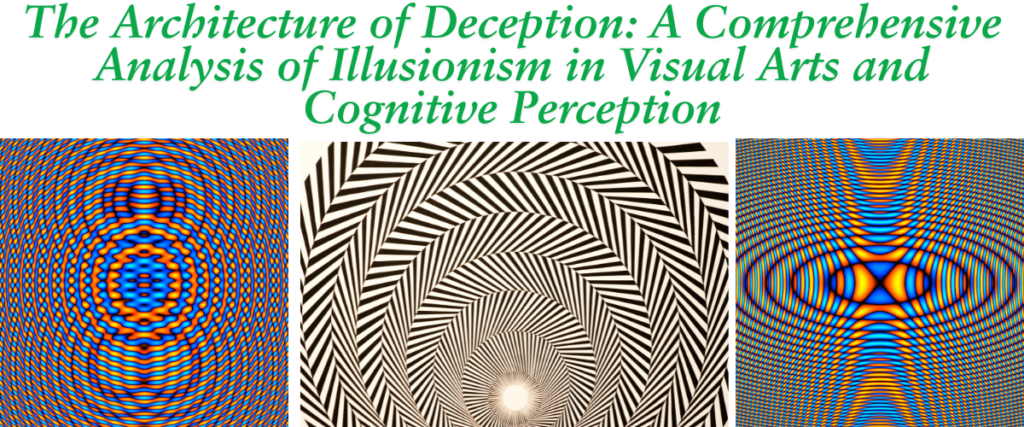
The history of visual representation is fundamentally a history of deception. From the earliest recorded artistic contests in Ancient Greece to the hyper-digital landscapes of 2026, the primary objective of the artist has often been to challenge the boundaries of what is real and what is merely perceived. Illusion art, categorised by its ability to manipulate the human visual system, represents a sophisticated intersection of mathematics, psychology, and fine art. This article provides an exhaustive examination of the techniques, historical trajectories, and neurological underpinnings of illusion art, analysing how static surfaces are transformed into dynamic, three-dimensional experiences. The following analysis explores the evolution of this field, the specific mechanisms that fool the human brain, and the modern applications that are redefining architecture, digital media, and social interaction.
Historical Foundations and the Classical Origin of Mimesis
The roots of illusionistic art are found in the classical period of Ancient Greece, specifically within the concept of mimesis, or the imitation of nature. The French term trompe l’oeil—meaning “to deceive the eye”—now serves as a catch-all for this tradition, but the practice predates the term by millennia.1 The earliest documented instance of this practice is found in the legendary rivalry between two master painters, Zeuxis and Parrhasius, during the 5th century BCE.1 In this contest, Zeuxis produced a painting of grapes so lifelike that birds were said to have flown down from the sky to peck at the fruit.1 This initial success emboldened Zeuxis, yet the triumph ultimately belonged to Parrhasius. When Zeuxis attempted to pull back a linen curtain in Parrhasius’s studio to reveal the painting behind it, he realised that the curtain itself was the artwork.2 This narrative establishes a foundational principle of illusion art: it is not merely about mimicking nature to fool animals, but about tricking the sophisticated observer who expects to be deceived.
The Greeks utilised a combination of pigment and wet plaster to render architectural ornaments such as faux columns, porticoes, and architraves, effectively expanding the perceived space of their structures.1 This practice reached a high degree of sophistication in the Roman cities of Pompeii and Herculaneum before the eruption of Mount Vesuvius in 79 CE.4 Excavations of the House of the Vettii and the House of Meleagro reveal frescoes where painted windows offer glimpses into mythological vistas and lush, imaginary gardens, effectively negating the physical constraints of windowless rooms.1 These early artists discovered that by playing with shadow and light, they could create the illusion of dimension and depth, transforming flat walls into three-dimensional marvels using only paint and brushes.1
| Historical Period | Key Technique | Primary Objective | Notable Example |
| Ancient Greece | Mimesis / Fresco | Physical deception of nature | Zeuxis’ Grapes 1 |
| Roman Era | Wall Painting | Spatial expansion of domestic interiors | House of the Vettii 5 |
| Early Renaissance | Linear Perspective | Mathematical accuracy in depth | Brunelleschi’s experiments 6 |
| High Renaissance | Quadratura | Ceilings opening to the heavens | Camera degli Sposi 2 |
| Baroque | Di Sotto in Sù | Extreme foreshortening for divine effect | St. Ignatius of Loyola 5 |
| 17th Century | Musca Depicta | Display of technical virtuosity | Gijsbrechts’ Still Lifes 2 |
By the Middle Ages, the pursuit of illusionism had largely waned as art shifted toward symbolic and devotional purposes. However, the 15th-century Renaissance witnessed a mathematical and technical revolution that elevated trompe l’oeil to its apotheosis. The discovery of the mathematical laws of perspective by the architect Filippo Brunelleschi and their subsequent codification by Leon Battista Alberti in Della pittura (1436) provided artists with the geometric tools necessary to simulate infinite depth on a two-dimensional plane.6 This period saw the rise of quadratura, a technique deeply rooted in mathematics and architecture that allowed artists to create the illusion of architectural features extending into the sky.4
Andrea Mantegna’s 1474 ceiling oculus in the Camera degli Sposi at the Ducal Palace in Mantua stands as a pioneering example of this era.1 By painting a circular opening to the sky, complete with cherubs and figures looking down into the room, Mantegna pioneered the style known as di sotto in sù (seen from below, upward).5 This technique made flat or barrel-vaulted ceilings appear to open up to the heavens, creating an illusion of infinite space that served to glorify the patrons of the work.5 The Baroque period further refined these techniques, using extreme foreshortening to evoke a sense of the divine. Andrea Pozzo’s monumental fresco on the flat ceiling of the Church of St. Ignatius of Loyola in Rome is a definitive Baroque masterpiece, where his use of perspective creates the stunning illusion of a massive, soaring dome that does not exist in the building’s actual architecture.2
Technical Mechanics: Perspective, Anamorphosis, and Forced Perception
The efficacy of illusion art relies on the systematic manipulation of human visual perception. Central to this manipulation is the concept of forced perspective, a technique that employs optical illusion to make an object appear farther away, closer, larger, or smaller than its actual physical dimensions.7 This is achieved by manipulating the correlation between scaled objects and the vantage point of the spectator.7 By constantly decreasing the scale of objects from the vantage point of the spectator toward the farthest point, artists create a convincing narrative of distance.7
Linear and Forced Perspective
The mathematical laws governing these illusions are rooted in the observation that objects appear to shrink and parallel lines and planes appear to converge as they recede in space.6 Linear perspective establishes a single vanishing point on the horizon, toward which all orthogonal lines lead. This creates a “triangle of vision” that reflects how light hits the retina, allowing the brain to interpret 2D shapes as 3D volumes.6
In contemporary filmmaking and photography, forced perspective is enhanced by controlling environmental conditions to obscure the difference in perspective. For instance, the final scene of the film Casablanca utilised a painted backdrop of an aircraft serviced by dwarfs standing next to it to create an illusion of a massive airfield within a restricted studio space.7 To make such illusions believable, the aperture of the camera must be stopped down sufficiently to achieve a deep depth of field (DOF), ensuring both the foreground and background remain sharp.7 Because light travels in a spherical wave, decreasing in intensity as the inverse square of the distance, objects intended to look distant require significantly more light to maintain the same illuminance as near objects, a critical consideration for practitioners.7
The Geometry of Anamorphosis
Anamorphosis represents a more complex branch of perspective, requiring the viewer to adopt a specific, often extreme, vantage point or to use a special optical device to resolve a distorted image.6 The term, derived from the Greek word for “to transform,” was first employed in the 17th century, though the practice emerged as a curiosity of 14th-century perspective studies.6
There are two primary categories of anamorphosis analysed in professional literature:
- Perspective (Angle-Based) Anamorphosis: This method relies on the viewer assuming a specific vantage point to resolve the image. To construct such a piece, an artist often maps a standard Cartesian grid onto a surface from a sharp angle, ensuring that when viewed from that specific point, the object appears normal.9 This is the foundation of modern 3D street art. The distortion is modified by varying the thickness of lines—thicker lines appear nearer—and utilising textures that appear less focused as they recede.9
- Mirror (Catoptric) Anamorphosis: This requires a curved mirror (cylindrical or conical) to “rectify” the distorted image. The construction relies on a circular grid that establishes a correspondence between Cartesian and polar coordinates.9
The technical execution of these illusions involves a precise application of shading and highlights. Darker shades are traditionally used for elements intended to appear recessed, while lighter shades bring elements forward.9 This exploitation of monocular cues of depth perception—angular size, aerial perspective, and relative size—allows the brain to fabricate a three-dimensional world from two-dimensional data.7
The Surrealist Paradox: Salvador Dalí and the Double Image
In the 20th century, the focus of illusion art shifted from purely architectural and decorative concerns to the exploration of the subconscious and the fallibility of perception. Salvador Dalí was a pioneer in this transition, inventing the “paranoiac-critical method,” which involved the spontaneous creation of irrational knowledge based on a delirium of interpretation.11 Dalí’s work suggests that what we construe as reality is a product of the habits of the mind more than the eye, influenced by desires, fears, and memories.11
Spatial Frequency and the Lincoln Illusion
Dalí’s fascination with the science of vision led him to experiment with spatial frequency. His 1977 work, Lincoln in Dalivision, serves as a masterclass in the “double image” illusion. Up close, the artwork depicts a nude woman (Dalí’s wife, Gala) looking out a window at the Mediterranean Sea. However, from a distance of 20 meters, the image transforms into a portrait of Abraham Lincoln.12
The mechanism behind this transformation is the separation of high and low spatial frequencies. High frequencies convey fine details—the edges of Gala’s body, the textures of the wall—and are processed by the retina’s subsystems that prioritise colour and sharpness.14 Low frequencies convey broad forms and mass. When viewed at a distance, the eye can no longer resolve the high-frequency details, allowing the underlying low-frequency structure (the portrait of Lincoln) to emerge.14 Dalí based this work on the research of Leon Harmon and Bela Julesz from Bell Labs, who used a 16×16 pixelated grid of Lincoln to demonstrate how little information is required for the brain to recognise a familiar face.12
| Perceptual Level | Spatial Frequency | Visual Content | Processing Mechanism |
| Proximal (Up Close) | High Frequency | Intricate details, edges, Gala’s form | Parvocellular pathway (colour/detail) 14 |
| Distal (20 Meters) | Low Frequency | Broad form, mass, Lincoln’s portrait | Magnocellular pathway (form/depth) 14 |
Dalí’s use of “face pareidolia”—the tendency of the human brain to find faces in vague patterns—exploits the fusiform face area of the brain, which becomes active even when perceiving illusory faces.11 In Lincoln in Dalivision, the highlight on Lincoln’s forehead is actually a miniature of Dalí’s painting St. John of the Cross, and Gala’s head forms Lincoln’s eye and nose area.14 This demonstrates Dalí’s intuition that the brain effectively “fills in” missing information to create a coherent whole, a process essential to his paranoiac-critical method.11
M.C. Escher and the Geometry of the Impossible
While Dalí explored the psychological and frequency-based aspects of illusion, Maurits Cornelis Escher focused on the mathematical and structural contradictions of space. Escher is renowned for his “impossible constructions,” which utilise traditional perspective techniques to represent objects that could not exist in three-dimensional reality.16 Escher affirmed that although he lacked formal mathematical training, his understanding of geometric relationships was intuitive and self-taught.17
Tessellation and Metamorphosis
Starting in the 1920s, after visiting the Alhambra Palace in Spain, Escher began to experiment with tessellation—the regular division of the plane using irregular interlocking shapes that cover a surface without gaps or overlaps.16 By replacing abstract Moorish patterns with recognisable figures like birds, fish, and reptiles, Escher created “metamorphoses” where one shape turns into another.17 This challenges the viewer’s figure-ground perception, where the brain must constantly switch between identifying a shape as the subject or the background.10
His works, such as Waterfall and Ascending and Descending, rely on the Penrose triangle and the “ever-ascending” staircase.10 These illusions work by exploiting the brain’s assumption that adjacent edges in a drawing must join in a consistent 3D plane. Escher deliberately breaks these connections at critical points, creating a visual loop where water appears to flow uphill against gravity.10 In Hand with Reflecting Sphere, Escher explores the distortion of reality through reflection, where the viewpoint from the artist to the crystal ball represents reality, while the reflection represents a warped perception.17 His work deftly explores the relationships between art and science, reality and illusion, and chaos and order.18
Op Art: The Physiology of Perceptual Instability
The 1960s saw the emergence of Op Art (Optical Art), a major development in painting that used geometric forms to create optical effects.19 Unlike trompe l’oeil, which seeks to convince the viewer of a false reality, Op Art seeks to destabilise the viewer’s vision, creating illusions of movement, vibration, and warping on a static canvas.20 This style exploits the fallibility of the eye through the use of optical illusions like afterimages and dazzling.20
Bridget Riley and the Mechanics of Vibration
Bridget Riley is the preeminent figure of the movement, known for her meticulously hand-painted compositions that utilise simple forms like circles, lines, and squares.20 Her early black-and-white works, such as Fall (1963) and Hesitate (1964), use repetitive, closely spaced lines to create an undulating or wave-like pattern.20 The effects created by Op Art range from the subtle to the disturbing and disorienting, drawing on colour theory and the psychology of perception.19
Riley’s process is notably devoid of texture; she hand-mixes paint to exact tones and intensities and avoids gestural brushstrokes because any physical surface texture would destroy the optical illusion.20 She learned from Georges Seurat’s Pointillism that “light” can be built from colour, and in her colour works, the interaction of a few tones can generate “other colours” in the mind of the viewer.20 Op Art reached its peak in 1965 with “The Responsive Eye” exhibition at the Museum of Modern Art in New York, which solidified the style’s influence on 1960s fashion, textiles, and industrial design.20
Victor Vasarely and the 3D Grid
Victor Vasarely, often cited as the father of Op Art, explored how geometric abstraction could be integrated into urban architecture and planning.19 His 1930s works, such as Zebra (1938), are considered the first works of Op Art, using curved black and white stripes to give a three-dimensional impression of a seated zebra.21 Vasarely’s work demonstrated that the superimposition of two grids of lines or dots can produce new, shifting visual images, often referred to as moiré effects.22
| Op Artist | Primary Method | Key Visual Effect | Philosophical Goal |
| Bridget Riley | Precise repetition, tonal control | Vibration, warping, undulation | Perceptual interaction with viewer 20 |
| Victor Vasarely | Geometric grids, colour contrast | Swelling, 3D volume on 2D | Integration into architecture 21 |
| Jesus Rafael Soto | Mobile elements, linear layering | Kinetic depth, flicker-effects | Fusion of Op and Kinetic art 19 |
The Neuroscience of Perception: Why the Brain is Fooled
The study of illusion art provides profound insights into the functional organisation of the brain. Recent neurological research has identified specialised neurons that explain why we see objects that are not physically present. This research underscores that vision is an active, inferential process rather than a passive reflection of the world.23
IC-Encoder Neurons and Pattern Completion
A landmark study from the Adesnik lab at UC Berkeley and the Allen Institute identified “illusory contour (IC)-encoder” neurons in the primary visual cortex (V1).24 These neurons respond specifically to illusions like the Kanizsa triangle, where the brain perceives a white triangle despite only being presented with incomplete black shapes.24 The perception of these illusory edges is the result of “recurrent pattern completion.” While lower visual areas receive initial sensory stimuli, higher-level brain areas interpret the data based on prior expectations and send signals back down to the V1 IC-encoder neurons to “fill in” the missing information.24 This suggests that the brain acts more like a computer monitor constructing reality than a camera recording it.24
Physiological Illusions and Cortical Spreading Depression
Some illusions are physiological rather than cognitive. Afterimages occur when specific neural paths are overstimulated, leading to a temporary imbalance in perception.10 In the context of Op Art, intense repetitive patterns can trigger “visual stress” or “pattern glare”.25 This is particularly prevalent in individuals prone to migraines, where a wave of electrochemical activity known as “cortical spreading depression” (CSD) sweeps across the visual cortex.26
CSD involves the massive release of neurotransmitters like glutamate and ions like potassium, followed by a period of suppressed nerve cell activity.26 This intense activity is metabolically demanding and can lead to visual auras, zigzags, or temporary blind spots.26 Individuals with high discomfort ratings have been found to have larger P1 components in their event-related potentials (ERPs), suggesting initial cortical hyperexcitability.25 This highlights the potential for illusion art to induce physical symptoms—including nausea and headaches—when the visual system is overwhelmed by high-contrast, repetitive stimuli.25
Contemporary Architecture and Structural Illusions
In the 21st century, illusion art has transitioned from the canvas to the built environment. Contemporary architects use interference patterns and optical strategies to transform static structures into dynamic perceptual environments.22 This influence extends beyond visual appearance, contributing to architectural communication and cognitive engagement.22
Interference Patterns and Moiré Effects
Modern architecture utilises interference patterns—visual effects resulting from the superimposition of repetitive geometric structures—to produce illusions of motion, depth, and contrast.22 These patterns become particularly intense when distributed across separate layers (3D interference), engaging the viewer’s binocular vision and motion parallax.22
- The Broad (Los Angeles): Designed by Diller Scofidio + Renfro, the façade features an openwork concrete structure moved away from the main wall. This creates 2D and 3D interference patterns that make the heavy parallelogram structure appear as a porous honeycomb.22
- Ginza Place (Tokyo): This building uses the moiré effect to obscure its true dimensions. By focusing the eye on ornamentation rather than vertical extent, the large structure appears less imposing and more human-scaled.22
- Phoenix Media Centre (Beijing): The building’s deformed torus shape, combined with light grey structural components and shadows, creates irregular 3D interference patterns that are visually variable as the observer moves.22
Architects also use illusions to integrate structures into their context. For instance, the University Library in Cottbus employs perspective anamorphosis to highlight the mass of the building while adding a sense of mystery.22 In contrast, some buildings use spectacular illusions to detach from their background and create an iconic identity, such as the Supertrees in Singapore or the Phoenix Media Centre.22
Street Art and the Asphalt Renaissance
The 1980s witnessed a transformation in street painting, as artists moved away from traditional religious subjects to focus on anamorphic 3D illusions. Kurt Wenner, a former NASA scientific illustrator, is credited with inventing three-dimensional pavement art by applying the principles of 17th-century Baroque ceiling perspective to the horizontal plane of the sidewalk.29
The Wow Moment and Interactive Engagement
Known as 3D street painting or 3D chalk art, this form of anamorphic perspective creates the illusion of depth or height—such as looking down into a large crevasse or seeing a person standing on a floating object—when viewed from a single point of perspective.30 Pavement artists like Julian Beever, Edgar Mueller, and Manfred Stader have since popularised the form globally.29
The “Wow moment” occurs when the viewer sees the artwork through a camera or phone screen, which effectively collapses the distorted image into a perfect three-dimensional projection.31 This makes 3D street art ideal for experiential marketing, as it provides a natural point of attraction and a prop for selfies that are then shared across social media.31 Julian Beever’s work often involves whimsical scenes that invite viewer participation, such as a man about to jump into a waterfall, which only appears believable when a real person is placed within the scene.30
| Street Artist | Notable Style | Primary Medium | Technical Root |
| Kurt Wenner | Renaissance Classicism | Pastel Chalk / Pastel | Baroque Ceilings 29 |
| Julian Beever | Whimsical / Interactive | Pastel Chalk | Trompe l’oeil 30 |
| Edgar Mueller | XXL Large-scale / Vistas | Acrylics on Asphalt | Anamorphosis 30 |
| Manfred Stader | Commercial / Interactive | Pastel Chalk | Quadratura 34 |
Digital Frontiers: 3D Billboards and Anamorphic LED Technology
One of the most spectacular recent developments is the rise of “naked-eye 3D” digital billboards in high-traffic urban areas like Times Square, Tokyo, and Seoul.35 These displays use L-shaped or curved LED screens that wrap around building corners to create an anamorphic illusion that doesn’t require special glasses.35
Immersive Out-of-Home (OOH) Advertising
The “magic” of these billboards relies on a precise synchronisation between the high-definition content and the spectator’s angle.37 Brands leverage these displays to turn city intersections into immersive theatres, generating viral reactions on social media.33
- Nike Air Max (Tokyo): This billboard showed shoes bouncing against the screen’s edges before appearing to fly off the screen, effectively showcasing the product’s “air” qualities.33
- Coca-Cola (New York): A mechanical 3D billboard in Times Square features 1,760 independent LED modules that move physically to create dynamic waves, making it one of the most high-tech displays in the world.36
- Netflix (London): A 20-meter-tall zombie tiger from the movie Army of the Dead celebrated the film’s release, providing a testament to the power of innovative advertising that blends entertainment and technology.36
Forward-thinking brands are now integrating these anamorphic visuals with AR filters and QR codes, creating a continuous engagement loop from the physical billboard to the user’s mobile device.33
The Future of Illusion: AR, VR, and Spatial Computing in 2026
As we look toward 2026, the distinction between physical and digital illusion is blurring. The emergence of spatial computing and extended reality (XR) is defining the future of immersive technology, transforming how we work, learn, and interact with the world.38
Trends in Immersive Technology
Spatial computing allows digital content to coexist and interact intuitively with the physical environment, using gesture and motion controls instead of flat screens.38 By 2026, several key trends are shaping the landscape:
- Headset-Free AR: Sophisticated projection systems are being developed that track the user’s eye position to create anamorphic illusions that appear 3D and are visible only to the player, essentially creating a personal hologram without the need for wearable hardware.39
- Generative Mapping: AI is expected to enable “generative mapping,” where game assets and textures are created in real-time based on the scanned architecture of a room, allowing for hyper-responsive environments.39
- Neumorphism and Tactile UI: Web design is moving toward neumorphism, which uses soft shadows and highlights to create a 3D, tactile feel on flat screens, making buttons and elements look “extruded” or “embedded”.40
- WebXR: This technology brings AR and VR experiences directly to the web browser, reducing onboarding friction and allowing users to visualise products in their own environment before making a purchase.38
| 2026 Technology Trend | Primary Feature | Industry Application | Key Benefit |
| Spatial Computing | Context-aware holograms | Corporate Collaboration | Real-time spatial interaction 38 |
| WebXR | Browser-based AR/VR | Omnichannel Retail | Try products virtually 38 |
| Volumetric Capture | Photogrammetry | Games & Animation | Realistic human scale 41 |
| Generative AI Mapping | Real-time scan rendering | Projection Mapping | Dynamic gaming environments 39 |
Immersive animation and VFX are also evolving, requiring artists to design worlds that can be explored from all angles. Performance optimisation is essential to ensure user comfort, as high frame rates and intelligent lighting are needed to prevent nausea in VR environments.41
Psychological and Cultural Dimensions of Perception
A critical question in the study of illusions is whether perception is a universal human trait or a culturally conditioned skill. This debate has centred largely on the Müller-Lyer illusion, where Western participants have historically shown greater susceptibility than non-Western populations.42
The WEIRD Debate and Environmental Calibration
The “Cultural Byproduct Hypothesis” (or “Carpentered-World Hypothesis”) proposed that people raised in environments filled with straight lines and right angles are more susceptible to geometric illusions because their brains have learned to interpret these features as indicators of depth.42 In societies without extensive carpentry, such as the San people of the Kalahari, participants often see no difference in line lengths.42
However, research from 2025 has provided evidence that these perception mechanisms may be hardwired into the biological species.42 Studies have shown that a variety of animals, including horses, parakeets, and guppies, fall for the Müller-Lyer illusion.42 Furthermore, children born with congenital cataracts who receive corrective surgery report seeing the illusion almost immediately after their first exposure to light, suggesting that the brain’s ability to infer depth is innate.42 While cultural context shapes how we think and interact with the world, the fundamental roots of visual illusion appear to be universal biological traits shared across the animal kingdom.42
Conclusion
The evolution of illusion art from the frescoed walls of Pompeii to the 3D LED billboards of 2026 represents a continuous journey of artistic innovation and scientific discovery. By mastering perspective, anamorphosis, and the manipulation of spatial frequencies, artists have successfully challenged our concept of what is real and what is imaginary. The development of Op Art and the “asphalt renaissance” of street painting proved that illusion could be democratised and integrated into the public square, fostering interactive and shared social experiences.
Furthermore, neurological research into IC-encoder neurons and the physiology of visual stress has provided a deeper understanding of the “recurrent pattern completion” that occurs within the human visual cortex. This research underscores that vision is an active, constructive process—a “brain monitor” rather than a “camera.” As we move into an era of spatial computing, generative mapping, and AR-enhanced architecture, the principles of illusion art will continue to redefine our relationship with our environment. The future of illusion art lies in its ability to bend reality, opening the mind to a world of wonder and possibility while reminding us that what we see is often a carefully constructed narrative of the mind.
Disclaimer
This article is intended for educational and research purposes only. The information contained herein is based on research as of 2026. Visual illusions, high-contrast patterns, and flickering stimuli can trigger migraines, nausea, or seizures in sensitive individuals. Readers with a history of neurological or psychiatric disorders should exercise caution when viewing intense illusion art or using immersive media like VR and AR. Always consult a medical professional if you experience visual disturbances. No part of this article constitutes medical or professional engineering advice. Trademarks and brand names mentioned are the property of their respective owners.
Reference
- Trompe l’Oeil | Stories | Oliver Burns Studio, accessed on February 17, 2026, https://www.oliverburns.com/stories/trompe-loeil
- Trompe L’Oeil: Optical Illusions In Art – Rehs Galleries, accessed on February 17, 2026, https://rehs.com/eng/2024/02/trompe-loeil-optical-illusions-in-art/
- accessed on February 17, 2026, https://benarrivati.com/trompe-loeil-art-of-deceiving-the-eye/#:~:text=ANCIENT%20GREEK%20ORIGINS,SKY%20TO%20PECK%20AT%20THEM.
- History of Trompe L’Oeil – Raymonde, accessed on February 17, 2026, https://raymonde.art/history-of-trompe-loeil/
- The History of Trompe l’Oeil: Art That Deceives the Eye – Benarrivati Italy, accessed on February 17, 2026, https://benarrivati.com/trompe-loeil-art-of-deceiving-the-eye/
- Anamorphosis | Perspective, Illusion, Transformation – Britannica, accessed on February 17, 2026, https://www.britannica.com/art/anamorphosis-art
- Forced perspective – Wikipedia, accessed on February 17, 2026, https://en.wikipedia.org/wiki/Forced_perspective
- What is Illusion Art? – Arts India, accessed on February 17, 2026, https://www.artsindia.com/blogs/news/what-is-illusion-art
- Anamorphic Art | Anamorphic | Anamorphosis Meaning, accessed on February 17, 2026, https://www.thelax.art/news/anamorphic-art.html
- Optical illusion – Wikipedia, accessed on February 17, 2026, https://en.wikipedia.org/wiki/Optical_illusion
- Marvels of illusion: illusion and perception in the art of Salvador Dali – PMC, accessed on February 17, 2026, https://pmc.ncbi.nlm.nih.gov/articles/PMC4586274/
- Lincoln in Dalivision by Salvador Dali | Overview & Analysis – Study.com, accessed on February 17, 2026, https://study.com/academy/lesson/salvador-dalis-lincoln-in-dalivision-analysis-meaning.html
- Lincoln in Dalivision – Wikipedia, accessed on February 17, 2026, https://en.wikipedia.org/wiki/Lincoln_in_Dalivision
- Salvador Dalí Painting: His wife or Abraham Lincoln? – Spanish-Teaching, accessed on February 17, 2026, https://www.spanish-teaching.com/2011/3/salvador-dali-painting-his-wife-or-abraham-lincoln
- #38: Gala Contemplating… by Salvador Dali – Scott McDaniel, accessed on February 17, 2026, http://www.scottmcd.net/artanalysis/?p=1131
- Escher at The Dalí – Dali Museum, accessed on February 17, 2026, https://thedali.org/exhibit/escher/
- Five Iconic M.C. Escher Works | Canvas: A Blog By Saatchi Art, accessed on February 17, 2026, https://canvas.saatchiart.com/art/art-history-101/five-iconic-m-c-escher-works
- M.C. Escher: Reality and Illusion – PANART – Pan Art Connections, accessed on February 17, 2026, https://pan-art-connections.com/exhibition/m-c-escher-reality-and-illusion/
- Op art – Tate, accessed on February 17, 2026, https://www.tate.org.uk/art/art-terms/o/op-art
- Bridget Riley and Op Art | Art UK, accessed on February 17, 2026, https://artuk.org/learn/learning-resources/bridget-riley-and-op-art
- Victor Vasarely Op Art Zebra & Zebras, accessed on February 17, 2026, https://www.cornell61.org/opart/page1.htm.
- The Role of Interference Patterns in Architecture: Between … – MDPI, accessed on February 17, 2026, https://www.mdpi.com/2076-0752/15/2/37
- Illusions in Humans and AI: How Visual Perception Aligns and Diverges – arXiv, accessed on February 17, 2026, https://arxiv.org/html/2508.12422v1
- Scientists discover brain mechanism behind optical illusions …, accessed on February 17, 2026, https://neuroscience.berkeley.edu/news/scientists-discover-brain-mechanism-behind-optical-illusions
- Visual Stimuli Are Common Triggers of Migraine and Are Associated With Pattern Glare | Request PDF – ResearchGate, accessed on February 17, 2026, https://www.researchgate.net/publication/6755886_Visual_Stimuli_Are_Common_Triggers_of_Migraine_and_Are_Associated_With_Pattern_Glare
- Ocular Migraine: A Deep Dive into What It Is, What It Isn’t, and Why Clarity Is Crucial, accessed on February 17, 2026, https://headacheaustralia.org.au/ocular-migraine/
- Understanding Ocular Migraines – Vision Source of Burlington, accessed on February 17, 2026, https://visionsource-burlington.com/2025/05/28/understanding-ocular-migraines/
- Understanding How Visual Strain Triggers Head Discomfort – Plasticity Brain Centres, accessed on February 17, 2026, https://www.plasticitycenters.com/blog/visual-strain-can-trigger-head-discomfort
- Master Artist and Master Architect – Kurt Wenner, accessed on February 17, 2026, https://kurtwenner.com/archive.html.
- Sidewalk Chalk Drawings: 3D Pavement Art and Anamorphic Street Painting – Art is Fun, accessed on February 17, 2026, https://www.art-is-fun.com/sidewalk-chalk-drawings
- 3d Street Art- Everything you need to know in 2026, accessed on February 17, 2026, https://www.streetadvertisingservices.com/blog/article/3d-street-art-a-guide-to-everything-you-need-to-know
- Top 5 3D sidewalk artist that will make you look twice! – Design Museum, accessed on February 17, 2026, https://www.designmuseum.me/artists/top-5-3d-sidewalk-artist-that-will-make-you-look-twice/
- How do brands use anamorphic billboards to create immersive, illusion-based experiences that boost audience engagement? – Outdoor | Transit | DOOH Ads – MyHoardings, accessed on February 17, 2026, https://www.myhoardings.com/FAQ/anamorphic-billboards-to-create-immersive-illusion-based-experiences/
- 3d street art painting pavement painting chalk art 3d strassenmaler, accessed on February 17, 2026, https://3d-street-art.com/
- Check Out the 21 Best 3D Advertising Examples of 2025! – UNIT LED, accessed on February 17, 2026, https://www.unit-led.com/3d-advertising-examples
- Top 20 Famous 3D LED Billboards Around the World, accessed on February 17, 2026, https://www.ledscreenparts.com/top-20-famous-3d-led-billboards-around-the-world/
- Times Square 3D Billboards: The Most Incredible Examples in 2025 – sryleddisplay, accessed on February 17, 2026, https://www.sryleddisplay.com/times-square-3d-billboards/
- Top AR/VR Trends Shaping Immersive Tech in 2026 – GoodworkLabs, accessed on February 17, 2026, https://www.goodworklabs.com/ar-vr-trends-immersive-technology-2026/
- Projection Mapping Games: Your Ultimate Guide to Immersive Interactive Worlds in 2026, accessed on February 17, 2026, https://www.mtprojection.com/blog/projection-mapping-games-guide-2026.html
- Top website design trends for 2026: AI, AR/VR, voice UI, and more – Network Solutions, accessed on February 17, 2026, https://www.networksolutions.com/blog/website-design-trends/
- Immersive Media in 2026: How AR/VR Is Changing Games, Animation, and VFX Careers – VanArts, accessed on February 17, 2026, https://www.vanarts.com/news-article/immersive-media-in-2026-how-ar-vr-is-changing-games-animation-and-vfx-careers/
- New Study Reveals Universal Roots Of Visual Illusions – Grand Pinnacle Tribune, accessed on February 17, 2026, https://evrimagaci.org/gpt/new-study-reveals-universal-roots-of-visual-illusions-494069
- The Influence of Culture on Visual Perception∗ | MIT, accessed on February 17, 2026, https://web.mit.edu/allanmc/www/socialperception14.pdf
- Is Visual Perception WEIRD? The Müller-Lyer Illusion and the Cultural Byproduct Hypothesis, accessed on February 17, 2026, https://perception.jhu.edu/files/PDFs/25_MullerLyer/AmirFirestone_MullerLyer_2025_PsychReview.pdf
- Culture and Perception, part II: The Muller-Lyer illusion, accessed on February 17, 2026, https://www.cognitionandculture.net/blogs/simons-blog/culture-and-perception-part-ii-the-muller-lyer-illusion/index.html
- Is visual perception WEIRD? The Müller-Lyer illusion and the cultural byproduct hypothesis., accessed on February 17, 2026, https://scholars.duke.edu/publication/1675668