The Philosophy of the Quirk
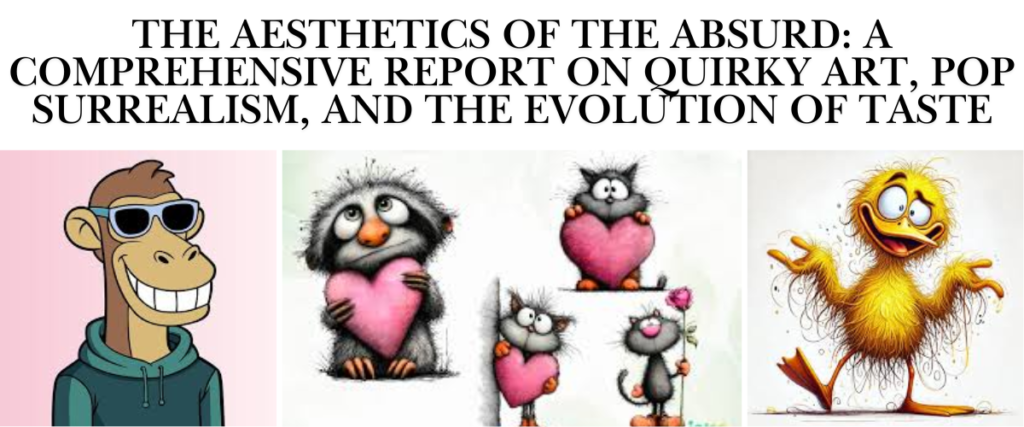
The landscape of contemporary art is no longer defined solely by the solemnity of the white cube gallery or the rigid academic standards of the past. Instead, a vibrant, chaotic, and deeply psychological movement has taken hold—a broad categorisation often referred to colloquially as “Quirky Art.” To define this aesthetic is to attempt to categorise a sensibility that is inherently resistant to categorisation. It is an umbrella term that captures a diverse range of unconventional styles, encompassing everything from whimsical illustrations and “Lowbrow” paintings to shocking, hyper-realistic sculptures of meat and duct-taped fruit. At its core, quirky art is characterised by its deviation from traditional norms of beauty, logic, and decorum. It embraces the weird, the ironic, and the humorous, often merging multiple mediums—collage, painting, sculpture, and digital art—to express ideas that traditional fine art might consider taboo, trivial, or simply too strange.1
The “quirky” aesthetic is not a singular movement but a convergence of several historical lineages. It challenges societal norms and traditional aesthetics by celebrating the “off-beat.” Where classical art sought harmony and idealised beauty, quirky art seeks a reaction—be it a laugh, a gasp, or a sense of deep confusion. It invites viewers to explore themes that are obscure, finding “beauty in the bizarre” and fostering a dialogue that is often more accessible and democratic than highbrow academic art.1 This report serves as an exhaustive analysis of this aesthetic, tracing its lineage from the anarchic anti-art of Dadaism through the commercial gloss of Pop Art, and into the modern manifestations of Pop Surrealism, Lowbrow, and the “Weirdcore” internet subculture. We will examine the seminal works that defined this sensibility, analyse the psychological underpinnings of why the human brain is drawn to the unusual, and assess the market dynamics that have turned “whimsy” into a multi-billion dollar industry.
The Intersection of High and Low
A defining characteristic of this genre is the dissolution of boundaries between “High Art” (museum-quality, intellectually rigorous work) and “Low Art” (comics, advertising, toys, and kitsch). Historically, these two worlds were kept separate by the gatekeepers of culture—critics, curators, and institutions. However, the evolution of quirky art, particularly through movements like Pop Surrealism, has blurred these lines irrevocably.2 As noted in recent cultural studies, the dichotomy between popular aesthetics (based on immediate beauty and harmony) and highbrow aesthetics (based on intellectual challenge) has shifted. The content of highbrow aesthetics has changed, now privileging “postmodernist” dimensions that include irony and playfulness over the serious formalism of Modernism.3
This shift has allowed for a re-evaluation of “Kitsch”—art previously dismissed as tacky or overly sentimental—as a legitimate vehicle for artistic expression. According to Kulka (1996), kitsch was traditionally defined by three conditions: it is charged with stock emotions that trigger an unreflective response; its subject matter is instantly identifiable; and it does not substantially enrich the spectator’s associations.3 However, the modern “quirky” artist takes these elements of kitsch and subverts them. By elevating the “stock emotion” or the “instantly identifiable” object (like a balloon dog or a soup can) into the realm of high art, the artist forces the viewer to confront their own taste and the mechanisms of value in society.
The Role of Humour and Irony
Unlike the solemn religious paintings of the Renaissance or the angst-ridden Abstract Expressionism of the mid-20th century, quirky art often refuses to take itself too seriously. It employs humour as a strategic tool. This can range from the “cheeky visual puns” of artists like Ross Muir and David Shrigley to the biting satire of Banksy.4 However, this humour is rarely empty; it often serves as a Trojan horse for deeper critique. By disarming the viewer with a joke or a cute character, the artist can slip in subversive messages about consumerism, politics, or existential dread.
For example, Banksy’s parody of Johannes Vermeer’s Girl with a Pearl Earring, updated with a Covid-19 face mask or other modern interventions, merges art history with contemporary crisis, using humour to bridge the gap between the past and the present.5 Similarly, artists like The Connor Brothers and Mr. Brainwash utilise text and appropriated imagery to create works that are visually accessible yet laden with ironic commentary on the art world itself.4 This reliance on humour allows quirky art to democratise the viewing experience; one does not need a degree in art history to “get” the joke, although a deeper understanding often reveals layers of cynicism regarding the commodification of creativity.
Historical Foundations: From Wartime Chaos to Surrealist Dreams
The genealogy of quirky art is rooted in moments of cultural rupture. It is the result of artists reacting against the status quo, whether that status quo was the brutality of war, the rigidity of the academy, or the banality of mass production. To understand why a banana taped to a wall is considered art in 2019, one must look back to the early 20th century.
Dadaism: The Grandfather of Quirk
The spiritual ancestor of all modern quirky art is Dadaism. Born in the early 20th century amidst the horrors of World War I, Dada was not just an art movement; it was a protest against the “rational” society that had led to such devastation. Dadaists rejected logic, beauty, and tradition in favour of absurdity, provocation, and chance.6 The movement asked fundamental questions: Can chaos be art? Can nonsense have meaning? What happens when artists refuse to conform?
One of the pioneers of this movement, Hannah Höch, utilised collage to shatter the definition of art. By slicing up images from mass media and rearranging them into disjointed, bizarre compositions, she mirrored the fractured reality of post-war Europe.6 This technique of “photomontage” was revolutionary. It took the “readymade” images of the press and repurposed them to critique gender roles, politics, and culture. This act of appropriation—taking something that already exists and recontextualising it—is the foundational technique of quirky art, influencing everyone from Pop Artists to modern internet meme creators.
Dadaism was born of disillusionment. It turned artistic norms upside down, swapping the pursuit of the sublime for the embrace of the ridiculous. But what began as an anarchic protest against societal structures didn’t disappear; it evolved. The spirit of defiance and the use of absurdity as a weapon against complacency became the DNA for future movements, particularly Pop Art, which swapped Dada’s nihilism for a playful critique of consumer culture.6
Surrealism: The Dream Logic
If Dada provided the rebellious spirit, Surrealism provided the visual vocabulary. Surrealism sought to liberate the unconscious mind, exploring the world of dreams and irrational juxtapositions. It validated the “weird” as a window into the human psyche.
Case Study: Salvador Dalí’s Lobster Telephone
Perhaps the most iconic example of early “quirky” sculpture is Salvador Dalí’s Lobster Telephone (1936), also known as the Aphrodisiac Telephone. Created for the eccentric British poet and collector Edward James, this object is a classic Surrealist juxtaposition of two unrelated objects: a functioning telephone and a plaster lobster.7
| Feature | Details |
| Artist | Salvador Dalí |
| Year | 1936 |
| Medium | Steel, plaster, rubber, painted details |
| Patron | Edward James (British Poet/Collector) |
| Location | Versions in Tate Modern, Scottish National Gallery, etc. |
Symbolism and Meaning:
The Lobster Telephone is not merely a random assembly of objects; it is a carefully coded work of psychological association.
- Sexuality: Dalí strongly associated lobsters with sexuality. In his iconography, the crustacean was linked to aphrodisiacs and erotic desire. The positioning of the lobster’s tail and genital region directly over the mouthpiece of the phone was a deliberate, sexually charged choice. To speak into the phone, one would have to place their mouth near the lobster’s sexual organs.9
- The Absurdity of Function: Dalí famously quipped in his autobiography, The Secret Life of Salvador Dalí, demanding to know why, when he asked for grilled lobster in a restaurant, he was never presented with a boiled telephone.7 This inversion of logic—expecting the telephone where the food should be—highlights the Surrealist goal of disrupting the mundane habits of daily life.
- Variations: Dalí created multiple versions, including a white version titled White Aphrodisiac (1938), where the telephone is white Bakelite and the lobster is white plaster. This serialisation of the object prefigures the “editioned” nature of modern art toys.9
The Lobster Telephone challenged the utility of everyday objects. By rendering the phone unusable (and arguably disgusting to touch), Dalí transformed a utilitarian tool into an object of contemplation and unease. This act of “defamiliarisation”—making the familiar strange—is a key tactic in quirky art.
Pop Art: Embracing the Consumer
In the post-war era, the torch was passed to Pop Art. While Dada was born of wartime chaos, Pop Art was born of mass consumerism. Yet, both movements used subversion and satire to redefine culture.6 Artists like Andy Warhol, Roy Lichtenstein, and Richard Hamilton elevated the mundane—soup cans, comic strips, and advertisements—to high art.
Richard Hamilton’s collage Just What Is It That Makes Today’s Homes So Different, So Appealing? (1956) is a seminal work that uses the Dadaist technique of photomontage to critique the barrage of mass media images experienced in everyday life.10 Similarly, Roy Lichtenstein appropriated the visual language of comic books, condensing text and using Ben-Day dots to challenge the definition of “high” art. His work, such as Drowning Girl, captures the melodrama of commercial art, leaving it unclear whether he is applauding the cultural sphere or critiquing it.10 This ambiguity is a hallmark of quirky art: is it a celebration of the banality of modern life, or a scathing indictment of it?
Pop Surrealism and Lowbrow: The West Coast Revolution
Emerging in Los Angeles in the late 1960s and 1970s, “Lowbrow” or “Pop Surrealism” represents the most direct ancestor of today’s quirky art market. It is a movement that originated outside the academic art world, finding its roots in underground comix, punk music, tiki culture, and hot-rod aesthetics.11
Defining the Movement
The term “Lowbrow” was initially derogatory, implying a lack of intellect or sophistication. However, artists in the movement embraced the label, wearing it as a badge of honour to distinguish themselves from the “snobbish” highbrow art world.11 The movement is characterised by its heavy use of commercial and modern imagery, enhanced by highly stylised and visually complex techniques.
Key Characteristics of Pop Surrealism:
- Technique: Unlike the “sloppy” aesthetic sometimes associated with punk, Pop Surrealism often employs highly polished, master painter techniques reminiscent of the Renaissance or Dutch Golden Age.2
- Subject Matter: A mix of pop culture icons, cartoon characters, and surreal, dreamlike scenarios. It is an interpretation of the creative boundaries of the unconscious.11
- Atmosphere: Often whimsical but with a dark, eerie, or unsettled undercurrent. It blurs the line between “cute” and “creepy.”
- Origins: Rooted in “outlaw” culture—tattoo artists, illustrators, and comic creators who were disregarded by the academic establishment.12
Artist Kenny Scharf is credited with coining the term “Pop Surrealism” to describe his paintings, which were an unlikely mix of Pop Art’s commercial imagery and Surrealism’s focus on the unconscious.2
Mark Ryden: The Godfather of Pop Surrealism
Mark Ryden is a seminal figure in this genre, known for his meticulous technique and unsettling subject matter. His work exemplifies the “quirky” tendency to mix innocence with macabre themes, creating a visual cognitive dissonance.
Analysis: Incarnation (2009)
Ryden’s painting Incarnation is a masterpiece of the genre. It depicts a young, ethereal girl, reminiscent of a “Gibson Girl” or a porcelain doll, wandering through a formal garden. However, she is wearing a dress made entirely of raw meat.13
- Etymology and Meaning: Ryden has explained that “Incarnation” literally means “in the meat” (from the Latin in carne). The work explores the idea that our spirits are trapped in physical, fleshy bodies. He asserts that “meat is what holds our spirits on the physical plane”.13
- Aesthetics: The painting juxtaposes the “sumptuous hues and textures of meat” with the delicate beauty of the subject. This creates a powerful tension; the image is simultaneously beautiful in its execution and repulsive in its subject matter. This duality is central to the quirky aesthetic—drawing the viewer in with beauty, only to confront them with something disturbing.
- Influence: This imagery pre-dated Lady Gaga’s famous meat dress, highlighting how Pop Surrealism often bleeds into mainstream pop culture.
- Artist’s Philosophy: Ryden often refuses to explain his work in words, believing that the image itself is the meaning. He prefers to “leave the mystery undisturbed,” allowing the viewer to interpret the symbols (meat, Abraham Lincoln, oversized eyes) through their own psychological lens.15
Other Voices in the Genre
While Ryden is a giant, the movement is populated by numerous artists who explore similar themes.
- Todd Schorr: Known for his intricate, cartoon-laden epics that rival Hieronymus Bosch in complexity.
- Barbara Kuebel: A contemporary artist who paints figurative portraits onto hand-crafted life-sized woodcuts, blending literary and art historical influences with a fluid approach to subject matter.16
- Katrin Roth: An artist who engages with climate change through quirky, billowing gestures and passionate layering, providing subtle nods to environmental impact within expansive fields of colour.16
Contemporary Giants: The Blue Chip Quirky
While Lowbrow started underground, the aesthetic has ascended to the highest echelons of the art market. Artists like Jeff Koons, Yayoi Kusama, and Maurizio Cattelan have turned quirkiness into a multi-million dollar industry, challenging the very definition of value in the process.
Jeff Koons and the Balloon Dog
Jeff Koons is perhaps the most polarising figure in contemporary art. His work is the ultimate evolution of Dadaist “readymades,” but instead of a urinal, he presents a highly polished, monumental version of a child’s party favour.
The Balloon Dog Phenomenon:
In 2013, Koons’ Balloon Dog (Orange) sold for $58.4 million, setting a record for a living artist at the time.17 This sale cemented the place of “quirky” or “kitsch” art in the pantheon of serious investment-grade assets.
- Materiality and Illusion: The sculpture looks like a weightless, air-filled balloon but is actually made of high-chromium stainless steel with a transparent colour coating. This play on perception—heavy steel appearing as light rubber—is a technical marvel that requires immense precision to fabricate. Koons captures the ephemeral moment of a balloon before it deflates, making it “indestructible”.17
- Meaning: Koons insists his work has no hidden meaning or irony. He describes the Balloon Dog as a symbol of the “human experience” of breathing—we inhale (inflate) and live; the balloon is a vessel for breath. He claims the work is about “acceptance” of one’s own cultural history (i.e., not being ashamed of liking “low” culture like balloon animals).17
- Critical Backlash: Critics have been divided. The late Robert Hughes famously loathed Koons, describing his work as having the “slimy assurance” of a salesman and calling it “unashamed kitsch.” Others view the work as a “Trojan horse”—a shiny, attractive object that smuggles in a critique of class and taste hierarchies.18
- Market Context: The Balloon Dog serves as a marker of the “surreal economics” of the art world, where banal objects are transmuted into gold through branding and scarcity.20
Yayoi Kusama: The Polka Dot Priestess
Yayoi Kusama’s work is quirky by nature but driven by profound psychological necessity. Her “quirkiness” is a manifestation of her hallucinations and obsessive-compulsive neuroses.
The Pumpkin Motif:
Kusama’s most recognisable motif is the pumpkin. For her, this vegetable is not just a plant but a “spiritual home.”
- Origins: Kusama began painting pumpkins in pre-war Japan. Her family owned a seed nursery, and she found pumpkins “charming and winsome,” admiring their “generous unpretentiousness” and solid spiritual balance.21
- Symbolism: The pumpkin functions as a self-portrait. It represents resilience (they are a hardy crop) and stability. The polka dots that cover them represent “self-obliteration”—a way for Kusama to dissolve her ego into the infinite universe. By covering the world in dots, she manages her fear of the infinite by becoming part of it.21
- Global Impact: Her giant yellow pumpkin on Naoshima Island is one of Japan’s most photographed artworks. Despite being damaged by a typhoon in 2021, its restoration symbolised the resilience the pumpkin itself represents. Her “Infinity Mirror Rooms” have become global sensations, pre-dating the “Instagram museum” trend and offering immersive experiences of her psychological state.21
Maurizio Cattelan: The Comedian
If Koons elevates the banal to the monumental, Maurizio Cattelan reduces the monumental to the ridiculous. His 2019 work Comedian—a fresh banana duct-taped to a wall—ignited a global firestorm about the definition of art.
The Anatomy of a Banana:
- The Concept: The artwork is not the banana itself (which rots and must be replaced) nor the tape. The “art” is the Certificate of Authenticity and the idea. This challenges the concept of art as a physical, permanent object, emphasising its conceptual nature.24
- Reception: The piece sold for $120,000 at Art Basel Miami Beach, drawing crowds so large the gallery had to remove it for safety. It was eaten (twice) by performance artists/onlookers, which only added to its lore.25
- Meaning: Cattelan described it as a commentary on consumerism, global trade, and how we assign value. It satirises the art market’s speculation, essentially asking: If I say this 30-cent fruit is worth $120,000, and you buy it, who is the comedian?26
- Viral Nature: The image was instantly meme-able, proving that in the 21st century, an artwork’s ability to travel on social media is a key component of its relevance. It democratised the art conversation, allowing everyone to have an opinion on what constitutes “art”.25
The Vinyl Revolution: Designer Toys and Art for the Masses
A crucial subset of quirky art is the “Designer Toy” or “Art Toy” movement. This sector democratised quirky art, allowing collectors who couldn’t afford a $58 million Koons sculpture to own a piece of the aesthetic for a few hundred dollars. This movement bridges the gap between toy collecting and fine art.
The Rise of “Urban Vinyl”
Originating in Hong Kong and Japan in the late 1990s, this movement blended street art, hip-hop culture, and toy manufacturing. It began with artists like Michael Lau and companies like Bounty Hunter, who created limited-edition figures that were sold in streetwear boutiques rather than toy stores.28
Key Players and Platforms
| Brand/Artist | Iconic Product | Significance |
| KAWS (Brian Donnelly) | Companion | KAWS is the titan of this genre. His Companion figure—a Mickey Mouse-esque character with “X”ed out eyes—bridged the gap between streetwear (collaborations with Supreme/Nike) and fine art auctions. A 4-foot version sold for $411,000, while smaller vinyls are entry-level collectibles. The character comes in various forms, including “Flayed” versions that reveal anatomy.28 |
| Medicom Toy | Be@rbrick | The Be@rbrick is the ultimate “platform toy.” It is a bear-shaped canvas that never changes shape, only surface design. Medicom collaborates with everyone from Chanel and Daft Punk to the estate of Basquiat. The rarity of “chase” figures drives a massive secondary market.30 |
| KidRobot | Dunny / Labbit | Founded by Paul Budnitz, KidRobot brought designer toys to the US mall. Frank Kozik’s Smorkin’ Labbit (a rabbit with a cigarette) became an icon of anti-cute rebellion. KidRobot popularised the “blind box” format, where buyers don’t know which figure they are getting, fueling addiction and community trading.29 |
| Hajime Sorayama | Sexy Robot | Known for his hyper-realistic metallic female robots (Gynoids). His limited edition figures are highly sought after and represent the intersection of erotica, sci-fi, and fine art sculpture.31 |
This market relies on “artificial scarcity” and “blind boxes,” triggering the hunter-gatherer instinct in collectors. It reinforces the idea that art does not need to be a unique painting; it can be a mass-produced, rotocast vinyl figure, provided it carries the artist’s specific visual language.32
Digital Aesthetics: Weirdcore and Internet Art
Quirky art has migrated from the gallery wall to the living room wall, and further into the digital ether. The internet has spawned its own native art movements that embrace the quirky, the glitchy, and the nostalgic.
Weirdcore: The Digital Surrealism
“Weirdcore” is an online aesthetic movement that uses low-quality photography, amateur editing, and liminal spaces to evoke a specific emotional response.
- Definition: It is centred on amateur or low-quality photography and visual images that have been constructed or edited to convey feelings of confusion, disorientation, dread, alienation, and nostalgia.33
- Visual Elements: Common motifs include “liminal spaces” (empty hallways, playgrounds at night, malls), eyes placed where they shouldn’t be, and repeated or nonsensical text (e.g., “I can feel your eyes”). The font is often basic Arial or early internet sans-serif, contributing to a “lo-fi” look.34
- Anemoia: A key concept in Weirdcore is “anemoia”—nostalgia for a time one has never known. The grainy, compressed images look like they are from the late 90s or early 2000s internet, triggering a sense of familiarity that is simultaneously comforting and unsettling.34
- Psychology: Weirdcore taps into the disorientation of the digital age. Unlike “Dreamcore,” which tends to be more soothing and ethereal, Weirdcore is intentionally off-putting. It acts as a visual representation of dissociation or a “glitch in memory,” resonating with a generation raised on the internet.35
Social Media Impact
Social media platforms like TikTok, Instagram, and Lemon8 have become the primary galleries for this type of art. The algorithms on these platforms favour content that stops the scroll. “Quirky” art—with its bright colours, shock value, or confusing imagery—is perfectly optimised for this environment.
- Scroll-Stopping Power: Designers are advised to use “Weirdcore” elements (glitch effects, strange captions) to grab attention in a saturated feed. It is a style that “stops the scroll”.35
- Community: Online forums and hashtags (like #unaesthetic or #alt) allow for the rapid formation of communities around these niche aesthetics, bypassing traditional art world gatekeepers.36
- 2025 Outlook: Trends for 2025 suggest a move toward “Maximalist Illustration” and “Mixed Media,” with AI-powered design tools allowing for even more surreal and rapid creation of quirky imagery.38
Living with the Absurd: Interior Design and Dopamine Decor
The quirky aesthetic has heavily influenced interior design, particularly in the post-pandemic era. We are seeing a rejection of “Sad Beige” minimalism in favour of spaces that spark joy.
Dopamine Decor
“Dopamine Decor” is a design philosophy based on the idea that our environment can directly influence our brain chemistry.
- The Science: Neuroaesthetics suggests that vibrant colours (particularly yellows, pinks, and oranges) and nostalgic objects stimulate the brain’s reward centres (dopamine systems). It is “instant gratification through visual stimulation”.39
- Implementation: This style encourages the use of bold accent walls, quirky lamps, and collections of meaningful objects. It is about curating a space that reflects the owner’s unique personality rather than a catalogue standard.41
Maximalism and the Gallery Wall
The trend for 2025 is “Minimalist Maximalism” or “Eclectic Maximalism”—a balance of bold expression with some restraint.
- The Gallery Wall: This is the primary vehicle for displaying quirky art. Advice for creating a successful gallery wall includes:
- Mixing Scales: Combine large statement pieces with small, intimate works.
- Theme and Coherence: Use a consistent accent colour or frame style to tie diverse pieces together.
- Breaking the Grid: Incorporate non-art objects like clocks, mirrors, or hanging plants to add texture and break up the monotony of frames.43
- Placement: Keep the heaviest visual elements at eye level to maintain balance.45
The Psychology of Collecting the Bizarre
Why do people fill their homes with creepy dolls, vinyl monsters, or duct-taped fruit? The psychology of collecting quirky art is complex and rooted in deep-seated human behaviours.
The Novelty Effect and the Hunter-Gatherer
Scientific research suggests that the “Novelty Effect” stimulates the Substantia nigra/ventral tegmental area of the brain, flooding it with dopamine when we encounter something new or unusual.46
- The Hunt: The search for a rare Be@rbrick or an obscure Lowbrow painting activates the ancient hunter-gatherer instinct. The “thrill of the hunt” is often as satisfying as the acquisition itself.47
- Completer’s Logic: For toy collectors especially, the drive to “finish the set” (e.g., getting all figures in a blind box series) is a powerful psychological compulsion, offering a sense of control and achievement in a chaotic world.48
Identity and Projection
Collecting is an act of autobiography. Art allows collectors to project their identity outward. A collection displayed in a living room becomes a story about the owner. A collector of Surrealism or weird taxidermy might be exploring their own unconscious or signalling their intellectual depth and tolerance for the unconventional. It provides a “safe, controlled space” to explore internal complexities or societal taboos.48
The “Dark Side” of Collecting
Some collectors are drawn to the “repugnant” or the morbid—taxidermy, medical oddities, or art that deals with death (like Damien Hirst’s sharks or Ryden’s meat). Research indicates that “ugly” or shocking art can stimulate the brain’s reward system just as beauty does, largely due to the Novelty Effect. It challenges the viewer, providing a more intense neural experience than safe, conventional beauty.46
Market Trends and Investment: Risks and Rewards
The market for quirky art is dynamic and lucrative, but it is also fraught with risk. It behaves differently from the market for Old Masters or Impressionism.
The Financial Landscape
- Blue Chip vs. Emerging: While a Koons or Basquiat is considered a “Blue Chip” investment (relatively stable, high value), the broader quirky/Lowbrow market is more volatile. However, data suggests that including art in a diversified portfolio can improve overall returns because art prices often have a negative correlation with stocks and bonds (i.e., they don’t necessarily crash when the stock market does).49
- Fractional Ownership: New financial models allow investors to buy “shares” of a high-value artwork (like a Banksy). This democratizes access to the asset class, allowing small investors to participate in the potential appreciation of blue-chip quirky art.50
- Young Collectors: A new generation of collectors is entering the market, driven less by pure ROI and more by emotional connection and the “spirit of the times” (Zeitgeist). They are interested in art that reflects their digital reality, which bodes well for the future of quirky and digital art.51
Risks of Investing in the Quirk
- Illiquidity: Unlike stocks, you cannot instantly sell a painting. It can take months or years to find a buyer.
- Fads and Trends: The art world is subject to rapid shifts in taste. What is “quirky and cool” today (e.g., the “Zombie Formalism” craze of the 2010s) may be worthless tomorrow. The “hot” vinyl toy of 2024 might be the Beanie Baby of 2030.52
- Maintenance: Physical objects can degrade. A banana rots. A meat dress cures and changes. Even plastics in designer toys can become sticky or brittle over decades. The risk of destruction or deterioration is higher than with digital assets or stocks.52
Conclusion
Quirky art is far more than a collection of funny images or weird objects. It is a century-long conversation about the nature of reality, value, and sanity. From the Dadaists gluing trash together to protest a war, to Mark Ryden painting meat dresses to explore the soul, to Maurizio Cattelan taping a banana to a wall to satirise the market, the “quirky” has always been the avant-garde in disguise.
In an increasingly algorithmic, polished, and curated world, the human appetite for the bizarre—the glitch, the uneven pumpkin, the disturbing doll—remains a vital assertion of individuality. It allows us to process the chaos of modern life through humour and absurdity. Whether through the purchase of a $20 blind box toy or a multi-million dollar stainless steel balloon, engagement with quirky art is an embrace of the unexpected. It reminds us that life, like art, doesn’t always have to make sense to be meaningful.
Disclaimer
The information provided in this report is for educational and informational purposes only. It does not constitute financial advice, investment recommendations, or an endorsement of any specific artist, gallery, or artwork. The art market is highly speculative, unregulated, and subject to rapid fluctuations. Values cited (e.g., auction results) are historical and not guarantees of future performance. Readers should conduct their own due diligence and consult with qualified financial advisors before making any investment decisions in the art market.
Reference
- Exploring the World of Weird Art: Unique Creations and Ideas – Lemon8-app, accessed on January 13, 2026, https://www.lemon8-app.com/brianhuntress/7217466102459384326?region=us
- Pop Surrealism: The Lowbrow Art Movement and Its Impact – Artsper Magazine, accessed on January 13, 2026, https://blog.artsper.com/en/a-closer-look/art-movements-en/pop-surrealism/
- A Functional Model of Kitsch and Art: Linking Aesthetic Appreciation to the Dynamics of Social Motivation – PMC – NIH, accessed on January 13, 2026, https://pmc.ncbi.nlm.nih.gov/articles/PMC6360167/
- The Joyful Disruption of Humour in Art—Exploring Irony, Wit and Wordplay through 6 Humorous Artists | Maddox Gallery, accessed on January 13, 2026, https://maddoxgallery.com/news/420-humour-in-art-through-six-humorous-artists/
- 7 Contemporary Artists and Their Historical Influence(s): Merging Past and Present, accessed on January 13, 2026, https://theartofeducation.edu/2023/10/oct-7-contemporary-artworks-and-their-historical-influences-merging-past-and-present/
- Dadaism and Pop Art: Four Artists Who Explore the Unexpected Connection Between Subversion, Satire & Mass Culture | Maddox Gallery, accessed on January 13, 2026, https://maddoxgallery.com/news/418-dadaism-and-pop-art/
- Lobster Telephone – Wikipedia, accessed on January 13, 2026, https://en.wikipedia.org/wiki/Lobster_Telephone
- Salvador Dalí and Edward James, Lobster Telephone | National Galleries of Scotland, accessed on January 13, 2026, https://www.nationalgalleries.org/art-and-artists/features/salvador-dal%C3%AD-and-edward-james-lobster-telephone
- “Lobster Telephone” by Salvador Dalí – A Detailed Analysis, accessed on January 13, 2026, https://artincontext.org/lobster-telephone-by-salvador-dali/
- Pop Art Movement Overview | TheArtStory, accessed on January 13, 2026, https://www.theartstory.org/movement/pop-art/
- What defines pop surrealism? – barrie j davies, accessed on January 13, 2026, https://www.barriejdavies.info/blogs/news/what-defines-pop-surrealism
- Pop surrealism lowbrow art – barrie j davies, accessed on January 13, 2026, https://www.barriejdavies.info/blogs/news/pop-surrealism-lowbrow-art
- Introducing Mark Ryden’s “The Gay ’90s” – Erratic Phenomena, accessed on January 13, 2026, https://www.erraticphenomena.com/2013/07/big-ups-to-ektopia.html
- Meatpaper Mar 2011 – Mark Ryden, accessed on January 13, 2026, https://www.markryden.com/meatpaper-mar-2011
- Undisturbed Mystery: Mark Ryden – Impakter, accessed on January 13, 2026, https://impakter.com/mark-ryden/
- Top Ten Unknown Artists | Rise Art, accessed on January 13, 2026, https://www.riseart.com/guide/2022/top-ten-unknown-artists
- Jeff Koons and His Infamous Balloon Dog – Artsper Magazine, accessed on January 13, 2026, https://blog.artsper.com/en/a-closer-look/jeff-koons-and-his-infamous-balloon-dog/
- Jeff Koons: ‘People respond to banal things – they don’t accept their own history’, accessed on January 13, 2026, https://www.theguardian.com/artanddesign/2015/jul/05/jeff-koons-people-respond-to-banal-things-they-dont-accept-their-own-history
- Jeff Koons – Wikipedia, accessed on January 13, 2026, https://en.wikipedia.org/wiki/Jeff_Koons
- Meaning From Money: Jeff Koons and The Tautology of Value | The Morningside Review, accessed on January 13, 2026, https://journals.library.columbia.edu/index.php/TMR/article/view/3451
- Yayoi Kusama Pumpkins | A Guide – Guy Hepner, accessed on January 13, 2026, https://guyhepner.com/news/481-yayoi-kusamas-pumpkins-a-complete-guide/
- Yayoi Kusama: Aspiring to Pumpkin’s Love, the Love in My Heart – SFMOMA, accessed on January 13, 2026, https://www.sfmoma.org/exhibition/yayoi-kusama-aspiring-to-pumpkins-love-the-love-in-my-heart/
- How Kusama paved the way for art today | Tate, accessed on January 13, 2026, https://www.tate.org.uk/art/artists/yayoi-kusama-8094/yes-but-why-yayoi-kusama
- Maurizio Cattelan’s ‘Comedian’: The Viral Banana Artwork That Keeps Coming Back, accessed on January 13, 2026, https://www.loughercontemporary.com/blogs/editorial/maurizio-cattelan-s-comedian-the-viral-banana-artwork-that-keeps-coming-back
- Maurizio Cattelan’s ‘Comedian,’ Explained: Here’s Everything We Published on the Viral Banana Art, All in One Place – Artnet News, accessed on January 13, 2026, https://news.artnet.com/art-world/maurizio-cattelan-banana-explained-1732773
- accessed on January 13, 2026, https://www.artcollectornews.com/post/maurizio-cattelans-comedian-a-symbol-a-question-a-provocation-a-banana#:~:text=Maurizio%20Cattelan’s%20Comedian%20is%20far,creativity%2C%20and%20democratizes%20artistic%20conversation.
- Maurizio Cattelan’s Comedian, a symbol, a question, a provocation, a banana. – Artcollectornews, accessed on January 13, 2026, https://www.artcollectornews.com/post/maurizio-cattelans-comedian-a-symbol-a-question-a-provocation-a-banana
- Most Expensive Designer Toy Collectibles in the World – Prestige Hong Kong, accessed on January 13, 2026, https://www.prestigeonline.com/th/lifestyle/culture-plus-entertainment/most-expensive-designer-toy-collectibles-in-the-world/
- How Collectible Designer Toys Became an Art Form – Artsy, accessed on January 13, 2026, https://www.artsy.net/article/artsy-editorial-collectible-designer-toys-art-form
- Exploring the Must-Know Creators in the Toy Design Universe | by ArToys | Medium, accessed on January 13, 2026, https://medium.com/@ArToys/exploring-the-must-know-creators-in-the-toy-design-universe-17501ffdc763
- 15 of the Most Important Vinyl Toys That Are Not “Toys” | Everpress, accessed on January 13, 2026, https://everpress.com/blog/15-important-vinyl-toys-not-toys/
- Everyone is Crazy About the Art Toys – From Kaws-Mania to Bearbrick, accessed on January 13, 2026, https://www.deodato.art/en/blog/post/everyone-is-crazy-about-the-art-toys-from-kaws-mania-to-bearbrick
- Weirdcore and the Eerie Atmospheres of Postmodernity – Nathaniel Metz’s Blog – Write.as, accessed on January 13, 2026, https://nathaniel-metz.writeas.com/weirdcore-and-the-eerie-atmospheres-of-postmodernity
- Weirdcore Aesthetic: The Fascinating World of the Oddly Familiar – Underground Sound, accessed on January 13, 2026, https://undergroundsound.eu/culture/weirdcore-aesthetic-the-fascinating-world-of-the-oddly-familiar/
- What is weirdcore? Tips for weirdcore design | Adobe Express, accessed on January 13, 2026, https://www.adobe.com/uk/express/learn/blog/what-is-weirdcore
- Exploring My Favorite Alt Drawings – Lemon8-app, accessed on January 13, 2026, https://www.lemon8-app.com/lemon5536692331/7285169375299404294?region=us
- Exploring Weirdcore Aesthetic Art: A Unique #ArtByMe Creation – Lemon8-app, accessed on January 13, 2026, https://www.lemon8-app.com/@ona.0_6/7527225611291476494?region=us
- Graphic design trends for 2025 – Adobe, accessed on January 13, 2026, https://www.adobe.com/express/learn/blog/design-trends-2025
- The Dopamine Décor Trend and Its Fashion Twin | by Prachi Srivastava | Medium, accessed on January 13, 2026, https://medium.com/@prachisrivastava809/the-dopamine-d%C3%A9cor-trend-and-its-fashion-twin-daa359521b62
- Dopamine Décor: The Colorful Trend That’s Sparking Joy—or Stress? – Hive Furniture Show, accessed on January 13, 2026, https://hivefurnitureshow.com/dopamine-decor-the-colorful-trend-thats-sparking-joy-or-stress/
- Dopamine Decor: Creating a Home That’s Authentically You – Lisee Ree Designs, accessed on January 13, 2026, https://www.liseeree.com/dopamine-decor-creating-a-home-that-s-authentically-you
- Designing for Joy: How to Embrace Dopamine Decor – Joybird, accessed on January 13, 2026, https://joybird.com/blog/embracing-dopamine-decor/
- How to Mix and Match Wall Art: A Complete Guide for Any Room – 365Canvas, accessed on January 13, 2026, https://365canvas.com/blog/how-to-mix-and-match-wall-art/
- How to Mix Art Styles on Your Home Gallery Wall – NakedPastor, accessed on January 13, 2026, https://nakedpastor.com/blogs/news/how-to-mix-art-styles-on-your-home-gallery-wall
- Mixing Art Styles: The Secret to a Stunning Space – BIG Wall Décor, accessed on January 13, 2026, https://bigwalldecor.com/mixing-art-styles-the-secret-to-a-stunning-space/
- The Dark Side of Collecting | Psychology Today, accessed on January 13, 2026, https://www.psychologytoday.com/us/blog/the-mind-of-a-collector/202110/the-dark-side-of-collecting
- The Psychology of Collecting – Melbourne Art Class, accessed on January 13, 2026, https://melbourneartclass.com/the-psychology-of-collecting/
- The Psychology of Collecting: Why We Love to Own Art – ArtRewards, accessed on January 13, 2026, https://www.artrewards.net/editorial/the-psychology-of-collecting-why-we-love-to-own-art
- Investing in Art: Returns, Risks, and Market Dynamics Over Six Decades, accessed on January 13, 2026, https://financialforum.be/en/bfw-digitaal/investing-in-art-returns-risks-and-market-dynamics-over-six-decades
- Investing in Art A Growing Asset Class – Citrin Cooperman, accessed on January 13, 2026, https://www.citrincooperman.com/In-Focus-Resource-Center/Investing-in-Art-A-Growing-Asset-Class
- 8 Captivating And Powerful Reasons Young Art Collectors Are Transforming The Art World — From Pop Surrealism To AI Art – hans kristo, accessed on January 13, 2026, https://hanskristo.com/8-captivating-and-powerful-reasons-young-art-collectors/
- The Risks of Investing in Art and Collectibles – Investopedia, accessed on January 13, 2026, https://www.investopedia.com/articles/personal-finance/061815/risks-investing-art-and-collectibles.asp