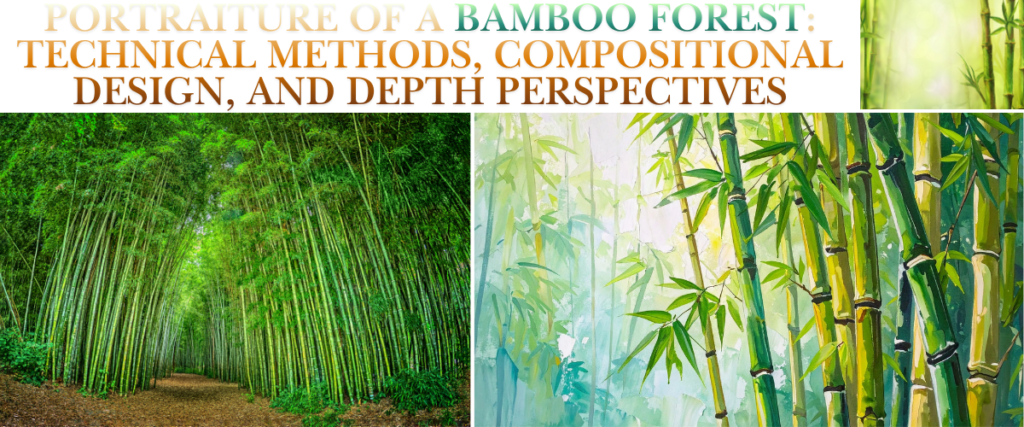
The depiction of a bamboo forest within a portrait orientation is a profound exercise in balancing structural discipline with spontaneous, fluid execution1. In traditional East Asian ink wash painting (sumi-e), which is deeply rooted in calligraphy, the bamboo is celebrated as one of the “Four Gentlemen” alongside the orchid, the plum blossom, and the chrysanthemum4. Each subject represents a specific seasonal spirit and technical brushwork progression4. To transition from drawing an isolated stem to composing an entire, dense forest portrait requires a thorough understanding of spatial design, line quality, and the physical dynamics of the chosen medium1. This analysis details the classical brushwork and modern sketching methodologies required to create a vertically oriented bamboo forest portrait, focusing on composition, depth representation, and technical execution1.
Cultural Philosophy and the Aesthetic Framework of Bamboo Portraiture
Before embarking on the physical act of drawing, an artist must understand the philosophical underpinning of the subject. A successful forest portrait is not a literal, rigid botanical illustration5. Instead, it uses the art of suggestion to capture the vital energy (Qi) and the tranquil atmosphere of the grove5. This aesthetic framework relies heavily on the relationship between form and empty space1. In a Zen-inspired composition, negative space acts as an active pictorial element rather than a passive background, representing mist, ambient light, and the winding paths that carve through a dense canopy1.
To capture the physical essence of bamboo, one must observe its natural growth patterns: the segmented stems partitioned by raised nodes, the flexible yet stable verticality of the stalks, the delicate secondary branches emerging at steep angles, and the light, feathery leaves draping in elegant, rhythmic groups1. A balanced portrait composition contrasts the stable, upright structure of the main stalks with the organic, dancing movement of the wind-swept foliage1.
Material Systems and Studio Organisation
The choice of artistic medium heavily dictates the fluidity, texture, and character of the final portrait1. Traditional ink brush artists rely on monochromatic carbon inks and highly absorbent papers, whereas contemporary sketchers adapt graphite, charcoal, and mixed media to achieve similar atmospheric qualities6.
Comparison of Traditional and Modern Media Systems
| Characteristic / Tool | Traditional Sumi-e System | Modern Graphite & Mixed Media System |
| Primary Media | Carbon-based liquid ink, solid ink sticks, and slate stones (suzuri)1 | High-grade pencils (4B, 6B for sketching; 10B for shading), black gel pens, sketch pens10 |
| Substrates | Absorbent rice paper (washi) backed by a thick, protective felt sheet1 | Heavyweight cartridge paper, 90 GSM to 80 GSM offset paper, or cold-press paper6 |
| Applicators | Tapered natural hair fude brushes (large and small sizes)1 | Graphite cores, paper blending stumps, tortillons, and cotton buds10 |
| Corrective Ability | Absolute; strokes are spontaneous, permanent, and cannot be erased or modified1 | High; utilise kneaded erasers, pen-shaped erasers, and graphite lifting techniques10 |
| Depth Mechanism | Tonal gradients created through precise dilution of ink with clean water1 | Graduated grey scales, smudging, cross-hatching, and varied hand pressure10 |
Practitioners setting up a workspace must ensure a stable, flat surface with adequate lighting, preferably natural north-light to prevent harsh shadows from obscuring fine paper details6. For traditional wet media, the application of a felt underlay is essential to absorb excess moisture and prevent the wet paper from adhering to the supporting desk1.
Anatomy of the Stalk: Technical Brushwork and Line Mechanics
The bamboo stalk, or culm, is built of distinct cylindrical segments separated by raised, ring-like nodes1. Rendering these stalks with structural integrity requires precise motor control1. In traditional brushwork, the artist holds the brush completely upright at a 90-degree angle to the paper, gripping the handle with the thumb on one side and the index and middle fingers on the other1. This grip facilitates movement that originates from the shoulder rather than the wrist, ensuring long, steady lines free from nervous tremors1.
The physical depiction of the forest utilizes four core brushstrokes:
- The Pulling Stroke: The brush is held vertically and drawn across or down the paper, engaging the entire arm7. This is primarily used for branches, stems, and leaf veins7.
- The Pressure Stroke: The artist varies the downward pressure while pulling the brush, which modulates the width of the line4. This is the foundation for painting tapered leaves and grass7.
- The Side Stroke: The brush is held at a 45-degree angle, dragging the belly of the bristles to produce broad, textured, and voluminous stalks5.
- The Smooshing Stroke: The brush is pressed flat so that both the tip and the heel contact the paper, followed by a slight twist to create irregular organic textures, such as rugged ground or bark7.
[Segment 1] ====> Broad, flat side stroke, moving downward or upward
(Pause brush and lift cleanly to leave a visual gap)
[Visual Gap] ====> Intentional blank space indicating the node joint
[Node Ridge] ====> Two hook-shaped, dark strokes painted close together
[Segment 2] ====> Second broad stroke, slightly offset to show organic bend
To paint a wide, realistic stalk, the artist loads the brush with a base of light-value grey ink, then flattens the bristle tips and applies concentrated dark ink to the outer edges1. When a side stroke is executed, this dual loading automatically produces a high-contrast highlight in the centre and shadow along the edges, giving the stalk three-dimensional volume in a single motion1.
Each segment is painted with a swift, confident movement1. The artist must leave a small visual gap between the strokes1. These gaps provide the negative space required to insert the nodes1.
The node ridges are marked by applying small, horizontal, slightly curved hook strokes across the gaps using dark, concentrated ink4. This adds immediate structure to the stem, transforming a series of disjointed cylinders into a cohesive, living organism1.
Foliage Dynamics and Leaf Groupings
Bamboo foliage must convey weightlessness and movement, responding to invisible currents of wind4. The technical execution of the leaf requires a highly controlled entry and exit1. The artist touches the tip of the brush to the paper, presses down firmly to broaden the stroke, and then pulls away rapidly while lifting the hand to taper the leaf to a sharp, elegant point1. Modern pencil artists achieve a similar effect through a combination of light-to-heavy pencil pressure and precise lifting, or by using a sharp pen-style eraser to slice highlights out of a shaded region10.
(Centre Leaf: Swift, vertical downward pressure-and-release stroke)
|
/ \
(Left Leaf: Angled stroke) / \ (Right Leaf: Balances the group)
Foliage is constructed in systematic groupings5. The artist begins by painting the centre leaf of a cluster, which establishes the primary directional flow5. The lateral leaves are then added to the left and right, ensuring they vary in size, length, and angle to maintain a natural, asymmetric appearance4.
A common compositional error is connecting every single leaf directly to the supporting sub-branch5. To preserve a sense of space and prevent the composition from looking rigid, the artist should paint the leaves with a deliberate physical gap between the foliage cluster and the branch5. This spatial separation allows the viewer’s eye to bridge the connection organically, embodying the classical concept of less is more5.
Designing a Vertical Portrait Composition
A portrait orientation is uniquely suited to the depiction of a bamboo forest2. The tall, vertical format amplifies the immense height, growth, and natural rhythm of the stalks, mirroring the real-world experience of standing within towering groves like the Arashiyama Bamboo Forest in Kyoto11. The design of a successful portrait scene is governed by several core visual rules that project a three-dimensional illusion onto a flat, two-dimensional surface9.
Core Principles of Depth and Composition
- Volume: Stalks and landscape features must avoid flat, cardboard-like appearances9. This is controlled by establishing a clear, single light source, which dictates where highlights and cast shadows fall9. Highlighted areas are left untouched (revealing the white paper) or enhanced with white paint, while the opposing sides are deepened with rich shadows14.
- Size Scaling: Objects appear smaller as their distance from the observer increases9. In a forest scene, foreground bamboo stalks must be drawn significantly wider and thicker than the thin, slender stalks positioned in the midground and background4.
- Overlapping: Laying one element over another is the most direct method to establish visual depth9. By drawing a dark, sharp foreground stalk so that it partially conceals a lighter, softer background stalk, the artist instantly creates a multi-layered environment5.
- Height Positioning: Due to human ocular perspective, the bases of closer objects sit lower on the drawing surface, while the bases of distant objects are positioned higher up the page9. Foreground bamboo should emerge from the very bottom edge of the frame, whereas distant groves are anchored higher up, closer to an implied horizon line9.
- Contrast and Detail Variation: Areas of high contrast and sharp detail naturally pull forward in a composition, while areas of low contrast and sparse detail recede9. Foreground elements should exhibit dark blacks, sharp contours, and visible leaf veins; background elements should be rendered in soft, pale grey tones with minimal internal detail4.
- Edge Softness (Atmospheric Perspective): As the distance increases, airborne particles scatter light, causing distant objects to lose their sharp edges8. Foreground stalks must have hard, crisp boundaries, while background stalks should feature soft, blurred, or diffuse edges to simulate mist, fog, or a shallow depth of field8.
Narrative Guide to Constructing the Forest Landscape
To execute a complete, atmospheric bamboo forest portrait, the artist should follow a structured, multi-phase workflow, building the composition from the background to the foreground8.
[Stage 1] Establish background washes, soft-edged distant stalks, and mist.
[Stage 2] Add midground stalks with medium value, incorporating slight curves.
[Stage 3] Paint bold, thick foreground stalks emerging from the bottom edge.
[Stage 4] Detail foreground foliage, nodes, ground rocks, and path textures.
Phase 1: Planning and Background Under-sketching
The artist begins by sketching a very light outline of the scene using a hard graphite pencil5. During this planning stage, one must map out the primary perspective lines—such as a winding stone pathway or a stream that cuts diagonally through the grove—to guide the viewer’s eye through the composition8. The artist also identifies areas of negative space that will remain unpainted to represent pockets of bright, filtered sunlight or morning fog1.
Phase 2: Painting the Atmospheric Background
Working on the deepest layer first, the artist applies a very light, diluted grey ink wash or soft charcoal tone to establish the background4. Here, thin, slender bamboo stalks are drawn high on the page9.
To simulate a dense, humid jungle, the artist can employ the traditional tarashi komi technique, which involves dropping clean water or slightly darker ink onto wet portions of the background to create soft, cloud-like bleeds and organic textures representing distant, out-of-focus foliage5. At this stage, a soft, kneaded eraser can be dragged vertically down the paper to lift graphite or pigment, carving out bright, radiant sunrays that stream through the canopy8.
Phase 3: Positioning the Midground
The midground acts as a bridge, anchoring the transition of scale and tone8. Using a medium-intensity ink value or a mid-grade pencil (such as a 4B), the artist adds stalks that are moderately thick and positioned slightly lower on the page than the background elements9. These stalks should not be drawn as perfectly straight, mechanical poles1.
The artist must introduce gentle curves and organic angles, reflecting how living trees bend and reach toward light sources in a natural forest1.
Phase 4: Executing the Bold Foreground
The foreground commands the immediate attention of the viewer8. The artist uses a dense, concentrated dark ink or a soft, dark pencil (such as a 10B) to draw wide, powerful stalks that span the full vertical length of the canvas, cutting boldly across the softer background layers4.
The bases of these foreground pillars emerge from the very bottom edge of the paper9. To ground these giants, the artist paints textured rocks, mossy patches, and decaying leaf litter around their roots11.
Using the rapid pressure-and-release brushstroke, foreground foliage is layered over the midground, with some leaves crossing directly in front of the primary stalks to cement the three-dimensional depth of the scene4.
Phase 5: Refining, Detailing, and Shading
With the structural layers complete, the artist executes the final refinement14. Fine details, such as leaf veins, are added using a sharp, fine-tipped brush or a black gel pen14.
The artist applies subtle shading along the edges of the node ridges to emphasise their raised, physical volume, and uses a fine white paint or a precise eraser to add sharp highlights along the vertical lengths of the stalks where they catch the filtered sunlight14.
Finally, the artist steps back to evaluate the visual balance: ensuring the negative space is well-distributed, the leading lines guide the eye smoothly, and the composition “breathes” with a sense of natural tranquility1.
Technical Mistakes and Practice Routines
Mastering the vertical bamboo portrait requires consistent, disciplined practice to overcome common technical errors that often plague beginners1.
Pitfalls to Avoid in Forest Drawing
- The Pencil Grip: Holding the brush like a standard writing pen limits the physical range of motion, freezes the wrist, and results in hesitant, trembling lines1. The brush must be held vertically, and the movement must flow smoothly from the shoulder1.
- The Telephone Pole Effect: Drawing every bamboo stalk as a perfectly straight, uniform vertical cylinder makes the forest look synthetic and dead1. Real trees exhibit subtle curves, taper gradually as they grow taller, and stand at slightly varied angles1.
- Stroke Correction: In traditional ink painting, attempting to “fix” or over-paint a damp, imperfect stroke only results in muddy, bleeding patches of paper1. The practitioner must accept each mark, move forward, and focus on refining the technique in the next attempt1.
- Mechanical Symmetry: Spacing stalks at equal intervals or painting identical, template-like leaf clusters destroys the organic randomness of nature1. Composition thrives on asymmetry, grouping elements in clusters of three or five while leaving open, breathing voids1.
To build the necessary muscle memory and brush control, artists are encouraged to adopt a daily six-minute warm-up routine1. This structured exercise helps refine pressure control and line consistency before attempting large-scale compositions1.
[Minute 1-2] ==> Draw slow, vertical lines of perfectly consistent thickness.
[Minute 3-4] ==> Practice “thin-thick-thin” pressure strokes to master stems.
[Minute 5] ==> Execute fluid, continuous curves to train whole-arm movement.
[Minute 6] ==> Practice two-stroke leaves, focusing on clean, tapered tips.
Conclusion
Creating a detailed portrait of a bamboo forest is a journey that merges structural geometry with artistic freedom1. By mastering the anatomical structure of the stalk, the fluid dynamics of leaf grouping, and the visual laws of atmospheric perspective, an artist can transform a flat, vertical surface into an expansive, light-filled sanctuary3. Whether using traditional carbon inks on delicate rice paper or graphite pencils on modern cartridge sheets, the key to success lies in capturing the underlying spirit of the forest rather than its literal minutiae5. Through mindful preparation, structured practice, and an appreciation for the balance of positive and negative space, the practitioner will find that drawing the bamboo grove is not only an excellent way to sharpen artistic skills, but also a calming, meditative, and deeply satisfying creative experience6.
Disclaimer
This guide is provided strictly for educational and informational purposes. The artistic techniques, material recipes, and tool handling methods described are intended to assist individuals in developing their creative skills. The author and publisher accept no liability for any physical strain, repetitive motion injuries, or damage to personal property resulting from the use of non-cosmetic inks, pigments, sharp drawing instruments, or incorrect ergonomic posture during artistic practice.
References
- How to paint bamboo in sumi-e, step by step | Kaoru Hirose, https://kaoruhirose-sumie.com/en/how-to-paint-bamboo-in-sumi-e-step-by-step/
- BAMBOO SHADES OF LIGHT Art Print on Canvas by Hase 8.5″x11″ – Unframed – eBay, https://www.ebay.com/itm/326281248881
- Bamboo Relief I by Studio M a handmade Original Framed Artwork under Glass – Luna Furniture, https://www.lunafurn.com/products/bamboo-relief-i-by-studio-m-a-handmade-original-framed-artwork-under-glass-15585-from-mercana
- Ink and Wash / Sumi-e Technique & Learning – A Short Painting Tutorial, https://www.asianbrushpainter.com/blogs/kb/painting-tutorial
- Sumi-e: All You Need to Know About Japanese Ink Painting – Japan Objects, https://japanobjects.com/features/sumie
- Creating Sumi-e (すみえ) for Beginners : 7 Steps – Instructables, https://www.instructables.com/Creating-Sumi-e-%E3%81%99%E3%81%BF%E3%81%88-for-Beginners/
- Sumi-e Painting 4 Basic Brushstrokes: Lesson 2 – Create Art with ME, https://createartwithme.com/chinesse-bamboo-brush-4-basic-brushstrokes-lesson-2/
- HOW TO DRAW FORESTS ! by ALYEK – Make better art | CLIP STUDIO TIPS, https://tips.clip-studio.com/en-us/articles/7614
- 15 Ways to Draw the Illusion of Depth – Ran Art Blog, https://ranartblog.com/blogarticle20.html
- Bamboo Scenery Drawing – Pencil Sketch – YouTube, https://www.youtube.com/watch?v=L3SIYmsNNDo
- Green Bamboo Forest Vertical Composition Stock Photos – Dreamstime.com, https://www.dreamstime.com/photos-images/green-bamboo-forest-vertical-composition.html
- Images of Chinese ink painting of a bamboo forest on steep mountain terraces, with narrow stone paths winding through the dense, s… | Deep Dream Generator, https://deepdreamgenerator.com/search?t=explore&q=7e2f48a3-d7d6-535d-88c8-a262cdcd0124&s=results
- Arashiyama Bamboo Forest – Canvas Prints & Wall Art | iCanvas, https://www.icanvas.com/canvas-art-prints/subject/arashiyama-bamboo-forest
- How to Draw Bamboo – Capturing Nature’s Grace on Paper – Art in Context, https://artincontext.org/how-to-draw-bamboo/
- How to draw Easy Pencil Shading Tutorial | Bamboo & Rocks Landscape Drawing for Beginners – YouTube, https://www.youtube.com/watch?v=fiIB35UW0TY
- Easy Bamboo Forest Drawing and Shading|Drawing and Shading Step by Step for Beginners|Waterfall #3 – YouTube, https://www.youtube.com/watch?v=_7O94zttE48
- Bamboo Forest Vertical royalty-free images – Shutterstock, https://www.shutterstock.com/search/bamboo-forest-vertical
- Bamboo Forest – Contemporary Impressionism Paintings by Erin Hanson, https://www.erinhanson.com/portfolio/bamboo-forest
- Bamboo Forest Vertical illustrations – Shutterstock, https://www.shutterstock.com/search/bamboo-forest-vertical?image_type=illustration
- How to Draw Bamboo: 8 Steps (with Pictures) – wikiHow, https://www.wikihow.com/Draw-Bamboo
- Drawing DIY: Bamboo Forest. – Hive.blog, https://hive.blog/hive-156509/@sharminmim/drawing-diy-bamboo-forest