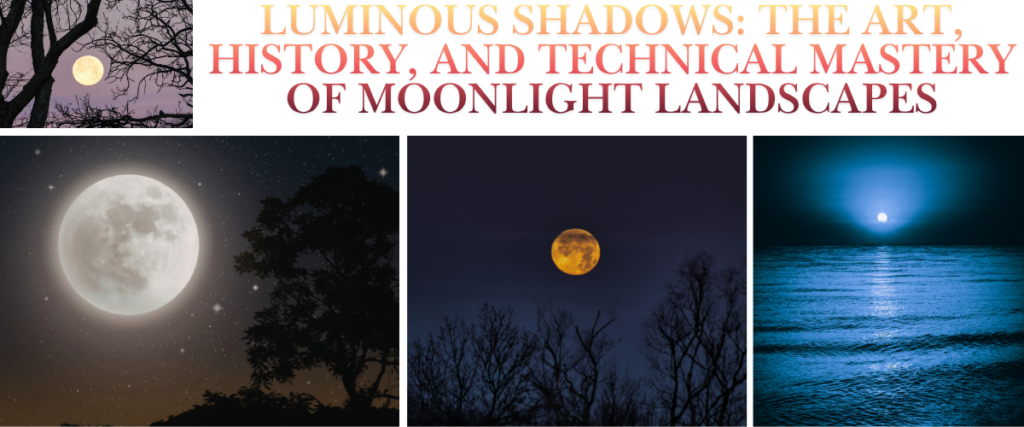
The depiction of the night has long stood as one of the most compelling challenges in art history. Painting or photographing a moonlit landscape is never merely an exercise in registering what is visible; rather, it is a complex mediation between optical reality, physical science, and cultural projection.1 As the philosopher and writer Henry David Thoreau observed, the night is a different country, and the shifts in perception that occur in a dimly lit landscape are inevitably influenced by the cultural concepts surrounding darkness.1 This nocturnal domain—where forms dissolve, colours shift, and shadows loom with psychological weight—has inspired centuries of artists to develop specialised techniques, distinct colour palettes, and unique conceptual frameworks to capture the elusive glow of the moon.2 Tracing this evolution reveals a rich history spanning Dutch realism, Romantic sublime, Tonalist mood-building, modern psychological symbolism, and advanced digital and photographic technologies.
The Historical Genesis of Nocturnal Art: Dutch Realism and Renaissance Roots
The nocturnal landscape, or nocturne, found its initial footing in Western art during the High Renaissance, but it emerged as a dedicated specialisation during the Dutch Golden Age.2 In the late 1640s, Dutch painter Aert van der Neer pioneered realistic tonal landscapes and winter scenes illuminated by moonlight.4 His masterwork, Moonlit Landscape with Bridge (c. 1648/1650), demonstrated a highly sophisticated ability to render the play of moonlight across water and low-lying clouds, establishing night scenes as a vital subgenre of landscape painting.4 Despite his technical innovation, pioneering this complex genre did not yield commercial stability for Van der Neer; he took on a second career as an Amsterdam tavern keeper in 1659, went bankrupt in 1662, and was heavily in debt at the time of his death in 1677.4
Parallel to these early realistic observations were idyllic, pastoral interpretations of the night. Peter Paul Rubens created Landscape by Moonlight (c. 1635–1640) as a direct response to Adam Elsheimer’s pioneering cabinet painting, The Flight into Egypt (1609–1610).3 Rubens depicted a serene, star-dusted sky reflected in placid waters, presenting a calm, harmonious vision of nature that would heavily influence later generations, including John Constable.3
By the 18th century, in the Age of Enlightenment, moonlit landscapes were heavily associated with restoration, calmness, and decorative elegance.1 Artists like Claude Joseph Vernet utilised a dual-light device in paintings such as Night a Port in Moonlight (1772), juxtaposing the cool, silvery reflection of the moon on water with the warm, localised glow of an artificial fire.1 Similarly, in Polish art of the late 18th century, Zygmunt Vogel’s Łazienki by Moonlight projected a quiet, sleepy tranquillity.2 Vogel used soft greys, subtle azures, and muted greens to depict elite strollers enjoying peaceful, moonlit evenings, maintaining a peaceful atmosphere that did not differ significantly in mood from daylight scenes.2
The Romantic Sublime and the Metaphysical Night
The transition into the late 18th and early 19th centuries brought a radical shift. The Romantic movement rejected the placid, rationalised night of the Enlightenment in favour of mystery, drama, and the Sublime.1 The moonlit landscape became a mirror for the human soul and a vehicle to explore metaphysical depth.1 Under the Romantic impulse, the night was no longer a backdrop for a sleepy stroll but a vast, untamable cosmic force.1
J.M.W. Turner’s Fishermen at Sea (1796) exemplifies this psychological pivot, depicting a fragile fishing boat tossed by a violent sea.3 The composition is dominated by a brilliant full moon shining through fractured clouds, acting as both a safeguarding light and a stark revealer of the ocean’s mortal dangers.3 Turner used this scene to emphasise human vulnerability and subjugation to the colossal, untamable forces of the cosmos.3 In a quieter fashion, his watercolour Moonlight on River (c. 1826) served as an exercise in transience, capturing light coruscating through the water and sky to convey the physical sensation of ephemeral illumination.3
John Constable’s Netley Abbey by Moonlight (c. 1833) was completed years after his wife, Maria Bicknell, died of tuberculosis in 1828.3 The cool, blue-dominated colour palette and the spectral, blurry figure standing near a gravestone transform the moonlit ruins into an intimate visual elegy, demonstrating how artists utilised nocturnal settings to project profound states of grief.3 This is contrasted by Caspar David Friedrich’s Two Men Contemplating the Moon (1819–1820), where two figures standing on a rugged mountain path gaze quietly at a waxing crescent moon.3 Friedrich’s composition celebrates human communion with nature, casting the moon as an emblem of hope and cosmic order.3
This metaphysical shift was reflected globally. In America, Thomas Cole painted Moonlight (1833–34) to capture the romantic wilderness.5 In Europe, John Linnell produced Harvest Moon (1855), and Victor-Florence Pollet completed Endymion and Selene (c. 1870), which used classical mythology to explore moonlit intimacy.3 In East Asia, Tsukioka Yoshitoshi completed extensive, deeply contemplative woodblock prints focusing on the moon, building upon earlier traditions such as Ishikawa Toyomasa’s The Eighth Month: Moon viewing (1770–1775).3 Later, Korean artist Lee Chong-sop painted Autumn Evening (1994), continuing this long tradition of Eastern lunar contemplation.3
Polish landscape developments during this era also highlighted the tension between academic clarity and expressive symbolism.2 Henryk Siemiradzki’s academic paintings, such as Night in Pompeii, avoided submerging scenes in complete darkness, using clear night settings and soft, sentimental lighting to portray youth and folklore.2 This approach was eventually challenged by Ferdynand Ruszczyc’s expressive symbolism, where the landscape literally drowns in heavy darkness, and Zofia Stryjeńska’s modernist, dynamic, and geometric folk representations.2 Additionally, Witold Pruszkowski’s Into Exile in Siberia reversed traditional proportions by using the vast, dark, and freezing night landscape as the primary narrative tool to communicate the tragic fate of political exiles.2
Evolution of Selected Nocturnal Masterpieces
To understand how the artistic treatment of the night evolved across different eras, movements, and regions, it is useful to examine the structural and thematic shifts of key masterpieces.
| Artist | Artwork & Date | Artistic Movement | Core Theme & Painting Technique |
| Peter Paul Rubens | Landscape by Moonlight (1635–40) 3 | Flemish Baroque 3 | Idyllic pastoral scene; starry sky reflected in placid waters; paint on panel responding to Elsheimer.3 |
| Aert van der Neer | Moonlit Landscape with Bridge (c. 1648/50) 4 | Dutch Golden Age 4 | Realistic tonal landscape; masterfully detailed play of light over clouds and a river bridge.4 |
| Zygmunt Vogel | Łazienki by Moonlight (Late 18th c.) 2 | Enlightenment Classicism 2 | Tranquil, decorative elegance; soft greys, subtle azures, and muted greens depicting aristocratic strollers.2 |
| J.M.W. Turner | Fishermen at Sea (1796) 3 | Romanticism 3 | The Sublime and cosmic power; a vulnerable fishing boat illuminated by a brilliant, dramatic full moon.3 |
| Caspar David Friedrich | Two Men Contemplating the Moon (1819–20) 3 | German Romanticism 3 | Human communion with nature; figures viewed from behind gazing at a waxing crescent moon.3 |
| John Constable | Netley Abbey by Moonlight (c. 1833) 3 | Romanticism 3 | Visual elegy and grief; cool, blue-dominated watercolour with a blurry figure standing near a gravestone.3 |
| Henryk Siemiradzki | Night in Pompeii (Late 19th c.) 2 | Academic Art 2 | Sentimental folklore; clear nighttime settings, avoiding complete darkness to preserve classical clarity.2 |
| Witold Pruszkowski | Into Exile in Siberia (Late 19th c.) 2 | Symbolism / Realism 2 | Political tragedy; vast, dark, freezing, snowy landscape acting as the primary narrative voice.2 |
Whistler’s Aesthetic Revolution, Tonalism, and the Expansion of Mood
In the late 19th century, the American expatriate artist James Abbott McNeill Whistler radically redefined how the night was painted.1 Seeking to detach art from narrative and moralising obligations, Whistler championed the Aesthetic movement’s ideal of art for art’s sake.6 He famously adopted the musical term “nocturne”—originally popularised by Frédéric Chopin’s piano compositions—to title his hazy, atmospheric nightscapes of the River Thames and Venice.1 Whistler worked extensively from memory, repeatedly observing a nighttime scene before retreating to his Chelsea studio to paint his spare, murky compositions.1
Whistler’s Nocturne in Black and Gold – The Falling Rocket (1872–1877), which captured the glittering, explosive spray of fireworks over Cremorne Gardens, proved incredibly controversial.6 The prominent art critic John Ruskin accused Whistler of flinging a pot of paint in the public’s face, leading to a famous libel lawsuit.6 Despite the backlash, Whistler’s highly expressive, near-abstract arrangements of colour and tone laid the groundwork for modern landscape painting.5 He expanded this aesthetic into winter themes with Nocturne in Grey and Gold: Chelsea Snow (1876), using a reduced palette to convey a chilling evening through which a solitary figure walks.6
While Whistler embraced a loose, suggestive brushwork to capture fleeting moods, his contemporary, the British painter John Atkinson Grimshaw, approached the nocturne from a highly detailed, precise perspective.6 Grimshaw focused on the damp, rain-slicked suburban streets of Victorian England, utilising the warm glow of gas lamps and shop windows to contrast against the cold, silvery light of a high moon in works such as On Hampstead Hill (1881) and A Moonlit Street Scene after Rain (1881).6
Whistler’s poetic simplification of the night had an immense influence on American painters, serving as the foundation for the Tonalist movement of the late 19th and early 20th centuries.1 Tonalism was characterised by soft, diffused light, muted tones, and hazy, mysterious outlines.1 Key works of this period include George Inness’s Pool in the Woods (1892), John Henry Twachtman’s Canal Venice (c. 1878) and L’Etang (c. 1884), Albert Pinkham Ryder’s Death on a Pale Horse (The Race Track) (c. 1910), Frank Tenney Johnson’s Rough Riding Rancheros (c. 1933), and Edward Hopper’s iconic study of urban isolation, Nighthawks (1942).5
Additionally, Charles Rollo Peters established an artistic hub at his Monterey, California, ranch, where he mastered the technical challenges of painting darkness.7 His signature motif of ramshackle Spanish adobes in works like Monterey Adobe and Mission Santa Ines exemplified Tonalist principles.7 Peters’s 1899 New York exhibition of sixteen moonlit California missions deeply influenced East Coast painters like Frederic Remington and young emerging artists such as DeWitt Parshall, who painted The Darkness He Called Night and Night near the Village.7 Other California painters, including Thomas Van Stein, Lockwood de Forest, and William Frederick Ritschel, carried this banner forward.7
The fascination with the night sky also yielded iconic masterpieces in other movements. Vincent Van Gogh completed Starry Night Over the Rhone (1888), using swirling, expressive brushstrokes.8 Edvard Munch painted Kiss by the Window, Ivan Aivazovsky created Moonlight Seascape with Shipwreck, Winslow Homer produced Summer Night, and René Magritte painted the surrealist masterpiece The Mysteries of the Horizon (1955).8 Childe Hassam adapted Impressionist techniques to the nocturne in works like Nocturne—which spotlighted the pure power of the moon and its striking reflection on water—and Winter in Union Square (1881), which captured carriages struggling through a bone-chilling New York snowfall.6
The Psychological and Atmospheric Resonance of Stimmung
The night has never been a neutral setting; it acts as a powerful psychological canvas.2 In German and Munich-based painterly circles of the late 19th century, this manifested as Stimmung—a term denoting a deep, resonant atmosphere or mood.2 Realist and symbolist painters transitioned from romantic picturesqueness to Stimmung, focusing on the meticulous observation of light, weather effects, and their psychological impact.2 Polish artists, who often gathered in Munich, embraced Stimmung to express a distinct, melancholy soul through the heavy use of dark pigments, capturing sad autumn evenings and gloomy, mysterious nights.2
This mood-driven darkness carried distinct psychological and narrative implications:
The Magnified Scale of Nature
The Polish critic and writer Ludwik Buszard noted that nature, enormous under the gaze of the sun, is a hundred times larger when enveloped in the mysterious shadows of the night, highlighting how darkness magnifies the scale of human perception.2
Atavistic Fear and the Sublime
The painter Stanisław Witkiewicz associated Stimmung landscapes with minor, heavy moods, claiming that the onset of night brings a psychic depression linked to an atavistic fear of danger always lurking for animals and primitive people in the shadows.2 His painting Foehn Wind captures this raw, elemental anxiety, representing the awe and terror of nature’s forces under the cover of darkness.2
Trauma and Memory
In the late 20th century, the surrealist artist Erna Rosenstein painted Night (1993), a work featuring a moonlit sky juxtaposed with a realistically painted, levitating knife.2 This seemingly dreamlike composition referred directly to the most traumatic night of her life: the brutal murder of her parents during a nighttime escape in World War II, illustrating how moonlight can evoke deep, recurring psychological wounds.2
Nostalgia and Expressionist Energy
Contrastingly, contemporary artists have used the night to evoke nostalgia or wild physical power.6 Peter Doig uses source photography as a springboard to transform nostalgic landscapes into fantastical, dusky memories in paintings like Ski Jacket and Bob’s House (1993), balancing the winter chill with warm tones to frame welcoming landscapes.6 Meanwhile, Maggi Hambling’s dynamic, wave-swept North Sea paintings, such as January Morning (2008/2009) and Moon and Sea (2005), build thick impasto surfaces to show a glowing moon obscured by clouds and spraying seafoam, emphasising the raw energy of the sea under the moon’s glowing eye.6
Scientific Principles of Nocturnal Vision and Traditional Painting Techniques
To paint the night convincingly, an artist must understand both the physics of light and the biology of human perception.9 The most fundamental biological factor in nighttime art is the Purkinje effect.9 As light levels drop, the human eye shifts from cone-dominated photopic vision to rod-dominated scotopic vision.9 Rod cells are highly sensitive to shorter wavelengths of light, specifically the blue and green spectrum, while their sensitivity to longer wavelengths, such as reds, drops drastically.9 Consequently, even though real moonlight is merely reflected sunlight with a slightly warm colour temperature, to human eyes, a moonlit landscape appears cool, blue, or cyan.9 Over the past two centuries, artists and filmmakers have embraced this biological quirk, establishing blue as the universal visual shorthand for night.9
Fine art painters have developed several sophisticated chromatic strategies to bypass the flat, lifeless quality that often plagues night scenes:
- The Underpainting of Reds: A major secret to painting a vibrant night sky is to begin with an underpainting of warm and cool reds.10 When cool blue and purple tones are subsequently layered over this red base, it creates a powerful colour vibration.10 This juxtaposition of warm undercurrents with cool surface tones simulates the undulating, breathing quality of a real night sky far more effectively than using simple complementary colours.10
- Middle-Value Mapping: Because night values are compressed and sit close together on the value scale, the artist must map middle values first.10 Only after the mid-tones are established should the absolute darkest darks and brightest highlights be introduced, starting with a highly limited colour palette to maintain control.10
- The Atmosphere of the Moon: The moon is warmer (yellowish-orange) at its bottom edge and cooler (white-blue) at its top.10 This occurs because there is significantly more air density, dust, and atmosphere closer to the horizon than above it.10
- Creating the Glow: To make the moon appear to radiate light rather than sit flatly on the canvas, the artist applies a soft, subtle, transparent white halo around the moon’s perimeter after the primary sky layer has dried completely.10
- The Prohibition of Tube Black: Master colourists strongly advise against using black directly from a tube, such as Ivory or Lamp Black.10 Tube black is flat and dull, absorbing light without reflecting colour, which destroys the harmony of a nocturne.10 Instead, artists mix their own chromatic darks using combinations of deep blues, warm browns, and purples to create darks with character, depth, and temperature.10
Technical Methodologies in Traditional Painting
The technical implementation of these chromatic and optical principles varies depending on the specific medium, subject matter, and level of abstraction.
| Technical Approach | Primary Supplies & Medium | Key Process Steps & Chromatic Principles |
| “Moonlight Joy” Process 13 | Acrylic on Canvas; Paper cutout, brushes (flat & fine), earpicks 13 | Mask the moon with a paper cutout; blend ultramarine, cerulean, and white skyward, fading to black edges.13 Paint the grass field with sap green and yellow using dry brush strokes for texture.13 Outline clouds in black with white upper edges; add black trees and silhouettes.13 Tap flowers using earpicks dipped in pink and white.13 |
| “Not-Waves” Method 12 | Acrylic on Canvas; Atelier Interactive paints, chalk, broad/flat brushes 12 | Block in water with a dark mix of Pthalo Blue and Dioxazine Purple.12 Use chalk to map out the “not-waves” (the dark, unlit troughs).12 Paint thinned white on the steepest edges of breaking ripples to capture the moon’s light.12 Layer transitional purples (Alizarine, Pthalo Blue, white) into the shaded fronts of the waves to simulate shallow reflections.12 |
Digital Painting: Layer Blending Modes and Algorithmic Glazing
In digital drawing, layer blending modes act as the mathematical equivalents to traditional glaze layers, determining how one layer’s pixels blend with the colour of the layers beneath it.14 This allows digital artists to replicate traditional glaze techniques with immense precision and control.14
To transition a digital illustration from day to night, artists often duplicate the base colour layer, apply a deep “Night Sky” blue-to-black gradient, and set the blending mode to Hard Light or Multiply at a reduced opacity.14 Localised moonlight highlights are then painted on a clipped layer above it.17
Digital artists rely on several key blending modes to establish nighttime lighting:
Multiply
This mode multiplies the RGB values of the blend and base layers, resulting in a dark, saturated colour.14 It is the primary tool for drawing nighttime shadows, casting silhouettes, or shifting a daytime scene to dusk by applying a dark blue overlay.15
Overlay
Behaving like Screen in bright areas and like Multiply in dark areas, Overlay enhances contrast while keeping the underlying highlights and shadows intact.14 It is used to apply grain textures, fog, or to integrate a rich night sky gradient over a flat background.15
Screen
This mode inverts base colours, multiplies them, and brightens the image while adding colour saturation.14 It is excellent for strong light sources or creating a luminous, transparent backlight around a character.15 To make the light look more natural, digital artists fill the layer with black first to provide natural spectrum compression.15
Linear Dodge (Add)
By increasing both brightness and saturation while improving contrast in the dark areas, Linear Dodge is ideal for rendering fine, luminous details in dim backgrounds, such as tiny stars, fireflies, or sparks.15
Colour Dodge and Glow Dodge
These modes lighten the base colours and reduce contrast, resulting in highly saturated mid-tones and a brilliant, glowing air perspective.14 They are perfect for the intense specular reflection of moonlight on water or the core of the moon itself.15
Photographic and Cinematic Engineering of Moonlit Scenes
While painters can rely on memory and poetic license, photographers and cinematographers capturing a real moonlit landscape are strictly bound by the laws of optics, filter technology, and camera sensors.1 Moonlight landscape photography is a delicate balancing act between capturing the faint landscape, preserving detail in an incredibly bright moon, and managing the movement of the stars across the sky.19
Because the moon is directly illuminated by the sun, it is vastly brighter than the landscape below.9 To photograph only the moon, photographers use the Looney f/11 Rule, which states that for a highly detailed shot of the full moon’s surface, the correct baseline exposure is:

However, to capture a landscape lit by that same full moon, the required light is several stops dimmer, making exposure a matter of careful calculation and testing.20
To prevent stars from smearing into lines due to the Earth’s rotation during long exposures, photographers apply the 500 Rule 19:

Technical Specifications for Photographing and Filming Moonlight
Capturing moonlight through a lens requires a systematic combination of camera exposure settings, optical filters, and specialised lighting equipment.
| Practical Application | Exposure Settings | Auxiliary Tools & Modifiers | Purpose & Optical Mechanics |
| Full Moon Landscape Baseline 20 | ,  , ISO , ISO  20 20 | Heavy-duty tripod, 2-sec shutter delay 19 | Standard exposure to capture ground details illuminated by a bright, high full moon.20 |
| Star Exposure (Single Shot) 19 | , or wider, ISO  19 19 | Wide-angle prime lens ( , ) 19 , ) 19 | Keeps stars sharp, round, and pinpointed, preventing motion blur.19 |
| Foreground Exposure (Bulb) 19 | ,  , ISO , ISO  19 19 | Bulb Mode, Shutter release remote 19 | Pulls rich detail out of the dark foreground for dual-exposure blending.19 |
| Neutral Density Shooting 24 | Variable based on ND rating |  , , , ,  , or -stop ND filters 24 , or -stop ND filters 24 | Extends shutter speed for creative motion blur; requires focus before mounting.24 |
| Moonburst Effect 21 | , , ISO 21 | Tilt-shift lens (optional for perspective) 21 | Creates sharp starburst rays by forcing light diffraction around aperture blades.21 |
| Cinematic Day-for-Night 9 | Underexposed by stops 9 | Deep blue camera filters 9 | Historical film trick; requires avoiding the sky to mimic moonlit conditions under the sun.9 |
| Classic Cine Night Shooting 9 | Matched to film stock speed |  or HMI lamps, CTB gels 9 or HMI lamps, CTB gels 9 | Daylight-balanced lamps mounted on cranes to create a powerful, soft moonlit glow.9 |
| Modern Digital Cinematography 9 | High-ISO digital sensor settings | Versatile LED fixtures (dialled to  ) 9 ) 9 | Allows dimming down to  without shifting colour temperature or adding noise.9 without shifting colour temperature or adding noise.9 |
Conclusion
The art of the moonlit landscape is a testament to the fluid dialogue between human biology, physical technology, and emotional expression. From the precise, atmospheric tonal studies of Aert van der Neer to James McNeill Whistler’s revolutionary, music-inspired Nocturnes, artists have continuously sought to render a world that our eyes struggle to fully comprehend in the dark.1 The Purkinje effect explains why we have collectively agreed that the night is blue, yet it is the artist’s manipulation of value, contrast, and colour vibration—such as laying cool blues over deep red underpaintings—that breathes life and emotional resonance into these cold, dark spaces.9
As technology has advanced, the methods of capturing the night have expanded but remained deeply connected. The classical painters’ struggle with value compression is mirrored in the modern digital artist’s selection of mathematical blending modes, and in the landscape photographer’s calculated dance between the 500 Rule and dual-exposure masking.15 Whether rendered on a traditional canvas, built through complex digital layers, or mapped across a high-ISO camera sensor, the moonlit landscape remains an enduring monument to our timeless fascination with the luminous, mysterious beauty of the dark.1
Disclaimer
This report is compiled for educational and research purposes only. The artistic techniques, historical analyses, and photographic parameters detailed herein are derived from historical records and modern photographic theories. Individual results in painting and photography may vary based on environmental factors, specific equipment, and regional atmospheric conditions. All historical artwork references, dimensions, and sales figures are sourced from public archives and should be verified independently for commercial or academic publication.
References
- Painting the Night – The Landscape Atelier, accessed on June 1, 2026, https://thelandscapeatelier.com/2019/09/09/painting-the-night/
- All the Shades of Night: Nocturnes in Polish Painting | Article …, accessed on June 1, 2026, https://culture.pl/en/article/all-the-shades-of-night-nocturnes-in-polish-painting
- Moonlight in art | Royal Museums Greenwich, accessed on June 1, 2026, https://www.rmg.co.uk/stories/art-culture/moonlight-art
- Moonlit Landscape with Bridge by Aert van der Neer – National Gallery of Art, accessed on June 1, 2026, https://www.nga.gov/artworks/71369-moonlit-landscape-bridge
- Night in paintings (Western art) – Wikipedia, accessed on June 1, 2026, https://en.wikipedia.org/wiki/Night_in_paintings_(Western_art)
- Nocturnes and Nightscapes: Painting the Winter Dark – Invaluable, accessed on June 1, 2026, https://www.invaluable.com/blog/nocturnes-and-nightscapes/
- Nocturnes – California Nature Art Museum, accessed on June 1, 2026, https://www.calnatureartmuseum.org/news/nocturnes-wa6kl
- Famous Nocturne Paintings – Streamline Publishing, accessed on June 1, 2026, https://streamlinepublishing.com/inside-art/famous-nocturne-paintings/
- A Cinematographer’s Guide to Cinematic Moonlight – Filmmakers Academy, accessed on June 1, 2026, https://www.filmmakersacademy.com/blog-cinematic-moonlight-guide/
- How Do You Paint Moonlight? 7 Night Painting Tips – Celebrating …, accessed on June 1, 2026, https://www.celebratingcolor.com/how-do-you-paint-moonlight-7-night-painting-tips/
- Painting a moonlit scene? : r/minipainting – Reddit, accessed on June 1, 2026, https://www.reddit.com/r/minipainting/comments/9qbm4l/painting_a_moonlit_scene/
- Painting a moonlight scene. Discover just how much colour you can get in there!, accessed on June 1, 2026, https://www.explore-acrylic-painting.com/painting-a-moonlight-scene.html
- Moonlight Joy Painting : 5 Steps – Instructables, accessed on June 1, 2026, https://www.instructables.com/Moonlight-Joy-Painting/
- Ultimate Guide to Blending Modes | Art Rocket – CLIP Studio Paint, accessed on June 1, 2026, https://www.clipstudio.net/how-to-draw/archives/154182
- 7 Layer Blending Modes that Digital Artists Must Know – Huion Community, accessed on June 1, 2026, https://community.huion.com/article?arid=27289
- A Guide to Blending Modes Part Two – Graphixly, accessed on June 1, 2026, https://graphixly.com/blogs/news/a-guide-to-blending-modes-part-two
- Most common ways to use blending modes! by ALYEK – Make better art | CLIP STUDIO TIPS, accessed on June 1, 2026, https://tips.clip-studio.com/en-us/articles/4115
- How blend modes ACTUALLY work? : r/ClipStudio – Reddit, accessed on June 1, 2026, https://www.reddit.com/r/ClipStudio/comments/1i7o6fs/how_blend_modes_actually_work/
- Guide to Moonlight Landscape Photography | Amateur Photographer, accessed on June 1, 2026, https://amateurphotographer.com/technique/landscape-photography/guide-to-moonlight-landscape-photography/
- Photographing Moonlit Landscapes, by Glenn Randall – RockyNook, accessed on June 1, 2026, https://rockynook.com/article/photographing-moonlit-landscapes-by-glenn-randall/
- Canon Photographing the Moon and Moonlit Landscapes, accessed on June 1, 2026, https://www.usa.canon.com/learning/training-articles/training-articles-list/photographing-the-moon-and-moonlit-landscapes
- accessed on June 1, 2026, https://rockynook.com/article/photographing-moonlit-landscapes-by-glenn-randall/#:~:text=That%20means%20a%20good%20starting,will%20need%20to%20be%20longer.
- Long Exposure Photography — Landscape Tips & Inspiration, accessed on June 1, 2026, https://kristenryanphotography.com/blog/category/Long+Exposure+Photography