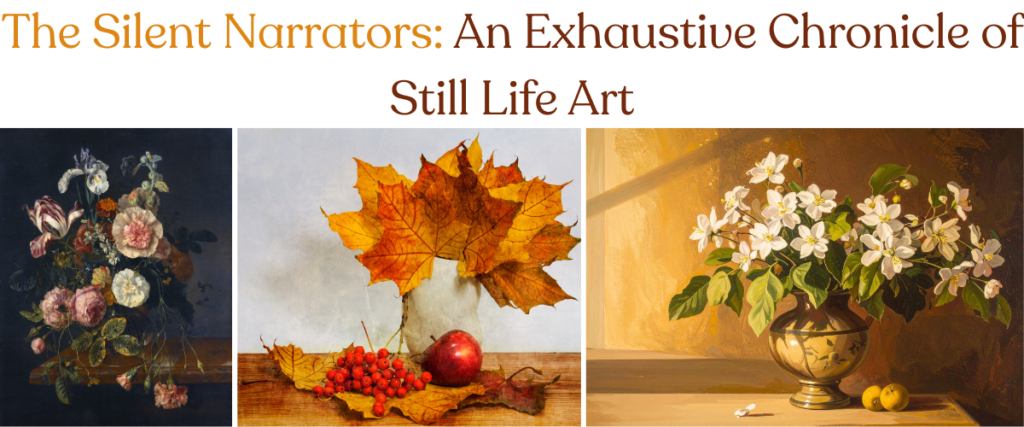
The Paradox of Stillness and the Hierarchy of Genres
In the grand theatre of art history, the genre known as Still Life occupies a paradoxical position. For centuries, the academic establishment relegated it to the lowest rung of the artistic hierarchy, placing it well beneath the “intellectual” pursuits of history painting, religious portraiture, and even landscape art.1 The reasoning was simple, if flawed: art was supposed to depict noble human action, moral narratives, or the grandeur of creation. A painting of a bowl of fruit, a dead hare, or a dusty book was seen as a mere exercise in technical imitation—a copy of nature lacking the “soul” of human drama.3
Yet, despite this historical disdain, still life has not only endured but flourished, outliving many of the “higher” genres to become a central pillar of modern and contemporary artistic practice. The genre survives because it addresses the most fundamental aspects of the human condition: our relationship with the material world, the relentless passage of time, and the inevitability of death. It is a genre of silence that speaks volumes.
The very name of the genre hints at a deep philosophical duality. In English and Dutch (stilleven), the term suggests a life that continues but is motionless—a “still life” that is calm, preserved, and enduring.1 However, in Romance languages, the terminology takes a darker turn. In French, it is nature morte; in Italian, natura morta; in Spanish, naturaleza muerta—all translating to “dead nature”.1 This linguistic schism perfectly captures the tension at the heart of the art form: is it a celebration of life’s abundance, or a melancholic meditation on mortality? Is it about the eternal presence of objects, or the transient nature of the people who own them?
This report provides an exhaustive analysis of still life art, tracing its evolution from the tomb paintings of ancient Egypt to the digital “glitch” art of the 21st century. It will explore how a simple arrangement of inanimate objects can serve as a complex text—documenting the rise of global empires, the oppression of colonial labour, the shifting roles of women in society, and the philosophical struggle to find meaning in a material world.
| Language | Term | Literal Meaning | Philosophical Connotation |
| Dutch | Stilleven | Still Life | A life paused; quiet existence; enduring presence.1 |
| English | Still Life | Still Life | Motionlessness; a frozen moment in time.7 |
| French | Nature Morte | Dead Nature | Mortality: the cessation of life; the object as a carcass.6 |
| Spanish | Bodegón | Pantry / Tavern | Humble utility; the storage of sustenance; domesticity.1 |
Foundations in Antiquity – The Afterlife and the Host
The Eternal Larder: Ancient Egyptian Offerings
The impulse to depict inanimate objects is as old as the human desire to overcome death. The earliest known precursors to the still life genre appear not in galleries or homes, but in the sealed darkness of ancient Egyptian tombs, dating back to the 15th century BCE.5 These images were not created for aesthetic pleasure; they were functional technologies of the afterlife.
In the Egyptian worldview, the Ka (spirit) required sustenance even after the body had perished. While physical food offerings placed in the tomb would eventually rot, pictorial representations of food were eternal. The walls of tombs, such as the famous Tomb of Menna, were adorned with exceptionally detailed frescoes of grapes, figs, fish, sheaves of wheat, and butchered meat.5
These paintings functioned through a form of magical realism. The image was the object. By depicting a table laden with bread and wine, the artist ensured that the deceased would have a perpetual food supply in the Field of Reeds.8 This foundational moment in art history established a link that would define still life for millennia: the connection between the depicted object and the denial of death. The artist paints the fruit so that it will never spoil, granting the object a kind of immortality that the human subject lacks.
The Xenia Tradition: Greek and Roman Hospitality
While the Egyptians looked toward the afterlife, the Greeks and Romans focused on the social rituals of the living. In classical antiquity, the representation of inanimate objects evolved into a distinct motif known as xenia.10 The term, derived from the Greek word for “guest-friendship” or hospitality, referred to the custom of wealthy hosts providing their guests with provisions—fresh produce, game, and wine—to take with them upon departure.10
By the Hellenistic period and later in the Roman Empire, this social obligation was translated into visual art. Mosaics and frescoes depicted the ingredients of a feast: baskets of figs, trussed game birds hanging from hooks, fish, and eggs.10 These images were typically found in the reception rooms and triclinia (dining rooms) of Roman villas. They served as a permanent signifier of the host’s generosity and wealth. A mosaic of a basket of fruit on the floor was a declaration: “In this house, abundance is permanent.”
The Pompeian Evidence
The eruption of Mount Vesuvius in 79 AD preserved a treasure trove of these early still lifes in the cities of Pompeii and Herculaneum. These frescoes reveal a sophisticated interest in utilitas—objects of use and consumption.3
A remarkable discovery in Pompeii’s Regio IX offers a vivid example of this tradition. The fresco depicts a silver platter holding a flat focaccia bread topped with fruits (pomegranate, dates) and spices, accompanied by a silver kantharos of wine.11 While modern observers quickly dubbed this the “Pompeii Pizza,” art historians recognise it as a high-quality xenia image. The presence of the silver platter elevates the humble focaccia, signalling the sophistication of the household. It recalls the literary descriptions found in Virgil’s Aeneid, where Aeneas and his men eat “tables” of bread—a humble meal elevated by destiny.11
Roman still life was also the birthplace of trompe l’oeil (trick of the eye) legends. The story of the Greek painter Zeuxis, who painted grapes so realistically that birds flew down to peck at them, underscores the ancient obsession with technical virtuosity.9 For the ancients, the value of a still life lay in its mimetic power—the artist’s ability to rival nature itself.
The Dutch Golden Age – The “Embarrassment of Riches”
The true blossoming of still life as an independent, complex, and highly collected genre occurred in Northern Europe—specifically the Netherlands—during the late 16th and 17th centuries.1 This period, known as the Dutch Golden Age, provided a unique confluence of religious, economic, and scientific factors that elevated the painting of objects to high art.
The Perfect Storm for Still Life
Three primary drivers fueled the explosion of Dutch still life:
- The Protestant Reformation: The rise of Calvinism led to the removal of religious imagery from churches. Artists, losing their primary patron (the Catholic Church), turned to secular subjects that could be sold on the open market to private citizens.14
- The Rise of the Merchant Class: The Dutch Republic was a global maritime superpower. A wealthy middle class of merchants emerged, eager to display their affluence and sophistication within their townhouses. They wanted art that reflected their world—their possessions, their food, and their global reach.5
- Scientific Empiricism: The era was marked by a fascination with optics, botany, and the natural world. This created a demand for paintings that documented reality with microscopic precision.13
In this environment, still life became a vehicle for complex storytelling, branching into specialised sub-genres that each carried its own symbolic weight.
The Ontbijtjes (Breakfast Pieces)
The earliest form of independent Dutch still life was the “breakfast piece” (ontbijtjes). These were relatively modest depictions of a meal, typically featuring local products: bread, cheese, butter, and perhaps a herring or a glass of beer.13
Masters of the Monochrome:
Artists like Pieter Claesz (1597–1660) and Willem Claesz Heda (1594–1680) defined this style. They are famous for their “monochrome” banquets, painting in subdued tones of grey, brown, and olive green.17
- The Narrative of Absence: These paintings often depict a meal that has just been interrupted. A knife teeters precariously on the edge of a table; a lemon is half-peeled, its rind spiralling down; a glass is overturned; crumbs are scattered. These details suggest a human presence that has just departed, adding a narrative “ghost” to the arrangement.1 The precarious placement of objects also served as a display of technical skill, allowing the artist to demonstrate their mastery of perspective and foreshortening.
The Pronkdstilleven (Banquet Pieces)
As Dutch wealth grew, so did the lavishness of the paintings. The Ontbijtjes evolved into the Pronk (ostentatious) still life. These works replaced local cheese and herring with luxury imports from the expanding Dutch empire.
The Aesthetics of Excess:
Pronk paintings are characterised by their clutter and opulence. They feature lobsters (a luxury food), oysters, Venetian glassware, Chinese porcelain (specifically Wanli bowls), and tropical fruits like lemons, oranges, and grapes.16
- Willem Kalf (1619–1693) was the undisputed master of this style. He utilised a dark, cavernous background to make the gold, silver, and crystal objects glow with an inner light.17 Kalf’s work is less about the meal and more about the texture of wealth—the way light catches the pebbled surface of a lemon peel or the sheen of a nautilus shell.
The Flower Piece and “Impossible Bouquets”
Flower painting became a highly specialised and lucrative sub-genre, driven in part by the national obsession with botany and the infamous “Tulip Mania” of the 1630s.19
- The Impossible Bouquet: Artists like Rachel Ruysch (1664–1750) and Jan Brueghel the Elder created floral arrangements that were botanically impossible. They combined flowers that bloomed in completely different seasons (e.g., a spring tulip next to an autumn chrysanthemum) into a single vase.16 This was not merely artistic license; it was a demonstration of the painter’s power to conquer time.
- Rachel Ruysch: Ruysch was one of the most successful artists of the era, female or male. Her works commanded prices higher than Rembrandt’s.20 She was renowned for her scientific accuracy, often including insects, dewdrops, and small reptiles to add vitality and realism. Her father was a professor of anatomy and botany, giving her unique access to specimens.20
The Philosophy of Vanitas and Memento Mori
Lurking beneath the surface of almost all Dutch still life was the concept of Vanitas. Derived from the biblical Book of Ecclesiastes (“Vanity of vanities, all is vanity”), these paintings were moral allegories meant to remind the viewer of the transience of life and the certainty of death (Memento Mori—”Remember you must die”).7
The Dutch burgher lived in a state of “moral anxiety”—enjoying immense wealth while adhering to a Calvinist faith that preached humility.22 The Vanitas painting resolved this tension. It allowed the owner to display beautiful, expensive objects while simultaneously claiming to meditate on their worthlessness.
Decoding the Symbolic Language:
The visual language of the Dutch Golden Age was highly codified. A viewer in the 17th century would read a still life like a text.
| Object | Symbolic Meaning |
| Skull | The most direct symbol of death is the physical remains of man.21 |
| Watch / Hourglass | The relentless passage of time; the limit of a human lifespan.16 |
| Extinguished Candle | A life that has just ended; the fragility of the human flame against the draft of death.19 |
| Musical Instruments | The fleeting nature of sound (music dies as soon as it is played), the vanity of worldly pleasure.16 |
| Soap Bubbles | Homo bulla (man is a bubble); the extreme fragility of life.16 |
| Rotting Fruit | The inevitability of decay and aging.25 |
| Peeling Lemon | Deceptive attraction; beautiful to look at but sour to taste (symbolising worldly temptations).16 |
| Glass / Porcelain | Fragility: wealth that can be shattered in an instant.7 |
| Bread & Wine | Eucharistic symbols (Body and Blood of Christ); the hope of redemption.16 |
| Insects | Flies represented corruption/decay; Butterflies represented the resurrection of the soul.16 |
The Hidden Cost – Post-Colonial and Feminist Perspectives
Modern art history has moved beyond simply admiring the technical skill of the Dutch masters to interrogating the social, political, and economic contexts of the objects they depicted. When we look at a 17th-century banquet piece today, we see not just a table, but a map of empire and gender.
The Unstill Life: Colonialism on the Table
The “Golden Age” of Dutch art coincided with the aggressive expansion of the Dutch East India Company (VOC) and West India Company (WIC). The objects celebrated in Pronk still lifes—sugar, tobacco, lemons, porcelain—were not neutral items; they were the fruits of colonialism, slavery, and global trade wars.16
- The Lemon: A ubiquitous item in Kalf and Heda paintings, the lemon was often imported from the Mediterranean or Dutch Brazil. Its presence signalled the reach of Dutch trade networks.
- Sugar and Tobacco: These commodities were directly linked to plantation economies in the Americas and the Caribbean, reliant on the labour of enslaved Africans.22
- Porcelain: The “Wanli” bowls so common in these paintings (often called kraak ware) were products of the Chinese trade dominance established by the VOC.
Insight: These paintings can be read as an aestheticisation of exploitation. By presenting these goods as clean, beautiful, and readily available domestic objects, the artists (and their patrons) divorced the commodity from the violent labour that produced it. The painting acted as a “fetish,” celebrating the consumer power of the Dutch Republic while erasing the colonial reality.26 A “still life” in this context masks the “unstill” and often brutal movement of goods and people across the globe.
A Room of Their Own: Women and the Still Life
Still life has historically been the genre most accessible to women, and for centuries, it was the only genre in which they could achieve professional parity with men.
In the 17th and 18th centuries, women were generally barred from studying the nude model, which was considered the prerequisite for “high art” (history painting and mythological scenes). Confined to the domestic sphere, women artists turned their gaze to the objects around them: flowers, food, and tableware.27
- Clara Peeters (c. 1589–1657): A pioneer of the breakfast piece, Peeters is known for her mastery of texture, particularly cheese and butter. She often inserted herself into her paintings through minute reflections in pewter jugs or glass goblets—a subtle but powerful assertion of her presence and authorship in a male-dominated field.20
- Rachel Ruysch: As noted, Ruysch achieved international fame. Her career challenges the notion that still life was a “hobby” for women; for her, it was a highly lucrative profession that she maintained while raising ten children.20
- The Feminist Re-reading: Feminist art historians argue that these women did not paint still lifes merely because they were forced to, but because the genre offered a space of autonomy. It allowed them to demonstrate technical virtuosity and engage with the scientific and economic currents of their time without needing the institutional support of the Academy.27
Divergent Paths – Spanish Austerity and French Silence
While the Dutch revelled in bourgeois luxury and moral anxiety, the tradition of still life developed along different philosophical lines elsewhere in Europe.
Spanish Bodegones: The Sacred and the Humble
In Spain, still life was known as bodegón (pantry). Unlike the cluttered, chaotic tables of the Dutch, Spanish still lifes were often austere, characterised by dramatic lighting (tenebrism) and a humble, almost sacramental reverence for simple vegetables and pottery.1
Juan Sánchez Cotán (1560–1627) is the exemplar of this style. His paintings often feature a dark, window-like opening (a cantarera) with vegetables suspended on strings in a precise parabolic curve. A single cabbage, a hanging quince, or a slice of melon is treated with geometric rigour and intense focus.8
- The Sacred in the Common: Cotán, who eventually became a Carthusian monk, imbued these objects with a religious intensity. By isolating the object against an impenetrable black background, he removed it from the realm of the kitchen and placed it in a space of meditation. It is an art of abstinence rather than consumption.9
French Silence: The Magic of Chardin
In 18th-century France, Jean-Baptiste-Siméon Chardin (1699–1779) revolutionised the genre by moving away from both the heavy symbolism of the Dutch and the severe austerity of the Spanish. Chardin’s work is defined by its “silence” and its focus on the sensory experience of the object.1
The Philosopher of the Pantry:
Chardin painted humble kitchen objects—a copper pot, a few onions, a glass of water, a dead rabbit—with a soft, granular touch that emphasised their physical presence. He was less interested in Vanitas warnings or showing off expensive imports than he was in the way light hit a fuzzy peach or the transparency of water in a glass.
- Diderot’s Praise: The Enlightenment philosopher Denis Diderot wrote of Chardin: “It is the air and light you take with the tip of your brush and fix to your canvas… [your work] exists between nature and art”.29 Diderot recognised that Chardin was not just copying reality; he was translating the sensation of seeing onto the canvas.
- The Ray (1728): One of his most famous and unsettling works, The Ray depicts a gutted ray fish hanging on a hook, its entrails exposed, alongside a cat and kitchen utensils.30 The “human-like” face of the ray and the raw physicality of the flesh shocked and fascinated viewers. The painting captures a moment of domestic brutality with a strange, compelling beauty. The rapid, zig-zag brushwork used to depict the cat’s fur and the fish’s slime anticipated the looser techniques of the Impressionists.31 Chardin elevated the mundane to the monumental, proving that the value of art lay in the how, not the what.
The Modernist Revolution – From Perception to Conception
The 19th and 20th centuries saw still life move from the bottom of the academic hierarchy to the very forefront of the avant-garde. As photography began to assume the role of documenting reality, painting was freed to experiment with the nature of vision itself. Still life, with its stable, controllable subjects, became the perfect laboratory for these experiments.
Cézanne: The Apple That Changed the World
Paul Cézanne (1839–1906) is often called the “father of modern art,” and his primary weapon of revolution was the apple. Cézanne was not interested in the texture of the fruit (like Chardin) or its symbolic meaning (like the Dutch). He was interested in form and perspective.
In masterpieces like Still Life with Apples and Oranges (1895–1900), Cézanne broke the rules of traditional single-point perspective.32 He painted objects as if seen from multiple angles simultaneously—a plate might be tilted impossibly forward to show its contents, while the table is seen from a different height. He modelled fruit not just with light and shadow, but with colour modulation (warm colours advancing, cool colours receding).32
Cézanne famously stated he wanted to represent nature by the “cylinder, the sphere, the cone”.33 His “architectural” approach to still life laid the direct groundwork for Cubism. He transformed the apple from an edible object into a purely pictorial form.
Cubism: Shattering the Object
Taking their cue from Cézanne, Pablo Picasso and Georges Braque dismantled the still life entirely. In the phase known as Analytic Cubism (c. 1907–1912), they fractured objects (guitars, bottles, pipes, newspapers) into geometric planes, showing them from multiple viewpoints at once.2
- The Conceptual Shift: The Cubists were not trying to show you what an object looked like from one spot; they were trying to show you the idea of the object in its totality.
- Collage and Reality: In the Synthetic Cubism phase, they began introducing real materials into the still life—gluing pieces of newspaper, rope, and chair caning directly onto the canvas (Still Life with Chair Caning, 1912).14 This blurred the line between “art” and “reality” more radically than any trompe l’oeil ever had. The still life was no longer a window into an illusory world; it was a physical object in itself.
Pop Art: The Object as Commodity
In the 1960s, the Pop Art movement, led by Andy Warhol and Roy Lichtenstein, returned to the depiction of recognisable objects, but with a cynical twist. They focused on mass-produced, commercial goods: Campbell’s Soup cans, Coca-Cola bottles, hamburgers.1
Unlike the unique, handcrafted luxury goods of the Dutch Golden Age, Pop Art still lifes depicted objects that were identical, disposable, and ubiquitous. These works were a commentary on American consumer culture, mass media, and the banality of modern life. They stripped the object of its “aura” and presented it as a graphic icon, flattened and replicated like an advertisement.
Contemporary Resurrection – Photography, Hyperrealism, and Digital Art
Far from dying out, still life is currently experiencing a dynamic renaissance. Contemporary artists are using the genre to tackle issues of technology, globalisation, and the environment, proving that the language of objects is as relevant as ever.
The Camera as Brush: Contemporary Photography
Photography has claimed still life as a major subject, often engaging in a direct dialogue with art history.
Ori Gersht: Violence and Beauty
Israeli artist Ori Gersht creates video and photographic works that reference classic still lifes but introduce explosive violence. His series Blow Up (2007) recreates the floral arrangements of 19th-century painter Henri Fantin-Latour. Gersht freezes these arrangements in liquid nitrogen and then detonates them, capturing the explosion with high-speed cameras.36
- The Insight: These images capture the moment of destruction, creating a “frozen” vanitas. They speak to the uncomfortable relationship between beauty and violence, perhaps reflecting the conflict in Gersht’s native Israel or the general fragility of peace. The “optical unconscious” (a term from Walter Benjamin) is revealed—the camera sees a moment of beauty in destruction that the human eye cannot process.36
Sharon Core: The Uncanny Replica
Sharon Core painstakingly recreates historical still lifes using photography. For her Early American series, she grew heirloom vegetables and collected period-accurate porcelain to reconstruct the paintings of Raphaelle Peale exactly.38
- The Insight: By replicating a painting with a photograph, she interrogates the “truth” claim of photography. We know the painting is an interpretation, but the photograph feels “real,” even though it is a staged simulation of a painting. It is a study of the gap between art history and reality.40
Mat Collishaw: The Last Meal
In his chilling series Last Meal on Death Row, Texas, Mat Collishaw photographs the final meal requests of executed prisoners. He lights these meals (a cheeseburger, a bucket of fried chicken, a single apple) in the dramatic, chiaroscuro style of 17th-century Baroque paintings.41
- Specifics: One image depicts the last meal of serial killer John Wayne Gacy: a bucket of KFC, 12 fried shrimp, French fries, and a pound of strawberries.41
- The Insight: This acts as a modern Vanitas of the most brutal kind. The “banquet” is no longer a symbol of merchant wealth but a stark memento of imminent state-sanctioned death. It humanises the condemned while critiquing the ritual of the “last meal” as a bizarre performance of hospitality before execution.41
Hyperrealism and Sculpture
Audrey Flack, a pioneer of Photorealism, updated the Vanitas genre for the 20th century. Her painting Marilyn (Vanitas) (1977) includes a lipstick, a mirror, a watch, and a photograph of Marilyn Monroe.43 It uses the high-gloss aesthetic of advertising to comment on the fleeting nature of celebrity and beauty, creating a “super-real” image that is both seductive and tragic.
In sculpture, Beth Lipman creates massive, elaborate tables of food and crockery entirely out of clear glass. These “Laid Tables” invoke the chaos of a Dutch banquet, but, being made of glass, they appear ghostly, fragile, and colourless.44 They emphasise the emptiness of material accumulation—a literal “ghost” of a feast.
Digital and Glitch Art
The newest frontier is digital. Artists use 3D rendering software (like Blender or Unreal Engine) to create “still lifes” of objects that do not exist physically. Glitch art introduces digital errors into image files, creating a visual breakdown that serves as a technological memento mori.45 Just as the rotting fruit in a Dutch painting reminded the viewer that the body will decay, the “glitched” image reminds us that our digital archives are corruptible, transient, and prone to decay. The “Vanitas.jpeg” is the modern skull.
Anatomy of a Still Life – Technique and Composition
What makes a still life “work”? It is rarely a random assortment of items. It is a carefully staged theatre of objects, governed by specific technical principles.
Compositional Geometry
Great still lifes are structured by hidden geometry.
- The Pyramid: A classic stability, often used by Chardin, where objects form a triangle, grounding the image and creating a sense of permanence.47
- The Ellipse: In Dutch banquet pieces, plates and goblets are often arranged in ovals to lead the eye around the table, mimicking the shape of the table itself.
- Asymmetry: Modernists and Baroque painters often used asymmetry (e.g., a knife hanging off the edge) to create tension and dynamism, suggesting movement in a static scene.47
Lighting and Chiaroscuro
Light is the protagonist of still life.
- North Light: Traditional studio light, cool and consistent, preferred for its ability to render true colour and subtle gradations.
- Tenebrism: The dramatic “spotlight” effect used by Spanish and Dutch painters to make objects emerge from darkness. This technique directs the viewer’s focus and adds a spiritual or dramatic dimension to ordinary objects.48
Texture and Haptics
A successful still life engages the viewer’s “haptic” (touch) sense visually.
- Contrast: Masters like Kalf and Chardin juxtaposed textures—rough lemon peel against smooth silver; soft velvet against hard glass; organic flowers against man-made porcelain.48 This contrast heightens the reality of each object. The goal is to make the viewer “feel” the object with their eyes.
Conclusion: The Endurance of the Ordinary
Why does still life endure? Why, in an age of 3D cinema, virtual reality, and instant digital media, do we still find meaning in a painting of a lemon or a photograph of a flower?
The answer lies in the genre’s ability to slow down the world. In our daily lives, we overlook objects; we consume food, use tools, and discard wrappers without a second thought. Still life forces us to pause. It grants dignity to the overlooked. It turns the mundane into the monumental.
But beyond aesthetics, still life remains the most honest genre about our mortality. Whether it is a 17th-century skull, a Chardin rabbit, or a Mat Collishaw photograph of a condemned prisoner’s final meal, these images remind us of the fundamental truth of the human condition: matter endures while we fade. The objects we own, use, and crave will outlast us.
The “Still Life” is, in the end, a misnomer. It is not still. It is vibrating with history, economics, labour, and the silent, persistent hum of existence. It is a mirror that reflects not just the objects on the table, but the society that put them there. As long as humans surround themselves with things—to use, to cherish, or to signal their status—the still life will remain a vital, evolving, and essential form of art.
Disclaimer
This report is intended for educational and informational purposes only. While every effort has been made to ensure the accuracy of the historical and art-historical data presented, interpretations of art are subjective and evolving. References to specific market values or attribution of artworks should be verified with professional appraisers or primary institutions. The analysis of colonial and feminist themes represents current academic perspectives and may be subject to ongoing scholarly debate.
Reference
- Still life – Art UK, accessed on December 16, 2025, https://artuk.org/discover/art-terms/still-life
- Still life – Tate, accessed on December 16, 2025, https://www.tate.org.uk/art/art-terms/s/still-life
- Still-life painting in Pompeii and Herculaneum – Google Arts & Culture, accessed on December 16, 2025, https://artsandculture.google.com/story/still-life-painting-in-pompeii-and-herculaneum-national-archaeological-museum-of-naples/dAUxzQaBSd6tLw?hl=en
- The Evolution of Still Life Art: A Journey Through Time – Kristina Gibb Photography, accessed on December 16, 2025, https://www.kristinagibb.com/blog/the-evolution-of-still-life-art-a-journey-through-time
- Still Lifes in Art History (Part 1) on “The Artistry of Jacques Pepin”, accessed on December 16, 2025, https://jacquespepinart.com/art/still-lifes-in-art-history-part-1
- Still Life Painting: History, Meaning, Techniques & Enduring Appeal – Zen Museum, accessed on December 16, 2025, https://www.zenmuseum.com/finder/page/what-is-still-life-painting-history-and-examples
- The Symbolism of Still Life Objects – 1st Art Gallery, accessed on December 16, 2025, https://www.1st-art-gallery.com/article/the-symbolism-of-still-life-objects/
- Still life | National Galleries of Scotland, accessed on December 16, 2025, https://www.nationalgalleries.org/art-and-artists/glossary-terms/still-life
- The History of Still Life Painting: How a Basket of Fruit Revolutionized Art | Domestika, accessed on December 16, 2025, https://www.domestika.org/en/blog/8253-the-history-of-still-life-painting-how-a-basket-of-fruit-revolutionized-art
- Xenia motif – Wikipedia, accessed on December 16, 2025, https://en.wikipedia.org/wiki/Xenia_motif
- Still life with pizza found at Pompeii – The History Blog, accessed on December 16, 2025, https://www.thehistoryblog.com/archives/67627
- Pompeii: a still life discovered by the new excavations of Regio IX – Scavi di Pompei, accessed on December 16, 2025, https://pompeiisites.org/en/comunicati/pompeii-a-still-life-discovered-by-the-new-excavations-of-regio-ix/
- Still Life | Guggenheim Museum Bilbao, accessed on December 16, 2025, https://www.guggenheim-bilbao.eus/en/learn/schools/teachers-guides/still-life
- The Evolution of Still Life From Baroque Art to Modern Minimalism – TheCollector, accessed on December 16, 2025, https://www.thecollector.com/evolution-still-life-baroque-modern-minimalism/
- Dutch Golden Age painting – Wikipedia, accessed on December 16, 2025, https://en.wikipedia.org/wiki/Dutch_Golden_Age_painting
- The Secret Meanings in Dutch Still-Life Paintings | Polyglottist Language Academy, accessed on December 16, 2025, https://www.polyglottistlanguageacademy.com/language-culture-travelling-blog/2025/10/7/the-secret-meanings-in-dutch-still-life-paintings
- Art in the Dutch Golden Age Class Notes – Fiveable, accessed on December 16, 2025, https://fiveable.me/art-in-the-dutch-golden-age/unit-7
- Is there still life in still life? – Art UK, accessed on December 16, 2025, https://artuk.org/discover/stories/is-there-still-life-in-still-life
- Research point: Still life (Part 1) – Learning mojo, accessed on December 16, 2025, https://learningmojo.wordpress.com/2015/07/21/research-point-still-life/
- Women and Dutch still life painting | NGV, accessed on December 16, 2025, https://www.ngv.vic.gov.au/essay/women-and-dutch-still-life-painting/
- Vanitas – Wikipedia, accessed on December 16, 2025, https://en.wikipedia.org/wiki/Vanitas
- GLOBAL MOBILITY AND CONSUMERISM IN STILL LIFE PAINTINGS – The Barber Institute of Fine Arts, accessed on December 16, 2025, https://barber.org.uk/wp-content/uploads/2024/06/Unstill-Life-Essay-screen-res.pdf
- Materialism & Symbolism in Dutch Golden Age Still Lifes – Patinatur Studio, accessed on December 16, 2025, http://patinaturstudio.dk/materialism-symbolism-in-still-lifes/
- The Art of dying: Memento mori through the ages – Google Arts & Culture, accessed on December 16, 2025, https://artsandculture.google.com/usergallery/the-art-of-dying-memento-mori-through-the-ages/DALS56IGGr1jIA
- The Secret Language of Still Lifes – Messy Nessy Chic, accessed on December 16, 2025, https://www.messynessychic.com/2019/04/05/the-secret-language-of-still-lifes/
- Reframing Dutch Still Lifes – ArcGIS StoryMaps, accessed on December 16, 2025, https://storymaps.arcgis.com/stories/4f6c73f289c5495e899533ca939504b8
- Why Were So Many Women Artists Still Life Painters? – TheCollector, accessed on December 16, 2025, https://www.thecollector.com/why-women-artists-still-life-painters/
- STILL LIFE & BEYOND – BYU Museum of Art, accessed on December 16, 2025, https://moa.byu.edu/still-life-beyond
- Still Life with Peaches, a Silver Goblet, Grapes, and Walnuts, accessed on December 16, 2025, https://www.getty.edu/education/teachers/classroom_resources/curricula/when_art_talks/downloads/still_life_with_peaches.pdf
- Jean-Baptiste-Siméon Chardin: A Guide to Chardin’s Paintings – 2025 – MasterClass, accessed on December 16, 2025, https://www.masterclass.com/articles/jean-baptiste-simeon-chardin-guide
- Jean Siméon Chardin, Still Life with Cat and Fish, 1728 – Nelson Atkins, accessed on December 16, 2025, https://nelson-atkins.org/fpc/eighteenth-century-pre-revolution/310/
- How Cézanne Influenced Cubism – the westologist – WordPress.com, accessed on December 16, 2025, https://thewestologist.wordpress.com/2015/01/02/how-cezanne-influenced-cubism/
- Paul Cézanne: Bridging Art Eras – Arts, Artists, Artwork, accessed on December 16, 2025, https://artsartistsartwork.com/paul-cezanne-bridging-art-eras/
- All about cubism | Tate, accessed on December 16, 2025, https://www.tate.org.uk/art/art-terms/c/cubism/all-about-cubism
- The Evolution of Still Life: Reinventing a Classic Art Form – RMCAD, accessed on December 16, 2025, https://www.rmcad.edu/blog/the-evolution-of-still-life-reinventing-a-classic-art-form/
- Blow Up 2007 | Mysite – Ori Gersht, accessed on December 16, 2025, https://www.origersht.com/copy-of-fragile-land-2018-6
- Blow Up, Ori Gersht’s photography – Prix Pictet, accessed on December 16, 2025, https://prix.pictet.com/cycles/disorder/ori-gersht
- Sharon Core – Early American, Still Life with Balsam Apples – Lincoln Center Editions, accessed on December 16, 2025, https://art.lincolncenter.org/products/early-american-still-life-with-balsam-apples
- Sharon Core: Early American – Radius Books, accessed on December 16, 2025, https://www.radiusbooks.org/all-books/p/sharon-core-early-american
- A Poetics of Appropriation: On Sharon Core – Hyperallergic, accessed on December 16, 2025, https://hyperallergic.com/a-poetics-of-appropriation-on-sharon-core/
- Mat Collishaw – Last Meal on Death Row, John Wayne Gacy (2011) : r/museum – Reddit, accessed on December 16, 2025, https://www.reddit.com/r/museum/comments/2u7nkp/mat_collishaw_last_meal_on_death_row_john_wayne/
- “Last Meal on Death Row” … Mat Collishaw | The Photographic Art of Food, accessed on December 16, 2025, https://philipmorrismaphotography.co.uk/2017/04/03/last-meal-on-death-row-mat-collishaw/
- 6 Realistic Styles in Modern Art – ThoughtCo, accessed on December 16, 2025, https://www.thoughtco.com/realistic-styles-modern-art-4148445
- Beth Lipman’s Memento Mori | Museum of Arts and Design, accessed on December 16, 2025, https://madmuseum.org/views/beth-lipmans-memento-mori
- Vanitas.jpeg, Digital Glitch, 1196×1117 : r/Art – Reddit, accessed on December 16, 2025, https://www.reddit.com/r/Art/comments/86991j/vanitasjpeg_digital_glitch_1196x1117/
- Glitch In the Artwork – YouTube, accessed on December 16, 2025, https://www.youtube.com/watch?v=IPn7nIQjdIY
- 6 still life composition tips to improve your paintings – Artists & Illustrators, accessed on December 16, 2025, https://www.artistsandillustrators.co.uk/how-to/still-life/6-still-life-composition-tips-to-improve-your-paintings/
- 7 Tips for Arranging a Compelling Still Life – Realism Today, accessed on December 16, 2025, https://realismtoday.com/7-tips-for-arranging-a-still-life/