
Between 20 November and 27 November 2026, defence planners in New Delhi and Canberra spent a remarkably busy week turning long-term strategic ambitions into ships, treaties, simulators, and domestic law—while confronting uncomfortable realities about supply chains, shipyard capacity, and democratic oversight. In India, the seven-day stretch delivered two domestically built naval vessels, the country’s first private-sector test of an autonomous counter-drone micro-missile, and an accelerated defence co-production pact with the United Arab Emirates1. Yet those achievements unfolded alongside a sobering industry investigation revealing that hundreds of Indian government and military tenders—overwhelmingly from the Indian Army—have continued to specify Chinese drone components5.
In Australia, the week reshaped the security map of the South Pacific and tested the domestic boundaries of national-security lawmaking. Canberra signed a landmark security treaty with the Solomon Islands that locks out foreign military bases and sidelines Beijing’s expiring security pact, while formally opening Australian Defence Force (ADF) recruitment to citizens of Papua New Guinea6. At the same time, Australia received its first sovereign Virginia-class submarine simulators at HMAS Stirling just days after a blunt US Congressional Budget Office (CBO) report exposed deep strains in American submarine shipyards—and a Labor-chaired parliamentary committee raised alarm over missing human rights safeguards in newly passed Australian base-protection laws9.
Taken together, the events of 20–27 November highlight a shared inflection point for two of the Indo-Pacific’s anchor democracies. Both countries are racing to deter regional coercion and build resilient military ecosystems, yet both are discovering that speed carries steep industrial, diplomatic, and institutional trade-offs. Where essential context immediately precedes the seven-day window—such as the 17 November Quad Leaders’ Summit in Manila or the late-October signing of an Australia–Japan communications pact formally announced on 27 November—exact dates are noted to keep the timeline clear12.
| Date (Nov 2026) | Country | Major Defence Development | Strategic Significance |
| 20 Nov | India | Delivery of indigenous Diving Support Craft DSC A21 in Mumbai; USNS Wally Schirra arrives at Kattupalli for repair | Advances domestic naval support capacity and operationalises US–India ship repair ties1 |
| 20 Nov | Australia | Media coverage of US CBO warning on AUKUS submarine industrial strain; Amnesty criticises new defence bill | Highlights US shipyard bottlenecks threatening 2032 Virginia-class transfers and domestic rights concerns10 |
| 21 Nov | India | Drone Federation of India flags 689 government tenders specifying Chinese drones or parts since 2021 | Exposes cyber and supply-chain vulnerabilities just after China imposed new drone export curbs5 |
| 22 Nov | Australia | Defence Minister Richard Marles rejects US fleet-weakening concerns on AUKUS; confirms US-led AI security deal | Signals Canberra’s commitment to AUKUS and allied technology protection16 |
| 23 Nov | India | Delivery of ASW craft Ashank; Pokhran test of JWALA MK-1 micro-missile; DRDO laser-link drone deal with olee.space | Marks a milestone day for indigenous shipbuilding and private-sector counter-drone innovation2 |
| 24 Nov | India | First India-made C295 enters final trials; Army aircraft land on NH-754A; Navy and ICG plan 76 utility helicopters | Demonstrates dual-use infrastructure, private aerospace maturity, and fleet modernisation17 |
| 25 Nov | Australia | Australia–Solomon Islands Treaty signed in Canberra; PNG recruitment into ADF opens; LGBTQIA+ ADF apology; VSCOT simulators announced | Secures a major Pacific diplomatic victory, expands regional recruitment, and marks AUKUS training readiness6 |
| 25 Nov | India | Exercise Suryakiran XX begins in Nepal; ICGS Sujay concludes Sri Lanka visit; Aero India 2027 expands space | Reinforces neighbourhood security diplomacy and growing global defence industry interest22 |
| 26 Nov | India | 14th India–UAE JDCC backs next-gen co-production; Rajnath Singh addresses 66th NDC; Rafale M88 tech limits reported | Broadens West Asian defence ties while underscoring persistent foreign tech-transfer hurdles3 |
| 26 Nov | Australia | Labour-led inquiry flags human rights risks in defence bill; PM Albanese defends law; Navy TG665.5 updates regional operations | Triggers sharp domestic debate over civil liberties versus base security9 |
| 27 Nov | Australia | Australia–Japan DEFCOMM Arrangement formally announced | Deepens secure cyber and military communications interoperability with Tokyo12 |
India: Naval Deliveries, Private-Sector Missiles, and a Drone Supply-Chain Wake-Up Call
India’s defence news over the past seven days reflected a country making visible strides in domestic manufacturing while still wrestling with legacy import dependencies and rapid changes in drone warfare.
Indigenous Warships and Maritime Aviation Plans
The Indian Navy took delivery of two homegrown vessels within four days, underscoring the steady pace of its shipyard pipeline under the Aatmanirbhar Bharat (Self-Reliant India) drive. On 20 November, Titagarh Rail Systems Limited (TRSL) handed over Diving Support Craft DSC A21 (Yard 326) at the Naval Dockyard in Mumbai1. Built to Indian Register of Shipping (IRS) naval rules with hydrodynamic model testing by the Defence Research and Development Organisation’s (DRDO) Naval Science and Technological Laboratory in Visakhapatnam, the twin-hull catamaran offers enhanced stability and a wide working deck for harbour diving, underwater inspection, and salvage operations1. DSC A21 is the second of five vessels contracted in February 2021—following DSC A20, which was commissioned in Kochi in December 2025—and Ministry of Defence figures released earlier in August 2026 indicate that roughly 70% of the class’s main and auxiliary equipment comes from Indian suppliers1.
Three days later, on 23 November, Kolkata-based Garden Reach Shipbuilders and Engineers (GRSE) delivered Ashank (Yard 3036), an Anti-Submarine Warfare Shallow Water Craft (ASW SWC), to the Navy at Visakhapatnam2. Powered by waterjets—making the class among the largest waterjet-propelled warships in Indian service—Ashank carries lightweight torpedoes, indigenous rocket launchers, and advanced sonar for coastal submarine hunting, underwater surveillance, and mine-laying2. With more than 80% indigenous content, Ashank is, according to open-source tracking of Ministry of Defence releases, the sixth of eight GRSE-built shallow-water anti-submarine vessels handed over since May 2025, following Arnala, Androth, Anjadip, Agray, and Amini (delivered earlier on 5 November)2.
Alongside surface deliveries, India’s maritime aviation planners moved to plug persistent rotary-wing gaps. Defence media reports on 24 November revealed that the Indian Navy and Indian Coast Guard are preparing an INR 15,000-crore plan to acquire 76 naval utility helicopters in the five-tonne-plus category after encountering operational issues with existing twin-engine choppers17. That effort fits into a wider tri-service requirement of roughly 500 light and utility helicopters, including 400 light utility helicopters sought by the Army and Air Force—split evenly between Hindustan Aeronautics Limited (HAL) and private firms partnering with foreign manufacturers—alongside 60 indigenous Utility Helicopters Marine planned by the Navy from HAL17.
Counter-Drone Innovation Meets a Procurement Paradox
The week’s sharpest technological contrast unfolded in India’s unmanned warfare sector. On 23 November, Noida-based private defence company IG Defence announced the successful test-firing of JWALA MK-1 from a 4×4 vehicle at the Pokhran Field Firing Range in Rajasthan4. Described by the company as India’s first private-sector autonomous Counter-Unmanned Aircraft System (CUAS) micro-missile, JWALA MK-1 uses a dual-pulse solid rocket motor, fin control, and a pre-fragmented high-explosive warhead with a proximity fuse4. Linked to IG Defence’s proprietary artificial intelligence (AI) mission-autonomy architecture called GRID, the system is pitched to detect, classify, and destroy hostile drones across a stated engagement envelope of 50 metres to 5,000 metres4. While IG Defence has not disclosed unit pricing or the exact intercept range achieved during the Pokhran trial, the weapon targets one of modern warfare’s thorniest financial problems: avoiding the depletion of expensive conventional air-defence interceptors against cheap attack drones4. The trial came barely nine days after IG Defence signed an agreement with Andhra Pradesh to establish a 200-acre missile and propulsion complex in Nellore4.
On the same day—23 November—DRDO awarded Pune-based deep-tech startup olee.space an 18-month contract to build an indigenous Free-Space Optical Communication (FSOC) laser-link system for drones, aiming to replace jam-prone radio-frequency links with secure optical communications17. Adding political weight to this push, defence reporting on 24 November noted that Prime Minister Narendra Modi urged DRDO to deepen research sharing with domestic private firms so military technologies move more quickly from laboratories into commercial production29.
Yet just 48 hours before those breakthroughs, an investigation published by ThePrint on 21 November based on bid data compiled by the Drone Federation of India (DFI) exposed a glaring vulnerability at the unit level5. Analysing procurement notices on the Government e-Marketplace (GeM) from 10 March 2021 through 19 November 2026, the DFI identified 689 tenders that explicitly specified Chinese drones or critical Chinese-linked components—including motors, flight controllers, electronic speed controller stacks, cameras, receivers, and video transmitters from brands such as EMAX, RunCam, SpeedyBee, RadioMaster, T-Motor, GEPRC, and HGLRC5.
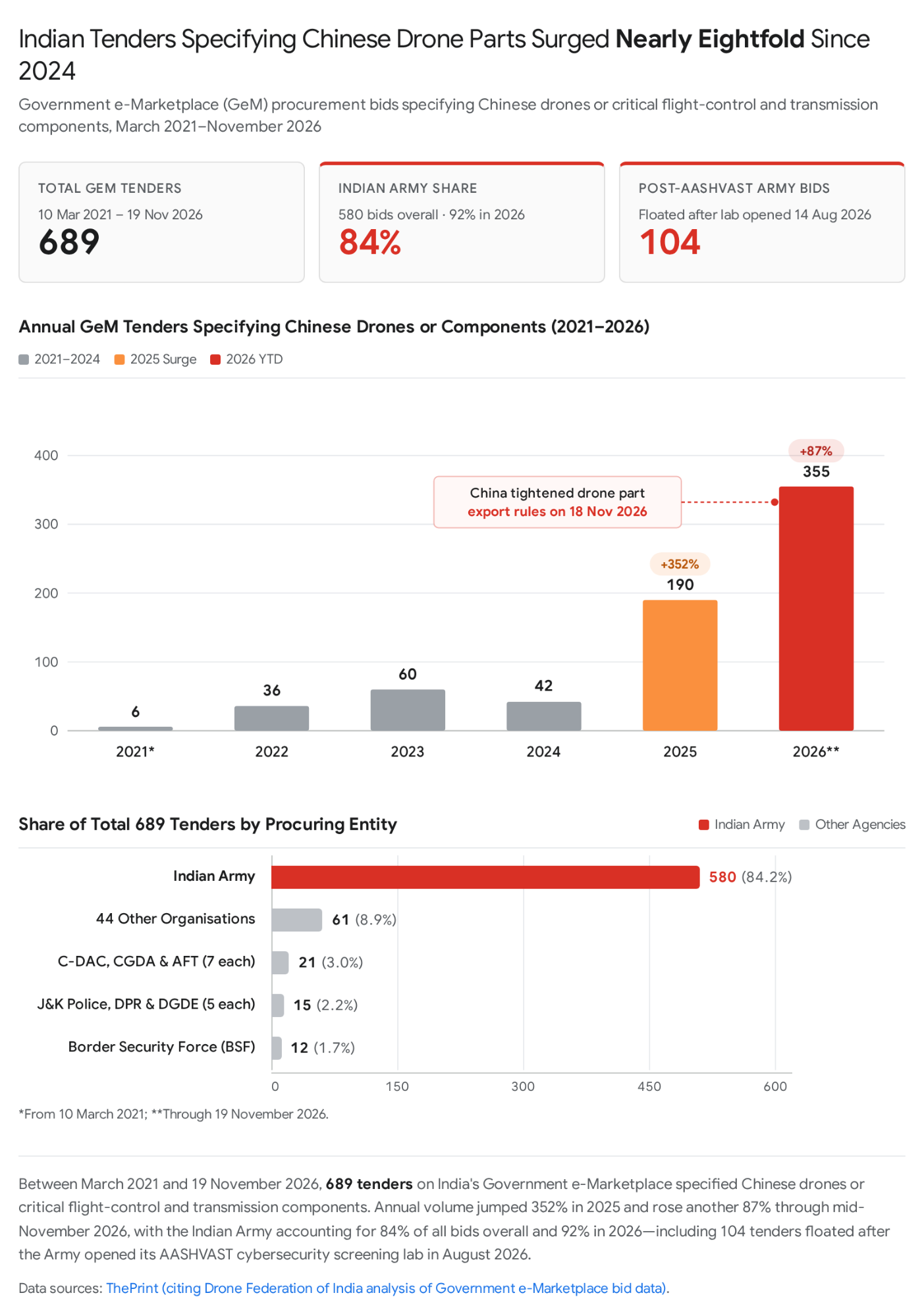
Why did this procurement spike happen even as New Delhi champions self-reliance? Industry sources quoted in ThePrint pointed to a practical shift on the ground: Army units have increasingly begun assembling their own tactical drones in-house and turning to fast local tenders for off-the-shelf components5. The DFI warned that these parts are “not peripheral accessories” because they govern flight control and data transmission, creating cyber vulnerabilities whenever individual unit purchases bypass centralised security vetting5. Notably, 104 of the Army’s 328 flagged tenders in 2026 were issued after the Army inaugurated its AASHVAST cybersecurity and firmware validation laboratory on 14 August 20265. Timing adds further urgency: Beijing introduced stricter export licensing controls on drone motors, speed controllers, autopilots, and radios on 18 November 2026, exposing tactical units to sudden supply cut-offs while undercutting Indian component makers trying to scale up5.
Air Power, Dual-Use Infrastructure, and Strategic Diplomacy
In aviation and infrastructure, India logged encouraging industrial progress alongside familiar foreign technology-transfer friction. On 24 November, officials quoted in Indian reporting stated that the first domestically manufactured C295 military transport aircraft—produced by Tata Advanced Systems Limited (TASL) in partnership with Airbus using more than 13,000 locally made parts—has entered final flight trials and certification, targeting handover to the Indian Air Force (IAF) by 31 December 202619. Under the 56-aircraft contract, 16 were slated to arrive from Spain and 40 to be built in India, with the remaining 39 Indian-made aircraft expected by August 203119. On the same day, four Indian Army aircraft—two fixed-wing microlights and two powered hang gliders from Team Mountain Eagles—successfully landed on a specially engineered stretch of the Amritsar–Jamnagar Economic Corridor (NH-754A) in Patan, Gujarat, demonstrating how reinforced highway pavements (built with a 550 mm crust and 500 mm subgrade designed for 170 million standard axles) can support emergency and dual-use aviation18.
Meanwhile, preparations accelerated for Aero India 2027 in February, with the Ministry of Defence announcing on 25–26 November that it is adding 12,000 square metres of exhibition space to accommodate record exhibitor demand23. Yet India’s flagship fighter procurement ran into renewed scrutiny on 26 November, when Indian defence media citing French reporting noted that Safran intends to retain control over critical M88 engine parts, software, and design rights under India’s proposed USD 36 billion Multi-Role Fighter Aircraft (MRFA) programme for 114 additional Rafales—reinforcing debates over how deeply foreign manufacturers are willing to share core propulsion intellectual property25.
India’s military diplomacy stayed active across four distinct corridors during the week. In West Asia, the 14th India–UAE Joint Defence Cooperation Committee (JDCC) meeting convened in Abu Dhabi on 26 November, co-chaired by Indian Defence Secretary Rajesh Kumar Singh and UAE Under Secretary Lt Gen Ibrahim Nasser M. Al Alawi3. Building on the May 2026 India–UAE Strategic Defence Partnership Framework, both countries agreed to accelerate co-development and co-production of next-generation defence equipment while expanding collaboration across AI, cyber, maritime safety, and military training, supported by an Indian industry delegation visiting Abu Dhabi’s Tawazun Industrial Park3. Closer to home, the 20th edition of the annual India–Nepal bilateral exercise Suryakiran XX opened on 25 November at the Nepal Army Battle School in Saljhandi (running through 8 December), bringing together 334 Indian troops from the Kumaon Regiment and an equal Nepali contingent from the Shri Jawla Dal Battalion for counter-insurgency, heliborne, and disaster-response drills24. At sea, the stealth frigate INS Sahyadri wrapped up a 20–22 November port call at Da Nang, Vietnam, while Indian Coast Guard offshore patrol vessel ICGS Sujay concluded a 23–25 November visit to Trincomalee, Sri Lanka, conducting marine pollution-response training with local counterparts17.
Sustainment and strategic leadership rounded out New Delhi’s week. On 20 November, the US Navy Military Sealift Command ship USNS Wally Schirra arrived at Larsen & Toubro’s Kattupalli shipyard near Chennai for maintenance under the US–India Master Ship Repair Agreement14. Three days later, a US–India Major Defence Partnership fact sheet highlighted the tempo of 2026 bilateral cooperation—from the August 2026 Javelin anti-tank missile agreement and Tata–Lockheed–Raytheon co-production memorandum to US F-35 fighters participating for the first time in a military exercise on Indian soil during Tarang Shakti14. Back in New Delhi on 26 November, Defence Minister Rajnath Singh addressed the convocation of the 66th National Defence College (NDC) course—graduating 122 participants, including 40 foreign officers from 24 countries—and urged the institution to link strategic research directly to national-security policy26. On the same day, marking 18 years since the 26/11 Mumbai attacks, Air Chief Marshal Ashutosh Dixit highlighted what he termed India’s “new normal” in responding decisively to cross-border terrorism25. Preparations also moved ahead for year-end officer graduations, with President Droupadi Murmu scheduled to review the Indian Naval Academy Passing Out Parade on 28 November and media reports pointing to Singh reviewing the 151st National Defence Academy parade on 29 November (though not yet confirmed by an official Press Information Bureau release as of 25 November)19.
Australia: Pacific Treaty Gains, AUKUS Reality Checks, and a Domestic Rights Flashpoint
For Australia, the past seven days brought major diplomatic wins in its immediate neighbourhood, a vivid split-screen on the future of AUKUS nuclear-powered submarines, and an unusually fierce political clash in Canberra over sweeping new domestic defence powers.
Locking In the Pacific: The Australia–Solomon Islands Treaty and PNG Recruitment
Australia achieved its biggest Pacific strategic breakthrough of the year on Wednesday, 25 November, when Prime Minister Anthony Albanese and Solomon Islands Prime Minister Matthew Wale signed the Australia–Solomon Islands Treaty in Canberra21. Coming just one day after reports that Honiara had notified Beijing it would not renew its secretive 2022 five-year security pact when it expires in April 2027, the treaty reverses four years of deep anxiety in Canberra over potential Chinese military footholds along Australia’s northeastern approaches8. Standing beside Albanese, Wale—who took office in May 2026—did not mince words: “Solomon Islands has been, for a number of years, a source of uncertainty and doubt in the region. Those days are done. Gone”8.
The treaty blends hard security guarantees with major long-term development backing. Formally naming Australia as the Solomon Islands’ “primary security partner,” the pact affirms Honiara’s sovereign decision to allow no foreign military or security bases on its territory7. Sensitive national infrastructure—explicitly covering ports, airports, energy, telecommunications, roads, and bridges—must remain free from militarisation, foreign interference, and unauthorised access, though the provisions do not apply retroactively7. Crucially, under Article 5 (clause 5c), Honiara agreed to consult Australia before entering security cooperation or critical infrastructure deals with countries outside the Pacific Islands Forum7.
In return, Australia committed AUD 740 million (approximately USD 490 million) over ten years, focused on delivering universal kindergarten-to-Year-12 education—a pressing priority in a country where one-third of children do not attend school and fewer than 20% finish Year 12—alongside police training, border security, and an expanded Pacific Australia Labour Mobility (PALM) scheme covering early childhood education and aged care7. To put that financial commitment in perspective using World Bank figures cited in reporting, USD 490 million spread over ten years averages USD 49 million annually, or roughly 2.8% of the Solomon Islands’ USD 1.75 billion annual GDP7. Analysts at the Australian Strategic Policy Institute noted that while the agreement locks in a clear strategic tilt toward Canberra, ongoing Chinese economic competition means Australia will have to deliver consistently on its promises50.
On the very same day (25 November), Australia also operationalised closer military integration with its nearest neighbour, formally opening ADF recruitment to eligible Papua New Guinea (PNG) citizens following two defence arrangements formalised between 22 and 24 November under October’s Pukpuk Treaty6. The pilot targets two cohorts of up to 50 recruits—up to 100 individuals in total—who must meet the exact same education, health, physical, and security standards as Australian applicants6. Selected candidates will complete a 16-week residential pre-enlistment course in PNG starting in mid-2027 to prepare for life and military training in Australia6. As Acting First Assistant Secretary Laura Darlington observed, the initiative reflects a shared recognition that Australian and PNG security are deeply interconnected6.
AUKUS Between Shipyard Strain and Sovereign Milestones
Few defence programmes illustrate the gap between strategic vision and industrial friction better than AUKUS, and both sides of that ledger played out in Australia during the week.
First came a sobering dose of arithmetic from Washington. Reporting on 19–20 November detailed a US Congressional Budget Office (CBO) assessment warning that the US submarine industrial base is struggling to meet the US Navy’s own requirements and that selling three to five Virginia-class nuclear-powered attack submarines (SSNs) to Australia starting in 2032 would shrink the US Navy’s attack submarine fleet for “many years”10. Worse still, the CBO noted that the US Navy’s latest shipbuilding plan relegates the Australian transfers to a footnote rather than factoring them into headline fleet projections10. The report also posed an uncomfortable strategic question: while Australian-based SSNs could respond faster to a crisis in the South China Sea or Taiwan Strait, sovereign Australian vessels cannot be ordered into a US–China war without Canberra’s consent10.
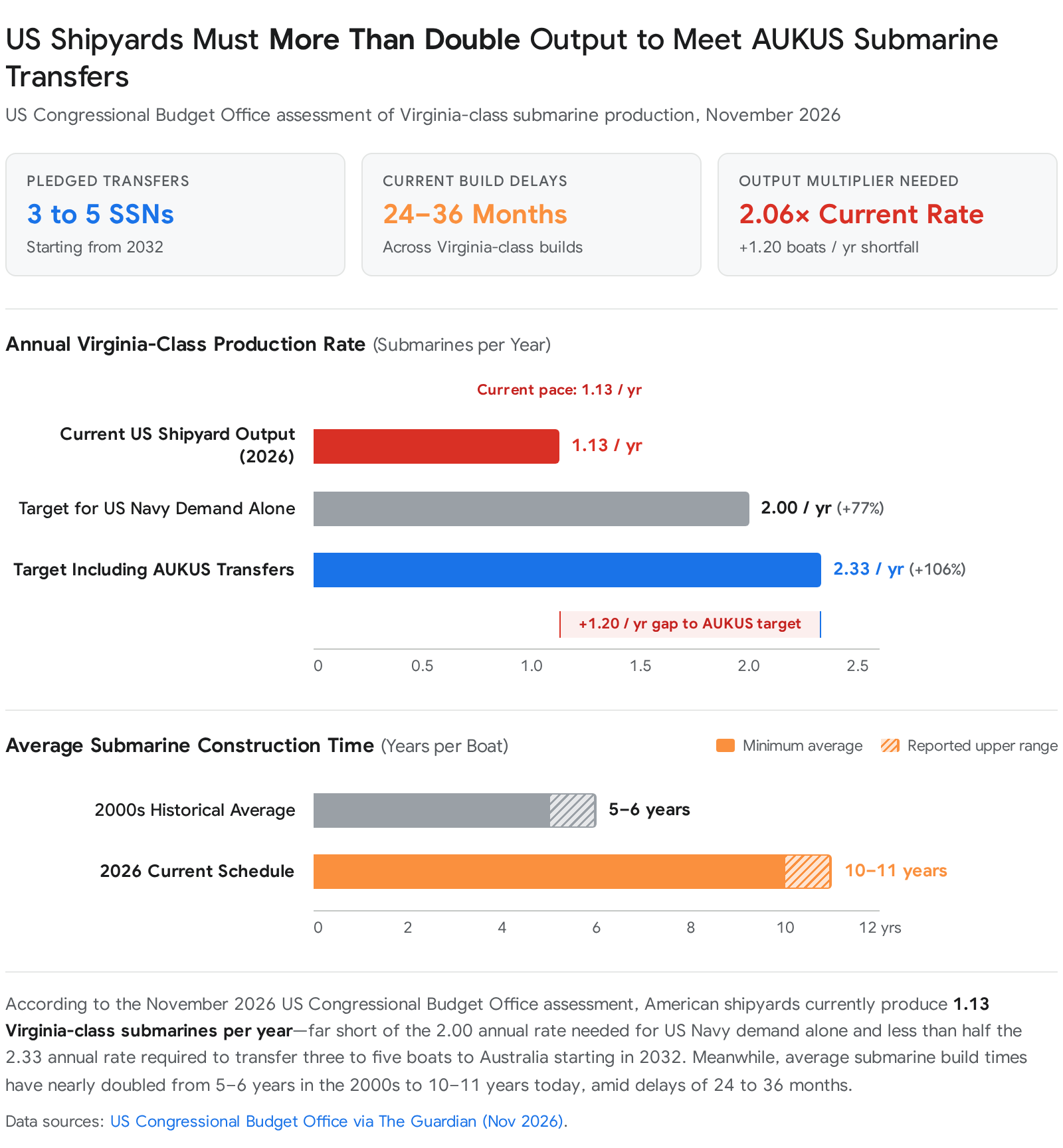
In remarks reported on Sunday, 22 November, Deputy Prime Minister and Defence Minister Richard Marles pushed back against concerns that AUKUS would weaken the US Navy, reaffirming Canberra’s confidence in the trilateral pathway16. He also noted that Australia had signed a US-led agreement that week aimed at identifying vulnerable supply chains, safeguarding sensitive AI technology from theft and foreign interference, and encouraging AI data-centre investment outside the United States—while insisting that any investment in Australia must happen “on our terms”16.
Just days later, on 25–26 November, the Australian Submarine Agency (ASA) delivered tangible hardware to counter AUKUS sceptics: the arrival at HMAS Stirling in Western Australia of Australia’s first sovereign Virginia-class submarine training systems11. Moved across sea, road, and strategic airlift, the package includes more than a dozen training devices anchored by the Virginia Ship Control Operations Trainer (VSCOT)—a high-fidelity simulator replicating a Virginia-class ship control station for manoeuvring and emergency drills11. Captain Jason Pittman, Commodore of Submarine Squadron 3 in the US Pacific Fleet, stressed the milestone’s significance, noting it marks the first time such core nuclear-powered submarine crew training systems have been delivered outside the United States11. Installation at SSN Training Centre-West is scheduled to finish in 2027, supporting both Australia’s future fleet and Submarine Rotational Force–West (SRF-West), which will host rotational US submarines starting with USS Colorado in late 202711.
Sweeping Defence Powers Spark a Human Rights Debate
While Pacific treaties enjoyed bipartisan applause, domestic defence legislation triggered an intense civil-liberties storm. At the centre of the controversy is the Defence Legislation Amendment (Accelerating Capability and Protecting Bases) Bill 2026, introduced quietly on 27 October and pushed rapidly through Parliament in late November with backing from Labor, the Coalition, and One Nation—after the Senate voted down efforts on 19 November to refer the 231-page bill to a committee9.
Designed by the government to protect sensitive bases, counter hostile drones, and accelerate domestic weapons testing and allied capability projects, the legislation grants expansive executive powers57. It allows the Defence Minister to declare areas of land, sea, or airspace—including temporary, mobile, or privately owned contractor sites—as “defence security zones,” some of which need not be publicly listed9. It also enables “capability declarations” exempting declared defence officials and contractors from certain federal, state, and territory laws9. Within declared zones, officials may search people and devices, detain individuals without arrest on “reasonable suspicion,” and use “reasonable and necessary force”—including lethal force in specific circumstances such as preventing serious injury or death or stopping a fleeing detainee9. Anyone suspected of entering or photographing declared sites faces up to seven years in prison, a fine of AUD 152,880, or both9.
On Thursday evening, 26 November, the Parliamentary Joint Committee on Human Rights—chaired by Labor MP Zaneta Mascarenhas—published a sharp assessment warning that the laws pose “significant” implications for liberty, privacy, free movement, expression, and life9. The committee flagged that the bill sets no maximum period for detention without arrest, fails to mandate basic humane detention standards (such as fresh drinking water, sanitation, healthcare, and humane temperatures), lacks notification obligations for affected civilians, and relies only on after-the-fact review by the Inspector-General of the Australian Defence Force9. Earlier in the week, the Law Council of Australia criticised the three-business-day public scrutiny window; Amnesty International warned on 20 November that the bill threatens peaceful protest, and press-freedom observers raised alarms about investigative journalism15.
Prime Minister Albanese forcefully defended the legislation in Question Time on 26 November, dismissing criticism as “nonsense” and “conspiracy theories” from both the “far left” and “far right”9. “What this legislation is about is simply making sure that our defence institutions and infrastructure are kept safe,” he argued, calling suggestions that a minister would abuse declaration powers “irresponsible”9. Even so, the unusual spectacle of a Labor-chaired committee raising red flags after the bill had already passed ensures the debate over national security versus democratic oversight will linger well beyond November.
Regional Interoperability, Naval Presence, and Cultural Reckoning
Rounding out Australia’s defence week were quieter but meaningful moves on allied networking, maritime deployment, and military culture. On 27 November, Defence formally announced the Australia–Japan Defence Communications (DEFCOMM) Arrangement, signed on 28 October in Honolulu by ADF Head of Cyber Operations and Strategic J6 Major General Warren Gould and Japan Self-Defense Forces (JSDF) C4 Systems Director General Major General Akitsugu Kimura12. The pact modernises networks and establishes trusted, interoperable links across communications, cyber, and information domains so both militaries can share data securely and make decisions faster during combined operations12. At sea, the Royal Australian Navy reported on 26 November that Task Group 665.5 remained deployed across the Indo-Pacific conducting multinational integration, including Australian officers embarking aboard the aircraft carrier USS Theodore Roosevelt during Exercise Keen Sword 2727.
Domestically, the week also featured a watershed moment of institutional repair alongside public outreach and emerging-technology policy debate. On 25 November, the Albanese Government delivered a formal national apology to current and former LGBTQIA+ ADF members, veterans, and their families for historical persecution and discrimination20. Addressing those harmed, Defence Minister Richard Marles said: “You and your families offered this nation everything that service asks. We offered in return condemnation, derision and suspicion. This country did not keep faith with you. Today, it says sorry”20. The following day, the ADF opened four days of public capability displays at the Adelaide Grand Final featuring F-35A Lightning II flypasts, Pilatus PC-21 displays, and heritage Spitfire flights65. Meanwhile, analysis published by the Australian Strategic Policy Institute on 25 November urged Defence to pair military qualification with an export pipeline so Australia’s domestic strengths in quantum clocks and sensors translate into real deterrent capability66.
Where India and Australia Intersect: From Manila’s Quad Summit to Shared Indo-Pacific Deterrence
Although no standalone India–Australia bilateral defence treaty was signed between 20 and 27 November, the operational shadow of the Quad Leaders’ Summit in Manila—held just days earlier on 17 November 2026, the first leaders’ gathering in two years—shaped strategic commentary in both New Delhi and Canberra throughout the week13.
Both the 23 November US–India defence fact sheet and Australian policy analyses published on 24 November underscored the summit’s most concrete military deliverable: the Quad’s first-ever joint military exercise in 202713. Under the plan endorsed by the leaders of India, Australia, Japan, and the United States, maritime patrol aircraft—including P-8 and P-3C aircraft from all four countries—will fly together in conjunction with Exercise Sea Dragon 2027 to tighten maritime surveillance, intelligence sharing, and operational coordination across Indo-Pacific sea lanes13. Beyond patrol aircraft, the Manila commitments expanded Australia’s regional cable-resilience work to include undersea electricity cables alongside telecommunications, backed an Indo-Pacific AI accelerator, and pledged deeper cybersecurity and counterterrorism coordination13.
For India and Australia specifically, this Quad operationalisation rests on a rapidly maturing bilateral foundation built throughout 2026, including their renewed Joint Declaration on Defence and Security Cooperation, amphibious and humanitarian drills during Exercise AUSTRAHIND 2026 in Kerala, and plans for expanded Indian participation in Australia’s Exercise Talisman Sabre 202769. Yet this past week also revealed a parallel strategic lesson for both nations. Whether it is India confronting Safran’s hold on fighter engine technology and unit-level reliance on Chinese drone parts, or Australia reckoning with US submarine shipyard delays and domestic friction over expedited capability laws, building sovereign deterrence in a contested Indo-Pacific requires far more than diplomatic communiqués—it demands sustained industrial depth, disciplined procurement, and public trust5.
Conclusion
The seven days from 20 November to 27 November 2026 offered a revealing snapshot of two major Indo-Pacific powers moving firmly from strategic planning into execution. India demonstrated clear momentum in domestic shipbuilding, private-sector counter-drone engineering, and Gulf defence industrial partnerships, yet the revelation of 689 government tenders specifying Chinese drones or components underscored how easily tactical shortcuts can erode long-term self-reliance1. Australia, meanwhile, scored a decisive geopolitical win in the Solomon Islands, deepened human and technological interoperability with Papua New Guinea and Japan, and brought its first AUKUS submarine simulators home to HMAS Stirling—even as US shipyard constraints and domestic human rights objections reminded Canberra that ambitious defence transformations carry real external and constitutional risks6. Watching how New Delhi closes its tactical supply-chain gaps and how Canberra balances fast-track military capability with democratic safeguards will be essential as both nations head toward joint Quad maritime operations in 202713.
Disclaimer
This article is compiled for general informational and analytical purposes based on publicly available government press releases, parliamentary inquiry reporting, think-tank publications, and open-source defence journalism published or updated between 20 November and 27 November 2026 (with select earlier dates explicitly identified for essential context). Defence procurement figures, delivery schedules, capability specifications, and legislative provisions are subject to official revision, classification limits, and ongoing political or operational developments. Certain reported details—such as unconfirmed ceremonial schedules or private-sector weapon performance claims—reflect open-source and vendor reporting rather than independent technical verification. This report does not constitute legal, financial, investment, or professional security advice.
References
- Indian Navy takes delivery of Diving Support Craft ‘DSC A21’, https://www.shanmugamiasacademy.in/ca-pdf/news/ca-2026-11-21-17-indian-navy-takes-delivery-of-diving-support-en.pdf
- Ashank Delivered: Another Shallow-Water Hunter from GRSE, https://www.cavalier.in/nda-current-affairs/2026-11-23/ashank-asw-shallow-water-craft-grse-delivery-2026
- https://www.pib.gov.in/PressReleasePage.aspx?PRID=2342210®=3&lang=1
- India’s first private-sector micro-missile, Jwala Mk-1, flight-tested at, https://www.indiasentinels.com/defence-industry/private/indias-first-private-sector-micro-missile-jwala-mk-1-flight-tested-at-pokhran-7724
- https://theprint.in/defence/industry-body-raises-alarm-689-tenders-for-chinese-drones-parts-floated-since-2021-84-by-army/3105003/
- Set to serve side by side – Defence, https://www.defence.gov.au/news-events/news/2026-11-25/set-serve-side-side
- Solomon Islands signs security deal with Australia, https://www.aljazeera.com/news/2026/11/25/solomon-islands-signs-security-deal-with-australia
- Australia’s security pact with Solomon Islands a blow to China’s, https://www.theguardian.com/world/2026/nov/25/australia-solomon-islands-treaty-blow-to-china-pacific-influence
- https://www.theguardian.com/australia-news/2026/nov/26/new-defence-laws-could-have-significant-implications-for-human-rights-labor-led-inquiry-finds
- US warned supplying nuclear-powered submarines to Australia, https://www.theguardian.com/world/2026/nov/20/aukus-defence-us-warned-supplying-nuclear-powered-submarines-to-australia-would-diminish-its-own-fleet-for-many-years
- Australia’s first sovereign submarine training capability delivered in Stirling effort by air, land and sea, https://www.asa.gov.au/news-hub/australias-first-sovereign-submarine-training-capability-delivered-stirling-effort-air-land-and-sea
- Australia and Japan strengthen partnership, https://www.defence.gov.au/news-events/news/2026-11-27/australia-japan-strengthen-partnership
- Quad Leaders’ Summit: 5 Bold Steps to Secure the Indo-Pacific, https://newscop.com.au/2026/11/24/quad-leaders-summit-manila-australia-5/
- US, India deepen defence partnership with major military exercises, Javelin deal, expanded Quad cooperation, https://www.aninews.in/news/world/asia/us-india-deepen-defence-partnership-with-major-military-exercises-javelin-deal-expanded-quad-cooperation20261123181439
- Sweeping new Defence laws threaten the right to peacefully protest, https://www.amnesty.org.au/sweeping-new-defence-laws-threaten-the-right-to-peacefully-protest/
- Australia Rejects US Report Warning AUKUS Submarine Deal, https://www.tasnimnews.ir/en/news/2026/11/22/3755136/australia-rejects-us-report-warning-aukus-submarine-deal-could-weaken-american-navy
- Daily Current Affairs 24 November 2026 – SSBCrackExams, https://media.ssbcrackexams.com/2026/11/DCA-24-November-2026.pdf
- High Standards of National Highways Facilitate Landing of Army Aircraft, https://www.pib.gov.in/PressReleseDetailm.aspx?PRID=2341794
- India-Made C295 Aircraft Nears IAF Delivery, Final Trials Underway, https://www.nationpathindia.com/defence/iaf-first-india-made-c295-aircraft-delivery-december-2026
- Apology to personnel shamed for who they were – Defence, https://www.defence.gov.au/news-events/news/2026-11-25/apology-personnel-shamed-who-they-were
- Signing of the Australia-Solomon Islands Treaty, https://www.pm.gov.au/media/signing-australia-solomon-islands-treaty
- ICGS Sujay Concludes Visit to Trincomalee, https://www.pib.gov.in/PressReleseDetailm.aspx?PRID=2341559
- India-UAE Defence Partnership: AI, Cyber, Next-Gen Equipment, https://defencestandard.com/india-uae-chart-joint-defence-cooperation-on-ai-cyber-maritime-safety/
- Suryakiran XX: India and Nepal Train Together at Saljhandi, https://www.cavalier.in/nda-current-affairs/2026-11-25/suryakiran-xx-india-nepal-joint-exercise-saljhandi-2026
- Indian Defence News, https://www.indiandefensenews.in/
- Defence Minister Rajnath Singh Calls for Forward-Looking National, https://thepublicworld.com/archives/121786
- Task group integrates with regional partners – Defence, https://www.defence.gov.au/news-events/news/2026-11-26/task-group-integrates-regional-partners
- DELIVERY OF DSC A21 (YARD 326) OF DIVING SUPPORT CRAFT, https://tendervigil.com/briefing/DIP-SIGNAL-1ef6f5855ec11343e633dac5
- PM Modi Pushes DRDO to Share Research with Industry, https://raksha-anirveda.com/pm-modi-pushes-drdo-to-share-research-with-industry/
- India’s first autonomous micro-missile system JWALA MK-1 tested at, https://timesofindia.indiatimes.com/defence/news/boost-to-atmanirbhar-bharat-indias-first-autonomous-micro-missile-system-jwala-mk-1-tested-at-pokhran-watch/articleshow/136094927.cms
- JWALA MK-1, India’s first autonomous counter-drone micro-missile, https://www.indiatvnews.com/news/india/jwala-mk-1-indias-first-autonomous-counter-drone-micro-missile-system-tested-at-pokhran-2026-11-23-1060161
- India’s first private-sector micro-missile JWALA MK-1 tested in Pokhran, https://www.business-standard.com/external-affairs-defence-security/news/india-first-private-sector-micro-missile-jwala-mk1-counter-drone-defence-126112300536_1.html
- IG Defence test-fires JWALA, India’s micro-missile built to take on low-cost drones, https://www.wionews.com/defence-pulse/ig-defence-test-fires-jwala-india-s-micro-missile-built-to-take-on-low-cost-drones-1795434758824
- India Test-Fires JWALA MK-1, Its First Autonomous Counter-Drone, https://defensemirror.com/news/42415
- This Laser Drones can’t be jammed . – YouTube, https://www.youtube.com/shorts/JiCXjoZoJls
- Aero India 2027 Sees Record Exhibitor Demand, Ministry … – DD India, https://ddindia.co.in/2026/11/aero-india-2027-sees-record-exhibitor-demand-ministry-of-defence-expands-infrastructure/
- Defence Minister orders NDC to link strategy research directly to policy, https://defencestandard.com/defence-minister-orders-ndc-to-link-strategy-research-directly-to-policy/
- Defence Ministry expands infrastructure for Aero India 2027 amid, https://www.indiastrategic.in/defence-ministry-expands-infrastructure-for-aero-india-2027-amid-rising-exhibitor-demand/
- India-Australia defence ties gain strategic depth amid China’s, https://defence.in/threads/india-australia-defence-ties-gain-strategic-depth-amid-chinas-assertiveness.19043/
- India and UAE agree to accelerate co-development & co-production, https://anine.ws/en/india/india-and-uae-agree-to-accelerate-co-development-co-production-of-next-generatio
- india–nepal joint military exercise ‘suryakiran xx’ commences in nepal, https://www.pib.gov.in/PressReleseDetailm.aspx?PRID=2341241
- indian naval ship sahyadri concludes port visit to da nang, vietnam, https://www.pib.gov.in/PressReleasePage.aspx?PRID=2340385
- Press Release: Press Information Bureau, https://www.pib.gov.in/PressReleaseDetail.aspx?PRID=2341878®=22&lang=1
- NDA Passing Out Parade On 29 November? 6 Things To Know, https://defencedirecteducation.com/2026/11/25/nda-passing-out-parade/
- President Murmu to Review Naval Officer Commissioning Parade, https://defencestandard.com/president-murmu-to-review-400-naval-officer-cadets-at-indian-naval-academy/
- Australia – Solomon Islands Treaty, https://www.dfat.gov.au/news/australia-solomon-islands-treaty
- Solomon Islands reshaped Pacific security ties, signed Strategic, https://www.vibemedia.net.au/solomon-islands-reshaped-pacific-security-ties-signed-strategic-treaty-with-australia/
- Solomon Islands names Australia as its primary security partner in a new treaty that excludes China, https://apnews.com/article/australia-solomon-islands-china-security-treaty-6eaee893cd625ad71bd34dbe887ac73a
- Solomon Islands plans to replace China security pact with Australia, https://www.dailymaverick.co.za/article/2026-11-24-solomon-islands-plans-to-replace-china-security-pact-with-australia-treaty-report-says/
- Solomons treaty locks in a strategic shift towards Australia, away from China, https://www.aspistrategist.org.au/solomons-treaty-locks-in-a-strategic-shift-towards-australia-away-from-china/
- Australia, Solomon Islands agree to security consultation clause in, https://pina.com.fj/2026/11/26/australia-solomon-islands-agree-to-security-consultation-clause-in-new-treaty/
- PNG & AUSTRALIA FORMALISE TWO KEY DEFENCE, https://pnghausbung.com/png-australia-formalise-two-key-defence-arrangements/
- Australia receives first Virginia-class submarine simulators at Stirling, https://www.naval-technology.com/news/australia-submarine-simulator-delivery/
- Australia receives first Virginia-class submarine training systems, https://www.navaltoday.com/2026/11/26/australia-receives-first-virginia-class-submarine-training-systems-under-aukus
- AUKUS Agreement | Australian Submarine Agency, https://www.asa.gov.au/aukus-agreement
- Labor, the Coalition and One Nation pass heinous Defence Bill, https://www.youtube.com/watch?v=qCEbqTuciFc
- Six things in the Government’s new Defence Capability Bill that should concern you, https://thepoint.com.au/explainers/261118-six-things-in-the-governments-new-defence-capability-bill-that-should-concern-you
- I move: At the end of the motion,…: 19 Nov 2026: Senate debates, https://www.openaustralia.org.au/senate/?id=2026-11-19.25.1
- Australia’s Sweeping Defence Bill Raises Fears Over Press, https://tongaindependent.com/australias-sweeping-defence-bill-raises-fears-over-press-freedom-and-government-oversight/
- Defence Legislation Amendment…: 18 Nov 2026: Senate debates, https://www.openaustralia.org.au/senate/?id=2026-11-18.210.1
- New legislation to facilitate Defence C-UAS operations at bases and, https://podcasts.apple.com/nz/podcast/new-legislation-to-facilitate-defence-c-uas-operations/id1521766192?i=1000802320816
- Urgency shouldn’t override due diligence where far-reaching, https://www.lawcouncil.au/media/media-releases/urgency-shouldn-t-override-due-diligence-where-far-reaching-defence-bill-raises-questions-about-civil-liberties
- ADF Apologises to LGBTQIA+ Personnel, Past and Present, https://www.miragenews.com/adf-apologises-to-lgbtqia-personnel-past-and-1783200/
- Apology to current and former LGBTQIA+ ADF veterans, members & their families, https://www.minister.defence.gov.au/statements/2026-11-25/apology-current-former-lgbtqia-adf-veterans-members-their-families
- ADF capabilities on show at the Adelaide Grand Final 2026 | Air Force, https://www.airforce.gov.au/news-events/flying-activities-events/2026-11-26/adf-capabilities-show-adelaide-grand-final-2026
- Australia must turn its quantum edge into a powerful deterrent, https://www.aspistrategist.org.au/australia-must-turn-its-quantum-edge-into-a-powerful-deterrent/
- From Manila, a question: Does Quad membership translate into influence?, https://indianexpress.com/article/opinion/columns/quad-summit-manila-india-strategic-autonomy-10974080/
- Beyond the optics of a quiet Quad, https://www.hindustantimes.com/ht-insight/international-affairs/beyond-the-optics-of-a-quiet-quad-101795172298877.html
- AUSTRAHIND 2026 HADR drills bring in Indian Navy, https://indiadefencewire.com/articles/austrahind-2026-hadr-drills-sea-air-insertion-navy-kerala-fire
- Australia-India Joint Declaration on Defence and Security, https://www.pm.gov.au/media/australia-india-joint-declaration-defence-security-cooperation
- Joint Statement on the Second India–Australia Defence Ministers, https://www.minister.defence.gov.au/statements/2026-06-01/joint-statement-second-india-australia-defence-ministers-dialogue