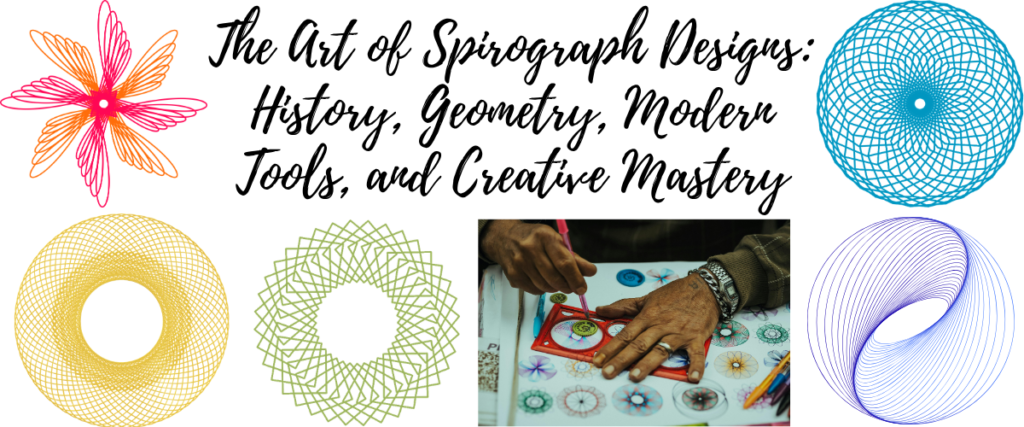
There is a quiet thrill in watching a single, uninterrupted pen line blossom into a shimmering starburst or a woven geometric mandala. Artistic spirograph design sits at the rare intersection of mathematics and tactile craft, turning simple interlocking gears into intricate, endlessly varied works of art1. For decades, many people knew these spiralling patterns mainly as a rainy-day childhood pastime, yet the craft reaches much further—backward into 18th-century luxury watchmaking and anti-counterfeiting currency design, and forward into laser-cut acrylic studio tools, gallery-scale installations, and robotic pen plotters3.
What makes spirograph art enduringly creative is that the mechanical rules do not cage the artist; they liberate them. Once you understand how a few gear ratios behave, you can layer dozens of shifted curves into optical illusions, blend ink gradients across hundreds of delicate loops, or break symmetry altogether with triangular and teardrop-shaped wheels3. Whether you are picking up a classic plastic set for the first time, upgrading to precision acrylic gears, or exploring code-driven drawing machines, this guide walks through the history, plain-English geometry, modern equipment, studio techniques, and contemporary artists defining the medium today.
From Luxury Watch Dials and Banknotes to a Cultural Icon
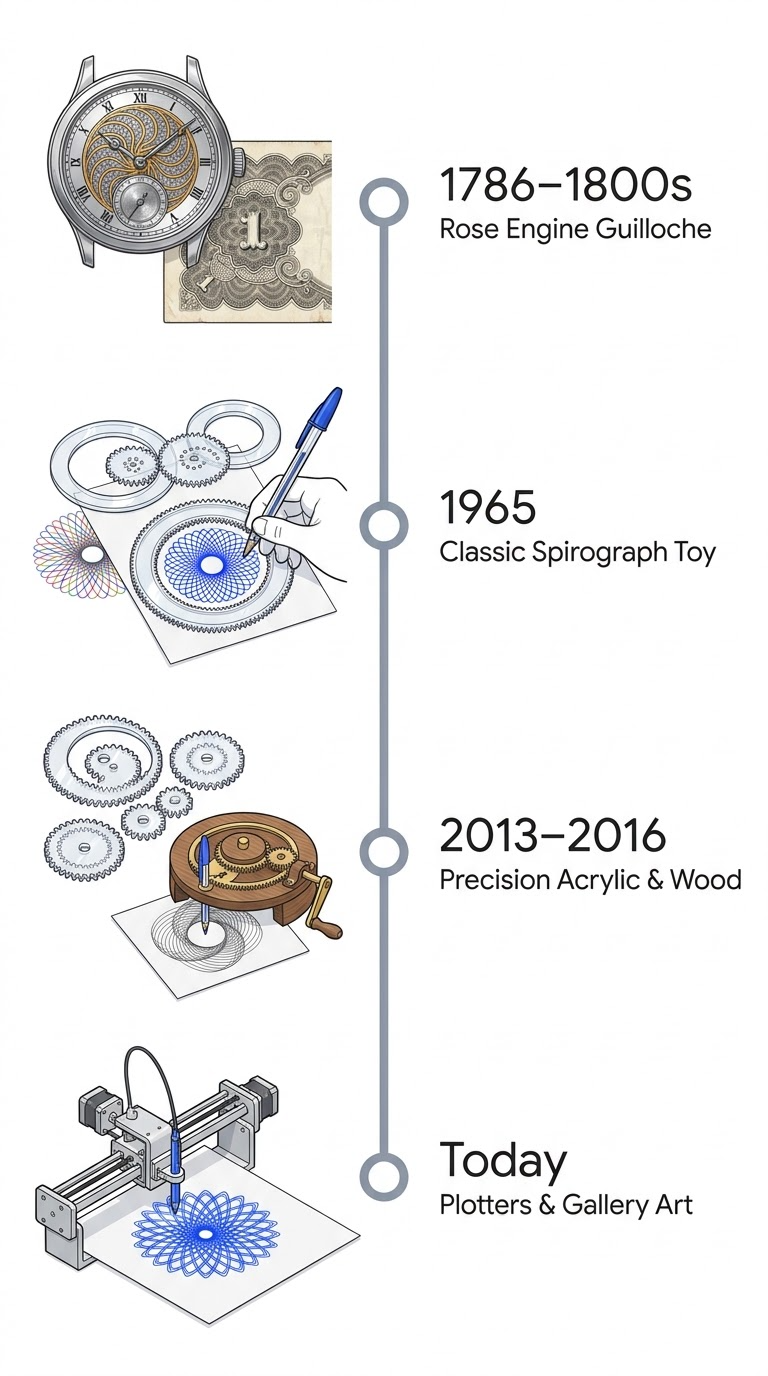
Long before plastic gears ever reached a toy shelf, spirographic curves served two of the most demanding fields in craftsmanship: fine horology and national currency security5. The visual ancestor of the spirograph is guilloché—named after the French verb guillocher, meaning to engrave with a rose engine7. Dating back to the 16th century, guilloché uses a specialised mechanical lathe fitted with eccentric cams, known as rosettes, that gently rock a metal workpiece back and forth as it turns against a cutting tool7. Around 1786, master watchmaker Abraham-Louis Breguet pioneered hand-turned guilloché on watch dials—most famously on his 1794 pocket watch No. 5 and the Marie-Antoinette watch—creating fine geometric textures such as sunbursts and Clous de Paris hobnail grids that combined practical function with extraordinary hand control5.
Because a rose engine’s interlocking wave lines were nearly impossible to imitate consistently by freehand drawing, printers soon adopted guilloché as “money lace” to thwart counterfeiters7. Early guilloché ornaments appeared on the 1814 Darlington Bank five-pound note and the 1840 Penny Black, the world’s first adhesive postage stamp7. Paired with intaglio printing—in which ink sits inside grooves carved into metal plates and transfers onto paper under intense pressure to leave tactile raised ridges—guilloché served for roughly a century as a major defence against forgery on banknotes worldwide7.
Throughout the 19th and early 20th centuries, inventors repeatedly tried to bring these captivating curves from heavy engraving workshops onto ordinary drawing paper. Early mechanical precursors included Greek-born English architect and engineer Peter Hubert Desvignes’s 1827 “Speiragraph”—a geared drawing machine he later adapted in Vienna between 1845 and 1848 to help prevent banknote forgery—John Holt Ibbetson’s lathe-mounted Geometric Chuck (circa 1833, built by Holtzappfel & Co.), and mathematician Bruno Abdank-Abakanowicz’s 1881–1900 spirograph built for calculating areas bounded by curves15. Consumer gear-based drawing toys also appeared as early as 1908, when The Marvelous Wondergraph was advertised in the Sears catalog15.
The modern icon, however, began in a quiet home loft in England. Between 1962 and 1964, British engineer Denys Fisher grew fascinated by the intricate rose-engine anti-counterfeiting designs on a British one-pound note and started tinkering with Meccano pieces to recreate similar patterns cleanly on paper15. Originally conceived as a drafting instrument, his Spirograph debuted at the 1965 Nuremberg International Toy Fair and went on sale in March 1965 at Schofields, a prestigious Leeds department store, where passersby crowded around Fisher’s live demonstrations in disbelief1. Kenner introduced the toy to the United States in 1966, and it was crowned UK Toy of the Year in 19677. According to a historical retrospective by FontLab, Spirograph sold 30 million units by 1977—and by placing banknote-style roulette curves into the hands of children with ballpoint pens, it helped shift guilloché from an exclusive security barrier into a familiar visual convention on diplomas, certificates, and graphic art7.
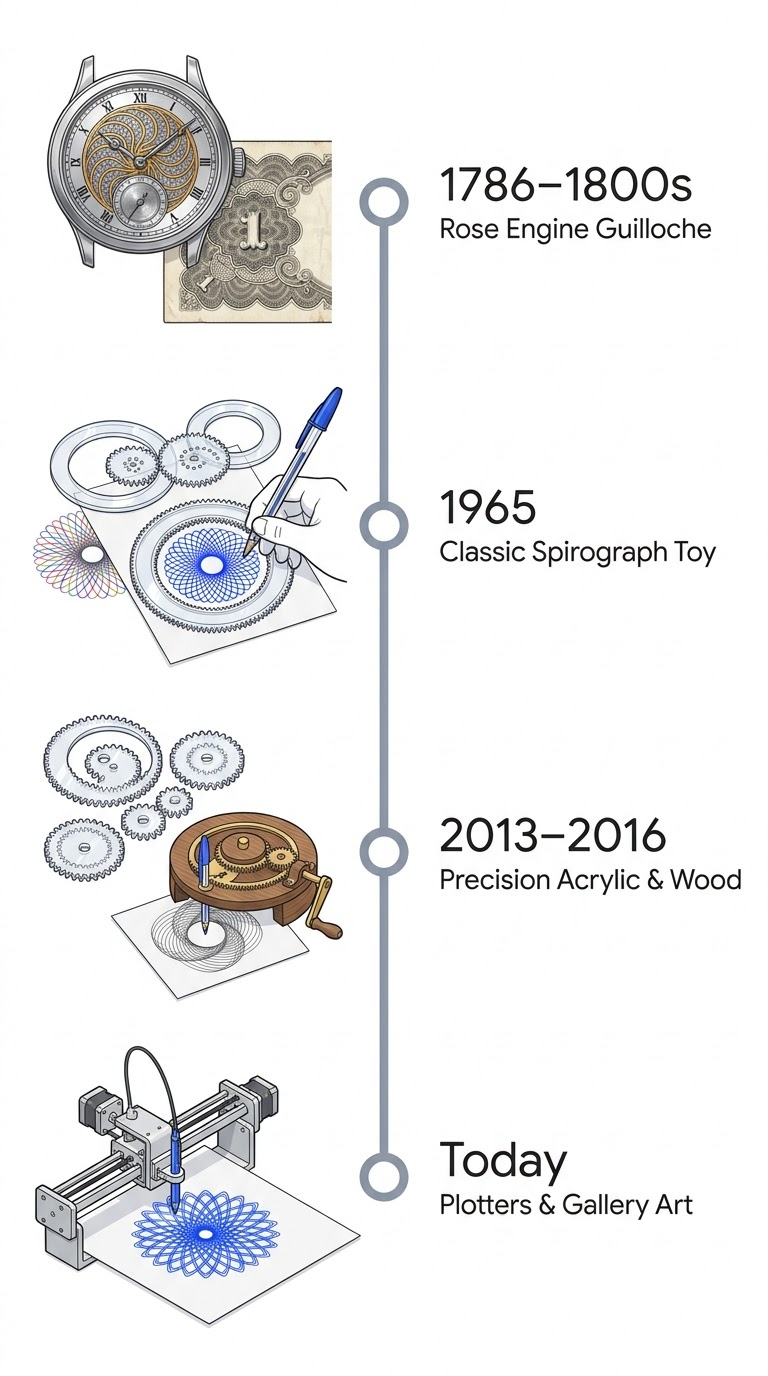
More than six decades later, the original brand remains remarkably resilient. Hasbro has held the Spirograph trademark since 1998, Kahootz Toys relaunched the classic gear sets worldwide in 2013 (replacing pinholes with removable putty), and PlayMonster LLC acquired Kahootz in 2019 under license from Hasbro1. PlayMonster has expanded the catalogue with formats such as Spirograph 3D and the Spirograph Mandala Maker (launched in 2022), followed by the announcement of an Electronic Spirograph Machine for the brand’s 60th anniversary in 20251. Buoyed by millions of views on soothing social-media ASMR drawing videos, Spirograph was named a 2025 National Toy Hall of Fame finalist at The Strong in Rochester, New York (where Battleship, Slime, and Trivial Pursuit were ultimately inducted that November)1.
The Simple Math Behind the Magic
You do not need an engineering degree to make extraordinary spirograph art, yet understanding a tiny bit of geometry transforms drawing from random trial and error into deliberate visual design. Every pattern a gear set produces belongs to a mathematical family called roulette curves—paths traced by a point attached to one shape as it rolls without slipping along another2.
In gear-based drawing, two sibling curves do almost all the work2:
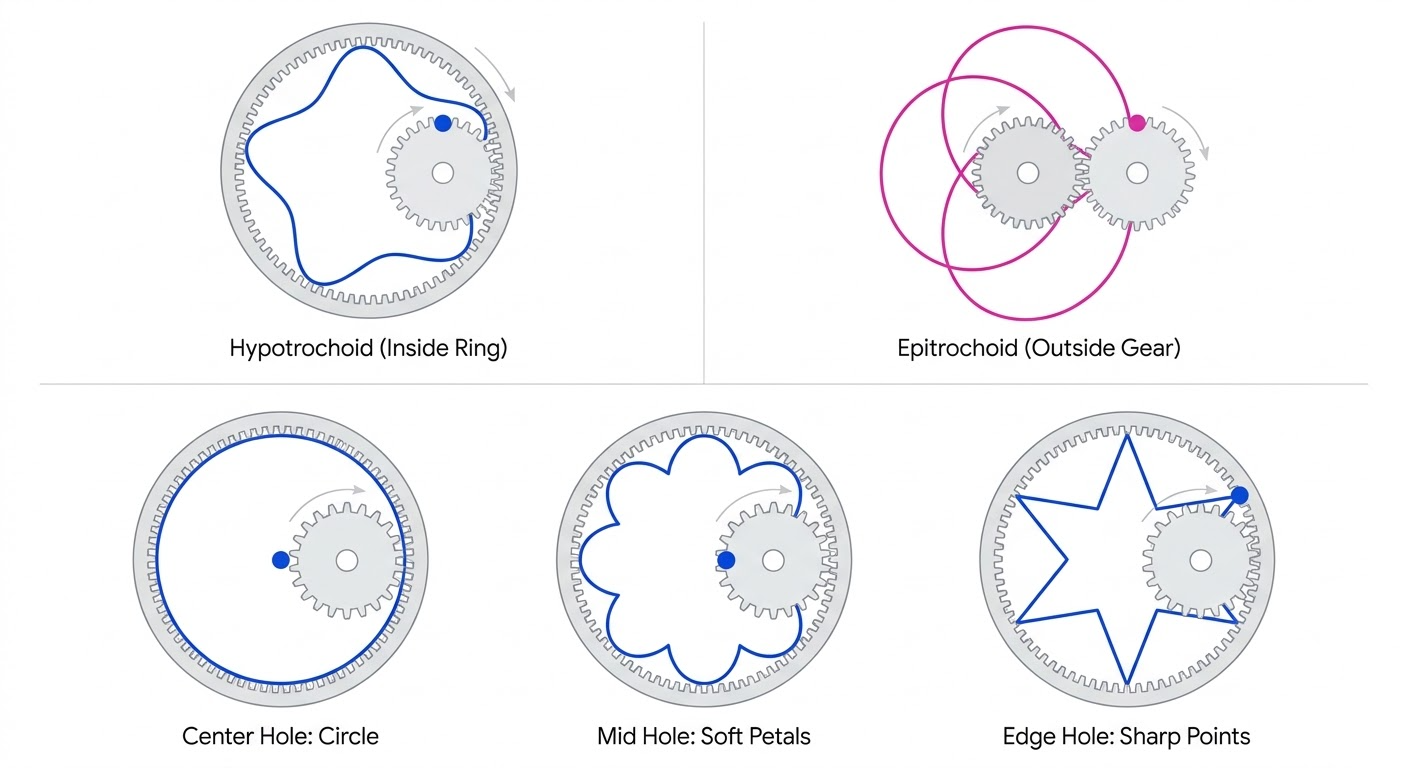
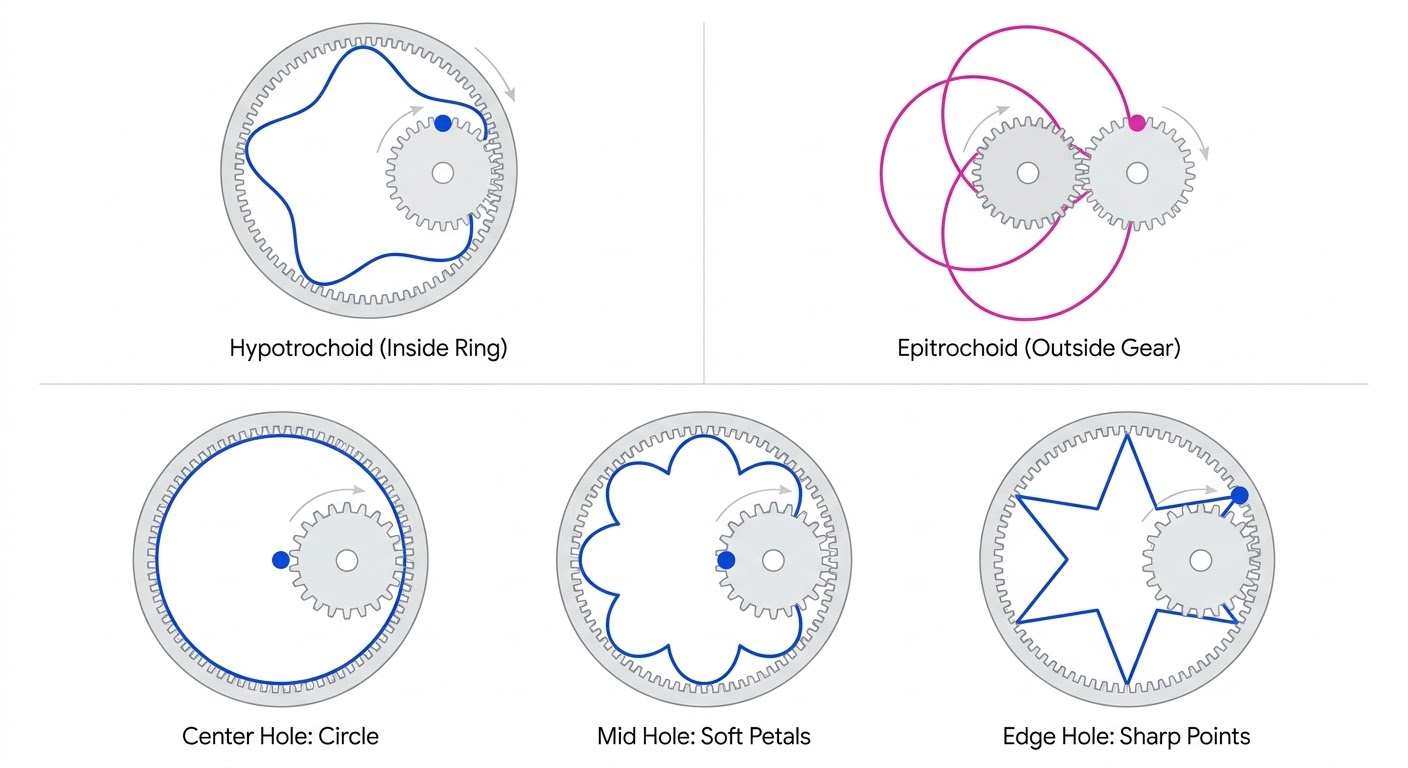
- Hypotrochoids (from “hypo,” meaning inside) form when a smaller wheel rolls around the inside edge of a larger stationary ring2. Nearly every classic spirograph design is a hypotrochoid2. When the pen sits directly on the outer circumference of the rolling wheel, it produces a sharp-pointed special case called a hypocycloid15.
- Epitrochoids (from “epi,” meaning outside) form when a smaller wheel rolls around the outside edge of a stationary ring or gear2. These curves bloom outward into rounded, cloud-like loops—a silhouette famously reflected in the classic Spirograph logo2.
Every single gear drawing is governed by just three variables: the tooth count of the stationary ring, the tooth count of the moving wheel, and the distance of the pen hole from the wheel’s centre2.
Predicting Petals Without Guesswork
If you want to plan a layered composition in advance, two quick arithmetic steps reveal how many petals (lobes or points) a gear combination will produce and how many trips around the ring it takes before the pen returns to its exact starting spot2.
First, find the Greatest Common Divisor (GCD)—the largest whole number that divides evenly into both the ring’s tooth count and the wheel’s tooth count2. Then divide:
- Number of Petals = Ring Teeth ÷ GCD28
- Rotations to Close = Wheel Teeth ÷ GCD2
Think of two meshing gears like two drummers playing interlocking polyrhythms—one striking every third beat while the other claps every fourth30. When the two tooth counts share a large common factor, the gears sync up quickly and finish a bold, sparse shape in just one or two laps2. When they share no common factor other than 1—a relationship mathematicians call coprime—the wheel cannot close early and must travel through every possible tooth alignment before meeting its starting point2.
For artists who prefer visual shortcuts, Wild Gears uses the Prime Factor Method: break both tooth counts into prime factors and cancel the shared numbers31. With a 60-tooth wheel inside a 180-tooth ring, the fraction 180/60 simplifies to 3/1, telling you immediately that you will draw 3 petals in 1 lap31. Meanwhile, two different gear pairs with the same simplified ratio—such as a 32-tooth wheel in a 96-tooth ring and a 50-tooth wheel in a 150-tooth ring—produce the exact same 3-petal geometry, just at different physical sizes2.
| Ring Teeth | Wheel Teeth | Greatest Common Divisor | Petals (Points) | Rotations to Close | Visual Character & Artistic Use |
| 96 | 48 | 48 | 2 | 1 | Clean oval or ellipse; a 2:1 Tusi couple that draws a straight line right at the rim29 |
| 96 | 32 | 32 | 3 | 1 | Bold 3-point rosette; ideal structural frame or repeatable motif for shifting2 |
| 96 | 72 | 24 | 4 | 3 | Wide, overlapping 4-lobe frame with sweeping arcs29 |
| 105 | 63 | 21 | 5 | 3 | Balanced 5-petal star; pairs naturally with 42- and 84-tooth wheels (also 5 petals)29 |
| 105 | 60 | 15 | 7 | 4 | Crisp 7-pointed floral symmetry with an open center28 |
| 96 | 60 | 12 | 8 | 5 | Classic 8-petal medallion; easy to layer with 24- or 48-tooth gears29 |
| 96 | 45 | 3 | 32 | 15 | Intricate 32-petal ring creating a luminous woven inner band2 |
| 96 | 50 | 2 | 48 | 25 | Dense circular lace; rewards deliberate pen color changes28 |
| 105 | 52 | 1 (Coprime) | 105 | 52 | Maximum density: literally one loop for every single tooth in the ring9 |
Notice also what pen-hole position does—and does not—do. Switching from an inner hole to an outer hole never changes the petal count28. Instead, it acts like a volume knob for drama: a hole at the exact centre traces a plain circle, holes at 60% to 85% of the wheel’s radius deliver the balanced classic spirograph look, and holes right against the gear teeth carve razor-sharp cusps and deep inward loops2.
Modern Tools: Beyond the Childhood Toy
While a classic retail Spirograph kit remains a joyful entry point—the Deluxe set pairs rings of 96, 105, 144, and 150 teeth with 18 wheels ranging from 24 to 84 teeth—dedicated artists eventually bump into its physical limits2. Modern injection-moulded toy pieces are thinner than vintage 1960s sets, so more pen types fit through the holes, yet that thinness can introduce warping and gear slippage during dense drawings34. Over the past decade, makers and engineers have responded with four distinct ecosystems that push geared art into fine-art territory.
Wild Gears: “Spirograph for Grownups”
Frustrated by flimsy plastic and limited ring sizes after playing with a candy-store gear toy in 2013, Canadian maker Aaron Bleackley launched Wild Gears via Kickstarter33. Laser-cut on demand from solid sheets of clear acrylic in British Columbia, Canada, Wild Gears has become a widely favoured studio upgrade among hand-drawn geometric artists, particularly in enthusiast hubs such as Reddit’s r/spirograph community3.
Several smart engineering choices separate Wild Gears from retail toys. Because every gear is laser-cut from a single sheet, every gear automatically leaves behind a matching stationary ring—a 14-gear set yields 14 rings, multiplying possible combinations exponentially3. The clear acrylic lets you watch your ink work cleanly underneath, and tight laser tolerances help lines meet their exact starting point without awkward gaps3. Even better, sets include non-circular gears (squares, triangles, pentagons, paisley teardrops, and oblong racks), nested hoops for multi-gear stacking, and tiny “doughnut” inserts or overlapping hole sizes that let you draw perfectly parallel lines3. Artists typically begin with either the Compact Gear Set (noted by community members as rich in multiples of 6, producing designs up to roughly 4 inches across) or the Full Page Gear Set (rich in multiples of 7, up to roughly 8 inches across), before expanding into Hoops, Strange Shapes, or the Encyclopedic Set featuring tiny gears from 12 to 30 teeth3. The main trade-offs are higher friction—flat acrylic rests fully against the paper, increasing smearing risk with wet inks—and tooth sizes that are incompatible with classic Spirograph kits42.
Large-Scale Studio Toolsets: Planarc
For artists chasing poster-sized compositions, GoMetric Studio’s Planarc line pairs durable aluminium with matte translucent neon acrylic45. Built with precise degree and hole markings, magnetic frame holders that eliminate adhesive residue, and straight-line options introduced in Planarc 2.0, the system scales dramatically—from 20 × 20 cm (Planarc 2.0) and 30 × 30 cm (MetalMax) up to 39 × 39 cm (XL) and a massive 58 × 58 cm (MEGA)45. That studio scale comes at a specialty price: according to the manufacturer’s storefront, large toolsets list around USD 340 to USD 580 on sale (regularly USD 450 to USD 640), with complete bundles listed at USD 2,55045.
Hand-Cranked Wooden Machines: The Cycloid Drawing Machine
Inspired by late-19th and early-20th-century mechanical drawing tables, artist Joe Freedman hand-builds the laser-cut wooden Cycloid Drawing Machine in small batches (a smaller licensed edition called the Hypnograph is manufactured by Thinfun Toys)46. Looking somewhat like a vintage record turntable, the desktop machine uses three geared turntables, 18 interchangeable gears, and an adjustable fulcrum arm47. Because you turn a hand crank rather than pushing a pen tip directly inside a loose plastic wheel, gear slippage virtually disappears—and you can pause mid-drawing, lift the pen, or even move the machine to another table without losing alignment48. Notably, Freedman avoids adding electric motors; as he observed when a user tried motorising a machine, hand-cranking keeps the artist physically connected to the rhythm and surprise of the emerging drawing50.
Generative Code and Robotic Pen Plotters
At the digital frontier, creative coders write trigonometric and waveform algorithms in languages like Processing, p5.js, or Python, breaking free from physical gear constraints altogether4. Rather than leaving their creations trapped on glowing screens, artists export vector SVG paths and draw them onto real fine-art paper with a desktop robotic pen plotter4.
For years, the most prominent desktop plotter in the generative art community was Evil Mad Scientist’s AxiDraw53. Following Bantam Tools’ acquisition of Evil Mad Scientist in January 2024, the line evolved into the Bantam Tools NextDraw family—launching at USD 699 for the letter/A4-sized NextDraw 8511—offering a smoother, quieter motion planner while preserving the established Inkscape extension, command-line interface, and Python API52. Budget-conscious makers looking for larger beds also turn to alternatives like the UUNA TEK iDraw 254. Because real pen nibs interact subtly with ink flow and paper grain, every plotted spirograph carries physical character that mass-produced digital prints cannot replicate51.
| Tool Ecosystem | Core Materials & Mechanism | Typical Artwork Scale | Signature Artistic Strengths | Key Trade-Offs |
| Classic / Modern Spirograph | Injection-molded plastic rings & wheels; removable putty2 | Compact rings; up to page-sized with Super Spirograph or Mandala Maker sets35 | Low cost, widely available, beginner-friendly; every wheel works with standard rings42 | Limited ring count; thinner modern plastic can warp and slip easily35 |
| Wild Gears | Laser-cut clear acrylic sheets; matching rings, hoops & racks3 | Approx. 4 inches (Compact) to 8 inches (Full Page) and larger (Enormous)3 | Clear visibility, high precision, non-circular gears, wheel-within-a-wheel, parallel lines3 | Higher surface friction increases ink smearing; not compatible with classic Spirograph teeth42 |
| Planarc | Durable aluminium & matte translucent neon acrylic; magnetic holders45 | 20 × 20 cm up to 58 × 58 cm (MEGA)45 | Architectural poster scale, degree/hole guides, straight-line integration, residue-free setup45 | Premium investment (USD 340–580+ per large set per vendor pricing)45 |
| Cycloid Drawing Machine | Laser-cut wood turntables, 18 gears, fulcrum arm & hand crank47 | Compact tabletop drawings48 | Eliminates manual pen slippage, movable mid-drawing without losing alignment, tactile hand-crank feel48 | Small-batch availability; less portable than flat acrylic sheets46 |
| Pen Plotters (AxiDraw / NextDraw) | Computer-controlled CoreXY robotic arm holding real pens54 | Letter/A4 up to A3 and larger beds54 | Unlimited algorithmic curves, multi-colour layer registration, zero gear-smudging on wet gel ink4 | Requires coding or vector design workflow; higher upfront cost (from USD 699 for NextDraw 8511)53 |
Artistic Techniques That Elevate Simple Loops Into Fine Art
A single hypotrochoid is pleasing, yet rarely breathtaking on its own. What turns mechanical loops into gallery-worthy geometric art is intentional composition—combining multiple motions, subtle offsets, and thoughtful colour orchestration.
Wheel-Within-a-Wheel (Nested Multi-Gear Systems)
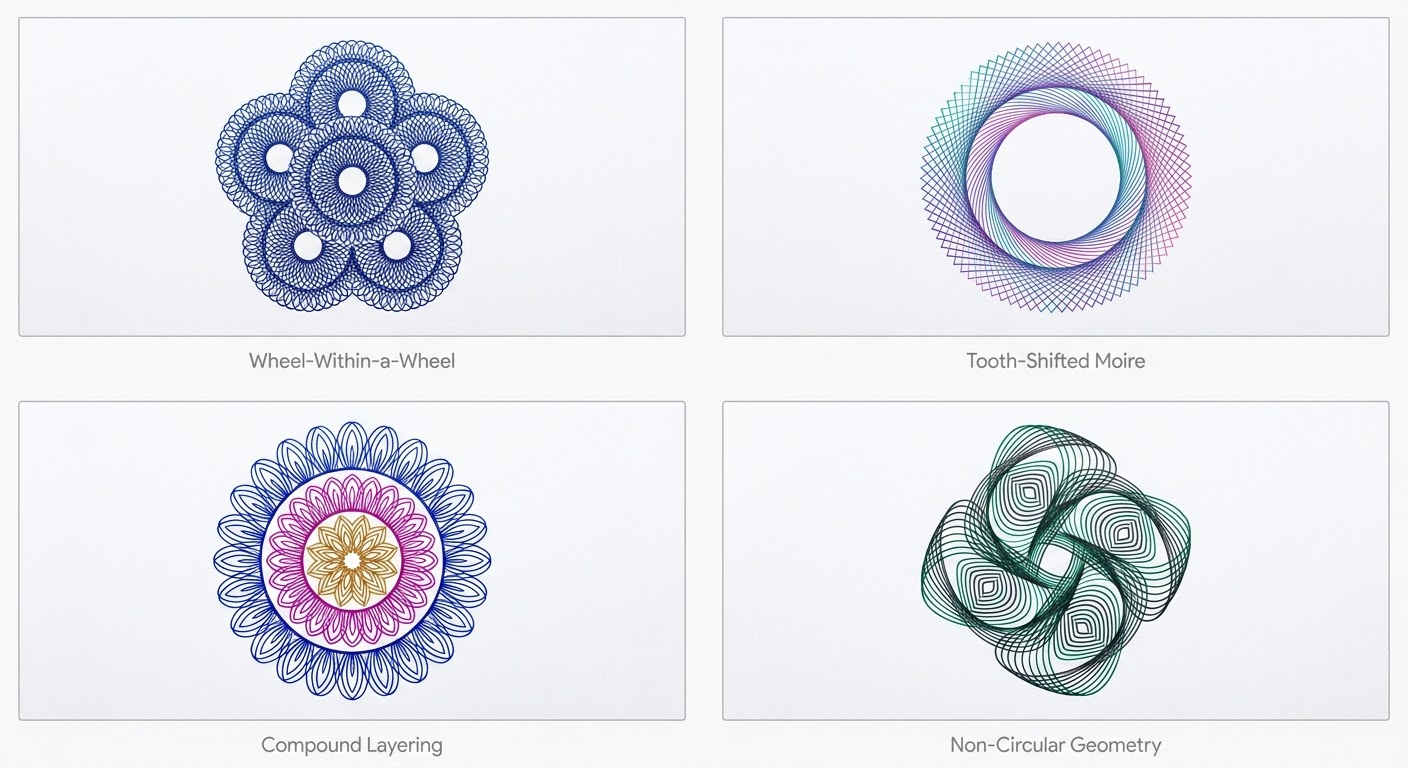
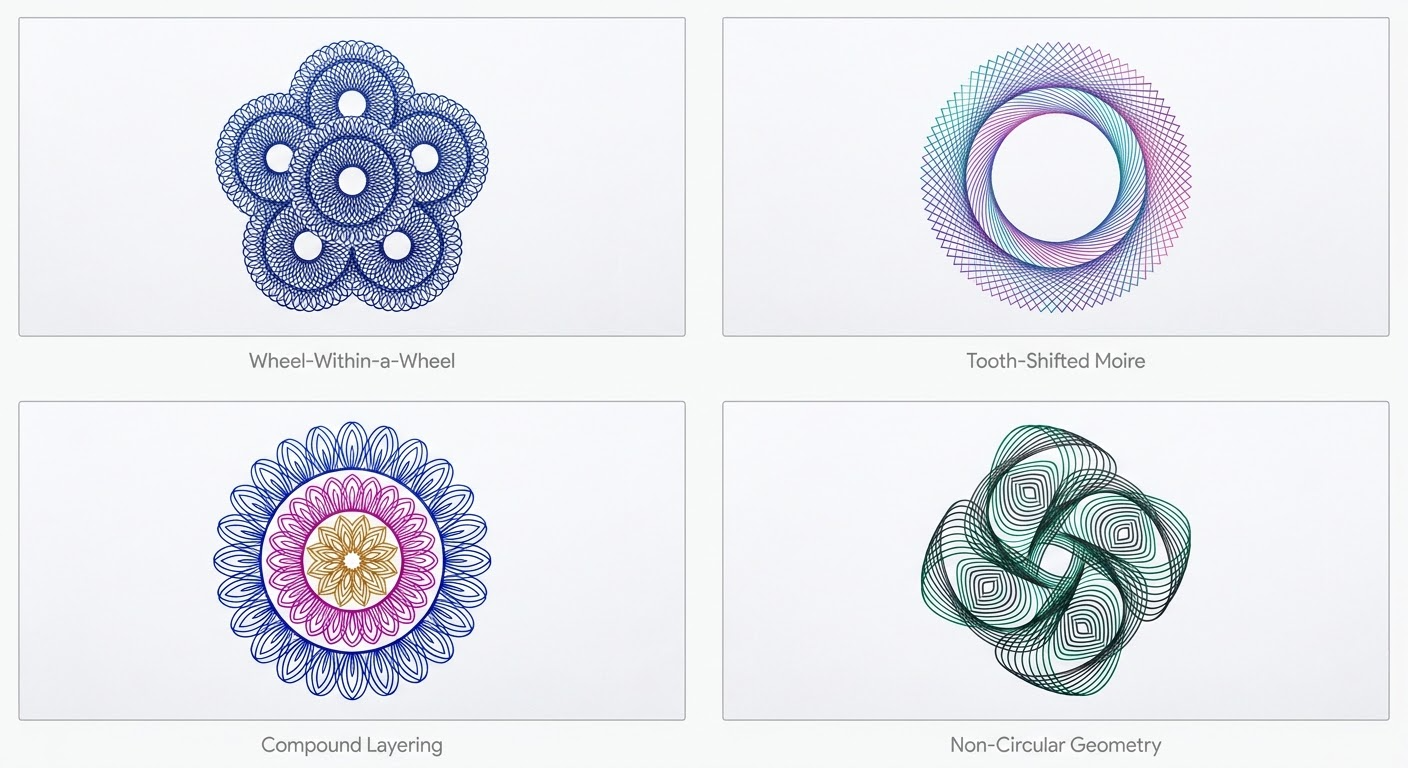
In a wheel-within-a-wheel setup, you place a geared hoop inside an outer stationary ring, and then roll an even smaller pen gear inside the hoop’s inner cutout8. Two rolling motions stack simultaneously—or three, if you nest two hoops inside a ring8. As spirograph artist and blogger Heather Holm demonstrated using a 120-tooth outer ring, a 96-tooth gear containing a 40-tooth off-centre cutout, and six different inner gears (16, 18, 26, 30, 32, and 34 teeth), the outer gear pair establishes the overarching silhouette—a graceful five-lobed frame—while the tiny inner gear acts like a texture brush, filling each lobe with either airy ribbons or lace-like knots62.
Tooth Shifting and “Stepping” for Optical Moiré
One of the most mesmerising contemporary techniques requires patience rather than complex math. Instead of relying on a single high-lap gear ratio, you draw a simple, crisp motif—such as a 3-point triangle, a 4-point square, or a diagonal oval—lift the pen, shift the gear or holding hoop forward by one or two teeth, and draw the shape again10.
Artists frequently pair opposing shifts: for instance, placing a 192-tooth gear (with a 96-tooth cutout) inside a 192-tooth ring and a 32-tooth wheel inside that cutout draws a neat triangle; shifting the middle gear one tooth right and the inner wheel one tooth left across 192 repetitions spins a sculptural, rainbow-wheel ring of overlapping triangles10. Stepping a hoop incrementally along a straight oblong rack creates sweeping architectural waves58. When closely spaced curves cross at slight, near-parallel angles, they trigger moiré interference patterns—ghostly secondary waves of light and dark that seem to shimmer like sand vibrating on a sound plate65.
Compound Layering With Common Factors
When stacking multiple separate designs around the same centre—known as a compound pattern—arbitrary gear combinations can quickly turn muddy8. An effortless way to guarantee visual harmony is choosing wheels that share large common factors with the inner ring boundary and with one another67. Using a 96-tooth internal boundary (such as a 120/96 hoop inside a stationary 160-tooth ring), gears of 24, 48, and 72 teeth represent exact quarters (1/4, 1/2, and 3/4) of the ring67. By aligning every piece consistently at the same starting landmark—such as the 6 o’clock mark—before drawing each stage, petals nest cleanly inside one another with crisp rotational symmetry28.
Breaking the Circle: Strange Shapes and Asymmetry
Standard circles radiate calm predictability, which is precisely why non-circular gears feel so electrifying. Rolling a square, triangular, pentagonal, or paisley-shaped wheel inside a circular ring—or rolling a round wheel inside a “blobby” triangular frame—stops the line from ever fully settling into a circle3. Corners compress curves into knotted tension while flatter sides stretch them into sweeping arcs, yielding organic teardrop motifs that look closer to botanical illustration or vintage textile paisley than rigid geometry8.
Colour Gradients, Pen Angle, and Mixed Media
Once the geometry works, colour and line quality supply the emotional voice. Switching pens at deliberate intervals—such as changing from dark blue to light blue to green every five loops across a 105-petal design, or stepping smoothly across a warm orange-to-crimson spectrum during tooth shifts—builds rich gradients directly out of individual ink strokes9.
Small changes in hand technique also yield surprising depth. Going over a completed pattern two or three times hides the start-and-stop seam and deepens the line into a bold, crisp ribbon; adding one extra pass with the pen gently tilted toward the centre of the ring introduces subtle calligraphic weight shifts69. Beyond pure linework, mixed-media artists mask sections of paper with washi tape so overlapping patterns appear woven over and under one another, fill closed petals with Zentangle ink doodles, or lay waterproof pigment-ink spirographs beneath translucent watercolour and gouache washes70.
Studio Essentials: Pens, Paper, Anchoring, and Slip-Free Technique
Nothing spoils an hour-long geometric mandala faster than a smudged ink streak or a gear popping out of its track on lap 47. Experienced spirograph artists treat pens, paper, and anchoring surfaces as a unified system.
Choosing Pens That Glide Without Smearing
Different inks behave dramatically differently when plastic or acrylic gears repeatedly sweep over fresh lines42:
- Fine-Tipped Felt Fineliners (Best All-Rounders): Community favourites include Stabilo Point 88, Staedtler Triplus Fineliners, Sakura Pigma Microns, and Faber-Castell Pitt Artist Pens70. Narrow nibs between 0.25 mm and 0.45 mm lay down crisp, dark lines that dry quickly with minimal drag74. Pigma Microns and Pitt Artist Pens carry the extra advantage of archival, lightfast, waterproof pigment ink—ideal if you plan to display your artwork in sunlight or add watercolour washes afterwards, though enthusiasts note that Pitt markers (especially black) can smudge unless paired with very absorbent paper53.
- Needle-Tip Pens for Tiny Holes: Miniature gears—such as the 1.0–1.5 mm holes in the Wild Gears Encyclopedic set—require pens with slim cylindrical metal tips, such as a Pilot Hi-Techpoint V5 (0.5 mm) or technical drawing pens77.
- Ballpoint Pens: Standard ballpoints resist bleeding when you pause, yet they require firmer downward pressure that can indent or tear paper on ultra-dense designs and sometimes skip at speed9.
- Gel Pens and Black Paper: Opaque white, metallic gold, and neon Sakura Gelly Roll pens (especially the medium 08 point or Moonlight series) look dazzling on dark paper, yet gel ink sits wet on the surface and smears easily under flat gears53. If you want luminous gel lines on black paper, a robotic pen plotter (which never drags a gear over wet ink) excels, while hand-drawing requires absorbent paper, slow movement, and drying pauses between stages35.
Matching Paper to Your Ink
Thin printer paper flexes under gear pressure and ripples when saturated, whereas high-gloss or clay-coated cardstock slows ink absorption and turns almost any fineliner into a smear risk74. The sweet spot is heavyweight, smooth, uncoated paper—typically 75 lb to 98 lb or heavier—such as Canson Mixed Media (98 lb), smooth Bristol board, cartridge paper, or thick watercolour paper when using wetter pigment markers70. Always test a new pen-and-paper pairing on a scrap sheet before committing to a complex drawing39.
Anchoring Without Pinholes
Vintage Spirograph sets relied on pins pushed into a cardboard backing board, leaving tiny punctures around the finished art16. Modern artists have far cleaner options:
- Removable Putty: Four small dabs of Spiro-Putty or Elmer’s Poster Tack pressed between the ridges of a ring hold firmly for dozens of drawings—just keep putty out of the gear teeth and press the ring flush against the paper so the wheel cannot wedge underneath35.
- Everyday Weights: Heavy books, metal weights, or soup cans secure large acrylic frames rapidly when you are testing prototypes across multiple sheets39.
- Magnetic Steel Board (The Studio Favourite): Place a clean, flat sheet of galvanised steel (such as 12 × 12 inches for standard sheets or 12 × 18 inches for larger pads, washed free of factory oil with sharp edges taped) beneath your paper84. Place strong neodymium magnets around the outer ring to lock it down completely—and place one or two tiny, lightweight magnets directly on the moving gear itself to gently weigh it flat against the paper without stopping its glide36.
Mastering the “Touch”
Even the finest gears will slip if forced. Across veteran tutorials and community discussions, four physical habits solve almost every slipping problem:
- Lighten your grip: Slippage almost always comes from pushing down too hard rather than too gently74.
- Hold the pen vertical and push sideways toward the meshing teeth: Keep your eye on the exact contact point where wheel teeth meet ring teeth, nudging the pen in the direction of the next tooth to engage—letting the wheel lead your hand, as Heather Holm describes it, like following a partner in ballroom dancing34.
- Start away from Hole #1: Holes closest to the outer rim undergo the sharpest directional reversals and pop out most easily; build muscle memory on middle holes first36.
- Slow down to stop smearing: Moving slower feels counterintuitive, yet a calm, steady pace gives paper a crucial fraction of a second to absorb ink before the gear passes back across the line74.
Contemporary Artists Pushing Spirograph Design Forward
Far from remaining a nostalgic novelty, spirograph geometry has carved out a distinct niche in contemporary galleries, design studios, and public light festivals. Several notable artists demonstrate just how differently the same underlying curves can speak.
British contemporary artist Lesley Halliwell originally trained as a painter before rediscovering a 1970s childhood Spirograph during her MA studies at Manchester Metropolitan University6. Using humble high-street ballpoint biros—often cycling systematically through 24-colour packs—she builds sprawling, luminous works that look almost out of focus from across a room before resolving up close into thousands of individual spirals6. Averaging roughly 60 motifs an hour in 30-minute sessions to cope with arm fatigue and dizziness, Halliwell logs her exact labour directly into her titles, such as Beauty is the First Test, 3026 Minutes and Fanatic I, 4500 Minutes (which joins its matching semi-circle, Fanatic II, to span a full 500-centimetre-wide wall circle)6. Rather than chasing sterile machine perfection, she embraces smudges, dry pens, and human error as honest markers of repetitive manual labor6. Extending that dialogue into the digital realm, Halliwell collaborated with digital artist William Card on Spirograph Reimagined—an 11.5-meter curved LED audiovisual installation that premiered at Leeds City Museum for Light Night Leeds in 2025 as a tribute to Denys Fisher’s hometown invention86.
In the United States, generative artist Michelle Chandra (of Dirt Alley Design) approaches the form through code and robotics53. Writing custom Processing sketches driven by trigonometric waveforms and rotational symmetry, she generates fluid geometric prints unconstrained by physical gear teeth and plots them onto paper with an AxiDraw pen plotter using fineliners, India ink pens, and shimmering metallic or white Gelly Roll inks on dark paper4. Viewers frequently compare her plotted geometry to botanical blooms and woven textiles88.
Other artists explode the scale altogether. Former street artist Jason Revok engineered giant custom plywood spirograph frames and gears—”the artist’s instruments”—to execute radiant, multi-layered synthetic polymer and acrylic spray-paint works on shaped canvases, including installations at the Museum of Contemporary Art Detroit (MOCAD)90. Meanwhile, dancer and visual artist Tony Orrico became widely known as “the human spirograph” by eliminating mechanical gears entirely, using the rotational motion and physical reach of his own body to create large-scale geometric drawings in live performances, including at the National Academy of Sciences91.
Running alongside these gallery voices is an extraordinarily generous online maker ecosystem—spanning Reddit’s r/spirograph community, YouTube educators such as SpiroGraphicArt, SpiroReeni, and Jeddy Grant, and Instagram collections under #wildgears—where hobbyists, mathematicians, and illustrators trade step-by-step “art recipes,” tooth-shift formulas, and mixed-media experiments every day41.
The Meditative Pull: Why Drawing Spirals Feels So Good
Ask almost any spirograph enthusiast why they keep returning to the drawing table, and they rarely talk only about the finished artwork; they talk about how the process feels1. Psychologists describe flow as a deeply absorbing mental state triggered by activities with clear goals, immediate visual feedback, and steady, hands-on concentration94. Rhythmic crafts—from embroidery and origami to geometric drawing—naturally invite that state, gently pulling attention away from daily clutter while giving a quiet sense of timelessness and accomplishment94.
Spirograph art is uniquely hospitable to beginners seeking creative calm because the gears carry the structural burden of symmetry93. You do not have to worry about drawing a straight line or judging proportions freehand; your mind is free to settle into the steady rotation of your wrist, the whisper of a fineliner nib across smooth paper, and the slow, unfolding surprise of intersecting arcs1. That soothing sensory feedback also helps explain why short #Spirograph ASMR drawing videos have gathered millions of views across TikTok and Instagram, turning a six-decade-old mechanical idea into a modern pocket of calm in a noisy digital world1.
Conclusion
Artistic spirograph designs endure because they strike a rare balance between mathematical discipline and boundless play1. What started on 18th-century rose engine lathes to beautify pocket watches and guard national currencies has blossomed into an open-ended visual language accessible to anyone with a pen and a curious eye5. A single formula—dividing ring teeth by a greatest common divisor—hands you predictive control over petals and density, while modern tools like laser-cut acrylic gears, hand-cranked wooden cycloids, and code-driven pen plotters stretch that simple geometry into sculptural moiré ribbons, luminous compound mandalas, and wall-spanning fine art3.
Best of all, the barrier to entry remains wonderfully low. You do not need expensive equipment or advanced mathematics to create something mesmerising—just a flat surface, heavyweight smooth paper, a quick-drying fineliner, and a light touch70. Start with a classic gear ratio, let the wheel guide your hand, and see what unfolds when you shift a single tooth and change colours.
Disclaimer
Trademarks and Brand References: Spirograph is a registered trademark of Hasbro, Inc., manufactured and marketed under license by PlayMonster LLC23. Throughout this article, the capitalised name Spirograph refers to the classic branded drawing system, while lowercase “spirograph” is used in the broader artistic sense to describe gear-driven roulette curve artwork. All other product names, tool systems, software, and pen or paper brands mentioned—including Wild Gears, Planarc, Cycloid Drawing Machine, Hypnograph, AxiDraw, and Bantam Tools NextDraw—are the property of their respective creators and trademark owners3. Brand mentions and approximate retail prices reflect publicly available information as of 2026 for educational reference only and do not constitute commercial endorsements; availability and pricing are subject to change.
Wellness and Creative Practice: Descriptions of mindfulness, flow states, stress relief, and calming sensory effects associated with geometric drawing are provided solely for general informational and recreational enjoyment94. Creative drawing is not a substitute for professional medical or mental health advice, diagnosis, or treatment; individuals experiencing severe anxiety or mental health concerns should consult a qualified healthcare professional99.
Studio Safety: If you adopt a magnetic anchoring board using strong neodymium magnets, handle magnets with care—they can pinch skin painfully or chip if allowed to snap together forcefully—and keep small magnets and loose gears safely away from young children77.
References
- Celebrating 60 Years of Spirograph: A Creative Classic Comes Full, https://www.peopleofplay.com/blog/celebrating-60-years-of-spirograph-a-creative-classic-comes-full-circle
- Spirograph Glossary — Terms & Definitions, https://spirography.com/glossary
- Wild Gears, https://www.wildgears.com/
- Endless Forms Most Beautiful – Generative Spirograph Prints, http://www.michellechandra.com/generative-design-2/generative-art-spirograph-prints/
- The Art and Craft of Guilloché | The Hour Glass Official, https://www.thehourglass.com/story/the-art-of-guilloche
- Sim Smith Gallery Interview – Lesley Halliwell, http://www.lesleyhalliwell.com/writings-about-lesley-halliwell/2015/2/9/sim-smith-gallery-interview
- Money lace — guilloché, intaglio, and the Spirograph – FontLab Blog, https://blog.fontlab.com/2026/04/14/money-lace-guilloche-intaglio-spirograph/
- FAQ — Wild Gears – Photography Galleries – Ronny Mariano, https://ronnymariano.com/wildgears/faq.html
- One Loop for Every Tooth: Spirograph Wheel 52 – SpiroGraphicArt, https://spirographicart.com/2014/04/02/one-loop-every-tooth/
- Another bunch of triangles : r/spirograph – Reddit, https://www.reddit.com/r/spirograph/comments/13i5mgp/another_bunch_of_triangles/
- Inside Manufacture Breguet – Partridge Jewellers, https://www.partridgejewellers.com/blog-articles/inside-manufacture-breguet:-a-journey-through-heritage-and-innovation/
- Rose Engine Lathe – Ornamental Turning Book of Knowledge, http://otbok.info/index.php?n=Main.RoseEngineLathe
- Breguet’s Art Of Guilloché Engraving: A Masterclass, https://www.watchswiss.com/perpetual/breguet-art-of-guilloche-masterclass/
- What is ‘guilloché’ in a banknote? It’s this. – ColeMone, https://coleccionismodemonedas.com/en/guilloche/
- Spirograph – Wikipedia, https://en.wikipedia.org/wiki/Spirograph
- History and Mechanics of Spirograph | PDF | Space – Scribd, https://www.scribd.com/document/657347057/Spirograph-Wikipedia
- The Spirograph: Past, Present, and Future – Victor Donnay, https://victordonnay.digital.brynmawr.edu/fall-2021-poster-gallery/the-spirograph-past-present-and-future/
- Ingenious machines for drawing curves: The Archives – Anita Chowdry, https://anitachowdry.wordpress.com/2014/10/06/ingenious-machines-for-drawing-curves-the-archives/
- Harmonographs. II. Circular design – BearWorks, https://bearworks.missouristate.edu/cgi/viewcontent.cgi?article=4356&context=articles-cnas
- Spirograph at 60: Meet Duncan Fisher, son of Denys Fisher, https://www.mojo-nation.com/spirograph-at-60-meet-duncan-fisher-son-of-denys-fisher-the-inventor-of-spirograph-cyclex-and-stickle-bricks/
- Spirograph – Nostalgia Central, https://nostalgiacentral.com/pop-culture/toys-games/spirograph/
- 1977: SPIROGRAPH inventor at work on his NEW CREATION! -, https://www.youtube.com/watch?v=vBvUahtCwqY
- spirograph, https://www.worldbrands.es/wp-content/uploads/80979_Spirograph-Guide_v2_EN_COMPLETE_compressed.pdf
- TIMELESS SPIROGRAPH BRAND EXPANDS WITH THREE NEW, https://www.playmonster.com/timeless-spirograph-brand-expands-with-three-new-products-in-2022/
- Meet the 12 Toy Hall Finalists – The Strong National Museum of Play, https://www.museumofplay.org/press-release/meet-the-12-toy-hall-finalists/
- National Toy Hall of Fame – Wikipedia, https://en.wikipedia.org/wiki/National_Toy_Hall_of_Fame
- Three vintage games make it in the National Toy Hall of Fame, https://www.wxxinews.org/local-news/2025-11-06/three-more-make-it-in-the-national
- SPRIOGRAPH in the ART CLASSROOM, https://images.kaplanco.com/content/spirographLessonPlan.pdf
- unknown_url
- Where is the Math in Spirographs? – HTLC, https://hightechlowcost.org/guides/spiro-inquiry/spiro-math/
- Math and Predictions – Wild Gears, https://www.wildgears.com/math-and-predictions.html
- Spirograph Curves Explained | Hypotrochoids & Epitrochoids, https://www.youtube.com/watch?v=cdmlATQ26lE
- Spirograph-Inspired Maker Blasts Kickstarter Goals By 224%, Then, https://www.ponoko.com/blog/maker-success-stories/spirograph-inspired-wild-gears-crowdfunding/
- A better working surface – SpiroGraphicArt, https://spirographicart.com/2011/12/20/a-better-working-surface/
- Comparing the new Spirograph® Deluxe Set to the old Super, https://spirographicart.com/2013/11/18/compare-new-spirograph-deluxe-super-spirograph/
- How to find a good Spirograph for use with one hand? – Reddit, https://www.reddit.com/r/spirograph/comments/1x7ej1h/how_to_find_a_good_spirograph_for_use_with_one/
- Friday/ here come the Wild Gears – Willem’s Planet, https://www.willemsplanet.com/2019/07/26/friday-here-come-the-wild-gears/
- Art Toy: Wild Gears | Made in CA, https://madeinca.ca/art-toy-wild-gears/
- Gear recommendations : r/spirograph – Reddit, https://www.reddit.com/r/spirograph/comments/t8e1tb/gear_recommendations/
- Recommendations, please : r/spirograph – Reddit, https://www.reddit.com/r/spirograph/comments/k3iow9/recommendations_please/
- Links and Resources – Wild Gears, https://www.wildgears.com/links-and-resources.html
- Wild Gears vs Spirograph, https://spirographicart.com/2014/07/30/wild-gears-different-spirograph/
- Blog – Wild Gears, https://www.wildgears.com/blog.html
- Wild Gear advice : r/spirograph – Reddit, https://www.reddit.com/r/spirograph/comments/12z0kra/wild_gear_advice/
- Planarc – G.O Metric Studio, https://gometricstudio.com/pages/planarc
- About – Sarabande Press, http://www.sarabande.com/about.html
- Crank Out Infinite Geometric Designs With The Wooden Cycloid, https://www.thisiscolossal.com/2016/03/cycloid-drawing-machine/
- Joe Freedman’s Amazing Cycloid Drawing Machine, https://www.waynesthisandthat.com/JoeFreedman-sAmazingCycloidDrawingMachine.html
- ME218A:Cycloid Drawing Machine – Home, https://me218cycloid.weebly.com/
- Sketch Intricate Designs with A Hand-Cranked Drawing Machine, https://www.vice.com/en/article/joe-freedman-drawing-machine-cycloid/
- Generative Hut, home of generative art and pen plotters, https://www.generativehut.com/
- Introduction – NextDraw API Migration Guide – Bantam Tools, https://bantam.tools/nd_migrate/
- How to Draw Code Art with an AxiDraw Pen Plotter – From Pixels to Ink, https://penplotterartwork.com/blog/2021/06/15/how-to-draw-generative-art-with-an-axidraw-pen-plotter/
- AxiDraw vs NextDraw: Which Should You Buy in 2026?, https://penplotterkit.com/blog/axidraw-vs-nextdraw/
- Bantam Tools, Fresh From Its Evil Mad Scientist Acquisition, https://www.hackster.io/news/bantam-tools-fresh-from-its-evil-mad-scientist-acquisition-launches-the-new-nextdraw-plotter-range-c483cf743665
- The Machines – Bre Pettis, https://www.brepettis.com/the-machines
- SPIROGRAPH CONTINUES TO INNOVATE AND INSPIRE, https://www.playmonster.com/spirograph-continues-to-innovate-and-inspire-creativity-with-new-spirograph-3d-spirograph-mandala-maker-and-licensed-spirograph-cyclex/
- Art Recipe #2: Oblong many step – Wild Gears, https://www.wildgears.com/blog/art-recipe-2-oblong-many-step
- About Pen Plotter Artwork – From Pixels to Ink, https://penplotterartwork.com/about-pen-plotter-artwork/
- AxiDraw Writing and Drawing Machines, https://axidraw.com/
- How to Use Gelly Roll Pens with a Pen Plotter (AxiDraw), https://penplotterartwork.com/blog/2021/10/15/how-to-use-gelly-roll-pens-with-a-pen-plotter-axidraw/
- Wheel-Within-a-Wheel Exploration with Wild Gears – SpiroGraphicArt, https://spirographicart.com/2021/03/02/wheel-within-a-wheel-exploration-with-wild-gears/
- I see you… : r/spirograph – Reddit, https://www.reddit.com/r/spirograph/comments/17g2suc/i_see_you/
- All Categories – Wild Gears, https://www.wildgears.com/blog/category/all/5
- Some explorations for the moiré lovers among you. Scroll for the set, https://www.reddit.com/r/spirograph/comments/x7ffnp/some_explorations_for_the_moir%C3%A9_lovers_among_you/
- Continuing my moire study. Today’s lesson taught me the … – Reddit, https://www.reddit.com/r/spirograph/comments/eef4qx/continuing_my_moire_study_todays_lesson_taught_me/
- https://www.wildgears.com/blog/art-recipe-4-easy-compound-designs-and-common-factors
- Experimenting with color gradients. This one makes them shine!, https://www.reddit.com/r/spirograph/comments/1eazlwk/experimenting_with_color_gradients_this_one_makes/
- Wild Gears Techniques #1: Pen Angle, https://www.wildgears.com/blog/wild-gears-techniques-1-pen-angle
- Supplies : r/spirograph – Reddit, https://www.reddit.com/r/spirograph/comments/etel4v/supplies/
- Fountain Pens, Zentangle and Wild Gears – SpiroGraphicArt, https://spirographicart.com/2017/05/03/fountain-pens-zentangle-wild-gears/
- Spirograph Tree: Using a spirograph for visual texture – ARTiful, https://paintingdemos.com/spirograph-tree-using-a-spirograph-for-visual-texture
- FAQ – Wild Gears, https://www.wildgears.com/faq.html
- Spirograph pens: Felt-tip pens – SpiroGraphicArt, https://spirographicart.com/2011/12/19/spirograph-pens/
- Tips on supplies? : r/spirograph – Reddit, https://www.reddit.com/r/spirograph/comments/194fsi5/tips_on_supplies/
- Faber-Castell Smearing : r/spirograph – Reddit, https://www.reddit.com/r/spirograph/comments/1px2ymg/fabercastell_smearing/
- Tips about Pens and Paper – Wild Gears, https://www.wildgears.com/tips-about-pens-and-paper.html
- Encyclopedic Gear Set – Wild Gears, https://www.wildgears.com/encyclopedic-gear-set.html
- Folks that use gel pens on black paper, a question for you. – Reddit, https://www.reddit.com/r/spirograph/comments/1fbop8c/folks_that_use_gel_pens_on_black_paper_a_question/
- Gel pen tips? I love the look of metallic colors on black but … – Reddit, https://www.reddit.com/r/spirograph/comments/yuah9o/gel_pen_tips_i_love_the_look_of_metallic_colors/
- Spirograph for Beginners: Your First 5 Patterns, https://spirography.com/beginner-guide
- COLLAGE JOY supply list 2.4.2026 – Catherine Rains, https://catherinerains.com/wp-content/uploads/2026/11/COLLAGE-JOY-supply-list-2.4.2026.pdf
- Ultra-Updated: Berol Pens, Sharpies and the Drawing Essentials, http://hoopercomicart.blogspot.com/2025/12/ultra-updated-berol-pens-sharpies-and.html
- Magnets? : r/spirograph – Reddit, https://www.reddit.com/r/spirograph/comments/lnlczr/magnets/
- Art at The National Centre for Craft & Design – Life After Money, http://meanqueen-lifeaftermoney.blogspot.com/2013/06/art-at-national-centre-for-craft-design.html
- Mesmerising artwork retraces history of beloved Leeds invention, https://museumsandgalleries.leeds.gov.uk/news-mesmerising-artwork-retraces-history-of-beloved-leeds-invention-5zsn
- Spirograph Reimagined – Artist Directory LUTN – Light Up the North, https://lightupthenorth.com/artist-directory/listings/spirograph-reimagined/
- Interview: Michelle Chandra of Dirt Alley Design – – IPaintMyMind, https://ipaintmymind.org/blog/interview-michelle-chandra/
- Favorite Pens for Axidraw, Plus How to Make Multiple Color Plots!, https://www.dirtalleydesign.com/blogs/news/favorite-pens-for-axidraw-plus-registering-multiple-layers-a-how-to
- Jason Revok: Now You See Him, Now You Don’t – New Art Examiner, https://www.thenewartexaminer.org/2023/01/27/jason-revok-now-you-see-him-now-you-dont/
- Tony Orrico, The Human Spirograph – Laughing Squid, https://laughingsquid.com/tony-orrico-the-human-spirograph/
- SpiroReeni – YouTube, https://www.youtube.com/channel/UCL8PO5w3QRUPj4TWoC9H_ow/about
- Spirograph Set Guide – JustCraftingAround, https://justcraftingaround.com/best-spirograph-set/
- The Art of Flow: Crafting Your Way to a Calmer Mind, https://thewellnesssociety.org/the-art-of-flow-crafting-your-way-to-a-calmer-mind/
- Spirograph Art For Stress Relief | ASMR Drawing – YouTube, https://www.youtube.com/watch?v=QPbSgIB1NZM
- Spirograph celebrates 60th anniversary – Toy World Magazine, https://toyworldmag.co.uk/spirograph-celebrates-60th-anniversary/
- PlayMonster 2024 Catalog – Issuu, https://issuu.com/playmonster/docs/playmonster_digitalcatalog_2024
- Page 9 – PlayMonster, https://www.playmonster.com/category/0/page/9/
- Calm Your Nervous System in Flow State (Art Meditation for Feeling, https://www.youtube.com/watch?v=NQ9u3EIP-2U
There is a quiet thrill in watching a single, uninterrupted pen line blossom into a shimmering starburst or a woven geometric mandala. Artistic spirograph design sits at the rare intersection of mathematics and tactile craft, turning simple interlocking gears into intricate, endlessly varied works of art1. For decades, many people knew these spiralling patterns mainly as a rainy-day childhood pastime, yet the craft reaches much further—backward into 18th-century luxury watchmaking and anti-counterfeiting currency design, and forward into laser-cut acrylic studio tools, gallery-scale installations, and robotic pen plotters3.
What makes spirograph art enduringly creative is that the mechanical rules do not cage the artist; they liberate them. Once you understand how a few gear ratios behave, you can layer dozens of shifted curves into optical illusions, blend ink gradients across hundreds of delicate loops, or break symmetry altogether with triangular and teardrop-shaped wheels3. Whether you are picking up a classic plastic set for the first time, upgrading to precision acrylic gears, or exploring code-driven drawing machines, this guide walks through the history, plain-English geometry, modern equipment, studio techniques, and contemporary artists defining the medium today.
From Luxury Watch Dials and Banknotes to a Cultural Icon
Long before plastic gears ever reached a toy shelf, spirographic curves served two of the most demanding fields in craftsmanship: fine horology and national currency security5. The visual ancestor of the spirograph is guilloché—named after the French verb guillocher, meaning to engrave with a rose engine7. Dating back to the 16th century, guilloché uses a specialised mechanical lathe fitted with eccentric cams, known as rosettes, that gently rock a metal workpiece back and forth as it turns against a cutting tool7. Around 1786, master watchmaker Abraham-Louis Breguet pioneered hand-turned guilloché on watch dials—most famously on his 1794 pocket watch No. 5 and the Marie-Antoinette watch—creating fine geometric textures such as sunbursts and Clous de Paris hobnail grids that combined practical function with extraordinary hand control5.
Because a rose engine’s interlocking wave lines were nearly impossible to imitate consistently by freehand drawing, printers soon adopted guilloché as “money lace” to thwart counterfeiters7. Early guilloché ornaments appeared on the 1814 Darlington Bank five-pound note and the 1840 Penny Black, the world’s first adhesive postage stamp7. Paired with intaglio printing—in which ink sits inside grooves carved into metal plates and transfers onto paper under intense pressure to leave tactile raised ridges—guilloché served for roughly a century as a major defence against forgery on banknotes worldwide7.
Throughout the 19th and early 20th centuries, inventors repeatedly tried to bring these captivating curves from heavy engraving workshops onto ordinary drawing paper. Early mechanical precursors included Greek-born English architect and engineer Peter Hubert Desvignes’s 1827 “Speiragraph”—a geared drawing machine he later adapted in Vienna between 1845 and 1848 to help prevent banknote forgery—John Holt Ibbetson’s lathe-mounted Geometric Chuck (circa 1833, built by Holtzappfel & Co.), and mathematician Bruno Abdank-Abakanowicz’s 1881–1900 spirograph built for calculating areas bounded by curves15. Consumer gear-based drawing toys also appeared as early as 1908, when The Marvelous Wondergraph was advertised in the Sears catalog15.
The modern icon, however, began in a quiet home loft in England. Between 1962 and 1964, British engineer Denys Fisher grew fascinated by the intricate rose-engine anti-counterfeiting designs on a British one-pound note and started tinkering with Meccano pieces to recreate similar patterns cleanly on paper15. Originally conceived as a drafting instrument, his Spirograph debuted at the 1965 Nuremberg International Toy Fair and went on sale in March 1965 at Schofields, a prestigious Leeds department store, where passersby crowded around Fisher’s live demonstrations in disbelief1. Kenner introduced the toy to the United States in 1966, and it was crowned UK Toy of the Year in 19677. According to a historical retrospective by FontLab, Spirograph sold 30 million units by 1977—and by placing banknote-style roulette curves into the hands of children with ballpoint pens, it helped shift guilloché from an exclusive security barrier into a familiar visual convention on diplomas, certificates, and graphic art7.
More than six decades later, the original brand remains remarkably resilient. Hasbro has held the Spirograph trademark since 1998, Kahootz Toys relaunched the classic gear sets worldwide in 2013 (replacing pinholes with removable putty), and PlayMonster LLC acquired Kahootz in 2019 under license from Hasbro1. PlayMonster has expanded the catalogue with formats such as Spirograph 3D and the Spirograph Mandala Maker (launched in 2022), followed by the announcement of an Electronic Spirograph Machine for the brand’s 60th anniversary in 20251. Buoyed by millions of views on soothing social-media ASMR drawing videos, Spirograph was named a 2025 National Toy Hall of Fame finalist at The Strong in Rochester, New York (where Battleship, Slime, and Trivial Pursuit were ultimately inducted that November)1.
The Simple Math Behind the Magic
You do not need an engineering degree to make extraordinary spirograph art, yet understanding a tiny bit of geometry transforms drawing from random trial and error into deliberate visual design. Every pattern a gear set produces belongs to a mathematical family called roulette curves—paths traced by a point attached to one shape as it rolls without slipping along another2.
In gear-based drawing, two sibling curves do almost all the work2:
- Hypotrochoids (from “hypo,” meaning inside) form when a smaller wheel rolls around the inside edge of a larger stationary ring2. Nearly every classic spirograph design is a hypotrochoid2. When the pen sits directly on the outer circumference of the rolling wheel, it produces a sharp-pointed special case called a hypocycloid15.
- Epitrochoids (from “epi,” meaning outside) form when a smaller wheel rolls around the outside edge of a stationary ring or gear2. These curves bloom outward into rounded, cloud-like loops—a silhouette famously reflected in the classic Spirograph logo2.
Every single gear drawing is governed by just three variables: the tooth count of the stationary ring, the tooth count of the moving wheel, and the distance of the pen hole from the wheel’s centre2.
Predicting Petals Without Guesswork
If you want to plan a layered composition in advance, two quick arithmetic steps reveal how many petals (lobes or points) a gear combination will produce and how many trips around the ring it takes before the pen returns to its exact starting spot2.
First, find the Greatest Common Divisor (GCD)—the largest whole number that divides evenly into both the ring’s tooth count and the wheel’s tooth count2. Then divide:
- Number of Petals = Ring Teeth ÷ GCD28
- Rotations to Close = Wheel Teeth ÷ GCD2
Think of two meshing gears like two drummers playing interlocking polyrhythms—one striking every third beat while the other claps every fourth30. When the two tooth counts share a large common factor, the gears sync up quickly and finish a bold, sparse shape in just one or two laps2. When they share no common factor other than 1—a relationship mathematicians call coprime—the wheel cannot close early and must travel through every possible tooth alignment before meeting its starting point2.
For artists who prefer visual shortcuts, Wild Gears uses the Prime Factor Method: break both tooth counts into prime factors and cancel the shared numbers31. With a 60-tooth wheel inside a 180-tooth ring, the fraction 180/60 simplifies to 3/1, telling you immediately that you will draw 3 petals in 1 lap31. Meanwhile, two different gear pairs with the same simplified ratio—such as a 32-tooth wheel in a 96-tooth ring and a 50-tooth wheel in a 150-tooth ring—produce the exact same 3-petal geometry, just at different physical sizes2.
| Ring Teeth | Wheel Teeth | Greatest Common Divisor | Petals (Points) | Rotations to Close | Visual Character & Artistic Use |
| 96 | 48 | 48 | 2 | 1 | Clean oval or ellipse; a 2:1 Tusi couple that draws a straight line right at the rim29 |
| 96 | 32 | 32 | 3 | 1 | Bold 3-point rosette; ideal structural frame or repeatable motif for shifting2 |
| 96 | 72 | 24 | 4 | 3 | Wide, overlapping 4-lobe frame with sweeping arcs29 |
| 105 | 63 | 21 | 5 | 3 | Balanced 5-petal star; pairs naturally with 42- and 84-tooth wheels (also 5 petals)29 |
| 105 | 60 | 15 | 7 | 4 | Crisp 7-pointed floral symmetry with an open center28 |
| 96 | 60 | 12 | 8 | 5 | Classic 8-petal medallion; easy to layer with 24- or 48-tooth gears29 |
| 96 | 45 | 3 | 32 | 15 | Intricate 32-petal ring creating a luminous woven inner band2 |
| 96 | 50 | 2 | 48 | 25 | Dense circular lace; rewards deliberate pen color changes28 |
| 105 | 52 | 1 (Coprime) | 105 | 52 | Maximum density: literally one loop for every single tooth in the ring9 |
Notice also what pen-hole position does—and does not—do. Switching from an inner hole to an outer hole never changes the petal count28. Instead, it acts like a volume knob for drama: a hole at the exact centre traces a plain circle, holes at 60% to 85% of the wheel’s radius deliver the balanced classic spirograph look, and holes right against the gear teeth carve razor-sharp cusps and deep inward loops2.
Modern Tools: Beyond the Childhood Toy
While a classic retail Spirograph kit remains a joyful entry point—the Deluxe set pairs rings of 96, 105, 144, and 150 teeth with 18 wheels ranging from 24 to 84 teeth—dedicated artists eventually bump into its physical limits2. Modern injection-moulded toy pieces are thinner than vintage 1960s sets, so more pen types fit through the holes, yet that thinness can introduce warping and gear slippage during dense drawings34. Over the past decade, makers and engineers have responded with four distinct ecosystems that push geared art into fine-art territory.
Wild Gears: “Spirograph for Grownups”
Frustrated by flimsy plastic and limited ring sizes after playing with a candy-store gear toy in 2013, Canadian maker Aaron Bleackley launched Wild Gears via Kickstarter33. Laser-cut on demand from solid sheets of clear acrylic in British Columbia, Canada, Wild Gears has become a widely favoured studio upgrade among hand-drawn geometric artists, particularly in enthusiast hubs such as Reddit’s r/spirograph community3.
Several smart engineering choices separate Wild Gears from retail toys. Because every gear is laser-cut from a single sheet, every gear automatically leaves behind a matching stationary ring—a 14-gear set yields 14 rings, multiplying possible combinations exponentially3. The clear acrylic lets you watch your ink work cleanly underneath, and tight laser tolerances help lines meet their exact starting point without awkward gaps3. Even better, sets include non-circular gears (squares, triangles, pentagons, paisley teardrops, and oblong racks), nested hoops for multi-gear stacking, and tiny “doughnut” inserts or overlapping hole sizes that let you draw perfectly parallel lines3. Artists typically begin with either the Compact Gear Set (noted by community members as rich in multiples of 6, producing designs up to roughly 4 inches across) or the Full Page Gear Set (rich in multiples of 7, up to roughly 8 inches across), before expanding into Hoops, Strange Shapes, or the Encyclopedic Set featuring tiny gears from 12 to 30 teeth3. The main trade-offs are higher friction—flat acrylic rests fully against the paper, increasing smearing risk with wet inks—and tooth sizes that are incompatible with classic Spirograph kits42.
Large-Scale Studio Toolsets: Planarc
For artists chasing poster-sized compositions, GoMetric Studio’s Planarc line pairs durable aluminium with matte translucent neon acrylic45. Built with precise degree and hole markings, magnetic frame holders that eliminate adhesive residue, and straight-line options introduced in Planarc 2.0, the system scales dramatically—from 20 × 20 cm (Planarc 2.0) and 30 × 30 cm (MetalMax) up to 39 × 39 cm (XL) and a massive 58 × 58 cm (MEGA)45. That studio scale comes at a specialty price: according to the manufacturer’s storefront, large toolsets list around USD 340 to USD 580 on sale (regularly USD 450 to USD 640), with complete bundles listed at USD 2,55045.
Hand-Cranked Wooden Machines: The Cycloid Drawing Machine
Inspired by late-19th and early-20th-century mechanical drawing tables, artist Joe Freedman hand-builds the laser-cut wooden Cycloid Drawing Machine in small batches (a smaller licensed edition called the Hypnograph is manufactured by Thinfun Toys)46. Looking somewhat like a vintage record turntable, the desktop machine uses three geared turntables, 18 interchangeable gears, and an adjustable fulcrum arm47. Because you turn a hand crank rather than pushing a pen tip directly inside a loose plastic wheel, gear slippage virtually disappears—and you can pause mid-drawing, lift the pen, or even move the machine to another table without losing alignment48. Notably, Freedman avoids adding electric motors; as he observed when a user tried motorising a machine, hand-cranking keeps the artist physically connected to the rhythm and surprise of the emerging drawing50.
Generative Code and Robotic Pen Plotters
At the digital frontier, creative coders write trigonometric and waveform algorithms in languages like Processing, p5.js, or Python, breaking free from physical gear constraints altogether4. Rather than leaving their creations trapped on glowing screens, artists export vector SVG paths and draw them onto real fine-art paper with a desktop robotic pen plotter4.
For years, the most prominent desktop plotter in the generative art community was Evil Mad Scientist’s AxiDraw53. Following Bantam Tools’ acquisition of Evil Mad Scientist in January 2024, the line evolved into the Bantam Tools NextDraw family—launching at USD 699 for the letter/A4-sized NextDraw 8511—offering a smoother, quieter motion planner while preserving the established Inkscape extension, command-line interface, and Python API52. Budget-conscious makers looking for larger beds also turn to alternatives like the UUNA TEK iDraw 254. Because real pen nibs interact subtly with ink flow and paper grain, every plotted spirograph carries physical character that mass-produced digital prints cannot replicate51.
| Tool Ecosystem | Core Materials & Mechanism | Typical Artwork Scale | Signature Artistic Strengths | Key Trade-Offs |
| Classic / Modern Spirograph | Injection-molded plastic rings & wheels; removable putty2 | Compact rings; up to page-sized with Super Spirograph or Mandala Maker sets35 | Low cost, widely available, beginner-friendly; every wheel works with standard rings42 | Limited ring count; thinner modern plastic can warp and slip easily35 |
| Wild Gears | Laser-cut clear acrylic sheets; matching rings, hoops & racks3 | Approx. 4 inches (Compact) to 8 inches (Full Page) and larger (Enormous)3 | Clear visibility, high precision, non-circular gears, wheel-within-a-wheel, parallel lines3 | Higher surface friction increases ink smearing; not compatible with classic Spirograph teeth42 |
| Planarc | Durable aluminium & matte translucent neon acrylic; magnetic holders45 | 20 × 20 cm up to 58 × 58 cm (MEGA)45 | Architectural poster scale, degree/hole guides, straight-line integration, residue-free setup45 | Premium investment (USD 340–580+ per large set per vendor pricing)45 |
| Cycloid Drawing Machine | Laser-cut wood turntables, 18 gears, fulcrum arm & hand crank47 | Compact tabletop drawings48 | Eliminates manual pen slippage, movable mid-drawing without losing alignment, tactile hand-crank feel48 | Small-batch availability; less portable than flat acrylic sheets46 |
| Pen Plotters (AxiDraw / NextDraw) | Computer-controlled CoreXY robotic arm holding real pens54 | Letter/A4 up to A3 and larger beds54 | Unlimited algorithmic curves, multi-colour layer registration, zero gear-smudging on wet gel ink4 | Requires coding or vector design workflow; higher upfront cost (from USD 699 for NextDraw 8511)53 |
Artistic Techniques That Elevate Simple Loops Into Fine Art
A single hypotrochoid is pleasing, yet rarely breathtaking on its own. What turns mechanical loops into gallery-worthy geometric art is intentional composition—combining multiple motions, subtle offsets, and thoughtful colour orchestration.
Wheel-Within-a-Wheel (Nested Multi-Gear Systems)
In a wheel-within-a-wheel setup, you place a geared hoop inside an outer stationary ring, and then roll an even smaller pen gear inside the hoop’s inner cutout8. Two rolling motions stack simultaneously—or three, if you nest two hoops inside a ring8. As spirograph artist and blogger Heather Holm demonstrated using a 120-tooth outer ring, a 96-tooth gear containing a 40-tooth off-centre cutout, and six different inner gears (16, 18, 26, 30, 32, and 34 teeth), the outer gear pair establishes the overarching silhouette—a graceful five-lobed frame—while the tiny inner gear acts like a texture brush, filling each lobe with either airy ribbons or lace-like knots62.
Tooth Shifting and “Stepping” for Optical Moiré
One of the most mesmerising contemporary techniques requires patience rather than complex math. Instead of relying on a single high-lap gear ratio, you draw a simple, crisp motif—such as a 3-point triangle, a 4-point square, or a diagonal oval—lift the pen, shift the gear or holding hoop forward by one or two teeth, and draw the shape again10.
Artists frequently pair opposing shifts: for instance, placing a 192-tooth gear (with a 96-tooth cutout) inside a 192-tooth ring and a 32-tooth wheel inside that cutout draws a neat triangle; shifting the middle gear one tooth right and the inner wheel one tooth left across 192 repetitions spins a sculptural, rainbow-wheel ring of overlapping triangles10. Stepping a hoop incrementally along a straight oblong rack creates sweeping architectural waves58. When closely spaced curves cross at slight, near-parallel angles, they trigger moiré interference patterns—ghostly secondary waves of light and dark that seem to shimmer like sand vibrating on a sound plate65.
Compound Layering With Common Factors
When stacking multiple separate designs around the same centre—known as a compound pattern—arbitrary gear combinations can quickly turn muddy8. An effortless way to guarantee visual harmony is choosing wheels that share large common factors with the inner ring boundary and with one another67. Using a 96-tooth internal boundary (such as a 120/96 hoop inside a stationary 160-tooth ring), gears of 24, 48, and 72 teeth represent exact quarters (1/4, 1/2, and 3/4) of the ring67. By aligning every piece consistently at the same starting landmark—such as the 6 o’clock mark—before drawing each stage, petals nest cleanly inside one another with crisp rotational symmetry28.
Breaking the Circle: Strange Shapes and Asymmetry
Standard circles radiate calm predictability, which is precisely why non-circular gears feel so electrifying. Rolling a square, triangular, pentagonal, or paisley-shaped wheel inside a circular ring—or rolling a round wheel inside a “blobby” triangular frame—stops the line from ever fully settling into a circle3. Corners compress curves into knotted tension while flatter sides stretch them into sweeping arcs, yielding organic teardrop motifs that look closer to botanical illustration or vintage textile paisley than rigid geometry8.
Colour Gradients, Pen Angle, and Mixed Media
Once the geometry works, colour and line quality supply the emotional voice. Switching pens at deliberate intervals—such as changing from dark blue to light blue to green every five loops across a 105-petal design, or stepping smoothly across a warm orange-to-crimson spectrum during tooth shifts—builds rich gradients directly out of individual ink strokes9.
Small changes in hand technique also yield surprising depth. Going over a completed pattern two or three times hides the start-and-stop seam and deepens the line into a bold, crisp ribbon; adding one extra pass with the pen gently tilted toward the centre of the ring introduces subtle calligraphic weight shifts69. Beyond pure linework, mixed-media artists mask sections of paper with washi tape so overlapping patterns appear woven over and under one another, fill closed petals with Zentangle ink doodles, or lay waterproof pigment-ink spirographs beneath translucent watercolour and gouache washes70.
Studio Essentials: Pens, Paper, Anchoring, and Slip-Free Technique
Nothing spoils an hour-long geometric mandala faster than a smudged ink streak or a gear popping out of its track on lap 47. Experienced spirograph artists treat pens, paper, and anchoring surfaces as a unified system.
Choosing Pens That Glide Without Smearing
Different inks behave dramatically differently when plastic or acrylic gears repeatedly sweep over fresh lines42:
- Fine-Tipped Felt Fineliners (Best All-Rounders): Community favourites include Stabilo Point 88, Staedtler Triplus Fineliners, Sakura Pigma Microns, and Faber-Castell Pitt Artist Pens70. Narrow nibs between 0.25 mm and 0.45 mm lay down crisp, dark lines that dry quickly with minimal drag74. Pigma Microns and Pitt Artist Pens carry the extra advantage of archival, lightfast, waterproof pigment ink—ideal if you plan to display your artwork in sunlight or add watercolour washes afterwards, though enthusiasts note that Pitt markers (especially black) can smudge unless paired with very absorbent paper53.
- Needle-Tip Pens for Tiny Holes: Miniature gears—such as the 1.0–1.5 mm holes in the Wild Gears Encyclopedic set—require pens with slim cylindrical metal tips, such as a Pilot Hi-Techpoint V5 (0.5 mm) or technical drawing pens77.
- Ballpoint Pens: Standard ballpoints resist bleeding when you pause, yet they require firmer downward pressure that can indent or tear paper on ultra-dense designs and sometimes skip at speed9.
- Gel Pens and Black Paper: Opaque white, metallic gold, and neon Sakura Gelly Roll pens (especially the medium 08 point or Moonlight series) look dazzling on dark paper, yet gel ink sits wet on the surface and smears easily under flat gears53. If you want luminous gel lines on black paper, a robotic pen plotter (which never drags a gear over wet ink) excels, while hand-drawing requires absorbent paper, slow movement, and drying pauses between stages35.
Matching Paper to Your Ink
Thin printer paper flexes under gear pressure and ripples when saturated, whereas high-gloss or clay-coated cardstock slows ink absorption and turns almost any fineliner into a smear risk74. The sweet spot is heavyweight, smooth, uncoated paper—typically 75 lb to 98 lb or heavier—such as Canson Mixed Media (98 lb), smooth Bristol board, cartridge paper, or thick watercolour paper when using wetter pigment markers70. Always test a new pen-and-paper pairing on a scrap sheet before committing to a complex drawing39.
Anchoring Without Pinholes
Vintage Spirograph sets relied on pins pushed into a cardboard backing board, leaving tiny punctures around the finished art16. Modern artists have far cleaner options:
- Removable Putty: Four small dabs of Spiro-Putty or Elmer’s Poster Tack pressed between the ridges of a ring hold firmly for dozens of drawings—just keep putty out of the gear teeth and press the ring flush against the paper so the wheel cannot wedge underneath35.
- Everyday Weights: Heavy books, metal weights, or soup cans secure large acrylic frames rapidly when you are testing prototypes across multiple sheets39.
- Magnetic Steel Board (The Studio Favourite): Place a clean, flat sheet of galvanised steel (such as 12 × 12 inches for standard sheets or 12 × 18 inches for larger pads, washed free of factory oil with sharp edges taped) beneath your paper84. Place strong neodymium magnets around the outer ring to lock it down completely—and place one or two tiny, lightweight magnets directly on the moving gear itself to gently weigh it flat against the paper without stopping its glide36.
Mastering the “Touch”
Even the finest gears will slip if forced. Across veteran tutorials and community discussions, four physical habits solve almost every slipping problem:
- Lighten your grip: Slippage almost always comes from pushing down too hard rather than too gently74.
- Hold the pen vertical and push sideways toward the meshing teeth: Keep your eye on the exact contact point where wheel teeth meet ring teeth, nudging the pen in the direction of the next tooth to engage—letting the wheel lead your hand, as Heather Holm describes it, like following a partner in ballroom dancing34.
- Start away from Hole #1: Holes closest to the outer rim undergo the sharpest directional reversals and pop out most easily; build muscle memory on middle holes first36.
- Slow down to stop smearing: Moving slower feels counterintuitive, yet a calm, steady pace gives paper a crucial fraction of a second to absorb ink before the gear passes back across the line74.
Contemporary Artists Pushing Spirograph Design Forward
Far from remaining a nostalgic novelty, spirograph geometry has carved out a distinct niche in contemporary galleries, design studios, and public light festivals. Several notable artists demonstrate just how differently the same underlying curves can speak.
British contemporary artist Lesley Halliwell originally trained as a painter before rediscovering a 1970s childhood Spirograph during her MA studies at Manchester Metropolitan University6. Using humble high-street ballpoint biros—often cycling systematically through 24-colour packs—she builds sprawling, luminous works that look almost out of focus from across a room before resolving up close into thousands of individual spirals6. Averaging roughly 60 motifs an hour in 30-minute sessions to cope with arm fatigue and dizziness, Halliwell logs her exact labour directly into her titles, such as Beauty is the First Test, 3026 Minutes and Fanatic I, 4500 Minutes (which joins its matching semi-circle, Fanatic II, to span a full 500-centimetre-wide wall circle)6. Rather than chasing sterile machine perfection, she embraces smudges, dry pens, and human error as honest markers of repetitive manual labor6. Extending that dialogue into the digital realm, Halliwell collaborated with digital artist William Card on Spirograph Reimagined—an 11.5-meter curved LED audiovisual installation that premiered at Leeds City Museum for Light Night Leeds in 2025 as a tribute to Denys Fisher’s hometown invention86.
In the United States, generative artist Michelle Chandra (of Dirt Alley Design) approaches the form through code and robotics53. Writing custom Processing sketches driven by trigonometric waveforms and rotational symmetry, she generates fluid geometric prints unconstrained by physical gear teeth and plots them onto paper with an AxiDraw pen plotter using fineliners, India ink pens, and shimmering metallic or white Gelly Roll inks on dark paper4. Viewers frequently compare her plotted geometry to botanical blooms and woven textiles88.
Other artists explode the scale altogether. Former street artist Jason Revok engineered giant custom plywood spirograph frames and gears—”the artist’s instruments”—to execute radiant, multi-layered synthetic polymer and acrylic spray-paint works on shaped canvases, including installations at the Museum of Contemporary Art Detroit (MOCAD)90. Meanwhile, dancer and visual artist Tony Orrico became widely known as “the human spirograph” by eliminating mechanical gears entirely, using the rotational motion and physical reach of his own body to create large-scale geometric drawings in live performances, including at the National Academy of Sciences91.
Running alongside these gallery voices is an extraordinarily generous online maker ecosystem—spanning Reddit’s r/spirograph community, YouTube educators such as SpiroGraphicArt, SpiroReeni, and Jeddy Grant, and Instagram collections under #wildgears—where hobbyists, mathematicians, and illustrators trade step-by-step “art recipes,” tooth-shift formulas, and mixed-media experiments every day41.
The Meditative Pull: Why Drawing Spirals Feels So Good
Ask almost any spirograph enthusiast why they keep returning to the drawing table, and they rarely talk only about the finished artwork; they talk about how the process feels1. Psychologists describe flow as a deeply absorbing mental state triggered by activities with clear goals, immediate visual feedback, and steady, hands-on concentration94. Rhythmic crafts—from embroidery and origami to geometric drawing—naturally invite that state, gently pulling attention away from daily clutter while giving a quiet sense of timelessness and accomplishment94.
Spirograph art is uniquely hospitable to beginners seeking creative calm because the gears carry the structural burden of symmetry93. You do not have to worry about drawing a straight line or judging proportions freehand; your mind is free to settle into the steady rotation of your wrist, the whisper of a fineliner nib across smooth paper, and the slow, unfolding surprise of intersecting arcs1. That soothing sensory feedback also helps explain why short #Spirograph ASMR drawing videos have gathered millions of views across TikTok and Instagram, turning a six-decade-old mechanical idea into a modern pocket of calm in a noisy digital world1.
Conclusion
Artistic spirograph designs endure because they strike a rare balance between mathematical discipline and boundless play1. What started on 18th-century rose engine lathes to beautify pocket watches and guard national currencies has blossomed into an open-ended visual language accessible to anyone with a pen and a curious eye5. A single formula—dividing ring teeth by a greatest common divisor—hands you predictive control over petals and density, while modern tools like laser-cut acrylic gears, hand-cranked wooden cycloids, and code-driven pen plotters stretch that simple geometry into sculptural moiré ribbons, luminous compound mandalas, and wall-spanning fine art3.
Best of all, the barrier to entry remains wonderfully low. You do not need expensive equipment or advanced mathematics to create something mesmerising—just a flat surface, heavyweight smooth paper, a quick-drying fineliner, and a light touch70. Start with a classic gear ratio, let the wheel guide your hand, and see what unfolds when you shift a single tooth and change colours.
Disclaimer
Trademarks and Brand References: Spirograph is a registered trademark of Hasbro, Inc., manufactured and marketed under license by PlayMonster LLC23. Throughout this article, the capitalised name Spirograph refers to the classic branded drawing system, while lowercase “spirograph” is used in the broader artistic sense to describe gear-driven roulette curve artwork. All other product names, tool systems, software, and pen or paper brands mentioned—including Wild Gears, Planarc, Cycloid Drawing Machine, Hypnograph, AxiDraw, and Bantam Tools NextDraw—are the property of their respective creators and trademark owners3. Brand mentions and approximate retail prices reflect publicly available information as of 2026 for educational reference only and do not constitute commercial endorsements; availability and pricing are subject to change.
Wellness and Creative Practice: Descriptions of mindfulness, flow states, stress relief, and calming sensory effects associated with geometric drawing are provided solely for general informational and recreational enjoyment94. Creative drawing is not a substitute for professional medical or mental health advice, diagnosis, or treatment; individuals experiencing severe anxiety or mental health concerns should consult a qualified healthcare professional99.
Studio Safety: If you adopt a magnetic anchoring board using strong neodymium magnets, handle magnets with care—they can pinch skin painfully or chip if allowed to snap together forcefully—and keep small magnets and loose gears safely away from young children77.
References
- Celebrating 60 Years of Spirograph: A Creative Classic Comes Full, https://www.peopleofplay.com/blog/celebrating-60-years-of-spirograph-a-creative-classic-comes-full-circle
- Spirograph Glossary — Terms & Definitions, https://spirography.com/glossary
- Wild Gears, https://www.wildgears.com/
- Endless Forms Most Beautiful – Generative Spirograph Prints, http://www.michellechandra.com/generative-design-2/generative-art-spirograph-prints/
- The Art and Craft of Guilloché | The Hour Glass Official, https://www.thehourglass.com/story/the-art-of-guilloche
- Sim Smith Gallery Interview – Lesley Halliwell, http://www.lesleyhalliwell.com/writings-about-lesley-halliwell/2015/2/9/sim-smith-gallery-interview
- Money lace — guilloché, intaglio, and the Spirograph – FontLab Blog, https://blog.fontlab.com/2026/04/14/money-lace-guilloche-intaglio-spirograph/
- FAQ — Wild Gears – Photography Galleries – Ronny Mariano, https://ronnymariano.com/wildgears/faq.html
- One Loop for Every Tooth: Spirograph Wheel 52 – SpiroGraphicArt, https://spirographicart.com/2014/04/02/one-loop-every-tooth/
- Another bunch of triangles : r/spirograph – Reddit, https://www.reddit.com/r/spirograph/comments/13i5mgp/another_bunch_of_triangles/
- Inside Manufacture Breguet – Partridge Jewellers, https://www.partridgejewellers.com/blog-articles/inside-manufacture-breguet:-a-journey-through-heritage-and-innovation/
- Rose Engine Lathe – Ornamental Turning Book of Knowledge, http://otbok.info/index.php?n=Main.RoseEngineLathe
- Breguet’s Art Of Guilloché Engraving: A Masterclass, https://www.watchswiss.com/perpetual/breguet-art-of-guilloche-masterclass/
- What is ‘guilloché’ in a banknote? It’s this. – ColeMone, https://coleccionismodemonedas.com/en/guilloche/
- Spirograph – Wikipedia, https://en.wikipedia.org/wiki/Spirograph
- History and Mechanics of Spirograph | PDF | Space – Scribd, https://www.scribd.com/document/657347057/Spirograph-Wikipedia
- The Spirograph: Past, Present, and Future – Victor Donnay, https://victordonnay.digital.brynmawr.edu/fall-2021-poster-gallery/the-spirograph-past-present-and-future/
- Ingenious machines for drawing curves: The Archives – Anita Chowdry, https://anitachowdry.wordpress.com/2014/10/06/ingenious-machines-for-drawing-curves-the-archives/
- Harmonographs. II. Circular design – BearWorks, https://bearworks.missouristate.edu/cgi/viewcontent.cgi?article=4356&context=articles-cnas
- Spirograph at 60: Meet Duncan Fisher, son of Denys Fisher, https://www.mojo-nation.com/spirograph-at-60-meet-duncan-fisher-son-of-denys-fisher-the-inventor-of-spirograph-cyclex-and-stickle-bricks/
- Spirograph – Nostalgia Central, https://nostalgiacentral.com/pop-culture/toys-games/spirograph/
- 1977: SPIROGRAPH inventor at work on his NEW CREATION! -, https://www.youtube.com/watch?v=vBvUahtCwqY
- spirograph, https://www.worldbrands.es/wp-content/uploads/80979_Spirograph-Guide_v2_EN_COMPLETE_compressed.pdf
- TIMELESS SPIROGRAPH BRAND EXPANDS WITH THREE NEW, https://www.playmonster.com/timeless-spirograph-brand-expands-with-three-new-products-in-2022/
- Meet the 12 Toy Hall Finalists – The Strong National Museum of Play, https://www.museumofplay.org/press-release/meet-the-12-toy-hall-finalists/
- National Toy Hall of Fame – Wikipedia, https://en.wikipedia.org/wiki/National_Toy_Hall_of_Fame
- Three vintage games make it in the National Toy Hall of Fame, https://www.wxxinews.org/local-news/2025-11-06/three-more-make-it-in-the-national
- SPRIOGRAPH in the ART CLASSROOM, https://images.kaplanco.com/content/spirographLessonPlan.pdf
- unknown_url
- Where is the Math in Spirographs? – HTLC, https://hightechlowcost.org/guides/spiro-inquiry/spiro-math/
- Math and Predictions – Wild Gears, https://www.wildgears.com/math-and-predictions.html
- Spirograph Curves Explained | Hypotrochoids & Epitrochoids, https://www.youtube.com/watch?v=cdmlATQ26lE
- Spirograph-Inspired Maker Blasts Kickstarter Goals By 224%, Then, https://www.ponoko.com/blog/maker-success-stories/spirograph-inspired-wild-gears-crowdfunding/
- A better working surface – SpiroGraphicArt, https://spirographicart.com/2011/12/20/a-better-working-surface/
- Comparing the new Spirograph® Deluxe Set to the old Super, https://spirographicart.com/2013/11/18/compare-new-spirograph-deluxe-super-spirograph/
- How to find a good Spirograph for use with one hand? – Reddit, https://www.reddit.com/r/spirograph/comments/1x7ej1h/how_to_find_a_good_spirograph_for_use_with_one/
- Friday/ here come the Wild Gears – Willem’s Planet, https://www.willemsplanet.com/2019/07/26/friday-here-come-the-wild-gears/
- Art Toy: Wild Gears | Made in CA, https://madeinca.ca/art-toy-wild-gears/
- Gear recommendations : r/spirograph – Reddit, https://www.reddit.com/r/spirograph/comments/t8e1tb/gear_recommendations/
- Recommendations, please : r/spirograph – Reddit, https://www.reddit.com/r/spirograph/comments/k3iow9/recommendations_please/
- Links and Resources – Wild Gears, https://www.wildgears.com/links-and-resources.html
- Wild Gears vs Spirograph, https://spirographicart.com/2014/07/30/wild-gears-different-spirograph/
- Blog – Wild Gears, https://www.wildgears.com/blog.html
- Wild Gear advice : r/spirograph – Reddit, https://www.reddit.com/r/spirograph/comments/12z0kra/wild_gear_advice/
- Planarc – G.O Metric Studio, https://gometricstudio.com/pages/planarc
- About – Sarabande Press, http://www.sarabande.com/about.html
- Crank Out Infinite Geometric Designs With The Wooden Cycloid, https://www.thisiscolossal.com/2016/03/cycloid-drawing-machine/
- Joe Freedman’s Amazing Cycloid Drawing Machine, https://www.waynesthisandthat.com/JoeFreedman-sAmazingCycloidDrawingMachine.html
- ME218A:Cycloid Drawing Machine – Home, https://me218cycloid.weebly.com/
- Sketch Intricate Designs with A Hand-Cranked Drawing Machine, https://www.vice.com/en/article/joe-freedman-drawing-machine-cycloid/
- Generative Hut, home of generative art and pen plotters, https://www.generativehut.com/
- Introduction – NextDraw API Migration Guide – Bantam Tools, https://bantam.tools/nd_migrate/
- How to Draw Code Art with an AxiDraw Pen Plotter – From Pixels to Ink, https://penplotterartwork.com/blog/2021/06/15/how-to-draw-generative-art-with-an-axidraw-pen-plotter/
- AxiDraw vs NextDraw: Which Should You Buy in 2026?, https://penplotterkit.com/blog/axidraw-vs-nextdraw/
- Bantam Tools, Fresh From Its Evil Mad Scientist Acquisition, https://www.hackster.io/news/bantam-tools-fresh-from-its-evil-mad-scientist-acquisition-launches-the-new-nextdraw-plotter-range-c483cf743665
- The Machines – Bre Pettis, https://www.brepettis.com/the-machines
- SPIROGRAPH CONTINUES TO INNOVATE AND INSPIRE, https://www.playmonster.com/spirograph-continues-to-innovate-and-inspire-creativity-with-new-spirograph-3d-spirograph-mandala-maker-and-licensed-spirograph-cyclex/
- Art Recipe #2: Oblong many step – Wild Gears, https://www.wildgears.com/blog/art-recipe-2-oblong-many-step
- About Pen Plotter Artwork – From Pixels to Ink, https://penplotterartwork.com/about-pen-plotter-artwork/
- AxiDraw Writing and Drawing Machines, https://axidraw.com/
- How to Use Gelly Roll Pens with a Pen Plotter (AxiDraw), https://penplotterartwork.com/blog/2021/10/15/how-to-use-gelly-roll-pens-with-a-pen-plotter-axidraw/
- Wheel-Within-a-Wheel Exploration with Wild Gears – SpiroGraphicArt, https://spirographicart.com/2021/03/02/wheel-within-a-wheel-exploration-with-wild-gears/
- I see you… : r/spirograph – Reddit, https://www.reddit.com/r/spirograph/comments/17g2suc/i_see_you/
- All Categories – Wild Gears, https://www.wildgears.com/blog/category/all/5
- Some explorations for the moiré lovers among you. Scroll for the set, https://www.reddit.com/r/spirograph/comments/x7ffnp/some_explorations_for_the_moir%C3%A9_lovers_among_you/
- Continuing my moire study. Today’s lesson taught me the … – Reddit, https://www.reddit.com/r/spirograph/comments/eef4qx/continuing_my_moire_study_todays_lesson_taught_me/
- https://www.wildgears.com/blog/art-recipe-4-easy-compound-designs-and-common-factors
- Experimenting with color gradients. This one makes them shine!, https://www.reddit.com/r/spirograph/comments/1eazlwk/experimenting_with_color_gradients_this_one_makes/
- Wild Gears Techniques #1: Pen Angle, https://www.wildgears.com/blog/wild-gears-techniques-1-pen-angle
- Supplies : r/spirograph – Reddit, https://www.reddit.com/r/spirograph/comments/etel4v/supplies/
- Fountain Pens, Zentangle and Wild Gears – SpiroGraphicArt, https://spirographicart.com/2017/05/03/fountain-pens-zentangle-wild-gears/
- Spirograph Tree: Using a spirograph for visual texture – ARTiful, https://paintingdemos.com/spirograph-tree-using-a-spirograph-for-visual-texture
- FAQ – Wild Gears, https://www.wildgears.com/faq.html
- Spirograph pens: Felt-tip pens – SpiroGraphicArt, https://spirographicart.com/2011/12/19/spirograph-pens/
- Tips on supplies? : r/spirograph – Reddit, https://www.reddit.com/r/spirograph/comments/194fsi5/tips_on_supplies/
- Faber-Castell Smearing : r/spirograph – Reddit, https://www.reddit.com/r/spirograph/comments/1px2ymg/fabercastell_smearing/
- Tips about Pens and Paper – Wild Gears, https://www.wildgears.com/tips-about-pens-and-paper.html
- Encyclopedic Gear Set – Wild Gears, https://www.wildgears.com/encyclopedic-gear-set.html
- Folks that use gel pens on black paper, a question for you. – Reddit, https://www.reddit.com/r/spirograph/comments/1fbop8c/folks_that_use_gel_pens_on_black_paper_a_question/
- Gel pen tips? I love the look of metallic colors on black but … – Reddit, https://www.reddit.com/r/spirograph/comments/yuah9o/gel_pen_tips_i_love_the_look_of_metallic_colors/
- Spirograph for Beginners: Your First 5 Patterns, https://spirography.com/beginner-guide
- COLLAGE JOY supply list 2.4.2026 – Catherine Rains, https://catherinerains.com/wp-content/uploads/2026/11/COLLAGE-JOY-supply-list-2.4.2026.pdf
- Ultra-Updated: Berol Pens, Sharpies and the Drawing Essentials, http://hoopercomicart.blogspot.com/2025/12/ultra-updated-berol-pens-sharpies-and.html
- Magnets? : r/spirograph – Reddit, https://www.reddit.com/r/spirograph/comments/lnlczr/magnets/
- Art at The National Centre for Craft & Design – Life After Money, http://meanqueen-lifeaftermoney.blogspot.com/2013/06/art-at-national-centre-for-craft-design.html
- Mesmerising artwork retraces history of beloved Leeds invention, https://museumsandgalleries.leeds.gov.uk/news-mesmerising-artwork-retraces-history-of-beloved-leeds-invention-5zsn
- Spirograph Reimagined – Artist Directory LUTN – Light Up the North, https://lightupthenorth.com/artist-directory/listings/spirograph-reimagined/
- Interview: Michelle Chandra of Dirt Alley Design – – IPaintMyMind, https://ipaintmymind.org/blog/interview-michelle-chandra/
- Favorite Pens for Axidraw, Plus How to Make Multiple Color Plots!, https://www.dirtalleydesign.com/blogs/news/favorite-pens-for-axidraw-plus-registering-multiple-layers-a-how-to
- Jason Revok: Now You See Him, Now You Don’t – New Art Examiner, https://www.thenewartexaminer.org/2023/01/27/jason-revok-now-you-see-him-now-you-dont/
- Tony Orrico, The Human Spirograph – Laughing Squid, https://laughingsquid.com/tony-orrico-the-human-spirograph/
- SpiroReeni – YouTube, https://www.youtube.com/channel/UCL8PO5w3QRUPj4TWoC9H_ow/about
- Spirograph Set Guide – JustCraftingAround, https://justcraftingaround.com/best-spirograph-set/
- The Art of Flow: Crafting Your Way to a Calmer Mind, https://thewellnesssociety.org/the-art-of-flow-crafting-your-way-to-a-calmer-mind/
- Spirograph Art For Stress Relief | ASMR Drawing – YouTube, https://www.youtube.com/watch?v=QPbSgIB1NZM
- Spirograph celebrates 60th anniversary – Toy World Magazine, https://toyworldmag.co.uk/spirograph-celebrates-60th-anniversary/
- PlayMonster 2024 Catalog – Issuu, https://issuu.com/playmonster/docs/playmonster_digitalcatalog_2024
- Page 9 – PlayMonster, https://www.playmonster.com/category/0/page/9/
- Calm Your Nervous System in Flow State (Art Meditation for Feeling, https://www.youtube.com/watch?v=NQ9u3EIP-2U