
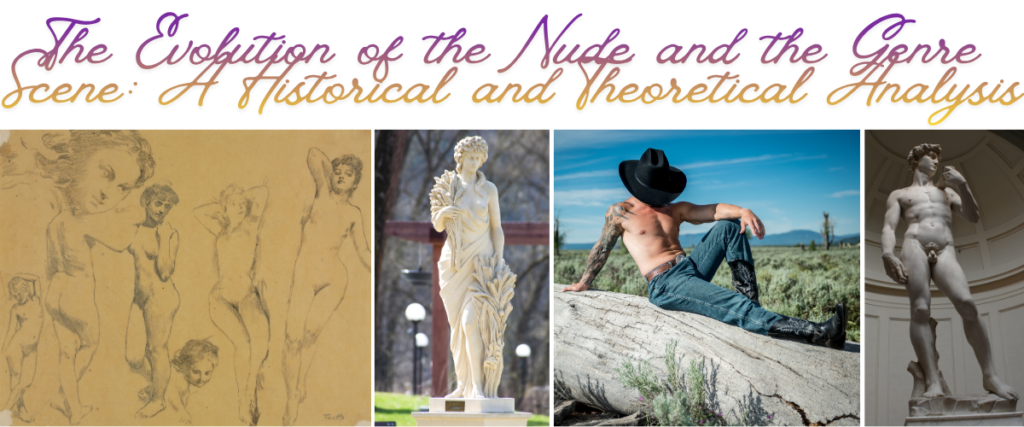
The trajectory of Western art is fundamentally defined by the parallel development and eventual collision of two distinct visual traditions: the nude and the genre scene. For centuries, these categories existed in strictly segregated domains within the rigid hierarchies of academic art. The nude, drawing its lineage from Greco-Roman antiquity, was elevated as the pinnacle of artistic achievement. Safely insulated by the contexts of mythology, ancient history, and religious allegory, the unclothed human body served as a transcendent vessel for ideal beauty, divine proportion, and heroic virtue. In stark contrast, the genre scene—which depicts the everyday activities of ordinary individuals—emerged as a lower-tier classification. Rooted in the mundane, the domestic, and occasionally the comedic, genre painting chronicled peasants, tavern revellers, and the quiet intimate moments of middle-class households.
The history of modernism, however, was catalysed when these two distinct worlds collided. When the idealised, mythological nude was dragged from its classical pedestal and placed directly into the unvarnished, contemporary reality of the genre scene, it triggered some of the most profound scandals and revolutionary shifts in visual culture. This synthesis stripped away the protective veneer of classical allegory, forcing viewers to confront the stark realities of gender, class, commercial transactionalism, and the inherent politics of looking.
This report provides an exhaustive, multi-century analysis of the evolution of the nude and the genre scene. It explores the foundational theoretical frameworks defining the human body in art, the rapid rise of everyday domestic life as a subject of profound visual interest, the explosive intersection of these forms in the nineteenth century, and the subsequent interventions by feminist critics and contemporary painters who continue to redefine the politics of the domestic space.
The Philosophy of the Unclothed Body: Naked Versus Nude
To comprehend the historical weight of the unclothed human body in art, it is necessary to examine the divergent theoretical frameworks that have governed its interpretation. The academic and cultural discourse is largely anchored by two monumental texts: Kenneth Clark’s The Nude: A Study in Ideal Form (1956) and John Berger’s Ways of Seeing (1972).
Kenneth Clark and the Classical Ideal
In his seminal 1956 text, the British art historian Kenneth Clark establishes a crucial semantic and philosophical distinction between the words “naked” and “nude”1. According to Clark, to be naked is to be deprived of clothes, a state that implies vulnerability, discomfort, and the profound embarrassment most humans feel in that condition1. Nakedness is a literal, biological, and often flawed reality4.
The nude, conversely, carries no uncomfortable overtone in educated usage1. It is not merely a subject of art, but a highly formalised category of art itself1. Clark argues that the nude depicts a “balanced, prosperous, and confident body: the body re-formed”2. Originating with the ancient Greeks, the nude was utilised to represent mathematical order, physical perfection, and divinity1. The nakedness of Apollo, for instance, was a fundamental part of his divinity1. Greek sculptors, such as Praxiteles—whose Knidian Aphrodite marked a turning point in female representation—did not simply replicate the imperfect human bodies before them1. Instead, they synthesised the most aesthetically pleasing elements from various models to construct an idealised whole, searching for the “middle form” where beauty equates to mathematical harmony1.
Clark posits that the nude survives through the centuries because it reconciles contrary states: it takes the deeply sensual, immediately interesting human body and elevates it through mathematical proportion and rational order, thereby placing it beyond the reach of time and earthly desire1. The disruption of this ideal was jarring; Clark notes that when observing Gothic paintings where the human body had lain muffled in protective darkness for a thousand years, the resulting “bulb-like women and root-like men” evoke disillusion and dismay1. Throughout the Renaissance and beyond, artists like Michelangelo, Titian, and later Rubens (who transformed Michelangelo’s muscularity into expressive, vegetable abundance) utilised the nude to convey profound humanist philosophies8. For Clark, the nude is an aesthetic triumph that sweetens the vague fears of the unknown with formal completeness1.
John Berger and the Politics of the Gaze
Sixteen years after Clark’s publication, the cultural critic John Berger radically dismantled this traditional art historical consensus in Ways of Seeing (1972)10. Berger reframed the distinction between naked and nude through the lens of Marxist and feminist theory, analysing the deep-seated power dynamics inherent in looking4.
Where Clark sees the nude as an aesthetic ideal, Berger identifies it as an ideological construct designed to serve male pleasure. Berger famously asserts that “to be naked is to be oneself,” whereas “to be nude is to be seen naked by others and yet not recognised for oneself”10. In Berger’s framework, a naked body must become an object of an external gaze to be transformed into a nude representation4.
Berger argues that the humanist tradition of European oil painting established a systemic inequality in which “men act, and women appear”12. The female nude in Western art is almost universally depicted with an awareness of being watched by a spectator10. The subject of the painting is often oriented not toward the other figures within the narrative frame, but outward toward the presumed male viewer—the “spectator-owner”13. Berger traces this to the Book of Genesis, where nakedness brought shame and woman was made subservient, and through narratives like Susannah and the Elders10. He sharply notes the hypocrisy of traditional allegories, such as paintings of Vanity wherein a nude woman is handed a mirror; this device allows the male artist and viewer to morally condemn the woman for a nakedness that they themselves have constructed for their own voyeuristic pleasure10. Furthermore, Berger draws a direct line between the European oil painting (a valuable commodity denoting the affluence of the owner) and modern advertising/publicity, which utilises the visual language of old masters to link consumer affluence with sexual virility10.
Theoretical Framework Comparison
The tension between Clark’s aesthetic idealism and Berger’s sociopolitical critique provides the essential theoretical foundation for analysing the nude’s historical evolution.
| Concept | Kenneth Clark (The Nude, 1956) | John Berger (Ways of Seeing, 1972) |
| Nakedness | A biological state of deprivation, vulnerability, and embarrassment1. | Being oneself, free from disguise, objectification, and the performance of gender10. |
| Nudity | An idealised art form, characterised by a confident, mathematically ordered, and re-formed body2. | A state of being placed on display; becoming an object and a costume for an external gaze4. |
| The Viewer | A connoisseur appreciating formal aesthetic beauty, historical continuity, and humanist ideals1. | The “spectator-owner,” typically male, consuming the image for sexual, social, or financial validation4. |
| Gender Dynamics | Focuses heavily on the male form (e.g., Apollo) as the origin of the classical ideal, with the female form emerging later1. | Focuses extensively on the systemic objectification of the female body and the internalisation of the male gaze12. |
The Elevation of the Everyday: The Rise of the Genre Scene
While the nude was bound to the lofty heights of classical mythology, the genre scene developed as an earnest reflection of earthly life. Initially marginalised as a lesser art form in academic circles, the genre scene gradually accumulated cultural capital, serving as a mirror for the shifting socioeconomic landscapes of Europe.
The Dutch Golden Age: The Mirror of the Middle Class
The formalisation of the genre scene as an independent, highly sought-after category of art occurred during the Dutch Golden Age of the seventeenth century15. The roots of this movement can be traced back to the sixteenth-century Flemish painter Pieter Bruegel the Elder, whose realistic, unvarnished depictions of peasant life, country fairs, and rustic weddings captured human existence in all its variousness15.
In the seventeenth century, following the Protestant Reformation and the subsequent decline of large-scale Catholic religious commissions, Dutch artists turned their attention to secular subjects. Driven by an unprecedented economic boom, a newly wealthy merchant middle class sought art that reflected their own prosperous lives and domestic realities15. Early proponents like Hendrick Avercamp painted sprawling winter landscapes, while Frans Hals, Hendrick ter Brugghen, and Willem Buytewech mastered merrymaking scenes15. Ter Brugghen brought the luminous chiaroscuro of Caravaggio to depictions of musicians, and Hals’s Merry Lute Player (c. 1624–1628) demonstrated how closely the emerging genre scene could overlap with character-driven portraiture15. Hals’s pupils, Adriaen Brouwer and Adriaen van Ostade, became highly adept at capturing the raucous vitality of low-life tavern scenes15.
Simultaneously, painters like Nicolaes Maes, Pieter de Hooch, and Johannes Vermeer elevated the domestic interior to a site of profound psychological and aesthetic depth15. Having studied under Rembrandt, Maes applied lessons of light and dark to intimate scenes; his series of eavesdroppers established a unique, direct relationship with the viewer through the subjects’ outward gazes15. Maes and De Hooch pioneered complex spatial arrangements, frequently utilising open doors and windows to create views into other rooms15. Samuel van Hoogstraten pushed this further in works like A View through a House (1662), employing trompe l’oeil devices to trick the viewer into reading immense depth into the canvas15.
Vermeer remains perhaps the most celebrated of these masters. Works like The Milkmaid elevated humble, ordinary labour to a state of monumental dignity15. Vermeer and Gerard ter Borch the Younger were primarily known for depicting the quiet pastimes of the well-heeled merchant classes—letter reading, courtship, and music-making—matching the superior social status their patrons wished to project15. While these works appeared highly realistic, they were, like the tavern scenes of Jan Steen, frequently laced with subtle moralising overtones, warning against excess, laziness, or promiscuity15.
William Hogarth and the Modern Moral Subject
In eighteenth-century Britain, William Hogarth expanded the boundaries of the genre scene by weaponising it for biting social satire. Moving away from the quiet domesticity of the Dutch masters, Hogarth invented a new subgenre which he termed “modern moral subjects”17. These were complex, serialised narrative paintings, subsequently mass-produced as affordable engravings, that chronicled the vices, follies, and moral decay of modern English society across all class divides18.
Hogarth’s pioneering series, A Harlot’s Progress (1732), follows the tragic, chronological descent of M. Hackabout, a naive country girl who arrives in London, is corrupted by a bawd, becomes a prostitute, and ultimately dies at the age of 23 from a venereal disease17. This six-scene series was a smash hit, selling 1,200 sets of engravings and establishing Hogarth as the grandfather of the modern comic17. He followed this with A Rake’s Progress (1733–1735), an eight-plate series detailing the ruin of Tom Rakewell, the heir of a wealthy merchant19. Surrounded by greedy sycophants and having abandoned his pregnant fiancée, Sarah Young, Tom squanders his fortune on luxury, gambling, and prostitution, ultimately ending his life in the squalor and madness of the Bethlem Royal Hospital (Bedlam)19.
Hogarth applied the narrative complexity traditionally reserved for grand history painting to contemporary urban life18. Marriage A-la-Mode (c. 1743), a searing critique of arranged marriages for money and status, demonstrates Hogarth’s unparalleled ability to infuse a domestic interior with subtle clues that unravel the moral bankruptcy of the inhabitants17. The series depicts the catastrophic union between the son of the bankrupt Earl of Squander and the daughter of a wealthy City of London Alderman18. Through visual cues—a stretched bride after a night of cards, a coral baby’s teether, an exotic artifact, and a visit to a French doctor (M. de la Pillule) to treat syphilis—Hogarth tracks the couple’s descent18. The narrative culminates in the Countess’s lover, Silvertongue, murdering the Viscount at a Turkish bath (the Bagnio), followed by the Countess’s own suicide by poison18.
Hogarth’s output was relentless in its critique of civic health and personal virtue. The Four Stages of Cruelty follows Tom Nero from childhood animal abuse to outright murder, warning that unchecked brutality destroys society21. Gin Lane starkly portrays the starvation, madness, and death wrought by alcohol addiction, while Credulity, Superstition, and Fanaticism turns a satirical lens on religious hysteria and clerical manipulation21. Furthermore, Hogarth was fiercely patriotic; his painting O the Roast Beef of Old England (‘The Gate of Calais’) contrasts a great hunk of beef symbolising British prosperity against scrawny French soldiers and salivating Catholic friars, though ironically his luscious still-life details betray an indebtedness to French painting22. Hogarth’s entrepreneurial approach to selling engravings was so successful that his work was widely pirated, leading him to successfully lobby Parliament for the Engravers’ Copyright Act of 1735 (“Hogarth’s Act”), the first law to recognise the authorial rights of an individual visual artist18.
Jean-Siméon Chardin: The Poetry of the Mundane
Contemporaneous with Hogarth, the French painter Jean-Siméon Chardin took the genre scene in a vastly different, deeply poetic direction. Rejecting the frivolous, aristocratic Rococo style favoured in eighteenth-century France, Chardin found profound beauty in the quiet, repetitive tasks of the working and bourgeois classes23.
Chardin depicted kitchen maids peeling turnips, children blowing soap bubbles, and governesses attending to their charges23. Works like The Governess (1739), which contrasts a seated, reprimanding older woman against a standing, ashamed young boy surrounded by discarded badminton equipment and cards, moved away from grand historical or moralistic gestures23. Instead, Chardin encouraged viewers to appreciate the visual harmony of ordinary life for its own sake24. Utilising a granular impasto technique and a soft diffusion of light, Chardin imbued pitchers, copper pots, and humble fabrics with a palpable physical presence23.
He was also a master of the still life; his 1728 work The Ray, which features a gutted skate whose red blood and white muscles contrast sharply with a cat and kitchen utensils, served as a massive influence on later artists, including Henri Matisse and the writer Marcel Proust23. In his later years, facing failing eyesight, Chardin shocked audiences at the 1771 Salon by pivoting to pastels, creating deeply intimate works like Self Portrait with Spectacles24. His deceptively simple style profoundly influenced later modernist painters like Édouard Manet and Paul Cézanne, proving that the genre scene could possess a structural and pictorial harmony equal to any historical epic23.
The Great Collision: Manet and the Subversion of Tradition
For centuries, the nude and the genre scene operated in strictly separate spheres. The public enthusiastically accepted the depiction of the naked body only if it was safely distanced by the cloaks of mythology, religion, or ancient history. A painting of Venus or a classical nymph could be unapologetically unclothed, as the subject existed in an idealised, fictitious realm25. Conversely, genre scenes depicted contemporary life, where people were expected to be fully clothed in accordance with the strict moral standards of the era.
This unspoken societal pact was violently shattered in the mid-nineteenth century by the French artist Édouard Manet. By forcefully inserting the unidealized nude into the contemporary genre scene, Manet precipitated the birth of modern art27.
Le Déjeuner sur l’herbe (1863)
When Manet submitted Le Déjeuner sur l’herbe (The Luncheon on the Grass) to the Paris Salon in 1863, it was summarily rejected by the conservative jury28. Seizing the opportunity, Manet exhibited the monumental canvas at the Salon des Refusés, where it provoked unprecedented public outrage, disgust, and bewilderment, with viewers reportedly striking the canvas with walking sticks28.
The painting depicts a starkly naked woman casually picnicking in a woodland clearing alongside two fully dressed, modern men28. In the background, out of scale with the foreground figures, a lightly clad woman bathes in a stream28. The discarded clothing of the nude woman, alongside a basket of fruit and a round loaf of bread, is arranged in the foreground like a magnificent Chardin still life28.
The scandal arose not strictly from the nudity, but from the aggressive contemporary context. The woman was not a nymph; she was a recognisable contemporary Parisian model and aspiring artist, Victorine Meurent28. The men were not classical heroes; they were dressed as modern university students or bohemian dandies, based on Manet’s brothers Eugène and Gustave, and his Dutch brother-in-law Ferdinand Leenhoff28. One man even wears a flat hat with a tassel, typically worn indoors28. Furthermore, Manet painted the work on a massive canvas (208 by 264.5 cm)—a scale traditionally reserved strictly for historical or religious epics28.
By merging the nude with the genre scene, Manet stripped away the mythological alibi32. He exposed the hypocrisy of the Parisian bourgeoisie, who enjoyed academic nudes under the guise of classical education but were horrified when confronted with the reality of contemporary sexuality, proximity, and potential prostitution33. What shocked critics most was the total lack of narrative interaction among the figures; the nude woman ignores her companions and stares directly, almost defiantly, at the viewer28.
Manet’s friend, the writer Émile Zola, fiercely defended the painting in his essays. Zola argued that the subject was merely a pretext for the artist to solve a formal, analytical problem: placing figures of natural grandeur within a landscape28. Zola criticised the public for seeking moral or narrative meaning where Manet was primarily concerned with the pure aesthetic interactions of light, shadow, and color28. By painting a scene that functioned as a self-reflexive allegory of the art of painting itself, Manet signalled the arrival of an era where the artist, not the academy, dictated reality36.
Olympia (1863) vs. Venus of Urbino (1538)
Manet pushed this subversion even further with Olympia (painted in 1863, but strategically held back until the 1865 Salon). The painting is a direct, modernist parody and homage to Titian’s Renaissance masterpiece, the Venus of Urbino (1538)37. A comparative analysis of the two works reveals precisely how Manet weaponised the contemporary genre scene to dismantle classical idealism.
| Element | Titian: Venus of Urbino (1538) | Manet: Olympia (1863) |
| Subject Identity | An idealised goddess or bride representing marital love, domestic fertility, and divine grace37. | A contemporary Parisian courtesan (again modelled by Victorine Meurent), recognisable as a working-class woman32. |
| The Gaze | Soft, inviting, and passive. Designed to comfortably accommodate the voyeuristic pleasure of the male spectator26. | Confrontational, assertive, and unimpressed. The subject meets the viewer’s eye with an unyielding, transactional stare26. |
| Animal Symbolism | A sleeping lapdog rests at her feet, a traditional symbol of domesticity and marital fidelity32. | A startled black cat with an arched back stands at the end of the bed, a symbol of female independence, unpredictability, and sexuality40. |
| Attendants | Servants rummage through a traditional cassone (marriage chest) in the background37. | A Black maid presents a lavish bouquet of flowers, clearly a gift from an unseen, waiting client37. |
| Formal Execution | Rendered with velatura (glazing) to create smooth, warm, luminous, and flawless flesh tones37. | Painted with harsh, washed-out lighting, flat patches of colour, and visible brushstrokes, stripping away classical illusionism37. |
While Titian’s Venus embodies the submissive perfection of Kenneth Clark’s classical nude, Manet’s Olympia reclaims the biological reality of the naked body and transforms it into agency3. Olympia refuses to be a passive object of fetishisation; her hand is clamped firmly over her genitals, indicating that access to her body is a financial transaction, not a divine or romantic right26. The collision of the high-art nude with the gritty, transactional reality of the modern genre scene created an inescapable reflection of nineteenth-century society, forever altering the trajectory of Western art33.
Technological and Cultural Shifts: Photography and Japonisme
As the nineteenth century progressed, the representation of the human body in domestic spaces was radically altered by the advent of two major visual influences: photography and Japanese woodblock prints (Japonisme). These mediums dismantled the central perspective and idealised anatomical proportions that had dominated Western art since the Renaissance.
Stop-Action Photography and Edgar Degas
The invention of photography—and specifically the chronophotography of Eadweard Muybridge—provided artists with empirical evidence of how the body actually moved in space44. Muybridge’s famous 1878 sequence, The Horse in Motion, proved definitively that a horse’s feet leave the ground in a rolling sequence, rather than the “hobbyhorse” pairs that traditional painters had favoured for centuries45. This proved that biological locomotion was far more awkward, disjointed, and asymmetric than academic painters had historically portrayed45.
The French Impressionist Edgar Degas was deeply fascinated by these photographic revelations44. He utilised photography as both a reference tool and a conceptual framework for his art, adopting the cropped compositions, unconventional angles, and off-centre focal points typical of the camera lens44.
Degas applied this unvarnished photographic realism to a vast series of female bathers47. For the eighth and final Impressionist exhibition in 1886, Degas presented a suite of nude women depicted “bathing, washing, drying, and rubbing”47. Abandoning the performative grace of traditional nudes, Degas depicted women in intensely private moments: awkwardly clambering in and out of shallow tin tubs, vigorously sponging the backs of their necks, or contorting themselves beneath huge sheets to dry their feet48. The viewer is positioned as a hidden voyeur looking through a keyhole, entirely unacknowledged by the subject49. Unlike Manet’s Olympia, who confronts the viewer, Degas’s bathers are wholly absorbed in their mundane ablutions. The bodies, rendered masterfully in pastel and graphite to show true-to-life bone and muscle, are presented not as objects of divine beauty or overt sexual desire, but as physical forms engaged in the laborious, unglamorous rituals of modern hygiene48.
Japonisme and the Domestic Interior
Concurrently, the opening of Japan to the West in the mid-nineteenth century flooded Europe with ukiyo-e woodblock prints53. Artists such as Katsushika Hokusai and Utagawa Hiroshige offered an entirely different visual paradigm: flattened pictorial space, bold outlines, asymmetrical compositions, and a focus on the fleeting moments of everyday life (the “floating world”)53.
Impressionist and Post-Impressionist artists eagerly absorbed these aesthetics to break free from the rigid conventions of European academic painting53. The influence of ukiyo-e is heavily visible in the works of Mary Cassatt and Pierre Bonnard53. Bonnard, specifically, continued Degas’s exploration of the domestic bather, but infused it with claustrophobic, psychologically charged atmospheres56. In works such as Man and Woman (1900) and Nude in Bathtub (ca. 1940-1946), Bonnard places the naked figure within highly patterned, fractured interiors56. Characterised by faux-naive colours, heavy impasto, and circular floor tiling reminiscent of Post-Impressionist vocabulary, Bonnard’s spaces feel dreamlike and muted56. Mirrors are used not as historical symbols of female vanity, but as semiotic devices to fragment the composition and highlight the internal emotionality and isolation of the figures10. In Bonnard’s domestic genre scenes, the nude becomes an element of the overarching decorative pattern, dissolving into the light, water, and textiles of the home56.
Feminist Interventions and Institutional Critique
Despite the radical formal shifts achieved by Manet, Degas, and Bonnard, the core dynamic remained stubbornly unchanged: male artists were painting female bodies primarily for the consumption of male audiences. In the late twentieth century, feminist art historians and activist artists began to violently deconstruct this dynamic, scrutinising the institutions that codified the male gaze as the default cultural perspective.
Griselda Pollock and the Spaces of Femininity
The art historian Griselda Pollock, in her foundational 1988 text Modernity and the Spaces of Femininity, systematically questions the inherent gender bias of the modernist canon59. Pollock points out that the quintessential sites of modernity celebrated by male Impressionists—the bars, brothels, cabarets, and public leisure spaces of Paris—were spaces governed entirely by masculine sexuality and looking59.
The flâneur (the detached, observing urban stroller) was a strictly male privilege. For a respectable bourgeois woman, whose identity was closely tied to her femininity, to wander the public spaces of Paris meant risking her reputation and exposing herself to the compromising, objectifying gaze of men59. Consequently, female artists like Mary Cassatt and Berthe Morisot painted from a distinctly different spatial reality: the domestic interior, the private garden, and the opera box59.
Pollock argues that the art historical elevation of the public genre scene and the nude as the defining markers of avant-garde modernism inherently marginalizes women59. Because female sexuality in the nineteenth century could not be directly registered or publicly explored by women themselves in these spaces, their absence from the realm of the nude and the brothel scene was not a lack of artistic ambition. Rather, it was a structural impossibility dictated by the gendered division of public and private spheres59. Pollock demands that viewers recognise the gender-specific conditions of these paintings’ existence, asking how the spectator outside the painting is often evoked as the mirror image of the man looking within it59.
The Guerrilla Girls’ Institutional Critique
This academic critique was matched by the fierce, public activism of the Guerrilla Girls. Formed in New York City in 1985, this anonymous collective of female artists adopted the names of deceased women artists (such as Käthe Kollwitz and Frida Kahlo) and wore gorilla masks in public62. This striking visual pun on their collective name protected their identities and kept the focus squarely on their political messages regarding sexism and racism in the art world62.
In 1989, the Guerrilla Girls produced one of the most iconic pieces of institutional critique in art history: a poster titled Do Women Have To Be Naked To Get Into the Met. Museum?62. Commissioned initially by the Public Art Fund in New York, the poster featured a reproduction of Jean-Auguste-Dominique Ingres’s famous 1814 academic nude, the Grande Odalisque, subversively altered to wear a snarling gorilla mask63. Beside the image was a devastating statistical fact: “Less than 5% of the artists in the Modern Art Sections are women, but 85% of the nudes are female”62.
When the Public Art Fund rejected the design for not being “clear enough,” the Guerrilla Girls personally funded the placement of the posters on advertising spaces within New York City transit buses66. The work brilliantly co-opted the visual magnetism of the traditional female nude to critique the very system that exploited it65. By juxtaposing the historical objectification of women’s bodies with the contemporary erasure of women’s intellectual and artistic labour, the Guerrilla Girls forced major cultural institutions to confront their complicity in perpetuating the male gaze63. The poster remains a defining moment in art history, utilising the language of modern advertising—a medium Berger identified as the descendant of oil painting—to dismantle the historical abuse of the female form10.
Contemporary Reclamations: The Genre Scene Redefined
In contemporary art, the domestic genre scene continues to be a vital, heavily contested battleground for asserting identity, agency, and complex social realities. Contemporary painters are reclaiming the intimate interior, dismantling the historical male gaze, and utilising the genre scene to explore intersections of race, gender, and transnational identity.
Caroline Walker and the Psychology of Spaces
The Scottish contemporary painter Caroline Walker creates large-scale, psychologically charged genre scenes that investigate the lived experiences of women in modern settings68. Moving beyond the historic confines of the bourgeois parlour, Walker depicts women in transient and labour-intensive spaces such as hotels, beauty parlours, and modern domestic interiors69.
Her work consciously engages with the history of the voyeuristic gaze—recalling the unacknowledged keyhole perspective of Degas’s bathers—but she subverts it by centring the internal psychological state and quiet labour of her female subjects46. Walker’s half-told narratives complicate traditional ideas of women as passive subjects, addressing the isolation and performative aspects of modern femininity in an intensely image-conscious age69. The women in her paintings are not offered up for aesthetic or sexual consumption; rather, they exist within their own complex psychological realities.
Njideka Akunyili Crosby and the Diasporic Interior
The Nigerian-born artist Njideka Akunyili Crosby radically reinvents the domestic genre scene to map the complexities of African diasporic identity68. Drawing on a multitude of references, Crosby creates densely layered figurative compositions utilising a combination of acrylic, colored pencil, pastel, charcoal, and acetone photographic transfers70.
Her interiors are deeply personal, often featuring herself, her husband, or family members in quiet moments of domestic repose, conversation, or intimacy70. However, the surfaces of her paintings are literally embedded with transferred images drawn from Nigerian pop culture, family photo albums, and political history70. In works such as The Beautyful Ones series, Crosby transforms the genre scene from a simple depiction of everyday life into a physical manifestation of existing in two cultural worlds simultaneously70. The physical intimacy in her works operates entirely outside the historical European tradition of the nude; it is a bold assertion of Black domesticity, vulnerability, and love, free from the external objectification of the colonial or patriarchal gaze70. Through artists like Crosby, the genre scene has evolved into a profound tapestry capable of expressing the intricacies of global, modern life.
Conclusion
The evolution of the nude and the genre scene provides a comprehensive map of how Western society has historically viewed the human body, the domestic space, and the complex power dynamics of looking. In its classical origin, the nude was a highly constructed aesthetic ideal—a mathematical and philosophical triumph designed to transcend earthly reality and human frailty. Concurrently, the genre scene emerged as a mirror to the mundane, capturing the morality, labour, and social structures of the emerging middle classes from the Dutch Golden Age to the satirical engravings of William Hogarth.
The watershed moment of modernism occurred when these two distinct domains violently intersected. By forcing the unidealized, contemporary naked body into the modern genre scene, artists like Édouard Manet destroyed the protective barrier of mythology. This collision exposed the hypocrisies of the nineteenth-century bourgeoisie and redefined the relationship between the viewer and the subject. This breakdown of academic hierarchy paved the way for photography and Japonisme to introduce new, intimate, and often psychologically disjointed perspectives on the private domestic sphere, as seen in the works of Degas and Bonnard.
Ultimately, the historical dominance of the male spectator—which dictated that men act and women appear—has been systematically dismantled by feminist theorists like Griselda Pollock and activist groups like the Guerrilla Girls. Today, the genre scene and the depiction of the human form are no longer tools for passive, voyeuristic consumption. Through the work of contemporary painters, these historical forms have been reclaimed as potent sites for asserting agency, exploring diasporic identity, and illustrating the multifaceted realities of modern existence. The human body in art is no longer just an idealised form to be admired; it is a lived experience to be understood.
Disclaimer: Historical Context and Artistic Nudity
This article contains discussions of artistic nudity and the unclothed human form, which has been a foundational subject in Western art since classical antiquity. The text explores the theoretical and cultural differences between being “naked” and “nude,” as well as the sociopolitical dynamics of the “male gaze” and the historical objectification of the female body. Additionally, the article examines genre scenes that depict sensitive historical topics, including courtesans, transactional relationships, and societal moral decay in the eighteenth and nineteenth centuries.
Please note that these themes are presented strictly for educational and art-historical analysis. The societal norms, gender dynamics, and cultural attitudes described reflect the specific historical eras in which these artists lived and worked. They are discussed here to provide a comprehensive understanding of how visual culture and domestic spaces have evolved over centuries, and the inclusion of these topics does not constitute an endorsement of the historical inequalities or objectification depicted in the artworks.
References
- The Nude – Bookey, https://cdn.bookey.app/files/pdf/book/en/the-nude.pdf
- Nude and naked – Cha, https://chajournal.com/2010/12/12/nude-and-naked/
- NOTES on Sir Kenneth Clark (1903-1983): The Naked and the Nude, https://cosplayvideos.wordpress.com/2018/02/09/notes-on-sir-kenneth-clark-1903-1983-the-naked-and-the-nude/
- Nakedness vs. Nudity Explained | PDF – Scribd, https://www.scribd.com/document/393518458/j-Berger
- The naked truth about nudes | Art | The Guardian, https://www.theguardian.com/artanddesign/jonathanjonesblog/2008/nov/21/nude-naked-art-diana-actaeon
- “Kenneth Clark on Naked, Nude, and Ideal Form – The Victorian Web, https://victorianweb.org/sculpture/nudes/naked.html
- Clark’s Analysis of Nude Balances Real and Ideal, https://www.thecrimson.com/article/1957/5/10/clarks-analysis-of-nude-balances-real/
- The Nude: A Study in Ideal Form by Kenneth M. Clark | Goodreads, https://www.goodreads.com/book/show/101128
- THE BODY OF ART – ResearchGate, https://www.researchgate.net/publication/342899894_The_Body_of_Art/fulltext/5f0c96e192851c38a51a1011/The-Body-of-Art.pdf
- Ways of Seeing – four part BBC film: John Berger, https://meaningandmanipulation.wordpress.com/readings-notes/ways-of-seeing-four-part-bbc-film-john-berger/
- Man vs Nude: The subversive and revelatory potential of the gaze of, https://www.palatinate.org.uk/man-vs-nude-the-subversive-and-revelatory-potential-of-the-gaze-of-the-artist/
- Nude vs Naked: Gendered Perspectives | PDF | Nudity – Scribd, https://www.scribd.com/document/440974552/UNIT-FOUR-1-Nude-vs-Naked
- Retrospect JournalOn John Berger’s Ways of Seeing, https://retrospectjournal.com/2023/04/16/on-john-bergers-ways-of-seeing/
- Guerrilla Girls, Do Women Have To Be Naked To Get Into the Met, https://www.reddit.com/r/ArtHistory/comments/ah8gx6/guerrilla_girls_do_women_have_to_be_naked_to_get/
- Elevating the everyday: genre painting through the ages | Art UK, https://artuk.org/discover/stories/elevating-the-everyday-genre-painting-through-the-ages
- Dutch Golden Age Painting Movement Overview | TheArtStory, https://www.theartstory.org/movement/dutch-golden-age/
- Modern moral subject – Tate, https://www.tate.org.uk/art/art-terms/m/modern-moral-subject
- William Hogarth (1697 – 1764) | National Gallery, London, https://www.nationalgallery.org.uk/artists/william-hogarth
- William Hogarth – Wikipedia, https://en.wikipedia.org/wiki/William_Hogarth
- What was so radical about Hogarth’s Moral Modern Subjects and his, https://medium.com/@nwankwopaschal.pn/what-was-so-radical-about-hogarths-moral-modern-subjects-and-his-approach-to-image-making-57aed16e484a
- The Satirical Art of William Hogarth Who Redefined Artistic Storytelling, https://www.thecollector.com/satirical-art-william-hogarth/
- The social commentary of William Hogarth | Art UK, https://artuk.org/discover/stories/the-social-commentary-of-william-hogarth
- Jean Siméon Chardin – Wikipedia, https://en.wikipedia.org/wiki/Jean_Sim%C3%A9on_Chardin
- Jean-Baptiste-Siméon Chardin: A Guide to Chardin’s Paintings – 2026, https://www.masterclass.com/articles/jean-baptiste-simeon-chardin-guide
- Olympia | painting by Édouard Manet – Britannica, https://www.britannica.com/topic/Olympia-painting-by-Manet
- Reversing the Gaze – Manet’s “Olympia” and Titian’s “The Venus of, http://www.hasta-standrews.com/features/https/artsandculturegooglecom/asset/olympia/ywfei4rxgcso1qhlen-gb
- MANET’S ‘COUP DE TÊTE’: THE SECRETS HIDDEN IN PLAIN SIGHT, https://www.scielo.br/j/ars/a/gC8wGDZHM8PY3sfYfvBfsSd/?lang=en&format=pdf
- Le Déjeuner sur l’herbe – Wikipedia, https://en.wikipedia.org/wiki/Le_D%C3%A9jeuner_sur_l%27herbe
- Paris Museum Puts Édouard Manet on Mock Trial for Painting a, https://www.smithsonianmag.com/smart-news/paris-museum-puts-edouard-manet-on-mock-trial-for-painting-scandalous-scene-nude-woman-180987478/
- Luncheon on the Grass (Le Déjeuner sur l’herbe), 1866-67, https://www.claude-monet.com/luncheon-on-the-grass.jsp
- The Mysterious Motives of Manet’s Masterpiece, Le Déjeuner Sur L, https://www.artdex.com/the-mysterious-motives-of-manets-masterpiece-le-dejeuner-sur-lherbe-art-and-nude-series-part-4/
- Olympia and Venus of Urbino together at last – The History Blog, https://www.thehistoryblog.com/archives/23846
- Manet’s Olympia – A Free Art History Course – Laurence Shafe, https://www.shafe.co.uk/essay_manets_olympia/
- Emile Zola (18401902) Edouard Manet’ – SobTell, https://www.sobtell.com/images/questions/1497003806-201364_1_EMILE-ZOLA-on-Edouard-Manet-1.pdf
- Édouard Manet’s Le déjeuner sur l’herb (1863) | Picnic Wit, https://picnicwit.com/art/a-picnic-with-edouard-manet-in-luncheon-on-the-grass-aka-le-dejeuner-sur-lherbe-1863/
- Édouard Manet’s “Le Déjeuner sur l’herbe” as a Veiled Allegory of, https://faculty.winthrop.edu/stockk/Modernism/Manet%20Dejeuner.pdf
- Olympia and Venus of Urbino: Simile and Contrast Between Paintings, https://gradesfixer.com/free-essay-examples/olympia-and-venus-of-urbino-simile-and-contrast-between-paintings/
- How are ‘Venus of Urbino’ and ‘Olympia’ alike and different? – Quora, https://www.quora.com/How-are-Venus-of-Urbino-and-Olympia-alike-and-different
- Venus and Olympia: A Comparative Study – Édouard Manet – Scribd, https://www.scribd.com/document/916843471/Compare-Contrast3
- Comparison Of Olympia And Venus Of Urbino – 2128 Words | Bartleby, https://www.bartleby.com/essay/Comparison-Of-Olympia-And-Venus-Of-Urbino-D3B882315D8CF154
- Chapter 3 Summary, Ways of Seeing Essay – 705 Words | Bartleby, https://www.bartleby.com/essay/Chapter-3-Summary-Ways-of-Seeing-FKPDJKCVC
- Olympia, 1856 by Édouard Manet, https://www.manet.org/olympia.jsp
- Manet’s Olympia & The Shock to Society – THATMuse, https://thatmuse.com/2021/11/23/manets-olympia-the-shock-to-society/
- The Influence of Photography on Degas’ Art – Canvas Prints Australia, https://www.canvasprintsaustralia.net.au/the-influence-of-photography-on-degas-art/
- Edgar Degas and photography – Kiama Art Gallery – WordPress.com, https://kiamaartgallery.wordpress.com/tag/edgar-degas-and-photography/
- EDGAR DEGAS, Photographer – The Metropolitan Museum of Art, https://resources.metmuseum.org/resources/metpublications/pdf/Edgar_Degas_Photographer.pdf
- Degas’ bathers paintings – modern realist Aphrodites, https://montmartrefootsteps.com/degas-paintings-nude-female-bathers/
- Edgar Degas: Intimität und Pose – Nineteenth-Century Art Worldwide, https://19thc-artworldwide.org/autumn09/edgar-degas-intimitaet-und-pose
- Four Bathers by Degas and Bonnard – Brooklyn Museum, https://www.brooklynmuseum.org/exhibitions/degas_bathers
- Edgar Degas: Master of Movement and Light, https://www.rwongphoto.com/gallery/edgar-degas/
- The Modern Nude in Later Nineteenth-Century French Painting, https://arthistoryteachingresources.org/lessons/the-modern-nude-in-later-nineteenth-century-french-painting/
- Art Review: Degas & the Nude – Deborah Feller, https://www.deborahfeller.com/news-and-views/?p=1316
- Learn How Japanese Woodblock Prints Inspired Impressionist Art, https://vaulteditions.com/blogs/news/learn-how-japanese-woodblock-prints-inspired-impressionist-art-and-a-guide-to-creating-your-own-ukiyo-e-inspired-pieces
- The influence of japanese art on impressionism, https://www.canvasprintsaustralia.net.au/the-influence-of-japanese-art-on-impressionism/
- “Japonisme” or the influence of Japan in Western painting., https://galeriekle.com/en/blogs/infos/japonism-what-exactly-are-we-talking-about
- Man and Woman – Pierre Bonnard | Artera | AskArtera, https://www.artera.ae/artworks/4bed7551-e9de-47ae-9826-545b50847ad9
- Pierre Bonnard | The Charleston Attic, https://thecharlestonattic.wordpress.com/tag/pierre-bonnard/
- Nude in Bathtub, ca. 1940-1946 by Pierre Bonnard – Paper Print, https://prints.carnegieart.org/detail/481950/bonnard-nude-in-bathtub-ca.-1940-1946
- Griselda Pollock – Columbia University, http://www.columbia.edu/itc/barnard/arthist/wolff/pdfs/week3_pollock.pdf
- Pollock Modernity And The Space Of Femininity – 123HelpMe, https://www.123helpme.com/essay/Pollock-Modernity-And-The-Space-Of-Femininity-5F1DEDC7A8074A9C
- Pollock on Feminism and Art History | PDF | Mary Cassatt – Scribd, https://www.scribd.com/document/904903056/Pollock-Vision-and-Difference-1
- Do Women Have To Be Naked To Get Into The Met. Museum, https://www.joseflebovicgallery.com/pages/books/CL189-173/guerrilla-girls-active-from-1985-american/do-women-have-to-be-naked-to-get-into-the-met-museum?soldItem=true
- Guerrilla Girls – Do Women Have To Be Naked To Get Into the Met, https://www.metmuseum.org/art/collection/search/849438
- Do Women Have To Be Naked To Get Into the Met. Museum? – Tate, https://www.tate.org.uk/art/artworks/guerrilla-girls-do-women-have-to-be-naked-to-get-into-the-met-museum-p78793
- “DO WOMEN HAVE TO BE NAKED TO GET INTO THE MET, https://dialnet.unirioja.es/descarga/articulo/5581571.pdf
- Guerrilla Girls, “Do women have to be naked to get into the Met, https://www.youtube.com/watch?v=gKBCN3LAmXU
- Naked Through The Ages – Guerrilla Girls, https://www.guerrillagirls.com/naked-through-the-ages
- Genre painting | Art UK, https://artuk.org/discover/art-terms/genre-painting
- Caroline Walker – Contemporary Art Curator Magazine, https://www.contemporaryartcuratormagazine.com/home-2/caroline-walker
- Njideka Akunyili Crosby – Artworks & Biography | David Zwirner, https://www.davidzwirner.com/artists/njideka-akunyili-crosby
- Contemporary figurative painting – Whitebank Fine Art, https://whitebankfineart.co.uk/art-movements/contemporary-figurative-painting
- Njideka Akunyili Crosby | Victoria Miro, https://www.victoria-miro.com/artists/185-njideka-akunyili-crosby/