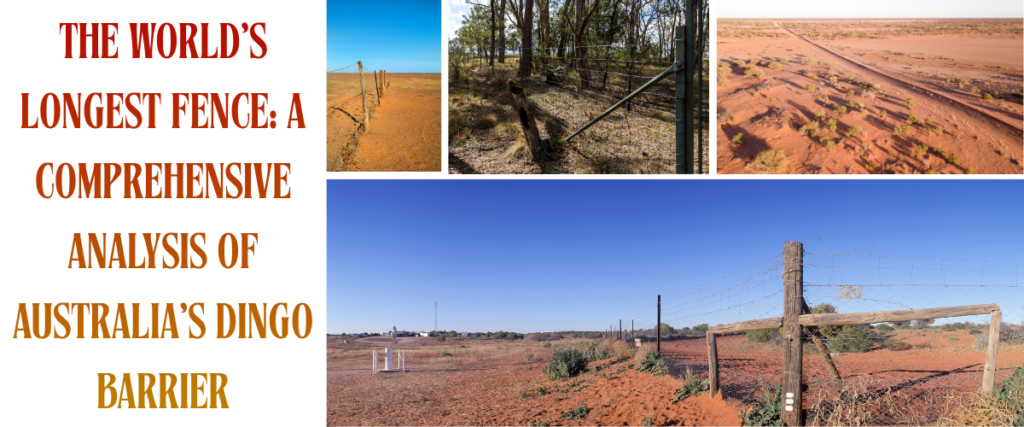
The vast, arid expanse of the Australian outback is divided by a structure of unprecedented scale and consequence. The Dingo Fence, officially known in various jurisdictions as the Wild Dog Barrier Fence, stands as the longest continuous fence in the world1. Spanning approximately 5,614 kilometres, this monumental feat of agricultural engineering connects the fertile, populated regions of Queensland’s Darling Downs to the precipitous limestone cliffs of the Nullarbor Plain, terminating above the Great Australian Bight in South Australia4. To conceptualise its sheer magnitude, the barrier is significantly longer than the distance from London to New York and surpasses the historic Great Wall of China in its continuous length2.
Originally conceived in the late nineteenth century as a desperate, fragmented measure to halt the relentless progression of an introduced rabbit plague, the barrier was later repurposed, heightened, and fortified to exclude Australia’s apex terrestrial predator—the dingo (Canis dingo)5. Its primary objective has remained singular and economically driven: to protect the highly vulnerable and lucrative sheep flocks of south-eastern Australia from predation1. However, this barrier has produced a legacy far more complex than simple predator exclusion. By artificially bifurcating the continent, the Dingo Fence has initiated an unintended ecological experiment on a massive scale, fundamentally altering trophic webs, vegetation density, soil nutrient profiles, and even the geomorphology of desert sand dunes—changes so profound they are visible from space10.
Furthermore, the barrier sits at the intersection of deeply entrenched agricultural interests, urgent conservation biology, and First Nations cultural heritage14. To understand the Dingo Fence is to understand the modern history of Australian land management, the delicate balance of arid ecosystems, and the cascading consequences of attempting to dominate a continent with a wall of wire and wood.
Historical Origins: From Rabbit Plague to Predator Exclusion
The genesis of the Dingo Fence is inextricably linked to the rapid expansion of European pastoralism and the devastating biological invasions that followed British colonisation. During the 1860s and 1870s, the introduction of domestic rabbits into Victoria—intended for recreational hunting—resulted in an ecological catastrophe of unprecedented proportions4. Breeding prolifically and completely unhindered by natural predators or localised diseases, rabbit populations exploded, advancing northward and westward across the continent at alarming rates of up to 100 kilometres per year8. These introduced herbivores decimated native vegetation, outcompeted local fauna, and threatened the viability of the entire agricultural sector.
In response to this existential threat, state governments and local pastoral boards initiated ambitious, large-scale fencing projects intended to halt the advancing “grey blanket” of rabbits. Between 1892 and 1905, the state of Queensland alone was subdivided into nine separate Rabbit Board Districts, each tasked with erecting netted barrier fences to protect their respective jurisdictions8. However, these early rabbit-proof fences were ultimately unsuccessful in their primary goal. Rabbits proved exceptionally adept at burrowing beneath the wire netting, and maintaining thousands of kilometres of fencing in harsh, remote conditions was an immense, and ultimately insurmountable, logistical challenge4.
As the rabbit threat permeated the continent and the fences fell into disrepair, pastoralists faced an equally pressing economic challenge: severe predation by dingoes and wild dogs. The sheep industry, which formed the absolute financial backbone of the Australian export economy, was highly vulnerable. Flocks grazing in the extensive pastoral zones suffered heavy losses, prompting a fundamental shift in the continent’s fencing strategy. By 1914, many of the dilapidated rabbit fences were being repaired, heightened, and reinforced with heavier gauge wire specifically to keep dingoes out of the established sheep-producing regions5.
The modern configuration of the Dingo Fence began to take definitive shape in the mid-twentieth century. In 1948, the Dingo Fence Scheme was formally proposed in Queensland, aiming to connect various disparate pastoral fences into a single, unified barrier across the continent1. Completed in the late 1950s, the resulting structure stretched over an astounding 8,000 kilometres1. However, maintaining such an expansive network proved financially and logistically unfeasible. Extensive deterioration, rugged terrain, and the frequent failure of individual landholders to uphold their sections led to a major legislative and structural reassessment. By 1981, following a comprehensive survey of the existing infrastructure, the Queensland section was strategically shortened to 2,125 kilometres, bringing the total continental length of the continuous fence to its current operational length of 5,614 kilometres1.
| Historical Era | Key Developments in Australian Pest Exclusion Fencing |
| 1860s – 1880s | Introduction and rapid spread of the European rabbit across southern Australia. Early, fragmented pest exclusion fences are erected to protect small crop plots4. |
| 1880s – 1905 | Construction of massive rabbit-proof fences. Queensland is divided into nine Rabbit Board Districts. Western Australia begins its No. 1 Fence8. |
| 1914 – 1930s | Realisation that rabbit fences are failing. Existing infrastructure is repaired, heightened, and converted to target dingoes to protect the booming sheep industry1. |
| 1940s – 1950s | Independent state fences are formally joined to create one continuous Dingo Barrier Fence, stretching over 8,000 kilometres at its peak1. |
| 1970s – 1980s | Maintenance becomes unmanageable. In 1981, Queensland surveys and shortens its section. The total length is reduced to the current 5,614 kilometers1. |
| 1990s – Present | Discovery of significant breaches allowing dingo infiltration. Implementation of modern maintenance regimes, high-tensile materials, and multi-million dollar rebuilds1. |
Geographic Route and Physical Specifications
The Dingo Fence follows a winding, arbitrary path dictated more by nineteenth-century land holdings, pastoral leases, and historical surveyor lines than by natural geographic or ecological boundaries16. Its northern terminus lies at Jimbour on the Darling Downs, near the town of Dalby in Queensland4. From the fertile agricultural plains of the Darling Downs, it strikes westward through thousands of kilometres of arid and semi-arid terrain, traversing the remote Channel Country before reaching Cameron Corner—the exact geographic point where the borders of Queensland, New South Wales, and South Australia converge20.
At Cameron Corner, a site steeped in outback surveying history, the barrier turns sharply southward, running directly along the New South Wales and South Australian border for 257 kilometers20. In this section, it cuts directly through the striking red sand dunes of Sturt National Park and the Strzelecki Desert, creating a stark visual divide in the landscape4. Entering South Australia proper, the barrier weaves through the remote pastoral leases near the opal-mining town of Coober Pedy, before finally terminating on the spectacular, sheer limestone cliffs of the Nullarbor Plain, plunging toward the waters of the Great Australian Bight near Nundroo4.
The physical construction of the fence varies considerably across its length, adapting to the specific topography, soil types, and environmental pressures of each region. However, standard specifications dictate a formidable and highly maintained structure.
| Specification Feature | Details and Dimensions |
| Total Operational Length | 5,614 kilometres (3,488 miles)1. |
| Above-Ground Height | Generally maintained at 1.8 metres (180 centimetres or approximately 6 feet)7. |
| Subsurface Extension | Netting extends 30 centimetres underground to prevent burrowing. Additionally, wire netting is laid flat a further 1.5 meters along the ground (the “skirt”) on the downstream side, secured by timber logs or heavy debris7. |
| Clearing Zone | A cleared buffer zone of 5 meters in width is strictly maintained on both sides of the fence line. This prevents structural damage from falling vegetation and allows constant vehicular access for boundary riders4. |
| Structural Supports | Constructed using a combination of heavy wooden posts, strainers, and steel star pickets spaced every 9 meters, bound by wire and heavy-duty, graded mesh7. |
| Technological Variations | Certain high-pressure sections, particularly in the South Australian outback, utilise multi-strand electric fencing to deliver shocks that deter persistent predators and large herbivores from testing the barrier4. |
Distinguishing the Dingo Fence from Western Australian Barriers
When analysing the history of Australian exclusion fencing, it is crucial to clearly distinguish the eastern Dingo Fence from the state barrier fences of Western Australia, as the two are frequently conflated in popular culture and historical discussions23. While both systems were born from the same era of agricultural protectionism, they serve different geographic regions and target different pest dynamics.
Western Australia constructed its own monumental barrier, famously known as the No. 1 Rabbit-Proof Fence, between 1901 and 190717. Stretching 1,833 kilometres from the northern coast to the southern coast, it was part of an extensive three-fence system (incorporating Fence No. 2 and Fence No. 3) totalling 3,256 kilometers19. This massive undertaking, which cost approximately $250 per kilometre at the time, was designed explicitly to keep eastern rabbit populations out of Western Australia’s pristine agricultural heartland19. Unfortunately, the rabbits breached the construction lines before the fence was even completed, necessitating the construction of the subsequent backup fences17.
Today, this historical network has evolved into the State Barrier Fence of Western Australia. It is managed independently of the eastern Dingo Fence and currently spans approximately 1,350 kilometres, with active projects underway to extend it to 1,800 kilometres around the Esperance agricultural region5. The modern Western Australian fence is designed to exclude wild dogs, emus, and kangaroos from the state’s south-western farming zones5. The Dingo Fence, conversely, is a continuous structure running strictly through Queensland, New South Wales, and South Australia, serving as the primary dividing line between the arid central interior and the south-eastern pastoral zone2.
Legislative Frameworks and the Life of Boundary Riders
A structure of this unparalleled magnitude, situated in one of the earth’s most unforgiving environments, requires relentless, ongoing maintenance. The Australian outback is a highly dynamic landscape; flash floods routinely wash away entire sections of wire, shifting desert sands bury the mesh, and large, panicked animals such as feral camels, kangaroos, and emus frequently crash into the barrier, creating breaches that dingoes swiftly exploit5.
Historically, the maintenance of the fence was a profound exercise in isolation, endurance, and bushcraft. In the early twentieth century, boundary riders utilised specialised camel teams to haul heavy supplies, timber, and wire along the line. Camels were uniquely suited to this task, capable of surviving for extended periods without water in the arid interior19. The logistics were so severe that boundary riders would often spend up to three-fourths of their working time merely securing water and rations, leaving only a fraction of their energy for the actual, back-breaking labour of fence repair19. Men like Inspector Matheson, who patrolled a gruelling 20-month continuous circuit along the South Australian segments in the 1930s, became emblematic of the rugged Australian boundary rider, living in almost total solitude to ensure the integrity of the barrier27.
Today, the responsibility falls to a modern, highly organised cohort of boundary riders equipped with specialised four-wheel-drive vehicles, heavy earth-moving machinery, and satellite communications. In New South Wales, a dedicated team of 13 staff manages sections of the fence ranging from 60 to 100 kilometres each, conducting exhaustive visual and physical inspections every Monday and Friday4. In Queensland, two-person crews patrol 300-kilometre sectors weekly, operating out of fully equipped maintenance depots strategically situated in towns like Quilpie and Roma8.
The governance and funding of the fence are heavily legislated through a complex, interdependent matrix of state governments, local councils, and industry levies.
State-by-State Legislative Frameworks
- South Australia: The fence is governed by the stringent Dog Fence Act 1946, which established the Dog Fence Board to oversee the construction, maintenance, and financial rating of the barrier. Landholders whose pastoral properties adjoin the fence are legally obligated to maintain their specific sections in a strictly defined “dog-proof condition” and must inspect them at intervals of no more than 14 days28. Strict penalties, including heavy divisional fines, are enforced for negligence, structural failure, or for simply leaving gates open29. Currently, South Australia is undertaking a historic, $27 million rebuild of 2,150 kilometres of the fence. Jointly funded by the federal government ($10 million), the state government ($11.6 million), and the livestock industry ($5.8 million), the project involves completely replacing aging infrastructure with 60,000 new wooden posts and 110,000 steel droppers, projected to deliver up to $113 million in economic benefits to the state14.
- New South Wales: Originally managed under the Wild Dog Destruction Act 1921, the legislation was fundamentally updated and renamed the Border Fence Maintenance Act 1927 in 2017 to better reflect modern biosecurity frameworks and administrative realities31. The Border Fence Maintenance Board, uniquely chaired by the Western Lands Commissioner, operates the fence using rates collected directly from pastoralists residing in the Western Division31.
- Queensland: The Queensland portion, which protects 26.5 million hectares of grazing land, is overseen by the Department of Natural Resources and Mines. It is funded through a hybrid model, with approximately 50% of contributions derived from the state government and 50% from the pastoral industry via local government levies7. It interfaces directly with the Darling Downs–Moreton Rabbit Board Fence to the east, creating a comprehensive exclusion zone5.
The Agricultural Imperative: Economics of the Wool and Sheep Industry
The fundamental justification for the immense capital, labour, and ecological disruption associated with the Dingo Fence is raw economic survival. Australia is one of the world’s leading producers of premium sheep meat and wool, industries that generate billions of dollars for the national economy and form the absolute lifeblood of rural communities across the continent33.
The dingo is Australia’s largest terrestrial predator, and domestic sheep—docile, ground-dwelling, and entirely lacking in natural evolutionary defence mechanisms against canine predators—are highly susceptible to attacks5. Dingo predation can have catastrophic, compounding effects on sheep enterprises. The predators not only kill lambs and adult sheep directly for food, but their presence can cause widespread panic within a flock. This panic frequently leads to the abandonment of young lambs, stress-induced miscarriages, and mass deaths from exhaustion or smothering as sheep crowd into fences or gullies36.
In the late 1800s, prior to the widespread establishment of exclusion fencing and coordinated, government-backed baiting programs, the impact of dingoes on sheep flocks was devastating. The constant threat often forced pastoralists to abandon highly profitable sheep farming altogether, transitioning their lands to the more resilient, but sometimes less profitable, cattle industry37. Today, proponents of the fence, including powerful agricultural bodies and pastoral associations, argue vehemently that the sheep industry simply cannot co-exist economically with an unmanaged dingo population7. The estimated direct cost of wild dog predation to rural industries in Queensland alone ranges between $40 million and $50 million annually1.
Inside the fence, in regions where dingoes are effectively suppressed, sheep populations can be maintained with high weaning and marking rates. However, in areas outside the fence, or in regions where breaches occur, lamb losses can rise from a baseline of 1% to as high as 32% in extreme cases of pack predation36. The financial success of the fence is undeniable from a purely agricultural standpoint. When the barrier was tightened and joined in the mid-twentieth century, dingo attacks in the protected south-eastern zones plummeted, and sheep flocks flourished, driving the Australian export economy5.
However, this economic security has been achieved through continuous, widespread lethal control. Inside the fence line, any dingo that manages to breach the barrier is subjected to aggressive eradication campaigns. These programs utilise broad-scale aerial and ground baiting with 1080 poison (sodium fluoroacetate), padded-jaw traps, and targeted shooting39. Furthermore, to mitigate ongoing risks, pastoralists are increasingly investing heavily in localised “cluster” or “cell” fences to enclose smaller groups of properties, indicating that the reliance on exclusion netting is only growing deeper in the agricultural community36.
The Continental Ecological Experiment: Trophic Cascades
While pastoralists view the Dingo Fence as an essential economic shield, ecologists and evolutionary biologists view it as the site of one of the world’s most remarkable—and unintentional—natural experiments43. By completely removing the apex predator from half a continent, the fence has provided a stark, real-time, landscape-scale demonstration of a phenomenon known as a trophic cascade.
A trophic cascade occurs when the removal or addition of a top predator triggers reciprocal, cascading changes in the relative populations of predator and prey throughout a food web, often resulting in dramatic alterations to ecosystem structure, nutrient cycling, and biodiversity39. The Dingo Fence, acting as a sharp, artificial dividing line through otherwise continuous habitats, allows researchers to directly compare landscapes with high dingo populations (outside the fence) against those where dingoes have been functionally extirpated (inside the fence)10.
Mesopredator Release
The dingo occupies the absolute peak of the Australian terrestrial food web. Where dingo populations are stable and undisturbed by lethal control, they naturally suppress the numbers of introduced mesopredators (mid-ranking predators), specifically the European red fox and the feral cat39. Dingoes exert this control through direct predation, killing foxes and cats, or through competitive exclusion, altering their behaviour by forcing them to spend less time hunting and more time hiding or avoiding prime habitats39.
Inside the fence, where dingoes are absent or heavily suppressed, fox and cat populations have flourished in a classic ecological phenomenon known as “mesopredator release”46. Because foxes and cats are highly efficient, prolific hunters of small prey, their unhindered proliferation inside the fence has decimated native small mammal and ground-nesting bird populations39. Long-term ecological surveys conducted in the Strzelecki Desert consistently confirm that small mammals, such as the dusky hopping mouse (Notomys fuscus), are far more abundant outside the fence, where the presence of dingoes provides a protective “shield” against foxes and cats45.
Herbivore Irruption and Vegetation Collapse
Simultaneously, the removal of the dingo triggers a massive “herbivore irruption.” Dingoes are the primary natural predators of large native herbivores, particularly red kangaroos (Osphranter rufus) and western grey kangaroos (Macropus fuliginosus), as well as introduced emus and feral goats4. Inside the dingo-free zone, kangaroo populations experience explosive growth, artificially inflated by the total absence of predation and the widespread provision of artificial watering points intended for livestock10.
The downstream, cumulative effects of this herbivore irruption are catastrophic for the landscape. Massive, unchecked populations of kangaroos relentlessly overgraze the native vegetation. Grasses, ephemeral forbs, and vital woody shrubs are continually cropped to the ground before they can seed, flower, and regenerate10.
Professor Mike Letnic and his research team at the University of New South Wales (UNSW) have conducted extensive, multi-year field studies in Sturt National Park, analysing the cascading effects of this overgrazing. Their research revealed that the impact extends far beyond the surface flora, reaching deep into the soil nutrient pool16. By continually stripping the landscape of plant matter, kangaroos drastically reduce the amount of senescent plant material (leaf litter) falling to the ground. This organic matter is the foundation of the “brown food web” and is essential for nutrient cycling; without it, soil quality rapidly plummets44.
Letnic’s data conclusively show that soils outside the fence (where dingoes regulate kangaroos) contain significantly higher levels of total carbon, total nitrogen, and available phosphorus compared to the depleted soils inside the fence16. The impoverished soil inside the fence struggles to support new plant growth even after rainfall, creating a vicious negative feedback loop of degradation and desertification13.
| Ecological Metric | Outside the Fence (Dingoes Present) | Inside the Fence (Dingoes Exterminated) |
| Apex Predator Dynamics | Dingoes establish stable pack structures, regulating the ecosystem. | Dingoes are subjected to continuous 1080 baiting and shooting. |
| Mesopredators | Fox and feral cat populations are naturally suppressed by dingoes. | Fox and feral cat populations irrupt (Mesopredator release). |
| Small Native Mammals | Higher abundance and biodiversity (e.g., hopping mice thrive). | Populations decimated by unsuppressed foxes and feral cats. |
| Large Herbivores | Kangaroo and emu numbers are regulated by top-down predation. | Kangaroo and emu numbers irrupt, causing severe overgrazing. |
| Vegetation Cover | Dense shrublands, high vegetation retention post-rain. | Sparse vegetation, failure of plants to reach maturity or seed. |
| Soil Health & Nutrients | High levels of sequestered carbon, nitrogen, and phosphorus. | Severe nutrient depletion due to lack of organic litter and erosion. |
| Geomorphology | Sand dunes are stabilized by deep, established root systems. | Dunes are highly mobile, taller, and susceptible to wind erosion. |
Table 1: The Trophic Cascade generated by the Dingo Fence. Data synthesised from extensive UNSW longitudinal studies10.
Geomorphology and Satellite Observation: The View from Space
The sheer physical scale of these ecological changes is difficult to fully grasp from ground level, but they become starkly visible when observed from space. Dr. Adrian Fisher, a remote sensing expert at UNSW, utilised 32 years of high-resolution Landsat satellite imagery from NASA and the United States Geological Survey to analyse long-term vegetation dynamics across the fence line in the Strzelecki Desert10.
Fisher’s advanced spatial analysis revealed a sharp, highly visible divide tracing the exact path of the fence across the continent. Following periods of rainfall, vegetation on the dingo-populated side grew significantly denser, covered more total land area, and displayed a higher concentration of woody shrubs and dry grasses. On the dingo-free side, the relentless grazing pressure of hyper-abundant kangaroos prevented the vegetation from recovering, rendering the landscape barren and white in satellite renders due to high soil reflectance6.
This massive loss of vegetation has profoundly altered the physical shape of the earth itself. In arid environments, plant roots act as vital anchors that stabilise sand dunes against constant wind erosion. Without sufficient shrub cover inside the fence, the dunes have become highly active and mobile13. Drone-derived geomorphological measurements show that dunes inside the dingo-free zone are, on average, 66 centimetres higher and significantly more irregularly shaped than those outside, as the unanchored sand is continuously reshaped by the prevailing winds11. The Dingo Fence has not merely altered the distribution of fauna; it has fundamentally reshaped the physical topography of the Australian desert.
Direct Wildlife Impacts: Entanglement and Migratory Disruption
Beyond the indirect, long-term effects of trophic cascades, the Dingo Fence exacts a direct, immediate, and gruesome toll on native wildlife. The 5,614-kilometre structure acts as a rigid, impermeable barrier slicing across ancient, semi-migratory pathways that animals have utilised for millennia to track unpredictable rainfall and patchily distributed food resources41.
Continental-scale exclusion fencing is disastrous for wide-ranging native species. Animals such as emus, red kangaroos, western grey kangaroos, and bare-nosed wombats (Vombatus ursinus) frequently mass against the wire during times of drought, attempting to reach water or forage on the other side41. Driven by desperation and instinct, these animals often become fatally entangled in the heavy wire mesh. It is estimated that along large-scale exclusion fences, mortality rates can average one bird per five kilometres per year, translating to well over a thousand avian deaths annually on the Dingo Fence alone41. Emus and kangaroos frequently suffer horrific injuries, including broken limbs, severe lacerations, and protracted starvation after becoming ensnared in the wire41. Large reptiles, including the sand goanna (Varanus gouldii) and the perentie (Varanus giganteus), also face a high risk of entrapment, strangulation, or mutilation while attempting to scale or breach the mesh structure41.
Furthermore, the barrier effect prevents the natural, landscape-scale dispersal of seeds—a critical ecological process largely driven by the movement of large animals like emus. By trapping seed-dispersing fauna, the fence interrupts genetic transfer between isolated plant populations, leading to localised losses of vegetation diversity and declining floral health over vast regions of the outback41.
First Nations Cultural Heritage and The Dingo
The narrative of the Dingo Fence cannot be fully examined without acknowledging the profound cultural and spiritual trauma it represents for Australia’s First Nations peoples. The dingo is not a recent agricultural pest, but Australia’s first introduced species, arriving via seafaring communities from South-East Asia between 4,000 and 5,000 years ago, as evidenced by archaeological discoveries in the Madura caves on the Nullarbor Plain35. Over millennia, the dingo became fully integrated into the Australian ecosystem, widely considered by ecologists to have taken over the ecological niche of the extinct thylacine on the mainland55.
More importantly, dingoes became deeply interwoven into the social, spiritual, and physical lives of Aboriginal Australians. Known by various names across hundreds of distinct language groups—such as Darrwal in the Wadawurrung language or Binure in other regions—the dingo provided vital companionship, hunting assistance, and physical warmth during cold desert nights15. Aboriginal peoples fitted dingoes into complex kinship structures, bestowed them with names, and afforded them ritual burials alongside humans, a practice unique among human-canid relationships globally55.
The dingo is revered in ancient Dreamtime narratives as a creator and an ancestral being inextricably linked to “Country”15. For instance, certain creation myths tell of human ancestors who possessed dual natures, shifting seamlessly between human and dingo forms to carve out the landscape, dig wells, and create notable rock formations that persist today35. The animal features prominently in rock art, ancient songlines, and traditional ceremonies across the continent, functioning as a vital spiritual totem15.
For many Indigenous communities, the systemic, government-mandated eradication of the dingo on the southern side of the fence is viewed as a direct continuation of colonial violence and ecological mismanagement. Organisations such as Dingo Culture, founded by Jirrbal Rainforest Traditional Owner Sonya Takau, advocate urgently for the legislative recognition of the dingo as a keystone species and a living cultural heritage57. First Nations advocates point out that the current legal frameworks surrounding the fence—which legally mandate the lethal baiting and shooting of dingoes—completely disregard sophisticated Indigenous ecological knowledge and the cultural obligation to respect and care for totemic animals58. Powerful documentaries such as Moort: Calling Dingo Back to Country highlight the profound grief experienced by Elders who have watched the dingo vanish from their ancestral lands over the past century due to pastoral protectionism60.
Conclusion
The Dingo Fence stands today as a monumental relic to a specific era of agricultural expansion, vividly embodying the post-colonial ethos of conquering and subdividing nature. For over a century, it has functioned exactly as its architects intended: as an economic fortress protecting the billion-dollar sheep and wool industries from catastrophic predation. Without the barrier and the associated lethal control programs, sheep farming in much of south-eastern Australia would likely face total collapse or be forced to transition entirely to less vulnerable cattle operations.
However, as scientific understanding of trophic cascades deepens, the devastating, continent-wide environmental consequences of the barrier have become indisputable. By removing the apex predator, the fence has inadvertently engineered a landscape defined by mesopredator irruptions, the local extinction of small mammals, severe overgrazing by hyper-abundant kangaroos, collapsing soil nutrients, and destabilised geomorphology.
The Dingo Fence represents a profound paradigm of modern environmental management: a localised, economically driven solution that generated a continental ecological crisis. Resolving the inherent conflict between the financial survival of the agricultural sector, the long-term ecological health of the outback, and the sovereign cultural rights of Indigenous Australians remains one of the most pressing, complex, and intractable land management challenges of the twenty-first century. Moving forward, policymakers must grapple with the reality that attempting to separate ecosystems with wire comes at a cost that the land itself is increasingly struggling to bear.
Disclaimer
This report is provided for general informational and educational purposes only. It does not constitute legal advice, environmental policy directives, or agricultural management guidelines. Readers should consult with qualified environmental professionals, legal counsel, or relevant government authorities before making decisions related to land management, wildlife control, or agricultural investments.
References
- Wild Dog – BARRIER FENCE, https://www.wdrc.qld.gov.au/files/assets/public/v/1/community-amp-recreation/parks-amp-outdoors/trails/new-folder/j007604-wild-dog-barrier-fence-brochure_final-print-ready-1.pdf
- Ahh, yes, Australia’s famous great barrier fence that took 50 years to, https://www.facebook.com/itvchase/posts/ahh-yes-australias-famous-great-barrier-fence-that-took-50-years-to-build-everyo/628660385961865/
- The Longest Fence in the World – 99% Invisible, https://99percentinvisible.org/episode/660-the-longest-fence-in-the-world/
- Dingo Fence – Wikipedia, https://en.wikipedia.org/wiki/Dingo_Fence
- Famous and Formidable Australian Fences, https://www.fencingspecialist.com.au/blog/famous-and-formidable-australian-fences/
- The Great Wall of China can be seen from space…and … – Facebook, https://www.facebook.com/nbntelevision/posts/the-great-wall-of-china-can-be-seen-from-spaceand-so-can-a-dingo-fence-which-str/10159153835183331/
- Wild Dog Barrier Fence – Explore Bulloo, https://www.explorebulloo.com.au/files/assets/tourism/v/1/our-region/documents/wild_dog_barrier_fence___information_sheet.pdf
- History of barrier fences in Queensland, http://www.ddmrb.org.au/Files/History%20of%20Barrier%20Fences.pdf
- Native dingoes and other canids killed by the wool industry, causing, https://www.collectivefashionjustice.org/articles/native-dingoes-and-other-canids-killed-by-the-wool-industry-causing-ecosystem-disruption
- Dingo effects on ecosystem visible from space – UNSW, https://www.unsw.edu.au/newsroom/news/2021/02/dingo-effects-on-ecosystem-visible-from-space-
- Linking trophic cascades to changes in desert dune geomorphology, https://pmc.ncbi.nlm.nih.gov/articles/PMC6073638/
- Positive Environmental Impact Of Dingoes Seen From Space In 32, https://www.newsofthearea.com.au/positive-environmental-impact-of-dingoes-seen-from-space-in-32-years-of-satellite-imagery
- Australia’s dingo fence from space: satellite images reveal its effects, https://www.theguardian.com/australia-news/2021/feb/24/australias-dingo-fence-from-space-satellite-images-reveal-its-effects-on-landscape
- Size no barrier to South Australian Dog Fence rebuild – News – Indaily, https://www.indailysa.com.au/news/just-in/2024/10/09/size-no-barrier-to-south-australian-dog-fence-rebuild
- Aboriginal Connection – Hello Dingo, https://www.hellodingo.com.au/aboriginalconnection
- Removal of an apex predator initiates a trophic cascade that extends, https://royalsocietypublishing.org/rspb/article/284/1854/20170111/101995/Removal-of-an-apex-predator-initiates-a-trophic
- Is Australia’s rabbit proof fence actually rabbit-proof? – Quora, https://www.quora.com/Is-Australias-rabbit-proof-fence-actually-rabbit-proof
- Dingo Fence: Australia’s 5,600Km Dog Fence | Amusing Planet, https://www.amusingplanet.com/2013/11/dingo-fence-australias-5600km-dog-fence.html
- Rabbit-proof fence – Wikipedia, https://en.wikipedia.org/wiki/Rabbit-proof_fence
- Cameron Corner, Queensland – Wikipedia, https://en.wikipedia.org/wiki/Cameron_Corner,_Queensland
- What Makes The Dingo Fence One Of The World’s Longest, https://www.worldatlas.com/articles/what-makes-the-dingo-fence-one-of-the-world-s-longest-structures.html
- Dingo Fence at Cameron Corner – 4x4Earth, https://4x4earth.com/forum/index.php?threads/dingo-fence-at-cameron-corner.45554/
- Australian Border Fences Are Wild! – Facebook, https://www.facebook.com/JohnnyHarrisVox/posts/australian-border-fences-are-wild/1434413184717144/
- The Rabbit Proof Fence of Australia | Amusing Planet, https://www.amusingplanet.com/2016/04/the-rabbit-proof-fence-of-australia.html
- State Barrier Fence | Department of Primary Industries and Regional, https://www.dpird.wa.gov.au/businesses/pests-weeds-and-diseases/control-methods/state-barrier-fence/
- The life of a dog fence boundary rider. – Visit Corner Country, https://visitcornercountry.com.au/wp-content/uploads/2022/10/The-life-of-a-dog-fence-boundary-rider.pdf
- ghan trip – the dingo proof fence, https://paulineconolly.com/2019/the-dingo-proof-fence-what-an-undertaking/
- Dog Fence Act 1946 (SA) – BarNet Jade, https://jade.io/summary/mnc/1946/SALegAct/34
- Dog Fence Act 1946 – South Australian Legislation, https://www.legislation.sa.gov.au/_legislation-documents/lz/c/a/dog-fence-act-1946/2005.11.09_2005.07.01/1946.34.auth.pdf
- DOG E N C E ACT, 1946 – South Australian Legislation, https://www.legislation.sa.gov.au/__legislation/lz/c/a/dog%20fence%20act%201946/1995.06.30_(1990.01.01)/1946.34.pdf
- Wild Dog Destruction Act 1921 No 17 – NSW Legislation, https://legislation.nsw.gov.au/view/whole/html/2009-01-01/act-1921-017
- Border Fence Maintenance Board – Wikipedia, https://en.wikipedia.org/wiki/Border_Fence_Maintenance_Board
- New Dog Fence on track as livestock attacks down but not out – News, https://www.indailysa.com.au/news/just-in/2025/12/03/new-dog-fence-on-track-as-livestock-attacks-down-but-not-out
- AUSTRALIAN SHEEP SUSTAINABILITY FRAMEWORK, https://www.sheepsustainabilityframework.com.au/globalassets/sheep-sustainability/media/ssf-final-21_lr.pdf
- The Elusive Dingo | American Scientist, https://www.americanscientist.org/article/the-elusive-dingo
- An economic analysis of cell-fencing in semi-arid rangelands, https://library.dpird.wa.gov.au/context/bs_research/article/1133/viewcontent/RJ24023.pdf
- Dog fence – History of Ag SA, https://pir.sa.gov.au/aghistory/natural_resources/weeds_pests_disease_management/pest_animals/dog_fence
- An economic analysis of cell-fencing in semi-arid rangelands, https://library.dpird.wa.gov.au/bs_research/134/
- inquiry into dingoes in national parks in new south wales, https://files.parliament.nsw.gov.au/fileapi/ParlFiles/GetArtifact?serverRelativeUrl=%2Flcdocs%2Fsubmissions%2F95486%2F057%20-%20Professor%20Mike%20Letnic.pdf
- National Code of Practice for the humane control of wild dogs, https://pestsmart.org.au/toolkit-resource/code-of-practice-wild-dogs/
- The Dingo Barrier Fence – Squarespace, https://static1.squarespace.com/static/612ee136efc1241e1fcc567e/t/63242f60a47eba6e62de1bd1/1663315823781/The+Dingo+Barrier+Fence-+Presenting+the+case+to+decommission+the+world%E2%80%99s+longest+environmental+barrier+in+the+United+Nations+Decade+on+Ecosystem+Restoration+2021%E2%80%932030+-+Philip.pdf
- What are the risks to wildlife associated with barrier and cluster, https://kb.rspca.org.au/categories/wild-animals/native-wildlife-management/what-are-the-risks-to-wildlife-associated-with-barrier-and-cluster-fencing
- 8 The dingo effect | Books Gateway | – ConnectSci, https://connectsci.au/books/edited-volume/1149/chapter/9349830/8-The-dingo-effect
- Mike LETNIC | UNSW | Research profile – ResearchGate, https://www.researchgate.net/profile/Mike-Letnic
- Are dingoes a trophic regulator in arid Australia? A comparison of, https://trophiccascades.forestry.oregonstate.edu/sites/default/files/Letnic%20and%20Koch%202010.pdf
- How dingoes sculpt the shape of sand dunes in the Australian desert, https://www.unsw.edu.au/newsroom/news/2018/07/how-dingoes-sculpt-the-shape-of-sand-dunes-in-the-australian-des
- Dingo fence study shows dingo extermination leads to poorer soil, https://www.unsw.edu.au/newsroom/news/2017/05/dingo-fence-study-shows-dingo-extermination-leads-to-poorer-soil
- Removal of an apex predator initiates a trophic cascade that extends, https://pubmed.ncbi.nlm.nih.gov/28490624/
- Damage from Australia’s Dingo Fence Can be Seen from Space – VOA, https://www.voanews.com/a/east-asia-pacific_damage-australias-dingo-fence-can-be-seen-space/6202628.html
- Dingo landscape impact seen from space | SBS News, https://www.sbs.com.au/news/article/dingo-landscape-impact-seen-from-space/b6yb0hie4
- How the Dingo Fence Impacts Emu Seed Dispersal Across Australia, https://www.facebook.com/onthefencefilm1/videos/the-dingo-fence-doesnt-just-stop-dingoesit-also-cuts-across-the-movement-pathway/1548876123946001/
- Impacts of exclusion fencing on target and non-target fauna – PubMed, https://pubmed.ncbi.nlm.nih.gov/32725786/
- Death trap: what to do about the everyday items catching and killing, https://www.theguardian.com/australia-news/2026/jul/11/everyday-items-catching-killing-native-animals-how-to-help-tangled-wildlife
- How the Dingo Fence affects Australia’s ecosystem and sheep farming, https://www.facebook.com/groups/acscswsvd/posts/1085042680987731/
- Arrival of the dingo | National Museum of Australia, https://www.nma.gov.au/defining-moments/resources/arrival-of-the-dingo
- Darrwal [Dingo] in Australia’s First Nations Peoples Cultures, https://www.repository.cam.ac.uk/bitstreams/2fd3b491-4abd-4df4-b7e4-97bd78eb716e/download
- Dingo Culture – Defend The Wild, https://www.defendthewild.org/dingo-culture
- ABOUT – Dingo Culture, https://www.dingoculture.com/about
- inquiry into dingoes in national parks in new south wales, https://files.parliament.nsw.gov.au/fileapi/ParlFiles/GetArtifact?serverRelativeUrl=%2Flcdocs%2Fsubmissions%2F95816%2F142%20-%20Dr%20Caitlyn%20Brightmon%20ORIGINAL.pdf
- ‘It’s our kinship’: can Australia learn to coexist with dingoes?, https://www.theguardian.com/film/2026/may/12/australia-dingoes-documentary-calling-dingo-back-to-country