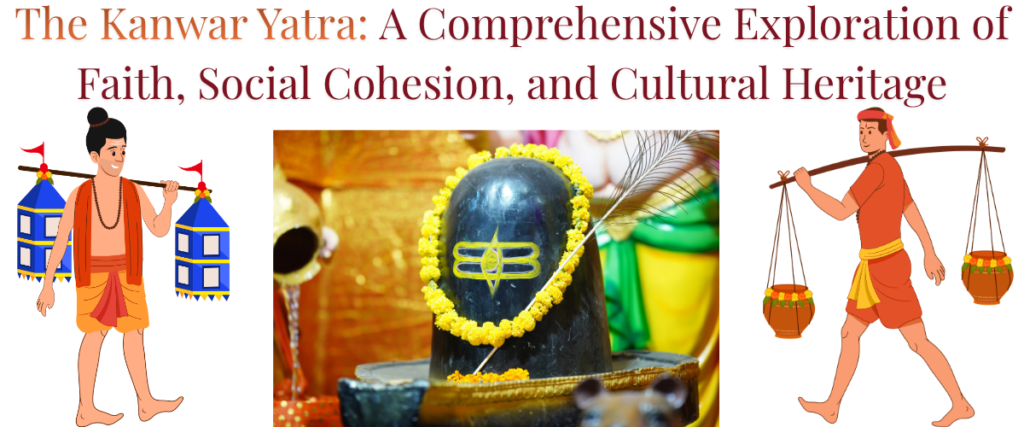
The Kanwar Yatra stands as one of the most profound, visually arresting, and demographically massive religious pilgrimages in the modern world. Conducted annually during the auspicious monsoon month of Shravan, which typically spans July and August, the pilgrimage mobilises tens of millions of devotees across the Indian subcontinent1. Clad in vibrant saffron garments, these pilgrims, universally referred to as Kanwariyas, embark on a deeply spiritual journey, walking hundreds of kilometres barefoot to fetch sacred water from the River Ganga and offer it to Lord Shiva at various local and major temples1.
Far from being a mere ritualistic obligation, the Kanwar Yatra represents a multi-dimensional cultural phenomenon that weaves together faith, societal transformation, and economic revitalisation. It is a massive logistical triumph for civil administrators, a vital economic engine for grassroots communities, a unique equaliser of deeply entrenched social hierarchies, and an increasingly prominent platform for environmental stewardship. In recent years, the pilgrimage has broken all previous participation records, with an estimated forty-five to forty-eight million devotees arriving in the holy city of Haridwar alone during the 2025 and 2026 iterations4. This comprehensive report explores the Kanwar Yatra in rigorous detail, analysing its mythological foundations, its historical evolution from a solitary ascetic practice to a mass movement, its profound socio-economic impacts, and the myriad positive transformations it brings to contemporary society.
Mythological Foundations and Cultural Significance
To fully comprehend the emotional gravity and the enduring appeal of the Kanwar Yatra, one must examine the ancient mythological tapestry from which it is woven. The pilgrimage does not originate from a single canonical text, but rather from a confluence of powerful cultural archetypes and legends that dictate the foundational values of the society. These narratives provide a psychological framework for the devotees, transforming physical endurance into a sacred act of cosmic gratitude.
The Churning of the Cosmic Ocean
The most prominent and universally cited mythology underpinning the Kanwar Yatra is the Samudra Manthan, or the churning of the cosmic ocean. According to Hindu cosmology, during a primordial era, the Devas (celestial deities) and the Asuras (demonic beings) forged a temporary alliance to churn the vast ocean of milk7. Their ultimate goal was to extract Amrita, the legendary nectar of immortality that lay hidden within the ocean’s depths7. However, the cosmic churning released numerous entities and substances before the nectar could emerge. Among these was Halahal, a lethal and highly volatile poison so virulent that it threatened to annihilate all of creation and end all life in the universe7.
Faced with impending cosmic destruction, the deities approached Lord Shiva, the supreme ascetic and protector. To save the universe, Lord Shiva willingly consumed the poison, carefully holding it within his throat to prevent it from entering his stomach or spilling back into the world. The toxicity of the Halahal was so severe that it burned his throat and turned it a deep shade of blue, earning him the revered epithet Neelkantha, meaning the blue-throated one3. The immense heat generated by the cosmic poison caused the deity excruciating agony. In a desperate bid to cool his burning throat and alleviate his suffering, Goddess Parvati and a host of other deities continuously poured the sacred, cooling waters of the River Ganga over him2.
Because theological traditions hold that the Samudra Manthan occurred during the month of Shravan, modern devotees replicate this ancient act of devotion. By carrying pitchers of fresh Ganga water to anoint Shiva lingams, the aniconic representations of the deity, they symbolically participate in cooling the Lord’s throat7. This ritual act, known as Jalabhishek, transcends mere worship; it is seen as a profound, visceral gesture of thanksgiving to a deity who voluntarily absorbed the world’s suffering so that humanity might thrive2.
The Archetype of Shravan Kumar and Identity Formation
While the Samudra Manthan provides the theological basis for the water offering, another deeply influential legend associated with the Kanwar apparatus itself is the epic story of Shravan Kumar from the Ramayana1. Shravan Kumar is venerated as the ultimate embodiment of filial piety and unwavering devotion to his elderly, blind parents. To fulfil their lifelong wish of completing a religious pilgrimage and lacking the financial means to secure transport, he engineered a scale-like carrying apparatus1. This structure consisted of two woven baskets tied securely to opposite ends of a sturdy bamboo pole, which is widely recognised as the original Kanwar1. Balancing this apparatus on his shoulders, he carried his parents across the subcontinent.
Tragically, Shravan Kumar was accidentally killed by King Dasharatha, who mistook him for a wild animal while hunting in the forest. This singular event set into motion a profound curse that would later dictate the epic narrative of the Ramayana, including the eventual exile of Lord Rama1. Today, Shravan Kumar serves as a vital cultural symbol, providing a potent psychological model for adolescent development. The psychoanalytic theories of human development, such as those proposed by Erik Erikson, suggest that youth require cultural ideals to navigate the transition from adolescent omnipotence to mature societal attachment10. The myth of Shravan Kumar facilitates this by providing a tangible model of selfless service, extreme endurance, and deep respect for elders. By shouldering the Kanwar, young pilgrims unconsciously emulate these virtues, utilising the physical weight of the apparatus to anchor their own psychological identity and moral compass2.
Additional Mythological Contributors and Astrological Timing
Various other prominent figures from Hindu antiquity are credited with shaping the tradition of carrying holy water. The warrior-sage Parshuram, recognised as an avatar of Lord Vishnu, is believed by certain regional traditions to have initiated the formal practice of carrying Ganga water to offer to Lord Shiva3. Furthermore, legends suggest that Lord Rama, as well as the demon-king Ravana, who was an unparalleled scholar and a devout follower of Shiva, performed similar acts of carrying holy water during their respective spiritual journeys7.
The timing of the pilgrimage is also deeply intertwined with ancient astrological sciences. The Hindu month of Sawan, or Shravan, derives its name from the Shravana nakshatra, a specific alignment of stars and lunar mansions7. Astrological traditions dictate that worshipping Lord Shiva during this specific nakshatra is exceptionally auspicious, amplifying the spiritual merits of the Jalabhishek ritual and drawing millions to the riverbanks during this highly specific cosmic window7.
To provide clarity on the ceremonial timing of the pilgrimage, the observance features specific milestones. The entire month is dedicated to the deity, with Mondays holding particular reverence.
| Event Milestone | Significance and Pilgrimage Activity |
| Commencement of Shravan | Marks the official start of the Kanwar Yatra. Devotees begin arriving at the Ganga to take their initial vows and collect the sacred water. |
| First Sawan Somwar (Monday) | The first Monday of the month is highly auspicious. Thousands of Kanwariyas aim to complete their journey and perform the initial Jalabhishek on this day. |
| Subsequent Sawan Somwars | The second and third Mondays typically witness the highest volume of pedestrian traffic, as the pilgrimage builds momentum across the highway networks. |
| Sawan Shivratri | The zenith of the Kanwar Yatra. This is the peak day when millions of devotees simultaneously offer the holy Ganga water to Shiva Lingams across the country, concluding the primary phase of the mass pilgrimage. |
| Conclusion of Shravan | The final Monday and the subsequent end of the month mark the conclusion of the fasting period and the formal closing of the seasonal festivities. |
| Structured calendar flow representing the traditional milestones of the Shravan Kanwar Yatra season12. |
Historical Evolution: From Ascetic Solitude to Mass Phenomenon
The Kanwar Yatra, in its current highly organised and demographically overwhelming form, is a relatively modern phenomenon, despite its roots stretching back several centuries. Tracing its historical trajectory reveals a fascinating sociological evolution, demonstrating how a quiet, localised practice transformed into India’s largest annual religious gathering2.
The Early Centuries and Colonial Observations
According to rigorous historical and anthropological analyses, the earliest specific mentions of barefoot pilgrims utilising a pole apparatus to carry Ganga water for the express purpose of performing an abhisheka on a Shivalinga date back to the 1700s2. This practice initially originated and concentrated primarily around the town of Sultanganj in modern-day Bihar, where devotees would carry water to the Baidyanath temple in Deoghar2. Prior to the eighteenth century, it was a common but informal practice for pious individuals returning from various pilgrimages to respectfully carry small amounts of Ganga water barefoot to their home villages, but it lacked the synchronised, mass-event structure observed today2.
During the early to mid-nineteenth century, British colonial administrators and European travellers reported encountering scattered groups of Kanwar pilgrims traversing the dusty plains of North India. They frequently noted the deep dedication of these individuals in their travelogues, though the overall scale of the movement was too small to warrant significant administrative intervention2. At this stage, the journey was largely an ascetic endeavour. It was undertaken almost exclusively by a select few saints, elderly devotees fulfilling specific lifelong vows, and rural mystics2.
The Turning Point: The 1960s to the 1980s
The demographic profile and the sheer scale of the pilgrimage began to shift dramatically during the 1960s. It slowly transitioned from a strictly rural and ascetic practice into the bustling urban landscapes of the Hindi-speaking belt. This initial urban expansion was partly catalysed by the financial and logistical patronage of wealthy Marwari business communities, who began sponsoring resting camps and facilitating the journeys of the less fortunate2.
However, the explosive upsurge in mass participation occurred in the late 1980s and early 1990s. Several converging socio-economic and technological factors drove this unprecedented mobilisation. The systematic expansion of infrastructure played a foundational role. Improved road connectivity and the construction of expansive national highway networks made the previously arduous and dangerous cross-country journeys safer, faster, and far more accessible to the general public2.
Concurrently, a technological and cultural shift redefined the sensory experience of the pilgrimage. The proliferation of affordable cassette tapes and portable audio players brought high-energy devotional music, known as bhajans, to the masses. The continuous playing of these rhythmic, devotionally charged songs created a shared, festive atmosphere that strongly appealed to younger generations. The music provided an auditory rhythm that helped pilgrims maintain their walking pace and masked the physical pain of the journey7.
Furthermore, rising average incomes across North India provided a larger segment of the working-class population with the disposable time and financial resources required to take a week or more away from their livelihoods to undertake the pilgrimage7. This economic mobility coincided with a broader socio-political climate marked by a rising assertion of cultural and religious identity. The collective desire to participate in highly visible, mass expressions of faith transformed the Kanwar Yatra from a solitary vow of penance into a monumental, collective celebration of Hindu identity2. Today, this evolution is evident in the astonishing scale of the event, with local authorities reporting between thirty and forty-eight million devotees taking to the national highways annually2.
The Anatomy of the Pilgrimage: Apparatus, Discipline, and Variations
The physical journey of the Kanwar Yatra is strictly defined by rigorous physical discipline, uncompromising devotion, and highly specific carrying techniques. The very name of the pilgrimage is derived from the apparatus utilised by the devotees. The Hindi word Kanwar, or Kavad, finds its etymological roots in the Sanskrit term kānvānrathi, which describes a scales-like structure2. The apparatus typically consists of a sturdy bamboo pole, meticulously decorated with vibrant fabrics, tinsel, bells, and images of deities. Two roughly equal loads, usually covered earthen pots or copper urns containing the sacred water, are fastened securely to opposite ends of the staff. The pilgrim carries the Kanwar by expertly balancing the middle of the pole on one or both of their shoulders, distributing the weight evenly2.
The Ascetic Codes of Conduct
While traversing the highways, Kanwariyas must adhere to a rigorous set of ascetic codes. The pilgrimage demands that devotees practice absolute discipline, mirroring the austere nature of Lord Shiva himself, who is revered as the greatest of all ascetics7. This disciplinary framework extends to nearly every aspect of the pilgrim’s daily life during the journey.
Dietary restrictions are strictly enforced. Participants must follow a completely vegetarian diet. The consumption of any form of meat, poultry, or fish is forbidden. Furthermore, the intake of alcohol, tobacco, and any other intoxicating substances is strictly prohibited, as the mind and body must remain pure and focused on the divine objective9.
Physical purity is equally paramount. Devotees are required to bathe thoroughly before touching the Kanwar or beginning their daily march. The use of modern comforts and vanity items, such as scented oils and commercial soaps, is heavily discouraged. Additionally, articles made of leather, including belts, wallets, and conventional footwear, are strictly banned, as they are considered ritually impure9.
To symbolise profound humility, deep respect for the sacred water, and submission to the natural earth, the vast majority of pilgrims travel entirely barefoot. They endure blistering asphalt heat, torrential monsoon downpours, and rough, debris-strewn terrain without the protection of shoes2. Throughout this gruelling physical ordeal, verbal discipline is maintained through the continuous, rhythmic chanting of mantras such as “Bol Bam” or “Har Har Mahadev.” This constant vocalisation serves a dual purpose: it maintains a highly charged spiritual atmosphere and acts as a psychological coping mechanism, allowing the mind to detach from physical exhaustion and maintain a steady marching cadence3.
Types of Kanwar Yatras
The Kanwar Yatra is not a monolithic, uniform experience. Depending on a devotee’s physical capacity, specific spiritual vow, and entrenched regional traditions, the pilgrimage can take several distinctly challenging forms3. These variations dictate the pace of the journey, the method of carrying the water, and the severity of the physical austerity involved.
| Type of Kanwar | Description of Practice | Spiritual Significance and Application |
| Samanya (Baithaki) Kanwar | The most common and accessible form of the pilgrimage. Devotees walk at a steady, manageable pace and are permitted to take planned rest breaks for meals and sleep. When resting, the Kanwar must never be placed directly on the ground; it is carefully hung on designated wooden stands or elevated structures. | Represents steady, enduring devotion without extreme physical punishment. It is highly suitable for first-time pilgrims, families travelling together, and older devotees seeking to fulfil their vows safely3. |
| Dak Kanwar (Fast Relay) | A highly rigorous, fast-moving journey where devotees cover the entire distance without a single halt. This is often executed in relay teams where the Kanwar is seamlessly passed between running members, or by a single highly conditioned individual. | Expresses raw speed, coordinated team effort, and an intense, burning urgency to deliver the water to the deity. These journeys are often completed within a compressed timeframe of 10 to 36 hours3. |
| Khadi (Standing) Kanwar | An arduous vow where the Kanwar must remain upright and continuously supported throughout the entire duration of the journey. Even when the primary bearer stops to eat or sleep, a companion must stand and hold the Kanwar aloft, ensuring it is never hung on a stand or laid to rest. | Symbolises extreme penance, continuous attentiveness, and unwavering focus. It requires a highly coordinated and dedicated support team to execute successfully3. |
| Dandi (Dandvat) Kanwar | The most physically punishing and time-consuming form of the yatra. The pilgrim completes the entire route through repeated full-body prostrations. They measure the distance with their bodies, lying flat on the ground, standing up, walking to the exact spot their hands touched, and prostrating again. | Reflects total physical surrender, profound humility, and the highest level of physical austerity. Depending on the route, this gruelling journey can take weeks or even months to complete14. |
| Jhoola Kanwar | The Kanwar is suspended on an elaborately decorated swinging mechanism or large frame, which is often carried by multiple people. It requires careful balance to ensure the swinging motion does not spill the water. | A specialised, highly aesthetic expression of devotion. It focuses on the ornate beautification of the offering and is prominent in specific regional and community traditions3. |
Sacred Geography: Navigating the Major Pilgrimage Routes
The Kanwar Yatra activates a vast, interconnected network of sacred geography across Northern and Eastern India. Pilgrims meticulously select their routes based on their geographical origin, their physical stamina, and the specific Shiva temple they intend to honour at the journey’s end3.
The Northern Routes: Uttarakhand and Uttar Pradesh
The northern routes are characterised by an overwhelming volume of participants, with tens of millions of pilgrims descending upon the mountainous state of Uttarakhand to access the glacial rivers2.
Haridwar serves as the undisputed epicentre of the northern Kanwar Yatra. Devotees gather in immense numbers at the sacred Har Ki Pauri ghat to bathe and collect water directly from the fast-flowing Ganges. The logistical scale here is staggering; in 2026, an all-time record of forty-eight million Kanwariyas visited Haridwar over a brief fourteen-day period4. From Haridwar, this sea of saffron fans out across a massive geographical footprint encompassing Delhi, Uttar Pradesh, Haryana, Rajasthan, and Punjab. They carry the water to thousands of local village shrines or major historical temples, such as the revered Augharnath Temple in Meerut and the Pura Mahadeva Temple in Baghpat2.
For those seeking an alternative to the intense crowding of Haridwar, Rishikesh offers a slightly more manageable route. The journey from Rishikesh covers a moderate distance of 100 to 250 kilometres, depending on the final destination, and is highly popular with families, first-time pilgrims, and those seeking a less congested path12.
Conversely, the Gaumukh and Gangotri routes are strictly reserved for the most seasoned, physically fit, and spiritually hardened devotees. Gaumukh is the high-altitude glacial origin of the Ganga. Fetching water from this pristine source involves demanding mountain trekking in thin air, followed by a journey of hundreds of kilometres across the plains2. Successfully completing this route is considered a mark of supreme endurance and is believed to yield the highest spiritual rewards12.
The Eastern Route: The Sultanganj to Deoghar Corridor
While the northern routes handle the largest sheer volume of people, the eastern route from Sultanganj in Bihar to Baidyanath Dham in Deoghar, Jharkhand, holds unparalleled historical pedigree and ritualistic significance2.
The geographical uniqueness of Sultanganj dictates its sacred status. At this specific juncture, the River Ganga takes a rare and abrupt turn, flowing northwards rather than its usual eastern course. This north-flowing stretch, known as the Uttarvahini Ganga, is considered exceptionally auspicious in Hindu scripture11. Devotees congregate at the ancient Ajgaibinath Temple, which sits on a rock island in the river, to collect the water. From there, they embark on a highly structured, gruelling 105-kilometre barefoot trek to Deoghar11.
The destination, Baidyanath Dham, is extraordinarily sacred because it represents a rare convergence of divine energies. It is simultaneously one of the twelve Jyotirlingas, representing the supreme, infinite light of Lord Shiva, and one of the fifty-one Shakti Peethas, representing the cosmic energy of the Mother Goddess11. The foundational myth of this specific route claims that the demon-king Ravana performed severe penance to obtain the Jyotirlinga, intending to carry it to Lanka. However, Shiva decreed that if the linga was ever placed on the ground, it would become permanently rooted. Through the trickery of the deities, Ravana was forced to hand the linga to a disguised god, who promptly set it down at Deoghar, where it remains to this day11.
The 105-kilometre path linking Sultanganj to Deoghar is a highly organised corridor, punctuated by traditional halting points where state agencies, local volunteers, and civil society groups provide extensive support infrastructure.
| Pilgrimage Route Stage (Sultanganj to Deoghar) | Segment Distance | Cumulative Journey Distance |
| Sultanganj to Asarganj | 13 kilometers | 13 kilometers |
| Asarganj to Rampur | 15 kilometers | 28 kilometers |
| Rampur to Chandan Nagar | 18 kilometers | 46 kilometers |
| Chandan Nagar to Suiya | 16 kilometers | 62 kilometers |
| Suiya to Katoria | 16 kilometers | 78 kilometers |
| Katoria to Inaravaran | 16 kilometers | 94 kilometers |
| Inaravaran to Deoghar (via Goryari and Bhootbangla) | 11 kilometers | Approximately 105 kilometers |
| Data reflecting the traditional and highly structured eastern halting points utilised by millions of pilgrims14. |
Social Cohesion, Egalitarianism, and Psychological Sanctuary
One of the most profound and widely celebrated positive aspects of the Kanwar Yatra is its function as a powerful engine for social cohesion, radical egalitarianism, and psychological empowerment. In a society historically characterised by complex social strata, the pilgrimage offers a unique space of equality and shared purpose.
The Dissolution of Caste and Class Hierarchies
Indian society, though rapidly modernising, still navigates the historical complexities of caste and class hierarchies. The Kanwar Yatra acts as a profound equaliser. The moment a devotee dons the simple saffron robes and lifts the Kanwar onto their shoulder, their secular identity—encompassing their profession, financial wealth, and caste background—is completely stripped away2. Within the pilgrimage ecosystem, every participant is uniformly addressed by divine epithets such as “Bhole,” “Bam,” or “Kanwariya,” serving as a constant linguistic reminder of the divine presence residing within each individual, regardless of their social standing2.
This communal levelling creates a shared sense of brotherhood and a phenomenon sociologists refer to as collective effervescence. Wealthy urban businessmen walk barefoot alongside rural daily wage labourers, sharing the same harsh environmental conditions, eating the same communal meals prepared in roadside tents, and sleeping on the same rudimentary bedding3. This shared physical endurance and mutual reliance builds deep social capital and cross-community solidarity that is rarely achieved in the stratified routines of everyday secular life.
Furthermore, historical reformist movements have utilised this cultural framework to foster social resilience. Organisations like the Arya Samaj, heavily influenced by figures such as Maharishi Dayanand Saraswati, utilised the deeply ingrained cultural values of regions like Punjab and North India to challenge colonial assumptions and promote indigenous educational and social reforms. By anchoring modern progress in ancient Vedic values, such movements reinforced social cohesion and cultural resilience, a legacy that continues to subtly influence collective participation in mass religious events like the Yatra18.
Psychological Empowerment for Marginalised Youth
Extensive sociological analyses, notably those conducted by researcher Vikash Singh, highlight the critical psychological sanctuary the Yatra provides, particularly for marginalised or economically disadvantaged young men2. In the context of a rapidly modernising, hyper-competitive economy where many individuals face systemic humiliations, long-term unemployment, and deep financial precarity, the Kanwar Yatra offers what sociologists term an “alternative field of performance and social recognition”7.
By voluntarily undertaking an extreme test of physical endurance, these individuals are granted a platform to publicly demonstrate their resolve, moral sincerity, and physical fortitude. Identifying intimately with Lord Shiva—a deity who is celebrated simultaneously as the master of the universe and a compassionate, ascetic saviour of the marginalised—allows participants to claim sovereignty, dignity, and desirability outside of the rigid, often exclusionary metrics of the capitalist economy9. The pilgrimage offers a sovereign timeframe, a temporary but potent escape from the chores, struggles, and banality of everyday life, providing immense psychological relief and a renewed sense of inherent worth9.
Cross-Community Hospitality and Harmony
The Kanwar Yatra also serves as a catalyst for inter-community harmony and the reinforcement of secular ideals at the grassroots level. As tens of millions of Hindu pilgrims traverse the national highways, it is a common and celebrated occurrence to witness remarkable scenes of hospitality from minority communities. In numerous regions across North India, Muslim residents, local shopkeepers, and community leaders actively set up large tents to welcome the passing Kanwariyas20. They freely distribute drinking water, provide vital medical aid, and offer safe resting spaces. This annual display of cross-community support acts as a powerful counter-narrative to sectarian division, reinforcing a localised culture of mutual respect, shared regional heritage, and robust social cohesion20.
Economic Impact and Grassroots Empowerment
Beyond its vast spiritual and sociological dimensions, the Kanwar Yatra operates as a colossal economic stimulus package. The mass mobilisation of millions of people generates significant financial activity that directly benefits grassroots artisan communities, the local transport sector, and state-level infrastructure development.
Boosting State and Municipal Revenues
The sheer influx of domestic religious tourists generates massive, concentrated revenue streams for local municipalities and state governments. In Uttar Pradesh, for example, the strategic implementation of urban revitalisation schemes alongside the promotion of religious tourism resulted in a remarkable thirty-three percent year-on-year growth in revenue collection among the top seventeen urban local bodies. These municipalities cornered Rs 3,100 crore in the FY24 financial period21.
Similarly, the state of Uttarakhand relies heavily on the economic engine of religious pilgrimages. Events like the Kanwar Yatra and the Chardham pilgrimage bring unprecedented economic benefits to the mountainous region. In recent years, the Kedarnath travel circuit alone recorded a massive seasonal turnover of Rs 211 crore22. The substantial revenues generated through increased tax collections, transportation fees, and local spending enable these states to continually reinvest in critical public infrastructure, enhanced sanitation facilities, and expanded transport networks, creating a positive feedback loop of economic development.
The Micro-Economy of the Pilgrimage
At the grassroots level, the Kanwar Yatra sustains a vast, intricate micro-economy that provides seasonal employment to hundreds of thousands of individuals. Months before the month of Shravan even begins, rural artisans across multiple states commence preparations. Bamboo growers and specialised craftspeople begin harvesting and meticulously constructing the thousands of Kanwar frames required. Local potters are heavily engaged to create the specific earthen vessels and clay pots utilised by the pilgrims to carry the Ganga water23.
During the actual event, the local service sector experiences a massive, sustained surge in income. Transport operators, bus syndicates, small roadside dhabas (eateries), and independent street vendors catering to the pilgrims see their annual revenues peak. To further support the pilgrims and the local economy, state governments and civil society organisations collaborate to establish thousands of temporary Kanwar Camps.
In the National Capital Territory of Delhi alone, the number of officially registered service camps increased significantly from 170 to over 308 in recent years to meet the growing demand24. The Delhi government, recognising the immense social utility and economic stimulation provided by these camps, proactively offers substantial financial assistance. Large camps can receive grants of up to Rs 1.5 lakh, alongside provisions for free electricity up to a specific unit cap24. This crucial financial support ensures that local community groups (Samitis) have the capital required to purchase food supplies, bulk medical inventory, and tent materials from local vendors, thereby directly injecting state funds into the hyper-local economy24.
Logistical Marvel: Administration, Security, and Public Safety
Facilitating the safe, orderly movement of up to forty-eight million pedestrians over a condensed two-week period requires a staggering feat of public administration, strategic foresight, and real-time logistical coordination. State governments, particularly the administrative bodies in Uttarakhand, Uttar Pradesh, Delhi, Haryana, and Bihar, deploy comprehensive, multi-agency strategies to ensure a “zero incident and zero accident” environment for the devotees4.
Advanced Security and Crowd Control Mechanisms
To safely manage the unprecedented crowds—which in 2026 peaked at an astonishing 6.36 million individual arrivals in Haridwar on a single day—authorities rely on a sophisticated blend of massive manpower deployment and cutting-edge surveillance technology4.
In Uttarakhand, the security apparatus is immense. Over 6,000 state police personnel are deployed along the riverbanks and highways. They are heavily supported by specialised units, including the Provincial Armed Constabulary (PAC), Central Armed Police Forces (CAPF), the State Disaster Response Force (SDRF), and highly trained Anti-Terrorist Squads (ATS)4.
To augment the physical presence of security forces, state police headquarters establish dedicated, high-tech Kanwar control rooms. These command centres utilise Artificial Intelligence-enabled surveillance software, 24/7 CCTV camera monitoring, and extensive fleets of aerial drones to monitor crowd density, identify potential stampede risks, and resolve traffic bottlenecks in real-time across the state6.
Traffic Management and Health Infrastructure
The most visible administrative intervention is the total restructuring of regional traffic flow. Entire stretches of major arterial roads and critical freight corridors are systematically diverted or completely closed to general vehicular traffic. For instance, sections of the Delhi-Haridwar national highway (NH-58) and the historic GT Road are heavily restricted to create safe, dedicated, uninterrupted walking corridors exclusively for the barefoot pilgrims, preventing vehicular accidents2.
Furthermore, the extreme physical toll of walking hundreds of kilometres barefoot, often through heavy monsoon downpours and oppressive humidity, necessitates a robust, highly responsive medical infrastructure. State health departments, functioning in tandem with voluntary organisations, establish thousands of temporary medical outposts directly along the walking routes25. These medical camps provide crucial, immediate triage for common pilgrimage ailments. Medical professionals treat severe asphalt blistering on the feet, acute dehydration, muscle cramps, and heat exhaustion13. Pilgrims are continuously provided with Oral Rehydration Solutions (ORS), fresh bandaging, and localised pain relief, ensuring they have the physical capacity to safely complete their spiritual vows17.
Environmental Stewardship and Eco-Friendly Initiatives
As the Kanwar Yatra has grown to unprecedented scales, so too has the collective consciousness regarding its environmental impact. The pilgrimage intrinsically takes place during the monsoon, a season deeply linked in Indian cultural consciousness to ecological rejuvenation, agricultural fertility, and the imperative of living in harmonious balance with nature1. Recognising the severe threat of pollution generated by mass gatherings, both civil administrators and the devotees themselves are increasingly championing sustainable, eco-friendly practices.
Cleanliness Drives and Enforcing Plastic Bans
Authorities and Non-Governmental Organizations (NGOs) actively promote extensive cleanliness drives along the pilgrimage routes and the fragile riverbanks, echoing broader national campaigns for sanitation and public hygiene6. In regions deemed environmentally sensitive, strict regulations are fiercely enforced. For instance, in the vicinity of the Gupteswar biodiversity heritage site in Odisha, local authorities and community-led gram sabhas have pushed for the rigid enforcement of plastic bans directed by the National Green Tribunal. They actively work to replace single-use styrofoam plates, plastic cutlery, and synthetic water bottles with sustainable, eco-friendly alternatives to protect the local river systems23. The spirit of civic duty extends beyond the immediate pilgrimage routes; associated volunteer groups frequently organise cleaning drives in public utility areas, such as major bus stands, to ensure the infrastructure remains hygienic during the heavy transit periods29.
The Return to Sustainable, Traditional Materials
A powerful, culturally driven movement is underway to return the Yatra to its traditional, highly biodegradable roots. Pilgrims are heavily encouraged through public awareness campaigns to utilise locally sourced bamboo baskets, traditional leaf plates (pattals) for their meals, and earthen clay pots rather than environmentally destructive plastic jerrycans for carrying the holy water8. This concerted shift serves a dual purpose: it significantly reduces the ecological footprint left behind by tens of millions of participants, and it simultaneously stimulates the rural economy by creating sustainable, high-volume employment for tribal communities and local artisans who manufacture these eco-friendly products23.
Conclusion
The Kanwar Yatra is a profound, awe-inspiring testament to the enduring power of faith and the remarkable resilience of cultural traditions in the modern era. What began centuries ago as a solitary, physically gruelling ascetic practice reserved for a select few has spectacularly blossomed into the world’s largest annual religious pilgrimage—a moving, vibrant city of millions bound together by a singular, shared devotion.
The positive impacts of the Yatra reverberate far beyond the intense spiritual fulfilment experienced by the individual Kanwariya. Sociologically, it serves as a powerful, democratizing force, effectively stripping away the rigid societal markers of caste, class, and economic status to forge a unified, fiercely egalitarian community of believers. Psychologically, it offers a vital, sovereign space for marginalised youth to assert their inherent dignity, resolve, and moral worth in a world that often overlooks them. Economically, the sheer scale of the event sustains a vast, intricate network of grassroots artisans, small businesses, and local municipalities, injecting billions of rupees into the regional economy and facilitating widespread infrastructure development.
Furthermore, the increasing integration of eco-friendly practices and the massive, highly successful logistical coordination demonstrated by state authorities highlight the remarkable ability of ancient traditions to adapt dynamically and responsibly to contemporary administrative and ecological challenges. Ultimately, the Kanwar Yatra is not merely a physical journey across the diverse geographical landscapes of India; it is a profound inward journey of physical endurance, psychological purification, and social unity. As millions of saffron-clad devotees walk barefoot through the monsoon rains, chanting the ancient names of Shiva, they carry forward an unbroken, vibrant legacy of resilience, deep social harmony, and profound cultural heritage.
Disclaimer
This article is intended for educational, cultural, and informational purposes only, providing a comprehensive overview of the sociological, historical, and administrative elements of the Kanwar Yatra. The pilgrimage involves severe physical austerities, including extended barefoot travel, strict fasting, and carrying heavy loads over long distances. Readers should note that undertaking such rigorous physical activities poses significant health risks; prospective pilgrims should consult with a qualified healthcare or medical professional to ensure they are physically fit before embarking on the journey. Furthermore, while every effort has been made to present accurate data regarding routes, participant demographics, and administrative guidelines, these logistical details and government regulations are subject to frequent changes. Readers must verify current travel advisories, route closures, and safety protocols with official government sources and local administrations prior to planning their participation.
References
- On the Significance of the Spiritual Month of Shravan – Hindu American Foundation, https://www.hinduamerican.org/blog/on-the-significance-of-the-spiritual-month-of-shravan
- Kanwar Yatra – Wikipedia, https://en.wikipedia.org/wiki/Kanwar_Yatra
- Kanwar Yatra 2025: History, Rituals, Routes & Dates | Tour My India, https://www.tourmyindia.com/blog/kanwar-yatra/
- Record 48 million Kanwariyas visit Haridwar in 2026 Kanwar fair: Officials – Hindustan Times, https://www.hindustantimes.com/india-news/record-48-million-kanwariyas-visit-haridwar-in-2026-kanwar-fair-officials-101786454347999.html
- Kanwar Yatra ends; 4.5 crore pilgrims reached Haridwar in 15 days – The Economic Times, https://m.economictimes.com/news/india/kanwar-yatra-ends-4-5-crore-pilgrims-reached-haridwar-in-15-days/articleshow/122861317.cms
- Record 45 million Kanwariyas visit Uttarakhand for Shravan; police cases filed over hooliganism | India News – Hindustan Times, https://www.hindustantimes.com/india-news/record-45mn-kanwariyas-visit-uttarakhand-for-shravan-police-cases-filed-over-hooliganism-101753297591057.html
- Why do millions join Kanwar Yatra? Story behind march for Lord Shiva – The Indian Express, https://indianexpress.com/article/explained/explained-culture/why-do-millions-join-kanwar-yatra-its-origins-10816313/
- Kanwar Yatra 2024 – Significance & Important Routes, https://www.tripclap.com/stories/kanwar-yatra-2024
- INDIA: Kanwar Yatra – history and mythology of the pilgrimage of Lord Shiva’s Kanwariyas, https://earthstoriez.com/india-kanwar-yatra-mythology-of-the-pilgrimage-of-lord-shivas-kanvaris
- Śravaṇ Kumār: Rethinking a Cultural Ideal for Indian Youth – MDPI, https://www.mdpi.com/2077-1444/14/6/695
- Shravani Mela in Baidyanath Dham: Complete Travel Guide for Devotees – EasyDarshan, https://www.easydarshan.com/blog/deoghar-baidyanath-shravani-mela-travel-guide
- Kanwar Yatra 2026 Date, Route, Registration, Rules, Travel Guide & Complete Information, https://vrindavanmathuratourism.com/blogs/kanwar-yatra-2026-date
- Kawad Yatra 2026: Check Kawad Yatra Jal Date, Sawan 2026 Dates, Route Map, Rules & Travel Advisory & Safety Tips – The Economic Times, https://m.economictimes.com/astrology/others/kawad-yatra-2026-check-kawad-yatra-jal-date-sawan-2026-dates-route-map-rules-travel-advisory-safety-tips/articleshow/132706119.cms
- Kanwar Yatra Deoghar Baba Dham – Baidyanath Nagri Online Puja Services, https://baidyanathnagri.com/kanwar-yatra-deoghar/
- Types of Kanwar Yatra Every Shiva Devotee Should Know, https://sciencedivine.org/blog/types-of-kanwar-yatra
- https://sciencedivine.org/blog/types-of-kanwar-yatra#:~:text=Khadi%20Kanwar%20represents%20continuous%20attentiveness,style%20found%20in%20some%20traditions.
- Shravani Mela 2026 Guide: Sultanganj to Deoghar Yatra, Route – Haveli Kharagpur, https://www.havelikharagpur.com/blog/shravani-mela/
- Maharishi Dayanand Saraswati and cultural awakening of Punjab – Organiser, https://organiser.org/2026/02/12/339718/bharat/maharishi-dayanand-saraswati-and-the-cultural-awakening-of-punjab/
- Walking with Pilgrims: The Kanwar Pilgrimage of Bihar, Jharkhand and the Terai of Nepal [1 ed.] 1000732509, 9781000732504 – DOKUMEN.PUB, https://dokumen.pub/walking-with-pilgrims-the-kanwar-pilgrimage-of-bihar-jharkhand-and-the-terai-of-nepal-1nbsped-1000732509-9781000732504.html
- VOL. 66, 2025 – Berkeley Journal of Sociology, https://berkeleyjournal.org/files/2025/06/BJS-Vol-66.pdf
- At Rs 3.1K crore, revenue mop-up of top local bodies of UP soars 33% – Business Standard, https://www.business-standard.com/economy/news/at-rs-3-1k-crore-revenue-mop-up-of-top-local-bodies-of-up-soars-33-124041100588_1.html
- Drishti IAS State PCS Current Affairs for PCS Exam Preparation, https://www.drishtiias.com/statepcs/31-12-2022
- Call to implement plastic ban in Gupteswar, a biodiversity site | Bhubaneswar News, https://timesofindia.indiatimes.com/city/bhubaneswar/call-to-implement-plastic-ban-in-gupteswar-a-biodiversity-site/articleshow/122800645.cms
- Delhi government announces major boost for Kanwar Camps, financial assistance enhanced, large camps to receive up to Rs 15 Lakh – The Economic Times, https://m.economictimes.com/news/india/delhi-government-announces-major-boost-for-kanwar-camps-financial-assistance-enhanced-large-camps-to-receive-up-to-rs-15-lakh/articleshow/132675492.cms
- AI surveillance, CCTV coverage: Kanwar Yatra goes hi-tech – Rediff, https://m.rediff.com/news/report/up-opts-for-ai-surveillance-medical-aid-for-for-kanwar-yatra/20260731.htm
- Kanwar Yatra: From AI surveillance to medical camps, elaborate measures in place across UP – ThePrint, https://theprint.in/india/kanwar-yatra-from-ai-surveillance-to-medical-camps-elaborate-measures-in-place-across-up/3001578/
- Sawan Shivratri and rain traffic alert: Delhi, Noida, Ghaziabad roads likely to face heavy congestion; check routes to avoid, https://m.economictimes.com/news/new-updates/sawan-shivratri-and-rain-traffic-alert-delhi-noida-ghaziabad-roads-likely-to-face-heavy-congestion-check-routes-to-avoid/articleshow/133141794.cms
- Focus: Ultimate Secrets of Folk Culture’s Timeless Legacy – Different Truths, https://www.differenttruths.com/focus-ultimate-secrets-of-folk-cultures-timeless-legacy/
- Volunteers clean service bus stand area in Mangaluru – The Hindu, https://www.thehindu.com/news/cities/Mangalore/volunteers-clean-service-bus-stand-area-in-mangaluru/article71073670.ece
- plastic free kanwar camps – The Economic Times, https://economictimes.indiatimes.com/topic/plastic-free-kanwar-camps