Hydrological and Sacred Topography of the River Gorge
The Ayung River, designated in the Balinese language as Tukad Ayung, represents the longest and most hydrologically significant fluvial artery on the island of Bali, Indonesia1. Originating in the northern volcanic highlands near Kintamani, the river flows approximately 68.5 to 71.8 kilometres southward, traversing the regencies of Buleleng, Bangli, Badung, and Gianyar before discharging into the Badung Strait at Padanggalak Beach in Sanur1. As the river descends through the elevated topography of the island’s interior, it carves deep, narrow gorges flanked by vertical basalt cliffs and dense riparian rainforests3.
Within specialised regional frameworks—particularly in classical Balinese Hinduism and traditional holistic wellness literature—the surrounding river valley is occasionally referred to as the “Ayush” valley5. This alternate nomenclature draws directly from the Sanskrit term Ayush, signifying longevity, vitality, and the life-sustaining essence of sacred water, or tirta5.
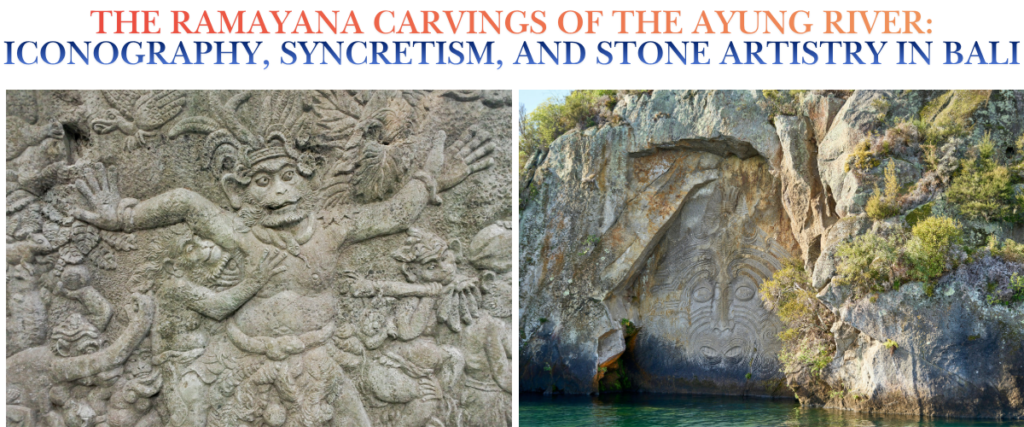
Within the geography of the river’s middle reaches near the artistic enclave of Ubud, the sheer rock walls of the gorge have been transformed into a monumental canvas of religious stone art4. These riverbank reliefs depict the classical narrative of the Ramayana, illustrating a unique intersection of classical Indian epic poetry, localised Javanese-Balinese literature, and monumental stone carving4.
Patronage, Modern Genesis, and the Alternative Antiquity Controversies
To analyse the Ramayana carvings of the Ayung River, it is essential to distinguish between their ancient thematic origin and their modern physical creation4. While the dense overgrowth of moss and tropical ferns often leads casual observers to mistake these reliefs for classical archaeological ruins, they are a highly sophisticated modern creation4. The monumental undertaking was conceived and financed in the early 2000s by a local luxury establishment, the Ayung Resort Ubud, which sought to pay homage to the island’s deep-rooted spiritual heritage and convert the secluded jungle gorge into a narrative temple of stone10.
The execution of these carvings represents one of the most ambitious modern stone-carving projects in Southeast Asia10. The resort commissioned a team of approximately 250 highly skilled local master artisans and village stone masons, whose lineage connects directly to the classical carving traditions of the Gianyar regency10. Working under challenging environmental conditions dictated by the river’s seasonal flow, humidity, and the steep topography of the canyon, these artisans spent two continuous years hand-chiselling the vertical rock faces11.
This targeted effort resulted in a continuous chiselled storyboard spanning between 600 meters and one kilometre along the river’s edge7. While the broader resort grounds feature extensive stone pathways and a scale replica of the central Javanese Buddhist monument, Borobudur—which took five years to complete—the riverside Ramayana reliefs stand as a distinct, two-year masterwork carved directly into the living basalt of the riverbed11.
| Feature | Description and Specifications |
| Geographic Location | Ayung River Gorge, Payangan, near Ubud, Gianyar Regency, Bali2 |
| Geomorphological Context | Sheer vertical basalt cliffs and riverbed rock walls11 |
| Linear Extent | Spanning approximately 600 meters to 1 kilometre along the riverbank7 |
| Artistic Style | Classical Balinese stone relief with modern naturalist integration4 |
| Master Artisans Involved | Approximately 250 local stone carvers and village masons10 |
| Construction Period | Early 2000s, completed over a continuous two-year span4 |
| Ecological State | Actively integrated with native mosses, lichens, and tropical ferns11 |
This modern provenance has occasionally become a point of friction within alternative history circles and popular digital media9. Content creators and sensationalist accounts have frequently framed these riverbank reliefs as “impossible ancient carvings,” suggesting they represent 1,300-year-old relics of a lost global civilization9.
The visual illusion of ancient origin is a direct consequence of Balinese geology and climate3. The highly porous volcanic rock walls, combined with the extreme humidity and seasonal flooding of the tropical monsoon climate, accelerate the weathering process3. Within a few years of completion, new stone carvings in Bali systematically accumulate a thick patina of moss, lichens, and micro-vegetation, mimicking the physical characteristics of classical antiquity10.
While some local guides refer to the reliefs as restorations of older, pre-existing sacred carvings, academic consensus and documented resort records confirm that the present contiguous basalt gallery is an early twenty-first-century creation4.
The Javanese-Balinese Literary Axis and Epic Transmission
The narrative progression of the carvings along the Ayung cliffs follows the classical narrative of the Ramayana, an epic that has served as a cornerstone of Southeast Asian cultural identity for over a thousand years4. The epic was introduced to the Indonesian archipelago around the eighth or ninth century CE via maritime trade and cultural exchange between the Indian subcontinent and the classical kingdoms of Java and Sumatra7. Once integrated into the local literary tradition, the text was translated and adapted into Old Javanese as the Kakawin Ramayana7. This localised version of the epic shifts the narrative focus to align with indigenous Javanese and Balinese cosmological systems, and it is this syncretic version that the riverbank reliefs bring to life in vivid detail7.
The historical connection between the Indonesian archipelago and the Indian epic is deeply embedded in the geography of the narrative itself7. In the Sanskrit Ramayana, Sugriva, the chief of the monkey army, specifically directs his search parties to Yawadvipa (the island of Java) in search of the abducted Sita, indicating an ancient geographical awareness between the two regions7.
Following the collapse of the Hindu Majapahit Empire in Java during the fifteenth century, classical artists, priests, and intellectuals migrated to Bali, preserving and further localising these literary epics19. Balinese Hinduism developed as a highly distinct, syncretic faith, seamlessly weaving classical Indian Vedantic and Puranic concepts with native animism, ancestral worship, and Buddhist practices7.
The Ayung River carvings reflect this syncretism, presenting the Ramayana not merely as a foreign import, but as a living storyboard that maps directly onto the sacred physical geography of the Balinese landscape4.
Iconographic Taxonomy of the Bas-Reliefs
The stone carvings along the Ayung River are characterised by an intricate collage of anthropomorphic, zoomorphic, and mythological figures chiselled directly into the dark, wet basalt11. The visual compositions utilise a high-relief technique, allowing the figures to project dramatically from the natural rock face, creating deep shadows that shift with the angle of the sun and the movement of the river11.
| Iconographic Subject | Visual Characteristics and Placement | Mythological/Symbolic Role in the Reliefs |
| Alligator | Chiselled at the water’s edge with rounded, individually outlined scales; clawed feet are frequently touched by the surging river flow11. | Serves as an aquatic guardian, representing the boundary between the terrestrial forest and the sacred river6. |
| Small-Eared Elephant | Depicted with a grinning facial expression, flinging its trunk upward above the alligator11. | Represents strength, wisdom, and auspiciousness within the tropical forest landscape11. |
| Young Stag (Maricha) | A beautiful young deer captured with its head turned backward in a posture of alert listening11. | Represents the golden deer used by Ravana to deceive Rama and facilitate Sita’s abduction7. |
| Great-Eyed Oxen | Carved with long, curving horns that butt up against a scaled, twisted serpentine form11. | Represents domestic strength and agricultural vitality, juxtaposed with wilder forest creatures3. |
| Chinese Dragon (Naga) | A scaled, twisted body that interweaves through the composition and terminates in a Chinese-style dragon face11. | Symbolises cultural syncretism, reflecting centuries of trade and maritime connection between Bali and China7. |
| Crazed Man | Bulging eyes, a bulbous nose, a straight moustache, and dramatic facial contortions11. | Captures the grotesque, chaotic nature of the demonic forces (rakshasas) loyal to Ravana7. |
| Warrior | Stern jawline, rigid posture, and armed with traditional weaponry10. | Represents the warrior monkey army (Vanara) or Lakshmana defending the exiles11. |
| Woman with Apples | A female figure carrying a basket of apples, woven into the forest collage11. | Represents the terrestrial world, localised agricultural abundance, and daily Balinese life6. |
The human and divine figures depicted within the storyboard exhibit stylistic features derived from the traditional Balinese Wayang (shadow puppet) performance arts7. Characters are rendered with full pressed lips, slanted eyes, and highly detailed, waving unibrows11. Each character is chiselled with a highly specific, individualised expression—ranging from the serene, stoic countenances of Prince Rama and Lakshmana to the wild, chaotic, and wide-eyed panic of the demonic rakshasas undergoing defeat11.
The seamless integration of these diverse figures into a single, continuous stone tapestry reflects a masterly command of space, converting the natural irregularities of the canyon wall into narrative assets4.
Ecological Colonisation and the Aesthetics of Impermanence
The physical location of the Ramayana carvings exposes them to a continuous geomorphological and ecological transformation that forms an essential part of their artistic and spiritual identity9. Carved directly into the porous, dark basalt walls of a narrow, high-humidity river canyon, the reliefs are subject to the intense forces of a tropical monsoon climate3. Over the years since their creation, the heavy tropical rains have washed organic matter and sediment down from the overhanging jungle canopy, allowing it to collect in the deep, chiselled crevices of the stone11.
This accumulation of organic substrate has catalysed a rapid biological colonisation of the artwork11. Green moss has systematically spread across the ridges of the carvings, softening the sharp edges of chiselled stone and giving the stern jawlines of ancient warriors a soft, fuzzy texture11. Tiny, delicate ferns and wild vines have taken root within the crevices of the sculptures; small, inch-long fern leaves congregate within the open mouth of the carved elephant, while vibrant green foliage bursts directly from the ear creases of bulging-eyed demonic figures11.
While conventional Western museum practices prioritise the static preservation of stone and view biological overgrowth as a destructive force, Balinese artistic philosophy embraces this ecological integration as the ultimate completion of the work4. This perspective is rooted in the core Balinese Hindu philosophical principle of Tri Hita Karana, which mandates the maintenance of harmonious relationships between humanity, the natural world, and the divine3. By allowing the natural environment to actively colonise, reshape, and soften the chiselled stone, the carvings cease to be artificial human impositions on the landscape; instead, they are converted into a living, organic extension of the river ecosystem itself14.
The deliberate vulnerability of the basalt reliefs to the forces of water and plant growth also reflects the profound Balinese philosophical acceptance of impermanence3. In this view, art is not a permanent monument to be shielded from time, but a transient offering that exists in a constant state of decay, regeneration, and dialogue with the natural elements3. The constant physical interaction of the flowing Ayung River, which surges against the lower panels of the reliefs, combined with the biological overgrowth above, ensures that the ancient story of the Ramayana is experienced not as a historical relic, but as an active, living force within the natural and spiritual landscape of Bali4.
Narrative Resolution and Cultural Legacy
The narrative sequence of the carvings reaches its climax in the depiction of the epic battle of Lanka and its profound spiritual aftermath7. The reliefs capture the kinetic energy of the clash between Prince Rama’s Wanara (monkey) army and the demonic forces of Ravana4.
The panels represent Hanuman flying across the straits, monkey warriors carrying massive stones to bridge the sea, and the final duel where Rama defeats the multi-headed Ravana7. This sequence is characterised by deep undercuts and dynamic postures that convey motion and chaos, contrasting sharply with the serene symmetry of the earlier courtly scenes7.
Following the military triumph, the storyboard concludes with the emotionally charged scene of Sita’s Agni Pariksha, or trial by fire11. To demonstrate her purity and devotion, Sita steps into a raging pyre11.
The genius of the local stone carvers is manifested in their rendering of this moment: rather than showing destructive, consuming flames, the rising fire is chiselled as a cascade of delicate, blossoming lotuses and tropical forest flowers that cradle her figure11. This visual metaphor, transforming fire into flowers, serves as a powerful spiritual resolution, emphasising that purity of devotion (bhakti) possesses the power to neutralise the most destructive forces of the material world11.
These riverbank carvings function as a vital contemporary cultural anchor4. By placing the Ramayana directly onto the natural basalt walls of the Ayung River, the local artisans have created a sacred space that operates independently of conventional temple structures4.
The reliefs serve as a powerful testament to the continuity of Balinese stone-carving traditions, demonstrating that the artistic lineages that constructed the island’s ancient temples remain vibrant, active, and capable of executing monumental works of public art in the twenty-first century4.
Conclusion
The Ramayana stone carvings along the Ayung River represent a remarkable synthesis of artistic devotion, literary heritage, and environmental integration4. Spanning up to a kilometre along the vertical basalt walls of the river gorge, these reliefs bring the ancient Javanese-Balinese Kakawin Ramayana to life through expressive, stylised panels chiselled by hundreds of local artisans7. By incorporating regional iconographical features and syncretic motifs like the Chinese dragon, the carvings visually map the island’s complex cultural history7.
Furthermore, their deliberate exposure to the damp river canyon allows for a unique ecological symbiosis, where the growth of moss and native flora actively completes the artwork11. In doing so, these carvings transcend their status as mere stone sculptures, illustrating the profound Balinese philosophy of Tri Hita Karana and celebrating the enduring, living connection between humanity, nature, and the divine3.
Disclaimer
This article is presented strictly for educational, cultural, and historical purposes. The descriptions and interpretations of the stone carvings, mythological narratives, and spiritual practices are based on regional Southeast Asian historical traditions, artistic records, and regional source materials24. This text does not represent a validation of alternative historical or archaeological theories.
References
- Ayung River – Wikipedia, https://en.wikipedia.org/wiki/Ayung_River
- Ayung River for Amazing Ubud Rafting Adventure in Bali, https://baliraftingadventure.com/ayung-river-ubud/
- Ayung River – Grokipedia, https://grokipedia.com/page/ayung_river
- Ayung River Rafting – Bali’s Scenic Waterway – Global Shananigans, https://www.globalshananigans.com/post/ayung-river-rafting-bali-s-scenic-waterway
- Best Spas in Ubud and around the Bali – Mantra Yoga Meditation School, https://mantrayogameditation.org/best-spas-in-ubud-and-around-the-bali/
- The Ultimate Guide to Rafting in Bali, https://balisuntours.com/en/blog/rafting-bali
- Revisit The Ramayana Along The Ayung River in Ubud, Bali | Outlook Traveller, https://www.outlooktraveller.com/experiences/heritage/revisit-the-ramayana-along-the-ayung-river-in-ubud-bali
- Indonesia: Wonderful Ramayana sculptures on the banks of Ayung River enchant everybody! | Struggle for Hindu Existence, https://hinduexistence.org/2023/07/14/indonesia-wonderful-ramayana-sculptures-on-the-banks-of-ayung-river-enchant-everybody/
- A River Full of Ramayana? Impossible Carvings Found in Bali! : r/AlternativeHistory – Reddit, https://www.reddit.com/r/AlternativeHistory/comments/1eptj8c/a_river_full_of_ramayana_impossible_carvings/
- Ayung Resort Ubud Review: Tropical Luxury and Art in Bali, https://sandinmysuitcase.com/ayung-resort-ubud-art-and-luxury/
- Journey with a River: Rafting the Ayung in Bali | Sierra Joy, https://sierrastevensmcgeever.com/2013/04/15/162/
- Ayung Resort Ubud, Indonesia – ar.trivago.com, https://ar.trivago.com/en-145/oar/ayung-resort-ubud?search=100-2615492
- Hotel Ayung Resort Ubud in Ubud, starting at £39 – Destinia, https://destinia.com/en/hotels/asia/indonesia/bali/ubud/ayung-resort-ubud/ho-302290
- Ubud’s Ayung River Walls Tell the 400 AD Epic of Ramayana and Vishnu’s Avatar | Ulagam, https://astroulagam.com.my/lifestyle/ubuds-ayung-river-walls-tell-400-ad-epic-ramayana-and-vishnus-avatar-303121
- Bali | Ayung Resort & Spa, Ubud | A Luxury 5-Star Hotel – Passion Purpose Passport, https://passionpurposepassport.com/2018/05/bali-ayung-resort-spa-ubud-luxury-5-star-hotel.html
- Ayung River Rafting: The Unforgettable White Water Experience in Bali – Pertiwi Adventure, https://pertiwiadventure.com/blog/ayung-river-rafting-the-unforgettable-white-water-experience-in-bali/
- A River Full of Ramayana? Impossible Carvings Found in Bali! – YouTube, https://www.youtube.com/watch?v=RuMNh9zDQUU
- Bali Stone Wall Art royalty-free images – Shutterstock, https://www.shutterstock.com/search/bali-stone-wall-art
- Wood Carving of Mas Ubud – The Bali Package, https://www.thebalipackage.com/wood-carving-of-mas-ubud/
- Ubud Wood Carving – Mas Village Bali, https://www.ubudcenter.com/mas-village/
- Ubud White Water Rafting: Ayung River Safety Guide & Prices – Bali Agung Tour, https://bali-agung-tours.com/ubud-white-water-rafting/
- Ramayana: The Bridge to Langka, Balinese painting E74168 – The Australian Museum, https://australian.museum/learn/cultures/international-collection/balinese/ramayana-the-bridge-to-langka-balinese-painting-e74168/
- Ayung Resort Ubud | Luxury 5 Star Resort In Ubud, Bali – Official Site, https://ayungresortubud.com/
- Artisans Have Carved The Story Of The Ramayana In Stone Along The Banks Of The Ayung River, Ubud, Bali, Indonesia. – SuperStock, https://www.superstock.com/asset/artisans-have-carved-story-ramayana-stone-along-banks-ayung-river/1899-20475322