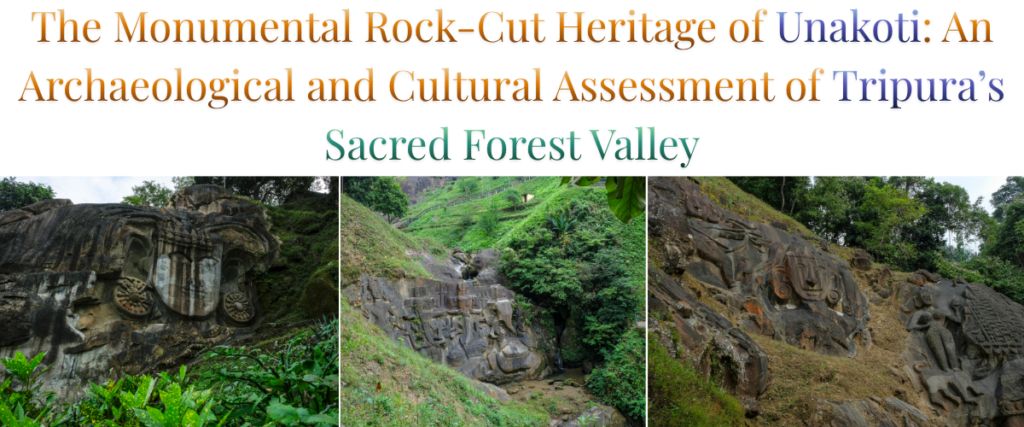
Located in the dense, subtropical forests of the Raghunandan Hills within the northern region of Tripura, India, the archaeological site of Unakoti stands as one of the most significant yet enigmatic open-air rock-cut galleries in India1. Known natively in the local Kokborok language as Subrai Khung—a term intimately tied to the Tripuri name for Lord Shiva as the supreme creator of the universe—Unakoti features a vast assemblage of colossal bas-relief carvings and freestanding stone sculptures dating primarily from the seventh to the ninth centuries CE1. The name “Unakoti” itself, translating to “one less than a crore” (or 9,999,999) in Bengali and Hindi, represents both a precise numerical concept in Hindu cosmology and a profound sculptural reality that defines this sacred forest valley1.
Over the centuries, the site functioned as a major regional epicentre for Shaivite pilgrimage, situated along ancient riverine trade and migration routes connecting the plains of Bengal to the rugged hills of northeast India1. The monumental open-air carvings, executed directly onto the living vertical sandstone cliffs, present an extraordinary synthesis of orthodox Brahmanical iconography and indigenous tribal aesthetic sensibilities, displaying a unique stylistic character that has earned the site the designation of the “Angkor Wat of the Northeast”7.
Geographic Setting and Environmental Profile
Unakoti is situated approximately 178 kilometres northeast of Agartala, the capital of Tripura, and is located roughly 8 kilometres east of the subdivisional headquarters of Kailashahar1. Geomorphologically, the site is nestled within the Raghunandan hill range, characterised by steep, heavily forested slopes cut by perennial mountain streams and seasonal waterfalls2. The primary sculptural panels are carved directly into a massive sandstone cliff face that is bisected by the Dhaluchhora stream, a small tributary that flows through the heart of the ravine, creating a dramatic natural sanctuary where water, vegetation, and sacred art merge2.
To understand the operational and environmental context of the site, physical and climatic parameters must be analysed. The region experiences a monsoonal climate with distinct seasonal variations that have historically influenced both pilgrim access and the physical preservation of the sandstone carvings12.
| Environmental and Spatial Parameter | Details and Specifications | Key Sources |
| Geographical Coordinates & District | Kailashahar Subdivision, Unakoti District, North Tripura1 | [cite: 1] |
| Elevation and Topography | Rugged hilly terrain, Raghunandan range, adjacent to Manu River basin2 | [cite: 2, 6] |
| Proximity to Key Urban Centres | 8 km from Kailashahar, 22 km from Dharmanagar, 178 km from Agartala14 | [cite: 14, 15] |
| Nearest Rail & Air Infrastructure | Dharmanagar Railway Station (19.6 km); Maharaja Bir Bikram Airport, Agartala5 | [cite: 5, 16] |
| Winter Climate (October to February) | Temperature ranges from 10°C to 26°C; minimal rainfall; ideal for tourism13 | [cite: 13, 17] |
| Summer Climate (March to July) | Temperature ranges from 18°C to 35°C; humidity rises; seasonal pre-monsoon rains13 | [cite: 13] |
| Monsoon Season (June to September) | Heavy precipitation; active waterfalls; dense forest growth; high rate of natural erosion10 | [cite: 10, 12, 17] |
Mythological Frameworks and Epistemic Interpretations
The cultural memory of Unakoti is sustained by a complex web of mythological narratives that explain the sheer density of its carvings through divine action, mortal ambition, or royal decree9. These stories are deeply embedded in the local belief systems of both the indigenous Tripuri tribes and the broader Hindu population, acting as explanations for the site’s unique numerical designation2.
The Legend of Shiva’s Wrath and the Petrified Pantheon
The most pervasive myth associated with the site describes a celestial journey undertaken by Lord Shiva5. En route to the sacred city of Kashi (Varanasi), Shiva was accompanied by an entourage of exactly ten million (one crore) gods and goddesses15. As night fell, the divine assembly chose the Raghunandan Hills as a temporary halting place3. Before retiring, Shiva strictly commanded all the deities to awaken before the break of dawn so they could resume their spiritual journey19.
However, when dawn broke, only Shiva arose; the remaining 9,999,999 gods and goddesses remained locked in deep sleep7. Infuriated by their disobedience and spiritual lethargy, Shiva unleashed his divine wrath, cursing his entire entourage and transforming them into petrified stone figures destined to remain on the hillside forever7. Shiva then proceeded to Kashi alone, leaving behind a hillside populated by exactly one less than a crore of divine stone representations5.
The Ambition of Kallu Kumhar
An alternative, highly localised tribal narrative attributes the rock-cut carvings to the artistic ambition of a mortal sculptor and potter named Kallu Kumhar (variously referred to as Kallu Gurjar or Kalu Kamar)1. Kallu was an ardent devotee of Goddess Parvati and desired to accompany Shiva and Parvati to their sacred abode on Mount Kailash15. Recognising the impossibility of taking a mortal to the divine peak, Shiva reluctantly agreed on one condition: Kallu had to sculpt exactly one crore (ten million) images of Shiva and his associate deities in a single night before the first light of dawn1.
Supported by Parvati’s intercession, Kallu set to work like a man possessed, working through the night with extraordinary speed19. Yet, as the sun began to rise over the hills, Kallu found himself exactly one image short of the stipulated ten million20. Shiva, eager to rid himself of the persistent artisan, utilised this minor deficit as a divine excuse to leave Kallu and his incomplete collection of 9,999,999 images behind at Unakoti5. In some versions of the story, Kallu’s failure is attributed to his own ego, as he chose to carve his own likeness as the final, incomplete sculpture, thereby preventing the target from being met22.
The Tripuri Royal Legend of Subrai
The indigenous Tripuri perspective, documented in the Rajmala (the royal chronicles of the kings of Tripura), connects Unakoti with King Hamtorfa (or Jujarpha), who ruled the region around 590 CE4. In this traditional account, Shiva is revered as Subrai, the supreme creator of the universe4. King Hamtorfa prayed extensively to Lord Shiva, requesting him to reside within his earthly kingdom4. In response, Shiva instructed the king to construct statues representing the entire Hindu pantheon4.
However, when the king petitioned Goddess Ganga to descend to the kingdom, she declined, citing the concern that her diversion to Tripura would leave the rest of India without water4. Instead, she sent the sacred Gomti River to flow through the land4. Because the king was unable to construct the image of Ganga, the royal sculptural commission fell exactly one short of a crore, thereby giving the sanctuary its name4.
Chronology, Patronage, and Epigraphic Analysis
From a scientific and academic standpoint, the chronology of Unakoti has been established primarily through stylistic, iconographic, and comparative art-historical analyses1. The bas-relief sculptures are generally ascribed to the early medieval period, spanning the seventh to the ninth centuries CE, corresponding to the pre-Manikya era of regional history1. This was a period when the area was under the administrative and cultural influence of the Deva Dynasty of Sribhumi, a ruling house that operated within the broader historical territory of Samatata—a prosperous kingdom in eastern Bengal1.
[Developmental Timeline of Unakoti]
│
├─ 7th–9th Century CE: Peak of rock-cut bas-relief execution; patronised by the
│ Deva Dynasty of Sribhumi in Samatata; integration of tribal and Shaivite styles.
│
├─ 9th–10th Century CE: Construction of a hilltop brick temple, pre-dating the
│ main phase of individual pilgrim inscriptions.
│
├─ 11th–12th Century CE: Active pilgrimage era; etching of the Chaturmukhalinga
│ rock inscription by the pilgrim Sri Jayadeva in medieval Bengali script.
│
├─ 15th–16th Century CE: Rise of the Manikya Dynasty; shift of royal patronage
│ southward to Devtamura (Chabimura) and Udaipur temples [cite: 24, 25, 26].
│
├─ Late 20th Century: Systematic documentation and adoption of Unakoti by the
│ Archaeological Survey of India (ASI) as a protected monument [cite: 1, 7, 15].
│
└─ December 2022: Formal inclusion of the Unakoti rock-cut sculptures and reliefs
on the UNESCO World Heritage Site Tentative List.
While historical texts from this era are scarce, the site contains one critical piece of epigraphic evidence: a brief rock inscription carved onto a Chaturmukhalinga (a four-faced Shiva lingam)1. This inscription, written in medieval Bengali characters dating to the eleventh or twelfth century CE, mentions an individual named Sri Jayadeva, who is believed to have been a prominent pilgrim rather than a royal patron1. This inscription confirms that even after the primary phase of rock carving had ceased, Unakoti remained an active, highly revered pilgrimage site for centuries5.
Furthermore, archaeological excavations on the hilltop have revealed the structural foundations of an ancient brick temple dating to the ninth or tenth century CE15. This indicates that the open-air sanctuary was once anchored by formal temple structures, serving as a highly organised sacred complex that accommodated both monastic communities and visiting devotees7.
Iconography and Sculptural Typologies
The artistic output at Unakoti is categorised into two distinct forms: rock-cut bas-reliefs carved directly into the vertical cliff faces and freestanding stone sculptures that have been recovered from the valley floor and placed on elevated terraces1. The visual language of these carvings is unique; the figures are characterised by simplified, flattened planes, oversized heads, and highly stylised facial features that display distinct Mongoloid and regional tribal physical traits, differing sharply from the classical post-Gupta art of central and northern India8.
The Unakotiswara Kal Bhairava
The monumental centrepiece of the entire complex is the giant bas-relief of Lord Shiva, known as Unakotiswara Kal Bhairava1. Carved onto the vertical face of a massive sandstone cliff, this colossal head stands approximately 30 feet high, which includes a highly ornate, embroidered head-dress (jatamukuta) measuring 10 feet in height1. The face is executed with clean, geometric lines; the eyes are wide and almond-shaped, and the mouth is depicted with a flat, stylised grin that highlights its regional artistic lineage10.
Shiva’s third eye is clearly visible on his forehead, and his ears are adorned with large, circular ornaments12. On the left of the central head, a large trident (trishula) is carved into the rock12. Flanking the central headdress are two full-size female figures standing on their respective animal mounts1. One of these figures represents Goddess Durga standing atop a lion, while the other is a female deity believed to be Ganga, riding her vahana, the Makara1. This composition is designed to interact with the natural topography; a mountain stream cascades directly adjacent to Shiva’s head, simulating the mythological descent of the river Ganga from Shiva’s matted locks10.
The Unique Ganesha Triad
Located approximately 50 meters downstream from the central Shiva head is an extraordinary rock-cut panel featuring three distinct images of Lord Ganesha29. This panel is of immense interest to iconographers due to the highly unusual anatomical and symbolic traits displayed by the figures29:
- The Seated Ganesha: The central figure is a colossal, four-armed Ganesha depicted in a seated, half-lotus posture (ardha-paryankasana) with a large, stylized potbelly29.
- The Sarabhuja Ganesha: Flanking the central figure is a standing Ganesha depicted with six arms (sarabhuja) and, uniquely, three distinct tusks29.
- The Ashtabhuja Ganesha: On the other side stands an eight-armed Ganesha (ashtabhuja) sculpted with four tusks29.
The depiction of three-tusked and four-tusked Ganesha figures is extremely rare in classical Indian iconography29. This suggests that the artisans of Unakoti operated under a distinct regional iconographic guide that incorporated local legends or specific Tantric traditions that diverged from canonical texts29.
Minor Carvings and Zoomorphic Figures
Beyond the primary panels of Shiva and Ganesha, the hillside features numerous other carvings, many of which have been weathered by centuries of monsoon rains and vegetation growth5. These include three enormous carvings of the Nandi bull—Shiva’s sacred vehicle—which lie half-buried in the silt of the valley floor, appearing to guard the entrance to the ravine7.
Further exploration reveals depictions of other deities, including a multi-faced Chaturmukhalinga, a representation of Uma-Maheshwar (Shiva and Parvati seated together), and figures of Vishnu, Hanuman, and Ravana11. Interspersed among these divine figures are symbolic representations of regional fauna, such as a sculpted peacock motif25. In classical symbolism, the peacock is the natural enemy of serpents; its inclusion near the snake-adorned figure of Shiva highlights the complex symbolic framework deployed by the ancient master sculptors10.
Comparative Analysis of Tripura’s Archaeological Landscape
To fully appreciate the historical and cultural significance of Unakoti, it must be compared with other major archaeological and sculptural sites within Tripura24. Together, these sites demonstrate that ancient Tripura was not an isolated mountain tract, but a highly active zone of artistic innovation and religious synthesis24.
| Feature / Metric | Unakoti (Subrai Khung) | Devtamura (Chabimura) | Pilak (Jolaibari) | Boxanagar Buddhist Ruins |
| Primary Chronology | 7th to 9th Century CE1 | 15th to 16th Century CE24 | 8th to 12th Century CE24 | 6th to 9th Century CE24 |
| Geographic Location | Unakoti District (North)1 | Gomati District (Central)6 | South Tripura District36 | Sipahijala District24 |
| Topographical Context | Forested valley, stream beds2 | Steep 90-degree river cliffs24 | Alluvial plains, flat mounds24 | Border plains, flat terrain24 |
| Primary Religious Sect | Shaivism (Orthodox Hindu)24 | Shaktism & Panchadevata6 | Hindu-Buddhist Blend24 | Buddhism (Vajrayana/Mahayana)24 |
| Sculptural Medium | Sandstone bas-relief & stone1 | Sandstone cliff carvings35 | Terracotta plaques, stone36 | Burnt-brick structures, clay24 |
| Key Artistic Landmark | 30-foot Shiva Head1 | 20-foot Goddess Durga24 | Avalokiteshvara & Narasimha36 | Large Brick Stupa & Vihara24 |
| Accessibility Mode | Pedestrian forest trails10 | Boat ride on Gomati River6 | Roadways to open mounds16 | Roadways, plain terrain37 |
This comparative analysis reveals a clear chronological and thematic shift in the religious history of Tripura24. The early period, represented by Boxanagar (sixth to ninth century CE) and Pilak (eighth to twelfth century CE), shows a strong Buddhist presence influenced by the Samatata and Harikela kingdoms of eastern Bengal, characterised by the peaceful coexistence of Mahayana Buddhism and early Hinduism24.
Unakoti (seventh to ninth century CE) represents a parallel, highly focused development of Shaivism in the northern hills, likely driven by regional tribal dynasties adopting Hindu state deities1.
In contrast, Devtamura (fifteenth to sixteenth century CE) belongs to a much later period of Manikya royal patronage24. The focus there shifts to Shaktism and the Panchadevata scheme, carved onto riverine cliffs that served as strategic trade routes connecting the hills to the Bengal plains6.
Conservation Challenges and Tourism Development
For centuries, Unakoti suffered from severe environmental degradation, vegetation growth, and physical neglect1. The high-humidity tropical climate of Northeast India, coupled with heavy monsoonal rainfall, has subjected the soft sandstone carvings to persistent water erosion, causing the fine details of several minor panels to fade12. Seismic activity, common in this high-risk zone, has caused several large boulders containing key carvings to fracture and slide into the riverbed below, where they lie partially submerged12.
[Environmental & Human Threats]
│
┌──────────────────┴──────────────────┐
▼ ▼
[Natural Factors] [Anthropogenic Factors]
├─ Soft Sandstone Rock Bed ├─ Lack of Specialised Drainage
├─ Heavy Monsoon Rainfall ├─ Historic Institutional Neglect
├─ Dense Root Penetration ├─ Unregulated Foot Traffic
└─ High Seismic Risk Zone └─ Soil Erosion from Deforestation
To counter these threats, the Archaeological Survey of India (ASI) took over the management of the site, implementing conservation measures to preserve the carvings1. These efforts received a major boost in December 2022 when Unakoti was officially added to the tentative list of UNESCO World Heritage Sites1. This listing has brought international attention and mandated the application of global preservation standards12.
To support this heritage status and develop the region into a sustainable tourism hub, the Government of India allocated a sum of INR 12 crore to the state of Tripura1. This funding is being utilised to implement several key infrastructural projects40:
- Sonamukhi Tea Estate Development: Located approximately 7 to 8 kilometres from the archaeological site, this area is being developed to include eco-accommodation facilities designed to house up to 32 families, a swimming pool, and an adventure sports park3.
- Site Infrastructure Upgrades: The Ministry of Tourism, in coordination with the ASI, is constructing essential visitor facilities at the core site, including clean drinking water stations, modern public restrooms, a cafeteria, and well-marked pedestrian pathways3.
- Upgradation of the Unakoti Tourist Lodge: The government-run lodge in nearby Kailashahar is being modernised to provide high-quality accommodation for international and domestic travelers40.
- Meditation and Interpretation Centre: A dedicated facility is being built to provide tourists with detailed historical, geological, and mythological context, helping visitors appreciate the site’s unique cultural heritage3.
Travel Logistics and Visitor Information
Visiting Unakoti requires some preparation due to its geographic setting within the hills of northern Tripura2. The closest major transport hub is Agartala, which is connected to key Indian cities via the Maharaja Bir Bikram Airport17.
For travellers planning a journey to Unakoti, the following transport and logistical routes are recommended:
- The Rail Route: The most efficient way to travel from Agartala is to board a morning train to Dharmanagar or Kumarghat railway station1. The morning train from Agartala reaches Dharmanagar before 10:00 AM, and returning trains run in the afternoon, arriving back in Agartala by 8:00 PM1. From Dharmanagar station, travellers can hire a private cab or take a local passenger vehicle to cover the remaining 19.6 kilometres to Unakoti, a journey of approximately 30 to 40 minutes1.
- The Road Route: Alternatively, private taxis can be hired directly from Agartala for a scenic but long road trip of approximately 178 kilometres. The drive takes roughly five hours along winding mountain roads that pass through dense tropical forests and tea gardens15.
- Local Transit from Kailashahar: For those staying in the nearby town of Kailashahar (8 kilometres away), local auto-rickshaws can be chartered to the entrance of the heritage site1.
The site is open to the public daily from sunrise to sunset, and there is a nominal registration fee collected at the entrance gate41. To ensure a safe and respectful visit, travellers are advised to wear sturdy, slip-resistant footwear suitable for climbing the steep, damp stone steps that wind through the ravine10.
Due to strict heritage preservation regulations, food items are not permitted inside the core archaeological zone, and visitors are requested to refrain from touching or defacing the delicate sandstone carvings to preserve this ancient heritage for future generations39.
Synthesis and Future Outlook
Unakoti remains a captivating monument to ancient India’s artistic and spiritual traditions7. Its colossal rock-cut figures, carved directly into the living stone of the Raghunandan Hills, represent a brilliant artistic movement that successfully bridged the gap between orthodox Shaivite theology and regional tribal culture2. The sheer scale of the 30-foot Kal Bhairava and the unique iconography of the multi-tusked Ganesha triad highlight the sophisticated skills of the anonymous artisans who transformed this remote forest ravine into an open-air cathedral of stone18.
With its recent inclusion on the UNESCO World Heritage Site Tentative List and the infusion of targeted conservation funding, Unakoti is poised to step out of historical obscurity and onto the global heritage stage1. The challenge ahead lies in balancing the demands of increased tourist footfall with the delicate requirements of archaeological preservation3. By implementing sustainable eco-tourism models, such as the low-impact development at the Sonamukhi Tea Estate, and continuing systematic scientific conservation of the sandstone cliff faces, India can ensure that this majestic “Lost Hill of Faces” remains a source of wonder, pilgrimage, and historical study for generations to come3.
Travel and Historical Disclaimer
This research report is compiled for educational, historical, and travel-planning purposes based on the latest available archaeological records and administrative tourism guidelines. While every effort has been made to verify the accuracy of the geographical distances, transport schedules, historical timelines, and infrastructure details, conditions on the ground—particularly regarding road quality, train timings, seasonal weather patterns, and local entry regulations—may vary. Travellers are strongly encouraged to verify operational timings and local travel advisories with the Tripura Tourism Development Corporation or the Archaeological Survey of India before undertaking their journey to the site.
References
- Unakoti – Wikipedia, https://en.wikipedia.org/wiki/Unakoti
- Unakoti Tripura Travel Guide & Sightseeing, https://www.east-himalaya.com/unakoti.php
- Unakoti In Tripura: The Ankor Wat Of The North East – Outlook Traveller, https://www.outlooktraveller.com/News/unakoti-tripura-the-ankor-wat-of-the-north-east
- Unakoti: Tripura’s spectacular rock carvings & the legend of ‘one less than a crore’ deities, https://30stades.com/2022/10/16/unakoti-tripura-spectacular-rock-carvings-legend-of-a-crore-deities-tourists/
- Why Unakoti is ‘Unakoti’: The one-short-of-a-crore legend explained | – The Times of India, https://timesofindia.indiatimes.com/life-style/travel/destinations/why-unakoti-is-unakoti-the-one-short-of-a-crore-legend-explained/articleshow/126071738.cms
- Devtamura Rock Carvings (New) – TPSC TCS (Tripura) Preparation All Subjects – EduRev, https://edurev.in/t/549419/Devtamura-Rock-Carvings-New
- A Homegrown Guide To The Historical & Cultural Legacy Of Unakoti, Tripura, https://homegrown.co.in/homegrown-explore/a-homegrown-guide-to-the-history-cultural-legacy-of-unakoti-tripura
- The Unique Angkor Wat of North East India Will Now Be More Accessible To Tourists, https://www.tripoto.com/botswana/trips/the-unique-angkor-wat-of-north-east-india-will-now-be-more-accessible-to-tourists-3c2887dbc1825639a
- ‘Angkor Wat of the North-East’- Unakoti vying for UNESCO world heritage tag for stunning rock carvings and murals – AuthIndia – India’s Largest Art Community, https://www.authindia.com/angkor-wat-of-the-north-east-unakoti-vying-for-unesco-world-heritage-tag-for-stunning-rock-carvings-and-murals
- Unakoti: Tripura’s hidden gallery of giant stone gods and sacred legends, https://mediaindia.eu/tourism/unakoti-tripuras-hidden-gallery-of-giant-stone-gods-and-sacred-legends/
- Journey to Unakoti: A Timeless Adventure in Tripura – Neindia, https://neindia.com/journey-to-unakoti-a-timeless-adventure-in-tripura/
- Why Unakoti Should Be Your Next Offbeat Getaway In Northeast India, https://www.travelandleisureasia.com/in/destinations/india/why-unakoti-should-be-your-next-offbeat-getaway-in-northeast-india/
- Best Time To Visit Unakoti > Weather, Temperature & Season – Holidify, https://www.holidify.com/places/unakoti/best-time-to-visit.html
- Unakoti Heritage Site | Travel & Tourism | Explore India, https://www.india.gov.in/explore-india/travel-and-tourism/details/unakoti-heritage-site-351327676723477
- UNAKOTI : ABODE OF LORD SHIVA IN TRIPURA – wanderlust, http://sagar-sen.blogspot.com/2014/12/unakoti-abode-of-lord-shiva-in-tripura.html
- Pilak | District South Tripura, Government of Tripura | India, https://southtripura.nic.in/tourist-place/pilak/
- Unakoti Tour & Travel Guide 2026 – Max Holidays, https://www.maxholidays.com/india/tripura/unakoti
- The land that faced Lord Shiva’s wrath! – Tripārambh, https://triparambh.com/unakoti/
- Unakoti hill – Hill Temples, http://hill-temples.blogspot.com/2012/10/unakoti-hill.html
- Unakoti the mystical lost hill of faces in Tripura – NewsBharati, https://www.newsbharati.com/Encyc/2022/5/5/Unakoti-the-mystical-lost-hill-of-faces-in-Tripura.html
- Alluring Tripura – Underthetamarindtree – WordPress.com, https://underthetamarindtreeblog.wordpress.com/2023/02/04/alluring-tripura/
- UNAKOTI – A BEWITCHING TOURISTS’ ATTRACTION. – www.Raindropshub.com, https://raindrops599.wordpress.com/2017/12/20/unakoti-a-bewitching-tourists-attraction/
- Lord Garia, the Almighty God of Tripuri people, also known as Subrai, Sibrai or Lord Siva, http://www.tripura.org.in/rooting.htm
- Archaeological Sources of Tripura – TPSC TCS (Tripura) Preparation All – EduRev, https://edurev.in/t/549360/archaeological-sources-of-tripura
- (PDF) The Archaeological Sites of Tripura: An Analysis of the Excavated Sites of Pilak, Boxanagar, Unakoti, Devtamura and the Temples of Udaipur – ResearchGate, https://www.researchgate.net/publication/377078620_The_Archaeological_Sites_of_Tripura_An_Analysis_of_the_Excavated_Sites_of_Pilak_Boxanagar_Unakoti_Devtamura_and_the_Temples_of_Udaipur
- The Archaeological Sites of Tripura: A Study of the Excavated Sites of Pilak, Boxanagar, Unakoti, Devtamura and the Temples of Udaipur, https://www.heritageuniversityofkerala.com/JournalPDF/Volume8.2/43.pdf
- Unakoti — Grokipedia, https://grokipedia.com/page/Unakoti
- Lost Hill of Faces, Unakoti | Sculpture & Installation, Premodern Culture | Impart, https://imp-art.org/articles/lost-hill-of-faces-unakoti/
- Unakoti: Will UNESCO take it up as a heritage site? – TRIPURAINFOWAY : Tripura’s Latest News, Views & IT Portal, http://www.tripurainfoway.com/column-details/21/unakoti-will-unesco-take-it-up-as-a-heritage-site.html
- Ghumchakkar’s Diary – 124 (Tripura, India : Unakoti) – Cogitations of a Bengali, https://arunavabose.wordpress.com/2022/10/29/ghumchakkars-diary-124-tripura-india-unakoti/
- Unakoti – One less than a crore : exploring Tripura, https://www.arteastic.in/blog/unakoti-one-less-than-a-crore-the-best-kept-secret-of-tripura/
- Elephant God Sasivekalu Ganesha Hampi – Incredible India, https://www.incredibleindia.gov.in/en/karnataka/hampi/sasivekalu-ganesha-temple
- Tripura- ancient caves – hinduism and sanatan dharma, https://pparihar.com/2018/03/04/tripura-ancient-caves/
- Rock Art Sculptures of Tripura: Unakoti- The Abode of Shiva | Exotic India Art, https://www.exoticindiaart.com/book/details/rock-art-sculptures-of-tripura-unakoti-abode-of-shiva-hab287/
- Chabimura – Wikipedia, https://en.wikipedia.org/wiki/Chabimura
- Pilak – tripuntold, https://www.tripuntold.com/india/tripura/south-tripura/pilak/
- Terracotta Plaques of Pilak in Tripura: A Hidden Cultural Heritage – Rhino Resource Center, https://rhinoresourcecenter.com/wp-content/uploads/2023/10/1697905172.pdf
- Pilak, Tripura – Wikipedia, https://en.wikipedia.org/wiki/Pilak,_Tripura
- Unakoti: The Lost Hill of Faces that You Need to See in Tripura – Tripoto, https://www.tripoto.com/kailashahar/places-to-visit/unakoti
- Tripura Urban and Tourism Development Project: Unakoti Tourism Destination Development (Package No. PRF-TRI/TTDCL/PDMC-02) Draft, https://www.adb.org/sites/default/files/project-documents/53276/53276-002-iee-en_6.pdf
- How to Reach Unakoti from Agartala by Train – YouTube, https://www.youtube.com/shorts/HWRJulq-yuQ
- About Rock-cut Heritage Unakoti – Incredible India, https://www.incredibleindia.gov.in/en/tripura/unakoti/rock-cut-heritage
- One Sculpture Short? The Curious Case of Unakoti – YouTube, https://www.youtube.com/watch?v=Yvytl_Ug6kw
- The Historical Significance of Unakoti Sculptures in Tripura – Archaeology in Marlow, https://archaeologyinmarlow.org.uk/the-historical-significance-of-unakoti-sculptures-in-tripura/