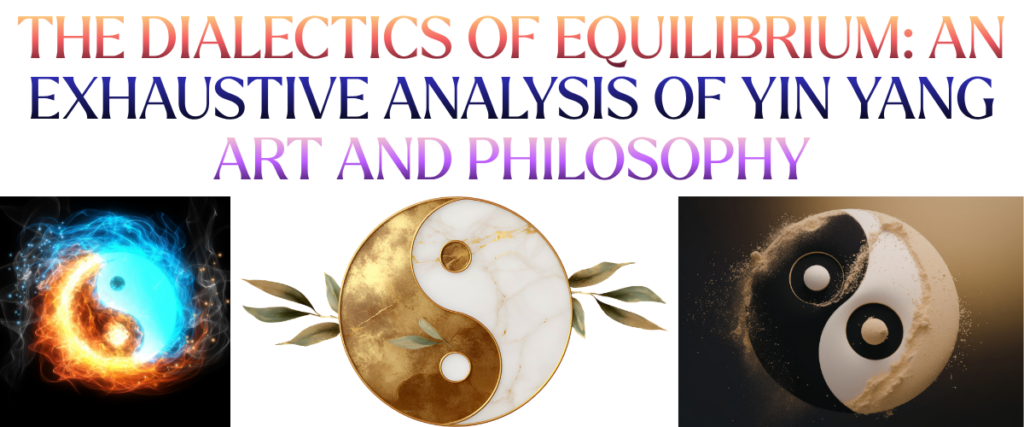
The conceptual framework of Yin Yang, frequently identified in contemporary vernacular as “Yin Yan,” represents one of the most sophisticated and enduring dualistic systems in the history of global aesthetics and metaphysics. Far from being a mere decorative motif, Yin Yang art serves as a visual manifestation of a profound cosmological theory that seeks to explain the origin, structure, and continuous transformation of the universe. This report provides a comprehensive examination of the artistic, historical, and philosophical dimensions of Yin Yang, tracing its journey from ancient divination practices to its current status as a fundamental driver of modern design and global cultural identity.1
Metaphysical Origins: The Genesis of the Dualistic Image
To understand the art of Yin Yang is to engage with the very core of Chinese cosmology. The system does not begin with duality, but with a state of absolute, undifferentiated potentiality known as Wuji (literally “without pole” or “limitless”). In the visual arts, Wuji is often represented by a simple, empty circle, signifying the primordial void or the state of the universe before the Big Bang.4 From this stillness, movement arises, leading to the state of Taiji, the “Supreme Ultimate.” Taiji is the pivot of all existence, the single point from which the two primary forces of Yin and Yang emerge.4
The transition from the oneness of Taiji to the duality of Yin and Yang is the central theme of traditional Chinese art. The symbol most associated with this transition is the Taijitu, or the “Diagram of the Supreme Ultimate.” While the modern “swirling fish” design is globally recognised, the historical development of the diagram was a multi-century process involving complex mathematical and astronomical observations.2 Early versions of the symbol were used to track the movement of the sun throughout the year. By recording the length of the shadow cast by a vertical pole (gnomon) during the 24 solar terms of the Chinese calendar, ancient observers noted that the shadow reached its maximum length during the winter solstice and its minimum during the summer solstice.7 When these measurements were plotted in a circular format, they naturally formed the “S-shaped” curve that defines the boundary between the light (Yang) and dark (Yin) halves of the symbol.7
Core Principles of Visual Duality
The visual logic of Yin Yang art is governed by four fundamental principles that ensure every artistic composition remains harmonious and dynamic.
| Principle | Description | Artistic Application |
| Opposition | Yin and Yang represent contrasting forces such as light/dark, cold/hot, and soft/hard. | Use of high-contrast palettes and contrasting textures (e.g., silk vs. stone). |
| Interdependence | One force cannot exist without its opposite; they define each other’s existence. | Balancing empty space (Liubai) with dense ink work in landscape painting. |
| Mutual Consumption | As one force increases, the other decreases in a constant, rhythmic cycle. | Depicting seasonal changes or the phases of the moon in narrative scrolls. |
| Transformation | At their extremes, Yin and Yang inevitably transform into one another. | The use of interstitial dots in the Taijitu represents the seed of the opposite. |
1
These principles dictate that Yin Yang is never a static binary. In art, this is reflected in the rejection of rigid symmetry in favour of a “living” balance. The S-curve suggests that the division between light and shadow is in constant motion, yielding and pushing in a perpetual dance.10 This fluid boundary is a critical feature that distinguishes Yin Yang art from Western forms of dualism, which often emphasise conflict or permanent separation between opposites.2
The Evolution of Graphic Expression: From Oracle Bones to the Taijitu
The visual history of the Yin and Yang characters can be traced back to the Shang Dynasty (ca. 14th century B.C.E.), where they appeared on oracle bones used for divination.14 At this earliest stage, the characters were literal descriptions of natural phenomena. “Yin” depicted the shady, northerly side of a hill, while “Yang” showed the sunny, southerly side.3 This focus on sunlight and topography deeply influenced the development of Chinese landscape painting (Shan Shui), where the play of light across mountain ridges became a primary method for conveying depth and spiritual resonance.14
By the Han Dynasty (206 B.C.E. – 220 C.E.), Yin-Yang theory was integrated into the “Five Elements” (Wu Xing) system, creating a comprehensive symbolic language used in everything from tomb art to bronze mirror design.1 Artists began using geometric patterns to represent the interaction of these forces, often placing the symbol for heaven (round) in conjunction with the symbol for earth (square).7
The Song Dynasty Renaissance
The most significant shift in Yin Yang art occurred during the Song Dynasty (960–1279 C.E.), a period of intense philosophical and artistic innovation. The Neo-Confucian scholar Zhou Dunyi authored the Taiji Tushuo (“Explanation of the Diagram of the Supreme Ultimate”), which formalised the visual structure of the universe’s creation.2 Zhou’s diagram consisted of a series of circles representing different stages of cosmic evolution, from the void of Wuji to the interaction of the five elements and the birth of the “ten thousand things”.2
During the subsequent Ming and Qing dynasties, the diagram was further refined. In the 14th century, Zhao Huiqian introduced the “swirling” version of the Taijitu, which emphasised the movement of Qi (vital energy).5 In the late 16th century, the scholar Lai Zhide simplified this into the interlocking spiral design we recognise today.5 This design eventually reached the Western world in the 19th century, where it was initially termed the “Great Monad” before becoming universally known as the “Yin-Yang symbol” in the mid-20th century.5
Traditional Media: The Art of Landscape and Calligraphy
The principles of Yin Yang are most eloquently expressed in the tradition of Shan Shui (Mountain-Water) painting. In this medium, the mountain represents the vertical, firm, and stable qualities of Yang, while water represents the horizontal, fluid, and yielding qualities of Yin.11 A successful painting is not merely a depiction of scenery but a record of the artist’s ability to balance these two primordial energies.17
Literati Landscapes and the Manifestation of Qi
Great Song dynasty masters like Fan Kuan and Guo Xi utilised the “Three Distances” technique to create landscapes that felt alive with Qi.18 In Fan Kuan’s Travellers Among Mountains and Streams, the massive central peak embodies the overwhelming power of Yang, while the mists at its base represent the receptive, mysterious nature of Yin.18 The use of ink wash—a technique where water is used to dilute black ink—allows for an infinite range of greys, mirroring the philosophical idea that there is always a measure of one force within the other.11
Later artists, such as Wu Boli in the Ming dynasty, explicitly connected their work to Taoist ritual. His Dragon Pine (late 14th century) uses the twisted, S-shaped trunk of a pine tree to evoke the movement of the Taijitu.17 The tree is not a static object but a “writhing dragon vein” of energy, uncoiling from the void of the paper.17 This relationship between calligraphy and painting is central; the brushstroke itself is a Yang action (active, expressive) occurring on a Yin surface (receptive, still paper).16
Ceramics and Technical Symbolism
The application of Yin Yang in decorative arts reached a technical zenith during the Qing dynasty, particularly under the reign of the Qianlong Emperor.22 The “Vase with revolving core and eight-trigram design” (ca. 1744) is a masterpiece of both aesthetics and engineering. The vase consists of four independent parts—the neck, the upper body, the lower body, and an inner vase—that were fired separately and then fitted together.22 When the neck is turned, the inner vase rotates, a physical metaphor for the cyclical movement of the cosmos.22 The exterior is adorned with the Eight Trigrams (Bagua), which are combinations of broken (Yin) and unbroken (Yang) lines from the I Ching.22
| Trigram | Attribute | Element | Direction | Yin/Yang Composition |
| Qian | Creative | Heaven | Northwest | Three Unbroken Lines (Pure Yang) |
| Kun | Receptive | Earth | Southwest | Three Broken Lines (Pure Yin) |
| Li | Clinging | Fire | South | Two Unbroken, One Broken |
| Kan | Abysmal | Water | North | Two Broken, One Unbroken |
| Zhen | Arousing | Thunder | East | Two Broken, One Unbroken (bottom) |
| Xun | Gentle | Wood | Southeast | Two Unbroken, One Broken (bottom) |
| Gen | Still | Mountain | Northeast | Two Broken, One Unbroken (top) |
| Dui | Joyous | Lake | West | Two Unbroken, One Broken (top) |
19
The Museum Perspective: Curating the Imperial Collection
The National Palace Museum in Taipei and the British Museum in London house some of the most significant artifacts that embody Yin Yang and Taiji principles.18 These objects are not merely historical relics but are “Smart Carvings” (Qiaodiao) that demonstrate a profound understanding of natural materials.20
The Jadeite Cabbage and the Meat-Shaped Stone
The Jadeite Cabbage is perhaps the most famous artifact in the National Palace Museum.20 Carved from a single piece of jade that was naturally half-white and half-green, it uses the stone’s inherent colours to represent the purity and delicacy of a bok choy cabbage.20 Hidden among the leaves are a locust and a grasshopper, symbols of fertility and the abundance of descendants.20 Philosophically, the cabbage represents the scholar’s life—pure and grounded—while the use of the stone’s “flaws” to create the white stem and green leaves demonstrates the Taoist principle of following the natural order of things.20
Similarly, the Meat-Shaped Stone is a piece of jasper carved to resemble a succulent piece of braised pork belly (Dongpo Rou).20 The artist utilised the layered structure of the stone to mimic the skin, fat, and lean meat, even drilling tiny holes into the surface to replicate pores.22 This transformation of a hard, cold mineral into a visual representation of soft, warm food is a classic example of the “unity of opposites” inherent in Yin Yang art.20
Bronzes and Ritual Vessels
The British Museum’s collection of early Chinese bronzes, such as the Kang Hou Gui from the Western Zhou dynasty, reveals the ritualistic roots of Yin Yang.24 These vessels were used for ancestor worship, serving as a bridge between the world of the living (Yang) and the world of the deceased (Yin).7 The intricate Taotie masks found on these vessels are often symmetrical, representing the balance required to maintain social and cosmic order.16
Architecture and Environmental Design: The Art of Living in Balance
The principles of Yin Yang find their most practical application in Feng Shui (wind and water), the art of arranging the human environment to harmonise with the flow of Qi.23 This is not limited to traditional temples but is a major factor in contemporary global architecture.19
Modern Skyscrapers and Ancient Principles
The HSBC Building in Hong Kong is a premier example of contemporary architecture guided by Feng Shui.19 Its open atrium and positioning allow for the free flow of Qi from the harbour (Yang, moving water) to the mountains (Yin, still earth).19 Similarly, the Sydney Opera House is often interpreted through a Feng Shui lens, with its expressive, shell-like roofs mimicking the organic curves of the Taijitu and the surrounding water providing a powerful Yang energy that is balanced by the solid concrete structure.19
In temple design, such as the Tien Kok Sie Temple, the application is even more literal.28 The orientation of the building, the choice of colours (red for Yang/Fire, black for Yin/Water), and the placement of decorative ornaments are all calculated to create a sacred space that is perfectly balanced.28 The “Qi flow” is managed by avoiding straight lines in entrances and pathways, as straight lines are believed to turn beneficial energy into “poison arrows” of aggressive force.27
Interior Harmony and the Five Elements
Interior designers use the Yin Yang system to create “Sensory Homes” that provide mental and physical rest.30 This involves balancing “hard” surfaces like stone or metal (Yang) with “soft” materials like wood or textiles (Yin).1 Lighting is also used strategically; natural light is prioritised during the day (Yang), while soft, indirect lighting is used in the evening to promote the receptive state of Yin.30
| Architectural Feature | Yin Property | Yang Property |
| Lighting | Low light, Shadows, Moon | Brightness, Sunlight, Fire |
| Form | Curves, Irregularity, Low height | Straight lines, Symmetry, Height |
| Material | Wood, Textiles, Earth | Steel, Glass, Concrete |
| Environment | Still ponds, Gardens, Silence | Moving rivers, Streets, and activity |
19
Contemporary Fine Art: Monochromatic Explorations
In the modern art world, the “Yin-Yan” aesthetic has evolved into a movement focused on formal constraints and psychological depth.9 The use of a strictly black-and-white palette allows artists to strip away the distractions of colour and focus on the fundamental “extremities of contrast”.9
Exhibition Analysis: Tinney Contemporary
The 2024–2025 exhibition YIN-YANG: A Group Exhibition in Black & White, curated by Joshua Edward Bennett explore how contemporary artists use monochromatic parameters to narrate complex stories.9 Bennett noted a personal, nostalgic connection to the symbol, which became a staple of 1990s pop culture on notebooks and backpacks.9 This “tongue-in-cheek” nuance allows for works that are both serious and humorous.9
Artists in this movement use varied techniques to express duality:
- John Phillip Abbott and Amy Pleasant utilise big, loose brushstrokes that illustrate the movement of the hand, emphasising the “Freehand Artistry” trend of 2026.9
- Joshua Edward Bennett’s work Enigo focuses on composition and technique to explore how contradicting forces are actually interdependent.9
- Lindsy Davis’s Mathematics of Mercy uses geometric shapes to explore the “dichotomous pair” of right and wrong, mirroring the philosophical structure of the Eight Trigrams.9
Contemporary Ethnic Fusion: Shanye Huang
Shanye Huang is a prominent Chinese-American artist who integrates his native Zhuang ethnic culture with modern abstraction.34 His Fusion Series uses symbols, metaphors, and calligraphy to express the appreciation of love and harmony through Yin-Yang philosophy.34 Huang’s work often features painted paper-cut installations, a medium that physically embodies the relationship between the solid material (Yang) and the empty spaces cut out of it (Yin).34
Global Branding and Graphic Minimalism
The simplicity of the Taijitu has made it one of the most successful logos in history. In the digital age, it has been stripped down to its essential curves and used as a shorthand for balance and “Zen” across various industries.35
Wellness and Corporate Identity
Minimalist graphic design frequently adapts the Yin Yang symbol for modern branding:
- Nutrition and Organics: Many health brands use a circular logo where two leaves form the Yin and Yang halves, signifying a balanced diet and a connection to nature.35
- Martial Arts and Sports: Organisations like “Eclipse Martial Arts” use the symbol to represent the meeting of two objects/forces, using a traditional Japanese crest (Mon) form to symbolise the flow and movement of limbs.38
- Technology and Security: Companies like “ZUNDA” have integrated a “Z” into the Yin-Yang shape, using the golden ratio to create a logo that feels futuristic yet grounded in ancient wisdom.39
Digital Harmony and Wallpapers
In the “always-on” world of technology, Yin Yang art has found a new niche as a tool for digital mindfulness.11 Simple black-and-white “Yin Yang aesthetic” wallpapers are marketed as a way to “reclaim” digital spaces from stress and distraction.11 High-resolution 4K images of watercolour splashes or nature-inspired interpretations—such as the sun and moon or a dark forest meeting a sunlit field—serve as gentle reminders to seek balance in work and rest.11
The Future of Yin Yang Art: 2025–2026 Design Trends
The principles of Yin Yang are currently driving a major shift in interior design and furniture manufacturing toward a concept known as “The Grounded Sanctuary”.33 As the world becomes more technologically saturated (high Yang), the home is evolving into a receptive, sensory-focused environment (high Yin).30
The Rise of “Fat Furniture” and Curated Curves
The 2026 design aesthetic explicitly rejects the sharp, clinical lines of past minimalism.31 Instead, it embraces “Fat Furniture”—oversized, voluptuous seating that prioritises comfort and “sinking into”.31 These pieces are not just furniture but sculptural art elements that anchor a room.31
- Organically Flowing Wooden Silhouettes: Advanced joinery, like CNC routing and steam-bending, allows for continuous, organic lines in hardwoods like oak and walnut.31 These frames follow the human body’s own contours, representing a “rejection of safe decorating” in favour of forms that “do the work on their own” to soften a space.31
- Algorithmic Ergonomics: Interestingly, this return to “soft” Yin forms is enabled by “hard” Yang technology. Algorithms are used to map how the spine shifts and where pressure builds, informing the geometry of the furniture to maximise comfort.31
Sensorial Immersion and “Textural Solids”
The 2026 home is a sensory experience. “Textural Solids”—fabrics that look solid from a distance but reveal intricate, hidden textures upon closer inspection—are replacing loud patterns.33
- Sustainable Luxury: Materials like wool, cork, and terracotta are seeing a massive revival.31 Cork headboards are carved to mimic “rippling water,” while plaster walls are etched to resemble bark, bringing the tactile world of nature into the modern apartment.31
- AI-Powered Indoor Gardens: Technology is being used to integrate nature directly into minimalist decor. Sleek wall panels sprouted with basil and microgreens under AI-timed LEDs represent the ultimate “unity of opposites”—advanced tech serving the most basic human need for living greenery.31
| Trend Category | Yin Element | Yang Element | Synthesis (The Result) |
| Furniture | Voluptuous, “Fat” shapes | Algorithmic precision | Ergonomic sculpture |
| Materials | Raw terracotta, Wool | Tech-driven recycling | Sustainable luxury |
| Lighting | “Warm Eucalyptus” hues | OLED dynamic displays | Circadian rhythm design |
| Nature | AI-managed gardens | Hand-painted motifs | Sensorial immersion |
30
Linguistic and Regional Variations: “Yin Yan” and the Japanese “In-Yo”
The term “Yin Yan” is a common phonetic variation or misspelling of “Yin Yang” found in various global contexts.12 While linguistically distinct from the traditional Chinese Yin Yang (where Yang ends in a nasal “ng” sound), the “Yin Yan” usage persists in modern pop culture and search queries, often retaining the same core meaning of balance and duality.12
In Japan, the philosophy is known as In-Yo.40 The cultural translation of these concepts has led to unique artistic developments, such as the Gakyil symbols of Tibetan Buddhism, which often feature three or four swirls rather than the two found in the Chinese Taijitu.5 These variations demonstrate the “universality of the Yin-Yang concept” and its ability to adapt to different cultural and linguistic frameworks while maintaining its philosophical integrity.13
Conclusion: The Eternal Return of Balance
Yin Yang art is not a relic of the past but a living, breathing dialect of human expression. Its history is a testament to the human desire to find order in chaos and harmony in opposition. From the first strokes on an oracle bone to the AI-generated displays of the 2026 home, the principles of duality remain the same: nothing is absolute, everything is in motion, and balance is a continuous process rather than a final destination.1
As we move forward into an era defined by rapid technological change and environmental uncertainty, the lessons of Yin Yang art become increasingly relevant. By teaching us to see the “seed of the opposite” in all things, this ancient philosophy offers a roadmap for a more tolerant, adaptable, and balanced global society.4 Whether expressed through a high-tech skyscraper or a simple black-and-white print, the art of Yin Yang continues to remind us that we are part of a whole, and that our well-being depends on our ability to harmonise with the dynamic forces of the universe.1
Disclaimer
This article is provided for informational and educational purposes only. The information contained herein is based on historical research, art historical analysis, and contemporary design trends. Interpretations of ancient Chinese philosophy and its application to modern architecture and medicine (Traditional Chinese Medicine) are subject to varying scholarly and professional perspectives. Any references to health benefits or environmental impacts of specific design choices should be verified with qualified professionals in the respective fields. The mention of specific artists, exhibitions, or commercial brands does not constitute an endorsement but serves as an illustrative example of the cultural application of Yin Yang principles. Museum artifact availability and gallery placements are subject to change by the respective institutions.
References
- History Of The Yin Yang Design Symbol – Nazmiyal Antique Rugs, accessed on May 5, 2026, https://nazmiyalantiquerugs.com/area-rug-guide/motifs-symbols/yin-yang-design-symbol-rugs/
- The Yin-Yang Symbol: A Journey Through History and Meaning – Nature of Flowers, accessed on May 5, 2026, https://natureofflowers.com/blogs/news/the-yin-yang-symbol-a-journey-through-history-and-meaning
- Yin and yang – Wikipedia, accessed on May 5, 2026, https://en.wikipedia.org/wiki/Yin_and_yang
- Taijitu: Philosophy of the Taiji (yin/yang) Symbol [Part 2 of 2] | The Splintered Staff, accessed on May 5, 2026, https://splinteredstaff.wordpress.com/2020/03/03/taijitu-philosophy-of-the-taiji-yin-yang-symbol-part-2-of-2/
- Taijitu – Wikipedia, accessed on May 5, 2026, https://en.wikipedia.org/wiki/Taijitu
- What is yin-yang? : r/taoism – Reddit, accessed on May 5, 2026, https://www.reddit.com/r/taoism/comments/179k58q/what_is_yinyang/
- Yin Yang and Taiji – Simplicity and Rich Cultural Meanings – ChinaFetching.com, accessed on May 5, 2026, https://www.chinafetching.com/yin-yang
- A Geomedical Approach to Chinese Medicine: the origin of the yin-yang symbol, accessed on May 5, 2026, https://lhncbc.nlm.nih.gov/LHC-publications/PDF/pub8968.pdf
- YIN-YANG – Tinney Contemporary, accessed on May 5, 2026, https://tinneycontemporary.com/YIN-YANG
- What Does the Yin Yang Symbol Mean? – Balanced Life Tai Chi, accessed on May 5, 2026, https://balancedlifetaichi.com/blog/what-does-the-yin-yang-symbol-mean
- Visual Art Featuring Yin Yang: Aesthetic Images and Backgrounds – Healing Sounds, accessed on May 5, 2026, https://healing-sounds.com/blogs/spirituality/yin-yang-backgrounds-art-guide
- Sunday Stills: The Light in #Yin-Yang – Second Wind Leisure Perspectives, accessed on May 5, 2026, https://secondwindleisure.com/2020/01/19/sunday-stills-the-light-in-yin-yang/
- Yin Yang: A New Perspective in Understanding the Development of Religion in Contemporary China – David Publishing, accessed on May 5, 2026, https://www.davidpublisher.com/Public/uploads/Contribute/552caa328e652.pdf
- Yinyang (Yin-yang) | Internet Encyclopedia of Philosophy, accessed on May 5, 2026, https://iep.utm.edu/yinyang/
- The “Yin” and “Yang” Ancient Chinese Philosophy and its Practical Application to Body Treatment – ResearchGate, accessed on May 5, 2026, https://www.researchgate.net/publication/366583561_The_Yin_and_Yang_Ancient_Chinese_Philosophy_and_its_Practical_Application_to_Body_Treatment
- Chinese art – Wikipedia, accessed on May 5, 2026, https://en.wikipedia.org/wiki/Chinese_art
- Daoism and Daoist Art – The Metropolitan Museum of Art, accessed on May 5, 2026, https://www.metmuseum.org/essays/daoism-and-daoist-art
- National Palace Museum – Wikipedia, accessed on May 5, 2026, https://en.wikipedia.org/wiki/National_Palace_Museum
- EXAMPLES OF FENG SHUI APPLIED TO CONTEMPORARY …, accessed on May 5, 2026, http://www.universitypublications.net/hssr/0103/pdf/HVD653.pdf
- 15 Must-See Treasures at National Palace Museum (2026 Ultimate Guide) – Justaiwantour, accessed on May 5, 2026, https://www.justaiwantour.com/national-palace-museum/
- Modern & Contemporary Chinese Art – Williams College Museum of Art, accessed on May 5, 2026, https://artmuseum.williams.edu/collection/modern-contemporary-chinese-art/
- Emperors’ Treasures: Chinese Art from the National Palace Museum …, accessed on May 5, 2026, https://exhibitions.asianart.org/exhibitions/emperors-treasures-chinese-art-from-the-national-palace-museum-taipei/
- The Cultural Connotations and Significance of Integrating Feng Shui Theory with Artistic Creation – Atlantis Press, accessed on May 5, 2026, https://www.atlantis-press.com/article/126009575.pdf
- China | British Museum, accessed on May 5, 2026, https://www.britishmuseum.org/collection/china
- 100 Treasures, 100 Stories – National museum – Národní muzeum, accessed on May 5, 2026, https://www.nm.cz/en/program/exhibitions/100-treasures-100-stories
- Asian Collection | The Hermitage Museum & Gardens, accessed on May 5, 2026, https://thehermitagemuseum.org/asian-collection/
- Application of Taoist Principles and Feng Shui in Urban Spaces (Landscaping and Garden Design), accessed on May 5, 2026, https://journalisslp.com/index.php/isslp/article/download/72/123/409
- Analysis of feng shui principles in the design of Tien Kok Sie Temple, accessed on May 5, 2026, https://www.journal-iasssf.com/index.php/Arc-JCC/article/download/1685/1581
- Applied Research on Yin and Yang Five Elements Feng Shui Thought in Garden Space Sequence Design – Darcy & Roy Press, accessed on May 5, 2026, https://drpress.org/ojs/index.php/jeer/article/view/34844
- 8 Interior Design Trends for 2026 – Naan Furniture, accessed on May 5, 2026, https://naanfurniture.com/blogs/finishing-and-tips/8-interior-design-trends-for-2026
- 16 Interior Design Trends 2026: Must-Have Looks You’ll Love …, accessed on May 5, 2026, https://www.decorilla.com/online-decorating/interior-design-trends-2026/
- Taoism | Definition, Principles & Symbol – Video | Study.com, accessed on May 5, 2026, https://study.com/learn/lesson/video/taoism-symbol-principles-yin-yan.html
- 2026 Interior and Exterior Design Trends: The Grounded Sanctuary – Kaleen, accessed on May 5, 2026, https://www.kaleen.com/2026-design-trends/
- Shanye Huang Contemporary Chinese-American Artist, accessed on May 5, 2026, https://www.shanyehuang.com/links.php?42630
- Yin Yang Logo royalty-free images – Shutterstock, accessed on May 5, 2026, https://www.shutterstock.com/search/yin-yang-logo
- Modern Yin Yang royalty-free images – Shutterstock, accessed on May 5, 2026, https://www.shutterstock.com/search/modern-yin-yang
- Yin Yang Design Illustrations & Vectors – Dreamstime.com, accessed on May 5, 2026, https://www.dreamstime.com/illustration/yin-yang-design.html
- Yin-yang Logos – 99Designs, accessed on May 5, 2026, https://99designs.com/inspiration/logos/yin-yang
- Yin Yang Designs – 99Designs, accessed on May 5, 2026, https://99designs.com/inspiration/designs/yin-yang
- Yin-yang, symbolism and the Gion Festival – Writers in Kyoto, accessed on May 5, 2026, https://writersinkyoto.com/2022/02/02/nonfiction/yin-yang-symbolism-and-the-gion-festival/